

The DOI matches its Crossref record; 62 of the 63 references it cites were found in a registry or an index; none of the 55 sources its claims cite is checked for support yet.
Advanced Diabetes Management Using Artificial Intelligence and Continuous Glucose Monitoring Sensors
Open accessAbstract
Wearable continuous glucose monitoring (CGM) sensors are revolutionizing the treatment of type 1 diabetes (T1D). These sensors provide in real-time, every 1–5 min, the current blood glucose concentration and its rate-of-change, two key pieces of information for improving the determination of exogenous insulin administration and the prediction of forthcoming adverse events, such as hypo-/hyper-glycemia. The current research in diabetes technology is putting considerable effort into developing decision support systems for patient use, which automatically analyze the patient’s data collected by CGM sensors and other portable devices, as well as providing personalized recommendations about therapy adjustments to patients. Due to the large amount of data collected by patients with T1D and their variety, artificial intelligence (AI) techniques are increasingly being adopted in these decision support systems. In this paper, we review the state-of-the-art methodologies using AI and CGM sensors for decision support in advanced T1D management, including techniques for personalized insulin bolus calculation, adaptive tuning of bolus calculator parameters and glucose prediction.
Overview
AI snapshot
Written from the paper’s full text.
TL;DR
This narrative review surveys state-of-the-art artificial intelligence (AI) methods that use continuous glucose monitoring (CGM) sensor data to support advanced type 1 diabetes (T1D) management. It focuses on three decision-support tasks: personalized insulin bolus calculation, adaptive tuning of bolus calculator parameters, and glucose prediction.
Key findings
- For personalized bolus calculation, a neural-network-based bolus calculator that corrects the standard formula achieved significantly lower blood glucose risk index (BGRI) values than the standard formula in silico, though in a non-negligible number of cases it performed worse; a separate LASSO-regularized linear regression formula (14 features, trained on 100 virtual subjects across 162,000 subject–meal combinations) also produced lower BGRI than the standard formula.
- For adaptive parameter tuning, a run-to-run plus case-based reasoning (R2R+CBR) algorithm improved glycemic control over stand-alone R2R in 20 virtual subjects and was robust to carb-counting error and CGM noise; implemented as ABC4D, it was tested in a six-week non-randomized study of 10 adults with T1D and reduced postprandial hypoglycemia. A temporal CBR variant reduced BGRI by up to 27% after three revisions in a six-month in silico study.
- For glucose prediction, benchmarking on the OhioT1DM dataset at a 30-min prediction horizon found best RMSE of 19–20 mg/dL (ARX, Ridge, linear SVR, LSTM, TCN), with maximum time gain of about 7 min (gradient boosting trees, LSTM); linear SVR and TCN gave RMSE ~20 mg/dL with ~6 min time gain.
- An XGBoost-based classifier for postprandial glycemic status, used to adjust meal boluses, improved time in euglycemia from 61.98% to 67.00% without increasing time in hypoglycemia in 100 virtual adults; a decision tree and random forest for exercise hypoglycemia reached 79.55% and 86.67% accuracy respectively.
Methods
- Narrative (non-systematic) review of AI-based decision support systems for patient use in T1D, organized around three tasks: personalized insulin bolus calculation, adaptive tuning of bolus calculator parameters, and glucose prediction.
- Describes specific algorithms and their validation studies, including in silico simulations using the UVa/Padova T1D Simulator, retrospective real-data analyses, and the OhioT1DM benchmarking dataset.
- Performance metrics discussed include BGRI, RMSE, time gain (TG), time in euglycemia, and classification accuracy.
Limitations
- The paper states that most reviewed techniques were validated only in silico or on retrospective real data, and that prospective clinical validation proving safety and effectiveness is required before adoption in T1D management.
- The paper notes the NN-based bolus calculator led to worse glycemic control than the standard formula in a non-negligible number of cases, and that the standard formula's structure may intrinsically limit correction-based approaches.
- The paper states the exercise-hypoglycemia prediction study (Reddy et al.) used data collected only in a controlled inpatient environment, requiring validation under free-living conditions and with different exercise types; it also notes the Patient Safety System modules were each validated only on retrospective data and need clinical validation.
Model-written summary. Check it against the paper before relying on it.
Integrity signals
Registry
Cites
Statistics
Figures
Verification
Claims the paper makes
47 Not checked yet · 7 Own interpretation · 7 No basis given
The paper states this without a source or data behind it here, so there is nothing to check it against. The quote shows it is in the paper.
In the paper
“However, most of these techniques were validated only in silico or on retrospective real data.”
§ Advanced Diabetes Management Using Artificial Intelligence and Continuous Glucose Monitoring Sensors > 6. Conclusions
plain- Asserted: passes — The authors put it forward as true.
- Checkable: passes — It can be checked against evidence.
- Load-bearing: passes — The paper’s conclusions depend on it.
- Based: passes — The paper gives a reason why it holds.
None of the sources cited for this claim have been checked yet.
In the paper
“The use of rtCGM sensors has proved to be very beneficial for glycemic control [10,16,17].”
§ Advanced Diabetes Management Using Artificial Intelligence and Continuous Glucose Monitoring Sensors > 1. Standard Type 1 Diabetes Therapy and Margins for Improvement Using New Technologies
What the sources say
- Not checked yetcites [10] Cappon, 2019, Continuous glucose monitoring sensors for diabetes management: A review of technologies and applications, Diabetes Metab. J. source
- Not checked yetcites [16] Bergenstal, 2010, STAR 3 Study Group. Effectiveness of sensor-augmented insulin-pump therapy in type 1 diabetes, N. Engl. J. Med. source
- Not checked yetcites [17] Juvenile Diabetes Research Foundation Continuous Glucose Monitoring Study Group, Tamborlane, W.V., Beck, R.W., Bode, B.W., Buckingham, B., Chase, H.P., Clemons, R., Fiallo-Scharer, R., Fox, L.A., and Gilliam, L.K. (2008). Continuous glucose monitoring and intensive treatment of type 1 diabetes. N. Engl. J. Med., 359, 1464–1476. source
boosteddirect- Asserted: passes — The authors put it forward as true.
- Checkable: passes — It can be checked against evidence.
- Load-bearing: passes — The paper’s conclusions depend on it.
- Based: passes — The paper gives a reason why it holds.
In the paper
“CGM sensors measure interstitial glucose concentrations in subcutaneous tissue almost continuously (e.g., every 1–5 min) for several consecutive days or weeks [9].”
§ Advanced Diabetes Management Using Artificial Intelligence and Continuous Glucose Monitoring Sensors > 1. Standard Type 1 Diabetes Therapy and Margins for Improvement Using New Technologies
What the sources say
- Not checked yetcites [9] Klonoff, 2017, Continuous glucose monitoring: A review of the technology and clinical use, Diabetes Res. Clin. Pract. source
plain- Asserted: passes — The authors put it forward as true.
- Checkable: passes — It can be checked against evidence.
- Load-bearing: passes — The paper’s conclusions depend on it.
- Based: passes — The paper gives a reason why it holds.
In the paper
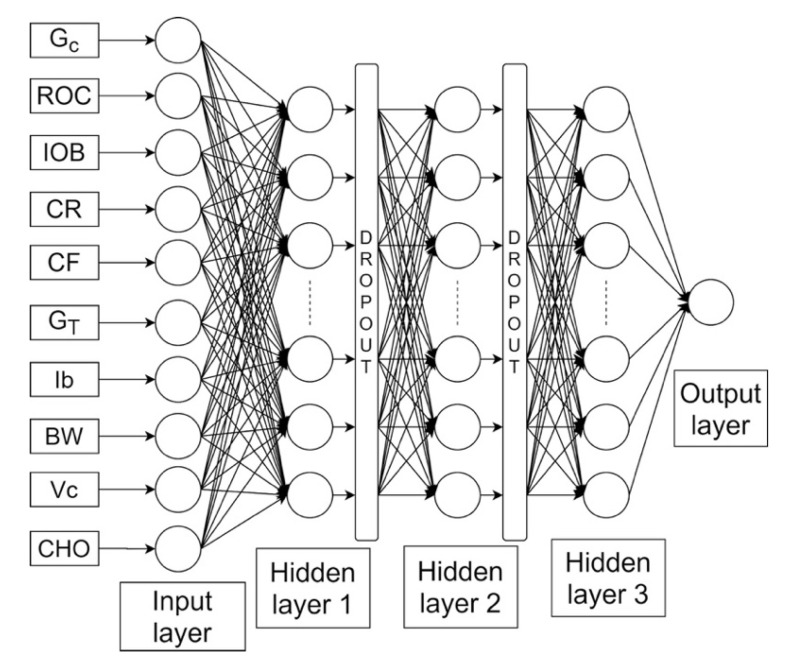
“In particular, Cappon et al. [37] used a large training set of simulated data to train a neural network (NN) that predicts the optimal value for X, i.e., the value of X that optimizes post-prandial glucose control.”
§ Advanced Diabetes Management Using Artificial Intelligence and Continuous Glucose Monitoring Sensors > 3. Personalized Insulin Bolus Calculation Based on Continuous Glucose Monitoring Sensors > 3.1. A Neural Network-Based Methodology for Personalized SF Correction
What the sources say
- Not checked yetcites [37] Cappon, 2018, A Neural-network-based approach to personalize insulin bolus calculation using continuous glucose monitoring, J. Diabetes Sci. Technol. source
plaindirect- Asserted: passes — The authors put it forward as true.
- Checkable: passes — It can be checked against evidence.
- Load-bearing: passes — The paper’s conclusions depend on it.
- Based: passes — The paper gives a reason why it holds.
In the paper
“The results showed that the NN-based BC achieved significantly lower BGRI values than did the SF.”
§ Advanced Diabetes Management Using Artificial Intelligence and Continuous Glucose Monitoring Sensors > 3. Personalized Insulin Bolus Calculation Based on Continuous Glucose Monitoring Sensors > 3.1. A Neural Network-Based Methodology for Personalized SF Correction
What the sources say
- Not checked yetcites [37] Cappon, 2018, A Neural-network-based approach to personalize insulin bolus calculation using continuous glucose monitoring, J. Diabetes Sci. Technol. source
plaindirect- Asserted: passes — The authors put it forward as true.
- Checkable: passes — It can be checked against evidence.
- Load-bearing: passes — The paper’s conclusions depend on it.
- Based: passes — The paper gives a reason why it holds.
In the paper
“Moreover, rtCGM devices provide vibratory or auditory alerts when hypo/hyperglycemic events are detected, i.e., when the glucose concentration measured exceeds pre-set, customizable, thresholds for hypoglycemia and hyperglycemia [10].”
§ Advanced Diabetes Management Using Artificial Intelligence and Continuous Glucose Monitoring Sensors > 1. Standard Type 1 Diabetes Therapy and Margins for Improvement Using New Technologies
What the sources say
- Not checked yetcites [10] Cappon, 2019, Continuous glucose monitoring sensors for diabetes management: A review of technologies and applications, Diabetes Metab. J. source
plaindirect- Asserted: passes — The authors put it forward as true.
- Checkable: passes — It can be checked against evidence.
- Load-bearing: unclear — It is unclear whether the paper’s conclusions depend on it.
- Based: passes — The paper gives a reason why it holds.
In the paper
“The results show that the new formula resulted in improved glycemic outcomes, i.e., lower BGRI values, than the SF.”
§ Advanced Diabetes Management Using Artificial Intelligence and Continuous Glucose Monitoring Sensors > 3. Personalized Insulin Bolus Calculation Based on Continuous Glucose Monitoring Sensors > 3.2. New Linear Regression Model for Insulin Dosing
What the sources say
- Not checked yetcites [40] Noaro, G., Cappon, G., Vettoretti, M., Sparacino, G., del Favero, S., and Facchinetti, A. (2020). Machine-learning based model to improve insulin bolus calculation in type 1 diabetes therapy. IEEE Trans. Biomed. Eng., 1. source
plaindirect- Asserted: passes — The authors put it forward as true.
- Checkable: passes — It can be checked against evidence.
- Load-bearing: passes — The paper’s conclusions depend on it.
- Based: passes — The paper gives a reason why it holds.
In the paper
“In Noaro et al. [40], a new formula to calculate meal insulin doses was derived using regularized multiple linear regression.”
§ Advanced Diabetes Management Using Artificial Intelligence and Continuous Glucose Monitoring Sensors > 3. Personalized Insulin Bolus Calculation Based on Continuous Glucose Monitoring Sensors > 3.2. New Linear Regression Model for Insulin Dosing
What the sources say
- Not checked yetcites [40] Noaro, G., Cappon, G., Vettoretti, M., Sparacino, G., del Favero, S., and Facchinetti, A. (2020). Machine-learning based model to improve insulin bolus calculation in type 1 diabetes therapy. IEEE Trans. Biomed. Eng., 1. source
plain- Asserted: passes — The authors put it forward as true.
- Checkable: passes — It can be checked against evidence.
- Load-bearing: passes — The paper’s conclusions depend on it.
- Based: passes — The paper gives a reason why it holds.
In the paper
“DreaMed (DreaMed Diabetes Ltd., Petah Tikva, Israel) recently introduced Advisor Pro, a AI-based DSS for diabetes management that analyzes the patient’s data and provides personalized recommendations on the adjustment of therapy parameters [32].”
§ Advanced Diabetes Management Using Artificial Intelligence and Continuous Glucose Monitoring Sensors > 2. Decision Support Systems for Advanced Diabetes Management
What the sources say
- Not checked yetcites [32] DreaMed Diabeted Ltd (2020, April 15). On DreaMed Advisor Pro. Available online: https://dreamed-diabetes.com/advisor/.
plain- Asserted: passes — The authors put it forward as true.
- Checkable: passes — It can be checked against evidence.
- Load-bearing: unclear — It is unclear whether the paper’s conclusions depend on it.
- Based: passes — The paper gives a reason why it holds.
In the paper
“The dataset was split into independent training and test sets, containing data from different subjects.”
§ Advanced Diabetes Management Using Artificial Intelligence and Continuous Glucose Monitoring Sensors > 3. Personalized Insulin Bolus Calculation Based on Continuous Glucose Monitoring Sensors > 3.2. New Linear Regression Model for Insulin Dosing
What the sources say
- Not checked yetcites [40] Noaro, G., Cappon, G., Vettoretti, M., Sparacino, G., del Favero, S., and Facchinetti, A. (2020). Machine-learning based model to improve insulin bolus calculation in type 1 diabetes therapy. IEEE Trans. Biomed. Eng., 1. source
plain- Asserted: passes — The authors put it forward as true.
- Checkable: passes — It can be checked against evidence.
- Load-bearing: passes — The paper’s conclusions depend on it.
- Based: passes — The paper gives a reason why it holds.
- It may state two separate claims as one. 28
- Probably not a substantial claim. 12
In the paper
“Indeed, in contrast to SMBG, CGM sensors allow to track glucose dynamics and they ensure prompt detection of even asymptomatic high/low glucose events, which are difficult to capture with SMBG.”
§ Advanced Diabetes Management Using Artificial Intelligence and Continuous Glucose Monitoring Sensors > 1. Standard Type 1 Diabetes Therapy and Margins for Improvement Using New Technologies
What the sources say
- Not checked yetcites [10] Cappon, 2019, Continuous glucose monitoring sensors for diabetes management: A review of technologies and applications, Diabetes Metab. J. source
plaindirect- Asserted: passes — The authors put it forward as true.
- Checkable: passes — It can be checked against evidence.
- Load-bearing: passes — The paper’s conclusions depend on it.
- Based: passes — The paper gives a reason why it holds.
It may state two separate claims as one.
The paper states this without a source or data behind it here, so there is nothing to check it against. The quote shows it is in the paper.
In the paper
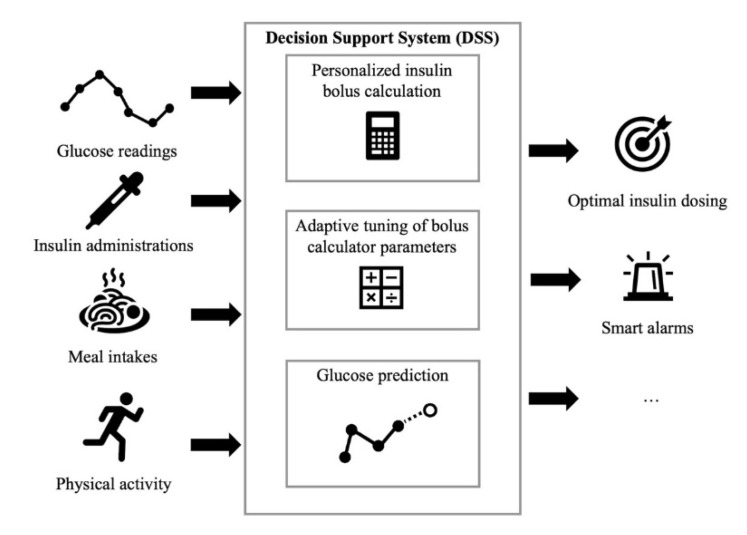
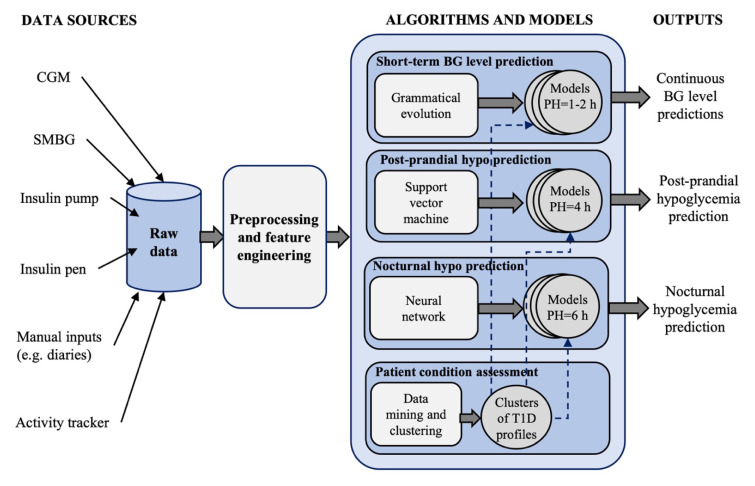
“The DSSs for patient use proposed in the literature receive input information about glucose concentration, diet, insulin administrations and physical activity and primarily perform three tasks: Personalized insulin bolus calculation, adaptive tuning of BC parameters and glucose prediction (Figure 1).”
§ Advanced Diabetes Management Using Artificial Intelligence and Continuous Glucose Monitoring Sensors > 2. Decision Support Systems for Advanced Diabetes Management
plain- Asserted: passes — The authors put it forward as true.
- Checkable: passes — It can be checked against evidence.
- Load-bearing: unclear — It is unclear whether the paper’s conclusions depend on it.
- Based: passes — The paper gives a reason why it holds.
It may state two separate claims as one.
The paper states this without a source or data behind it here, so there is nothing to check it against. The quote shows it is in the paper.
In the paper
“The SF was designed when SMBG was the only way to measure glucose concentration at home. In fact, the SF only uses information about the current glucose concentration (Gc), ignoring the information on glucose rate-of-change (ROC) that is now available with modern CGM sensors.”
§ Advanced Diabetes Management Using Artificial Intelligence and Continuous Glucose Monitoring Sensors > 3. Personalized Insulin Bolus Calculation Based on Continuous Glucose Monitoring Sensors
plaindirect- Asserted: passes — The authors put it forward as true.
- Checkable: passes — It can be checked against evidence.
- Load-bearing: passes — The paper’s conclusions depend on it.
- Based: passes — The paper gives a reason why it holds.
It may state two separate claims as one.
A conclusion the paper draws from its own results — it cites no other source for it, so there is none to check. The quote shows it is in the paper.
In the paper
“In conclusion, machine learning methods can be used to design new data-driven formulae for insulin dosing that are able to naturally account for CGM information (including glucose ROC) and which could improve glycemic control in T1D.”
§ Advanced Diabetes Management Using Artificial Intelligence and Continuous Glucose Monitoring Sensors > 3. Personalized Insulin Bolus Calculation Based on Continuous Glucose Monitoring Sensors > 3.2. New Linear Regression Model for Insulin Dosing
hedgedconditional- Asserted: passes — The authors put it forward as true.
- Checkable: passes — It can be checked against evidence.
- Load-bearing: passes — The paper’s conclusions depend on it.
- Based: passes — The paper gives a reason why it holds.
It may state two separate claims as one.
In the paper
“Although, on average, the NN-based BC did improve BG control when compared to the SF, in a non-negligible number of cases the dose provided by the NN-based BC led to worse glycemic control than did the SF.”
§ Advanced Diabetes Management Using Artificial Intelligence and Continuous Glucose Monitoring Sensors > 3. Personalized Insulin Bolus Calculation Based on Continuous Glucose Monitoring Sensors > 3.1. A Neural Network-Based Methodology for Personalized SF Correction
What the sources say
- Not checked yetcites [37] Cappon, 2018, A Neural-network-based approach to personalize insulin bolus calculation using continuous glucose monitoring, J. Diabetes Sci. Technol. source
plaindirect- Asserted: passes — The authors put it forward as true.
- Checkable: passes — It can be checked against evidence.
- Load-bearing: passes — The paper’s conclusions depend on it.
- Based: passes — The paper gives a reason why it holds.
It may state two separate claims as one.
None of the sources cited for this claim have been checked yet.
In the paper
“These DSSs for patients offer an alternative to closed-loop systems. Indeed, many users do not feel confident about using the artificial pancreas [28,29], as they are concerned about possible errors occurring in the insulin pump and so prefer an open-loop therapy (i.e., a therapy in which the patient manually sets the insulin doses), which can be assisted by a DSS.”
§ Advanced Diabetes Management Using Artificial Intelligence and Continuous Glucose Monitoring Sensors > 2. Decision Support Systems for Advanced Diabetes Management
What the sources say
- Not checked yetcites [28] Hendrieckx, 2017, “It is definitely a game changer”: A qualitative study of experiences with in-home overnight closed-loop technology among adults with type 1 diabetes, Diabetes Technol. Ther. source
- Not checked yetcites [29] Kropff, 2016, Psychological outcomes of evening and night closed-loop insulin delivery under free living conditions in people with Type 1 diabetes: A 2-month randomized crossover trial, Diabet. Med. source
plaindirect- Asserted: passes — The authors put it forward as true.
- Checkable: passes — It can be checked against evidence.
- Load-bearing: passes — The paper’s conclusions depend on it.
- Based: passes — The paper gives a reason why it holds.
It may state two separate claims as one.
In the paper
“The results obtained from a simulated experiment suggested that R2R offers a promising approach to optimizing SF parameters [41].”
§ Advanced Diabetes Management Using Artificial Intelligence and Continuous Glucose Monitoring Sensors > 4. Adaptive Tuning of Bolus Calculator Parameters Exploiting AI Techniques
What the sources say
- Not checked yetcites [41] Herrero, 2015, Method for automatic adjustment of an insulin bolus calculator: In silico robustness evaluation under intra-day variability, Comput. Methods Programs Biomed. source
hedgedconditional- Asserted: passes — The authors put it forward as true.
- Checkable: passes — It can be checked against evidence.
- Load-bearing: passes — The paper’s conclusions depend on it.
- Based: passes — The paper gives a reason why it holds.
Probably not a substantial claim.
In the paper
“Since 2015, some rtCGM devices have also received regulatory approval for therapeutic use, which means that rtCGM measurements may be used for making therapeutic decisions, such as insulin dosing [19].”
§ Advanced Diabetes Management Using Artificial Intelligence and Continuous Glucose Monitoring Sensors > 1. Standard Type 1 Diabetes Therapy and Margins for Improvement Using New Technologies
What the sources say
- Not checked yetcites [19] Edelman, 2016, Regulation Catches Up to Reality, J. Diabetes Sci. Technol. source
hedgedconditional- Asserted: passes — The authors put it forward as true.
- Checkable: passes — It can be checked against evidence.
- Load-bearing: unclear — It is unclear whether the paper’s conclusions depend on it.
- Based: passes — The paper gives a reason why it holds.
It may state two separate claims as one.
In the paper
“Herrero et al. [41] proposed an approach to automatically adjust CR and CF using CGM measurements. This method updates the parameters values every day in a run-to-run (R2R) fashion.”
§ Advanced Diabetes Management Using Artificial Intelligence and Continuous Glucose Monitoring Sensors > 4. Adaptive Tuning of Bolus Calculator Parameters Exploiting AI Techniques
What the sources say
- Not checked yetcites [41] Herrero, 2015, Method for automatic adjustment of an insulin bolus calculator: In silico robustness evaluation under intra-day variability, Comput. Methods Programs Biomed. source
plaindirect- Asserted: passes — The authors put it forward as true.
- Checkable: passes — It can be checked against evidence.
- Load-bearing: fails — The paper’s conclusions may not depend on it.
- Based: passes — The paper gives a reason why it holds.
Probably not a substantial claim. The paper’s conclusions may not depend on it. It may state two separate claims as one.
In the paper
“However, an in silico head-to-head comparison of these methods has shown that their efficacy depends on the pre-meal scenario and that not one of these methodologies globally outperforms the others [36].”
§ Advanced Diabetes Management Using Artificial Intelligence and Continuous Glucose Monitoring Sensors > 3. Personalized Insulin Bolus Calculation Based on Continuous Glucose Monitoring Sensors
What the sources say
- Not checked yetcites [36] Cappon, 2018, In Silico Assessment of literature insulin bolus calculation methods accounting for glucose rate of change, J. Diabetes Sci. Technol. source
plain- Asserted: passes — The authors put it forward as true.
- Checkable: passes — It can be checked against evidence.
- Load-bearing: passes — The paper’s conclusions depend on it.
- Based: passes — The paper gives a reason why it holds.
It may state two separate claims as one.
The paper states this without a source or data behind it here, so there is nothing to check it against. The quote shows it is in the paper.
In the paper
“rtCGM devices are able to provide, in real-time, not only the glucose concentration present but also information about the glucose trend (typically displayed to the user by an arrow), which can be used for making more informed therapeutic decisions.”
§ Advanced Diabetes Management Using Artificial Intelligence and Continuous Glucose Monitoring Sensors > 1. Standard Type 1 Diabetes Therapy and Margins for Improvement Using New Technologies
plainconditional- Asserted: passes — The authors put it forward as true.
- Checkable: passes — It can be checked against evidence.
- Load-bearing: passes — The paper’s conclusions depend on it.
- Based: passes — The paper gives a reason why it holds.
It may state two separate claims as one.
In the paper
“Indeed, the SF is intrinsically suboptimal, and using it as a starting point to be corrected might prove to be an obstacle in the training process of NN [36].”
§ Advanced Diabetes Management Using Artificial Intelligence and Continuous Glucose Monitoring Sensors > 3. Personalized Insulin Bolus Calculation Based on Continuous Glucose Monitoring Sensors > 3.1. A Neural Network-Based Methodology for Personalized SF Correction
What the sources say
- Not checked yetcites [36] Cappon, 2018, In Silico Assessment of literature insulin bolus calculation methods accounting for glucose rate of change, J. Diabetes Sci. Technol. source
hedgedconditional- Asserted: passes — The authors put it forward as true.
- Checkable: passes — It can be checked against evidence.
- Load-bearing: passes — The paper’s conclusions depend on it.
- Based: passes — The paper gives a reason why it holds.
It may state two separate claims as one.
In the paper
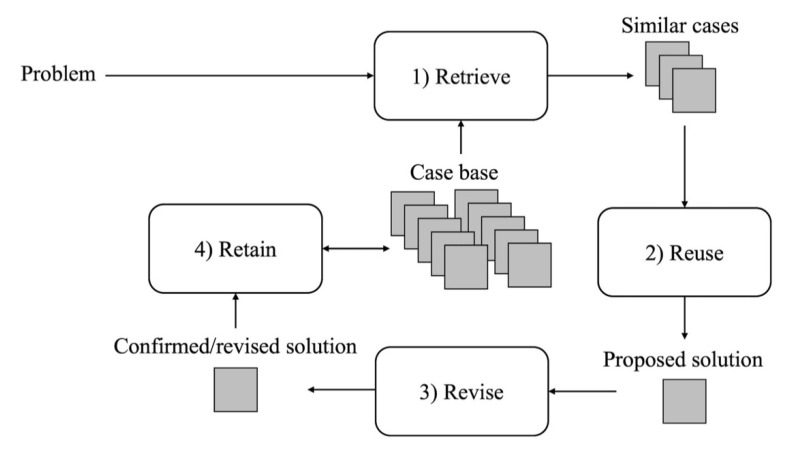
“For example, PEPPER (Patient Empowerment through Predictive PERsonalised decision support), a project funded by the European Commission under the Horizon 2020 program, recently developed a DSS for personalized T1D management that includes an adaptive bolus advisor, based on case-based reasoning, as well as a system for carbohydrate recommendations based on a predictive model [31].”
§ Advanced Diabetes Management Using Artificial Intelligence and Continuous Glucose Monitoring Sensors > 2. Decision Support Systems for Advanced Diabetes Management
What the sources say
- Not checked yetcites [31] Herrero, P., Lopez, B., and Martin, C. (2016, January 30). PEPPER: Patient empowerment through predictive personalized decision support. Proceedings of the AID: Artificial Intelligence for Diabetes: 1st ECAI Workshop on Artificial Intelligence for Diabetes at the 22nd European Conference on Artificial Intelligence (ECAI 2016), The Hague, The Netherlands.
plain- Asserted: passes — The authors put it forward as true.
- Checkable: passes — It can be checked against evidence.
- Load-bearing: unclear — It is unclear whether the paper’s conclusions depend on it.
- Based: passes — The paper gives a reason why it holds.
It may state two separate claims as one.
In the paper
“The results obtained in a cohort of 20 virtual subjects showed that the adoption of R2R+CBR significantly improved glycemic control, achieving better results than the stand-alone R2R algorithm.”
§ Advanced Diabetes Management Using Artificial Intelligence and Continuous Glucose Monitoring Sensors > 4. Adaptive Tuning of Bolus Calculator Parameters Exploiting AI Techniques
What the sources say
- Not checked yetcites [42] Herrero, 2014, Advanced insulin bolus advisor based on run-to-run control and case-based reasoning, IEEE J. Biomed. Health Inform.
plaindirectn = 20- Asserted: passes — The authors put it forward as true.
- Checkable: passes — It can be checked against evidence.
- Load-bearing: passes — The paper’s conclusions depend on it.
- Based: passes — The paper gives a reason why it holds.
It may state two separate claims as one.
In the paper
“The study demonstrated the safety and effectiveness of ABC4D, which made it possible to reduce the occurrence of postprandial hypoglycemia.”
§ Advanced Diabetes Management Using Artificial Intelligence and Continuous Glucose Monitoring Sensors > 4. Adaptive Tuning of Bolus Calculator Parameters Exploiting AI Techniques
What the sources say
- Not checked yetcites [45] Reddy, 2016, Clinical safety and feasibility of the advanced bolus calculator for type 1 diabetes based on case-based reasoning: A 6-week nonrandomized single-arm pilot study, Diabetes Technol. Ther. source
boosteddirectn = 10- Asserted: passes — The authors put it forward as true.
- Checkable: passes — It can be checked against evidence.
- Load-bearing: passes — The paper’s conclusions depend on it.
- Based: passes — The paper gives a reason why it holds.
It may state two separate claims as one.
The paper states this without a source or data behind it here, so there is nothing to check it against. The quote shows it is in the paper.
In the paper
“Current research in diabetes is putting considerable effort into developing algorithms and software applications to enhance T1D therapy by exploiting the latest technologies and their interoperability.”
§ Advanced Diabetes Management Using Artificial Intelligence and Continuous Glucose Monitoring Sensors > 1. Standard Type 1 Diabetes Therapy and Margins for Improvement Using New Technologies
plain- Asserted: passes — The authors put it forward as true.
- Checkable: passes — It can be checked against evidence.
- Load-bearing: fails — The paper’s conclusions may not depend on it.
- Based: passes — The paper gives a reason why it holds.
Probably not a substantial claim. The paper’s conclusions may not depend on it.
In the paper
“The encouraging results obtained in a simulated study suggest that reinforcement learning could be a promising approach, one able to both personalize insulin therapy parameters and improve glycemic control.”
§ Advanced Diabetes Management Using Artificial Intelligence and Continuous Glucose Monitoring Sensors > 4. Adaptive Tuning of Bolus Calculator Parameters Exploiting AI Techniques
What the sources say
- Not checked yetcites Sun et al. [48] Sun, 2019, A dual mode adaptive basal-bolus advisor based on reinforcement learning, IEEE J. Biomed. Health Inform. source
hedgedconditional- Asserted: passes — The authors put it forward as true.
- Checkable: passes — It can be checked against evidence.
- Load-bearing: passes — The paper’s conclusions depend on it.
- Based: passes — The paper gives a reason why it holds.
It may state two separate claims as one.
In the paper
“The NN hyper-parameters (i.e., the number of neurons per layer and the activation function type) were tuned using a five-fold CV procedure, in other words, the training set was divided into five groups of data, four of which were used for training the NN and the remaining one used as a validation set to compute the mean squared error (MSE).”
§ Advanced Diabetes Management Using Artificial Intelligence and Continuous Glucose Monitoring Sensors > 3. Personalized Insulin Bolus Calculation Based on Continuous Glucose Monitoring Sensors > 3.1. A Neural Network-Based Methodology for Personalized SF Correction
What the sources say
- Not checked yetcites [37] Cappon, 2018, A Neural-network-based approach to personalize insulin bolus calculation using continuous glucose monitoring, J. Diabetes Sci. Technol. source
plain- Asserted: passes — The authors put it forward as true.
- Checkable: passes — It can be checked against evidence.
- Load-bearing: fails — The paper’s conclusions may not depend on it.
- Based: passes — The paper gives a reason why it holds.
Probably not a substantial claim. The paper’s conclusions may not depend on it.
The paper states this without a source or data behind it here, so there is nothing to check it against. The quote shows it is in the paper.
In the paper
“The increasing availability of information offered by wearable devices, such as CGM sensors, insulin pumps, smart pens, and activity trackers, is making the decision-making process increasingly complex.”
§ Advanced Diabetes Management Using Artificial Intelligence and Continuous Glucose Monitoring Sensors > 1. Standard Type 1 Diabetes Therapy and Margins for Improvement Using New Technologies
plaindirect- Asserted: passes — The authors put it forward as true.
- Checkable: passes — It can be checked against evidence.
- Load-bearing: passes — The paper’s conclusions depend on it.
- Based: fails — The paper may give no reason why it holds.
Probably not a substantial claim. The paper may give no reason why it holds.
A conclusion the paper draws from its own results — it cites no other source for it, so there is none to check. The quote shows it is in the paper.
In the paper
“One fundamental issue of R2R is that it assumes that the process that is to be controlled, in our case the BG level, is repetitive. This assumption is somewhat unrealistic in many cases, thus it limits R2R applicability.”
§ Advanced Diabetes Management Using Artificial Intelligence and Continuous Glucose Monitoring Sensors > 4. Adaptive Tuning of Bolus Calculator Parameters Exploiting AI Techniques
plaindirect- Asserted: passes — The authors put it forward as true.
- Checkable: passes — It can be checked against evidence.
- Load-bearing: passes — The paper’s conclusions depend on it.
- Based: passes — The paper gives a reason why it holds.
It may state two separate claims as one.
In the paper
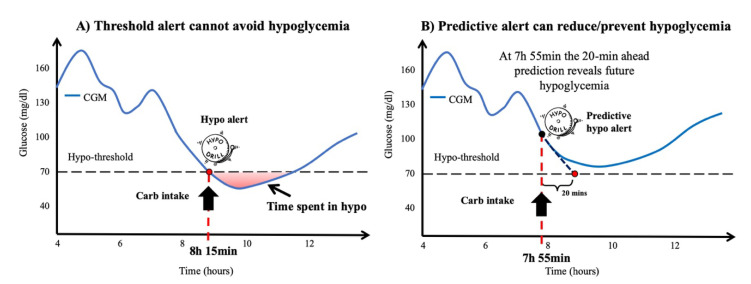
“The most recent CGM sensors adopt very simple prediction algorithms, e.g., linear extrapolation, to predict future interstitial glucose concentrations (e.g., 15–30 min in advance) in real-time and generate predictive alerts when a hypo/hyperglycemic event is foreseen [49].”
§ Advanced Diabetes Management Using Artificial Intelligence and Continuous Glucose Monitoring Sensors > 5. Glucose Prediction
What the sources say
- Not checked yetcites [49] Abraham, S.B., Arunachalam, S., Zhong, A., Agrawal, P., Cohen, O., and McMahon, C.M. (2019). Improved real-world glycemic control with continuous glucose monitoring system predictive alerts. J. Diabetes Sci. Technol. source
plaindirect- Asserted: passes — The authors put it forward as true.
- Checkable: passes — It can be checked against evidence.
- Load-bearing: unclear — It is unclear whether the paper’s conclusions depend on it.
- Based: passes — The paper gives a reason why it holds.
It may state two separate claims as one.
In the paper
“The proposed R2R+CBR algorithm was able to tackle intrasubject variability and external perturbations, and it was shown to be robust to uncertainty in carbohydrate input (i.e., carb-counting error) and noise in CGM measurements.”
§ Advanced Diabetes Management Using Artificial Intelligence and Continuous Glucose Monitoring Sensors > 4. Adaptive Tuning of Bolus Calculator Parameters Exploiting AI Techniques
What the sources say
- Not checked yetcites [42] Herrero, 2014, Advanced insulin bolus advisor based on run-to-run control and case-based reasoning, IEEE J. Biomed. Health Inform.
plaindirectn = 20- Asserted: passes — The authors put it forward as true.
- Checkable: passes — It can be checked against evidence.
- Load-bearing: passes — The paper’s conclusions depend on it.
- Based: passes — The paper gives a reason why it holds.
It may state two separate claims as one.
In the paper
“The results obtained in a virtual cohort of 100 adults, showed that, compared to the SF, the XGB-based BC significantly improved time in euglycemia (from 61.98% to 67.00%) without increasing time in hypoglycemia.”
§ Advanced Diabetes Management Using Artificial Intelligence and Continuous Glucose Monitoring Sensors > 5. Glucose Prediction > 5.2. Hypoglycemic Event Prediction
What the sources say
- Not checked yetcites Cappon et al. [59] Cappon, G., Facchinetti, A., Sparacino., G., Georgiou, P., and Herrero, P. (2019). Classification of postprandial glycemic status with application to insulin dosing in type 1 diabetes—An in silico proof-of-concept. Sensors, 19. source
plaindirectn = 100- Asserted: passes — The authors put it forward as true.
- Checkable: passes — It can be checked against evidence.
- Load-bearing: passes — The paper’s conclusions depend on it.
- Based: passes — The paper gives a reason why it holds.
It may state two separate claims as one.
In the paper
“Most of the prediction algorithms in the literature approach the problem of glucose prediction as a regression problem, in other words they seek to predict the value of interstitial glucose concentration with a prediction horizon (PH) typically below 60 min (30 min is the most frequent PH value) [52].”
§ Advanced Diabetes Management Using Artificial Intelligence and Continuous Glucose Monitoring Sensors > 5. Glucose Prediction > 5.1. Prediction of Interstitial Glucose Concentration Level
What the sources say
- Not checked yetcites [52] Oviedo, 2016, A review of personalized blood glucose prediction strategies for T1DM patients, Int. J. Numer. Methods Biomed. Eng. source
plain- Asserted: passes — The authors put it forward as true.
- Checkable: passes — It can be checked against evidence.
- Load-bearing: unclear — It is unclear whether the paper’s conclusions depend on it.
- Based: passes — The paper gives a reason why it holds.
It may state two separate claims as one.
The paper states this without a source or data behind it here, so there is nothing to check it against. The quote shows it is in the paper.
In the paper
“Most studies on glucose prediction have focused on forecasting future glucose concentration levels using a regression approach, usually with a short PH (e.g., 30 min).”
§ Advanced Diabetes Management Using Artificial Intelligence and Continuous Glucose Monitoring Sensors > 5. Glucose Prediction > 5.2. Hypoglycemic Event Prediction
plain- Asserted: passes — The authors put it forward as true.
- Checkable: passes — It can be checked against evidence.
- Load-bearing: passes — The paper’s conclusions depend on it.
- Based: fails — The paper may give no reason why it holds.
Probably not a substantial claim. The paper may give no reason why it holds.
In the paper
“Although each module has been independently validated on retrospective data, a clinical validation of the proposed DSS is needed to prove its efficacy as a tool for improving glycemic control in subjects with T1D.”
§ Advanced Diabetes Management Using Artificial Intelligence and Continuous Glucose Monitoring Sensors > 5. Glucose Prediction > 5.2. Hypoglycemic Event Prediction
What the sources say
- Not checked yetcites [61] Vehi, 2019, Prediction and prevention of hypoglycaemic events in type-1 diabetic patients using machine learning, Health Inform. J. source
plain- Asserted: passes — The authors put it forward as true.
- Checkable: passes — It can be checked against evidence.
- Load-bearing: fails — The paper’s conclusions may not depend on it.
- Based: passes — The paper gives a reason why it holds.
Probably not a substantial claim. The paper’s conclusions may not depend on it. It may state two separate claims as one.
None of the sources cited for this claim have been checked yet.
In the paper
“As reported in recent systematic reviews [25,54], AI techniques, especially supervised machine learning techniques, are extensively used for building black-box models for glucose prediction. The most used method is NN, but other machine learning methodologies, such as random forest, support vector regression, regression algorithms and deep-learning techniques.”
§ Advanced Diabetes Management Using Artificial Intelligence and Continuous Glucose Monitoring Sensors > 5. Glucose Prediction
What the sources say
- Not checked yetcites [25] Contreras, 2018, Artificial intelligence for diabetes management and decision support: Literature review, J. Med. Internet Res. source
- Not checked yetcites [54] Woldaregay, 2019, Data-driven modeling and prediction of blood glucose dynamics: Machine learning applications in type 1 diabetes, Artif. Intell. Med. source
plaincorrelational- Asserted: passes — The authors put it forward as true.
- Checkable: passes — It can be checked against evidence.
- Load-bearing: unclear — It is unclear whether the paper’s conclusions depend on it.
- Based: passes — The paper gives a reason why it holds.
It may state two separate claims as one.
In the paper
“The models showing best performance in terms RMSE were ARX, Ridge regression, linear SVR, LSTM, and TCN, with RMSE between 19 and 20 mg/dL.”
§ Advanced Diabetes Management Using Artificial Intelligence and Continuous Glucose Monitoring Sensors > 5. Glucose Prediction > 5.1. Prediction of Interstitial Glucose Concentration Level
What the sources say
- Not checked yetcites [58] Xie, J., and Wang, Q. (2020). Benchmarking machine learning algorithms on blood glucose prediction for Type 1 Diabetes in comparison with classical time-series models. IEEE Trans. Biomed. Eng., 1. source
plain- Asserted: passes — The authors put it forward as true.
- Checkable: passes — It can be checked against evidence.
- Load-bearing: passes — The paper’s conclusions depend on it.
- Based: passes — The paper gives a reason why it holds.
It may state two separate claims as one.
A conclusion the paper draws from its own results — it cites no other source for it, so there is none to check. The quote shows it is in the paper.
In the paper
“On the other hand, predicting the exact glucose concentration level over such a long PH would be a very challenging task.”
§ Advanced Diabetes Management Using Artificial Intelligence and Continuous Glucose Monitoring Sensors > 5. Glucose Prediction > 5.2. Hypoglycemic Event Prediction
hedged- Asserted: passes — The authors put it forward as true.
- Checkable: passes — It can be checked against evidence.
- Load-bearing: passes — The paper’s conclusions depend on it.
- Based: fails — The paper may give no reason why it holds.
Probably not a substantial claim. The paper may give no reason why it holds.
In the paper
“Considering both of the metrics, the models that performed better were linear SVR and TCN with RMSE around 20 mg/dL and a TG of about 6 min.”
§ Advanced Diabetes Management Using Artificial Intelligence and Continuous Glucose Monitoring Sensors > 5. Glucose Prediction > 5.1. Prediction of Interstitial Glucose Concentration Level
What the sources say
- Not checked yetcites [58] Xie, J., and Wang, Q. (2020). Benchmarking machine learning algorithms on blood glucose prediction for Type 1 Diabetes in comparison with classical time-series models. IEEE Trans. Biomed. Eng., 1. source
plain- Asserted: passes — The authors put it forward as true.
- Checkable: passes — It can be checked against evidence.
- Load-bearing: unclear — It is unclear whether the paper’s conclusions depend on it.
- Based: passes — The paper gives a reason why it holds.
It may state two separate claims as one.
In the paper
“Another option is to develop subject-specific algorithms, where a different model is trained for each subject, in order to take into account the large inter-individual variability characterizing individuals with T1D [52].”
§ Advanced Diabetes Management Using Artificial Intelligence and Continuous Glucose Monitoring Sensors > 5. Glucose Prediction
What the sources say
- Not checked yetcites [52] Oviedo, 2016, A review of personalized blood glucose prediction strategies for T1DM patients, Int. J. Numer. Methods Biomed. Eng. source
plaindirect- Asserted: passes — The authors put it forward as true.
- Checkable: passes — It can be checked against evidence.
- Load-bearing: fails — The paper’s conclusions may not depend on it.
- Based: passes — The paper gives a reason why it holds.
Probably not a substantial claim. The paper’s conclusions may not depend on it.
In the paper
“However, one limitation of this study is that all the data were collected in a controlled inpatient environment. Further validation of the approach with data gathered under free-living conditions, and with different types of exercise, is required.”
§ Advanced Diabetes Management Using Artificial Intelligence and Continuous Glucose Monitoring Sensors > 5. Glucose Prediction > 5.2. Hypoglycemic Event Prediction
What the sources say
- Not checked yetcites Reddy et al. [60] Reddy, 2019, Prediction of hypoglycemia during aerobic exercise in adults with type 1 diabetes, J. Diabetes Sci. Technol. source
plain- Asserted: passes — The authors put it forward as true.
- Checkable: passes — It can be checked against evidence.
- Load-bearing: passes — The paper’s conclusions depend on it.
- Based: passes — The paper gives a reason why it holds.
Probably not a substantial claim. It may state two separate claims as one.
In the paper
“The maximum TG was achieved for Gradient boosting trees and LSTM, which made it possible to predict the CGM data, on average, 7 min in advance.”
§ Advanced Diabetes Management Using Artificial Intelligence and Continuous Glucose Monitoring Sensors > 5. Glucose Prediction > 5.1. Prediction of Interstitial Glucose Concentration Level
What the sources say
- Not checked yetcites [58] Xie, J., and Wang, Q. (2020). Benchmarking machine learning algorithms on blood glucose prediction for Type 1 Diabetes in comparison with classical time-series models. IEEE Trans. Biomed. Eng., 1. source
plaindirect- Asserted: passes — The authors put it forward as true.
- Checkable: passes — It can be checked against evidence.
- Load-bearing: unclear — It is unclear whether the paper’s conclusions depend on it.
- Based: passes — The paper gives a reason why it holds.
It may state two separate claims as one.
None of the sources cited for this claim have been checked yet.
In the paper
“The data collected by activity trackers can be used to automatically detect exercise sessions [65], predict exercise-induced hypoglycemia [60], and if necessary, recommend the consumption of carbohydrates to avoid hypoglycemia.”
§ Advanced Diabetes Management Using Artificial Intelligence and Continuous Glucose Monitoring Sensors > 6. Conclusions
What the sources say
- Not checked yetcites [65] Dasanayake, 2015, Early detection of physical activity for people with type 1 diabetes mellitus, J. Diabetes Sci. Technol. source
- Not checked yetcites [60] Reddy, 2019, Prediction of hypoglycemia during aerobic exercise in adults with type 1 diabetes, J. Diabetes Sci. Technol. source
plaindirect- Asserted: passes — The authors put it forward as true.
- Checkable: passes — It can be checked against evidence.
- Load-bearing: passes — The paper’s conclusions depend on it.
- Based: passes — The paper gives a reason why it holds.
It may state two separate claims as one.
A conclusion the paper draws from its own results — it cites no other source for it, so there is none to check. The quote shows it is in the paper.
In the paper
“Amongst the possible applications, AI-enabled DSSs are promising tools that could potentially reduce the patient burden in diabetes management and improve glucose control.”
§ Advanced Diabetes Management Using Artificial Intelligence and Continuous Glucose Monitoring Sensors > 6. Conclusions
hedgedconditional- Asserted: passes — The authors put it forward as true.
- Checkable: fails — It may be too vague to check against evidence.
- Load-bearing: passes — The paper’s conclusions depend on it.
- Based: fails — The paper may give no reason why it holds.
Probably not a substantial claim. It may be too vague to check against evidence. The paper may give no reason why it holds. It may state two separate claims as one.
A conclusion the paper draws from its own results — it cites no other source for it, so there is none to check. The quote shows it is in the paper.
In the paper
“A prospective clinical validation proving the safety and effectiveness of such techniques is required to support the adoption of AI-based DSS applications in T1D management.”
§ Advanced Diabetes Management Using Artificial Intelligence and Continuous Glucose Monitoring Sensors > 6. Conclusions
plain- Asserted: passes — The authors put it forward as true.
- Checkable: fails — It may be too vague to check against evidence.
- Load-bearing: passes — The paper’s conclusions depend on it.
- Based: passes — The paper gives a reason why it holds.
Probably not a substantial claim. It may be too vague to check against evidence.
The paper relies on this without support.
AI techniques can handle big datasets with different types of data without the need of an underlying physiological model.
“AI techniques, indeed, can handle big datasets with different types of data, without the need of an underlying physiological model.”
The paper relies on this without support.
The increased availability of internet-connected and interoperable sensors makes it possible to construct large databases of interstitial glucose measurements integrated with other data sources.
“In managing T1D, the increased availability of internet-connected and interoperable sensors makes it possible to construct large databases, consisting of interstitial glucose concentration measurements, integrated with several other data sources.”
Claims other papers make about this one
Each is checked against this paper’s own text: does it say what the citing paper says it does?
In the citing paper
“DL algorithms have been proven effective in the early detection and preventing of chronic diseases, like diabetes and cardiovascular disease [17,195].”
From The emergence of AI-based wearable sensors for digital health technology: a review (2023) · cites this paper as [195]
In the citing paper
“Moreover, continuous glucose monitoring is not possible without involving AI in sensors for diabetes management [195].”
From The emergence of AI-based wearable sensors for digital health technology: a review (2023) · cites this paper as [195]
Citations
Cites
Case-Based Reasoning: Foundational Issues, Methodological Variations, and System Approaches
Aamodt, A., & Plaza, E. (1994) · AI Communications · doi:10.3233/aic-1994-7104 · Cited by 5,624
Feldman, E. L., Callaghan, B. C., Pop-Busui, R., Zochodne, D. W., Wright, D. E., Bennett, D. L., Bril, V., Russell, J. W., & Viswanathan, V. (2019) · Nature Reviews Disease Primers · doi:10.1038/s41572-019-0092-1 · Cited by 1,697
Continuous glucose monitoring and intensive treatment of type 1 diabetes
(2008) · New England Journal of Medicine · doi:10.1056/nejmoa0805017 · Cited by 1,559
Effectiveness of Sensor-Augmented Insulin-Pump Therapy in Type 1 Diabetes
Bergenstal, R. M., Tamborlane, W. V., Ahmann, A., Buse, J. B., Dailey, G., Davis, S. N., Joyce, C., Peoples, T., Perkins, B. A., Welsh, J. B., et al. (2010) · New England Journal of Medicine · doi:10.1056/nejmoa1002853 · Cited by 894
The UVA/PADOVA Type 1 Diabetes Simulator: New Features
Man, C. D., Micheletto, F., Lv, D., Breton, M., Kovatchev, B., & Cobelli, C. (2014) · Journal of Diabetes Science and Technology · doi:10.1177/1932296813514502 · Cited by 791 · cited 4×
“…set, which spanned a wide range of pre-meal conditions and patient characteristics, was created in silico by the UVa / Padova T1D Simulator [38], a simulation tool that includes a model of glucose-insulin-glucagon dynamics in subjects with T1D, accepted by the FDA to substitute preclinical…”
MethodInfluential(2009) · Archives of Internal Medicine · doi:10.1001/archinternmed.2009.193 · Cited by 653
Artificial intelligence for diabetes management and decision support: Literature review
Contreras, I., & Vehi, J. (2018) · Journal of Medical Internet Research · doi:10.2196/10775 · Cited by 560
Cappon, G., Vettoretti, M., Sparacino, G., & Facchinetti, A. (2019) · Diabetes & Metabolism Journal · doi:10.4093/dmj.2019.0121 · Cited by 477
Self-citationWoldaregay, A. Z., Årsand, E., Walderhaug, S., Albers, D., Mamykina, L., Botsis, T., & Hartvigsen, G. (2019) · Artificial Intelligence in Medicine · doi:10.1016/j.artmed.2019.07.007 · Cited by 358
Continuous glucose monitoring: A review of the technology and clinical use
Klonoff, D. C., Ahn, D., & Drincic, A. (2017) · Diabetes Research and Clinical Practice · doi:10.1016/j.diabres.2017.08.005 · Cited by 320
Research works printed but not linked: 1
- Herrero, P., Lopez, B., and Martin, C. (2016, January 30). PEPPER: Patient empowerment through predictive personalized decision support. Proceedings of the AID: Artificial Intelligence for Diabetes: 1st ECAI Workshop on Artificial Intelligence for Diabetes at the 22nd European Conference on Artificial Intelligence (ECAI 2016), The Hague, The Netherlands.
Cited by
Sorted by citations
The Role of AI in Hospitals and Clinics: Transforming Healthcare in the 21st Century
Varnosfaderani, S. M., & Forouzanfar, M. (2024) · Bioengineering · doi:10.3390/bioengineering11040337 · Cited by 1,141
The emergence of AI-based wearable sensors for digital health technology: a review
Shajari, S., Kuruvinashetti, K., Komeili, A., & Sundararaj, U. (2023) · Sensors · doi:10.3390/s23239498 · Cited by 535
Fahim, Y. A., Hasani, I. W., Kabba, S., & Ragab, W. M. (2025) · European Journal of Medical Research · doi:10.1186/s40001-025-03196-w · Cited by 329
Role of Machine Learning Assisted Biosensors in Point-of-Care-Testing For Clinical Decisions
Bhaiyya, M. L., Panigrahi, D., Rewatkar, P., & Haick, H. (2024) · ACS Sensors · doi:10.1021/acssensors.4c01582 · Cited by 251
Review—Electrochemistry and Other Emerging Technologies for Continuous Glucose Monitoring Devices
Das, S. K., Nayak, K. K., Krishnaswamy, P. R., Kumar, V., & Bhat, N. (2022) · ECS Sensors Plus · doi:10.1149/2754-2726/ac7abb · Cited by 145
Metadata
- Authors
- Vettoretti, M., Cappon, G., Facchinetti, A., & Sparacino, G.
- Affiliations
- University of Padua (IT)
- Corresponding author
- Sparacino, Giovanni
- Venue
- Sensors
- Publisher
- MDPI AG
- Published
- 2020-07-10
- Volume
- 20
- Issue
- 14
- Pages
- 3870
- ISSN
- 1424-8220 (ISSN-L)
- PMC
- PMC7412387
- OpenAlex
- W3040810687
- Cited by
- 176
- References
- 63
- Citations by year
- 2026: 25 · 2025: 53 · 2024: 37 · 2023: 33 · 2022: 17 · 2021: 9 · 2020: 2
- FWCI
- 2.34
- Type
- journal article
- Language
- en
- Open access
- gold
- dx.doi.org
- Licence
- Locations
- Sensors (publishedVersion, cc-by)
- PubMed Central (publishedVersion, cc-by)
- PubMed (publishedVersion)
- DOAJ (DOAJ: Directory of Open Access Journals) (submittedVersion, cc-by-sa)
- Padua Research Archive (University of Padova) (submittedVersion, cc-by)
- Funders
- Ministero dell’Istruzione, dell’Università e della Ricerca (Law 232/2016 (Initiative "Departments of Excellence"))
- Topics
- Health Sciences › Medicine › Endocrinology, Diabetes and Metabolism › Diabetes Management and Research
- Health Sciences › Medicine › Endocrinology, Diabetes and Metabolism › Diabetes Management and Education
- Health Sciences › Medicine › Endocrinology, Diabetes and Metabolism › Diabetes Treatment and Management
- Keywords
- type 1 diabetes, continuous glucose monitoring, artificial intelligence, decision support system, glucose prediction, hypoglycemia prediction, hyperglycemia prediction, wearable sensors, diabetes management
- MeSH terms
- Wearable Electronic Devices, Artificial Intelligence, Blood Glucose, Diabetes Mellitus, Type 1, Humans, Insulin Infusion Systems, Blood Glucose Self-Monitoring, Disease Management
About these checks
Registry, retraction, Cites and statistics results are computed, not judged, with one exception: a printed reference that no index lists is read once by a model before it counts as a citation error. Claims are extracted by a model and kept only when their quote appears verbatim in the text; each cited source is then checked, with a model’s help, for whether it says what the claim relies on. Those verdicts can be wrong — read the claim’s quote and the cited source before relying on one.
A language model drew the claims from the paper on 2026-10-09, under version 3 of the claim definition (model deepseek-v4.1-flash, prompt extract-v3).
A second model labelled each claim on 2026-10-09 (model jev-1.13-20260917, definition revision gold-guideline-v0.2).
Statistics and arithmetic are recomputed, not judged.
Confidence bands are shown only for fields calibrated on our annotated test set. None is calibrated yet, so no band is shown.
What counts as a claim ›How we measure confidence ›How we check this ›
Are you an author, or do you see a problem with this page? Request a review
