

EMG and Joint Angle-Based Machine Learning to Predict Future Joint Angles at the Knee
Open accessThe DOI matches its Crossref record; 52 of the 52 references it cites were found in a registry or an index.
Abstract
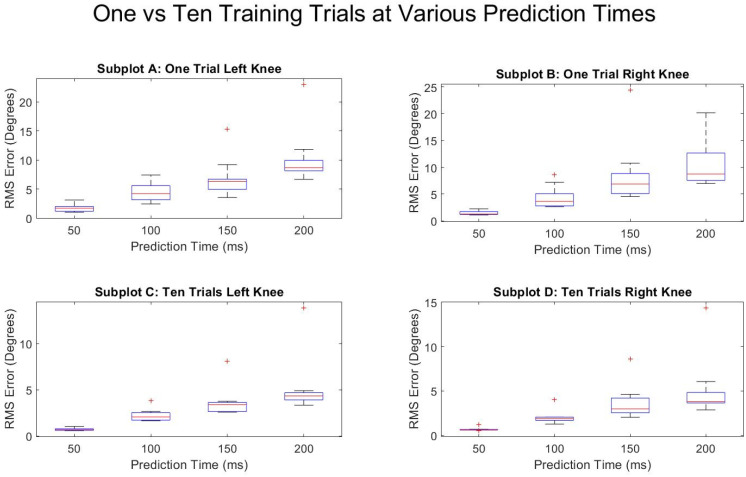
Electromyography (EMG) is commonly used to measure electrical activity of the skeletal muscles. As exoskeleton technology advances, these signals may be used to predict human intent for control purposes. This study used an artificial neural network trained and tested with knee flexion angles and knee muscle EMG signals to predict knee flexion angles during gait at 50, 100, 150, and 200 ms into the future. The hypothesis of this study was that the algorithm’s prediction accuracy would only be affected by time into the future, not subject, gender or side, and that as time into the future increased, the prediction accuracy would decrease. A secondary hypothesis was that as the number of algorithm training trials increased, the prediction accuracy of the artificial neural network (ANN) would increase. The results of this study indicate that only time into the future affected the accuracy of knee flexion angle prediction (p < 0.001), whereby greater time resulted in reduced accuracy (0.68 to 4.62 degrees root mean square error (RMSE) from 50 to 200 ms). Additionally, increased number of training trials resulted in increased angle prediction accuracy.
Overview
The claims and statistics of this paper haven’t been checked yet.
Free: it reads the open-access text and checks the first 5 claims that cite a source we can check. Create a free account to check every claim.
Integrity signals
Registry
Cites
Statistics
Figures




Verification
Claims the paper makes
The claims and statistics of this paper haven’t been checked yet.
Free: it reads the open-access text and checks the first 5 claims that cite a source we can check. Create a free account to check every claim.
Claims other papers make about this one
Each is checked against this paper’s own text: does it say what the citing paper says it does?
The source backs part of the claim, not all of it — or backs it for a different population, condition or comparison.
In the citing paper
“Researchers employ sEMG with high-density electrodes placed over target muscle bellies to capture anticipatory mechanical signals indicated by the slope of EMG pre-activation at high sampling rates 93,94 .”
From Recent advances in intelligent wearable systems: from multiscale biomechanical features towards human motion intent prediction (2026) · cites this paper as [94]
Experimental — accuracy not yet measuredIn the citing paper
“Studies have revealed that muscles exhibit characteristic burst activation approximately 100 ms before movement initiation, and the high correlation between activation slope and muscle activity makes it a sensitive indicator for motion prediction 93,94 .”
From Recent advances in intelligent wearable systems: from multiscale biomechanical features towards human motion intent prediction (2026) · cites this paper as [94]
In the citing paper
“| Gait | Thigh skeletal muscle contraction, knee flexion angle | EMG | 94 |”
From Recent advances in intelligent wearable systems: from multiscale biomechanical features towards human motion intent prediction (2026) · cites this paper as [94]
Self-check
Percentages, sums and reported differences re-computed from the paper’s own numbers.
The self-check needs the paper’s full text.
Citations
Cites
Development of recommendations for SEMG sensors and sensor placement procedures
Hermens, H. J., Freriks, B., Disselhorst-Klug, C., & Rau, G. (2000) · Journal of Electromyography and Kinesiology · doi:10.1016/s1050-6411(00)00027-4 · Cited by 7,213
Grood, E. S., & Suntay, W. J. (1983) · Journal of Biomechanical Engineering · doi:10.1115/1.3138397 · Cited by 3,805
Lower Extremity Exoskeletons and Active Orthoses: Challenges and State-of-the-Art
Dollar, A. M., & Herr, H. (2008) · IEEE Transactions on Robotics · doi:10.1109/tro.2008.915453 · Cited by 1,327
Control strategies for active lower extremity prosthetics and orthotics: a review
Tucker, M. R., Olivier, J., Pagel, A., Bleuler, H., Bouri, M., Lambercy, O., Millán, J. D. R., Riener, R., Vallery, H., & Gassert, R. (2015) · Journal of NeuroEngineering and Rehabilitation · doi:10.1186/1743-0003-12-1 · Cited by 1,047 · cited 3×
“High-level controllers have inferred discrete actions using EMG measurements, with classi-fication algorithms [10,32] that often require features [6], or alternative, wavelets [33] to be pre-computed.”
BackgroundISB recommendations for standardization in the reporting of kinematic data
Wu, G., & Cavanagh, P. R. (1995) · Journal of Biomechanics · doi:10.1016/0021-9290(95)00017-c · Cited by 884
Human-in-the-loop optimization of hip assistance with a soft exosuit during walking
Ding, Y., Kim, M., Kuindersma, S., & Walsh, C. J. (2018) · Science Robotics · doi:10.1126/scirobotics.aar5438 · Cited by 612
A Point Cluster Method for In Vivo Motion Analysis: Applied to a Study of Knee Kinematics
Andriacchi, T. P., Alexander, E. J., Toney, M. K., Dyrby, C., & Sum, J. (1998) · Journal of Biomechanical Engineering · doi:10.1115/1.2834888 · Cited by 495
Developments in hardware systems of active upper-limb exoskeleton robots: A review
Gopura, R. A. R. C., Bandara, D. S. V., Kiguchi, K., & Mann, G. K. I. (2016) · Robotics and Autonomous Systems · doi:10.1016/j.robot.2015.10.001 · Cited by 480
A myosignal-based powered exoskeleton system
Rosen, J., Brand, M., Fuchs, M. B., & Arcan, M. (2001) · IEEE Transactions on Systems, Man, and Cybernetics - Part A: Systems and Humans · doi:10.1109/3468.925661 · Cited by 437
A Simple Exoskeleton That Assists Plantarflexion Can Reduce the Metabolic Cost of Human Walking
Malcolm, P., Derave, W., Galle, S., & De Clercq, D. (2013) · PLoS ONE · doi:10.1371/journal.pone.0056137 · Cited by 428
Cited by
An ergonomic assessment tool for evaluating the effect of back exoskeletons on injury risk
Zelik, K. E., Nurse, C. A., Schall, M. C., Sesek, R. F., Marino, M. C., & Gallagher, S. (2021) · Applied Ergonomics · doi:10.1016/j.apergo.2021.103619 · Cited by 86
Self-citationHuman Lower Limb Motion Intention Recognition for Exoskeletons: A Review
Li, L., Cao, G., Liang, H., Zhang, Y.-P., & Cui, F. (2023) · IEEE Sensors Journal · doi:10.1109/jsen.2023.3328615 · Cited by 70
Song, Q., Ma, X., & Liu, Y. (2023) · Computers in Biology and Medicine · doi:10.1016/j.compbiomed.2023.107124 · Cited by 65
Sitole, S. P., & Sup, F. C. (2023) · IEEE Transactions on Medical Robotics and Bionics · doi:10.1109/tmrb.2023.3292451 · Cited by 64
Use of Artificial Intelligence Techniques to Assist Individuals with Physical Disabilities
Pancholi, S., Wachs, J. P., & Duerstock, B. S. (2023) · Annual Review of Biomedical Engineering · doi:10.1146/annurev-bioeng-082222-012531 · Cited by 77
The Influence of Gait Phase on Predicting Lower-Limb Joint Angles
Hollinger, D. S., Schall, M. C., Chen, H., Bass, S., & Zabala, M. E. (2023) · IEEE Transactions on Medical Robotics and Bionics · doi:10.1109/tmrb.2023.3260261 · Cited by 37
Self-citationPrediction of lower limb joint angles from surface electromyography using XGBoost
Lü, Z., Chen, S.-W., Yang, J., Liu, C., & Zhao, H. (2024) · Expert Systems with Applications · doi:10.1016/j.eswa.2024.125930 · Cited by 36
Predicting Continuous Locomotion Modes via Multidimensional Feature Learning From sEMG
Fu, P., Zhong, W., Zhang, Y., Xiong, W., Lin, Y., Tai, Y., Meng, L., & Zhang, M. (2024) · IEEE Journal of Biomedical and Health Informatics · doi:10.1109/jbhi.2024.3441600 · Cited by 28
Prediction of Joint Angles Based on Human Lower Limb Surface Electromyography
Zhao, H., Qiu, Z., Peng, D., Wang, F., Wang, Z., Qiu, S., Shi, X., & Chu, Q. (2023) · Sensors · doi:10.3390/s23125404 · Cited by 28
Zhang, Y., & Doyle, T. E. (2023) · Frontiers in Robotics and AI · doi:10.3389/frobt.2023.1233328 · Cited by 34
Lower Body Joint Angle Prediction Using Machine Learning and Applied Biomechanical Inverse Dynamics
Choffin, Z., Jeong, N. S., Callihan, M., Sazonov, E. E., & Jeong, S. (2022) · Sensors · doi:10.3390/s23010228 · Cited by 17
Machine Learning-Based Performance Comparison to Diagnose Anterior Cruciate Ligament Tears
Awan, M. J., Rahim, M. S. M., Salim, N. B., Rehman, A. U., & Nobanee, H. (2022) · Journal of Healthcare Engineering · doi:10.1155/2022/2550120 · Cited by 18
RetractedHan, J., Wang, H., & Tian, Y. (2024) · IEEE Sensors Journal · doi:10.1109/jsen.2024.3486443 · Cited by 19
Continuous knee joint angle prediction with surface EMG
Yang, J., Lü, Z., Chen, S.-W., Liu, C., & Zhao, H. (2024) · Biomedical Signal Processing and Control · doi:10.1016/j.bspc.2024.106354 · Cited by 15
Guo, W., Liu, Q., Huang, P., Wang, D., Shi, L., & Han, D. H. (2023) · PeerJ · doi:10.7717/peerj.15792 · Cited by 10
The Effect of Sensor Feature Inputs on Joint Angle Prediction across Simple Movements
Hollinger, D. S., Schall, M. C., Chen, H., & Zabala, M. E. (2024) · Sensors · doi:10.3390/s24113657 · Cited by 14
Self-citationChen, S., Peng, C., Yang, B., Lin, J., Zhou, L., Jiang, Z., Liu, Z., Liu, Y., & Tang, L. (2026) · npj Artificial Intelligence · doi:10.1038/s44387-026-00083-5 · Cited by 9
Haq, I. U., Felicetti, F., & Lamonaca, F. (2026) · Journal of Sensor and Actuator Networks · doi:10.3390/jsan15010008 · Cited by 9
Niño-Tejada, K., Saldaña-Aristizábal, L., Rivas-Caicedo, J. L., & Patarroyo-Montenegro, J. F. (2025) · Electronics · doi:10.3390/electronics14153039 · Cited by 9
A Systems Approach to Biomechanics, Mechanobiology, and Biotransport
Peirce, S. M., Sander, E. A., Fisher, M. B., Deymier, A. C., LaDisa, J. F., O’Connell, G. D., Corr, D. T., Han, B., Singh, A. K., Wilson, S. E., et al. (2024) · Journal of Biomechanical Engineering · doi:10.1115/1.4064547 · Cited by 7
Wang, L., Wang, Y., Guo, F., Yan, H., & Zhao, F. (2024) · Machines · doi:10.3390/machines12120901 · Cited by 6
Pollard, R. S., Bass, S. M., Schall, M. C., & Zabala, M. E. (2024) · Sensors · doi:10.3390/s24175673 · Cited by 5
Self-citationWang, Z., Chen, H., Yang, F., Wang, X., Wu, X., & Chen, C. (2024) · IEEE International Conference on Robotics and Biomimetics (ROBIO) · doi:10.1109/robio64047.2024.10907528 · Cited by 5
Self-citationLv, J., Huang, B., & Qiang, L. (2025) · Journal of King Saud University - Computer and Information Sciences · doi:10.1007/s44443-025-00164-6 · Cited by 4
A Kinematically Informed Approach to Near-Future Joint Angle Estimation at the Ankle
Pollard, R. S., Hollinger, D. S., Nail-Ulloa, I., & Zabala, M. E. (2024) · IEEE Transactions on Medical Robotics and Bionics · doi:10.1109/tmrb.2024.3408892 · Cited by 4
Self-citationKoul, M., Thanki, R. M., Koul, R., Fujarski, S., Radhakrishnan, S., & Jodbhavi, S. (2025) · Computers in Biology and Medicine · doi:10.1016/j.compbiomed.2025.110848 · Cited by 4
Zhang, Y., Xiong, J., Xian, H., Chen, X., Fu, C., & Leng, Y. (2025) · IEEE Transactions on Cognitive and Developmental Systems · doi:10.1109/tcds.2025.3582970 · Cited by 4
Predict joint angle of body parts based on sequence pattern recognition
Kasani, A. A., & Sajedi, H. (2022) · International Conference on Ubiquitous Information Management and Communication (IMCOM) · doi:10.1109/imcom53663.2022.9721801 · Cited by 3
Analysis of Elbow Joint Angle for Prediction based on EMG using Kalman Filtering Technique
Ingale, S. S., & Ram, S. P. (2022) · International Conference on Smart Technologies, Communication and Robotics (STCR) · doi:10.1109/stcr55312.2022.10009635 · Cited by 2
Using Smartwatch Data to Estimate Motion
Soon, M. L. I., Hang, C. L. S., & Sivakumar, S. (2023) · International Conference on Digital Applications, Transformation & Economy (ICDATE) · doi:10.1109/icdate58146.2023.10248833 · Cited by 2
A CNN-LSTM neural network model for upper limb joint angle estimation based on mechanomyograph
Ma, Z., Cao, G., Kang, G., Chang, Y., & Xia, C. (2024) · IEEE International Conference on Electronic Technology, Communication and Information (ICETCI) · doi:10.1109/icetci61221.2024.10594132 · Cited by 1
Menga, G., Geng, J., & Mancin, M. (2024) · Artificial intelligence · doi:10.5772/intechopen.115174 · Cited by 1
Lozano, A., Ortiz, D. C., Ballesteros, M., & Chaírez, I. (2024) · Engineering Applications of Artificial Intelligence · doi:10.1016/j.engappai.2024.109670 · Cited by 1
A Neural Network Approach to Estimate Lower Extremity Muscle Activity during Walking
Khant, M., Lee, D. T., Gouwanda, D., Gopalai, A. A., Lim, K. H., & Foong, C. C. (2022) · IEEE-EMBS Conference on Biomedical Engineering and Sciences · doi:10.1109/iecbes54088.2022.10079316 · Cited by 1
Learning a Shared Model for Motorized Prosthetic Joints to Predict Ankle-Joint MotionPreprint
Dey, S., Boughorbel, S., & Schilling, A. F. (2021) · arXiv (Cornell University) · doi:10.48550/arxiv.2111.07419 · Cited by 2
Multi-Session Electrocardiogram–Electromyogram Database for User Recognition
Kim, J.-S., Song, C. H., Kim, J. M., Lee, J., Byeon, Y.-H., Jung, J., Choi, H., Kwak, K.-C., Kim, Y. T., Bak, E., et al. (2024) · Applied Sciences · doi:10.3390/app14062607 · Cited by 2
Bai, Y., Guan, X., Li, H., Cheng, S., Zhang, R., & He, L. (2025) · Applied Sciences · doi:10.3390/app15126454
Prediction of Knee Angle by EMG Regression Based on BP Neural Network
Shen, S. (2025) · Asia-Pacific Conference on Communications Technology and Computer Science (ACCTCS) · doi:10.1109/acctcs66275.2025.00203
A Hybrid Kinematic and Machine Learning Approach to Future Joint Angle Estimation at the Ankle
Pollard, R. S., Brokamp, J. R., Nail-Ulloa, I., & Zabala, M. E. (2025) · IEEE Transactions on Medical Robotics and Bionics · doi:10.1109/tmrb.2025.3619769
Self-citationWang, X., Li, Y. M., Xu, X., & Yu, H. (2025) · Sensors · doi:10.3390/s25247618
Radio Frequency Identification Tag Based Flexible Angle Sensor for Dynamic Range Measurement
Yang, X., Wu, E., & Liang, J. (2025) · Microwave and Optical Technology Letters · doi:10.1002/mop.70303
Knee Trajectory Prediction via Decoupling and Conditional Diffusion
Cui, J., Wang, C., Ma, R., Zou, R., Ge, Z., Liang, G., Wang, Y. Z., & Hou, Z.-G. (2026) · Lecture notes in computer science · doi:10.1007/978-981-95-4445-5_26
PSO-LSTM-KAN Based Gait Trajectory Prediction for Lower Limb Exoskeleton Using IMU
Li, J., Tong, Y., Li, Y., He, L., & Hu, L. (2025) · International Conference on Robotics, Intelligent Control and Artificial Intelligence (RICAI) · doi:10.1109/ricai68060.2025.11385087
Rostami, M. R., & Rostam, S. A. R. (2026) · SSRN Electronic Journal · doi:10.2139/ssrn.7069219
Prediction of Exoskeleton Knee Angle Based on Unilateral Lower Limb Information
Song, Z., Liu, Y., Ma, X., Zhang, K., Li, X., & Song, Q. (2026) · International Conference on Robotics and Control Engineering (RobCE) · doi:10.1145/3820709.3820718
Zhou, Z., Zeng, Q., Liu, Z., Luo, M., Hu, K., & Sheng, Y. (2026) · International Conference on Control and Automation · doi:10.1109/icca69928.2026.11618270
Hu, Z., Xu, Q., Su, S., Tang, Y., & Xu, Y. (2026) · Sensors · doi:10.3390/s26165144
Multi-Source Motion Inputs and FA-TA-BiLSTM for Lower-Limb Joint Angle Prediction
Yang, C., Zhao, P., Guo, Y., Han, X., Gao, X., & Deng, J. (2026) · Sensors · doi:10.3390/s26165235
Chang, J., Zheng, C., Ying, Z., Tang, F., Chen, W., Huang, Z., & Chen, Z. (2026) · SSRN Electronic Journal · doi:10.2139/ssrn.7460171
Pan, B., Wang, Y., & Xiang, M. (2026) · Bioengineering · doi:10.3390/bioengineering13101112
She, Z., Shi, L., Xie, D., Jiang, F., Zhong, C., Cheng, Z., Shuning, J., Xie, H., Li, Y., & Zhou, J. (2026) · Chemical Engineering Journal · doi:10.1016/j.cej.2026.183437
Metadata
- Authors
- Coker, J., Chen, H., Schall, M. C., Gallagher, S., & Zabala, M.
- Affiliations
- Auburn University (US)
- Corresponding author
- Zabala, Michael
- Venue
- Sensors
- Publisher
- MDPI AG
- Published
- 2021-05-22
- Volume
- 21
- Issue
- 11
- Pages
- 3622
- ISSN
- 1424-8220 (ISSN-L)
- PMC
- PMC8197024
- OpenAlex
- W3165653836
- Cited by
- 56
- References
- 52
- Citations by year
- 2026: 11 · 2025: 10 · 2024: 14 · 2023: 14 · 2022: 5 · 2021: 2
- FWCI
- 2.66
- Type
- journal article
- Language
- en
- Open access
- gold
- doi.org
- Licence
- Locations
- Sensors (publishedVersion, cc-by)
- PubMed Central (publishedVersion, cc-by)
- PubMed (publishedVersion)
- DOAJ (DOAJ: Directory of Open Access Journals) (submittedVersion, cc-by-sa)
- Funders
- National Institute for Occupational Safety and Health (T42 OH008436)
- Topics
- Physical Sciences › Engineering › Biomedical Engineering › Muscle activation and electromyography studies
- Physical Sciences › Engineering › Biomedical Engineering › Prosthetics and Rehabilitation Robotics
- Physical Sciences › Engineering › Biomedical Engineering › Lower Extremity Biomechanics and Pathologies
- Keywords
- electromyography, gait, exoskeleton control, artificial neural networks, time horizon, training trials, joint angle prediction
- MeSH terms
- Machine Learning, Electromyography, Humans, Knee, Knee Joint, Muscle, Skeletal
About these checks
Registry, retraction, Cites and statistics results are computed, not judged, with one exception: a printed reference that no index lists is read once by a model before it counts as a citation error. Claims are extracted by a model and kept only when their quote appears verbatim in the text; each cited source is then checked, with a model’s help, for whether it says what the claim relies on. Those verdicts can be wrong — read the claim’s quote and the cited source before relying on one.
Statistics and arithmetic are recomputed, not judged.
Confidence bands are shown only for fields calibrated on our annotated test set. None is calibrated yet, so no band is shown.
What counts as a claim ›How we measure confidence ›How we check this ›
Are you an author, or do you see a problem with this page? Request a review
Data sources
Bibliographic data: Semantic Scholar, OpenAlex, Crossref.
Contains information from the Semantic Scholar Academic Graph Datasets, made available under the ODC Attribution License (ODC-BY 1.0).
Semantic Scholar’s data is described in: Kinney, R., et al. (2023). The Semantic Scholar Open Data Platform. arXiv:2301.10140.
