

EMG and Joint Angle-Based Machine Learning to Predict Future Joint Angles at the Knee
Open accessThe DOI matches its Crossref record; 52 of the 52 references it cites were found in a registry or an index.
Abstract
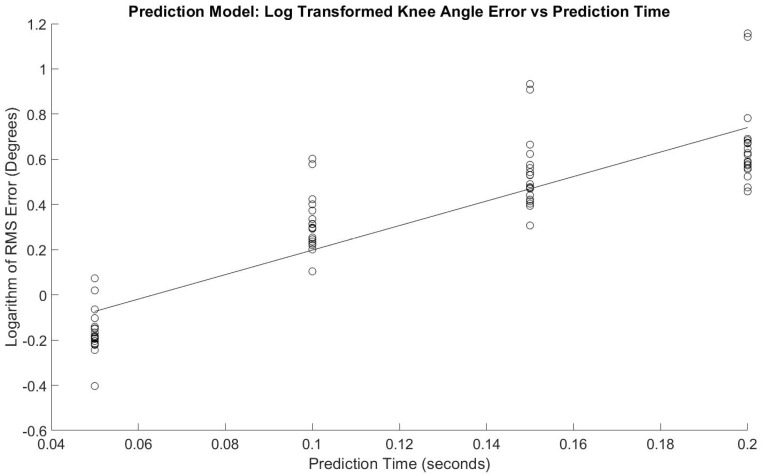
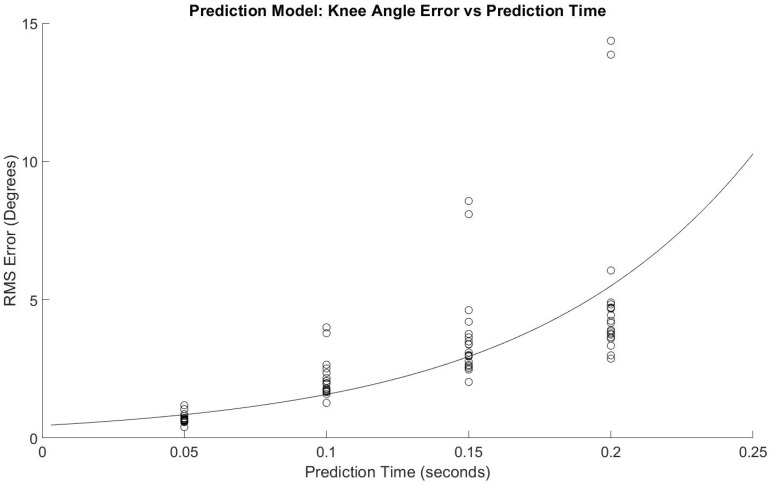
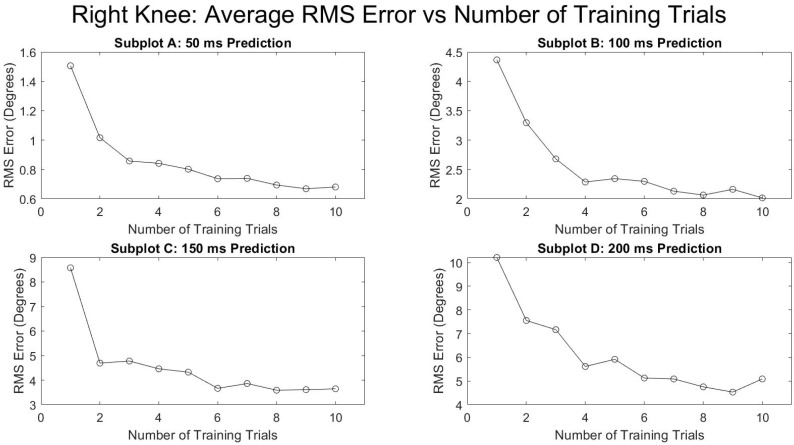
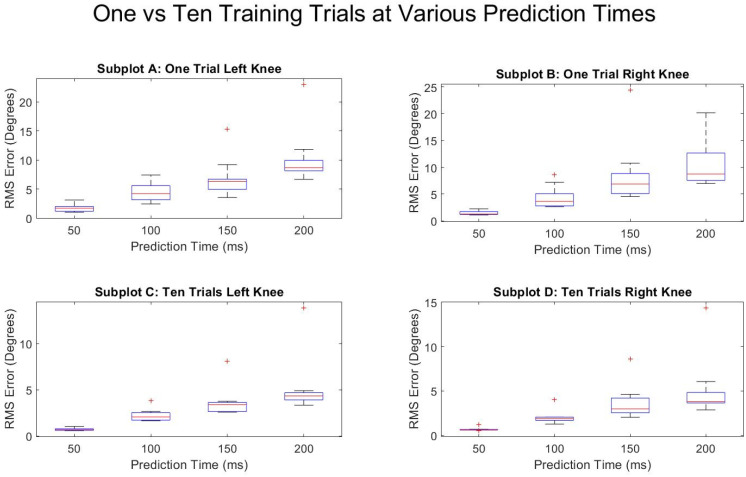
Electromyography (EMG) is commonly used to measure electrical activity of the skeletal muscles. As exoskeleton technology advances, these signals may be used to predict human intent for control purposes. This study used an artificial neural network trained and tested with knee flexion angles and knee muscle EMG signals to predict knee flexion angles during gait at 50, 100, 150, and 200 ms into the future. The hypothesis of this study was that the algorithm’s prediction accuracy would only be affected by time into the future, not subject, gender or side, and that as time into the future increased, the prediction accuracy would decrease. A secondary hypothesis was that as the number of algorithm training trials increased, the prediction accuracy of the artificial neural network (ANN) would increase. The results of this study indicate that only time into the future affected the accuracy of knee flexion angle prediction (p < 0.001), whereby greater time resulted in reduced accuracy (0.68 to 4.62 degrees root mean square error (RMSE) from 50 to 200 ms). Additionally, increased number of training trials resulted in increased angle prediction accuracy.
Overview
The claims and statistics of this paper haven’t been checked yet.
Free: it reads the open-access text and checks the first 5 claims that cite a source we can check. Create a free account to check every claim.
Integrity signals
Registry
Cites
Statistics
Figures




Verification
Claims the paper makes
The claims and statistics of this paper haven’t been checked yet.
Free: it reads the open-access text and checks the first 5 claims that cite a source we can check. Create a free account to check every claim.
Claims other papers make about this one
Each is checked against this paper’s own text: does it say what the citing paper says it does?
The source backs part of the claim, not all of it — or backs it for a different population, condition or comparison.
In the citing paper
“Researchers employ sEMG with high-density electrodes placed over target muscle bellies to capture anticipatory mechanical signals indicated by the slope of EMG pre-activation at high sampling rates 93,94 .”
From Recent advances in intelligent wearable systems: from multiscale biomechanical features towards human motion intent prediction (2026) · cites this paper as [94]
Experimental — accuracy not yet measuredIn the citing paper
“Studies have revealed that muscles exhibit characteristic burst activation approximately 100 ms before movement initiation, and the high correlation between activation slope and muscle activity makes it a sensitive indicator for motion prediction 93,94 .”
From Recent advances in intelligent wearable systems: from multiscale biomechanical features towards human motion intent prediction (2026) · cites this paper as [94]
In the citing paper
“| Gait | Thigh skeletal muscle contraction, knee flexion angle | EMG | 94 |”
From Recent advances in intelligent wearable systems: from multiscale biomechanical features towards human motion intent prediction (2026) · cites this paper as [94]
Self-check
Percentages, sums and reported differences re-computed from the paper’s own numbers.
The self-check needs the paper’s full text.
Citations
Cites
Development of recommendations for SEMG sensors and sensor placement procedures
Hermens, H. J., Freriks, B., Disselhorst-Klug, C., & Rau, G. (2000) · Journal of Electromyography and Kinesiology · doi:10.1016/s1050-6411(00)00027-4 · Cited by 7,213
Grood, E. S., & Suntay, W. J. (1983) · Journal of Biomechanical Engineering · doi:10.1115/1.3138397 · Cited by 3,805
Lower Extremity Exoskeletons and Active Orthoses: Challenges and State-of-the-Art
Dollar, A. M., & Herr, H. (2008) · IEEE Transactions on Robotics · doi:10.1109/tro.2008.915453 · Cited by 1,327
Control strategies for active lower extremity prosthetics and orthotics: a review
Tucker, M. R., Olivier, J., Pagel, A., Bleuler, H., Bouri, M., Lambercy, O., Millán, J. D. R., Riener, R., Vallery, H., & Gassert, R. (2015) · Journal of NeuroEngineering and Rehabilitation · doi:10.1186/1743-0003-12-1 · Cited by 1,047 · cited 3×
“High-level controllers have inferred discrete actions using EMG measurements, with classi-fication algorithms [10,32] that often require features [6], or alternative, wavelets [33] to be pre-computed.”
BackgroundISB recommendations for standardization in the reporting of kinematic data
Wu, G., & Cavanagh, P. R. (1995) · Journal of Biomechanics · doi:10.1016/0021-9290(95)00017-c · Cited by 884
Human-in-the-loop optimization of hip assistance with a soft exosuit during walking
Ding, Y., Kim, M., Kuindersma, S., & Walsh, C. J. (2018) · Science Robotics · doi:10.1126/scirobotics.aar5438 · Cited by 612
A Point Cluster Method for In Vivo Motion Analysis: Applied to a Study of Knee Kinematics
Andriacchi, T. P., Alexander, E. J., Toney, M. K., Dyrby, C., & Sum, J. (1998) · Journal of Biomechanical Engineering · doi:10.1115/1.2834888 · Cited by 495
Developments in hardware systems of active upper-limb exoskeleton robots: A review
Gopura, R. A. R. C., Bandara, D. S. V., Kiguchi, K., & Mann, G. K. I. (2016) · Robotics and Autonomous Systems · doi:10.1016/j.robot.2015.10.001 · Cited by 480
A myosignal-based powered exoskeleton system
Rosen, J., Brand, M., Fuchs, M. B., & Arcan, M. (2001) · IEEE Transactions on Systems, Man, and Cybernetics - Part A: Systems and Humans · doi:10.1109/3468.925661 · Cited by 437
A Simple Exoskeleton That Assists Plantarflexion Can Reduce the Metabolic Cost of Human Walking
Malcolm, P., Derave, W., Galle, S., & De Clercq, D. (2013) · PLoS ONE · doi:10.1371/journal.pone.0056137 · Cited by 428
Multiclass Real-Time Intent Recognition of a Powered Lower Limb Prosthesis
Varol, H. A., Sup, F., & Goldfarb, M. (2010) · IEEE Transactions on Biomedical Engineering · doi:10.1109/tbme.2009.2034734 · Cited by 425
The exoskeleton expansion: improving walking and running economy
Sawicki, G. S., Beck, O. N., Kang, I., & Young, A. J. (2020) · Journal of NeuroEngineering and Rehabilitation · doi:10.1186/s12984-020-00663-9 · Cited by 424
A Review of Classification Techniques of EMG Signals during Isotonic and Isometric Contractions
Nazmi, N., Abdul Rahman, M., Yamamoto, S.-I., Ahmad, S., Zamzuri, H., & Mazlan, S. (2016) · Sensors · doi:10.3390/s16081304 · Cited by 377
A survey of sensor fusion methods in wearable robotics
Novak, D., & Riener, R. (2015) · Robotics and Autonomous Systems · doi:10.1016/j.robot.2014.08.012 · Cited by 252
Biologically-inspired soft exosuit
Asbeck, A. T., Dyer, R. J., Larusson, A. F., & Walsh, C. J. (2013) · 2013 IEEE 13th International Conference on Rehabilitation Robotics (ICORR) · doi:10.1109/icorr.2013.6650455 · Cited by 240
Reference Trajectory Generation for Rehabilitation Robots: Complementary Limb Motion Estimation
Vallery, H., van Asseldonk, E. H. F., Buss, M., & van der Kooij, H. (2009) · IEEE Transactions on Neural Systems and Rehabilitation Engineering · doi:10.1109/tnsre.2008.2008278 · Cited by 228
Control of Stair Ascent and Descent With a Powered Transfemoral Prosthesis
Lawson, B. E., Varol, H. A., Huff, A., Erdemir, E., & Goldfarb, M. (2013) · IEEE Transactions on Neural Systems and Rehabilitation Engineering · doi:10.1109/tnsre.2012.2225640 · Cited by 206
sEMG-based continuous estimation of joint angles of human legs by using BP neural network
Zhang, F., Li, P., Hou, Z.-G., Lu, Z., Chen, Y., Li, Q., & Tan, M. (2012) · Neurocomputing · doi:10.1016/j.neucom.2011.05.033 · Cited by 202
Fully autonomous hip exoskeleton saves metabolic cost of walking
Seo, K., Lee, J., Lee, Y., Ha, T., & Shim, Y. (2016) · 2016 IEEE International Conference on Robotics and Automation (ICRA) · doi:10.1109/icra.2016.7487663 · Cited by 177
Chen, J., Zhang, X., Cheng, Y., & Xi, N. (2018) · Biomedical Signal Processing and Control · doi:10.1016/j.bspc.2017.10.002 · Cited by 177
Design and Validation of a Torque-Controllable Knee Exoskeleton for Sit-to-Stand Assistance
Shepherd, M. K., & Rouse, E. J. (2017) · IEEE/ASME Transactions on Mechatronics · doi:10.1109/tmech.2017.2704521 · Cited by 174
Real-Time Neural Network-Based Gait Phase Estimation Using a Robotic Hip Exoskeleton
Kang, I., Kunapuli, P., & Young, A. J. (2020) · IEEE Transactions on Medical Robotics and Bionics · doi:10.1109/tmrb.2019.2961749 · Cited by 168
Real-Time Gait Phase Estimation for Robotic Hip Exoskeleton Control During Multimodal Locomotion
Kang, I., Molinaro, D. D., Duggal, S., Chen, Y., Kunapuli, P., & Young, A. J. (2021) · IEEE Robotics and Automation Letters · doi:10.1109/lra.2021.3062562 · Cited by 162
Momen, K., Krishnan, S., & Chau, T. (2007) · IEEE Transactions on Neural Systems and Rehabilitation Engineering · doi:10.1109/tnsre.2007.908376 · Cited by 152
Power assist method for HAL-3 estimating operator's intention based on motion information
Kawamoto, H., Kanbe, S., & Sankai, Y. (2004) · doi:10.1109/roman.2003.1251800 · Cited by 149
Fang, C., He, B., Wang, Y., Cao, J., & Gao, S. (2020) · Biosensors · doi:10.3390/bios10080085 · Cited by 147
Autonomous exoskeleton reduces metabolic cost of human walking
Mooney, L. M., Rouse, E. J., & Herr, H. M. (2014) · Journal of NeuroEngineering and Rehabilitation · doi:10.1186/1743-0003-11-151 · Cited by 145
Gautam, A., Panwar, M., Biswas, D., & Acharyya, A. (2020) · IEEE Journal of Translational Engineering in Health and Medicine · doi:10.1109/jtehm.2020.2972523 · Cited by 142
The Effect of Hip Assistance Levels on Human Energetic Cost Using Robotic Hip Exoskeletons
Kang, I., Hsu, H., & Young, A. J. (2019) · IEEE Robotics and Automation Letters · doi:10.1109/lra.2019.2890896 · Cited by 135
Real-Time Intended Knee Joint Motion Prediction by Deep-Recurrent Neural Networks
Huang, Y., He, Z., Liu, Y., Yang, R., Zhang, X., Cheng, G., Yi, J., Ferreira, J. P., & Liu, T. (2019) · IEEE Sensors Journal · doi:10.1109/jsen.2019.2933603 · Cited by 105
Khazoom, C., Veronneau, C., Bigué, J.-P. L., Grenier, J., Girard, A., & Plante, J. (2019) · IEEE Robotics and Automation Letters · doi:10.1109/lra.2019.2924852 · Cited by 89
Cavallaro, E., Rosén, J., Perry, J. C., Burns, S. P., & Hannaford, B. (2006) · Proceedings - IEEE International Conference on Robotics and Automation/Proceedings · doi:10.1109/robot.2005.1570815 · Cited by 81
Recognition of walking environments and gait period by surface electromyography
Kyeong, S., Shin, W., Yang, M., Heo, U., Feng, J.-R., & Kim, J. (2019) · Frontiers of Information Technology & Electronic Engineering · doi:10.1631/fitee.1800601 · Cited by 68 · cited 2×
“High-level controllers have inferred discrete actions using EMG measurements, with classification algorithms [10,32] that often require features [6], or alternative, wavelets [33] to be pre-computed.”
BackgroundGautam, A., Panwar, M., Wankhede, A., Arjunan, S. P., Naik, G. R., Acharyya, A., & Kumar, D. (2020) · IEEE Journal of Translational Engineering in Health and Medicine · doi:10.1109/jtehm.2020.3023898 · Cited by 66
Ma, X., Liu, Y., Song, Q., & Wang, C. (2020) · Sensors · doi:10.3390/s20174966 · Cited by 64
Estimation of Knee Movement from Surface EMG Using Random Forest with Principal Component Analysis
Li, Z., Guan, X., Zou, K., & Xu, C. (2019) · Electronics · doi:10.3390/electronics9010043 · Cited by 62
Pang, M., Guo, S., Huang, Q., Ishihara, H., & Hirata, H. (2015) · Journal of Medical and Biological Engineering · doi:10.1007/s40846-015-0033-8 · Cited by 53
Kim, D.-S., Lee, H.-J., Lee, S., Chang, W. H., Jang, J., Choi, B., Ryu, G.-H., & Kim, Y. (2018) · BMC Geriatrics · doi:10.1186/s12877-018-0921-1 · Cited by 53
Mercorelli, P. (2006) · Journal of the Franklin Institute · doi:10.1016/j.jfranklin.2006.10.003 · Cited by 49
Electromyography (EMG) Signal Contributions in Speed and Slope Estimation Using Robotic Exoskeletons
Kang, I., Kunapuli, P., Hsu, H., & Young, A. J. (2019) · International Conference on Rehabilitation Robotics · doi:10.1109/icorr.2019.8779433 · Cited by 46
Walking speed and slope estimation using shank-mounted inertial measurement units
Li, Q., Young, M., Naing, V., & Donelan, J. M. (2009) · International Conference on Rehabilitation Robotics · doi:10.1109/icorr.2009.5209598 · Cited by 45
Al-Quraishi, M. S., Ishak, A. J., Ahmad, S. A., Hasan, M. K., Al‐Qurishi, M., Ghapanchizadeh, H., & Alamri, A. M. (2016) · Medical & Biological Engineering & Computing · doi:10.1007/s11517-016-1551-4 · Cited by 45
Facial EMG Correlates of Subjective Hedonic Responses During Food Consumption
Sato, W., Minemoto, K., Ikegami, A., Nakauma, M., Funami, T., & Fushiki, T. (2020) · Nutrients · doi:10.3390/nu12041174 · Cited by 44
sEMG Based ANN for Shoulder Angle Prediction
Aung, Y. M., & Al-Jumaily, A. A. (2012) · Procedia Engineering · doi:10.1016/j.proeng.2012.07.276 · Cited by 40
Lee, J.-W., & Lee, G.-K. (2005) · International Journal of Control Automation and Systems · Cited by 34
Walking speed and slope estimation using shank-mounted inertial measurement units
Li, Q., Young, M., Naing, V., & Donelan, J. M. (2009) · International Conference on Rehabilitation Robotics · doi:10.1109/icorr.2009.5209470 · Cited by 24
Fethke, N. B., Gerr, F., Anton, D. C., Cavanaugh, J. E., & Quickel, M. (2011) · Journal of Occupational and Environmental Hygiene · doi:10.1080/15459624.2012.634361 · Cited by 23
Prediction of lower limb joint angle using sEMG based on GA-GRNN
Wang, F., Yin, T., Lei, C., Zhang, Y., Wang, Y., & Liu, J. (2015) · IEEE International Conference on Cyber Technology in Automation, Control, and Intelligent Systems · doi:10.1109/cyber.2015.7288236 · Cited by 22
Prediction of Continuous Motion for Lower Limb Joints Based on SEMG Signal
Shi, Y., Wang, S., Li, J., Gao, X., Lv, J., Lv, P., Liu, H., Zhang, P., Luo, D., Che, H., et al. (2020) · IEEE International Conference on Mechatronics and Automation (ICMA) · doi:10.1109/icma49215.2020.9233813 · Cited by 17
Estimation of foot orientation with respect to ground for an above knee robotic prosthesis
Scandaroli, G. G., Borges, G. A., Ishihara, J. Y., Terra, M. H., da Rocha, A. F., & Nascimento, F. A. D. O. (2009) · IEEE/RSJ International Conference on Intelligent Robots and Systems (IROS) · doi:10.1109/iros.2009.5354820 · Cited by 15
Design and Evaluation of a Proportional Myoelectric Controller for Hip Exoskeletons During Walking
Hsu, H., Kang, I., & Young, A. J. (2018) · ASME Dynamic Systems and Control Conference (DSCC) · doi:10.1115/dscc2018-9226 · Cited by 10
Adaptation to knee flexion torque during gait
Sulzer, J. S., Gordon, K. E., Hornby, T. G., Peshkin, M. A., & Patton, J. L. (2009) · International Conference on Rehabilitation Robotics · doi:10.1109/icorr.2009.5209499 · Cited by 8
Cited by
An ergonomic assessment tool for evaluating the effect of back exoskeletons on injury risk
Zelik, K. E., Nurse, C. A., Schall, M. C., Sesek, R. F., Marino, M. C., & Gallagher, S. (2021) · Applied Ergonomics · doi:10.1016/j.apergo.2021.103619 · Cited by 86
Self-citationHuman Lower Limb Motion Intention Recognition for Exoskeletons: A Review
Li, L., Cao, G., Liang, H., Zhang, Y.-P., & Cui, F. (2023) · IEEE Sensors Journal · doi:10.1109/jsen.2023.3328615 · Cited by 70
Song, Q., Ma, X., & Liu, Y. (2023) · Computers in Biology and Medicine · doi:10.1016/j.compbiomed.2023.107124 · Cited by 65
Sitole, S. P., & Sup, F. C. (2023) · IEEE Transactions on Medical Robotics and Bionics · doi:10.1109/tmrb.2023.3292451 · Cited by 64
Use of Artificial Intelligence Techniques to Assist Individuals with Physical Disabilities
Pancholi, S., Wachs, J. P., & Duerstock, B. S. (2023) · Annual Review of Biomedical Engineering · doi:10.1146/annurev-bioeng-082222-012531 · Cited by 77
Metadata
- Authors
- Coker, J., Chen, H., Schall, M. C., Gallagher, S., & Zabala, M.
- Affiliations
- Auburn University (US)
- Corresponding author
- Zabala, Michael
- Venue
- Sensors
- Publisher
- MDPI AG
- Published
- 2021-05-22
- Volume
- 21
- Issue
- 11
- Pages
- 3622
- ISSN
- 1424-8220 (ISSN-L)
- PMC
- PMC8197024
- OpenAlex
- W3165653836
- Cited by
- 56
- References
- 52
- Citations by year
- 2026: 11 · 2025: 10 · 2024: 14 · 2023: 14 · 2022: 5 · 2021: 2
- FWCI
- 2.66
- Type
- journal article
- Language
- en
- Open access
- gold
- doi.org
- Licence
- Locations
- Sensors (publishedVersion, cc-by)
- PubMed Central (publishedVersion, cc-by)
- PubMed (publishedVersion)
- DOAJ (DOAJ: Directory of Open Access Journals) (submittedVersion, cc-by-sa)
- Funders
- National Institute for Occupational Safety and Health (T42 OH008436)
- Topics
- Physical Sciences › Engineering › Biomedical Engineering › Muscle activation and electromyography studies
- Physical Sciences › Engineering › Biomedical Engineering › Prosthetics and Rehabilitation Robotics
- Physical Sciences › Engineering › Biomedical Engineering › Lower Extremity Biomechanics and Pathologies
- Keywords
- electromyography, gait, exoskeleton control, artificial neural networks, time horizon, training trials, joint angle prediction
- MeSH terms
- Machine Learning, Electromyography, Humans, Knee, Knee Joint, Muscle, Skeletal
About these checks
Registry, retraction, Cites and statistics results are computed, not judged, with one exception: a printed reference that no index lists is read once by a model before it counts as a citation error. Claims are extracted by a model and kept only when their quote appears verbatim in the text; each cited source is then checked, with a model’s help, for whether it says what the claim relies on. Those verdicts can be wrong — read the claim’s quote and the cited source before relying on one.
Statistics and arithmetic are recomputed, not judged.
Confidence bands are shown only for fields calibrated on our annotated test set. None is calibrated yet, so no band is shown.
What counts as a claim ›How we measure confidence ›How we check this ›
Are you an author, or do you see a problem with this page? Request a review
Data sources
Bibliographic data: Semantic Scholar, OpenAlex, Crossref.
Contains information from the Semantic Scholar Academic Graph Datasets, made available under the ODC Attribution License (ODC-BY 1.0).
Semantic Scholar’s data is described in: Kinney, R., et al. (2023). The Semantic Scholar Open Data Platform. arXiv:2301.10140.
