

Child Playground Entry/Exit Tracking and Log Visualization System Using BLE Beacons and Smart Devices
Open accessThe DOI matches its Crossref record; 22 of the 22 references it cites were found in a registry or an index; 9 of the 36 sources its claims cite were checked for support.
Abstract
Playground safety for preschool and early elementary school children has become an increasingly important issue for families and local communities. In semi-open playground environments, direct supervision by caregivers is often difficult, while conventional positioning approaches may be costly, infrastructure-dependent, or unreliable due to frequent signal obstructions. This study presents an integrated low-cost monitoring system that combines commercial BLE beacons, a single smart device installed in the playground, a push-notification server, and a caregiver smartphone application to detect children’s entrance and exit events and visualize their playground usage logs. Rather than proposing a new localization algorithm, the main contribution of this work is the practical system integration and field validation of BLE-based entrance/exit detection in semi-open playground settings. The smart device continuously scans beacon RSSI values, applies Kalman-filter-based smoothing and threshold-based state transitions, and transmits detected events to the server, where daily, weekly, and monthly statistics are generated and visualized for caregivers. Field experiments conducted at five real playgrounds showed that the proposed system achieved over 99% entrance/exit detection accuracy with an average response time of less than 7 s. These results demonstrate that reliable playground entry/exit monitoring can be implemented at low cost, with simple infrastructure and practical deployment in residential environments.
Overview
CoChat Summary
TL;DR
This paper presents a low-cost BLE-beacon and single-smart-device system for detecting children’s playground entry/exit events and visualizing usage logs for caregivers. Field tests across five real playgrounds reported about 99% detection accuracy, 6.5 s average response time, and >99% push-delivery success, with 97.5% accuracy in a 10-participant simultaneous-beacon test.
Key findings
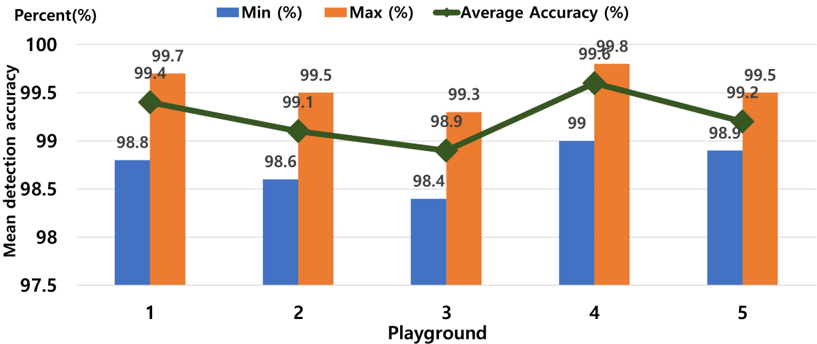
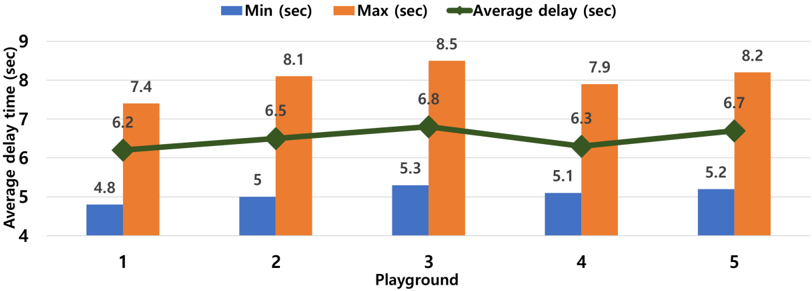
- In 30-day field validation at five playgrounds, average entrance/exit decision accuracy was 99.2%, with incorrect notifications about 0.8%; mean accuracy ranged from 98.9% (Playground 3) to 99.6% (Playground 4), all playgrounds achieved at least 98.8%, and the standard deviation was about 0.25%. Average detection delay was 6.5 s (SD 1.1 s), and push-delivery success exceeded 99%.
- Against a simple RSSI threshold baseline, the proposed method achieved entry Precision 1, Recall 0.989, F1 0.994 (TP 89, FP 0, FN 1) and exit Precision 1, Recall 1, F1 1 (TP 90, FP 0, FN 0); baseline entry F1 was 0.924 and exit F1 was 0.902.
- Proposed average entry/exit detection delays were 5.7/7.6 s in the apartment playground, 5.3/7.4 s in the neighborhood park playground, and 5.2/7.1 s in the kindergarten playground; 95th-percentile entry and exit events were detected within 10 s across all three environments.
- In the multi-beacon experiment with 10 participants and 40 entrance/exit events, 39 were correctly detected, 1 was missed due to a short exit/re-entry within 5 s, no false detections occurred, and total detection accuracy was 97.5%.
Methods
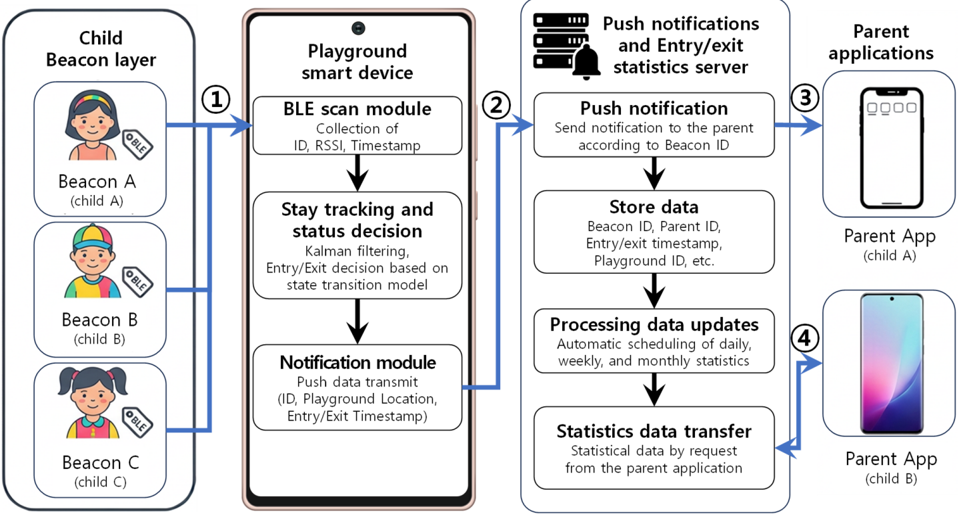
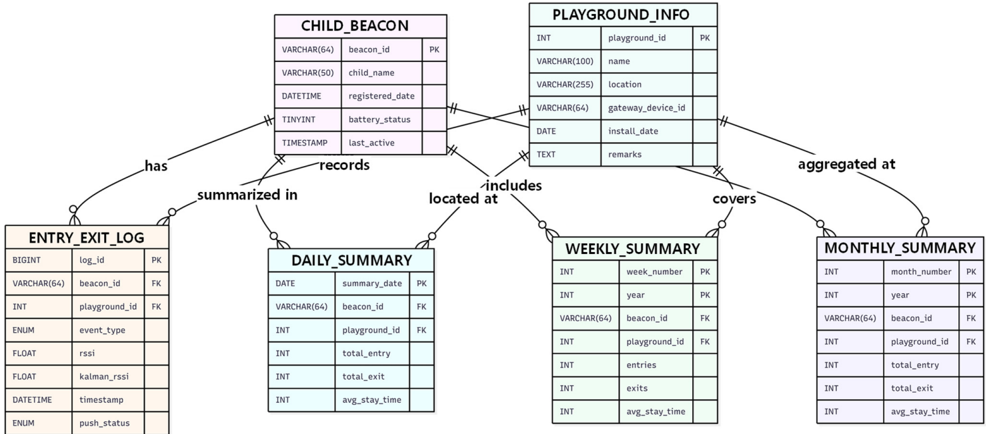
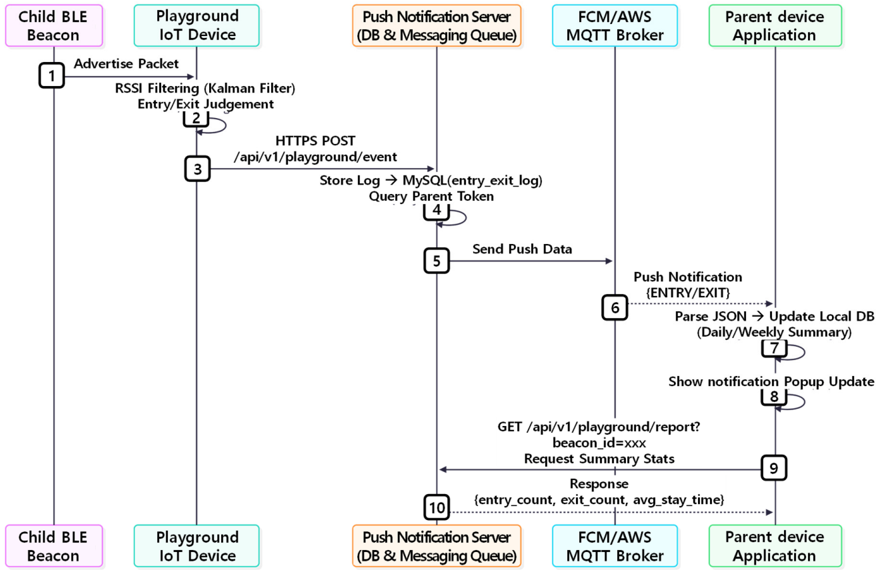
- The system uses commercial BLE beacons carried by children, a single smart device installed in the playground, a push-notification server, and a caregiver smartphone application. The smart device scans RSSI at 0.3 s intervals, applies Kalman-filter smoothing and a threshold/time-based state machine (S0–S3), sends JSON event data to the server, stores logs in MySQL 8.0, aggregates daily/weekly/monthly summaries, and delivers notifications via Firebase Cloud Messaging.
- Main field experiments were conducted at five playgrounds in apartment complexes in Incheon, Republic of Korea. At each playground, one Samsung Galaxy Note 20 Ultra and one test participant carrying one BLE beacon (Beacon E7 by B-Fon) repeatedly entered and exited over a 20 min session, with dwell time at least 5 min per visit, once per day for 30 days, using a shared Wi-Fi 2.4 GHz network.
- A simultaneous-beacon experiment used 10 participants, each carrying one BLE beacon, repeatedly entering and leaving a single playground for 20 min at random intervals with at least 5 min per visit; average entrances per participant was about two, yielding 40 total events. A separate detailed setup is also described with ten participants over 30 min and nine trials across three playgrounds.
Limitations
- The paper states that because the method relies on RSSI in semi-open environments, stability may be affected by weather variations; future experiments are planned under snow, rain, and temperature changes. Future work also includes TLS 1.3-based encryption and enhanced user authentication, implying current data protection is not fully detailed.
- The paper states data availability restrictions: data belong to the owner/operator and can be requested from the author. It also states the study did not require ethics approval because no personal, medical, or sensitive data were collected.
- Evident from the text: the main 30-day accuracy validation used a single test participant per playground, so simultaneous multi-child performance rests on a separate 10-participant test; that test missed one event due to re-entry within the 5 s hysteresis window. The system also uses a single BLE receiver/single smart-device configuration.
Model-written summary. Check it against the paper before relying on it.
Integrity signals
Registry
Cites
Statistics
Figures
Verification
Claims the paper makes
8 Valid · 1 Not valid · 21 Not checked · 60 Own results and interpretations
The cited sources support only part of this claim — read each source’s verdict below.
In the paper
“Semi-open spaces such as playgrounds within apartment complexes, daycare playgrounds, and neighborhood parks offer opportunities for physical and emotional development, yet they also introduce situations in which a child's location is temporarily unknown, and the risk of accidents or disappearance is elevated.”
§ Child Playground Entry/Exit Tracking and Log Visualization System Using BLE Beacons and Smart Devices > 1. Introduction
What the sources say
- Partly supportedcites [1] 1. Senthamilarasi, N.; Bharathi, N.D.; Ezhilarasi, D.; Sangavi, R.B. Child Safety Monitoring System Based on IoT. J. Phys. Conf. Ser. 2019, 1362, 012012. [CrossRef] sourceExperimental — accuracy not yet measured
The Abstract says parents cannot stay with their children all the time, and the Fig. 2: GPS section describes tracking a child's live location. These passages support the general concern that a child's whereabouts may be unknown, but they do not discuss semi-open spaces or the specified playgrounds and parks. Page numbers are unavailable in our copy. (LLM, conf=0.83)
- Not matchedcites [2] 2. Zainab, M. Child Safety Device with GPS Tracking and Alert Messaging. J. Sci. Res. Technol. 2025, 3, 194-200.
We searched by its title and found no matching paper.
plainstates a cause- Asserted: passes — The authors put it forward as true.
- Checkable: passes — It can be checked against evidence.
- Load-bearing: passes — The paper’s conclusions depend on it.
- Based: passes — The paper gives a reason why it holds.
- Partly supported
The cited sources support only part of this claim — read each source’s verdict below.
In the paper
“Semi-open spaces such as playgrounds within apartment complexes, daycare playgrounds, and neighborhood parks offer opportunities for physical and emotional development, yet they also introduce situations in which a child's location is temporarily unknown, and the risk of accidents or disappearance is elevated.”
§ Child Playground Entry/Exit Tracking and Log Visualization System Using BLE Beacons and Smart Devices > 1. Introduction
What the sources say
- Partly supportedcites [1] 1. Senthamilarasi, N.; Bharathi, N.D.; Ezhilarasi, D.; Sangavi, R.B. Child Safety Monitoring System Based on IoT. J. Phys. Conf. Ser. 2019, 1362, 012012. [CrossRef] sourceExperimental — accuracy not yet measured
The Abstract says children go missing and that parents cannot monitor them continuously; the GPS section describes tracking a child’s location and setting a boundary. These passages support a general concern about children’s whereabouts, but they do not discuss semi-open spaces or establish an elevated risk of accidents or disappearance in those settings. (LLM, conf=0.83)
- Not matchedcites [2] 2. Zainab, M. Child Safety Device with GPS Tracking and Alert Messaging. J. Sci. Res. Technol. 2025, 3, 194-200.
We searched by its title and found no matching paper.
plainstates a cause- Asserted: passes — The authors put it forward as true.
- Checkable: passes — It can be checked against evidence.
- Load-bearing: passes — The paper’s conclusions depend on it.
- Based: passes — The paper gives a reason why it holds.
- Partly supported
A result the paper reports from its own data — it cites no other source for it, so there is none to check. The quote shows it is in the paper.
In the paper
“As a result, it can be confirmed that the proposed method maintains Precision, Recall, and F1-scores of 0.95 or higher for both entry and exit event detection.”
- Also stated in: § Simultaneous beacon processing capability · boosted
“it can be confirmed that the proposed method maintains Precision, Recall, and F1-scores of 0.95 or higher for both entry and exit event detection.”
§ Child Playground Entry/Exit Tracking and Log Visualization System Using BLE Beacons and Smart Devices > Simultaneous beacon processing capability
boostedn = 10- Asserted: passes — The authors put it forward as true.
- Checkable: passes — It can be checked against evidence.
- Load-bearing: passes — The paper’s conclusions depend on it.
- Based: passes — The paper gives a reason why it holds.
- Rests on an assumption not shown here.
- Also stated in: § Simultaneous beacon processing capability · boosted
A result the paper reports from its own data — it cites no other source for it, so there is none to check. The quote shows it is in the paper.
In the paper
“Field experiments conducted at five real playgrounds showed that the proposed system achieved over 99% entrance/exit detection accuracy with an average response time of less than 7 s.”
§ Child Playground Entry/Exit Tracking and Log Visualization System Using BLE Beacons and Smart Devices > Abstract
plain- Asserted: passes — The authors put it forward as true.
- Checkable: passes — It can be checked against evidence.
- Load-bearing: passes — The paper’s conclusions depend on it.
- Based: passes — The paper gives a reason why it holds.
A result the paper reports from its own data — it cites no other source for it, so there is none to check. The quote shows it is in the paper.
In the paper
“The experimental results show that the proposed system achieves more than 99% detection accuracy with an average delay of less than 7 s, indicating that low-cost entrance/exit monitoring can be realized with minimal infrastructure in real semi-open playground settings.”
§ Child Playground Entry/Exit Tracking and Log Visualization System Using BLE Beacons and Smart Devices > 1. Introduction
plain- Asserted: passes — The authors put it forward as true.
- Checkable: passes — It can be checked against evidence.
- Load-bearing: passes — The paper’s conclusions depend on it.
- Based: passes — The paper gives a reason why it holds.
45 more claims
Create a free account to see all 90 claims and to verify the 5 references still open.
- Probably not a substantial claim. 26
- It may state two separate claims as one. 21
- The quote only partly states this claim. 2
Self-check
Percentages, sums and reported differences re-computed from the paper’s own numbers.
Each contradiction between two passages listed here was confirmed by an independent check.
Rated minor: it would not touch a result — a value no result rests on, a p-value that stays on the same side of the significance level, or a conflict that is clerical, resolved elsewhere in the paper, or outside its own findings.
In the paper
§ Child Playground Entry/Exit Tracking and Log Visualization System Using BLE Beacons and Smart Devices > 3. Design and Architecture of Child Playground Entry/Exit Tracking and Log Visualization System
“In practice, the minimum observed delay of 4 s resulted from the temporal buffer introduced to improve detection stability.”
§ Child Playground Entry/Exit Tracking and Log Visualization System Using BLE Beacons and Smart Devices > 5. Conclusions and Future Research
“| Apartment | Entry | Baseline Proposed | 4.1 5.7 | 3.2 2.1 | 0.5 1.2 | 18.3 8.8 | 9.8 6.3 |”
Rated minor: it would not touch a result — a value no result rests on, a p-value that stays on the same side of the significance level, or a conflict that is clerical, resolved elsewhere in the paper, or outside its own findings.
In the paper
§ Child Playground Entry/Exit Tracking and Log Visualization System Using BLE Beacons and Smart Devices > Simultaneous beacon processing capability
“Table 2 summarizes the statistical results for the detection delay of entry and exit events in the playground environments.”
§ Child Playground Entry/Exit Tracking and Log Visualization System Using BLE Beacons and Smart Devices > 5. Conclusions and Future Research
“Table: 2 Table 2 . Detection accuracy of entry and exit events.”
Rated minor: it would not touch a result — a value no result rests on, a p-value that stays on the same side of the significance level, or a conflict that is clerical, resolved elsewhere in the paper, or outside its own findings.
In the paper
§ Child Playground Entry/Exit Tracking and Log Visualization System Using BLE Beacons and Smart Devices > •
“Exit candidate (S3): When the RSSI drops sharply or the beacon signal is not received for 3 s or longer, the child is regarded as leaving the playground, and the state changes to S3.”
§ Child Playground Entry/Exit Tracking and Log Visualization System Using BLE Beacons and Smart Devices > 5. Conclusions and Future Research
“| Exit candidate/exit | S3 | RSSI < -78 dBm for ≥3 s or no signal for ≥5 s |”
Citations
Cites
Effects of Temperature and Humidity on Radio Signal Strength in Outdoor Wireless Sensor Networks
Luomala, J., & Hakala, I. (2015) · Annals of Computer Science and Information Systems · doi:10.15439/2015f241 · Cited by 162 · cited 1×
“The propagation behavior of BLE signals in semi-open outdoor environments has been analyzed as well, with models that capture the impact of weather, humidity, and obstacles on RSSI attenuation, providing a foundation for more robust tracking in dynamic playground-like spaces [12].”
Giordano, M., Baumann, N., Crabolu, M., Fischer, R., Bellusci, G., & Magno, M. (2022) · IEEE Transactions on Instrumentation and Measurement · doi:10.1109/tim.2022.3165816 · Cited by 72 · cited 1×
“Lightweight convolutional neural networks have also been proposed to support behavior monitoring under strict power budgets, allowing continuous operation below a few watts [19].”
Ezzati Khatab, Z., Hajihoseini Gazestani, A., Ghorashi, S. A., & Ghavami, M. (2021) · Signal Processing · doi:10.1016/j.sigpro.2020.107915 · Cited by 44 · cited 1×
“Furthermore, context-aware and semi-supervised calibration methods have been developed to adapt BLE ranging models to changing playground environments and to improve accuracy even when labeled training data are limited [22,23].”
Child Safety Monitoring System Based on IoT
Senthamilarasi, N., Bharathi, N. D., Ezhilarasi, D., & Sangavi, R. B. (2019) · Journal of Physics: Conference Series · doi:10.1088/1742-6596/1362/1/012012 · Cited by 27 · cited 1×
“These challenges are typical in urban living environments and highlight the need for technical support that can efficiently monitor a child’s movement and rapidly detect potentially dangerous situations [1,2].”
Combining Multichannel RSSI and Vision with Artificial Neural Networks to Improve BLE Trilateration
Naghdi, S., & O’Keefe, K. (2022) · Sensors · doi:10.3390/s22124320 · Cited by 23 · cited 1×
“…work has introduced AI-enhanced pipelines that fuse BLE RSSI data with vision-based models, such as transformer architectures, to classify children’s activity patterns and identify spatio-temporal risk behaviors, moving from simple location tracking toward more cognitive safety management [16].”
An Improved Authentication Scheme for BLE Devices with No I/O Capabilities
Gupta, C., & Varshney, G. (2023) · Computer Communications · doi:10.1016/j.comcom.2023.01.001 · Cited by 21 · cited 1×
“Privacy-preserving communication mechanisms, including Diffie–Hellman-based encryption and anonymization for children’s IoT devices, have been integrated into BLE protocols to protect sensitive location data [21].”
Autonomous Navigation Systems in GPS-Denied Environments: A Review of Techniques and Applications
Alghamdi, S., Alahmari, S., Yonbawi, S., Alsaleem, K., Ateeq, F., & Almushir, F. (2025) · 2025 11th International Conference on Automation, Robotics, and Applications (ICARA) · doi:10.1109/icara64554.2025.10977619 · Cited by 20 · cited 1×
“GPS tracking also tends to require higher power consumption and recurring communication costs, which can be limiting factors for low-cost, always-on monitoring systems [3].”
Intelligent Child Safety System using Machine Learning in IoT Devices
Srinivasan, A., Abirami, S., Divya, N., Akshya, R., & Sreeja, B. S. (2020) · 2020 5th International Conference on Computing, Communication and Security (ICCCS) · doi:10.1109/icccs49678.2020.9277136 · Cited by 17 · cited 1×
“Other studies have employed IoT sensor data with AI models to automatically detect abnormal or risky behavior patterns and trigger immediate alerts to caregivers [14].”
Viability Characterization of a Proof-of-Concept Bluetooth Mesh Smart Building Application
Eras, L., Domínguez, F., & Martinez, C. (2022) · International Journal of Distributed Sensor Networks · doi:10.1177/15501329221097819 · Cited by 15
WLAN-BLE Based Indoor Positioning System using Machine Learning Cloud Services
Teran, M., Carrillo, H., & Parra, C. (2018) · 2018 IEEE 2nd Colombian Conference on Robotics and Automation (CCRA) · doi:10.1109/ccra.2018.8588127 · Cited by 14 · cited 1×
“For example, prior work has combined BLE and Wi-Fi signals to improve tracking performance in mixed indoor–outdoor environments and mitigate the weaknesses of single-technology approaches [5].”
A Low-Cost Tracking System for Running Race Applications Based on Bluetooth Low Energy Technology
Perez-Diaz-de-Cerio, D., Hernández-Solana, Á., Valdovinos, A., & Valenzuela, J. (2018) · Sensors · doi:10.3390/s18030922 · Cited by 10 · cited 1×
“Beacon configuration and deployment strategies have also been studied, including adaptive power-control schemes that balance tracking precision and energy efficiency across dense IoT deployments [10].”
Sakphrom, S., Suwannarat, K., Haiges, R., & Funsian, K. (2021) · Informatics · doi:10.3390/informatics8040065 · Cited by 10 · cited 1×
“Furthermore, context-aware and semi-supervised calibration methods have been developed to adapt BLE ranging models to changing playground environments and to improve accuracy even when labeled training data are limited [22,23].”
Improved Child Safety Using Edge-Fog-Cloud Enabled Smart IoT Wearable Device: An Architecture
Agrawal, N., Kumar, R., & Tapaswi, S. (2024) · 2024 16th International Conference on COMmunication Systems & NETworkS (COMSNETS) · doi:10.1109/comsnets59351.2024.10427466 · Cited by 7 · cited 1×
“Cloud-integrated dashboards have also been designed to visualize per-child location logs and reduce the cognitive burden on parents by presenting concise summaries rather than raw event streams [15].”
Enhanced Deep Learning-Aided Kalman Filter Based on KalmanNet for Robust Nonlinear State Estimation
Fu, T., Mao, G., Wang, Z., & Wang, K. (2026) · IEEE Internet of Things Journal · doi:10.1109/jiot.2026.3672319 · Cited by 6
BLE-based Indoor Positioning Platform Utilizing Edge Tiny Machine Learning
Avellenada, D., Mendez, D., & Fortino, G. (2022) · 2022 IEEE Intl Conf on Dependable, Autonomic and Secure Computing, Intl Conf on Pervasive Intelligence and Computing, Intl Conf on Cloud and Big Data Computing, Intl Conf on Cyber Science and Technology Congress (DASC/PiCom/CBDCom/CyberSciTech) · doi:10.1109/dasc/picom/cbdcom/cy55231.2022.9927866 · Cited by 5 · cited 1×
“To mitigate these issues, edge-centric architectures have been explored, in which preliminary filtering and aggregation are performed on local nodes to reduce response times and offload the cloud [17,18].”
BLEdge: Edge-Centric Programming for BLE Applications with Multi-Connection Optimization
Li, Y., Li, B., Lv, J., & Dong, W. (2024) · ACM Transactions on Sensor Networks · doi:10.1145/3698201 · Cited by 4
Ja'afar, A. S., Suseenthiran, K., Saipullah, K. M., Aziz, M. Z. A. A., Khang, A. W. Y., & Salleh, A. (2023) · Indonesian Journal of Electrical Engineering and Computer Science · doi:10.11591/ijeecs.v30.i2.pp972-981 · Cited by 3
Child Safety Monitoring Using a Smart IoT Bracelet
Bai, K. R., & M, S. Y. (2025) · 2025 IEEE International Conference on Emerging Trends in Computing and Communication (ETCOM) · doi:10.1109/etcom66606.2025.11437330 · Cited by 1
Real-Time Alert Service for Infant Location Management Using Beacon Technology
(2020) · The Journal of the Korea institute of electronic communication sciences · doi:10.13067/jkiecs.2020.15.1.205 · Cited by 1
Mallick, N., Nanda, H., Sahu, S., Pattnayak, P., Mohanty, A., & Das, T. (2026) · 2026 IEEE International Conference on Interdisciplinary Approaches in Technology and Management for Social Innovation (IATMSI) · doi:10.1109/iatmsi68868.2026.11466166
Investigation for Applicability of Bluetooth Mesh Networking in Underground Space
(2019) · Tunnel and Underground Space · doi:10.7474/tus.2019.29.6.367
An Improved Authentication Scheme for Ble Devices with No I/O Capabilities
Gupta, C., & Varshney, G. (2022) · doi:10.2139/ssrn.4132290
Research works printed but not linked: 3
- 2. Zainab, M. Child Safety Device with GPS Tracking and Alert Messaging. J. Sci. Res. Technol. 2025, 3, 194-200.
- 4. Orujov, F.; Maskeli ūnas, R.; Damaševičius, R. FUZIPS: Fuzzy v2 Based Algorithm for Automatic Switching from GPS Based Location Services to the Indoor Positioning Service. In Recent Developments and the New Direction in Soft-Computing Foundations and Applications;
- 5. Aliev, R.A., Pedrycz, W., Kacprzyk, J., Eds.; Springer International Publishing: Cham, Switzerland, 2020; Volume 318, pp. 373-383. [CrossRef]
Metadata
- Authors
- Chung, M.
- Affiliations
- Sungkyul University (KR)
- Corresponding author
- Chung, Myoungbeom
- ORCID
- Chung, Myoungbeom
- Venue
- Signals
- Publisher
- MDPI AG
- Published
- 2026-07-10
- Volume
- 7
- Issue
- 4
- Pages
- 67
- ISSN
- 2624-6120 (ISSN-L)
- OpenAlex
- W7167943535
- Cited by
- 0
- References
- 16
- FWCI
- 0.00
- Type
- journal article
- Language
- en
- Open access
- gold
- doi.org
- Licence
- Locations
- Signals (publishedVersion, cc-by)
- DOAJ (DOAJ: Directory of Open Access Journals) (submittedVersion)
- Topics
- Physical Sciences › Engineering › Electrical and Electronic Engineering › Indoor and Outdoor Localization Technologies
- Physical Sciences › Computer Science › Computer Networks and Communications › Bluetooth and Wireless Communication Technologies
- Physical Sciences › Computer Science › Computer Networks and Communications › RFID technology advancements
- Keywords
- playground safety, child supervision, BLE beacons, received signal strength indicator, Kalman filter smoothing, push notifications, low-cost monitoring system
About these checks
Registry, retraction, Cites and statistics results are computed, not judged, with one exception: a printed reference that no index lists is read once by a model before it counts as a citation error. Claims are extracted by a model and kept only when their quote appears verbatim in the text; each cited source is then checked, with a model’s help, for whether it says what the claim relies on. Those verdicts can be wrong — read the claim’s quote and the cited source before relying on one.
The claim verdicts this report counts are experimental: their accuracy is not yet measured.
A language model drew the claims from the paper on 2026-10-11, under version 3 of the claim definition (model deepseek-v4.1-flash, prompt extract-v3).
A second model labelled each claim on 2026-10-11 (model jev-1.13-20260917, definition revision gold-guideline-v0.2).
Cited sources are checked with a language model’s help (gpt-6-sol).
Statistics and arithmetic are recomputed, not judged.
Confidence bands are shown only for fields calibrated on our annotated test set. None is calibrated yet, so no band is shown.
What counts as a claim ›How we measure confidence ›How we check this ›
Are you an author, or do you see a problem with this page? Request a review
Data sources
Bibliographic data: Semantic Scholar, OpenAlex, Crossref.
Contains information from the Semantic Scholar Academic Graph Datasets, made available under the ODC Attribution License (ODC-BY 1.0).
Semantic Scholar’s data is described in: Kinney, R., et al. (2023). The Semantic Scholar Open Data Platform. arXiv:2301.10140.
