

From Transition to Domains of Transformation: Getting to Sustainable and Just Food Systems through Agroecology
Open accessThe DOI matches its Crossref record; 126 of the 126 references it cites were found in a registry or an index.
Abstract
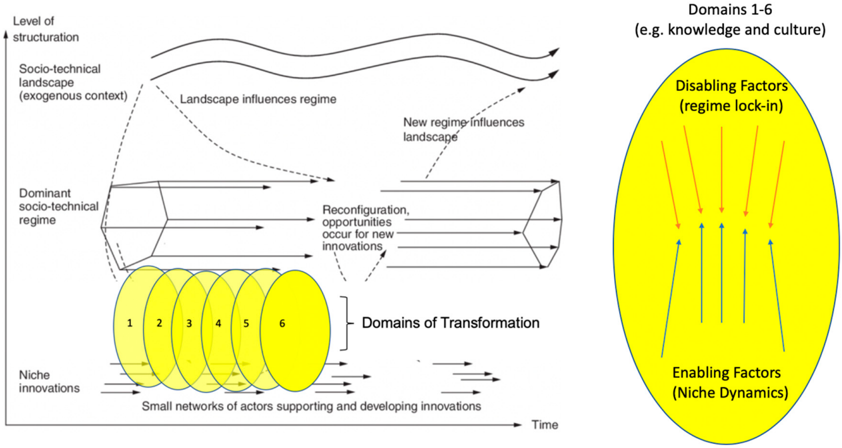
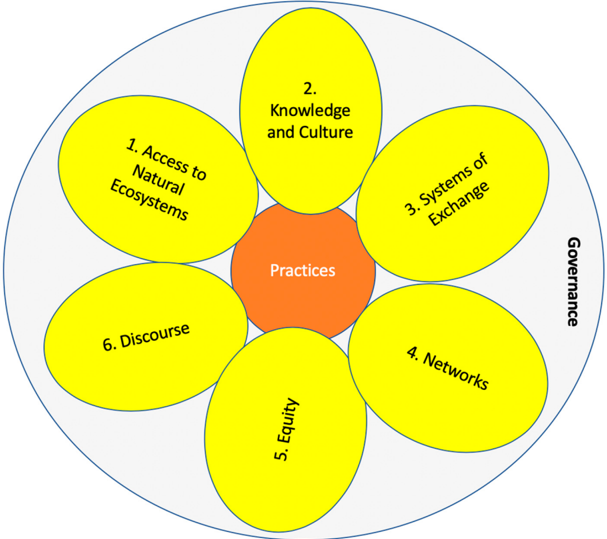
The acceleration of ecological crises has driven a growing body of thinking on sustainability transitions. Agroecology is being promoted as an approach that can address multiple crises in the food system while addressing climate change and contributing to the Sustainable Development Goals. Beyond the more technical definition as, “the ecology of food systems”, agroecology has a fundamentally political dimension. It is based on an aspiration towards autonomy or the agency of networks of producers and citizens to self-organize for sustainability and social justice. In this article, we use the multi-level perspective (MLP) to examine agroecology transformations. Although the MLP has been helpful in conceptualizing historic transitions, there is a need to better understand: (a) the role of and potential to self-organize in the context of power in the dominant regime, and (b) how to shift to bottom-up forms of governance—a weak point in the literature. Our review analyzes the enabling and disabling conditions that shape agroecology transformations and the ability of communities to self-organize. We develop the notion of ‘domains of transformation’ as overlapping and interconnected interfaces between agroecology and the incumbent dominant regime. We present six critical domains that are important in agroecological transformations: access to natural ecosystems; knowledge and culture; systems of exchange; networks; discourse; and gender and equity. The article focuses on the dynamics of power and governance, arguing that a shift from top down technocratic approaches to bottom up forms of governance based on community-self organization across these domains has the most potential for enabling transformation for sustainability and social justice.
Overview
The claims and statistics of this paper haven’t been checked yet.
Free: it reads the open-access text and checks the first 5 claims that cite a source we can check. Create a free account to check every claim.
Integrity signals
Registry
Cites
Statistics
Figures
Verification
Claims the paper makes
The claims and statistics of this paper haven’t been checked yet.
Free: it reads the open-access text and checks the first 5 claims that cite a source we can check. Create a free account to check every claim.
Claims other papers make about this one
Each is checked against this paper’s own text: does it say what the citing paper says it does?
The source backs part of the claim, not all of it — or backs it for a different population, condition or comparison.
In the citing paper
“Engaging in on-farm experiments, however, challenges current scientific approaches such as dealing with variability of farmer management, requiring more frequent communication between researchers and farmers, and maybe also different cross-disciplinary analytical tools (González-Sánchez et al. 2012, Anderson et al. 2019a).”
From A heuristic framework to portray agroecological transition initiatives in reflexive arrangements, illustrated with a conservation agriculture network in Denmark (2025) · cites this paper as Anderson et al. 2019a
Experimental — accuracy not yet measuredThe cited source says what the claim attributes to it.
In the citing paper
“Social networks mediate agroecological transitions by acting as conduits of information, collaboration, and material resources (see review in Anderson et al. 2019a).”
From A heuristic framework to portray agroecological transition initiatives in reflexive arrangements, illustrated with a conservation agriculture network in Denmark (2025) · cites this paper as Anderson et al. 2019a
The cited source says what the claim attributes to it.
In the citing paper
“This focus on horizontal knowledge structures through a facilitative and participatory advisory approach was distinct from the dominant centralized knowledge production and top-down knowledge diffusion (Anderson et al. 2019a).”
From A heuristic framework to portray agroecological transition initiatives in reflexive arrangements, illustrated with a conservation agriculture network in Denmark (2025) · cites this paper as Anderson et al. 2019a
The cited source says what the claim attributes to it.
In the citing paper
“Such an advisory approach strengthens horizontal knowledge structures (Anderson et al. 2019a, Bourne et al. 2021) and enhances the development of farmer skills to solve complex problems arising in their specific context (Cristofari et al. 2017, Charatsari et al. 2019, Bourne et al. 2021, Krafft et al. 2022), which makes it more effective (Ataei et al. 2019, Anderson et al. 2019a).”
From A heuristic framework to portray agroecological transition initiatives in reflexive arrangements, illustrated with a conservation agriculture network in Denmark (2025) · cites this paper as Anderson et al. 2019a
The cited source says what the claim attributes to it.
In the citing paper
“This is not surprising since, according to Anderson et al. (2019), access to natural resources is one of the main lock-ins to the wide-scale use of agroecological practices.”
From Scenarios for an agroecological transition of smallholder family farmers: a case study in Guadeloupe (2022) · cites this paper as Anderson et al. (2019)
2 more claims about this paper
Create a free account to see every claim other papers make about this one.
Self-check
Percentages, sums and reported differences re-computed from the paper’s own numbers.
The self-check needs the paper’s full text.
Citations
Cites
Governing the Commons: The Evolution of Institutions for Collective Action
Ostrom, E. (1990) · doi:10.1017/cbo9780511807763 · Cited by 20,653
Governing the Commons: The Evolution of Institutions for Collective Action
Field, B. C., & Ostrom, E. (1992) · Land Economics · doi:10.2307/3146384 · Cited by 18,859
(1976) · Cited by 10,813
Framing Processes and Social Movements: An Overview and Assessment
Benford, R. D., & Snow, D. A. (2000) · Annual Review of Sociology · doi:10.1146/annurev.soc.26.1.611 · Cited by 9,953 · cited 5×
“Given the dynamic and contested framing of agroecology, discourse on agroecology is in constant flux, and these fluid framing processes influence the direction of the agroecological transition, and the capacity of communities to self-organize and shape agroecological transformations [136,137].”
BackgroundInfluentialTypology of sociotechnical transition pathways
Geels, F. W., & Schot, J. (2007) · Research Policy · doi:10.1016/j.respol.2007.01.003 · Cited by 5,245 · cited 4×
“We then introduce the multi-level perspective—an influential framework for analyzing sustainability transitions [17,18].”
BackgroundInfluentialSustainability transitions: An emerging field of research and its prospects
Markard, J., Raven, R., & Truffer, B. (2012) · Research Policy · doi:10.1016/j.respol.2012.02.013 · Cited by 3,763 · cited 2×
“The regime level involves, “established practices and associated rules that stabilize existing systems” [17,26] where alignments and interdependencies across regime dimensions generate processes of path-dependency or ‘lock-in’ that enable stability and preserve the status quo.”
BackgroundThe multi-level perspective on sustainability transitions: responses to seven criticisms
Geels, F. W. (2011) · Environmental Innovation and Societal Transitions · doi:10.1016/j.eist.2011.02.002 · Cited by 3,092 · cited 3×
“We then introduce the multi-level perspective—an influential framework for analyzing sustainability transitions [17,18].”
BackgroundThe Politics of the Earth: Environmental Discourses
Dryzek, J. S. (1997) · Cited by 3,013
An agenda for sustainability transitions research: State of the art and future directions
Köhler, J., Geels, F. W., Kern, F., Markard, J., Onsongo, E., Wieczorek, A., Alkemade, F., Avelino, F., Bergek, A., Boons, F., et al. (2019) · Environmental Innovation and Societal Transitions · doi:10.1016/j.eist.2019.01.004 · Cited by 2,800 · cited 1×
“Whereas power and governance are not typically the central focus in the sustainability transitions literature [27], our approach is based on the assumption that any transformative system’s change will require an analysis of power and governance.”
BackgroundThe number, size, and distribution of farms, smallholder farms, and family farms worldwide
Lowder, S. K., Skoet, J., & Raney, T. (2016) · World Development · doi:10.1016/j.worlddev.2015.10.041 · Cited by 2,012 · cited 1×
“In addition, processes of land fragmentation and declining average farm size in most of the world’s less industrialized countries over the past several decades are undermining agroecology [56].”
Background
Research works printed but not linked: 6
- 76. Petersen, P.F. Arreglos Institucionales Para la Intensificación Agroecológica. Una Mirada al Caso Brasileño Desde la Agroecología Política. Ph.D. Thesis, Universidad de Pablo de Olavide, Sevilla, Spain, 2017.
- 87. Rivera Ferre, M.; Álvare, I. From a Market Approach to the Centrality of Life: An Urgent Change for Women; Right to Food and Nutrition Watch; Global Network for the Right to Food and Nutrition: Vienna, Austria, 2017; pp. 36-41.
- Campeau, 2018, Equity, equality and non-discrimination to guide food-system reform, UNSCN-News, 45, 7
- Mora, 2018, Inequality and malnutrition, UNSCN-News, 45, 15
- 2014, There will be no agroecology without feminism. The Brazilian case, Sustentabilidade em Debate, 5, 76
- Loconto, 2019, Defining agroecology, Int. J. Sociol. Agric. Food, 25, 116
Cited by
Items 201–300 of 374
Dagoudo, B. A., Ssekyewa, C., Ssekandi, J., Ngom, K., Naigaga, H., Moumouni-Moussa, I., & Noba, K. (2024) · Discover Agriculture · doi:10.1007/s44279-024-00047-w · Cited by 6
“Agroecology as a science focuses on diversity, efficiency synergies, recycling, and resilience [18, 20–23] as criteria to assess health, ecology, fairness, and care in organic farming.”
Sarku, R., Tauzie, M., & Whitfield, S. (2023) · Frontiers in Sustainable Food Systems · doi:10.3389/fsufs.2022.1033152 · Cited by 5
“Such perspectives arguably pay less attention to the issues of politics and power, but can also be somewhat blind to micro-level, autonomous and ad-hoc process of bottom-up change (Anderson et al., 2019).”
BackgroundPelman, A., de Vries, J. W., Tepper, S., Eshel, G., Carmel, Y., & Shepon, A. (2024) · PLOS Sustainability and Transformation · doi:10.1371/journal.pstr.0000066 · Cited by 6
Houde-Tremblay, É., Cloutier, G., McClintock, N., & Olivier, A. (2025) · Agriculture and Human Values · doi:10.1007/s10460-024-10700-1 · Cited by 5
“New municipalism potentially opens the door to policymaking at scales identified as “critical” by agroecology scholars (Anderson et al. 2019), while calling into question what local and territorial governance is and can be.”
How To Normatively Transform Food Systems: Propositions of a Holistic Framework of Politics
Abdulai, A., & Béné, C. (2025) · Cambridge University Press eBooks · doi:10.1017/9781009509633 · Cited by 4
Building movements for transformation : defending and advancing agroecology in Brazil
van den Berg, L. (2020) · doi:10.18174/531633 · Cited by 7
Cassart, P., Frei, A., Hauggaard-Nielsen, H., Kruse Rasmussen, H., Swartebroeckx, A., Froidmont, E., Stilmant, D., & Rossing, W. (2025) · Ecology and Society · doi:10.5751/es-15770-300210 · Cited by 4
Gutiérrez-Briceño, I., Pérez‐Ramírez, I., Ochoa, C. Y., Lucantoni, D., Vizuete, B., Hevia, V., González, J. A., Schwarz, G., & García-Llorente, M. (2025) · International Journal of Agricultural Sustainability · doi:10.1080/14735903.2025.2551423 · Cited by 8
“However, agroecology transcends farming practices, intertwined with political dimensions and commitment to social activism (Anderson et al., 2019).”
InfluentialVillalba‐Eguiluz, U., & Barona, C. C. (2025) · Current Research in Environmental Sustainability · doi:10.1016/j.crsust.2025.100308 · Cited by 5
Ujj, A., Pércsi, K. N., Ramos-Diaz, F., Marjanović, J., Horstink, L., Queiroga-Bento, R., Mukosha, C. E., Moudrý, J., Györke, D. K., & Jancsovszka, P. (2025) · Agriculture · doi:10.3390/agriculture15232414 · Cited by 8
Anderson, C., Ferrando, T., Blay‐Palmer, A., Espinosa-García, F. J., Cabral, L., Termine, P., Wilkes, J., Soma, T., Bhalla, G., Madzorera, I., et al. (2025) · Agroecology and Sustainable Food Systems · doi:10.1080/21683565.2025.2588252 · Cited by 6
“This failure has led to growing calls for a new paradigm to transform food systems (Anderson et al. 2019; HLPE 2020; Ingram and Thornton 2022; Zurek et al. 2022).”
Self-citationYap, C., & Treuherz, S. (2025) · Local Environment · doi:10.1080/13549839.2025.2467865 · Cited by 4
“However, it falls short of the more socially and ecologically sensitive conceptions of place and territory that exist beyond public policy jurisdictions or bounded spatial categories (Anderson et al. 2019; Forster and Mattheisen 2016; Sonnino, Marsden, and Moragues-Faus 2016).”
Elton, S., Dipieri, M., & Cole, D. C. (2025) · Journal of Agriculture Food Systems and Community Development · doi:10.5304/jafscd.2025.142.010 · Cited by 5
Rudolph, M. J., & Zenda, M. (2025) · Frontiers in Sustainable Food Systems · doi:10.3389/fsufs.2025.1519382 · Cited by 7
Impact of agroecological practices on farm performance in Botswana
Selelo, O. T., Danso-Abbeam, G., & Ogundeji, A. A. (2024) · Renewable Agriculture and Food Systems · doi:10.1017/s1742170524000036 · Cited by 5
“Agroecology is the integration of several sectors into one ’ s efforts to improve the sustainability of the food system (Anderson et al., 2019; Aare et al., 2021).”
BackgroundRutting, L., Veeger, M., Randolph von Breymann, F., Garcia, U., Sancir, N., Calel, S., Canek, F., Suyuk, M., & Vervoort, J. (2024) · Current Research in Environmental Sustainability · doi:10.1016/j.crsust.2024.100270 · Cited by 4
Farmer movement oversight of the Mexican Government’s scaled-up fertilizer program
Fox, J., & Jiménez, C. G. (2025) · Agroecology and Sustainable Food Systems · doi:10.1080/21683565.2024.2448564 · Cited by 8
“The sustainability transitions literature deploys a different kind of multi-level perspective, understood in terms of the “socio-technical landscape” (Anderson et al. 2019, 3).”
Ocampo, S. D., Hegwood, M., BECERRA, A. D. R., Rodríguez-Pinilla, J. P., & Newton, P. (2025) · Agriculture and Human Values · doi:10.1007/s10460-024-10685-x · Cited by 6
“Many researchers in the last two decades have explored how interventions aimed at changing perspectives, world-views, and/or epistemic fundamentals can change food system structures (e.g., Abson et al. 2017; Anderson et al. 2019; Meadows 1999).”
InfluentialSpring, C., Temmer, J., Skinner, K. A., Simba, M., Chicot, L., & Spring, A. (2025) · Conservation · doi:10.3390/conservation5010013 · Cited by 8
“Its principles foreground cultural and bio-ecological relationships between places, people, and food; use of appropriate technology; and political-economic arrangements that foster just and sustainable livelihoods and territorial sovereignty [29,30].”
Gimovski, F., & de Oliveira, C. M. R. (2025) · Agroecology and Sustainable Food Systems · doi:10.1080/21683565.2025.2549021 · Cited by 5
“The risk is that sustainability becomes measured by external metrics, reducing living communities to quantifiable benchmarks and stripping their practices of meaning and political agency (Anderson et al. 2019).”
Anderson, C., Bruil, J., Chappell, M. J., Kiss, C., & Pimbert, M. P. (2020) · Springer eBooks · doi:10.1007/978-3-030-61315-0_1 · Cited by 4
“In 2019, we published snippets of our findings, for example in an article in the journal Sustainability and as a ‘backgrounder’ (Anderson et al. 2019).”
MethodSelf-citationCoudel, É., Nasuti, S., Silva, D. W., Bonnet, M., da Silva, M. P., dos Santos, B. A., Folhes, R. T., Bonnal, V., Fechine, V., Lima, D., et al. (2021) · VertigO · doi:10.4000/vertigo.33716 · Cited by 8
Seed commodification and contestation in US farmer seed systems
Isbell, C., Tobin, D., Mares, T., & Jones, K. (2024) · Renewable Agriculture and Food Systems · doi:10.1017/s174217052400019x · Cited by 3
“As Anderson et al. (2019) discuss in support of agroecology, food system transformation requires a paradigmatic shift in the way that food (and seed) is exchanged, valued, and governed – tasks that cannot and should not be left to the private sector.”
Nunes, K., & Lamine, C. (2024) · Journal of Rural Studies · doi:10.1016/j.jrurstud.2024.103488 · Cited by 4
Gallego, D. O., & Córdoba, D. (2025) · Agroecology and Sustainable Food Systems · doi:10.1080/21683565.2025.2538143 · Cited by 5
Orounladji, B. M., Sib, O., Kouakou, P. K., Darmaun, M., Sanogo, S., & Vall, É. (2025) · Frontiers in Sustainable Food Systems · doi:10.3389/fsufs.2025.1657011 · Cited by 4
Biot, N., Hecquet, C., Maréchal, K., Lobet, G., & Dendoncker, N. (2025) · Agroecology and Sustainable Food Systems · doi:10.1080/21683565.2025.2597006 · Cited by 4
“Additional place-based research, examining the distinct differences and challenges related to farmers’ distribution channels, can provide valuable insights for evaluating the viability of such agroecological farms (Mundler and Rumpus 2012; Anderson et al. 2019; Maréchal et al. 2019).”
Agroecological transition assessment frameworks: a critical scoping review
Sean, C., Peeters, A., Blundo-Canto, G., Antoine‐Moussiaux, N., & Lassois, L. (2026) · Frontiers in Sustainable Food Systems · doi:10.3389/fsufs.2025.1703907 · Cited by 7
Averbuch, B., Stone, T. F., Sandén, T., Schwarz, G., Thorsøe, M. H., Bindelle, J., Boeraeve, F., Cassart, P., Dalgaard, T., Dumont, B., et al. (2026) · Frontiers in Sustainable Food Systems · doi:10.3389/fsufs.2026.1762693 · Cited by 4
Building capacities in regional food systems: mapping change towards transformation
Blay‐Palmer, A., Anderson, M. D., Aunio, A., Ballamingie, P., Carey, R., Gudu, S. O., Mullinix, K., Murphy, M., Pulasinghage, C., Spring, A., et al. (2026) · Agriculture and Human Values · doi:10.1007/s10460-025-10840-y · Cited by 3
“…and aggregate nested alternative systems within and across human and eco-systems that result in impacts across multiple food sys-tem capacities (Spring et al. 2018; Pereira et al. 2020 ; Hipel et al. 2010; Hinrichs 2014 ; Anderson et al. 2019 ; Felici and Mazzocchi 2022 ; Leeuwis et al. 2021).”
Typology and social network of grassroots initiatives that promote agroecology in Mexico
González, C. F., Garza, H. N., Espinoza, J. F. N., Aguilar, M. Á. E., Pérez-Olvera, M. A., & Bellon, S. (2023) · Agroecology and Sustainable Food Systems · doi:10.1080/21683565.2023.2253760 · Cited by 5
“These issues are context and language situated in their sociodemographic, cultural, and environmental context (Anderson et al. 2019).”
BackgroundMethodInfluentialPathways for Agroecological Transitions
Tittonell, P. A. (2023) · Springer eBooks · doi:10.1007/978-3-031-42939-2_10 · Cited by 3
Luna, A. G., Anderzén, J., Gonzalez, D. L., Méndez, V. E., & Ferguson, B. G. (2025) · Elementa Science of the Anthropocene · doi:10.1525/elementa.2024.00040 · Cited by 7
An agroecological turn in intermediating sustainability transitions with continuous living cover
Conway, T. M. (2023) · Frontiers in Sustainable Food Systems · doi:10.3389/fsufs.2023.1009195 · Cited by 4
“It remains undetermined as to whether CLC agriculture can be described as agroecological in the more political understanding of the term as a transformative process that centers power, governance, and democracy (Anderson et al., 2019).”
BackgroundGarcía, D. L., Vázquez-Macías, G., García-Fernández, J., Schmitt, M., Ortega-Faura, P., & Espluga, J. (2023) · Sustainability · doi:10.3390/su151310091 · Cited by 6
Reflections on research agendas in agroecology: In search of a practical guide
Perfecto, I., & Vandermeer, J. H. (2024) · Journal of Agriculture Food Systems and Community Development · doi:10.5304/jafscd.2024.133.006 · Cited by 3
“Other studies have shown that improved gender equity can result in improved nutritional outcomes, higher use of agri-biodiversity, and other aspects of agroecol-ogy (Anderson et al., 2019).”
BackgroundHolligan, B., & Howe, H. R. (2024) · Elementa Science of the Anthropocene · doi:10.1525/elementa.2023.00082 · Cited by 4
Tremembé, L., Tremembé, M., & Bowness, E. (2025) · AlterNative An International Journal of Indigenous Peoples · doi:10.1177/11771801251369560 · Cited by 4
“…deliver on goals for social justice related to food, proponents of agroecology must still navigate tensions and disparities in knowledge systems (Anderson et al., 2019), primarily because in settler colonial contexts, settler knowledge is prioritized at the expense of Indigenous and other ways…”
Blandi, M. L., Gargoloff, N. A., Iermanó, M. J., Paleologos, M. F., & Sarandón, S. J. (2021) · Revista de Economia e Sociologia Rural · doi:10.1590/1806-9479.2021.233521 · Cited by 5
Khalatbari, A. (2024) · Preprints.org · doi:10.20944/preprints202407.1525.v1 · Cited by 3
Rising Climate Risk and Loss and Damage to Coastal Subsistence-oriented LivelihoodsPreprint
Maina, J. M., Asamoah, E. F., D'Agata, S., GAMOYO, M., RAKOTO, P., GEORGE, R., OCHIEWO, J., JUIZO, D., & Bosire, J. O. (2023) · Research Square · doi:10.21203/rs.3.rs-3583708/v1 · Cited by 5
Baur, P., Jennings, R., Aliu, S., Calo, A. J., Farhangi, M., He, Y., Kanki, K., Koch, A.-K., Kiyoyama, Y., Martin, M. A., et al. (2025) · Frontiers in Sustainable Food Systems · doi:10.3389/fsufs.2025.1653448 · Cited by 4
Shemshad, M., Klimek‐Kopyra, A., Kopyra, M., & Szpunar-Krok, E. (2026) · Agriculture · doi:10.3390/agriculture16040477 · Cited by 2
“…loss, soil degradation, greenhouse gas emissions, and ecosystem service disruption [14,15] have prompted the FAO to emphasize environmentally safe pest management alternatives and to frame agroecology as a holistic, people-centered pathway toward sustainable agriculture and food systems [4,16,17].”
Nichols, C. E., & Kumari, N. (2026) · The Journal of Peasant Studies · doi:10.1080/03066150.2026.2643200 · Cited by 3
Starting points of agroecological transitions in Africa: Why and how farm structure matter
Girard, P., Mercandalli, S., Berre, D., Andrieu, N., Kerr, R. B., Coe, R., Dedieu, B., Madsen, S., Scopel, É., Asnake, W., et al. (2026) · Ecological Economics · doi:10.1016/j.ecolecon.2026.109117 · Cited by 2
Scaling situated agroecology: Lessons from a 7-country study in Latin America and the Caribbean
Ferguson, B. G., López, V. G., Maya, E. M. A., Cisneros, A. C., Domené-Painenao, O. E., Duché-García, T. T. A., Cacho, M. M. Y. T. G., Morales, H., Urbano, L. F. P., & Vázquez-Nava, L. (2026) · Elementa Science of the Anthropocene · doi:10.1525/elementa.2025.00087 · Cited by 2
Dietrich, K., Bieling, C., Ciaccia, C., & Graß, I. (2026) · People and Nature · doi:10.1002/pan3.70392 · Cited by 2
“As emphasized in the agro-ecology literature, principles cannot be uniformly operationalized across contexts, as real-world farming systems are shaped by local ecological conditions, social relations, and governance structures (Anderson et al., 2019 ).”
Liu, C., Pinzón, N., & Rogé, P. (2023) · Elementa Science of the Anthropocene · doi:10.1525/elementa.2019.00033 · Cited by 2
Agroecology and Institutional Framework in Eastern Antioquia, Colombia: A Case Study
Valencia, A. F. M., & Hendrickson, M. (2024) · Latin American Perspectives · doi:10.1177/0094582x241246240 · Cited by 3
“Sociopolitical approaches often overlook these complexities, focusing on industrialized agrifood systems' power over smallholder communities (Anderson et al., 2019).”
Agroecological transition towards sustainable food. A human survival strategy
Vázquez, L. L. (2024) · Journal of Clinical and Laboratory Research · doi:10.31579/2768-0487/128 · Cited by 3
Drivers for agroecological transition: An analysis of 40 years of experience in Minas Gerais, Brazil
Monteiro, F. T., Wilson, A. J., Teixeira, H. M., Gomes, L. C., Fernandes, R. B. A., Botelho, M. I. V., Lopes, I. D. S., Simas, F. N. B., Kuyper, T. W., & Cardoso, I. M. (2024) · Agricultural Systems · doi:10.1016/j.agsy.2024.104174 · Cited by 6
Exploring the role of a social carrier in advancing agroecology and territorial autonomy
James, D., Blesh, J., Liebert, J. A., Magnanti, N. J., Mehrabi, Z., Motter, C., & Wittman, H. K. (2024) · Agroecology and Sustainable Food Systems · doi:10.1080/21683565.2024.2431863 · Cited by 2
“There is an urgent need to transform global agri-food systems to better align food production with environmental sustainability and social equity (Anderson et al. 2019; Bezner Kerr 2020; FAO 2018a; IAASTD 2009; IPES-Food and ETC Group 2021).”
Methodological principles of modern agroecological science: a critical analysis
Borodina, O. (2023) · Ekonomìčna teorìâ · doi:10.15407/etet2025.01.097 · Cited by 2
Smith, K., Cruz, D., & Langford, A. (2025) · Agriculture and Human Values · doi:10.1007/s10460-025-10708-1 · Cited by 3
“…politics” within the SSE movement (Farias & Healy 2021, p.304) and contributing to an understanding of how governance becomes “the result of numerous interactions among the social actors who, directly or indirectly, shape its content interpretation and implemen-tation” (Anderson et al. 2019, p.5).”
Chaussebourg, L., Maughan, N., Visser, M., & Maréchal, K. (2025) · Sustainability Science · doi:10.1007/s11625-025-01742-3 · Cited by 3
“Creating a podcast like Le Pain qu’on Sème (LPQS) involves both knowledge production and the development of multi-actor networks, which are recognized as two key domains for agroecological transformation (Anderson et al. 2019).”
Temmer, J., Spring, A., Simba, R., & Chicot, L. (2025) · Frontiers in Climate · doi:10.3389/fclim.2025.1642633 · Cited by 3
Will Sustainable Food Sovereignty Research Be Sustainable in the Future?
Teo, T. C. (2024) · Agricultural Sciences · doi:10.4236/as.2024.151010 · Cited by 4
Ortiz-Valverde, R., & Peris, J. (2024) · Sustainability · doi:10.3390/su16177433 · Cited by 4
Socolar, Y., Carlisle, L., & Bowles, T. M. (2024) · Elementa Science of the Anthropocene · doi:10.1525/elementa.2023.00139 · Cited by 3
From multifunctionality and ecosystem services to a just transition of agri-food systems
Mann, S., Buergi, E., Schader, C., & Jacobi, J. (2024) · International Journal of Social Economics · doi:10.1108/ijse-09-2023-0740 · Cited by 1
Sorensen, T., Si, Z., Scott, S., & Sridharan, T. (2025) · Agroecology and Sustainable Food Systems · doi:10.1080/21683565.2025.2466428 · Cited by 7
“…the agroecological movement utilizes a framework that centers the relationship between the environment and humans, the agency, knowledge and rights of food producers and other food system actors, and prioritizes the de-centering of profit, the market and technology transfer (Anderson et al. 2019).”
On Eight Structural Conditions Hampering Urban Green Transitions in the EU
Trane, M., Luisa, M., Pollo, R., & Lombardi, P. (2025) · Urban Science · doi:10.3390/urbansci9090340 · Cited by 1
Dalimier, J., Maréchal, K., & Dendoncker, N. (2025) · Environmental Innovation and Societal Transitions · doi:10.1016/j.eist.2025.101059 · Cited by 2
Liebert, J. A., Kerr, R. B., Gennet, S., Hart, A. K., Power, A. G., & Ryan, M. R. (2025) · Agriculture and Human Values · doi:10.1007/s10460-025-10796-z · Cited by 2
“Given the importance of small-scale farmers to agroecology (Altieri 2009; Rosset and Martínez-Torres 2012), agroecological transitions are often centered, at times implicitly, on small farms (IPES-Food, 2018; Mier y Terán Giménez et al. 2018; Anderson et al. 2019 ; Ferguson et al. 2019).”
Striving towards food sovereignty: the Kerala experience during the pandemic
Arun Kumar, R., & Nair, M. S. (2025) · Agroecology and Sustainable Food Systems · doi:10.1080/21683565.2025.2576533 · Cited by 1
“…and farmer rights, committing towards strengthening national food production without relying on imported technology and large-scale external inputs, ensuring access to land, and promoting import substitution and regional markets (Rodríguez and Antonio Casimiro González 2018; Anderson et al. 2019).”
de Lucio, J. V., Montes, D., & Seijo, F. (2025) · Agroecology and Sustainable Food Systems · doi:10.1080/21683565.2025.2575013 · Cited by 2
“Community resilience principles are closely connected to the so-called critical “domains of transformation” (Anderson et al. 2019) and the key drivers of scaling local agroecological initiatives within the broader agri-food system level (Mier y Terán Giménez Cacho et al. 2018).”
Beyond soil and yields: a systematic review of social capital’s role in regenerative agriculture
Gaspar, B., Moïse, L.-L., Versaillot, V., Baptiste, F. J., & Versaillot, P.-D. (2025) · Discover Agriculture · doi:10.1007/s44279-025-00405-2 · Cited by 5
“Many scholars have promoted more inclusive models of agroecological transition that recognize community networks and collective identity as central determinants of success [70, 71].”
InfluentialSocio-economic potential of agroecology
Borodina, O., Ksenofontov, M., Mykhailenko, O. V., Movchan, V., Prokopa, I., Rykovska, O., Fedorova, K., Fraier, O., & Yarovyi, V. (2025) · doi:10.15407/978-617-14-0473-1 · Cited by 1
Hill, G., Zurek, M., & Obersteiner, M. H. (2025) · Land Use Policy · doi:10.1016/j.landusepol.2025.107869 · Cited by 1
Chisadza, B. (2026) · AMBIO · doi:10.1007/s13280-025-02330-6 · Cited by 1
“Transdisciplinary, farmer-led research models, in which scientists, farmers, extension officers, and policy actors collaborate to co-generate con-text-specific knowledge, offer a promising alternative to top-down experimentation (Anderson et al. 2019; Africa Alliance for Food Sovereignty 2023).”
InfluentialMoving forward AKIS research and practice for agroecological transitions in Europe
Zerbian, T., Gallagher-Squires, C., & López-García, D. (2026) · The Journal of Agricultural Education and Extension · doi:10.1080/1389224x.2026.2640918 · Cited by 2
Sica, G., Spiniello, C., Palazzo, M., Lusini, G., & Micozzi, A. (2026) · International Entrepreneurship and Management Journal · doi:10.1007/s11365-026-01166-0 · Cited by 1
Kaluzi, L., Kambewa, D., & Mambo, I. (2026) · Agroecology and Sustainable Food Systems · doi:10.1080/21683565.2026.2649770 · Cited by 2
Boari, Y. (2026) · Journal of Hunan University Natural Sciences · doi:10.55463/issn.1674-2974.53.1.13 · Cited by 1
Carolan, M. (2026) · Agroecology and Sustainable Food Systems · doi:10.1080/21683565.2026.2668666 · Cited by 1
“Another related “transformative agroecology learning” strategy (Anderson et al. 2019b) is Campesino a Campesino , a peasant-centered approach to innovation and knowledge co-creation and sharing (e.g., Holt-Giménez et al. 2010; Acevedo-Osorio and Chohan 2020).”
Knowledge co-creation in agroecology: a review of the participatory action research approach
Ferreira, C. A., Velásquez, C., Marques, M., Forti, V. A., Gallo, A. D. S., & de Magalhães, L. P. (2026) · Agroecology and Sustainable Food Systems · doi:10.1080/21683565.2026.2667748 · Cited by 1
“Additionally, action research addresses the structural inequalities embedded in contemporary food systems, promoting transformations toward greater equity and social justice (Méndez et al. 2017; Anderson et al. 2019; Montenegro de Wit et al. 2021; Toro and Muñoz 2023).”
Zhang, Q. F. (2026) · The Journal of Peasant Studies · doi:10.1080/03066150.2026.2663525 · Cited by 2
Martínez-Ramón, V., Rossing, W. A. H., Leitheiser, S., Andreotti, F., & Oteros‐Rozas, E. (2026) · Agroecology and Sustainable Food Systems · doi:10.1080/21683565.2026.2680602 · Cited by 1
Ascani, M., Zanetti, B., Briamonte, L., Luca, D. D., Ricciardi, D., Selvaggi, G., & D’Oronzio, M. A. (2026) · Sustainability · doi:10.3390/su18136781 · Cited by 1
Graeuwe, M. D., Brostaux, Y., & Maréchal, K. (2026) · Frontiers in Sustainable Food Systems · doi:10.3389/fsufs.2026.1808583 · Cited by 1
Cruz, A., Wood, K., Dankbar, H., Kidd, S., & Schroeder-Moreno, M. S. (2026) · Frontiers in Sustainable Food Systems · doi:10.3389/fsufs.2026.1856063 · Cited by 1
de Aquino, K. M., Passini, A., & Cadore, J. S. (2021) · Research Society and Development · doi:10.33448/rsd-v10i9.16659 · Cited by 13
Desarrollo sostenible agroecológico y sociedad resiliente
Chiriboga-Mendoza, F. R., González-Zambrano, R. V., & Meza, K. T. (2022) · Revista Científica Multidisciplinaria SAPIENTIAE · doi:10.56124/sapientiae.v5i10.0052 · Cited by 1
Vieira, M. G. M., Iza, O. B., Goetten, G. I., & Pereira, Y. C. C. (2022) · Revista Ciência em Extensão · doi:10.23901/1679-4605.2021v17p1-19 · Cited by 1
Análise e visualização de pesquisas sobre insetos comestíveis através do software VOSviewer®
Peixoto, P. G., Leite, J. V., de Laurentiz, B. L., Vieira, D. M. L., Leite, J. L. V., Borba, H., & Bortoli, S. A. D. (2024) · Insect Farming Technologies · doi:10.61184/ift.v3i1.5 · Cited by 1
Commercialization in family farming fairs: a case study on the structure of these channels
Miranda, S. P., Wegner, R. C., & Dias, A. (2024) · Revista de Economia e Sociologia Rural · doi:10.1590/1806-9479.2023.270700en · Cited by 1
Vázquez, L. L. (2024) · Journal of Applied Biotechnology & Bioengineering · doi:10.15406/jabb.2024.11.00371 · Cited by 1
Cuéllar-Padilla, M., Peréz, I. H., Masso, M. D., Bermejo, L. R., & Gómez, J. R. M. (2024) · Agriculture and Human Values · doi:10.1007/s10460-024-10656-2 · Cited by 2
“Authors such as Anderson et al. (2019 ) affirm that participation can be fostered through horizontal, bottom-up processes and fomenting organisa - tions.”
Chaussebourg, L., Baijot, F., Maughan, N., Visser, M., & Maréchal, K. (2025) · Frontiers in Sustainable Food Systems · doi:10.3389/fsufs.2025.1522643 · Cited by 1
The Third Way of Seed Governance: The Potential of the Seed Commoning in Japan
Tamura, N. (2022) · Springer eBooks · doi:10.1007/978-3-030-89405-4_12 · Cited by 1
“Colin Anderson et al. (2019) propose six critical domains for agricultural transformation: access to natural ecosystems, knowledge and culture, systems of exchange, networks, discourse, and gender and equity.”
BackgroundChabi, A. G. A., Tovignan, S., & Yabi, J. A. (2022) · European Scientific Journal ESJ · doi:10.19044/esipreprint.12.2022.p98 · Cited by 3
Growing agroecology in Nicaragua : Towards a multi-scale perspective on agroecological transitions
Schiller, K. (2023) · doi:10.18174/585945 · Cited by 1
Valuing Sustainable Food Systems
Blay‐Palmer, A., & Jekums, A. J. (2024) · Elsevier eBooks · doi:10.1016/b978-0-323-90386-8.00093-0 · Cited by 2
The role of meso-spaces for the sustainable transformation of food systemsPreprint
Passero, A., & Randelli, F. (2020) · RePEc: Research Papers in Economics
Procedural Justice and the Realization of Just Outcomes in Agricultural Innovation
Timmermann, C. (2020) · The international library of environmental, agricultural and food ethics/The International library of environmental, agricultural and food ethics · doi:10.1007/978-3-030-56193-2_8 · Cited by 2
Distributing Research Attention in Global Agriculture
Timmermann, C. (2020) · The international library of environmental, agricultural and food ethics/The International library of environmental, agricultural and food ethics · doi:10.1007/978-3-030-56193-2_5
Gender Perspectives on Climate Change: A Review
Song, S., Choi, Y., Jeon, H., Kang, H., Sung, C., Paik, H. Y., & Lee, H. (2021) · Journal of Climate Change Research · doi:10.15531/ksccr.2021.04.12.2.121
University collaboration for co-designing sustainable urban areas
Čajka, P., Grebennikova, V. M., Vu, H. M. T., & Ngo, V. T. (2021) · E3S Web of Conferences · doi:10.1051/e3sconf/202130103002
Nishikawa, Y. (2022) · Springer eBooks · doi:10.1007/978-3-030-89405-4_13
Integration of Endogenous Development Theory into the Study of Seed Governance
Nishikawa, Y. (2022) · Springer eBooks · doi:10.1007/978-3-030-89405-4_3 · Cited by 1
Metadata
- Authors
- Anderson, C. R., Bruil, J., Chappell, M. J., Kiss, C., & Pimbert, M. P.
- Affiliations
- Coventry University (GB)
- Cultivate !, Schuurhoven 29, 6721SM Bennekom, The Netherlands
- Corresponding author
- Anderson, Colin Ray
- Venue
- Sustainability
- Publisher
- MDPI AG
- Published
- 2019-09-25
- Volume
- 11
- Issue
- 19
- Pages
- 5272
- ISSN
- 2071-1050 (ISSN-L)
- OpenAlex
- W2975637527
- Cited by
- 375
- References
- 126
- Citations by year
- 2026: 65 · 2025: 63 · 2024: 57 · 2023: 65 · 2022: 49 · 2021: 47 · 2020: 28 · 2019: 1
- FWCI
- 64.81
- Type
- journal article
- Language
- en
- Open access
- gold
- dx.doi.org
- Licence
- Locations
- Sustainability (publishedVersion, cc-by)
- Pure (Coventry University) (submittedVersion, cc-by)
- RePEc: Research Papers in Economics (submittedVersion)
- DOAJ (DOAJ: Directory of Open Access Journals) (submittedVersion)
- Topics
- Social Sciences › Development › Agriculture, Land Use, Rural Development
- Physical Sciences › Environmental Science › Global and Planetary Change › Sustainability and Climate Change Governance
- Life Sciences › Agricultural and Biological Sciences › Ecology, Evolution, Behavior and Systematics › Agriculture and Rural Development Research
- Keywords
- agroecology, sustainability transitions, food systems, social justice, multi-level perspective, self-organization, bottom-up governance, power relations, community networks, knowledge and culture, discourse, Sustainable Development Goals, climate change
About these checks
Registry, retraction, Cites and statistics results are computed, not judged, with one exception: a printed reference that no index lists is read once by a model before it counts as a citation error. Claims are extracted by a model and kept only when their quote appears verbatim in the text; each cited source is then checked, with a model’s help, for whether it says what the claim relies on. Those verdicts can be wrong — read the claim’s quote and the cited source before relying on one.
Statistics and arithmetic are recomputed, not judged.
Confidence bands are shown only for fields calibrated on our annotated test set. None is calibrated yet, so no band is shown.
What counts as a claim ›How we measure confidence ›How we check this ›
Are you an author, or do you see a problem with this page? Request a review
Data sources
Bibliographic data: Semantic Scholar, OpenAlex, Crossref.
Contains information from the Semantic Scholar Academic Graph Datasets, made available under the ODC Attribution License (ODC-BY 1.0).
Semantic Scholar’s data is described in: Kinney, R., et al. (2023). The Semantic Scholar Open Data Platform. arXiv:2301.10140.
