

From Transition to Domains of Transformation: Getting to Sustainable and Just Food Systems through Agroecology
Open accessThe DOI matches its Crossref record; 126 of the 126 references it cites were found in a registry or an index.
Abstract
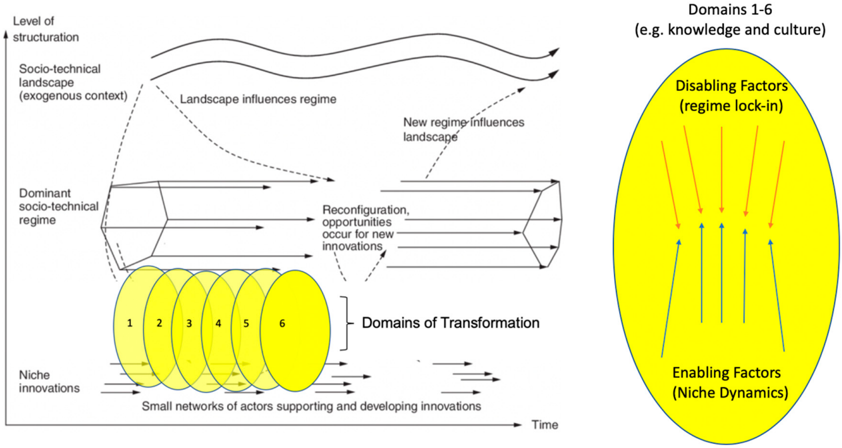
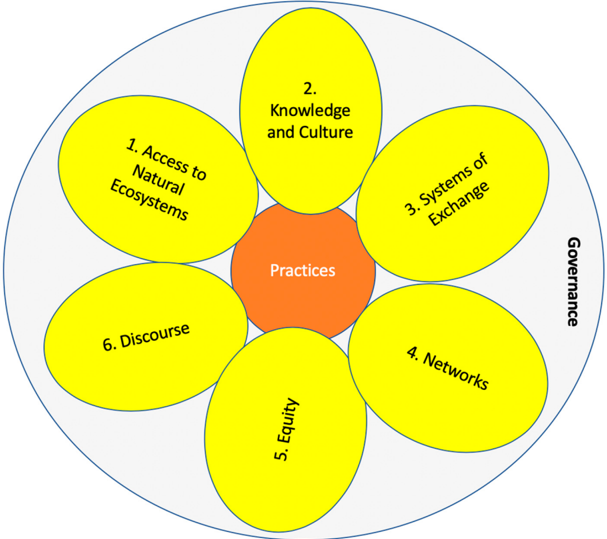
The acceleration of ecological crises has driven a growing body of thinking on sustainability transitions. Agroecology is being promoted as an approach that can address multiple crises in the food system while addressing climate change and contributing to the Sustainable Development Goals. Beyond the more technical definition as, “the ecology of food systems”, agroecology has a fundamentally political dimension. It is based on an aspiration towards autonomy or the agency of networks of producers and citizens to self-organize for sustainability and social justice. In this article, we use the multi-level perspective (MLP) to examine agroecology transformations. Although the MLP has been helpful in conceptualizing historic transitions, there is a need to better understand: (a) the role of and potential to self-organize in the context of power in the dominant regime, and (b) how to shift to bottom-up forms of governance—a weak point in the literature. Our review analyzes the enabling and disabling conditions that shape agroecology transformations and the ability of communities to self-organize. We develop the notion of ‘domains of transformation’ as overlapping and interconnected interfaces between agroecology and the incumbent dominant regime. We present six critical domains that are important in agroecological transformations: access to natural ecosystems; knowledge and culture; systems of exchange; networks; discourse; and gender and equity. The article focuses on the dynamics of power and governance, arguing that a shift from top down technocratic approaches to bottom up forms of governance based on community-self organization across these domains has the most potential for enabling transformation for sustainability and social justice.
Overview
The claims and statistics of this paper haven’t been checked yet.
Free: it reads the open-access text and checks the first 5 claims that cite a source we can check. Create a free account to check every claim.
Integrity signals
Registry
Cites
Statistics
Figures
Verification
Claims the paper makes
The claims and statistics of this paper haven’t been checked yet.
Free: it reads the open-access text and checks the first 5 claims that cite a source we can check. Create a free account to check every claim.
Claims other papers make about this one
Each is checked against this paper’s own text: does it say what the citing paper says it does?
The source backs part of the claim, not all of it — or backs it for a different population, condition or comparison.
In the citing paper
“Engaging in on-farm experiments, however, challenges current scientific approaches such as dealing with variability of farmer management, requiring more frequent communication between researchers and farmers, and maybe also different cross-disciplinary analytical tools (González-Sánchez et al. 2012, Anderson et al. 2019a).”
From A heuristic framework to portray agroecological transition initiatives in reflexive arrangements, illustrated with a conservation agriculture network in Denmark (2025) · cites this paper as Anderson et al. 2019a
Experimental — accuracy not yet measuredThe cited source says what the claim attributes to it.
In the citing paper
“Social networks mediate agroecological transitions by acting as conduits of information, collaboration, and material resources (see review in Anderson et al. 2019a).”
From A heuristic framework to portray agroecological transition initiatives in reflexive arrangements, illustrated with a conservation agriculture network in Denmark (2025) · cites this paper as Anderson et al. 2019a
The cited source says what the claim attributes to it.
In the citing paper
“This focus on horizontal knowledge structures through a facilitative and participatory advisory approach was distinct from the dominant centralized knowledge production and top-down knowledge diffusion (Anderson et al. 2019a).”
From A heuristic framework to portray agroecological transition initiatives in reflexive arrangements, illustrated with a conservation agriculture network in Denmark (2025) · cites this paper as Anderson et al. 2019a
The cited source says what the claim attributes to it.
In the citing paper
“Such an advisory approach strengthens horizontal knowledge structures (Anderson et al. 2019a, Bourne et al. 2021) and enhances the development of farmer skills to solve complex problems arising in their specific context (Cristofari et al. 2017, Charatsari et al. 2019, Bourne et al. 2021, Krafft et al. 2022), which makes it more effective (Ataei et al. 2019, Anderson et al. 2019a).”
From A heuristic framework to portray agroecological transition initiatives in reflexive arrangements, illustrated with a conservation agriculture network in Denmark (2025) · cites this paper as Anderson et al. 2019a
The cited source says what the claim attributes to it.
In the citing paper
“This is not surprising since, according to Anderson et al. (2019), access to natural resources is one of the main lock-ins to the wide-scale use of agroecological practices.”
From Scenarios for an agroecological transition of smallholder family farmers: a case study in Guadeloupe (2022) · cites this paper as Anderson et al. (2019)
2 more claims about this paper
Create a free account to see every claim other papers make about this one.
Self-check
Percentages, sums and reported differences re-computed from the paper’s own numbers.
The self-check needs the paper’s full text.
Citations
Cites
Governing the Commons: The Evolution of Institutions for Collective Action
Ostrom, E. (1990) · doi:10.1017/cbo9780511807763 · Cited by 20,653
Governing the Commons: The Evolution of Institutions for Collective Action
Field, B. C., & Ostrom, E. (1992) · Land Economics · doi:10.2307/3146384 · Cited by 18,859
(1976) · Cited by 10,813
Framing Processes and Social Movements: An Overview and Assessment
Benford, R. D., & Snow, D. A. (2000) · Annual Review of Sociology · doi:10.1146/annurev.soc.26.1.611 · Cited by 9,953 · cited 5×
“Given the dynamic and contested framing of agroecology, discourse on agroecology is in constant flux, and these fluid framing processes influence the direction of the agroecological transition, and the capacity of communities to self-organize and shape agroecological transformations [136,137].”
BackgroundInfluentialTypology of sociotechnical transition pathways
Geels, F. W., & Schot, J. (2007) · Research Policy · doi:10.1016/j.respol.2007.01.003 · Cited by 5,245 · cited 4×
“We then introduce the multi-level perspective—an influential framework for analyzing sustainability transitions [17,18].”
BackgroundInfluentialSustainability transitions: An emerging field of research and its prospects
Markard, J., Raven, R., & Truffer, B. (2012) · Research Policy · doi:10.1016/j.respol.2012.02.013 · Cited by 3,763 · cited 2×
“The regime level involves, “established practices and associated rules that stabilize existing systems” [17,26] where alignments and interdependencies across regime dimensions generate processes of path-dependency or ‘lock-in’ that enable stability and preserve the status quo.”
BackgroundThe multi-level perspective on sustainability transitions: responses to seven criticisms
Geels, F. W. (2011) · Environmental Innovation and Societal Transitions · doi:10.1016/j.eist.2011.02.002 · Cited by 3,092 · cited 3×
“We then introduce the multi-level perspective—an influential framework for analyzing sustainability transitions [17,18].”
BackgroundThe Politics of the Earth: Environmental Discourses
Dryzek, J. S. (1997) · Cited by 3,013
An agenda for sustainability transitions research: State of the art and future directions
Köhler, J., Geels, F. W., Kern, F., Markard, J., Onsongo, E., Wieczorek, A., Alkemade, F., Avelino, F., Bergek, A., Boons, F., et al. (2019) · Environmental Innovation and Societal Transitions · doi:10.1016/j.eist.2019.01.004 · Cited by 2,800 · cited 1×
“Whereas power and governance are not typically the central focus in the sustainability transitions literature [27], our approach is based on the assumption that any transformative system’s change will require an analysis of power and governance.”
BackgroundThe number, size, and distribution of farms, smallholder farms, and family farms worldwide
Lowder, S. K., Skoet, J., & Raney, T. (2016) · World Development · doi:10.1016/j.worlddev.2015.10.041 · Cited by 2,012 · cited 1×
“In addition, processes of land fragmentation and declining average farm size in most of the world’s less industrialized countries over the past several decades are undermining agroecology [56].”
Background
Research works printed but not linked: 6
- 76. Petersen, P.F. Arreglos Institucionales Para la Intensificación Agroecológica. Una Mirada al Caso Brasileño Desde la Agroecología Política. Ph.D. Thesis, Universidad de Pablo de Olavide, Sevilla, Spain, 2017.
- 87. Rivera Ferre, M.; Álvare, I. From a Market Approach to the Centrality of Life: An Urgent Change for Women; Right to Food and Nutrition Watch; Global Network for the Right to Food and Nutrition: Vienna, Austria, 2017; pp. 36-41.
- Campeau, 2018, Equity, equality and non-discrimination to guide food-system reform, UNSCN-News, 45, 7
- Mora, 2018, Inequality and malnutrition, UNSCN-News, 45, 15
- 2014, There will be no agroecology without feminism. The Brazilian case, Sustentabilidade em Debate, 5, 76
- Loconto, 2019, Defining agroecology, Int. J. Sociol. Agric. Food, 25, 116
Cited by
Viewpoint: The case for a six-dimensional food security framework
Clapp, J., Moseley, W. G., Burlingame, B., & Termine, P. (2022) · Food Policy · doi:10.1016/j.foodpol.2021.102164 · Cited by 512
“Food sovereignty advocates call for a stronger voice for farmers in shaping food systems as well as the institutions that govern them (Anderson et al., 2019).”
BackgroundBarrios, E., Gemmill-Herren, B., Bicksler, A., Siliprandi, E., Brathwaite, R., Moller, S., Batello, C., & Tittonell, P. (2020) · Ecosystems and People · doi:10.1080/26395916.2020.1808705 · Cited by 293
“…yet holistic version of reality that can facilitate decision-making by policymakers, practitioners and other stakeholders at different scales along agroecological transitions towards sustainable agriculture and food systems (Biovision 2019; HLPE 2019; INKOTA 2019; Anderson et al. 2019a).”
BackgroundInfluentialAssessment and Principles of Environmentally Sustainable Food and Agriculture Systems
Çakmakçı, R., Salık, M. A., & Çakmakçı, S. (2023) · Agriculture · doi:10.3390/agriculture13051073 · Cited by 269
“…systems [124], creates a healthy relationship between people and food [19], and focuses on ecological solutions, community-based economic development, and the transition to a sustainable agricultural system [125], conservation practices [112,126], agroecosystems and the agri-food system [85].”
BackgroundSustainable Agri-Food Systems: Environment, Economy, Society, and Policy
El Bilali, H., Strassner, C., & Ben Hassen, T. (2021) · Sustainability · doi:10.3390/su13116260 · Cited by 213
Assessing resilience and adaptability in agroecological transitions
Tittonell, P. (2020) · Agricultural Systems · doi:10.1016/j.agsy.2020.102862 · Cited by 199
Potential Role of Technology Innovation in Transformation of Sustainable Food Systems: A Review
Khan, N., Ray, R. L., Kassem, H. S., Hussain, S., Zhang, S., Khayyam, M., Ihtisham, M., & Asongu, S. A. (2021) · Agriculture · doi:10.3390/agriculture11100984 · Cited by 160
Agroecology in Large Scale Farming—A Research Agenda
Tittonell, P., Piñeiro, G., Garibaldi, L. A., Dogliotti, S., Olff, H., & Jobbagy, E. G. (2020) · Frontiers in Sustainable Food Systems · doi:10.3389/fsufs.2020.584605 · Cited by 147
Climate change and agrarian struggles: an invitation to contribute to a JPS Forum
Borras, S. M., Scoones, I., Baviskar, A., Edelman, M., Peluso, N. L., & Wolford, W. (2021) · The Journal of Peasant Studies · doi:10.1080/03066150.2021.1956473 · Cited by 174
Akanmu, A. O., Akol, A. M., Ndolo, D. O., Kutu, F. R., & Babalola, O. O. (2023) · Frontiers in Sustainable Food Systems · doi:10.3389/fsufs.2023.1143061 · Cited by 163
Avelino, F., Wijsman, K., van Steenbergen, F., Jhagroe, S., Wittmayer, J. M., Akerboom, S., Bogner, K., Jansen, E. F., Frantzeskaki, N., & Kalfagianni, A. K. (2024) · Annual Review of Environment and Resources · doi:10.1146/annurev-environ-112321-081722 · Cited by 199
Petersen-Rockney, M., Baur, P., Guzman, A., Bender, S. F., Calo, A. J., Castillo, F., Master, K. D., Dumont, A. M., Esquivel, K., Kremen, C., et al. (2021) · Frontiers in Sustainable Food Systems · doi:10.3389/fsufs.2021.564900 · Cited by 171
“that influence adaptive capacity (Box 1), or the ability to respond flexibly and effectively to changing circumstances (Wilson, 2007; Tomich et al., 2011; Anderson et al., 2019; Chhetri et al., 2019).”
BackgroundHuman and social values in agroecology
Bezner Kerr, R., Liebert, J., Kansanga, M., & Kpienbaareh, D. (2022) · Elementa: Science of the Anthropocene · doi:10.1525/elementa.2021.00090 · Cited by 95
Sampson, D., Cely‐Santos, M., Gemmill‐Herren, B., Babin, N. L., Bernhart, A., Kerr, R. B., Blesh, J., Bowness, E., Feldman, M., Gonçalves, A. L., et al. (2021) · Frontiers in Sustainable Food Systems · doi:10.3389/fsufs.2021.686492 · Cited by 138
“We then drew from relevant literature (e.g., Pimbert, 2006; Lemke and Bellows, 2015; Anderson et al., 2019) and our collective experience in academic, intergovernmental, and social movement engagements with these approaches to define a set of “action types” expected to affect FSN (Table 1).”
BackgroundFood system narratives to end hunger: extractive versus regenerative
Anderson, M. D., & Rivera‐Ferre, M. G. (2021) · Current Opinion in Environmental Sustainability · doi:10.1016/j.cosust.2020.12.002 · Cited by 104
de Molina, M. G., & García, D. L. (2021) · Agroecology and Sustainable Food Systems · doi:10.1080/21683565.2021.1913690 · Cited by 118
“worldwide scattering of agroecology experiences represent niches of social innovation (Anderson et al. 2019).”
BackgroundInfluentialDeepening democracy for the governance toward just transitions in agri-food systems
Tschersich, J., & Kok, K. P. W. (2022) · Environmental Innovation and Societal Transitions · doi:10.1016/j.eist.2022.04.012 · Cited by 102
What grows from a pandemic? Toward an abolitionist agroecology
de Wit, M. M. (2020) · The Journal of Peasant Studies · doi:10.1080/03066150.2020.1854741 · Cited by 86
“Indeed, much has been written in the years following the food crisis of 2007– 2008 about agroecology’s transformative potential (Altieri and Toledo 2011; Méndez et al. 2016; Anderson et al. 2019; de Molina et al. 2020).”
BackgroundEmancipatory agroecologies: social and political principles
Giraldo, O. F., & Rosset, P. M. (2022) · The Journal of Peasant Studies · doi:10.1080/03066150.2022.2120808 · Cited by 98
“While Dumont, Wartenberg, and Baret (2021), Sandhu (2021), Kapgen and Roudart (2020), Wezel et al. (2020), Anderson et al. (2019, 2020) and González de Molina et al. (2019), and González de Molina and Lopez-Garcia (2021), among others, have all elaborated one form or another of social principles…”
BackgroundUnlocking and accelerating transformations to the SDGs: a review of existing knowledge
Allen, C., & Malekpour, S. (2023) · Sustainability Science · doi:10.1007/s11625-023-01342-z · Cited by 98
“1) often entail breaking down resilient structures and processes while also building new desirable ones (Herrfahrdt-Pähle et al. 2020; Elmqvist et al. 2019; Markard et al. 2020; Anderson et al. 2019).”
Background“The Innovation Imperative”: The Struggle Over Agroecology in the International Food Policy Arena
Anderson, C. R., & Maughan, C. (2021) · Frontiers in Sustainable Food Systems · doi:10.3389/fsufs.2021.619185 · Cited by 68
“We found that innovation can serve to contain and co-opt the transformative potential of agroecology (Anderson et al., 2019), and was intentionally mobilized by detractors of agroecology for that very purpose.”
BackgroundSelf-citationImpact of Zero Budget Natural Farming on Crop Yields in Andhra Pradesh, SE India
Duddigan, S., Collins, C. D., Hussain, Z., Osbahr, H., Shaw, L. J., Sinclair, F., Sizmur, T., Thallam, V. K., & Winowiecki, L. A. (2022) · Sustainability · doi:10.3390/su14031689 · Cited by 78
“Enthusiasm about the value of adopting the ZBNF approach by a range of stakeholders from government to local communities could be seen as reflecting a social movement [29], and mirrors prior legacy around agroecology [30–33].”
BackgroundAgainst the odds: Network and institutional pathways enabling agricultural diversification
Blesh, J., Mehrabi, Z., Wittman, H. K., Kerr, R. B., James, D., Madsen, S., Smith, O. M., Snapp, S. S., Stratton, A. E., Bakarr, M. I., et al. (2023) · One Earth · doi:10.1016/j.oneear.2023.03.004 · Cited by 92
Farmers’ Organizations as innovation intermediaries for agroecological innovations in Burkina Faso
Iyabano, A. H., Klerkx, L., Faure, G. O., & Toillier, A. (2021) · International Journal of Agricultural Sustainability · doi:10.1080/14735903.2021.2002089 · Cited by 84
“These are reflected from their fulfillment of two broad innovation intermediaries’ functions identified in the literature i.e. the knowledge and innovation intermediations which may contribute to what has been called ‘transformative agroecology learning’ (Anderson et al., 2019b).”
BackgroundInfluentialGuth, M., Stępień, S., Smędzik-Ambroży, K., & Matuszczak, A. (2021) · Journal of Rural Studies · doi:10.1016/j.jrurstud.2021.11.026 · Cited by 81
Skrimizea, E., Lécuyer, L., Bunnefeld, N., Butler, J., Fickel, T., Hodgson, I. D., Holtkamp, C., Marzano, M., Parra, C., Pereira, L. M., et al. (2020) · Advances in ecological research/Advances in Ecological Research · doi:10.1016/bs.aecr.2020.08.003 · Cited by 81
Duff, H., Hegedus, P. B., Loewen, S., Bass, T. M., & Maxwell, B. D. (2021) · Sustainability · doi:10.3390/su14010106 · Cited by 72
Lécuyer, L., Alard, D., Calla, S., Coolsaet, B., Fickel, T., Heinsoo, K., Henle, K., Herzon, I., Hodgson, I. D., Quétier, F., et al. (2021) · Advances in ecological research/Advances in Ecological Research · doi:10.1016/bs.aecr.2021.10.005 · Cited by 77
Elsner, F., Herzig, C., & Strassner, C. (2023) · Frontiers in Sustainable Food Systems · doi:10.3389/fsufs.2023.1207476 · Cited by 64
Kalt, T. (2024) · Environmental Innovation and Societal Transitions · doi:10.1016/j.eist.2024.100812 · Cited by 69
Baur, P. (2020) · Agriculture and Human Values · doi:10.1007/s10460-020-10123-8 · Cited by 57
“2013; Carlisle 2014; IPES-Food 2016; Anderson 2019).”
The evolving landscape of agroecological research
Mason, R. E., White, A., Bucini, G., Anderzén, J., Méndez, V. E., & Merrill, S. C. (2020) · Agroecology and Sustainable Food Systems · doi:10.1080/21683565.2020.1845275 · Cited by 61
“…each other and with a “reflexive perspective that . . . [is] clear about the normative values, politics, and possibilities for transformative change that are at play in today’s agro-food systems” (Méndez, Bacon, and Cohen 2013, p7; see also Anderson et al. 2019; González de Molina et al. 2019).”
BackgroundDemystifying food systems transformation: a review of the state of the field
Juri, S., Terry, N., & Pereira, L. M. (2024) · Ecology and Society · doi:10.5751/es-14525-290205 · Cited by 64
“Andersonetal.”
Borras, S. M. (2023) · The Journal of Peasant Studies · doi:10.1080/03066150.2023.2176760 · Cited by 57
“38See Mier y Terán Giménez Cacho et al. (2018), Anderson et al. (2019), Akram-Lodhi (2021), Holt-Giménez, Shattuck, and Van Lammeren (2021), van der Ploeg (2021).”
BackgroundAn Operational Approach to Agroecology-Based Local Agri-Food Systems
López-García, D., & González de Molina, M. (2021) · Sustainability · doi:10.3390/su13158443 · Cited by 43
“Finally, from a feminist perspective, ALAS are presented as a valid means to reverse the feminization of food poverty (and related health problems) and to allow the re-valuing of the role of women in different farming systems and in the agroecology movement itself [37,43,44].”
BackgroundEsquivel, K., Carlisle, L., Ke, A., Olimpi, E. M., Baur, P., Ory, J., Waterhouse, H., Iles, A., Karp, D. S., Kremen, C., et al. (2021) · Frontiers in Sustainable Food Systems · doi:10.3389/fsufs.2021.734088 · Cited by 55
“agriculture currently locks many farmers on a pathway toward large scale, input-dependent systems (IPES-Food, 2018; Anderson et al., 2019; Petersen-Rockney et al., 2021).”
BackgroundWalthall, B., Vicente‐Vicente, J. L., Friedrich, J., Piorr, A., & García, D. L. (2024) · Environmental Science & Policy · doi:10.1016/j.envsci.2024.103748 · Cited by 56
Agroecology now - connecting the dots to enable agroecology transformations
Anderson, C., Pimbert, M. P., Chappell, M. J., Brem-Wilson, J., Claeys, P., Kiss, C., Maughan, C., Milgroom, J., McAllister, G., Moeller, N. I., et al. (2020) · Agroecology and Sustainable Food Systems · doi:10.1080/21683565.2019.1709320 · Cited by 43
“(Anderson et al. 2019) ● A report on, “Nourishing Life – Territories of Life and Food Sovereignty.””
Self-citationPower in resilience and resilience's power in climate change scholarship
Garcia, A., Gonda, N., Atkins, E., Godden, N. J., Henrique, K. P., Parsons, M., Tschakert, P., & Ziervogel, G. (2022) · Wiley Interdisciplinary Reviews Climate Change · doi:10.1002/wcc.762 · Cited by 73
“This and other examples from the literature sample (Anderson et al., 2019; Bezner Kerr et al., 2018; Ciplet, 2017; Ravera et al., 2019) demonstrate that resilience is embroiled within ambivalent and unpredictable processes of power.”
BackgroundAgroecology and resilience of smallholder food security: a systematic review
Dagunga, G., Ayamga, M., Laube, W., Ansah, I. G. K., Kornher, L., & Kotu, B. H. (2023) · Frontiers in Sustainable Food Systems · doi:10.3389/fsufs.2023.1267630 · Cited by 77
Bacon, C. M., Sundstrom, W. A., Stewart, I. T., Maurer, E. P., & Kelley, L. C. (2021) · World Development · doi:10.1016/j.worlddev.2021.105468 · Cited by 49
“…transformations of the adverse terms of resource access (e.g., prices received by farmers, land tenure policies, drinking water delivery systems) that smallholders in Nicaragua and elsewhere have faced for decades (Anderson et al., 2019; Gliessman, 2013; Béné et al., 2017; Bacon et al., 2017).”
Sustainability, justice and equity in food systems: Ideas and proposals in dispute in Brazil
Maluf, R. S., Burlandy, L., Cintrão, R. P., Jomalinis, E., Carvalho, T. C. O., & Tribaldos, T. (2022) · Environmental Innovation and Societal Transitions · doi:10.1016/j.eist.2022.10.005 · Cited by 39
Vizuete, B., Oteros‐Rozas, E., & García‐Llorente, M. (2024) · Agriculture and Human Values · doi:10.1007/s10460-023-10537-0 · Cited by 60
“In agreement with Anderson et al. (2019), most reported activities fell in the domain of access to natural ecosystems (48%), and practices related to the equity domain were described least frequently.”
Kaufmann, S., Hruschka, N., & Vogl, C. R. (2020) · Sustainability · doi:10.3390/su12198100 · Cited by 33
“PGS therefore have the potential to enable transformation towards sustainability [11] and promote the”
BackgroundEasier said than defined? Conceptualising justice in food system transitions
de Bruin, A., de Boer, I. J. M., Faber, N. R., de Jong, G., Termeer, C. J. A. M., & de Olde, E. M. (2023) · Agriculture and Human Values · doi:10.1007/s10460-023-10482-y · Cited by 63
“They discussed the redistribution of power to those who grow and consume local food (Smith and Patterson 2018) and the concept of subsidiarity in which decisions are taken at as local a scale as relevant to what is discussed (Anderson et al. 2019).”
Conti, C., Hall, A., Percy, H., Stone-Jovicich, S., Turner, J. A., & McMillan, L. (2023) · Global Food Security · doi:10.1016/j.gfs.2023.100733 · Cited by 65
Scale and the politics of the organic transition in Sikkim, India
Meek, D., & Anderson, C. (2019) · Agroecology and Sustainable Food Systems · doi:10.1080/21683565.2019.1701171 · Cited by 48
Self-citationMuñoz, E. F. P., Niederle, P. A., Gennaro, B. D., & Roselli, L. (2021) · Sustainability · doi:10.3390/su13063096 · Cited by 45
“Some scholars [7] have identified six primary domains of the agroecological field: (1) access to natural ecosystems; (2) knowledge and culture; (3) systems of exchange; (4) networks; (5) gender and equity; and (6) discourse.”
BackgroundThe agroecological transition in Senegal: transnational links and uneven empowerment
Boillat, S., Belmin, R., & Bottazzi, P. (2022) · Agriculture and Human Values · doi:10.1007/s10460-021-10247-5 · Cited by 37
The political economy of agroecological transitions: key analytical dimensions
McKay, B. M., Nehring, R., & Catacora‐Vargas, G. (2024) · The Journal of Peasant Studies · doi:10.1080/03066150.2024.2399138 · Cited by 45
“…socioeconomic dimensions (Dumont et al. 2016; Giraldo and Rosset 2023), policy incentives (Place et al. 2022) or the political elements and the necessity to challenge the underlying relations of power in food systems (Anderson et al. 2019; González de Molina et al. 2020; Rosset and Altieri 2017).”
Bataille, C. Y., Malinen, S. K., Yletyinen, J., Scott, N. J., & Lyver, P. O. (2021) · People and Nature · doi:10.1002/pan3.10244 · Cited by 41
Hammelman, C., Shoffner, E., Cruzat, M., & Lee, S. (2021) · Agriculture and Human Values · doi:10.1007/s10460-021-10253-7 · Cited by 47
Béné, C., & Abdulai, A. (2024) · Frontiers in Sustainable Food Systems · doi:10.3389/fsufs.2024.1399024 · Cited by 58
Are Small Farms Sustainable by Nature?—Review of an Ongoing Misunderstanding in Agroecology
Ebel, R. H. (2020) · Challenges in Sustainability · doi:10.12924/cis2020.08010017 · Cited by 45
Owen, L., Udall, D., Franklin, A., & Kneafsey, M. (2020) · Sustainability · doi:10.3390/su12124890 · Cited by 52
“, who argue that “experiments with new institutional arrangements in existing agroecological innovation niches, such as food policy councils, are providing exemplary developments where territorially based organizations are carving out new strategic roles” [41] (p.”
Ullman, A. N., & Kittner, N. (2023) · Energy Research & Social Science · doi:10.1016/j.erss.2023.103371 · Cited by 49
Bocean, C. G. (2024) · Foods · doi:10.3390/foods13081281 · Cited by 39
Topaloglou, L., Kouskoura, A., Janikowska, O. J., Grozeva, R., Nikolaidou, K., Karagiannis, I., & Kulczycka, J. (2024) · Energy Research & Social Science · doi:10.1016/j.erss.2024.103708 · Cited by 33
Goetz, A., Hussein, H., & Thiel, A. (2023) · International Journal of Water Resources Development · doi:10.1080/07900627.2023.2260902 · Cited by 41
“This means that we recognize the political understanding of agroecology (Anderson et al., 2019) and its transformative predisposition, but we do not undertake an analysis of whether the practices mentioned in the collected data are de facto reformist or transfor-mative.”
Food democracy: possibilities under the frame of the current food system
Cifuentes, M. L., & Gugerell, C. (2021) · Agriculture and Human Values · doi:10.1007/s10460-021-10218-w · Cited by 44
“1 3 sustainable, transformative pathway (Anderson et al. 2019).”
BackgroundCan Australia transition to an agroecological future?
Iles, A. (2020) · Agroecology and Sustainable Food Systems · doi:10.1080/21683565.2020.1780537 · Cited by 39
“Anderson et al. (2019) have begun exploring how self-organization and bottom-up governance can enrich MLP analysis, while Ingram (2018) has considered how permaculture knowledge systems develop locally and interact with the dominant agrarian regime.”
BackgroundPath dependencies in US agriculture: Regional factors of diversification
Spangler, K., Schumacher, B. L., Bean, B., & Burchfield, E. (2022) · Agriculture Ecosystems & Environment · doi:10.1016/j.agee.2022.107957 · Cited by 43
Ortiz-Valverde, R., Aránguiz, P., & Peris, J. (2022) · Environmental Innovation and Societal Transitions · doi:10.1016/j.eist.2022.11.002 · Cited by 41
Agroecology as a Philosophy of Life
James, D., Wolff, R., & Wittman, H. K. (2023) · Agriculture and Human Values · doi:10.1007/s10460-023-10455-1 · Cited by 45
“Use of the term “agroecology” has greatly increased over the past few decades, with scholars (e.g., Anderson et al. 2019; Bezner Kerr 2020), civil society actors (e.g., HLPE 2019; IPES-Food 2016), social movements (e.g., La Via Campe-sina 2019), and intergovernmental organizations (e.g., FAO 2018a,…”
BackgroundOzaki, Y., & Shaw, R. (2022) · Sustainability · doi:10.3390/su142114471 · Cited by 49
“Almeida Heliyon 2019 Agroecology All [30] 76 C.”
BackgroundMaughan, C., & Anderson, C. (2023) · Frontiers in Sustainable Food Systems · doi:10.3389/fsufs.2023.1162658 · Cited by 36
Self-citationLuna, A. G., Bacon, C. M., Méndez, V. E., Gómez, M. E. F., Anderzén, J., Cacho, M. M. Y. T. G., Jonapá, R. H., Rivas, M., Duarte-Canales, H. A., & González, Á. N. B. (2022) · Frontiers in Sustainable Food Systems · doi:10.3389/fsufs.2022.810840 · Cited by 46
“This is a key characteristic of transformative agroecology (Anderson et al., 2019).”
BackgroundMethodInfluentialVicente‐Vicente, J. L., Borderieux, J., Martens, K., González-Rosado, M., & Walthall, B. (2023) · Agroecology and Sustainable Food Systems · doi:10.1080/21683565.2023.2187003 · Cited by 59
“…(levels 4 and 5) scales will provide the necessary knowledge so that context-specific policy recommendations with the overall goal, as suggested by previous studies (Anderson et al. 2019; Gliessman 2014), of developing a transformative agroecology for food sovereignty in the region can be proposed.”
BackgroundThe 10 elements of agroecology interconnected: making them operational in FAO’S work on agroecology
Bicksler, A. J., Mottet, A., Lucantoni, D., Sy, M. R., & Barrios, E. (2023) · Elem Sci Anth · doi:10.1525/elementa.2022.00041 · Cited by 27
A decade of advances in the study of buckwheat for organic farming and agroecology (2013-2023)
Vieites‐Álvarez, Y., Reigosa, M. J., & Sánchez‐Moreiras, A. M. (2024) · Frontiers in Plant Science · doi:10.3389/fpls.2024.1354672 · Cited by 42
“…the study, design, and management of sustainable food systems, the integration of the diverse knowledge systems generated by food system professionals, and the involvement of the social movements that are promoting the transition to fair, just, and responsible food systems (Anderson et al., 2019).”
BackgroundFrancis, D. V., Asif, A., & Ahmed, Z. F. R. (2024) · Springer eBooks · doi:10.1007/978-981-97-0851-2_19 · Cited by 34
Exploring Sustainability Implications of Transitions to Agroecology: a Transdisciplinary Perspective
Schwarz, G., Vanni, F., Miller, D., Helin, J. A., Pražan, J., Albanito, F., Frățilă, M., Galioto, F., Gava, O., Irvine, K. N., et al. (2022) · EuroChoices · doi:10.1111/1746-692x.12377 · Cited by 31
Omotayo, A. O., Ndhlovu, P. T., Tshwene, S. C., Olagunju, K. O., & Aremu, A. O. (2021) · Sustainability · doi:10.3390/su13105458 · Cited by 26
“The current global food system remains a diverse mixture of localized and industrialized systems of interconnected food chains [5,6].”
BackgroundTaking food out the private sphere? Addressing gender relations in urban food policy
Masso, M. D., García, D. L., Clemente-Longás, J., & García, V. G. (2021) · Agroecology and Sustainable Food Systems · doi:10.1080/21683565.2021.1936742 · Cited by 32
“Indeed, men are fundamentally linked to food production and physical tasks (Bezner Kerr et al. 2019; Siliprandi 2010), while women tend to occupy organizational and administrative spaces (Anderson et al. 2019).”
BackgroundInfluentialVilas-Boas, J., Klerkx, L., & Lie, R. (2021) · Journal of Rural Studies · doi:10.1016/j.jrurstud.2021.11.025 · Cited by 38
Unfolding sustainability transitions in food systems: Insights from UK and French trajectories
Lamine, C., & Marsden, T. (2023) · Proceedings of the National Academy of Sciences · doi:10.1073/pnas.2206231120 · Cited by 42
Participatory future visions of collaborative agroecological farmer-pastoralist systems in Tanzania
Johansson, E., Martin, R., & Mapunda, K. M. (2023) · Agroecology and Sustainable Food Systems · doi:10.1080/21683565.2023.2165592 · Cited by 34
“Thus, agroecology contains a fundamental political dimension, that producers and citizens should have increased autonomy and agency to self-organize for sustainable food production and consumption (Anderson et al. 2019).”
BackgroundMcGreevy, S. R., Tamura, N., Kobayashi, M., Zollet, S., Hitaka, K., Nicholls, C. I., & Altieri, M. A. (2021) · Frontiers in Sustainable Food Systems · doi:10.3389/fsufs.2021.699694 · Cited by 37
Using property law to expand agroecology: Scotland’s land reforms based on human rights
Calo, A. J., Shields, K., & Iles, A. (2022) · The Journal of Peasant Studies · doi:10.1080/03066150.2022.2083506 · Cited by 34
“…markets for agroecological production, agroecologists need social and political power to intervene in established corporate food market relations (Anderson et al. 2019) yet large landowning agricultural operations that represent the largest commodity producers enjoy political representation to…”
BackgroundGender in sustainability transition studies: Concepts, blind spots and future orientations
Wolfram, M., & Kienesberger, M. (2022) · Environmental Innovation and Societal Transitions · doi:10.1016/j.eist.2022.100686 · Cited by 34
García, D. L., & Carrascosa-García, M. (2023) · Journal of Rural Studies · doi:10.1016/j.jrurstud.2023.103160 · Cited by 34
Challenging Agroecology—Promise and Pitfalls for Agrarian Studies
McKay, B. M., Catacora‐Vargas, G., Castellanos-Navarrete, A., Kerr, R. B., & Luna, J. K. (2025) · Journal of Agrarian Change · doi:10.1111/joac.70019 · Cited by 29
Calo, A. J. (2020) · Frontiers in Sustainable Food Systems · doi:10.3389/fsufs.2020.555270 · Cited by 33
“Agroecologists view secure farmland tenure as an enabling condition that must proceed technical food system interventions (Anderson et al., 2019; Giraldo and McCune, 2019).”
Backgroundde Wit, M. M., Shattuck, A., Iles, A., Graddy‐Lovelace, G., Roman-Alcalá, A., & Chappell, M. J. (2021) · Journal of Agriculture Food Systems and Community Development · doi:10.5304/jafscd.2021.102.022 · Cited by 37
Self-citationCultivating Pedagogy for Transformative Learning: A Decade of Undergraduate Agroecology Education
Horner, C. E., Morse, C. E., Carpenter, N., Nordstrom, K. L., Faulkner, J. W., Mares, T., Kinnebrew, E., Caswell, M., Izzo, V. M., Méndez, V. E., et al. (2021) · Frontiers in Sustainable Food Systems · doi:10.3389/fsufs.2021.751115 · Cited by 31
Envisioning sustainable carbon sequestration in Swedish farmland
Johansson, E., Brogaard, S., & Brodin, L. (2022) · Environmental Science & Policy · doi:10.1016/j.envsci.2022.04.005 · Cited by 37
Heiges, J., & O’Neill, K. (2022) · Journal of Cleaner Production · doi:10.1016/j.jclepro.2022.134367 · Cited by 31
Lucantoni, D., & Domarle, J. (2023) · Agroecology and Sustainable Food Systems · doi:10.1080/21683565.2023.2230931 · Cited by 26
The crises inherent in the success of the global food system
Lähde, V., Vadén, T., Toivanen, T., Järvensivu, P., & Eronen, J. T. (2023) · Ecology and Society · doi:10.5751/es-14624-280416 · Cited by 33
García, D. L., & Carrascosa-García, M. (2023) · Agroecology and Sustainable Food Systems · doi:10.1080/21683565.2023.2217095 · Cited by 26
“Agroecologists strongly defend and advocate equity, bottom-up governance and multi-actor participatory processes at the core of their approach (Anderson et al. 2019; López-García and González de Molina 2021; Méndez et al. 2017), in order to address the existing power imbalance in food systems, within what has been cal…”
BackgroundPlateau, L., Roudart, L., Hudon, M., & Maréchal, K. (2021) · Ecological Economics · doi:10.1016/j.ecolecon.2021.107048 · Cited by 30
Assessing Cover Crop and Intercrop Performance Along a Farm Management Gradient
Stratton, A. E., Comin, J. J., Siddique, I., Zak, D. R., Filipini, L. D., Lucas, R. R., & Blesh, J. (2021) · Agriculture Ecosystems & Environment · doi:10.1016/j.agee.2022.107925 · Cited by 32
Global Food System Transformation for Resilience
Elechi, J. O. G., Nwiyi, I. U., & Smah, A. C. (2022) · Sustainable development · doi:10.5772/intechopen.102749 · Cited by 36
Food Autonomy within Food Sovereignty: Evidence from a Structural Model
Vergara-Romero, A., del Río, J. A. J., & Márquez-Sánchez, F. (2022) · Agronomy · doi:10.3390/agronomy12051141 · Cited by 35
Agroecological transitions in the mind
Soini, E., & Coe, R. (2023) · Elementa Science of the Anthropocene · doi:10.1525/elementa.2022.00026 · Cited by 36
Bakker, E., Hassink, J., & van Veluw, K. (2023) · Agroecology and Sustainable Food Systems · doi:10.1080/21683565.2023.2180563 · Cited by 34
“…Levidow, and Pearce 2020), on exploring enabling and disabling factors as described by Anderson et al. (2019) in the Netherlands, or on the effect of on-farm or nature education, for both children and adults (Anderson et al. 2019; Mezirow 1997; Taylor 2017), and the links with societal awareness.”
BackgroundMujtar, V. A. E., Zamor, R., Salmerón, F. J., Guerrero, A. D. S., Laborda, L., Tittonell, P. A., & Hogan, R. (2023) · Agricultural Systems · doi:10.1016/j.agsy.2023.103686 · Cited by 27
Governance networks for agroecology transitions in rural Europe
Gava, O., Vanni, F., Schwarz, G., Guisepelli, E., Vincent, A., Pražan, J., Weißhaidinger, R., Frick, R., Hrabalová, A., Carolus, J., et al. (2024) · Journal of Rural Studies · doi:10.1016/j.jrurstud.2024.103482 · Cited by 42
Can low-income consumers choose food from sustainable production methods?
Hough, G., & Contarini, A. (2023) · Current Opinion in Food Science · doi:10.1016/j.cofs.2023.101035 · Cited by 35
Steinke, J., Ivanova, Y., Jones, S. K., Minh, T. T., Sánchez, A., Sánchez-Choy, J., & Mockshell, J. (2024) · World Development Sustainability · doi:10.1016/j.wds.2024.100185 · Cited by 36
The integration of food policies in a local administration system: the case of the Milan food policy
Minotti, B., Affinita, V., Calori, A., & Federici, F. (2022) · Agroecology and Sustainable Food Systems · doi:10.1080/21683565.2022.2091718 · Cited by 24
“However, participatory forms of governance have been highlighted as an important key in agroecological transition (Ray Anderson et al., 2019).”
BackgroundResultInfluential
Metadata
- Authors
- Anderson, C. R., Bruil, J., Chappell, M. J., Kiss, C., & Pimbert, M. P.
- Affiliations
- Coventry University (GB)
- Cultivate !, Schuurhoven 29, 6721SM Bennekom, The Netherlands
- Corresponding author
- Anderson, Colin Ray
- Venue
- Sustainability
- Publisher
- MDPI AG
- Published
- 2019-09-25
- Volume
- 11
- Issue
- 19
- Pages
- 5272
- ISSN
- 2071-1050 (ISSN-L)
- OpenAlex
- W2975637527
- Cited by
- 375
- References
- 126
- Citations by year
- 2026: 65 · 2025: 63 · 2024: 57 · 2023: 65 · 2022: 49 · 2021: 47 · 2020: 28 · 2019: 1
- FWCI
- 64.81
- Type
- journal article
- Language
- en
- Open access
- gold
- dx.doi.org
- Licence
- Locations
- Sustainability (publishedVersion, cc-by)
- Pure (Coventry University) (submittedVersion, cc-by)
- RePEc: Research Papers in Economics (submittedVersion)
- DOAJ (DOAJ: Directory of Open Access Journals) (submittedVersion)
- Topics
- Social Sciences › Development › Agriculture, Land Use, Rural Development
- Physical Sciences › Environmental Science › Global and Planetary Change › Sustainability and Climate Change Governance
- Life Sciences › Agricultural and Biological Sciences › Ecology, Evolution, Behavior and Systematics › Agriculture and Rural Development Research
- Keywords
- agroecology, sustainability transitions, food systems, social justice, multi-level perspective, self-organization, bottom-up governance, power relations, community networks, knowledge and culture, discourse, Sustainable Development Goals, climate change
About these checks
Registry, retraction, Cites and statistics results are computed, not judged, with one exception: a printed reference that no index lists is read once by a model before it counts as a citation error. Claims are extracted by a model and kept only when their quote appears verbatim in the text; each cited source is then checked, with a model’s help, for whether it says what the claim relies on. Those verdicts can be wrong — read the claim’s quote and the cited source before relying on one.
Statistics and arithmetic are recomputed, not judged.
Confidence bands are shown only for fields calibrated on our annotated test set. None is calibrated yet, so no band is shown.
What counts as a claim ›How we measure confidence ›How we check this ›
Are you an author, or do you see a problem with this page? Request a review
Data sources
Bibliographic data: Semantic Scholar, OpenAlex, Crossref.
Contains information from the Semantic Scholar Academic Graph Datasets, made available under the ODC Attribution License (ODC-BY 1.0).
Semantic Scholar’s data is described in: Kinney, R., et al. (2023). The Semantic Scholar Open Data Platform. arXiv:2301.10140.
