

From Transition to Domains of Transformation: Getting to Sustainable and Just Food Systems through Agroecology
Open accessThe DOI matches its Crossref record; 126 of the 126 references it cites were found in a registry or an index.
Abstract
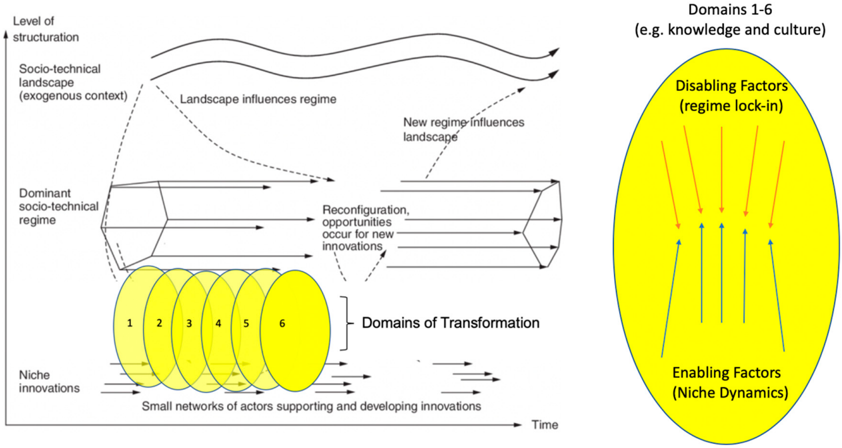
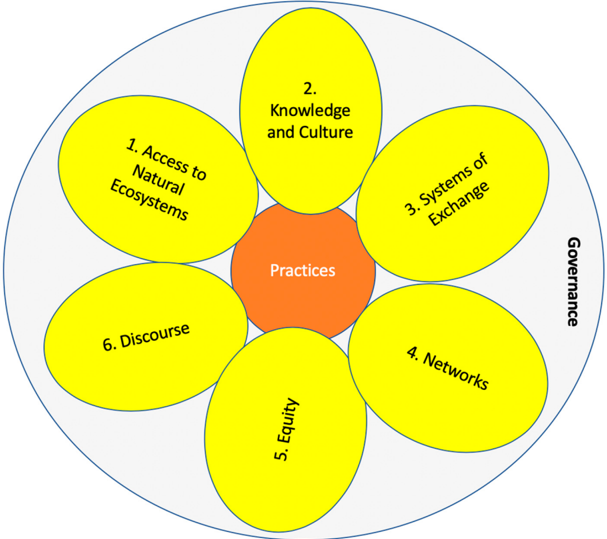
The acceleration of ecological crises has driven a growing body of thinking on sustainability transitions. Agroecology is being promoted as an approach that can address multiple crises in the food system while addressing climate change and contributing to the Sustainable Development Goals. Beyond the more technical definition as, “the ecology of food systems”, agroecology has a fundamentally political dimension. It is based on an aspiration towards autonomy or the agency of networks of producers and citizens to self-organize for sustainability and social justice. In this article, we use the multi-level perspective (MLP) to examine agroecology transformations. Although the MLP has been helpful in conceptualizing historic transitions, there is a need to better understand: (a) the role of and potential to self-organize in the context of power in the dominant regime, and (b) how to shift to bottom-up forms of governance—a weak point in the literature. Our review analyzes the enabling and disabling conditions that shape agroecology transformations and the ability of communities to self-organize. We develop the notion of ‘domains of transformation’ as overlapping and interconnected interfaces between agroecology and the incumbent dominant regime. We present six critical domains that are important in agroecological transformations: access to natural ecosystems; knowledge and culture; systems of exchange; networks; discourse; and gender and equity. The article focuses on the dynamics of power and governance, arguing that a shift from top down technocratic approaches to bottom up forms of governance based on community-self organization across these domains has the most potential for enabling transformation for sustainability and social justice.
Overview
The claims and statistics of this paper haven’t been checked yet.
Free: it reads the open-access text and checks the first 5 claims that cite a source we can check. Create a free account to check every claim.
Integrity signals
Registry
Cites
Statistics
Figures
Verification
Claims the paper makes
The claims and statistics of this paper haven’t been checked yet.
Free: it reads the open-access text and checks the first 5 claims that cite a source we can check. Create a free account to check every claim.
Claims other papers make about this one
Each is checked against this paper’s own text: does it say what the citing paper says it does?
The source backs part of the claim, not all of it — or backs it for a different population, condition or comparison.
In the citing paper
“Engaging in on-farm experiments, however, challenges current scientific approaches such as dealing with variability of farmer management, requiring more frequent communication between researchers and farmers, and maybe also different cross-disciplinary analytical tools (González-Sánchez et al. 2012, Anderson et al. 2019a).”
From A heuristic framework to portray agroecological transition initiatives in reflexive arrangements, illustrated with a conservation agriculture network in Denmark (2025) · cites this paper as Anderson et al. 2019a
Experimental — accuracy not yet measuredThe cited source says what the claim attributes to it.
In the citing paper
“Social networks mediate agroecological transitions by acting as conduits of information, collaboration, and material resources (see review in Anderson et al. 2019a).”
From A heuristic framework to portray agroecological transition initiatives in reflexive arrangements, illustrated with a conservation agriculture network in Denmark (2025) · cites this paper as Anderson et al. 2019a
The cited source says what the claim attributes to it.
In the citing paper
“This focus on horizontal knowledge structures through a facilitative and participatory advisory approach was distinct from the dominant centralized knowledge production and top-down knowledge diffusion (Anderson et al. 2019a).”
From A heuristic framework to portray agroecological transition initiatives in reflexive arrangements, illustrated with a conservation agriculture network in Denmark (2025) · cites this paper as Anderson et al. 2019a
The cited source says what the claim attributes to it.
In the citing paper
“Such an advisory approach strengthens horizontal knowledge structures (Anderson et al. 2019a, Bourne et al. 2021) and enhances the development of farmer skills to solve complex problems arising in their specific context (Cristofari et al. 2017, Charatsari et al. 2019, Bourne et al. 2021, Krafft et al. 2022), which makes it more effective (Ataei et al. 2019, Anderson et al. 2019a).”
From A heuristic framework to portray agroecological transition initiatives in reflexive arrangements, illustrated with a conservation agriculture network in Denmark (2025) · cites this paper as Anderson et al. 2019a
The cited source says what the claim attributes to it.
In the citing paper
“This is not surprising since, according to Anderson et al. (2019), access to natural resources is one of the main lock-ins to the wide-scale use of agroecological practices.”
From Scenarios for an agroecological transition of smallholder family farmers: a case study in Guadeloupe (2022) · cites this paper as Anderson et al. (2019)
2 more claims about this paper
Create a free account to see every claim other papers make about this one.
Self-check
Percentages, sums and reported differences re-computed from the paper’s own numbers.
The self-check needs the paper’s full text.
Citations
Cites
Governing the Commons: The Evolution of Institutions for Collective Action
Ostrom, E. (1990) · doi:10.1017/cbo9780511807763 · Cited by 20,653
Governing the Commons: The Evolution of Institutions for Collective Action
Field, B. C., & Ostrom, E. (1992) · Land Economics · doi:10.2307/3146384 · Cited by 18,859
(1976) · Cited by 10,813
Framing Processes and Social Movements: An Overview and Assessment
Benford, R. D., & Snow, D. A. (2000) · Annual Review of Sociology · doi:10.1146/annurev.soc.26.1.611 · Cited by 9,953 · cited 5×
“Given the dynamic and contested framing of agroecology, discourse on agroecology is in constant flux, and these fluid framing processes influence the direction of the agroecological transition, and the capacity of communities to self-organize and shape agroecological transformations [136,137].”
BackgroundInfluentialTypology of sociotechnical transition pathways
Geels, F. W., & Schot, J. (2007) · Research Policy · doi:10.1016/j.respol.2007.01.003 · Cited by 5,245 · cited 4×
“We then introduce the multi-level perspective—an influential framework for analyzing sustainability transitions [17,18].”
BackgroundInfluentialSustainability transitions: An emerging field of research and its prospects
Markard, J., Raven, R., & Truffer, B. (2012) · Research Policy · doi:10.1016/j.respol.2012.02.013 · Cited by 3,763 · cited 2×
“The regime level involves, “established practices and associated rules that stabilize existing systems” [17,26] where alignments and interdependencies across regime dimensions generate processes of path-dependency or ‘lock-in’ that enable stability and preserve the status quo.”
BackgroundThe multi-level perspective on sustainability transitions: responses to seven criticisms
Geels, F. W. (2011) · Environmental Innovation and Societal Transitions · doi:10.1016/j.eist.2011.02.002 · Cited by 3,092 · cited 3×
“We then introduce the multi-level perspective—an influential framework for analyzing sustainability transitions [17,18].”
BackgroundThe Politics of the Earth: Environmental Discourses
Dryzek, J. S. (1997) · Cited by 3,013
An agenda for sustainability transitions research: State of the art and future directions
Köhler, J., Geels, F. W., Kern, F., Markard, J., Onsongo, E., Wieczorek, A., Alkemade, F., Avelino, F., Bergek, A., Boons, F., et al. (2019) · Environmental Innovation and Societal Transitions · doi:10.1016/j.eist.2019.01.004 · Cited by 2,800 · cited 1×
“Whereas power and governance are not typically the central focus in the sustainability transitions literature [27], our approach is based on the assumption that any transformative system’s change will require an analysis of power and governance.”
BackgroundThe number, size, and distribution of farms, smallholder farms, and family farms worldwide
Lowder, S. K., Skoet, J., & Raney, T. (2016) · World Development · doi:10.1016/j.worlddev.2015.10.041 · Cited by 2,012 · cited 1×
“In addition, processes of land fragmentation and declining average farm size in most of the world’s less industrialized countries over the past several decades are undermining agroecology [56].”
Background
Research works printed but not linked: 6
- 76. Petersen, P.F. Arreglos Institucionales Para la Intensificación Agroecológica. Una Mirada al Caso Brasileño Desde la Agroecología Política. Ph.D. Thesis, Universidad de Pablo de Olavide, Sevilla, Spain, 2017.
- 87. Rivera Ferre, M.; Álvare, I. From a Market Approach to the Centrality of Life: An Urgent Change for Women; Right to Food and Nutrition Watch; Global Network for the Right to Food and Nutrition: Vienna, Austria, 2017; pp. 36-41.
- Campeau, 2018, Equity, equality and non-discrimination to guide food-system reform, UNSCN-News, 45, 7
- Mora, 2018, Inequality and malnutrition, UNSCN-News, 45, 15
- 2014, There will be no agroecology without feminism. The Brazilian case, Sustentabilidade em Debate, 5, 76
- Loconto, 2019, Defining agroecology, Int. J. Sociol. Agric. Food, 25, 116
Cited by
Items 301–374 of 374
Nadirli, N., & Babayev, V. R. (2022) · Agricultural sciences · doi:10.22620/agrisci.2022.32.010
“PGS have the potential to enable transformation towards sustainability (Anderson et al., 2019) but convincing evidence is needed on how PGS promote the transition to more sustainable food system (FAO/INRA, 2016).”
BackgroundM.G.M, V., Petry, C., & J., F. (2020) · Revista Latino-americana de Geografia e Genero · doi:10.5212/rlagg.v.11.i2.0004
Lauvie, A., Nozières-Petit, M.-O., & Couix, N. (2022) · Agroecology and Sustainable Food Systems · doi:10.1080/21683565.2022.2092578
“Research tackles the social dimension of agricultural activities for agroecology from multiple angles, particularly aimed at supporting and enhancing political action (Anderson et al. 2019; De Molina 2013), but also to analyze the ongoing dynamics (Bacon et al. 2012; D’Annolfo et al. 2017).”
BackgroundRuggieri, F., Coulon‐Leroy, C., Mongondry, P., & Mazé, A. (2022) · Acta Horticulturae · doi:10.17660/actahortic.2022.1355.36
Designing farming systems for a sustainable agriculture
Gafsi, M., & Terrieux, A. (2023) · Elsevier eBooks · doi:10.1016/b978-0-323-90500-8.00007-5 · Cited by 2
Sanubari, T. P. E., & Sukmi, S. N. (2023) · Journal of Intercultural Studies · doi:10.1080/07256868.2023.2229255
“As noted by Anderson et al. (2019), knowledge is intimately linked to power and can drive transformative processes based on who possesses and values that knowledge or acts as valid holders and producers of it.”
BackgroundBlay‐Palmer, A., Valette, É., Lepiller, O., & Battista, A. D. (2023) · Routledge eBooks · doi:10.4324/9781003285441-2
A transição alimentar de uma família açoriana em Santa Catarina
Leal, A. N. (2023) · Digital Library of Theses and Dissertations (Universidade de São Paulo) · doi:10.11606/d.6.2023.tde-18092023-162406 · Cited by 1
Altieri, M. A. (2023) · Open Access Journal of Agricultural Research · doi:10.23880/oajar-16000309 · Cited by 2
Lantremange, H., Magrini, M.-B., Frayssignes, J., Fortun‐Lamothe, L., Lauri, P., Lebret, B., Gouis, J. L., Lullien‐Pellerin, V., Nozières-Petit, M.-O., Saint-Gès, V., et al. (2023) · SSRN Electronic Journal · doi:10.2139/ssrn.4665942
Ortiz, E. H. S. (2023) · Magna Scientia UCEVA · doi:10.54502/msuceva.v3n2a10
Gauna, C. P. G., Moreno, M. D. C. H., & Moreno-Calles, A. I. (2024) · Entreciencias diálogos en la Sociedad del Conocimiento · doi:10.22201/enesl.20078064e.2024.26.86759 · Cited by 3
Ramirez-Santos, A. G. (2023) · UPCommons institutional repository (Universitat Politècnica de Catalunya) · doi:10.5821/dissertation-2117-405944
Sustainable intensification of smallholder farming systems in Sub-Saharan Africa and South Asia
Karikari, B., Tetteh, F., Kizito, F., Folorunso, M. A., Mutungi, C., Kotu, B. H., Ansah, T., & Rahman, N. A. (2024) · Frontiers research topics · doi:10.3389/978-2-8325-4647-5
Transitioning to a public-minded food system
Dipieri, M. (2023) · Canadian Food Studies / La Revue canadienne des études sur l alimentation · doi:10.15353/cjds.v10i2.611
Peasant Displacement and Food Sustainability: The Colombian Case
Roldan, C. S., & Méndez-Giraldo, G. A. (2024) · SN Computer Science · doi:10.1007/s42979-024-02877-3
“…m e d e li v e r y op ti on , a nd a d i s t r i bu t e d n e t w o r k b a s e d on t h e c on ce p t o f c o ll ec ti ve l og i s ti c s 6 2019 [ 16 ] F r o m t r a n s iti on t o do m a i n s o f t r a n s f o r m a ti on : g e tti ng t o s u s t a i n a b l e a nd f a i r f ood s y s t e m s…”
Fertile grounds: Co-creating agroecological knowledge in a pluriverse
Steele, J., Steele-McCutchen, C., Gonchikara, S., Hossain, S., & McCutchen, B. (2024) · Elementa Science of the Anthropocene · doi:10.1525/elementa.2023.00080
The Evidence Project: Genetic (geo)engineering in a climate-changing world
de Wit, M. M., & Iles, A. (2024) · Elementa Science of the Anthropocene · doi:10.1525/elementa.2024.00005
Critical Sustainability Transitions: Relaunching local agriculture after declinePreprint
Lopez-Merino, P., Zeppini, P., & Lazaric, N. (2024) · Research Square · doi:10.21203/rs.3.rs-5317338/v1 · Cited by 1
Bacon, C. M., & Sundstrom, W. A. (2025) · Research Square · doi:10.21203/rs.3.rs-4903058/v1
Михайленко, О. (2024) · Економіка та суспільство · doi:10.32782/2524-0072/2024-70-132
Vindevoghel, V., Bocquet, R., & Daudigeos, T. (2025) · SSRN Electronic Journal · doi:10.2139/ssrn.5177291
Bader, C. L., Moeller, N. I., Grard, B., Wezel, A., Féret, S., Andreotti, F., & Vandenbroucke, P. (2025) · Agroecology and Sustainable Food Systems · doi:10.1080/21683565.2025.2489416 · Cited by 1
“…key public institutions to agroecology are only a fraction of money invested toward agricultural development in general (Achterberg and Quiroz 2021; Anderson et al. 2019; Biovision Foundation for Ecological Development & IPES-Food 2020; BothEnds 2022; Botreau, Brochard, and Verrière 2021;…”
What drives agroecological transitions in Africa? A systematic reviewPreprint
Tumuhe, C. L., Katusiime, D., Ssekamatte, D., Muloi, J. M., Bwambale, B. B., Taddeo, S. B., Nuwasasira, R., Kaire, S., Mkindi, A. G., Owot, R., et al. (2025) · Research Square · doi:10.21203/rs.3.rs-6886777/v1
Rhouma, A., Midouni, H., Trifa, Y., Trabelsi, T., Rebaï, A., Benismail, H., Rahmouni, H. B., Turki, S., Beji, S., Beltaifa, L., et al. (2025) · SSRN Electronic Journal · doi:10.2139/ssrn.5759312
Rhouma, A., Midouni, H., Trifa, Y., Trabelsi, T., Rebaï, A., Benismail, H., Rahmouni, H. B., Turki, S., Beji, S., Beltaifa, L., et al. (2025) · SSRN Electronic Journal · doi:10.2139/ssrn.5759314
The Politics Behind the Plate: Inequality, Power, and Food Access Worldwide
Fahrudin, F. I. (2025) · Springer eBooks · doi:10.1007/978-3-030-68127-2_828-1
Haya, H., & Zurayk, R. A. (2026) · Sustainability Science Practice and Policy · doi:10.1080/15487733.2025.2610882
“The discourses of these mobilizations increasingly pose agroecology as a pathway forward (Anderson et al. 2019; Motta 2016).”
Power relations and challenges for organic soy and sustainability transitions in Paraná, Brazil
Cintrão, R. P., Trivilin, M. I., Sigrist, M., Thom, B., Malembaka, R. B., & Jacobi, J. (2026) · The Journal of Peasant Studies · doi:10.1080/03066150.2025.2595445
“The association between ‘greater productivity’ and ‘greater sustainability’ points to polysemy and highlights how disputes over the notion of ‘sustainability’ are related to framing power (Morrison et al. 2019) in the domain of discourse (Anderson et al. 2019).”
InfluentialThe role of civil society networks in catalyzing agroecological transitions in Uganda
Tumuhe, C. L., Katusiime, D., Ssekamatte, D., Muloi, J. M., Audain, K. A., Kamau, H., Byaruhanga, R., & Molina, G. A. R. (2026) · Journal of Agriculture Food Systems and Community Development · doi:10.5304/jafscd.2026.152.004
Ecological Imperialism Revisited: Land Grabs, Resource Frontiers, and Global Demand
Ogwu, M. C., & Izah, S. C. (2026) · World-systems evolution and global futures · doi:10.1007/978-3-032-17639-4_7
Farming with care: Naming, protecting, and sustaining Black farm practices in the US South
Burkett, D., Barnes, J., & Franzen, S. (2026) · Environment and Planning E Nature and Space · doi:10.1177/25148486261427212
“Eventually larger institutions, most notably the FAO began to also turn from Green Revolution paradigms to agroecology which gave these agroecological movements and programs legitimacy (Dourado et al., 2025).”
Marjanović, J., Hammad, S. Y., Turdalieva, S., Nomentsoa, A. F., Eze, U. J., Shipar, S. I., Dorado, J., & Ujj, A. (2026) · Agriculture · doi:10.3390/agriculture16060689 · Cited by 2
Beeby, E., & Evans, J. D. (2026) · Food and Foodways · doi:10.1080/07409710.2026.2650588
“…for themselves which foods they eat and how they produce them (Pimbert 2009; Wittman 2011)—including which traditions to innovate to keep them living—rather than having a rigid preservation mindset imposed on them or being judged because others don’t like them changing (Anderson et al. 2019).”
Lantremange, H., Magrini, M.-B., Frayssignes, J., Fortun‐Lamothe, L., Lauri, P., Lebret, B., Gouis, J. L., Lullien‐Pellerin, V., Nozières-Petit, M.-O., Saint-Gès, V., et al. (2026) · Agroecology and Sustainable Food Systems · doi:10.1080/21683565.2026.2649771
“To understand the “enabling and disabling dynamics” (Anderson et al. 2019) in agrifood value chains, we developed a framework based on the innovation activities conducted by firms, originated in the innovation economics literature by Hekkert et al. (2007) and Bergek et al. (2008).”
Bayiha, G. D. L. P. (2020) · theses.fr (ABES) · doi:10.70675/d259adc0z43ccz404azbf82z38fd06719634
Empowerment of former female migrant workers in rural food security
Handoko, W., Sulaiman, A. I., Prastyanti, S., Sari, L. K., Wijayanti, I. K. E., Windiasih, R., & Rofik, A. (2026) · Multidisciplinary Science Journal · doi:10.31893/multiscience.2026576 · Cited by 2
“Numerous studies indicate that approaches involving communities actively in the planning, implementation, and evaluation stages of programs have higher success rates in sustainably improving local food security (Béné et al., 2019; Anderson et al., 2019).”
InfluentialLooking back to move forward: historical Agroecology and reciprocity in Ecuador and Bolivia
Carrasco-Torrontegui, A., Gallegos-Riofrío, C. A., Méndez, E., Quispe, M., Pintag, M., Pardo, R., Caranqui, M., McCune, N., Bucini, G., Mares, T., et al. (2026) · Agriculture and Human Values · doi:10.1007/s10460-026-10865-x · Cited by 1
“Agroecology aims to transform all aspects of the food system toward greater sustainability and justice (Anderson et al. 2019).”
Self-citationRhouma, A., Midouni, H., Trifa, Y., Trabelsi, T., Rebaï, A., Ismaıl, H. B., Rahmouni, H. B., Turki, S., Beji, S., Beltaifa, L., et al. (2026) · Agricultural Systems · doi:10.1016/j.agsy.2026.104786
Sustainability transitions can revitalize integrated pest management
Gratton, C., & Iuliano, B. G. (2026) · Ecosphere · doi:10.1002/ecs2.70649
Aguirre, G. E. P., Ortiz-Valdés, C., & Rubio, J. S. R. (2026) · Sustainability · doi:10.3390/su18105034
Revisiting organic agriculture and the global food supply, twenty years on
Badgley, C., Perfecto, I., & Moghtader, J. (2026) · Renewable Agriculture and Food Systems · doi:10.1017/s1742170526100416
“Agroecological farming also entails a commitment to social justice in the food system (Anderson et al., 2019; Perfecto and Vandermeer, 2024).”
Contested transition pathways in pastoral landscapes: Stakeholder perspectives on agroecology
Jiren, T. S. (2026) · Agricultural Systems · doi:10.1016/j.agsy.2026.104850
Kaluzi, L., Kambewa, D., & Mambo, I. (2026) · Discover Sustainability · doi:10.1007/s43621-026-03781-x
Martínez-Vérez, A., Lucini, C., & Córdoba-Cely, C. (2026) · Frontiers in Sustainable Food Systems · doi:10.3389/fsufs.2026.1849791
Of crises, advocates, and framings. The formation of agroecology policy landscapes in Peru and Kenya
Hidalgo, F., Blanco, M., Ritter, T. N., Quintero, M., & Mockshell, J. (2026) · World Development Sustainability · doi:10.1016/j.wds.2026.100338
Duché-García, T. T. A., Ferguson, B. G., Vázquez-Nava, L., Cacho, M. M. Y. T. G., Morales, H., Domené-Painenao, O. E., Lopez, V. G., & Rosset, P. (2026) · Frontiers in Sustainable Food Systems · doi:10.3389/fsufs.2026.1858911 · Cited by 1
Kaluzi, L., Kambewa, D., & Mambo, I. (2026) · The Journal of Agricultural Education and Extension · doi:10.1080/1389224x.2026.2685498
Cooperation as resistance: relational foodways in Alberta’s regenerative farming movement
Rozanski, C. (2026) · Food Culture & Society · doi:10.1080/15528014.2026.2701578
Young, J. C., & Skrimizea, E. (2026) · Sustainability Science · doi:10.1007/s11625-026-01871-3
Soto, R. L., Rivera‐Ferre, M. G., Leitheiser, S., Dumont, B., Rossing, W. A. H., Tittonell, P. A., Blaix, C., & Oteros‐Rozas, E. (2026) · Agroecology and Sustainable Food Systems · doi:10.1080/21683565.2026.2703206
van den Berg, L., Krzywoszynska, A., & Turnhout, E. (2026) · Agriculture and Human Values · doi:10.1007/s10460-026-10935-0
“…eco - logical farming practices, farmer led knowledge exchange, alternative markets, and collective experimentation aimed at restoring ecological relations and strengthening farmer agency and democratic influence over food systems (Rosset et al. 2019; Anderson et al. 2019; van der Ploeg 2018).”
Kumari, C., Shukla, R., Maskell, G., Carvalho, T. M. N., Riar, A. S., & Gornott, C. (2026) · Agroecology and Sustainable Food Systems · doi:10.1080/21683565.2026.2710291
Capri, C., Farolfi, C., Zaccone, C., Capri, E., & Lamastra, L. (2026) · Agronomy · doi:10.3390/agronomy16151463
Food Sovereignty and Agroecology in Conflict Zones: Building Resilience Amidst Crisis
Alum, E. U., Ainebyoona, C., Izah, S. C., Ogwu, M. C., Uti, D. E., Egwu, C. K., Alum, R. O., & Govindarajan, R. K. (2026) · Food and Energy Security · doi:10.1002/fes3.70296
Evaluation of the agroecological transition in family farm units in southwestern Colombia
Pachón, E. M., Revelo-Gómez, E. G., Jaimes, A. P., & Díaz, G. F. G. (2026) · Agroecology and Sustainable Food Systems · doi:10.1080/21683565.2026.2710881
Wigboldus, S., Wezel, A., Dauber, J., Migliorini, P., Schmutz, U., & Hassink, J. (2026) · Agroecology and Sustainable Food Systems · doi:10.1080/21683565.2026.2710292 · Cited by 1
Kimuli, I., Nakyejwe, S. L. K., & Kirabira, J. B. (2026) · Next research. · doi:10.1016/j.nexres.2026.102329
Conway, T. M. (2026) · Elementa Science of the Anthropocene · doi:10.1525/elementa.2025.00021 · Cited by 1
Dossa, K. F., & Bissonnette, J. (2026) · Frontiers in Sustainable Food Systems · doi:10.3389/fsufs.2026.1894064
Chirwa, W. B., Liu, X., Zhiyou, Y., Mutai, R. K., Jemi, P., & Mukami, N. L. (2026) · Frontiers in Sustainable Food Systems · doi:10.3389/fsufs.2026.1842276
Montalba, R., Vieli, L., Spirito, F., & Muñoz, E. (2026) · Frontiers in Sustainable Food Systems · doi:10.3389/fsufs.2026.1914152
Cultivating Good Anthropocenes: Innovation Pathways in Agroecological SeedsPreprint
García‐Llorente, M., Pérez‐Ramírez, I., Gutiérrez-Briceño, I., Vizuete, B., & Ochoa, C. Y. (2026) · SSRN Electronic Journal · doi:10.2139/ssrn.7411191
Leslie, I. ". S. (2026) · Society & Natural Resources · doi:10.1080/08941920.2026.2717710
Salazar-Rojas, Á., Sepúlveda, J. E., Castro-Huerta, R., & Altieri, M. A. (2026) · Land · doi:10.3390/land15091671
Unlocking the agroecological transition in intensive farming systems
Delandmeter, M., Bindelle, J., Schutter, O. D., van der Velde, M., Baret, P. V., & Dumont, B. (2026) · Global Food Security · doi:10.1016/j.gfs.2026.100943
Johnson, E., Harris, J., Nisbett, N., Chao, S., & Thow, A. M. (2026) · World Food Policy · doi:10.1002/wfp2.70033
The juçara countermovement in Brazil: agroecology and the (en)countering of commodification
Neira, J., Farley, J., & Filho, A. L. S. (2026) · Agroecology and Sustainable Food Systems · doi:10.1080/21683565.2026.2735864
Díaz-Calderon, J. F., Cañar-Serna, D. Y., & Pachón, E. M. (2026) · Agriculture · doi:10.3390/agriculture16202208
Women’s self-help groups, natural farming, and the gendered politics of agrarian governance in India
Nichols, C. E., & Kumari, N. (2026) · Agriculture and Human Values · doi:10.1007/s10460-026-10997-0
“The last decade has seen increased interest in how agroecological promotion happens “at scale” (Anderson et al. 2020, 2019; Houde-Tremblay et al. 2025), and how mainstream institutions such as national governments, large donors, and corporations are increasingly “adopting” and oftentimes coopting…”
The Politics Behind the Plate: Inequality, Power, and Food Access Worldwide
Fahrudin, F. I. (2026) · Springer eBooks · doi:10.1007/978-3-032-35717-5_828
Monroy‐Sais, A. S., & Astier, M. (2026) · Agroecology and Sustainable Food Systems · doi:10.1080/21683565.2026.2747754
Metadata
- Authors
- Anderson, C. R., Bruil, J., Chappell, M. J., Kiss, C., & Pimbert, M. P.
- Affiliations
- Coventry University (GB)
- Cultivate !, Schuurhoven 29, 6721SM Bennekom, The Netherlands
- Corresponding author
- Anderson, Colin Ray
- Venue
- Sustainability
- Publisher
- MDPI AG
- Published
- 2019-09-25
- Volume
- 11
- Issue
- 19
- Pages
- 5272
- ISSN
- 2071-1050 (ISSN-L)
- OpenAlex
- W2975637527
- Cited by
- 375
- References
- 126
- Citations by year
- 2026: 65 · 2025: 63 · 2024: 57 · 2023: 65 · 2022: 49 · 2021: 47 · 2020: 28 · 2019: 1
- FWCI
- 64.81
- Type
- journal article
- Language
- en
- Open access
- gold
- dx.doi.org
- Licence
- Locations
- Sustainability (publishedVersion, cc-by)
- Pure (Coventry University) (submittedVersion, cc-by)
- RePEc: Research Papers in Economics (submittedVersion)
- DOAJ (DOAJ: Directory of Open Access Journals) (submittedVersion)
- Topics
- Social Sciences › Development › Agriculture, Land Use, Rural Development
- Physical Sciences › Environmental Science › Global and Planetary Change › Sustainability and Climate Change Governance
- Life Sciences › Agricultural and Biological Sciences › Ecology, Evolution, Behavior and Systematics › Agriculture and Rural Development Research
- Keywords
- agroecology, sustainability transitions, food systems, social justice, multi-level perspective, self-organization, bottom-up governance, power relations, community networks, knowledge and culture, discourse, Sustainable Development Goals, climate change
About these checks
Registry, retraction, Cites and statistics results are computed, not judged, with one exception: a printed reference that no index lists is read once by a model before it counts as a citation error. Claims are extracted by a model and kept only when their quote appears verbatim in the text; each cited source is then checked, with a model’s help, for whether it says what the claim relies on. Those verdicts can be wrong — read the claim’s quote and the cited source before relying on one.
Statistics and arithmetic are recomputed, not judged.
Confidence bands are shown only for fields calibrated on our annotated test set. None is calibrated yet, so no band is shown.
What counts as a claim ›How we measure confidence ›How we check this ›
Are you an author, or do you see a problem with this page? Request a review
Data sources
Bibliographic data: Semantic Scholar, OpenAlex, Crossref.
Contains information from the Semantic Scholar Academic Graph Datasets, made available under the ODC Attribution License (ODC-BY 1.0).
Semantic Scholar’s data is described in: Kinney, R., et al. (2023). The Semantic Scholar Open Data Platform. arXiv:2301.10140.
