

The DOI matches its Crossref record; 38 of the 38 references it cites were found in a registry or an index; none of the 53 sources its claims cite is checked for support yet.
Millennials’ Sleep and Unethical Behavior: Testing the Relationship between Sleep and Academic Dishonesty of Millennials in a Korean University
Open accessAbstract
This study empirically examined the impact of sleep quantity and sleep quality on academic dishonesty as a kind of unethical behavior with a sample of 237 millennials in a Korean university. Sleep quantity was calculated by subtracting bedtime, sleep latency, and wake after sleep onset (WASO) from wake-up time. Sleep quality was measured with the Insomnia Scale developed by Jenkins et al. (1988), and all items are reverse coded. Plagiarism and attitudes toward academic dishonesty (ATAD) were selected as unethical behaviors of millennials at the university. The results of this study are as follows: (1) sleep quantity and sleep quality have negative relationships with ego depletion; (2) ego depletion has no significant relationship with plagiarism or ATAD; (3) sleep quantity has no relationship with plagiarism or ATAD; (4) sleep quality has negative relationships with plagiarism and ATAD; (5) all four indirect effects of sleep quantity and sleep quality on plagiarism and ATAD through ego depletion are not significant. Based on the results, theoretical and practical implications are discussed, and the limitations of this study and recommendations for future research are provided.
Overview
AI snapshot
Written from the paper’s full text.
TL;DR
This study tested whether sleep quantity and sleep quality predict academic dishonesty (plagiarism and attitudes toward academic dishonesty) among 237 Korean university millennials, with ego depletion as a proposed mediator. Sleep quality, but not sleep quantity, was negatively related to academic dishonesty, while ego depletion did not mediate the relationships.
Key findings
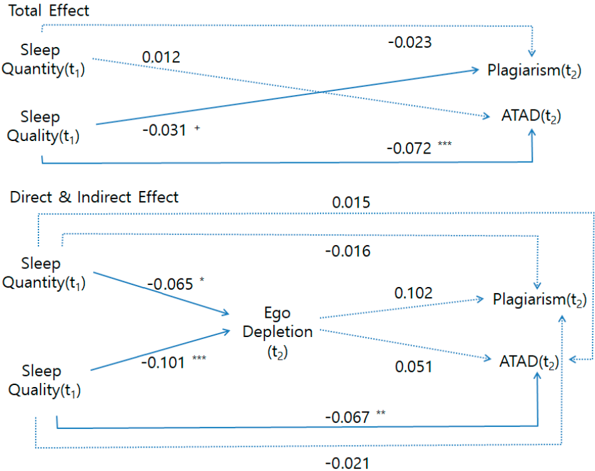
- Sleep quantity and sleep quality were negatively related to ego depletion: B = −0.065, p < 0.05 for sleep quantity; B = −0.101, p < 0.001 for sleep quality.
- Ego depletion was not significantly related to plagiarism (B = 0.102, ns) or ATAD (B = 0.051, ns).
- Sleep quantity was not significantly related to plagiarism (B = −0.023, ns) or ATAD (B = 0.012, ns); sleep quality was negatively related to plagiarism (B = −0.031, p < 0.1) and ATAD (B = −0.072, p < 0.001).
- All four indirect effects through ego depletion were not significant; for example, sleep quality → ego depletion → plagiarism was −0.010, 95% CI (−0.025, 0.003), and sleep quality → ego depletion → ATAD was −0.005, 95% CI (−0.023, 0.012).
Methods
- Sample: 237 millennials enrolled in management courses at a Korean university; data collected across two semesters, with 105 students in the first semester and 132 in the second, using two surveys per semester. Sleep was measured in the first survey; plagiarism, ATAD, ego depletion, and time demand were measured in the second survey.
- Measures: sleep quantity was calculated from Pittsburgh Sleep Diary reports of bedtime, sleep latency, and WASO subtracted from wake-up time; sleep quality used the Jenkins et al. Insomnia Scale reverse-coded; plagiarism used Ellahi et al.’s 4-item scale; ATAD used Davis et al.’s 4-item scale; ego depletion used 4 items from the State Self-Control Capacity Scale. Controls included gender, time demand, and exercise.
- Analysis: factor analysis, correlations, hierarchical regression, and mediation tests using bias-corrected bootstrap confidence intervals over 5000 iterations.
Limitations
- The paper states that future research should control a person’s desire to behave unethically, because the study examined only willpower/ego depletion and not desire as a possible moderator.
- The paper states that because the sample completed two surveys with all self-rated variables, future research should limit common method effects by having a focal person’s manager rate unethical behavior and by partialing out trait affectivity.
- Evident from the text: the sample is limited to 237 undergraduates in management courses at one Korean university, mostly male (154 males, 83 females), and all focal variables are self-reported, so generalizability and causal inference are constrained.
Model-written summary. Check it against the paper before relying on it.
Integrity signals
Registry
Cites
Statistics
Figures
Verification
Claims the paper makes
22 No full text of the sources · 20 Own result · 11 Check pending · 10 Own method · 9 Own interpretation · 5 Not checked yet · 1 No basis given
A result the paper reports from its own data — it cites no other source for it, so there is none to check. The quote shows it is in the paper.
In the paper
“Plagiarism and ATAD are positively related as two kinds of academic dishonesty.”
§ Millennials' Sleep and Unethical Behavior: Testing the Relationship between Sleep and Academic Dishonesty of Millennials in a Korean University > 4. Results
plaincorrelational- Asserted: passes — The authors put it forward as true.
- Checkable: passes — It can be checked against evidence.
- Load-bearing: unclear — It is unclear whether the paper’s conclusions depend on it.
- Based: passes — The paper gives a reason why it holds.
A result the paper reports from its own data — it cites no other source for it, so there is none to check. The quote shows it is in the paper.
In the paper
“sleep quantity and sleep quality have negative relationships with ego depletion”
- Also stated in: § 4. Results · plain
“sleep quantity has a negative relationship with ego depletion (B = -0.065,p < 0.05)”
- Also stated in: § 5. Discussion · plain
“sleep quantity and sleep quality have negative relationships with ego depletion”
§ Millennials' Sleep and Unethical Behavior: Testing the Relationship between Sleep and Academic Dishonesty of Millennials in a Korean University > Abstract
plaincorrelational- Asserted: passes — The authors put it forward as true.
- Checkable: passes — It can be checked against evidence.
- Load-bearing: passes — The paper’s conclusions depend on it.
- Based: passes — The paper gives a reason why it holds.
- Also stated in: § 4. Results · plain
A result the paper reports from its own data — it cites no other source for it, so there is none to check. The quote shows it is in the paper.
In the paper
“Among sleep and academic dishonesty variables, only sleep quality is significantly related to ATAD.”
§ Millennials' Sleep and Unethical Behavior: Testing the Relationship between Sleep and Academic Dishonesty of Millennials in a Korean University > 4. Results
plaincorrelational- Asserted: passes — The authors put it forward as true.
- Checkable: passes — It can be checked against evidence.
- Load-bearing: passes — The paper’s conclusions depend on it.
- Based: passes — The paper gives a reason why it holds.
A result the paper reports from its own data — it cites no other source for it, so there is none to check. The quote shows it is in the paper.
In the paper
“sleep quantity has no relationship with plagiarism or ATAD”
- Also stated in: § 4. Results · plain
“sleep quantity does not have any significant relationships with plagiarism (B = -0.023,not significant)”
§ Millennials' Sleep and Unethical Behavior: Testing the Relationship between Sleep and Academic Dishonesty of Millennials in a Korean University > Abstract
plain- Asserted: passes — The authors put it forward as true.
- Checkable: passes — It can be checked against evidence.
- Load-bearing: passes — The paper’s conclusions depend on it.
- Based: passes — The paper gives a reason why it holds.
- Also stated in: § 4. Results · plain
A result the paper reports from its own data — it cites no other source for it, so there is none to check. The quote shows it is in the paper.
In the paper
“sleep quality has negative relationships with plagiarism and ATAD”
- Also stated in: § 4. Results · plain
“Sleep quality has significant relationships with plagiarism (B = -0.031,p < 0.1) and ATAD (B = -0.072,p < 0.001).”
§ Millennials' Sleep and Unethical Behavior: Testing the Relationship between Sleep and Academic Dishonesty of Millennials in a Korean University > Abstract
plaincorrelational- Asserted: passes — The authors put it forward as true.
- Checkable: passes — It can be checked against evidence.
- Load-bearing: passes — The paper’s conclusions depend on it.
- Based: passes — The paper gives a reason why it holds.
- Also stated in: § 4. Results · plain
A result the paper reports from its own data — it cites no other source for it, so there is none to check. The quote shows it is in the paper.
In the paper
“sleep quantity has no relationship with plagiarism or ATAD”
- Also stated in: § 4. Results · plain
“sleep quantity does not have any significant relationships with plagiarism (B = -0.023,not significant) and ATAD (B = 0.012, not significant), respectively.”
§ Millennials' Sleep and Unethical Behavior: Testing the Relationship between Sleep and Academic Dishonesty of Millennials in a Korean University > Abstract
plain- Asserted: passes — The authors put it forward as true.
- Checkable: passes — It can be checked against evidence.
- Load-bearing: passes — The paper’s conclusions depend on it.
- Based: passes — The paper gives a reason why it holds.
- Also stated in: § 4. Results · plain
A result the paper reports from its own data — it cites no other source for it, so there is none to check. The quote shows it is in the paper.
In the paper
“ego depletion has no significant relationship with plagiarism or ATAD”
- Also stated in: § 4. Results · plain
“ego depletion does not have any significant relationships with plagiarism (B = 0.102, not significant)”
- Also stated in: § 5. Discussion · plain
“ego depletion has no significant relationship with plagiarism or ATAD”
- Also stated in: § 5. Discussion · plain
“Ego depletion has no significant effect on academic dishonesty, including plagiarism and ATAD.”
§ Millennials' Sleep and Unethical Behavior: Testing the Relationship between Sleep and Academic Dishonesty of Millennials in a Korean University > Abstract
plain- Asserted: passes — The authors put it forward as true.
- Checkable: passes — It can be checked against evidence.
- Load-bearing: passes — The paper’s conclusions depend on it.
- Based: passes — The paper gives a reason why it holds.
- Also stated in: § 4. Results · plain
None of the sources cited for this claim have been checked yet.
In the paper
“Sleep quantity and sleep quality have a marginal correlation of 0.14, as Barnes et al. [14] reported between-individual correlations of 0.11 in study 3 and 0.07 in study 4.”
§ Millennials' Sleep and Unethical Behavior: Testing the Relationship between Sleep and Academic Dishonesty of Millennials in a Korean University > 4. Results
plaincorrelational- Asserted: passes — The authors put it forward as true.
- Checkable: passes — It can be checked against evidence.
- Load-bearing: unclear — It is unclear whether the paper’s conclusions depend on it.
- Based: passes — The paper gives a reason why it holds.
A result the paper reports from its own data — it cites no other source for it, so there is none to check. The quote shows it is in the paper.
In the paper
“Among ego depletion and academic dishonesty variables, only plagiarism is significantly related to ego depletion.”
§ Millennials' Sleep and Unethical Behavior: Testing the Relationship between Sleep and Academic Dishonesty of Millennials in a Korean University > 4. Results
plaincorrelational- Asserted: passes — The authors put it forward as true.
- Checkable: passes — It can be checked against evidence.
- Load-bearing: passes — The paper’s conclusions depend on it.
- Based: passes — The paper gives a reason why it holds.
A result the paper reports from its own data — it cites no other source for it, so there is none to check. The quote shows it is in the paper.
In the paper
“sleep quantity and sleep quality have negative relationships with ego depletion”
- Also stated in: § 4. Results · plain
“sleep quality also has a negative relationship with ego depletion (B = -0.101,p < 0.001)”
- Also stated in: § 5. Discussion · plain
“sleep quantity and sleep quality have negative relationships with ego depletion”
§ Millennials' Sleep and Unethical Behavior: Testing the Relationship between Sleep and Academic Dishonesty of Millennials in a Korean University > Abstract
plaincorrelational- Asserted: passes — The authors put it forward as true.
- Checkable: passes — It can be checked against evidence.
- Load-bearing: passes — The paper’s conclusions depend on it.
- Based: passes — The paper gives a reason why it holds.
- Also stated in: § 4. Results · plain
- The quote only partly states this claim. 1
- It may state two separate claims as one. 6
- Probably not a substantial claim. 26
A result the paper reports from its own data — it cites no other source for it, so there is none to check. The quote shows it is in the paper.
In the paper
“sleep quality has negative relationships with plagiarism and ATAD”
- Also stated in: § 4. Results · plain
“Sleep quality has significant relationships with plagiarism (B = -0.031,p < 0.1)”
§ Millennials' Sleep and Unethical Behavior: Testing the Relationship between Sleep and Academic Dishonesty of Millennials in a Korean University > Abstract
plaincorrelational- Asserted: passes — The authors put it forward as true.
- Checkable: passes — It can be checked against evidence.
- Load-bearing: passes — The paper’s conclusions depend on it.
- Based: passes — The paper gives a reason why it holds.
The quote only partly states this claim.
- Also stated in: § 4. Results · plain
A result the paper reports from its own data — it cites no other source for it, so there is none to check. The quote shows it is in the paper.
In the paper
“The mean values of plagiarism and ATAD are 1.95 and 2.29 in this study.”
§ Millennials' Sleep and Unethical Behavior: Testing the Relationship between Sleep and Academic Dishonesty of Millennials in a Korean University > 5. Discussion
plain- Asserted: passes — The authors put it forward as true.
- Checkable: passes — It can be checked against evidence.
- Load-bearing: unclear — It is unclear whether the paper’s conclusions depend on it.
- Based: passes — The paper gives a reason why it holds.
It may state two separate claims as one.
A result the paper reports from its own data — it cites no other source for it, so there is none to check. The quote shows it is in the paper.
In the paper
“They sleep less than 7 h, only 6 h and 42 min.”
§ Millennials' Sleep and Unethical Behavior: Testing the Relationship between Sleep and Academic Dishonesty of Millennials in a Korean University > 5. Discussion
plain- Asserted: passes — The authors put it forward as true.
- Checkable: passes — It can be checked against evidence.
- Load-bearing: unclear — It is unclear whether the paper’s conclusions depend on it.
- Based: passes — The paper gives a reason why it holds.
It may state two separate claims as one.
A conclusion the paper draws from its own results — it cites no other source for it, so there is none to check. The quote shows it is in the paper.
In the paper
“In other words, people who have been depleted the self-regulation resource are more likely to do the academic dishonesty.”
§ Millennials' Sleep and Unethical Behavior: Testing the Relationship between Sleep and Academic Dishonesty of Millennials in a Korean University > Hypothesis 1. (a) Sleep quantity and (b) sleep quality will be negatively related to ego depletion.
hedgedcorrelational- Asserted: passes — The authors put it forward as true.
- Checkable: passes — It can be checked against evidence.
- Load-bearing: passes — The paper’s conclusions depend on it.
- Based: fails — The paper may give no reason why it holds.
Probably not a substantial claim. The paper may give no reason why it holds.
- The authors state this as an assumption: Under the Ego Depletion Model, self-control activities draw from a common, limited resource.
In the paper
“Many studies showed that sleep was negatively related to unethical behavior [14][15][16][17], and that ego depletion mediated the relationship between sleep and unethical behavior [14,16,17].”
§ Millennials' Sleep and Unethical Behavior: Testing the Relationship between Sleep and Academic Dishonesty of Millennials in a Korean University > Hypothesis 2. Ego depletion will be positively related to academic dishonesty.
What the sources say
- Not checked — no full text of the sourcecites [14] Barnes, 2011, Lack of sleep and unethical conduct, Organ. Behav. Hum. Decis. Process. source
- Check pendingcites [15] Christian, 2011, Examining the effects of sleep deprivation on workplace deviance: A self-regulatory perspective, Acad. Manag. J. source
- Check pendingcites [16] Welsh, 2014, Building a self-regulatory model of sleep deprivation and deception: The role of caffeine and social influence, J. Appl. Psychol. source
- Not checked — no full text of the sourcecites [17] Welsh, 2018, Overcoming the effects of sleep deprivation on unethical behavior: An extension of integrated self-control theory, J. Exp. Soc. Psychol. source
plaincorrelational- Asserted: passes — The authors put it forward as true.
- Checkable: passes — It can be checked against evidence.
- Load-bearing: passes — The paper’s conclusions depend on it.
- Based: passes — The paper gives a reason why it holds.
Probably not a substantial claim.
In the paper
“Many studies showed that sleep was negatively related to unethical behavior [14][15][16][17], and that ego depletion mediated the relationship between sleep and unethical behavior [14,16,17].”
§ Millennials' Sleep and Unethical Behavior: Testing the Relationship between Sleep and Academic Dishonesty of Millennials in a Korean University > Hypothesis 2. Ego depletion will be positively related to academic dishonesty.
What the sources say
- Not checked — no full text of the sourcecites [14] Barnes, 2011, Lack of sleep and unethical conduct, Organ. Behav. Hum. Decis. Process. source
- Check pendingcites [16] Welsh, 2014, Building a self-regulatory model of sleep deprivation and deception: The role of caffeine and social influence, J. Appl. Psychol. source
- Not checked — no full text of the sourcecites [17] Welsh, 2018, Overcoming the effects of sleep deprivation on unethical behavior: An extension of integrated self-control theory, J. Exp. Soc. Psychol. source
plaindirect- Asserted: passes — The authors put it forward as true.
- Checkable: passes — It can be checked against evidence.
- Load-bearing: passes — The paper’s conclusions depend on it.
- Based: passes — The paper gives a reason why it holds.
Probably not a substantial claim.
What the paper did — it cites no source for this, so there is none to check. The quote shows it is in the paper.
In the paper
“The overlap between the students in the first semester and in the second semester is only three students.”
§ Millennials' Sleep and Unethical Behavior: Testing the Relationship between Sleep and Academic Dishonesty of Millennials in a Korean University > 3. Method
plain- Asserted: passes — The authors put it forward as true.
- Checkable: passes — It can be checked against evidence.
- Load-bearing: fails — The paper’s conclusions may not depend on it.
- Based: passes — The paper gives a reason why it holds.
Probably not a substantial claim. The paper’s conclusions may not depend on it.
In the paper
“Among various kinds of academic dishonesty, plagiarism is more common among millennials because their integration of IT into their lives easily provides temptation for copying others' thoughts and writing, and they also lack basic literary fundamentals and have short attention spans [1].”
§ Millennials' Sleep and Unethical Behavior: Testing the Relationship between Sleep and Academic Dishonesty of Millennials in a Korean University > 2. Theoretical Background and Hypotheses
What the sources say
- Not checked — no full text of the sourcecites [1] Weber, 2017, Discovering the millennials’ personal values orientation: A comparison to two managerial populations, J. Bus. Ethics source
plaindirect- Asserted: passes — The authors put it forward as true.
- Checkable: passes — It can be checked against evidence.
- Load-bearing: fails — The paper’s conclusions may not depend on it.
- Based: passes — The paper gives a reason why it holds.
Probably not a substantial claim. The paper’s conclusions may not depend on it. It may state two separate claims as one.
In the paper
“Sleep deprivation is a negative function of both sleep quantity and sleep quality, which show”
§ Millennials' Sleep and Unethical Behavior: Testing the Relationship between Sleep and Academic Dishonesty of Millennials in a Korean University > 2. Theoretical Background and Hypotheses
What the sources say
- Not checked — no full text of the sourcecites [17] Welsh, 2018, Overcoming the effects of sleep deprivation on unethical behavior: An extension of integrated self-control theory, J. Exp. Soc. Psychol. source
- Not checked — no full text of the sourcecites [29] Barnes, 2012, Working in our sleep: Sleep and self-regulation in organizations, Organ. Psychol. Rev. source
- Check pendingcites [30] Štefan, L., Vučetić, V., Vrgoć, G., and Sporiš, G. (2018). Sleep duration and sleep quality as predictors of health in elderly individuals. Sustainability, 10. source
plaindirect- Asserted: passes — The authors put it forward as true.
- Checkable: passes — It can be checked against evidence.
- Load-bearing: passes — The paper’s conclusions depend on it.
- Based: passes — The paper gives a reason why it holds.
Probably not a substantial claim.
In the paper
“Some are included as control variables, such as gender, time demand, and exercise [14].”
§ Millennials' Sleep and Unethical Behavior: Testing the Relationship between Sleep and Academic Dishonesty of Millennials in a Korean University > 3. Method
What the sources say
- Not checked — no full text of the sourcecites [14] Barnes, 2011, Lack of sleep and unethical conduct, Organ. Behav. Hum. Decis. Process. source
plain- Asserted: passes — The authors put it forward as true.
- Checkable: passes — It can be checked against evidence.
- Load-bearing: fails — The paper’s conclusions may not depend on it.
- Based: passes — The paper gives a reason why it holds.
Probably not a substantial claim. The paper’s conclusions may not depend on it.
In the paper
“Further regression models did not have any problems at multicollinearity indices such as variance inflation factor, tolerance, eigenvalue, and condition index [40].”
§ Millennials' Sleep and Unethical Behavior: Testing the Relationship between Sleep and Academic Dishonesty of Millennials in a Korean University > 4. Results
What the sources say
- Not checked yetcites [40] Hair, J.E., Anderson, R.E., Tatham, R.L., and Black, W.C. (1995). Multivariate Data Analysis with Readings, Prentice-Hall. [4th ed.].
plain- Asserted: passes — The authors put it forward as true.
- Checkable: passes — It can be checked against evidence.
- Load-bearing: fails — The paper’s conclusions may not depend on it.
- Based: passes — The paper gives a reason why it holds.
Probably not a substantial claim. The paper’s conclusions may not depend on it.
In the paper
“prior studies on self-regulation and unethical behavior have typically focused on low willpower (i.e., ego depletion) instead of strong desire as the reason for self-regulatory problems.”
§ Millennials' Sleep and Unethical Behavior: Testing the Relationship between Sleep and Academic Dishonesty of Millennials in a Korean University > 5. Discussion
What the sources say
- Check pendingcites [10] Seuntjens, 2019, Greedy bastards: Testing the relationship between wanting more and unethical behavior, Pers. Individ. Differ. source
plain- Asserted: passes — The authors put it forward as true.
- Checkable: passes — It can be checked against evidence.
- Load-bearing: passes — The paper’s conclusions depend on it.
- Based: passes — The paper gives a reason why it holds.
Probably not a substantial claim.
In the paper
“Baumeister et al. [25] speculated that sleep is needed to replenish the self-regulatory resource postulated in their Ego Depletion Model.”
§ Millennials' Sleep and Unethical Behavior: Testing the Relationship between Sleep and Academic Dishonesty of Millennials in a Korean University > 2. Theoretical Background and Hypotheses
What the sources say
- Not checked — no full text of the sourcecites Baumeister et al. [25] Baumeister, 2000, Edo depletion: A resources model of volition, self-regulation, and controlled processing, Soc. Cogn. source
hedgedconditional- Asserted: passes — The authors put it forward as true.
- Checkable: passes — It can be checked against evidence.
- Load-bearing: passes — The paper’s conclusions depend on it.
- Based: passes — The paper gives a reason why it holds.
Probably not a substantial claim.
In the paper
“Henderson and Horan [42] showed that sleep quality is more related to work performance than sleep quantity through the meta-analysis.”
§ Millennials' Sleep and Unethical Behavior: Testing the Relationship between Sleep and Academic Dishonesty of Millennials in a Korean University > 5. Discussion
What the sources say
- Not checked — no full text of the sourcecites [42] Henderson, A., and Horan, K. (2019, January 13). A meta-analysis of sleep and work performance. Proceedings of the Annual Meeting of the Academy of Management, Boston, MA, USA. source
plaincorrelational- Asserted: passes — The authors put it forward as true.
- Checkable: passes — It can be checked against evidence.
- Load-bearing: fails — The paper’s conclusions may not depend on it.
- Based: passes — The paper gives a reason why it holds.
Probably not a substantial claim. The paper’s conclusions may not depend on it.
What the paper did — it cites no source for this, so there is none to check. The quote shows it is in the paper.
In the paper
“because the sample completed two surveys with all self-rated variables”
§ Millennials' Sleep and Unethical Behavior: Testing the Relationship between Sleep and Academic Dishonesty of Millennials in a Korean University > 5. Discussion
plain- Asserted: passes — The authors put it forward as true.
- Checkable: passes — It can be checked against evidence.
- Load-bearing: passes — The paper’s conclusions depend on it.
- Based: passes — The paper gives a reason why it holds.
Probably not a substantial claim. It may state two separate claims as one.
What the paper did — it cites no source for this, so there is none to check. The quote shows it is in the paper.
In the paper
“Although unethical behavior is a function of willpower and desire, this study only examined willpower and ego depletion.”
§ Millennials' Sleep and Unethical Behavior: Testing the Relationship between Sleep and Academic Dishonesty of Millennials in a Korean University > 5. Discussion
plain- Asserted: passes — The authors put it forward as true.
- Checkable: passes — It can be checked against evidence.
- Load-bearing: passes — The paper’s conclusions depend on it.
- Based: passes — The paper gives a reason why it holds.
Probably not a substantial claim.
- Rests on an assumption: Unethical behavior is a function of willpower and desire.
What the paper did — it cites no source for this, so there is none to check. The quote shows it is in the paper.
In the paper
“Finally, because the sample completed two surveys with all self-rated variables, future research needs to further limit the potential for common method effects”
§ Millennials' Sleep and Unethical Behavior: Testing the Relationship between Sleep and Academic Dishonesty of Millennials in a Korean University > 5. Discussion
hedged- Asserted: passes — The authors put it forward as true.
- Checkable: passes — It can be checked against evidence.
- Load-bearing: fails — The paper’s conclusions may not depend on it.
- Based: passes — The paper gives a reason why it holds.
Probably not a substantial claim. The paper’s conclusions may not depend on it.
In the paper
“The result is similar to study 2 of Barnes et al. [14].”
§ Millennials' Sleep and Unethical Behavior: Testing the Relationship between Sleep and Academic Dishonesty of Millennials in a Korean University > 5. Discussion
What the sources say
- Not checked — no full text of the sourcecites [14] Barnes, 2011, Lack of sleep and unethical conduct, Organ. Behav. Hum. Decis. Process. source
plain- Asserted: passes — The authors put it forward as true.
- Checkable: passes — It can be checked against evidence.
- Load-bearing: fails — The paper’s conclusions may not depend on it.
- Based: passes — The paper gives a reason why it holds.
Probably not a substantial claim. The paper’s conclusions may not depend on it.
A conclusion the paper draws from its own results — it cites no other source for it, so there is none to check. The quote shows it is in the paper.
In the paper
“They need self-regulation to overcome the temptation to engage in academic dishonesty.”
§ Millennials' Sleep and Unethical Behavior: Testing the Relationship between Sleep and Academic Dishonesty of Millennials in a Korean University > Hypothesis 1. (a) Sleep quantity and (b) sleep quality will be negatively related to ego depletion.
plaindirect- Asserted: passes — The authors put it forward as true.
- Checkable: fails — It may be too vague to check against evidence.
- Load-bearing: passes — The paper’s conclusions depend on it.
- Based: fails — The paper may give no reason why it holds.
Probably not a substantial claim. It may be too vague to check against evidence. The paper may give no reason why it holds.
In the paper
“Academic dishonesty is easy, because the integration of IT into their lives provides the temptation for copying others' thoughts and writing [1].”
§ Millennials' Sleep and Unethical Behavior: Testing the Relationship between Sleep and Academic Dishonesty of Millennials in a Korean University > Hypothesis 1. (a) Sleep quantity and (b) sleep quality will be negatively related to ego depletion.
What the sources say
- Not checked — no full text of the sourcecites [1] Weber, 2017, Discovering the millennials’ personal values orientation: A comparison to two managerial populations, J. Bus. Ethics source
plaindirect- Asserted: passes — The authors put it forward as true.
- Checkable: fails — It may be too vague to check against evidence.
- Load-bearing: fails — The paper’s conclusions may not depend on it.
- Based: passes — The paper gives a reason why it holds.
Probably not a substantial claim. It may be too vague to check against evidence. The paper’s conclusions may not depend on it.
In the paper
“The average amount of sleep of U.S. citizen is 7 h and 45 min [43].”
§ Millennials' Sleep and Unethical Behavior: Testing the Relationship between Sleep and Academic Dishonesty of Millennials in a Korean University > 5. Discussion
What the sources say
- Not checked — no full text of the sourcecites [43] Barnes, 2009, Changing to daylight saving time cuts into sleep and increases workplace injuries, J. Appl. Psychol. source
plain- Asserted: passes — The authors put it forward as true.
- Checkable: passes — It can be checked against evidence.
- Load-bearing: fails — The paper’s conclusions may not depend on it.
- Based: passes — The paper gives a reason why it holds.
Probably not a substantial claim. The paper’s conclusions may not depend on it.
In the paper
“Only sleep duration has a negative impact on cheating behavior, whereas cognitive fatigue has no impact on cheating behavior.”
§ Millennials' Sleep and Unethical Behavior: Testing the Relationship between Sleep and Academic Dishonesty of Millennials in a Korean University > 5. Discussion
What the sources say
- Not checked — no full text of the sourcecites [14] Barnes, 2011, Lack of sleep and unethical conduct, Organ. Behav. Hum. Decis. Process. source
plaindirect- Asserted: passes — The authors put it forward as true.
- Checkable: passes — It can be checked against evidence.
- Load-bearing: passes — The paper’s conclusions depend on it.
- Based: passes — The paper gives a reason why it holds.
It may state two separate claims as one.
In the paper
“Sleep quantity and sleep quality are employees' individual differences, which may vary over time [14].”
§ Millennials' Sleep and Unethical Behavior: Testing the Relationship between Sleep and Academic Dishonesty of Millennials in a Korean University > 5. Discussion
What the sources say
- Not checked — no full text of the sourcecites [14] Barnes, 2011, Lack of sleep and unethical conduct, Organ. Behav. Hum. Decis. Process. source
hedged- Asserted: passes — The authors put it forward as true.
- Checkable: passes — It can be checked against evidence.
- Load-bearing: passes — The paper’s conclusions depend on it.
- Based: passes — The paper gives a reason why it holds.
Probably not a substantial claim. It may state two separate claims as one.
A conclusion the paper draws from its own results — it cites no other source for it, so there is none to check. The quote shows it is in the paper.
In the paper
“Without self-regulation, they will be academically dishonest.”
§ Millennials' Sleep and Unethical Behavior: Testing the Relationship between Sleep and Academic Dishonesty of Millennials in a Korean University > Hypothesis 1. (a) Sleep quantity and (b) sleep quality will be negatively related to ego depletion.
plaindirect- Asserted: passes — The authors put it forward as true.
- Checkable: passes — It can be checked against evidence.
- Load-bearing: passes — The paper’s conclusions depend on it.
- Based: fails — The paper may give no reason why it holds.
Probably not a substantial claim. The paper may give no reason why it holds.
In the paper
“Ethical factors, including unethical behavior, are an important dimension of sustainability [18].”
§ Millennials' Sleep and Unethical Behavior: Testing the Relationship between Sleep and Academic Dishonesty of Millennials in a Korean University > 2. Theoretical Background and Hypotheses
What the sources say
- Check pendingcites [18] Cuadrado, D., Salgado, J.F., and Moscoso, S. (2019). Prevalence and correlates of academic dishonesty: Towards a sustainable university. Sustainability, 11. source
plain- Asserted: passes — The authors put it forward as true.
- Checkable: passes — It can be checked against evidence.
- Load-bearing: fails — The paper’s conclusions may not depend on it.
- Based: passes — The paper gives a reason why it holds.
Probably not a substantial claim. The paper’s conclusions may not depend on it.
In the paper
“Prior studies have examined relatively static individual differences, such as conscientiousness, agreeableness, general mental ability, sex, age, emotional stability, extraversion, and openness to experience, as antecedents of academic dishonesty [18].”
§ Millennials' Sleep and Unethical Behavior: Testing the Relationship between Sleep and Academic Dishonesty of Millennials in a Korean University > 5. Discussion
What the sources say
- Check pendingcites [18] Cuadrado, D., Salgado, J.F., and Moscoso, S. (2019). Prevalence and correlates of academic dishonesty: Towards a sustainable university. Sustainability, 11. source
plaincorrelational- Asserted: passes — The authors put it forward as true.
- Checkable: passes — It can be checked against evidence.
- Load-bearing: passes — The paper’s conclusions depend on it.
- Based: passes — The paper gives a reason why it holds.
Probably not a substantial claim.
In the paper
“Some studies empirically found that the usage of cell phones late at night negatively influenced sleep quantity and quality [13].”
§ Millennials' Sleep and Unethical Behavior: Testing the Relationship between Sleep and Academic Dishonesty of Millennials in a Korean University > 1. Introduction
What the sources say
- Not checked — no full text of the sourcecites [13] Barnes, 2016, Sabotaging the benefits of our own human capital: Work unit characteristics and sleep, J. Appl. Psychol. source
plaindirect- Asserted: passes — The authors put it forward as true.
- Checkable: passes — It can be checked against evidence.
- Load-bearing: fails — The paper’s conclusions may not depend on it.
- Based: passes — The paper gives a reason why it holds.
Probably not a substantial claim. The paper’s conclusions may not depend on it.
In the paper
“More than 80% of them sleep with a cell phone at their bedside in order to respond to texts, emails, or tweets immediately [12].”
§ Millennials' Sleep and Unethical Behavior: Testing the Relationship between Sleep and Academic Dishonesty of Millennials in a Korean University > 1. Introduction
What the sources say
- Not checked yetcites [12] Pew Research Center (2019, January 11). Millennials: A Portrait of Generation Next—Confident. Available online: www.pewresearch.org/millennials.
plain- Asserted: passes — The authors put it forward as true.
- Checkable: passes — It can be checked against evidence.
- Load-bearing: fails — The paper’s conclusions may not depend on it.
- Based: passes — The paper gives a reason why it holds.
Probably not a substantial claim. The paper’s conclusions may not depend on it.
In the paper
“Academic dishonesty is a persistent and pervasive unethical behavior on college campuses in the world, including in the United States and the Republic of Korea [18][19][20].”
§ Millennials' Sleep and Unethical Behavior: Testing the Relationship between Sleep and Academic Dishonesty of Millennials in a Korean University > 1. Introduction
What the sources say
- Check pendingcites [18] Cuadrado, D., Salgado, J.F., and Moscoso, S. (2019). Prevalence and correlates of academic dishonesty: Towards a sustainable university. Sustainability, 11. source
- Not checked — no full text of the sourcecites [19] Ellahi, 2013, Multi campus investigation of academic dishonesty in higher education of Pakistan, Int. J. Educ. Manag. source
- Not checked — no full text of the sourcecites [20] Bolin, 2004, Self-control, perceived opportunity, and attitudes as predictors of academic dishonesty, J. Psychol. source
plain- Asserted: passes — The authors put it forward as true.
- Checkable: passes — It can be checked against evidence.
- Load-bearing: fails — The paper’s conclusions may not depend on it.
- Based: passes — The paper gives a reason why it holds.
Probably not a substantial claim. The paper’s conclusions may not depend on it.
A conclusion the paper draws from its own results — it cites no other source for it, so there is none to check. The quote shows it is in the paper.
In the paper
“Students could benefit from academic dishonesty, including plagiarism.”
§ Millennials' Sleep and Unethical Behavior: Testing the Relationship between Sleep and Academic Dishonesty of Millennials in a Korean University > Hypothesis 1. (a) Sleep quantity and (b) sleep quality will be negatively related to ego depletion.
hedged- Asserted: passes — The authors put it forward as true.
- Checkable: fails — It may be too vague to check against evidence.
- Load-bearing: fails — The paper’s conclusions may not depend on it.
- Based: fails — The paper may give no reason why it holds.
Probably not a substantial claim. It may be too vague to check against evidence. The paper’s conclusions may not depend on it. The paper may give no reason why it holds.
The authors state this as an assumption.
Under the Ego Depletion Model, self-control activities draw from a common, limited resource.
“Self-control activities draw from a common resource under the Ego Depletion Model [22].”
The authors state this as an assumption.
A person's self-regulatory resource is limited and can be depleted over time through self-regulation.
“A person could be depleted over time as one engages in self-regulation, because one's self-regulatory resource is limited.”
The paper relies on this without support.
The sampled Korean university students are representative of millennials generally.
“The results of this study showed that millennials with sleep problems are more likely to behave unethically, including being academically dishonest.”
“Millennials in this study sleep 1 h less than average U.S. citizen.”
The paper relies on this without support.
Unethical behavior is a function of willpower and desire.
“Although unethical behavior is a function of willpower and desire, this study only examined willpower and ego depletion.”
The paper relies on this without support.
The observed relationships between sleep quality and academic dishonesty are causal.
“Sleep quality was shown to be a more important cause of unethical behavior than sleep quantity.”
Self-check
Percentages, sums and reported differences re-computed from the paper’s own numbers.
Each contradiction between two passages listed here was confirmed by an independent check.
Rated minor: it would not touch a result — a value no result rests on, a p-value that stays on the same side of the significance level, or a conflict that is clerical, resolved elsewhere in the paper, or outside its own findings.
In the paper
§ Millennials' Sleep and Unethical Behavior: Testing the Relationship between Sleep and Academic Dishonesty of Millennials in a Korean University > 3. Method
“This study collected data from 237 millennials enrolled in management courses”
§ Millennials' Sleep and Unethical Behavior: Testing the Relationship between Sleep and Academic Dishonesty of Millennials in a Korean University > 3. Method
“The overlap between the students in the first semester and in the second semester is only three students.”
Citations
Cites
The Pittsburgh Sleep Quality Index: a new instrument for psychiatric practice and research
Buysse, D. J., Reynolds, C. F., Monk, T. H., Berman, S. R., & Kupfer, D. J. (1989) · Psychiatry Research · doi:10.1016/0165-1781(89)90047-4 · Cited by 35,234
SPSS and SAS procedures for estimating indirect effects in simple mediation models
Preacher, K. J., & Hayes, A. F. (2004) · Behavior Research Methods, Instruments, & Computers · doi:10.3758/bf03206553 · Cited by 17,383
Self-Reports in Organizational Research: Problems and Prospects
Podsakoff, P. M., & Organ, D. W. (1986) · Journal of Management · doi:10.1177/014920638601200408 · Cited by 17,102
Ego depletion: Is the active self a limited resource?
Baumeister, R. F., Bratslavsky, E., Muraven, M., & Tice, D. M. (1998) · Journal of Personality and Social Psychology · doi:10.1037//0022-3514.74.5.1252 · Cited by 5,312
Self-regulation and depletion of limited resources: Does self-control resemble a muscle?
Muraven, M., & Baumeister, R. F. (2000) · Psychological Bulletin · doi:10.1037/0033-2909.126.2.247 · Cited by 4,510
Ethical Decision Making in Organizations: A Person-Situation Interactionist Model
Treviño, L. (1986) · Academy of Management Review · doi:10.5465/amr.1986.4306235 · Cited by 3,538
Neurocognitive consequences of sleep deprivation
Goel, N., Rao, H., Durmer, J., & Dinges, D. (2009) · Seminars in Neurology · doi:10.1055/s-0029-1237117 · Cited by 2,154
Neurocognitive Consequences of Sleep Deprivation
Durmer, J. S., & Dinges, D. F. (2005) · Seminars in Neurology · doi:10.1055/s-2005-867080 · Cited by 1,473
Self-control relies on glucose as a limited energy source: Willpower is more than a metaphor.
Gailliot, M. T., Baumeister, R. F., DeWall, C. N., Maner, J. K., Plant, E. A., Tice, D. M., Brewer, L. E., & Schmeichel, B. J. (2007) · Journal of Personality and Social Psychology · doi:10.1037/0022-3514.92.2.325 · Cited by 1,297
A scale for the estimation of sleep problems in clinical research
Jenkins, C. D., Stanton, B.-A., Niemcryk, S. J., & Rose, R. M. (1988) · Journal of Clinical Epidemiology · doi:10.1016/0895-4356(88)90138-2 · Cited by 1,216
Pathways to adolescent health sleep regulation and behavior
Dahl, R. E., & Lewin, D. S. (2002) · Journal of Adolescent Health · doi:10.1016/s1054-139x(02)00506-2 · Cited by 746
Too tired to tell the truth: Self-control resource depletion and dishonesty
Mead, N. L., Baumeister, R. F., Francesca Gino, B., Schweitzer, M. E., & Ariely, D. (2009) · Journal of Experimental Social Psychology · doi:10.1016/j.jesp.2009.02.004 · Cited by 638
Monk, T. H., Reynolds, C. F., Kupfer, D. J., Buysse, D. J., Coble, P. A., HAYES, A. J., Machen, M. A., PETRIE, S. R., & Ritenour, A. (1994) · Journal of Sleep Research · doi:10.1111/j.1365-2869.1994.tb00114.x · Cited by 537
Academic Dishonesty: Prevalence, Determinants, Techniques, and Punishments
Davis, S. F., Grover, C. A., Becker, A. H., & McGregor, L. N. (1992) · Teaching of Psychology · doi:10.1207/s15328023top1901_3 · Cited by 506
Ego Depletion: A Resource Model of Volition, Self-Regulation, and Controlled Processing
Baumeister, R. F., Muraven, M., & Tice, D. M. (2000) · Social Cognition · doi:10.1521/soco.2000.18.2.130 · Cited by 457
Examining the effects of sleep deprivation on workplace deviance: A self-regulatory perspective
Christian, M. S., & Ellis, A. P. J. (2011) · Academy of Management Journal · doi:10.5465/amj.2010.0179 · Cited by 433
Some Personality Correlates of Business White‐Collar Crime
Blickle, G., Schlegel, A. P., Fassbender, P., & Klein, U. (2006) · Applied Psychology · doi:10.1111/j.1464-0597.2006.00226.x · Cited by 418
Lack of sleep and unethical conduct
Barnes, C. M., Schaubroeck, J., Huth, M., & Ghumman, S. (2011) · Organizational Behavior and Human Decision Processes · doi:10.1016/j.obhdp.2011.01.009 · Cited by 330
Changing to daylight saving time cuts into sleep and increases workplace injuries
Barnes, C. M., & Wagner, D. T. (2009) · Journal of Applied Psychology · doi:10.1037/a0015320 · Cited by 206
Millennials’ work values: differences across the school to work transition
Kuron, L. K. J., Lyons, S. T., Schweitzer, L., & Ng, E. S. (2015) · Personnel Review · doi:10.1108/pr-01-2014-0024 · Cited by 205
Development and retention of Generation Y employees: a conceptual framework
Naim, M. F., & Lenka, U. (2018) · Employee Relations · doi:10.1108/er-09-2016-0172 · Cited by 182
Akbulut, Y., Şendağ, S., Birinci, G., Kılıçer, K., Sahin, M. C., & Odabaşı, H. F. (2007) · Computers & Education · doi:10.1016/j.compedu.2007.06.003 · Cited by 169
Self-control, perceived opportunity, and attitudes as predictors of academic dishonesty
Bolin, A. U. (2004) · The Journal of Psychology · doi:10.3200/jrlp.138.2.101-114 · Cited by 167
Working in our sleep: Sleep and self-regulation in organizations
Barnes, C. M. (2012) · Organizational Psychology Review · doi:10.1177/2041386612450181 · Cited by 164
Academic Integrity: Comparing Faculty and Student Attitudes
Nuss, E. M. (1984) · Improving College and University Teaching · doi:10.1080/00193089.1984.10533862 · Cited by 159
Discovering the Millennials’ Personal Values Orientation: A Comparison to Two Managerial Populations
Weber, J. (2017) · Journal of Business Ethics · doi:10.1007/s10551-015-2803-1 · Cited by 128
He, J., Morrison, A. M., & Zhang, H. (2019) · Sustainability · doi:10.3390/su11164410 · Cited by 108
Greedy bastards: Testing the relationship between wanting more and unethical behavior
Seuntjens, T. G., Zeelenberg, M., van de Ven, N., & Breugelmans, S. M. (2019) · Personality and Individual Differences · doi:10.1016/j.paid.2018.09.027 · Cited by 94
Welsh, D. T., Ellis, A. P. J., Christian, M. S., & Mai, K. M. (2014) · Journal of Applied Psychology · doi:10.1037/a0036202 · Cited by 86
Barnes, C. M. (2010) · Organizational Dynamics · doi:10.1016/j.orgdyn.2010.10.001 · Cited by 52
Sabotaging the benefits of our own human capital: Work unit characteristics and sleep
Barnes, C. M., Jiang, K., & Lepak, D. P. (2016) · Journal of Applied Psychology · doi:10.1037/apl0000042 · Cited by 48
Formánková, S., Trenz, O., Faldík, O., Kolomazník, J., & Sládková, J. (2019) · Sustainability · doi:10.3390/su11020504 · Cited by 40
Exploring the generation gap in the workplace in South Korea
Park, S., & Park, S. (2017) · Human Resource Development International · doi:10.1080/13678868.2017.1306769 · Cited by 39
Prevalence and Correlates of Academic Dishonesty: Towards a Sustainable University
Cuadrado, D., Salgado, J. F., & Moscoso, S. (2019) · Sustainability · doi:10.3390/su11216062 · Cited by 37
Welsh, D. T., Mai, K. M., Ellis, A. P. J., & Christian, M. S. (2018) · Journal of Experimental Social Psychology · doi:10.1016/j.jesp.2018.01.007 · Cited by 26
Multi campus investigation of academic dishonesty in higher education of Pakistan
Ellahi, A., Mushtaq, R., & Bashir Khan, M. (2013) · International Journal of Educational Management · doi:10.1108/ijem-03-2012-0039 · Cited by 23
Sleep Duration and Sleep Quality as Predictors of Health in Elderly Individuals
Štefan, L., Vučetić, V., Vrgoč, G., & Sporiš, G. (2018) · Sustainability · doi:10.3390/su10113918 · Cited by 17
A meta-analysis of sleep and work performance
Henderson, A., & Horan, K. (2019) · Academy of Management Proceedings · doi:10.5465/ambpp.2019.18914abstract · Cited by 1
Research works printed but not linked: 2
- Philips, 2014, The 23-Year-olds will save America, Bloom. Bus. Week, 4384, 15
- Whang, 2004, The study on Korean’s lifestyles and its generational identity: A psychological model of “Generational Differences” in Korea, Korean J. Soc. Pers. Psychol., 18, 31
Cited by
Sorted by citations
Martínez-González, J. A., & Álvarez‐Albelo, C. D. (2021) · Sustainability · doi:10.3390/su13031425 · Cited by 63
Hotel managers' sleep quality, ethical leadership, and hotel employees' proactive behavior
Jiang, R. (2026) · International Journal of Hospitality Management · doi:10.1016/j.ijhm.2026.104555 · Cited by 3
Gunia, B. (2022) · Current Opinion in Psychology · doi:10.1016/j.copsyc.2022.101379 · Cited by 3
Cahyani, R. M., & Wajdi, D. M. F. W. (2023) · UMS Library Center of Academic Activities (Universitas Surakarta)
Metadata
- Authors
- Ha, S.
- Affiliations
- Hansung University (KR)
- Corresponding author
- Ha, Seongwook
- ORCID
- Ha, Seongwook
- Venue
- Sustainability
- Publisher
- MDPI AG
- Published
- 2020-05-11
- Volume
- 12
- Issue
- 9
- Pages
- 3902
- ISSN
- 2071-1050 (ISSN-L)
- OpenAlex
- W3023098974
- Cited by
- 4
- References
- 38
- Citations by year
- 2026: 1 · 2023: 1 · 2022: 1 · 2021: 1
- FWCI
- 0.95
- Type
- journal article
- Language
- en
- Open access
- gold
- dx.doi.org
- Licence
- Locations
- Sustainability (publishedVersion, cc-by)
- RePEc: Research Papers in Economics (submittedVersion)
- DOAJ (DOAJ: Directory of Open Access Journals) (submittedVersion, cc-by-sa)
- Funders
- Hansung University (Hansung University)
- Topics
- Social Sciences › Education › Academic integrity and plagiarism
- Social Sciences › Psychology › Experimental and Cognitive Psychology › Sleep and related disorders
- Social Sciences › Business, Management and Accounting › Organizational Behavior and Human Resource Management › Ethics in Business and Education
- Keywords
- sleep quantity, sleep quality, academic dishonesty, plagiarism, unethical behavior, millennials, ego depletion, university students, Korean higher education
About these checks
Registry, retraction, Cites and statistics results are computed, not judged, with one exception: a printed reference that no index lists is read once by a model before it counts as a citation error. Claims are extracted by a model and kept only when their quote appears verbatim in the text; each cited source is then checked, with a model’s help, for whether it says what the claim relies on. Those verdicts can be wrong — read the claim’s quote and the cited source before relying on one.
A language model drew the claims from the paper on 2026-11-11, under version 3 of the claim definition (model deepseek-v4.1-flash, prompt extract-v3).
A second model labelled each claim on 2026-11-11 (model jev-1.13-20260917, definition revision gold-guideline-v0.2).
Statistics and arithmetic are recomputed, not judged.
Confidence bands are shown only for fields calibrated on our annotated test set. None is calibrated yet, so no band is shown.
What counts as a claim ›How we measure confidence ›How we check this ›
Are you an author, or do you see a problem with this page? Request a review
