

Educational Design Principles of Using AI Chatbot That Supports Self-Regulated Learning in Education: Goal Setting, Feedback, and Personalization
Open accessThe DOI matches its Crossref record; 73 of the 74 references it cites were found in a registry or an index.
Abstract
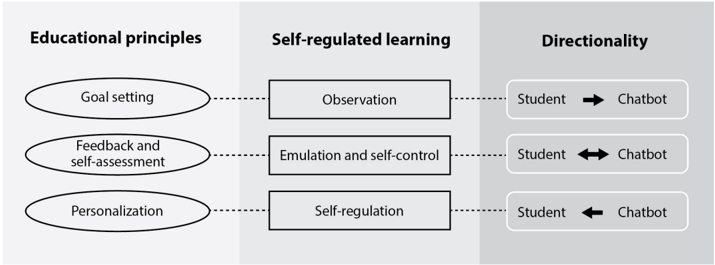
The invention of ChatGPT and generative AI technologies presents educators with significant challenges, as concerns arise regarding students potentially exploiting these tools unethically, misrepresenting their work, or gaining academic merits without active participation in the learning process. To effectively navigate this shift, it is crucial to embrace AI as a contemporary educational trend and establish pedagogical principles for properly utilizing emerging technologies like ChatGPT to promote self-regulation. Rather than suppressing AI-driven tools, educators should foster collaborations among stakeholders, including educators, instructional designers, AI researchers, and developers. This paper proposes three key pedagogical principles for integrating AI chatbots in classrooms, informed by Zimmerman’s Self-Regulated Learning (SRL) framework and Judgment of Learning (JOL). We argue that the current conceptualization of AI chatbots in education is inadequate, so we advocate for the incorporation of goal setting (prompting), self-assessment and feedback, and personalization as three essential educational principles. First, we propose that teaching prompting is important for developing students’ SRL. Second, configuring reverse prompting in the AI chatbot’s capability will help to guide students’ SRL and monitoring for understanding. Third, developing a data-driven mechanism that enables an AI chatbot to provide learning analytics helps learners to reflect on learning and develop SRL strategies. By bringing in Zimmerman’s SRL framework with JOL, we aim to provide educators with guidelines for implementing AI in teaching and learning contexts, with a focus on promoting students’ self-regulation in higher education through AI-assisted pedagogy and instructional design.
Overview
The claims and statistics of this paper haven’t been checked yet.
Free: it reads the open-access text and checks the first 5 claims that cite a source we can check. Create a free account to check every claim.
Integrity signals
Registry
Cites
Statistics
Figures
Verification
Claims the paper makes
The claims and statistics of this paper haven’t been checked yet.
Free: it reads the open-access text and checks the first 5 claims that cite a source we can check. Create a free account to check every claim.
Claims other papers make about this one
Each is checked against this paper’s own text: does it say what the citing paper says it does?
The source backs part of the claim, not all of it — or backs it for a different population, condition or comparison.
In the citing paper
“Empirical studies have shown that learners who effectively integrate digital tools into their study routines demonstrate higher levels of metacognitive awareness and learning regulation, particularly in complex or information-rich contexts (Chang et al., 2023; Chiu, 2023; Lee and Hwang, 2022).”
From Cognitive offloading through digital tools and its relationship with critical thinking, task persistence, and learning depth (2026) · cites this paper as Chang et al., 2023
Experimental — accuracy not yet measured
Self-check
Percentages, sums and reported differences re-computed from the paper’s own numbers.
The self-check needs the paper’s full text.
Citations
Cites
I.—COMPUTING MACHINERY AND INTELLIGENCE
TURING, A. M. (1950) · Mind · doi:10.1093/mind/lix.236.433 · Cited by 10,290 · cited 1×
“The history of chatbots can be extended back to the early 1950s [20].”
BackgroundA revision of bloom's taxonomy: an overview
Krathwohl, D. R. (2002) · Theory Into Practice · doi:10.1207/s15430421tip4104_2 · Cited by 8,132 · cited 1×
“To better understand this, we can break prompts down into two types: cognitive prompts and metacognitive prompts, by drawing on Bloom’s Taxonomy [62].”
MethodBem, D. J. (1972) · Advances in Experimental Social Psychology · doi:10.1016/s0065-2601(08)60024-6 · Cited by 5,241 · cited 1×
“For example, the social cognitive model [17] emphasizes the influence of social and environmental factors on learning, and the self-perception model suggests that individuals’ JOL is influenced by their perceptions of their abilities and self-worth [18].”
BackgroundDwivedi, Y. K., Kshetri, N., Hughes, L., Slade, E. L., Jeyaraj, A., Kar, A. K., Baabdullah, A. M., Koohang, A., Raghavan, V., Ahuja, M., et al. (2023) · International Journal of Information Management · doi:10.1016/j.ijinfomgt.2023.102642 · Cited by 4,584
ELIZA—a computer program for the study of natural language communication between man and machine
Weizenbaum, J. (1966) · Communications of the ACM · doi:10.1145/365153.365168 · Cited by 4,452 · cited 1×
“In particular, ELIZA [21] and A.L.I.C.E. [22] were well-known early chatbot systems simulating real human communication.”
BackgroundBAİDOO-ANU, D., & OWUSU ANSAH, L. (2023) · Journal of AI · doi:10.61969/jai.1337500 · Cited by 3,939
A Conceptual Framework for Assessing Motivation and Self-Regulated Learning in College Students
Pintrich, P. R. (2004) · Educational Psychology Review · doi:10.1007/s10648-004-0006-x · Cited by 3,269
Baidoo-Anu, D., & Owusu Ansah, L. (2023) · doi:10.2139/ssrn.4337484 · Cited by 3,004 · cited 2×
“Baidoo-Anu and Ansa [79] underscore that the efficacy of generative AI tools is intricately Baidoo-Anu and Ansa [79] under-score that the e ffi cacy of generative AI tools is intricately linked to the training data that were fed into the tool, wherein the composition of training data can inadvertently…”
BackgroundA Review of Self-regulated Learning: Six Models and Four Directions for Research
Panadero, E. (2017) · Frontiers in Psychology · doi:10.3389/fpsyg.2017.00422 · Cited by 2,915 · cited 1×
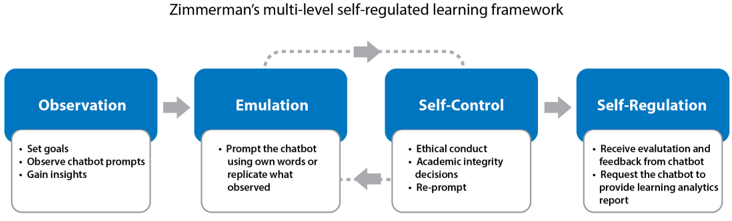
“Review of Zimmerman’s Multi-Level Self-Regulated Learning Framework Zimmerman’s multi-level SRL framework [7,8] encompasses four distinct levels: observation Zimmerman’s multi-level SRL framework [7,8] encompasses four distinct levels: observation, emulation, self-control, and self-regulation (see…”
Social Cognitive Theory: An Agentic Perspective
Bandura, A. (1999) · Asian Journal of Social Psychology · doi:10.1111/1467-839x.00024 · Cited by 2,050 · cited 1×
“For example, the social cognitive model [17] emphasizes the influence of social and environmental factors on learning, and the self-perception model suggests that individuals’ JOL is influenced by their perceptions of their abilities and self-worth [18].”
Background
Research works printed but not linked: 12
- 8. Zimmerman, B.J. Attaining Self-Regulation. In Handbook of Self-Regulation; Elsevier: Amsterdam, The Netherlands, 2000; pp. 13-39. [CrossRef]
- 19. Berkowitz, L., Ed.; Academic Press: Cambridge, MA, USA, 1972; Volume 6, pp. 1-62. [CrossRef]
- 24. Epstein, R., Roberts, G., Beber, G., Eds.; Springer: Dordrecht, The Netherlands, 2009; pp. 181-210. [CrossRef]
- 35. Castiglione, A., Pop, F., Ficco, M., Palmieri, F., Eds.; Lecture Notes in Computer Science Book Series; Springer International Publishing: Cham, Switzerland, 2018; Volume 11161, pp. 291-302. [CrossRef]
- 37. Kim, H.-S.; Kim, N.Y. Effects of AI chatbots on EFL students' communication skills. Commun. Ski. 2021, 21, 712-734.
- 41. Kompatsiaris, I., Cave, J., Satsiou, A., Carle, G., Passani, A., Kontopoulos, E., Diplaris, S., McMillan, D., Eds.; Lecture Notes in Computer Science Book Series; Springer International Publishing: Cham, Switzerland, 2017; Volume 10673, pp. 377-392. [CrossRef]
- 44. Hattie, J. The black box of tertiary assessment: An impending revolution. In Tertiary Assessment & Higher Education Student Outcomes: Policy, Practice & Research; Ako Aotearoa: Wellington, New Zealand, 2009; pp. 259-275.
- 46. Winne, P.H. Cognition and metacognition within self-regulated learning. In Handbook of Self-Regulation of Learning and Performance, 2nd ed.; Routledge: London, UK, 2017.
- 48. Shneiderman, B.; Plaisant, C. Designing the User Interface: Strategies for Effective Human-Computer Interaction, 4th ed.; Pearson: Boston, MA, USA; Addison Wesley: Hoboken, NJ, USA, 2004.
- 56. Burke, J. (Ed.) Outcomes, Learning and the Curriculum: Implications for Nvqs, Gnvqs and Other Qualifications; Routledge: London, UK, 1995. [CrossRef]
- 62. Taylor & Francis Group: Milton Park, UK, 2018.
- 75. Newman, R.S. Adaptive help seeking: A strategy of self-regulated learning. In Self-Regulation of Learning and Performance: Issues and Educational Applications; Lawrence Erlbaum Associates, Inc.: Hillsdale, NJ, USA, 1994; pp. 283-301.
Cited by
Items 101–200 of 369
Liu, D., Carter, L. D., & Lin, J. (2024) · Online Learning · doi:10.24059/olj.v28i2.4047 · Cited by 26
“Self-regulated learning (SRL) plays a pivotal role in digital education, highlighting the individual’s capacity to autonomously oversee and direct their learning processes toward achieving goals within an online setting (Chang et al., 2023; Wong et al., 2019).”
BackgroundExploring the potential use of generative ai for learner support in ODL at scale
Gevher, M., Öncü, S. E., & Erdoğdu, E. (2025) · Journal of Educational Technology and Online Learning · doi:10.31681/jetol.1559442 · Cited by 15
Dhakal, S. P. (2025) · Metrics · doi:10.3390/metrics2030017 · Cited by 11
Chang, S., & Dao, N. D. (2025) · Computers & Education · doi:10.1016/j.compedu.2025.105470 · Cited by 16
Coman, C., Gherheș, V., Bucs, A., Coman, E., Cioca, V.-R., Bódi, D.-C., & Șerbănescu, R.-M. (2026) · Frontiers in Artificial Intelligence · doi:10.3389/frai.2026.1750978 · Cited by 23
“These algorithms generate translations, explanations, feedback, and ideas, producing outputs that resemble human-authored content based on the prompts we provide (Chang et al., 2023).”
Revolutionizing Content Creation and Curriculum Development Through Generative AI
Singha, S., & Singha, R. (2024) · Advances in educational technologies and instructional design book series · doi:10.4018/979-8-3693-1351-0.ch013 · Cited by 13
Leveraging Generative Artificial Intelligence to Expedite UDL Implementation in Online Courses
Morgan, A. (2024) · Advances in educational technologies and instructional design book series · doi:10.4018/979-8-3693-1269-8.ch009 · Cited by 13
The Use of Virtual Patients to Provide Feedback on Clinical Reasoning: A Systematic Review
Jay, R., Sandars, J. E., Patel, R. M., Leonardi‐Bee, J., Ackbarally, Y., Bandyopadhyay, S., Faraj, D., O’Hanlon, M., Brown, J., & Wilson, E. E. (2024) · Academic Medicine · doi:10.1097/acm.0000000000005908 · Cited by 22
“104 Many studies included in this review took place with undergraduate medical students for whom VPs may be su ffi ciently acceptable as learning resources given the lack of experience in authentic clinical settings and the lack of experience in the clinical workplace.”
Han, S. (2025) · Computers & Education · doi:10.1016/j.compedu.2025.105464 · Cited by 14
Desafiando el estado del arte en el uso de ChatGPT en educación en el año 2023
Saz-Pérez, F., & Pizà-Mir, B. (2023) · REIRE Revista d Innovació i Recerca en Educació · doi:10.1344/reire.44018 · Cited by 24
Digital Learning Management using OpenAI ChatGPT: A Systematic Literature Review
Faruq, M. S. S. A., Sunoko, A., Ibda, H., & Wahyudi, K. (2023) · International Journal of Learning Teaching and Educational Research · doi:10.26803/ijlter.22.12.2 · Cited by 33
Yang, F., & Stefaniak, J. E. (2025) · Educational Technology Research and Development · doi:10.1007/s11423-025-10509-7 · Cited by 17
“Chang et al. (2023) indicated an obvious lack of studies that engage teachers and instructional designers to determine the most effective ways to incorporate AI tools in classroom settings.”
Mukhamedkarimova, D. F., & Umurkulova, M. M. (2025) · European Journal of Educational Research · doi:10.12973/eu-jer.14.4.1373 · Cited by 20
Communication technologies in STEM education: A systematic review
Tasilova, N., Shashayeva, G. K., Yernazarova, Z. S., Akhmetova, A. I., Arynov, Z., & Karimova, Z. K. (2025) · Eurasia Journal of Mathematics Science and Technology Education · doi:10.29333/ejmste/17178 · Cited by 16
Wang, J. (2026) · Frontiers in Psychology · doi:10.3389/fpsyg.2026.1781101 · Cited by 10
“Empirical studies have shown that learners who effectively integrate digital tools into their study routines demonstrate higher levels of metacognitive awareness and learning regulation, particularly in complex or information-rich contexts (Chang et al., 2023; Chiu, 2023; Lee and Hwang, 2022).”
Brünner, B., Burgsteiner, H., Schön, S., & Ebner, M. (2025) · Lecture notes in networks and systems · doi:10.1007/978-3-031-85649-5_30 · Cited by 11
The Future of Artificial Intelligence in Interactive Learning: Trends, Challenges, Opportunities
Alam, T. H. I., & Windiarti, I. S. (2025) · Mechanical Engineering, Science and Technology International Conference (MEST) · doi:10.3390/engproc2025084087 · Cited by 16
“For example, a study by [6,7] found that AI-based adaptive learning platforms can improve student performance by providing learning experiences tailored to individual needs.”
Moreno-Guaicha, J. A., Salazar-Luna, P. I., & Escobar-Córdova, S. K. (2025) · Revista Andina de Educación · doi:10.32719/26312816.5432 · Cited by 34
Shen, W., Lin, X., Liu, J., Liang, X., Chen, R., Xiao-yun, L., & Zheng, X. N. (2025) · Journal of Computer Assisted Learning · doi:10.1111/jcal.70140 · Cited by 12
Huang, H. L., Hwang, G., Chen, P.-Y., & Hwang, G. H. (2026) · Educational Technology Research and Development · doi:10.1007/s11423-025-10583-x · Cited by 15
Abbas, A., Azar, B. B., Mahrishi, M., Núñez, J. L. M., & Mishra, D. (2025) · Equilibrium Quarterly Journal of Economics and Economic Policy · doi:10.24136/eq.3551 · Cited by 21
“Artificial Intelligence in Education, or AIEd, started with the advent of chatbots (Kooli, 2023) that either support self-regulated learning (Chang et al. , 2023), online video recommendation (Farhi et al. , 2022), improve computational thinking skills, programming self-efficacy (Yilmaz & Karaoglan…”
Amjad, A. I., & Sheikh, B. S. (2026) · European Journal of Education · doi:10.1111/ejed.70457 · Cited by 11
Generative AI use and self-learning in higher education: the role of learning difficulties
Saleh, D., & ElSayary, A. (2026) · Frontiers in Education · doi:10.3389/feduc.2025.1737928 · Cited by 20
Subiyantoro, S., Degeng, I. N. S., Kuswandi, D., & Ulfa, S. U. (2023) · Jurnal Pekommas · doi:10.56873/jpkm.v8i2.5206 · Cited by 37
Practical Approach for Smart and Circular Cities: Chatbots Used in Waste Recycling
Zota, R. D., Cîmpeanu, I.-A., Dragomir, D.-A., & Lungu, M. A. (2024) · Applied Sciences · doi:10.3390/app14073060 · Cited by 21
Exploring Inclusivity in AI Education: Perceptions and Pathways for Diverse Learners
Lin, M. P.-C., & Chang, D. (2024) · Lecture notes in computer science · doi:10.1007/978-3-031-63031-6_21 · Cited by 17
Self-citationMaheswari, B., & Nagarajan, R. (2024) · Kybernetes · doi:10.1108/k-01-2024-0103 · Cited by 13
Alruwaili, N. M., Ali, Z., Siddiqui, M. S., Butt, A. H., Ahmad, H., Ali, R., & Alsalem, S. H. (2025) · Sustainability · doi:10.3390/su17146632 · Cited by 7
The Social Consequences of Language Technologies and Their Underlying Language Ideologies
Goldshtein, M., Ocumpaugh, J. L., Potter, A., & Roscoe, R. D. (2024) · Lecture notes in computer science · doi:10.1007/978-3-031-60875-9_18 · Cited by 15
Letteri, I., & Vittorini, P. (2025) · International Journal of Artificial Intelligence in Education · doi:10.1007/s40593-025-00492-8 · Cited by 18
“Anintegrationofself-regulatedlearningandjudgementoflearningis insteaddiscussedinChangetal.”
Saeedi, Z., & Soltani, M. D. (2025) · Computer Assisted Language Learning · doi:10.1080/09588221.2025.2532014 · Cited by 13
Pan, M., Lai, C., Guo, K., & Huang, J. (2025) · Computers & Education · doi:10.1016/j.compedu.2025.105474 · Cited by 11
Chen, S.-Y., & Chen, W. (2025) · Expert Systems · doi:10.1111/exsy.70184 · Cited by 10
“This includes effective time and resource management, individualised goal setting and continuous monitoring and evaluation of their strategies and progress (Chang et al. 2023).”
Matijević, M. M., Pisker, B., & Đokić, K. (2024) · Social Sciences · doi:10.3390/socsci13090479 · Cited by 9
Ranuharja, F., Ganefri, G., Rizal, F., Langeveldt, D. C., -, R. E., Torres-Toukoumidis, Á., & Jalinus, N. (2025) · Salud Ciencia y Tecnología · doi:10.56294/saludcyt20251336 · Cited by 20
Wu, S., & Luo, M. (2025) · IEEE Access · doi:10.1109/access.2025.3530413 · Cited by 11
“To discuss the implementation of AI chatbots to foster self-regulated learning, Chang et al. [17] advocated for pedagogical principles that leverage goal setting, feedback, and personalization, finding that such integration significantly boosted student autonomy and engagement.”
Bridging Gaps: AI-Driven Accessibility in Language Education
Asrifan, A., Shafa, S., Pratiwi, W. R., Bahri, A., Siregar, S. R., & Ingilan, S. S. (2025) · Advances in computational intelligence and robotics book series · doi:10.4018/979-8-3693-7260-9.ch006 · Cited by 7
Exploring Implementations of GenAI in Teaching IS Subjects and Student Perceptions
Jiang, Y., & Nakatani, K. (2025) · Journal of Information Systems Education · doi:10.62273/wfho1011 · Cited by 15
“Guided by the self-regulated learning (SRL) and judgment of learning frameworks, Chang et al. (2023) proposed a conceptual model and provided examples to help educators implement chatbots in the classroom.”
Is Gen AI a professor in creativity? A case study in postgraduate students
Zhang, H., & Ge, S. (2025) · Education and Information Technologies · doi:10.1007/s10639-025-13644-z · Cited by 8
“Their training requirements aim to encourage self-exploration and the generation of critical and creative insights for understand - ing and advancing their areas of study (Chang et al., 2023).”
InfluentialChatGPT in academic assessments: upholding integrity
Finkel-Gates, A. (2025) · Journal of Learning Development in Higher Education · doi:10.47408/jldhe.vi36.1491 · Cited by 20
Promoting Reflection Skills of Pre-Service Teachers—The Power of AI-Generated Feedback
Hofmann, F., Daunicht, T.-M., Plößl, L., & Gläser‐Zikuda, M. (2025) · Education Sciences · doi:10.3390/educsci15101315 · Cited by 14
Zhang, R., Zou, D., Xie, H., & Wang, F. L. (2025) · Computers and Education Artificial Intelligence · doi:10.1016/j.caeai.2025.100489 · Cited by 9
Wıbowo, F. C., Hasbey, H., Aziz, T. A., Darman, D. R., Kusuma, A. A. K., Ihsan, I., & Bunyamin, M. A. H. (2025) · Multidisciplinary Science Journal · doi:10.31893/multiscience.2025583 · Cited by 12
Lin, M. P.-C., Liu, A. L., Saffari, S., Chang, D., & Ryoo, J. (2025) · Lecture notes in computer science · doi:10.1007/978-3-031-98281-1_7 · Cited by 6
Self-citationLi, T. W., Song, Y., Sundaram, H., & Karahalios, K. G. (2025) · ACM Conference on Learning @ Scale (L@S) · doi:10.1145/3698205.3729550 · Cited by 7
Learning Design with an AI Assistant
Divjak, B., Svetec, B., Vondra, P., Bađari, J., & Grabar, D. (2025) · Lecture notes in computer science · doi:10.1007/978-3-031-98414-3_15 · Cited by 7
Stănescu, D. F., Frunzaru, V., & Ștefăniță, O. (2024) · Kybernetes · doi:10.1108/k-03-2024-0585 · Cited by 9
Wong, E. K. C., & Chiu, D. K. W. (2025) · Journal of Librarianship and Information Science · doi:10.1177/09610006251331977 · Cited by 11
“Despite AI chatbot’s aim at emulating human behavior, they still need detailed instructions to deliver more specific and relevant results for the users (Chang et al., 2023; Kuhail et al., 2023).”
Gusman, E., Gide, E., Elkhodr, M., & Chaudhry, G. M. (2024) · International Conference on Information Technology Based Higher Education and Training (ITHET) · doi:10.1109/ithet61869.2024.10837597 · Cited by 13
Geier, G. F., Ebner, M., & Burgsteiner, H. (2025) · Lecture notes in computer science · doi:10.1007/978-3-031-93567-1_5 · Cited by 5
Yang, M., Lovett, N., Li, B., & Hou, Z. (2025) · Education Sciences · doi:10.3390/educsci15081004 · Cited by 4
Li, K. (2025) · Frontiers in Psychology · doi:10.3389/fpsyg.2025.1716913 · Cited by 10
Wang, J., Zhang, J., & Kang, Y. (2026) · Journal of Computer Assisted Learning · doi:10.1002/jcal.70221 · Cited by 10
Reconsidering Student GenAI Disclosure Through Postdigital Agency
Chang, D., Lin, M. P. C., Huang, J.-Y., & Ryoo, J. (2026) · Postdigital Science and Education · doi:10.1007/s42438-026-00679-9 · Cited by 7
Self-citationEmpowering Learners: GenIA and Their Impact on Self-regulated learning
Safsouf, Y., & Mouachi, R. (2024) · ITM Web of Conferences · doi:10.1051/itmconf/20246901004 · Cited by 4
“This approach encourages students to analyze, reflect on, and improve their reading processes [15].”
Empowering Education Harnessing AI Tools for Innovative Content Development
Hossain, M., Amin, S. Z., & Hossain, F. (2025) · Advances in computational intelligence and robotics book series · doi:10.4018/979-8-3693-6507-6.ch012 · Cited by 6
Liu, C., Wang, H., & Gu, X. (2025) · The Internet and Higher Education · doi:10.1016/j.iheduc.2025.101018 · Cited by 14
Li, H., & Xing, W. (2025) · Lecture notes in computer science · doi:10.1007/978-3-031-98465-5_32 · Cited by 4
Aldreabi, H., Alhur, M., Al‐Okaily, M., Qasim, D., Dahdoul, N. K. S., & Shiyyab, F. S. (2025) · Computers and Education Artificial Intelligence · doi:10.1016/j.caeai.2025.100456 · Cited by 9
Dervić, M., Bećirović, S., & Polz, E. (2025) · Future education and learning spaces · doi:10.1007/978-981-96-7937-9_9 · Cited by 10
Trinovita, D., Nurchurifiani, E., Hastomo, T., Andewi, W., & Hasbi, M. (2025) · JURNAL IQRA · doi:10.25217/ji.v10i2.6389 · Cited by 30
“The semi-structured interview guide was adapted from the instrument developed by Chang et al. (2023), featuring open-ended questions such as “How does ChatGPT help you plan your autonomous learning goals?” or “What is the biggest challenge when using AI to evaluate your learning progress?”.”
A Systematic Review of the Potential Influencing Factors for ChatGPT-Assisted Education
Xu, C. (2024) · International Journal of Technology-Enhanced Education · doi:10.4018/ijtee.339189 · Cited by 10
“ChatGPT had the capacity to enhance educators’ efficiency, offering instant support, generating content, and aiding assessment (Chang et al., 2023).”
BackgroundMiranda, C. H., Pérez, J. D. R., & Torres, G. S. (2024) · REVISTA COLOMBIANA DE TECNOLOGIAS DE AVANZADA · doi:10.24054/rcta.v1i43.2803 · Cited by 4
“Another critical aspect, highlighted in [33], is the integration of AI chatbots to support self-regulated learning, highlighting the need for personalized learning experiences despite challenges such as biased information and the dissemination of inaccuracies.”
BackgroundLee, S. (2024) · Advances in educational technologies and instructional design book series · doi:10.4018/979-8-3693-0872-1.ch013 · Cited by 9
Mzwri, K., & Turcsányi-Szabó, M. (2025) · Research Square · doi:10.21203/rs.3.rs-6256444/v1 · Cited by 4
Ballantyne, E., Lin, M. P.-C., Chang, D., & Poitras, E. (2025) · Journal of Computing in Higher Education · doi:10.1007/s12528-025-09475-z · Cited by 9
“…this to be fully realized, research has recommended that chatbots and other GenAI tools should be designed with educators, as their expertise is essential for ensuring that key pedagogical principles are effectively integrated and aligned with learning goals (Chang et al., 2023; Varshney, 2022).”
InfluentialSelf-citationYang, C., Hou, S., & Chen, J. (2025) · Frontiers in Psychology · doi:10.3389/fpsyg.2025.1604825 · Cited by 7
Using Artificial Intelligence in Test Construction: A Practical Guide
Suárez‐Álvarez, J., He, Q., Guenole, N., & D'Urso, E. D. (2026) · Psicothema · doi:10.70478/psicothema.2026.38.01 · Cited by 7
Revolutionizing Assessment: AI-Powered Feedback Systems for Personalized Learning
Asrifan, A., Rismawati, R., Jakob, J. C., Irmadani, A. S., & Musdalifah, M. (2026) · Advances in computational intelligence and robotics book series · doi:10.4018/979-8-3373-2752-5.ch011 · Cited by 5
Cao, X., Xu, S., Chen, X., Song, Y., Luo, Q., & He, T. (2026) · IEEE Transactions on Learning Technologies · doi:10.1109/tlt.2026.3668051 · Cited by 8
“In contrast, recent research has extensively explored the use of GenAI-powered classroom learning analytics to enhance instructional effectiveness, an approach that indirectly fosters reflective practices [59], [60].”
Leveraging the Use of AI Tools in Practice Teaching: Insights from Science Pre-Service Teachers
Jackaria, P. M., Pon, M. M. R., Eldani, N.-A. S., Alvarado, H. A. L., & Iralan, S. A. (2026) · Advances in computational intelligence and robotics book series · doi:10.4018/979-8-3373-8027-8.ch005 · Cited by 3
Nguyen, H., Chen, H., & Asfani, K. (2026) · Journal of Educational Computing Research · doi:10.1177/07356331261450647 · Cited by 10
Technology-mediated self-assessment in higher education: A critical review
Cao, Y., Yan, Z., Yang, L., Panadero, E., & Chen, C. (2025) · Contemporary Educational Technology · doi:10.30935/cedtech/16739 · Cited by 8
Glushkova, T. A., & Staribratov, I. (2025) · Digital education and learning · doi:10.1007/978-3-032-03977-4_5 · Cited by 6
Nghi, T. T. (2024) · Studies in computational intelligence · doi:10.1007/978-3-031-63447-5_8 · Cited by 8
Engagement and Learning Benefits of Goal Setting with Rewards in Human-AI Tutoring
Borchers, C., Houk, A., Aleven, V. A. W. M. M., & Koedinger, K. R. (2025) · Lecture notes in computer science · doi:10.1007/978-3-031-98459-4_4 · Cited by 9
Kleinman, E., Jahani, R., McGivney, E., Kosa, M., Cooper, S., & Harteveld, C. (2025) · CHI Conference on Human Factors in Computing Systems · doi:10.1145/3706598.3713811 · Cited by 4
“As a result, the last few years saw an increased interest in AI-powered reflection for learning [35, 73, 77], which already started to produce guidelines for design [1, 13].”
Enhancing Self-regulated Learning Through an Emotional Chatbot: A Conceptual Framework
Mourabit, I. E., Andaloussi, S. J., Ouchetto, O., & Miyara, M. (2025) · Lecture notes in networks and systems · doi:10.1007/978-3-031-88653-9_50 · Cited by 2
Leveraging AI for Nurturing Learners With Empathy, Ethics, and Social Responsibility
Wahi, R. B., Chuah, K.-M., & Junaini, S. N. (2025) · IGI Global eBooks · doi:10.4018/979-8-3373-5077-6.ch008 · Cited by 5
Artificial Intelligence Integration in Mathematics Education: A SWOT-BWM Analysis
Şahin, S., & Teke, B. (2025) · Journal of Learning and Teaching in Digital Age · doi:10.53850/joltida.1667650 · Cited by 6
AI-enhanced Chatbot for Student Support in Robotics and Control Education
Morano, M., Screpanti, L., Castagna, B., Cesaretti, L., & Scaradozzi, D. (2025) · Mediterranean Conference on Control and Automation (MED) · doi:10.1109/med64031.2025.11073475 · Cited by 4
“Building on the infrastructure described in [11], the system integrates an AI-powered chatbot into the classroom, providing minimal, incremental, timely, and adaptive guidance during hands-on ER sessions [12], [13].”
Inteligencia artificial en educación: una revisión sistemática
Herrero, P. C., & Espada, R. A. (2025) · Miguel Hernández Communication Journal · doi:10.21134/0rh1zg17 · Cited by 5
Navigating the Impact of Artificial Intelligence Tools on Design Learning
Zuhra, F.-T. (2025) · Journal of Design and Textiles · doi:10.32350/jdt.41.01 · Cited by 2
AI Chatbots for Educators: Transforming Online Learning in Higher Education
Engeness, I., Nohr, M., & Fossland, T. (2025) · Lecture notes in computer science · doi:10.1007/978-3-032-00056-9_18 · Cited by 9
Ratniyom, J., Boonphadung, S., Intaraprasit, M., & Chumkaeo, P. (2025) · Chemistry Teacher International · doi:10.1515/cti-2025-0048 · Cited by 3
Marconi, L., Brasca, F., & Ferri, P. M. (2026) · Lecture notes in computer science · doi:10.1007/978-3-032-13187-4_14 · Cited by 3
Al-Shamaileh, O., Hammady, R., Abdelrahman, M., & Mubin, O. (2026) · Computers in Human Behavior Reports · doi:10.1016/j.chbr.2026.100980 · Cited by 10
“In 34 papers, including those by Fegade et al. (2023) and Chang et al. (2023), this response takes the form of policies, guidelines, and institutional frameworks.”
Early detection and personalized academic support using a predictive chatbot for student success
Arévalo-Cordovilla, F. E., & Pe, M. (2026) · PeerJ Computer Science · doi:10.7717/peerj-cs.3656 · Cited by 2
Adhantoro, M. S., Riyanti, R. F., Purnomo, E., & Negara, S. P. P. S. (2026) · AIP conference proceedings · doi:10.1063/5.0319161 · Cited by 3
Kim, M.-J., Jeong, S., & Lim, C. (2026) · Asia Pacific Education Review · doi:10.1007/s12564-026-10114-0 · Cited by 3
“In the context of CPBL, these chatbots possess the capacity to support SSRL by prompting teams to reflect on their goals, sug - gesting strategies for conflict resolution, and encouraging equitable participation (Chang et al., 2023).”
ESL tertiary learners’ engagement in ChatGPT-assisted second language writing
Shujun, Y. U. A. N., & Dao, P. (2026) · Language Awareness · doi:10.1080/09658416.2026.2652333 · Cited by 5
Exploring student motivations for AI usage in education: Nisantasi in Turkey, a case study
AL-Sayid, F., Alpago, H., & Kirkil, G. (2026) · Acta Psychologica · doi:10.1016/j.actpsy.2026.106852 · Cited by 7
Can ChatGPT be integrated into Blended Learning in Science: A Systematic Literature Review
Rusdiawan, A., Hasriyani, E., Zeswita, A. L., Ruth Rize Paas Megahati, S., & Susanto, N. (2024) · Jurnal Penelitian Pendidikan IPA · doi:10.29303/jppipa.v10i2.7001 · Cited by 3
Integration of Artificial Intelligence in Virtual Reality-Based Learning
Shabir, A., Herwin, H., Asriadi, A., Nurhayati, R., Prasojo, L. D., & Dahalan, S. C. (2025) · Data & Metadata · doi:10.56294/dm2025859 · Cited by 4
Feregrino, G. R., & Sayeg-Sánchez, G. (2025) · Institute for the Future of Education Conference (IFE) · doi:10.1109/ife63672.2025.11024621 · Cited by 5
“In their article, [12] highlighted the potential of AI to support self-regulated learning through personalized and adaptive educational tools.”
Saz-Pérez, F., & Pizà-Mir, B. (2024) · SocArXiv (OSF Preprints) · doi:10.31235/osf.io/hmw69 · Cited by 4
Kouam, A. W. F., & Muchowe, R. M. (2024) · SSRN Electronic Journal · doi:10.2139/ssrn.4748274 · Cited by 3
Artificial Intelligence Applied in Higher Education: A Bibliometric Analysis
Cano, C. A. G., & Castillo, V. S. (2024) · Information systems engineering and management · doi:10.1007/978-3-031-65014-7_44 · Cited by 3
Exploring the Impact of Artificial Intelligence on Education: A Perspective on Future Learning
Ahmed, N. S. I., & Hamdan, A. (2024) · Studies in systems, decision and control · doi:10.1007/978-3-031-62102-4_54 · Cited by 7
Integración de la inteligencia artificial en la enseñanza universitaria
Gaibor, D. S. P., Jiménez, J. F. M., Granja, C. D. A., & Jiménez, J. A. V. (2024) · Revista Chone Ciencia y Tecnología · doi:10.56124/cct.v2i2.005 · Cited by 6
Metadata
- Authors
- Chang, D. H., Lin, M. P.-C., Hajian, S., & Wang, Q. Q.
- Affiliations
- Simon Fraser University (CA)
- Mount Saint Vincent University (CA)
- Kwantlen Polytechnic University (CA)
- Corresponding author
- Chang, Daniel H.
- Venue
- Sustainability
- Publisher
- MDPI AG
- Published
- 2023-08-27
- Volume
- 15
- Issue
- 17
- Pages
- 12921
- ISSN
- 2071-1050 (ISSN-L)
- OpenAlex
- W4386221177
- Cited by
- 370
- References
- 69
- Citations by year
- 2026: 130 · 2025: 151 · 2024: 83 · 2023: 6
- FWCI
- 86.83
- Type
- journal article
- Language
- en
- Open access
- gold
- doi.org
- Licence
- Locations
- Sustainability (publishedVersion, cc-by)
- RePEc: Research Papers in Economics (submittedVersion)
- Funders
- Social Sciences and Humanities Research Council of Canada (SSHRC) (430-2023-00368)
- Topics
- Social Sciences › Education › Artificial Intelligence in Education
- Physical Sciences › Computer Science › Artificial Intelligence › Intelligent Tutoring Systems and Adaptive Learning
- Social Sciences › Psychology › Developmental and Educational Psychology › Innovative Teaching and Learning Methods
- Keywords
- AI chatbots in education, student self-regulation, goal setting, prompting, self-assessment, feedback, personalization, learning analytics, judgments of learning, generative AI in higher education, instructional design, ethical use of AI
About these checks
Registry, retraction, Cites and statistics results are computed, not judged, with one exception: a printed reference that no index lists is read once by a model before it counts as a citation error. Claims are extracted by a model and kept only when their quote appears verbatim in the text; each cited source is then checked, with a model’s help, for whether it says what the claim relies on. Those verdicts can be wrong — read the claim’s quote and the cited source before relying on one.
Statistics and arithmetic are recomputed, not judged.
Confidence bands are shown only for fields calibrated on our annotated test set. None is calibrated yet, so no band is shown.
What counts as a claim ›How we measure confidence ›How we check this ›
Are you an author, or do you see a problem with this page? Request a review
Data sources
Bibliographic data: Semantic Scholar, OpenAlex, Crossref.
Contains information from the Semantic Scholar Academic Graph Datasets, made available under the ODC Attribution License (ODC-BY 1.0).
Semantic Scholar’s data is described in: Kinney, R., et al. (2023). The Semantic Scholar Open Data Platform. arXiv:2301.10140.
