

Educational Design Principles of Using AI Chatbot That Supports Self-Regulated Learning in Education: Goal Setting, Feedback, and Personalization
Open accessThe DOI matches its Crossref record; 73 of the 74 references it cites were found in a registry or an index.
Abstract
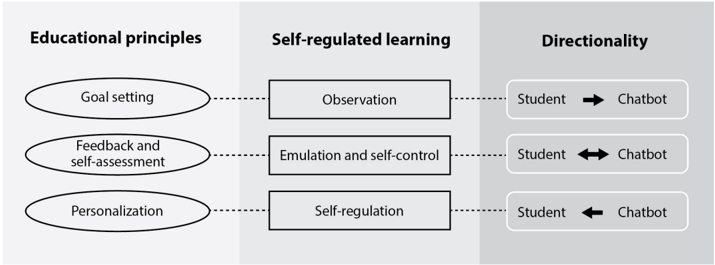
The invention of ChatGPT and generative AI technologies presents educators with significant challenges, as concerns arise regarding students potentially exploiting these tools unethically, misrepresenting their work, or gaining academic merits without active participation in the learning process. To effectively navigate this shift, it is crucial to embrace AI as a contemporary educational trend and establish pedagogical principles for properly utilizing emerging technologies like ChatGPT to promote self-regulation. Rather than suppressing AI-driven tools, educators should foster collaborations among stakeholders, including educators, instructional designers, AI researchers, and developers. This paper proposes three key pedagogical principles for integrating AI chatbots in classrooms, informed by Zimmerman’s Self-Regulated Learning (SRL) framework and Judgment of Learning (JOL). We argue that the current conceptualization of AI chatbots in education is inadequate, so we advocate for the incorporation of goal setting (prompting), self-assessment and feedback, and personalization as three essential educational principles. First, we propose that teaching prompting is important for developing students’ SRL. Second, configuring reverse prompting in the AI chatbot’s capability will help to guide students’ SRL and monitoring for understanding. Third, developing a data-driven mechanism that enables an AI chatbot to provide learning analytics helps learners to reflect on learning and develop SRL strategies. By bringing in Zimmerman’s SRL framework with JOL, we aim to provide educators with guidelines for implementing AI in teaching and learning contexts, with a focus on promoting students’ self-regulation in higher education through AI-assisted pedagogy and instructional design.
Overview
The claims and statistics of this paper haven’t been checked yet.
Free: it reads the open-access text and checks the first 5 claims that cite a source we can check. Create a free account to check every claim.
Integrity signals
Registry
Cites
Statistics
Figures
Verification
Claims the paper makes
The claims and statistics of this paper haven’t been checked yet.
Free: it reads the open-access text and checks the first 5 claims that cite a source we can check. Create a free account to check every claim.
Claims other papers make about this one
Each is checked against this paper’s own text: does it say what the citing paper says it does?
The source backs part of the claim, not all of it — or backs it for a different population, condition or comparison.
In the citing paper
“Empirical studies have shown that learners who effectively integrate digital tools into their study routines demonstrate higher levels of metacognitive awareness and learning regulation, particularly in complex or information-rich contexts (Chang et al., 2023; Chiu, 2023; Lee and Hwang, 2022).”
From Cognitive offloading through digital tools and its relationship with critical thinking, task persistence, and learning depth (2026) · cites this paper as Chang et al., 2023
Experimental — accuracy not yet measured
Self-check
Percentages, sums and reported differences re-computed from the paper’s own numbers.
The self-check needs the paper’s full text.
Citations
Cites
I.—COMPUTING MACHINERY AND INTELLIGENCE
TURING, A. M. (1950) · Mind · doi:10.1093/mind/lix.236.433 · Cited by 10,290 · cited 1×
“The history of chatbots can be extended back to the early 1950s [20].”
BackgroundA revision of bloom's taxonomy: an overview
Krathwohl, D. R. (2002) · Theory Into Practice · doi:10.1207/s15430421tip4104_2 · Cited by 8,132 · cited 1×
“To better understand this, we can break prompts down into two types: cognitive prompts and metacognitive prompts, by drawing on Bloom’s Taxonomy [62].”
MethodBem, D. J. (1972) · Advances in Experimental Social Psychology · doi:10.1016/s0065-2601(08)60024-6 · Cited by 5,241 · cited 1×
“For example, the social cognitive model [17] emphasizes the influence of social and environmental factors on learning, and the self-perception model suggests that individuals’ JOL is influenced by their perceptions of their abilities and self-worth [18].”
BackgroundDwivedi, Y. K., Kshetri, N., Hughes, L., Slade, E. L., Jeyaraj, A., Kar, A. K., Baabdullah, A. M., Koohang, A., Raghavan, V., Ahuja, M., et al. (2023) · International Journal of Information Management · doi:10.1016/j.ijinfomgt.2023.102642 · Cited by 4,584
ELIZA—a computer program for the study of natural language communication between man and machine
Weizenbaum, J. (1966) · Communications of the ACM · doi:10.1145/365153.365168 · Cited by 4,452 · cited 1×
“In particular, ELIZA [21] and A.L.I.C.E. [22] were well-known early chatbot systems simulating real human communication.”
BackgroundBAİDOO-ANU, D., & OWUSU ANSAH, L. (2023) · Journal of AI · doi:10.61969/jai.1337500 · Cited by 3,939
A Conceptual Framework for Assessing Motivation and Self-Regulated Learning in College Students
Pintrich, P. R. (2004) · Educational Psychology Review · doi:10.1007/s10648-004-0006-x · Cited by 3,269
Baidoo-Anu, D., & Owusu Ansah, L. (2023) · doi:10.2139/ssrn.4337484 · Cited by 3,004 · cited 2×
“Baidoo-Anu and Ansa [79] underscore that the efficacy of generative AI tools is intricately Baidoo-Anu and Ansa [79] under-score that the e ffi cacy of generative AI tools is intricately linked to the training data that were fed into the tool, wherein the composition of training data can inadvertently…”
BackgroundA Review of Self-regulated Learning: Six Models and Four Directions for Research
Panadero, E. (2017) · Frontiers in Psychology · doi:10.3389/fpsyg.2017.00422 · Cited by 2,915 · cited 1×
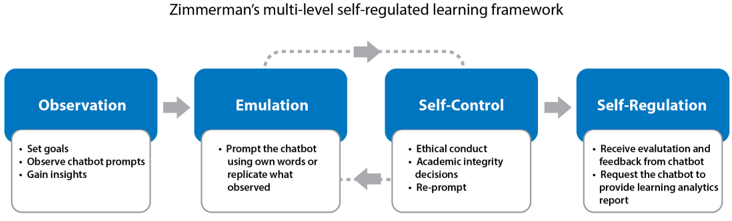
“Review of Zimmerman’s Multi-Level Self-Regulated Learning Framework Zimmerman’s multi-level SRL framework [7,8] encompasses four distinct levels: observation Zimmerman’s multi-level SRL framework [7,8] encompasses four distinct levels: observation, emulation, self-control, and self-regulation (see…”
Social Cognitive Theory: An Agentic Perspective
Bandura, A. (1999) · Asian Journal of Social Psychology · doi:10.1111/1467-839x.00024 · Cited by 2,050 · cited 1×
“For example, the social cognitive model [17] emphasizes the influence of social and environmental factors on learning, and the self-perception model suggests that individuals’ JOL is influenced by their perceptions of their abilities and self-worth [18].”
Background
Research works printed but not linked: 12
- 8. Zimmerman, B.J. Attaining Self-Regulation. In Handbook of Self-Regulation; Elsevier: Amsterdam, The Netherlands, 2000; pp. 13-39. [CrossRef]
- 19. Berkowitz, L., Ed.; Academic Press: Cambridge, MA, USA, 1972; Volume 6, pp. 1-62. [CrossRef]
- 24. Epstein, R., Roberts, G., Beber, G., Eds.; Springer: Dordrecht, The Netherlands, 2009; pp. 181-210. [CrossRef]
- 35. Castiglione, A., Pop, F., Ficco, M., Palmieri, F., Eds.; Lecture Notes in Computer Science Book Series; Springer International Publishing: Cham, Switzerland, 2018; Volume 11161, pp. 291-302. [CrossRef]
- 37. Kim, H.-S.; Kim, N.Y. Effects of AI chatbots on EFL students' communication skills. Commun. Ski. 2021, 21, 712-734.
- 41. Kompatsiaris, I., Cave, J., Satsiou, A., Carle, G., Passani, A., Kontopoulos, E., Diplaris, S., McMillan, D., Eds.; Lecture Notes in Computer Science Book Series; Springer International Publishing: Cham, Switzerland, 2017; Volume 10673, pp. 377-392. [CrossRef]
- 44. Hattie, J. The black box of tertiary assessment: An impending revolution. In Tertiary Assessment & Higher Education Student Outcomes: Policy, Practice & Research; Ako Aotearoa: Wellington, New Zealand, 2009; pp. 259-275.
- 46. Winne, P.H. Cognition and metacognition within self-regulated learning. In Handbook of Self-Regulation of Learning and Performance, 2nd ed.; Routledge: London, UK, 2017.
- 48. Shneiderman, B.; Plaisant, C. Designing the User Interface: Strategies for Effective Human-Computer Interaction, 4th ed.; Pearson: Boston, MA, USA; Addison Wesley: Hoboken, NJ, USA, 2004.
- 56. Burke, J. (Ed.) Outcomes, Learning and the Curriculum: Implications for Nvqs, Gnvqs and Other Qualifications; Routledge: London, UK, 1995. [CrossRef]
- 62. Taylor & Francis Group: Milton Park, UK, 2018.
- 75. Newman, R.S. Adaptive help seeking: A strategy of self-regulated learning. In Self-Regulation of Learning and Performance: Issues and Educational Applications; Lawrence Erlbaum Associates, Inc.: Hillsdale, NJ, USA, 1994; pp. 283-301.
Cited by
Items 201–300 of 369
Wang, R., & Cao, Y. (2024) · International Conference on Educational Technology Management (ICETM) · doi:10.1145/3711403.3711451 · Cited by 1
“Additionally, studies have explored the use of chatbots to scaffold self-regulated learning (SRL) among students [8] [9] [10] [11].”
Kristianto, V. A., Sucipto, S., Sri, H., & Yuhanafia, N. (2025) · Language Circle Journal of Language and Literature · doi:10.15294/lc.v19i2.21540 · Cited by 2
“…feedback that adapts to different writing styles and goals is promising, potentially offering an edge over traditional human feedback in this area (Chang et al, 2023) Overall, the study is in an interesting intersection of an established understanding of writing instruction (Strunk & White, 2000;…”
Eom, S. B. (2025) · Lecture notes in business information processing · doi:10.1007/978-3-031-90863-7_6 · Cited by 2
Elizalde, A. F. C., Ramirez, O. C. G., Cueva, E. L. L., & Asanza, W. B. R. (2025) · Estudios y Perspectivas Revista Científica y Académica · doi:10.61384/r.c.a..v5i2.1200 · Cited by 10
Exploring Students' Attitudes and Usage of Artificial Intelligence in the Learning Process
Mohtashami, F., Ghasemtabar, S. A., & Nasab, Y. M. (2025) · International and National Conference on E-Learning and E-Teaching (ICeLeT) · doi:10.1109/icelet66022.2025.11025227 · Cited by 3
Designing XAI Chatbots to Enhance Self-Efficacy in Youth in Pathfinding Problem Domains
Lookingbill, V., Fu, J. L., Irvin, M. J., Wu, D., & Agostinelli, F. (2025) · ACM International Conference on Interaction Design and Children (IDC) · doi:10.1145/3713043.3731492 · Cited by 2
“Artificial intelligence (AI)-driven chatbots have the potential to revolutionize how youth learn [1, 2] by promoting self-regulated learning (SRL) skills and self-efficacy [3, 4].”
ÜNİVERSİTE ÖĞRENCİLERİNİN YAPAY ZEKÂ KONUSUNDAKİ GÖRÜŞLERİNİN DEĞERLENDİRİLMESİ
Benzer, S., Benzer, R., & Akkaya, M. M. (2025) · Kapadokya eğitim dergisi. · doi:10.69643/kaped.1450794 · Cited by 2
The Evolution of Artificial Intelligence in Education: From Theory to Practice
Kayyali, M. (2025) · Advances in computational intelligence and robotics book series · doi:10.4018/979-8-3373-6007-2.ch004 · Cited by 1
VETTING AI for Deeper Learning: Constraining LLMs to Encourage Student Inquiry
Zhang, S., Li, H., Lee, S. M., Schroeder, N. L., & Botelho, A. F. (2025) · Communications in computer and information science · doi:10.1007/978-3-031-99264-3_33 · Cited by 1
Artificial Intelligence in Learning Design: Acceptance, Perceived Effectiveness, and Barriers
Pradana, H. D., Rusijono, R., Maureen, I. Y., & Youhanita, E. (2025) · Jurnal Penelitian dan Pengkajian Ilmu Pendidikan e-Saintika · doi:10.36312/e-saintika.v9i2.2688 · Cited by 3
da Silva, R. R., Pinheiro, C. L. D. S., Geraldeli, D., Júnior, J. A. D. S., & Rosa, C. R. (2025) · Caderno Pedagógico · doi:10.54033/cadpedv22n11-241 · Cited by 4
Ask Not What Math Can Do for AI, Ask What AI Can Do for Math (Education)
Rakić, K., & Rakić, I. M. (2025) · Communications in computer and information science · doi:10.1007/978-3-032-02801-3_9 · Cited by 1
Xu, B., & Zheng, L. (2025) · Advances in computational intelligence and robotics book series · doi:10.4018/979-8-3373-7508-3.ch009 · Cited by 2
AI-Driven Personalized Learning and Adaptive Assessment: Transforming Higher Education Pedagogy
Adiyono, A., Ritonga, M., Sukarno, Wurdianto, K., & Matari, A. S. A. (2025) · Information systems engineering and management · doi:10.1007/978-3-032-05306-0_6 · Cited by 8
Du, J., Li, S., Chen, J., & Li, J. (2025) · Education and Information Technologies · doi:10.1007/s10639-025-13842-9 · Cited by 2
“…these challenges and enhance LLMs’ adaptive feedback, theoretical frameworks like the Stimulus-Organism-Response (S-O-R) model (Masrom et al., 2021) and practical guidelines(Chang et al., 2023) grounded in Zimmerman’s framework (goal setting, self-evaluation, personalization) have been proposed.”
AI Representation of African Culture: Perspectives, Challenges, and Implications for Media Studies
Ditlhokwa, G. (2025) · Future education and learning spaces · doi:10.1007/978-981-96-9251-4_7 · Cited by 3
Sagita, M., Sagita, E. S., & Syafari, N. (2025) · Journal of Pedagogy and Education Science · doi:10.56741/iistr.jpes.001082 · Cited by 11
“…and personalised SRL support, which provides tailored guidance, sequential problem-solving approaches, and immediate responses to learners' enquiries, accelerates conceptual understanding and strategic application by enabling mutually adaptive interactions between learners and technology [18][32].”
Generative AI and Self-Regulated Learning in Education: A Scientometric Review
Wang, H., Wang, Z., & Zhou, T. (2025) · International Conference on Artificial Intelligence and Intelligent Information Processing (AIIIP) · doi:10.1145/3778534.3778581 · Cited by 2
“Foundational works by [2, 3] provide theoretical anchoring, while recent studies by [13] and [14] shape contemporary discourse on AI-enhanced learning.”
Zarkadoulas, D., & Virvou, M. K. (2025) · International Conference on Information, Intelligence, Systems & Applications (IISA) · doi:10.1109/iisa66859.2025.11311296 · Cited by 2
“Unlike static instructional tools, chatbots employ interactive dialogues and adaptive scaffolding, which guide students through incremental problem-solving steps rather than merely providing direct answers [24, 25].”
Ryoo, J., Lin, M. P.-C., Rai, S., He, W., Park, S. M., & Ho, M. (2025) · IEEE Frontiers in Education Conference (FIE) · doi:10.1109/fie63693.2025.11328198 · Cited by 1
“Chang et al. out-line design principles for AI chatbots aimed at supporting SRL, emphasizing features such as goal-setting assistance, timely feedback on tasks, and personalized reminders or hints [11].”
Self-citationRubio, A. D. J., & Conesa, I. M. G. (2026) · Advances in computational intelligence and robotics book series · doi:10.4018/979-8-3373-9220-2.ch007 · Cited by 1
Factors affecting innovative teaching methods with AI transnational higher education in Bangladesh
Rahman, M. M., Moniruzzaman, M., Khan, A. R., Islam, M. E., Islam, H., Joof, F., & Siddik, A. B. (2026) · Discover Education · doi:10.1007/s44217-026-01220-7 · Cited by 4
A GenAI-Powered Feedback System for Automated Short-Answer Assessment in Education
Chen, C., & Lai, P. P. Y. (2025) · International Workshop on Artificial Intelligence and Education (WAIE) · doi:10.1109/waie67422.2025.11381214 · Cited by 1
“Cen et al. [6] demonstrate that thoughtful UI design significantly improves user engagement, while Chang et al. [7] establish key design principles for AI interfaces emphasizing feedback presentation and personalization.”
Transforming higher education through AI-enriched tools: an open innovation approach
Āboliņa, A., Zorins, A., Vindača, O., Ušča, S., & Petrushenko, Y. M. (2026) · Frontiers in Education · doi:10.3389/feduc.2026.1766004 · Cited by 4
The Impact of Chatbot-Supported Self-Regulation Learning Strategies on Second Language Writing
Eryılmaz, R. (2026) · Dil Eğitimi ve Araştırmaları Dergisi · doi:10.31464/jlere.1721342 · Cited by 1
Decision analysis based on reinforcement learning and transfer learning
Sun, S. (2026) · Discover Artificial Intelligence · doi:10.1007/s44163-026-01156-9 · Cited by 1
Berikkhanova, G., Begarisheva, G., Берикханова, А., Rakhymova, A. T., & Berikkhanova, K. (2026) · Education Sciences · doi:10.3390/educsci16040513 · Cited by 1
Rashid, S., & Malik, S. (2026) · Cogent Education · doi:10.1080/2331186x.2026.2661437 · Cited by 3
Yin, X., & Chen, F. N. (2026) · Frontiers in Psychology · doi:10.3389/fpsyg.2026.1802856 · Cited by 1
“This personalized approach helps capture students’ interests, offering individual attention, and making learning relevant and engaging within their ZPD (Sayed et al., 2023).”
InfluentialElshall, A. S., Badir, A. M., & Gebremedhin, M. A. (2026) · Frontiers in Education · doi:10.3389/feduc.2026.1834090 · Cited by 2
Zhang, Q., & Liang, Y. (2026) · Education and Information Technologies · doi:10.1007/s10639-026-14038-5 · Cited by 9
“The chatbot’s on-demand guidance may have helped reduce task ambiguity, thereby enabling students to formulate clearer and more precise goals (Chang et al., 2023).”
An empirical study of ChatGPT use in engineering education: Prompting and performance
Domínguez, L. G. I., Robles-Gómez, A., & Pastor-Vargas, R. (2026) · The Internet and Higher Education · doi:10.1016/j.iheduc.2026.101105 · Cited by 3
Generative Artificial Intelligence and English-Medium Education
Moorhouse, B. L., Pun, J., & Curle, S. M. (2026) · Cambridge University Press eBooks · doi:10.1017/9781009736862 · Cited by 5
Sabani, A., Farah, M. H., Catyanadika, P. E., Dewi, D. R. S., & Tawani, V. (2026) · Computers and Education Artificial Intelligence · doi:10.1016/j.caeai.2026.100667 · Cited by 8
CRAFT INTELLIGENT CONVERSATIONS: DEVELOPING AN AI CHATBOT WITH PYTHON
(2024) · International Research Journal of Modernization in Engineering Technology and Science · doi:10.56726/irjmets51344 · Cited by 1
Adi, F. P., Atmojo, I. R. W., Matsuri, M., Chumdari, C., Ardiansyah, R., & Saputri, D. Y. (2024) · Mimbar Sekolah Dasar · doi:10.53400/mimbar-sd.v11i4.78850 · Cited by 2
Kızılay, F. E., & Çelik, M. (2025) · WMU Journal of Maritime Affairs · doi:10.1007/s13437-025-00374-9 · Cited by 3
“Although researchers such as Chang (2023) and Smith ( 2018 ) point out the shortcomings of traditional assessment models, GAI is still waiting to be explored in this field.”
Optimizing feedback mechanisms in higher education quality assessment through an AI-driven framework
Wang, Y. (2025) · Journal of Computational Methods in Sciences and Engineering · doi:10.1177/14727978251361550 · Cited by 2
Imran, M., Shahid, A. R., Hou, M., & Imteaj, A. (2024) · doi:10.36227/techrxiv.170630660.06963201/v1 · Cited by 6
Wang, R., & Raman, A. L. (2025) · Research Square · doi:10.21203/rs.3.rs-6372448/v1 · Cited by 2
Gao, L., Sun, Y., & Khan, S. U. (2026) · Frontiers in Psychology · doi:10.3389/fpsyg.2026.1847369 · Cited by 1
From AI Literacy to AI Fluency: A Developmental Framework for Higher Education
Zentner, A. (2026) · SSRN Electronic Journal · doi:10.2139/ssrn.7014818
Possibilities of Application of Chat-Bots in the Educational Process
Шевелькова, М. А., Nikitin, P. V., & Gorokhova, R. I. (2023) · Sovremennye informacionnye tehnologii i IT-obrazovanie. · doi:10.25559/sitito.019.202302.508-515 · Cited by 2
Self-Regulated Learning of Pre-Service Teachers in Digital Learning Environments
Zhang, C., Hofmann, F., Kamran, F., & Gläser‐Zikuda, M. (2024) · Education and human development · doi:10.5772/intechopen.1006330 · Cited by 4
Emotional Intelligence Training Tools in Entrepreneurship Education
Fedorova, Y. V., Pilková, A., Kovalenko, D., Mikuš, J., & Бондаренко, Т. (2024) · Lecture notes in networks and systems · doi:10.1007/978-3-031-72430-5_17
Designing XAI Chatbots to Enhance Learner Self-efficacy in Education
Lookingbill, V., Fu, J., & Irvin, M. J. (2024) · Lecture notes in computer science · doi:10.1007/978-3-031-76806-4_10
The Study on Motivation and Emotion Management Among University Students for Time Management Balance
Ramlan, N., Rahim, N. C. A., Saffinee, S. S., & Najid, M. H. M. (2024) · Studies in systems, decision and control · doi:10.1007/978-3-031-71526-6_45
A Case on Artificial Intelligence Technologies Using for Tutoring and Achieving Learning Outcomes
Gudonienė, D., Stanevičienė, E., Dambrauskas, E., Janik, J., E-Martín, Y., & Fischerauer, G. (2025) · Communications in computer and information science · doi:10.1007/978-3-031-84263-4_24
Research on the Application of Big Data and Artificial Intelligence in Personalized Education
Li, Y., Guo, Y., & Gao, C. (2024) · International Conference on Educational Technology Management (ICETM) · doi:10.1145/3711403.3711437
“According to Zimmerman’s Self-Regulated Learning (SRL) framework and Judgment of Learning (JOL), chatbot designers should consider goal setting and planning, self-assessment, and personalization to ensure that chatbots effectively support student learning and improve academic performance [19].”
Ranuharja, F., Ganefri, G., Rizal, F., Langeveldt, D. C., -, R. E., Torres-Toukoumidis, Á., & Jalinus, N. (2025) · Salud Ciencia y Tecnología · doi:10.56294/saludcyt20251636 · Cited by 2
Case Study on Providing AI Chabot-Based Support Services in E-Learning Platforms
Baneș, V., & Ravariu, C. (2025) · Lecture notes in networks and systems · doi:10.1007/978-3-031-83520-9_56
Teaching with AI: The Implications and Challenges
Shen, I. (2025) · Studies in computational intelligence · doi:10.1007/978-3-031-82915-4_5
Role of GenAI in Student Knowledge Enhancement: Learner Perception
Fayaza, M. S. F., Senthilrajah, T., Wijesinghe, U., & Ahangama, S. (2025) · International Conference on Advanced Research in Computing (ICARC) · doi:10.1109/icarc64760.2025.10963193 · Cited by 3
Bisaso, S., Wasswa, W., & Muhumuza, G. (2025) · European Journal of Applied Science Engineering and Technology · doi:10.59324/ejaset.2025.3(3).16
“Furthermore, the literature indicates that personalization, a highly desired feature, necessitates the integration of Machine Learning (ML) algorithms [14], [19].”
Enhancing Competition-Based Big Data Analytics Learning Through AI-Driven Distributed Scaffolding
Chen, X., Li, N., Bajaj, N., & Fan, P. (2025) · IEEE Global Engineering Education Conference (EDUCON) · doi:10.1109/educon62633.2025.11016504 · Cited by 2
López, I. M. G., Soledad, M., & Espinosa, J. M. M. (2025) · Institute for the Future of Education Conference (IFE) · doi:10.1109/ife63672.2025.11024736 · Cited by 1
Enhancing numeracy literacy through algebra learning materials: A vocational high school context
Hapsari, T. C., Rif’at, M., & Kusumastuti, N. (2025) · Al-Jabar Jurnal Pendidikan Matematika · doi:10.24042/ajpm.v16i1.27935 · Cited by 3
AI’s Functions and Influences Among University Students in Indonesian Context
Maryansyah, Y., Badeni, B., & Masito, F. (2025) · Journal of English Education and Teaching · doi:10.33369/jeet.9.1.128-148
Leveraging Lecture and Student Knowledge for Improved AI Chatbot Responses in Education
Shimada, A. (2025) · Lecture notes in computer science · doi:10.1007/978-3-031-98462-4_43 · Cited by 3
Enhancing LLM Responses Through Instructional Design Theory: A Prompt-Based Approach
Baek, D., & Park, W. (2025) · The Japanese Journal of Ergonomics · doi:10.5100/jje.61.2f06-01
Wang, Y., Luo, Z., Guo, D., Zhou, Z., & PAAS, F. G. W. C. (2025) · International Conference on Computer Science and Technologies in Education (CSTE) · doi:10.1109/cste64638.2025.11092104 · Cited by 1
“It offers personalized feedback that is precisely tailored to individual student needs, enhancing learning outcomes by targeting specific areas for improvement [8].”
Application of Artificial Intelligence in E-Learning as a Tool for Inclusive Education
Daneva, M. (2025) · International Scientific Conference Electronics (ET) · doi:10.1109/et66806.2025.11204159
“Among the core pedagogical principles recommended when using AI chatbots are the setting of clear goals, the provision of timely feedback, and the opportunity for personalisation [17].”
Transforming Creative Problem-Solving with Generative AI Tools
Urban, M., & Urban, K. (2025) · Signals and communication technology · doi:10.1007/978-3-031-96855-6_17 · Cited by 2
AI in Communication and Its Impact on Interpersonal and Group Interaction
Nisha, A. R., Subramani, A. K., Gayathri, A. R., & Pandian, R. D. (2025) · Advances in computational intelligence and robotics book series · doi:10.4018/979-8-3373-5606-8.ch002
A Comparative Analysis of Different Platforms for Creating Educational Chatbots
Stoyanova, T., & Anguelov, K. (2025) · International Scientific Conference on Computer Science (COMSCI) · doi:10.1109/comsci67172.2025.11225232
“In this regard, the articles by Chaves and Gerosa [6], Belda-Medina and Calvo-Ferrer [7], Joni Salminen at all [8] and Chang, Lin, Hajian and Wang [9] can be noted, which consider important aspects related to the construction of chatbots while maintaining the requirement for effective communication…”
Abdullah, Sanjani, M. A. F., Faishol, R., Aisyah, E. N., Wahyudin, A., Safitri, S. D., & Thohir, P. F. D. M. (2025) · International Conference on Electronic and Electrical Engineering and Intelligent System (ICE3IS) · doi:10.1109/ice3is66769.2025.11281284 · Cited by 3
“AI can be categorized based on technical aspects and conceptual aspects in the context of academic editing [18].”
Utilizing AI to Enhance Self-Regulated Learning
Aydan, S. (2025) · Advances in computational intelligence and robotics book series · doi:10.4018/979-8-3373-2948-2.ch002
Isaeva, A., Özavnik, E., Delgado, I. R. A., Hartono, J. K., Tadepalli, S. K., & Utesch, M. C. (2026) · Lecture notes in networks and systems · doi:10.1007/978-3-032-09908-2_16
A RAG-Driven Conversational System for Citizen Information Requests at Ecuador's Tax Authority
Camino-Moreno, S. (2026) · Journal of Emerging & Sustainable Smart Engineering · doi:10.31243/jesse.uta.v2i1.2998.2026 · Cited by 1
McDermott, B., & Ross, R. (2026) · Advances in computational intelligence and robotics book series · doi:10.4018/979-8-3373-3000-6.ch012
The Rise of the Digital Tutor: AI Chatbots and Virtual Assistants in Education
Yingsoon, G. Y., Wenpang, L., Suyan, Z., Chua, N. A., & Rahman, N. A. A. (2026) · IGI Global eBooks · doi:10.4018/979-8-3373-9225-7.ch010
Creation of BAPOLAIC: An AI-Powered Chatbot for Document Recognition and Voice Assistance
Prayoga, S., Fahreji, R., Jamzuri, E. R., Firdaus, A. R., Syahputra, A., & Wijaya, R. S. (2025) · IEEE International Conference on Data and Software Engineering (ICoDSE) · doi:10.1109/icodse68111.2025.11351553
“Furthermore, while technologies like OCR for accessibility[10], [11], [12] and generative AI such as the Gemini API[13] to hold immense potential, their integrated application within a unified academic tool remains a significant and underexplored challenge.”
Motivasi Berprestasi sebagai Fondasi Self-Regulated Learning Siswa di Era Media Sosial
Hidayat, R. R. (2026) · DA WA Jurnal Bimbingan Penyuluhan & Konseling Islam · doi:10.36420/eh0s0676
“Ketika siswa memiliki motivasi berprestasi yang kuat, para siswa memiliki kecenderungan untuk mengalokasikan waktu, usaha, dan perhatian secara konsisten serta lebih efektif dalam menerapkan strategi yang relevan (Chang et al., 2023).”
Aldous, K. K., Salminen, J. O., Jung, S.-G., Azem, J. Y., Medina, J., Khan, S. M., Alabed, A., & Jansen, B. J. (2025) · International Conference on Foundation and Large Language Models (FLLM) · doi:10.1109/fllm67465.2025.11390874
“Beyond answering student queries, these conversational agents can facilitate skill development, support collaborative learning, and streamline administrative tasks, all while dynamically adapting to individual learning levels [63].”
Perceiving Generative AI in Teacher Practice: A Design-Based Case Study in a Graduate Course
Lin, M. P.-C., Lin, F. O., Lan, Y.-F., & Ryoo, J. (2025) · IEEE Smart World Congress (SWC) · doi:10.1109/swc65939.2025.00063
“Positioned as adaptive content generators, tools like ChatGPT have been adopted for purposes ranging from automated writing support to instructional resource development [1, 2].”
Self-citationRepurposing Generative AI for Learning A Topic Modeling Approach Beyond EdTech
Saffari, S., & Lin, M. P.-C. (2025) · IEEE Smart World Congress (SWC) · doi:10.1109/swc65939.2025.00071
“This reflects a broader shift in the literature from AI as an instructional deliverer toward AI as a cognitive partner or metacognitive prompt [4].”
Self-citationLi, R., & Qing, Z. (2026) · Frontiers in Education · doi:10.3389/feduc.2025.1715381
Human Collaboration in the Age of AI: Building Responsible Digital Competencies in Education
ElSayary, A., & Ragab, K. (2026) · Advances in computational intelligence and robotics book series · doi:10.4018/979-8-2600-0328-2.ch002
Li, M., Binbin, Z., Li, G., Tao, W., Harun, M. T., Li, J., & Fu, J. (2026) · Physical Education Theory and Methodology · doi:10.17309/tmfv.2026.2.03 · Cited by 1
“AI and reinforcement learning effectiveness of personalized retention (Chang et al., 2023), the professional knowledge is rules and instructional decisions 2018).”
Pineda, F. V. C., & Meléndez, J. G. P. (2026) · Horizon Nexus Journal. · doi:10.70881/hnj/v4/n1/108 · Cited by 3
Large Language Models in the Business World: Usage Areas, Benefits, Impacts, and Future Perspectives
KARACA, M. F., & Aslan, K. (2026) · Acta Infologica · doi:10.26650/acin.1663665
“Bespoke Bots”: Diverse Instructor Needs for Customizing Generative AI Classroom Chatbots
Hou, I., Xiong, Z., Guo, P. J., & Wang, A. Y. (2026) · CHI Conference on Human Factors in Computing Systems · doi:10.1145/3772318.3791491 · Cited by 4
“Across higher education, generative AI chat-bots have been used to answer student questions, provide formative feedback, generate practice and assessment materials, and even integrate with learning management systems [9, 16, 26, 36, 39].”
Hsieh, C., Bali, S., Chiu, T. K. F., Yen, A.-C., Liu, M.-C., Chen, T.-C., & Ardhyantama, V. (2026) · Acta Psychologica · doi:10.1016/j.actpsy.2026.106834 · Cited by 2
Generative AI and adaptive systems for customising help-seeking scaffolds: A systematic review
Jecha, J., Igweani, C. C., Banaras, A., Liang, Y., & Mwalyego, F. M. (2026) · Information Services & Use · doi:10.1177/18758789261486037
Jung, H., & Shin, S. (2026) · Interactive Learning Environments · doi:10.1080/10494820.2026.2662457
“Artificial intelligence (AI), such as tutoring systems and chatbots, have enabled personalized and adaptive learning experiences (Chang et al., 2023; Kavitha & Lohani, 2019).”
Ratniyom, J., Boonphadung, S., Intaraprasit, M., & Chumkaeo, P. (2026) · Chemistry Teacher International · doi:10.1515/cti-2025-0097 · Cited by 2
Duan, C., & Wang, Y. (2026) · International Journal of Mechanical Engineering Education · doi:10.1177/03064190261445582 · Cited by 4
Sunarto, M. J. D., Wardhanie, A. P., Lemantara, J., & Kisworo, A. Y. (2026) · Studies in Learning and Teaching · doi:10.46627/silet.v7i1.787
“Research has also indicated that over-reliance on AI can negatively impact students' written and verbal communication skills (Segbenya et al., 2023), as well as create opportunities for plagiarism (Chang et al., 2023).”
Building Collaborative Classrooms: Iteration and Co-Creation in Practice
Semwal, R. L., Tripathi, N., & Tyagi, P. (2026) · IGI Global eBooks · doi:10.4018/979-8-3373-7102-3.ch009
Alanazi, A. A., Osman, K., & Halim, L. (2026) · Studies in computational intelligence · doi:10.1007/978-3-032-16153-6_3 · Cited by 1
An Integrated Design Framework for AI-Based Learning Support Systems Based on Cross-Case Analyses
Seo, H.-J., & Kim, J.-S. (2026) · Journal of Digital Contents Society · doi:10.9728/dcs.2026.27.4.1047
Jia, F., & Looi, C. (2026) · Lecture notes in computer science · doi:10.1007/978-981-95-7141-3_18
Maluleke, A. F. (2026) · Advances in computational intelligence and robotics book series · doi:10.4018/979-8-3373-6182-6.ch005
Acceptability of Instructional Materials in Araling Panlipunan as Perceived by Pre–Service Teachers
Alpay, J., Arpia, L. M., & Cantos, A. (2026) · Psychology and Education A Multidisciplinary Journal · doi:10.70838/pemj.560709
Düzler, A., & Kartal, G. (2026) · International Journal for Lesson and Learning Studies · doi:10.1108/ijlls-07-2025-0177
Anshary, M. R., & Ayriza, Y. (2026) · Counsenesia Indonesian Journal Of Guidance and Counseling · doi:10.36728/cijgc.v7i1.6496
“Similarly, Chang et al. (2023) explains that AI chatbots designed with goal-setting and feedback features are effective in improving students’ ability to manage their own learning processes.”
Lai, T. Y., Samah, N. A., Radzali, M., Redzuan, N. R., Lee, Y. S., & Hamdan, N. (2026) · International Conference on AI Decision-Making and Management · doi:10.1145/3811839.3811841
Cheng, F.-F., & Wu, C.-S. (2026) · Enterprise Information Systems · doi:10.1080/17517575.2026.2683831
Metadata
- Authors
- Chang, D. H., Lin, M. P.-C., Hajian, S., & Wang, Q. Q.
- Affiliations
- Simon Fraser University (CA)
- Mount Saint Vincent University (CA)
- Kwantlen Polytechnic University (CA)
- Corresponding author
- Chang, Daniel H.
- Venue
- Sustainability
- Publisher
- MDPI AG
- Published
- 2023-08-27
- Volume
- 15
- Issue
- 17
- Pages
- 12921
- ISSN
- 2071-1050 (ISSN-L)
- OpenAlex
- W4386221177
- Cited by
- 370
- References
- 69
- Citations by year
- 2026: 130 · 2025: 151 · 2024: 83 · 2023: 6
- FWCI
- 86.83
- Type
- journal article
- Language
- en
- Open access
- gold
- doi.org
- Licence
- Locations
- Sustainability (publishedVersion, cc-by)
- RePEc: Research Papers in Economics (submittedVersion)
- Funders
- Social Sciences and Humanities Research Council of Canada (SSHRC) (430-2023-00368)
- Topics
- Social Sciences › Education › Artificial Intelligence in Education
- Physical Sciences › Computer Science › Artificial Intelligence › Intelligent Tutoring Systems and Adaptive Learning
- Social Sciences › Psychology › Developmental and Educational Psychology › Innovative Teaching and Learning Methods
- Keywords
- AI chatbots in education, student self-regulation, goal setting, prompting, self-assessment, feedback, personalization, learning analytics, judgments of learning, generative AI in higher education, instructional design, ethical use of AI
About these checks
Registry, retraction, Cites and statistics results are computed, not judged, with one exception: a printed reference that no index lists is read once by a model before it counts as a citation error. Claims are extracted by a model and kept only when their quote appears verbatim in the text; each cited source is then checked, with a model’s help, for whether it says what the claim relies on. Those verdicts can be wrong — read the claim’s quote and the cited source before relying on one.
Statistics and arithmetic are recomputed, not judged.
Confidence bands are shown only for fields calibrated on our annotated test set. None is calibrated yet, so no band is shown.
What counts as a claim ›How we measure confidence ›How we check this ›
Are you an author, or do you see a problem with this page? Request a review
Data sources
Bibliographic data: Semantic Scholar, OpenAlex, Crossref.
Contains information from the Semantic Scholar Academic Graph Datasets, made available under the ODC Attribution License (ODC-BY 1.0).
Semantic Scholar’s data is described in: Kinney, R., et al. (2023). The Semantic Scholar Open Data Platform. arXiv:2301.10140.
