

Educational Design Principles of Using AI Chatbot That Supports Self-Regulated Learning in Education: Goal Setting, Feedback, and Personalization
Open accessThe DOI matches its Crossref record; 73 of the 74 references it cites were found in a registry or an index.
Abstract
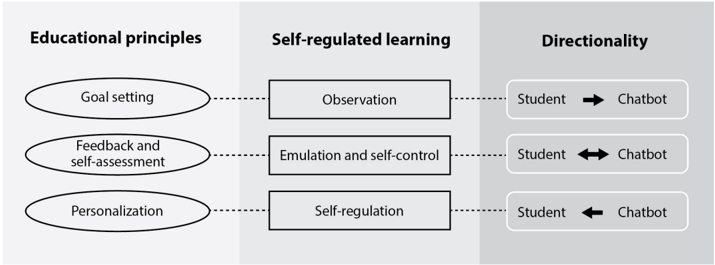
The invention of ChatGPT and generative AI technologies presents educators with significant challenges, as concerns arise regarding students potentially exploiting these tools unethically, misrepresenting their work, or gaining academic merits without active participation in the learning process. To effectively navigate this shift, it is crucial to embrace AI as a contemporary educational trend and establish pedagogical principles for properly utilizing emerging technologies like ChatGPT to promote self-regulation. Rather than suppressing AI-driven tools, educators should foster collaborations among stakeholders, including educators, instructional designers, AI researchers, and developers. This paper proposes three key pedagogical principles for integrating AI chatbots in classrooms, informed by Zimmerman’s Self-Regulated Learning (SRL) framework and Judgment of Learning (JOL). We argue that the current conceptualization of AI chatbots in education is inadequate, so we advocate for the incorporation of goal setting (prompting), self-assessment and feedback, and personalization as three essential educational principles. First, we propose that teaching prompting is important for developing students’ SRL. Second, configuring reverse prompting in the AI chatbot’s capability will help to guide students’ SRL and monitoring for understanding. Third, developing a data-driven mechanism that enables an AI chatbot to provide learning analytics helps learners to reflect on learning and develop SRL strategies. By bringing in Zimmerman’s SRL framework with JOL, we aim to provide educators with guidelines for implementing AI in teaching and learning contexts, with a focus on promoting students’ self-regulation in higher education through AI-assisted pedagogy and instructional design.
Overview
The claims and statistics of this paper haven’t been checked yet.
Free: it reads the open-access text and checks the first 5 claims that cite a source we can check. Create a free account to check every claim.
Integrity signals
Registry
Cites
Statistics
Figures
Verification
Claims the paper makes
The claims and statistics of this paper haven’t been checked yet.
Free: it reads the open-access text and checks the first 5 claims that cite a source we can check. Create a free account to check every claim.
Claims other papers make about this one
Each is checked against this paper’s own text: does it say what the citing paper says it does?
The source backs part of the claim, not all of it — or backs it for a different population, condition or comparison.
In the citing paper
“Empirical studies have shown that learners who effectively integrate digital tools into their study routines demonstrate higher levels of metacognitive awareness and learning regulation, particularly in complex or information-rich contexts (Chang et al., 2023; Chiu, 2023; Lee and Hwang, 2022).”
From Cognitive offloading through digital tools and its relationship with critical thinking, task persistence, and learning depth (2026) · cites this paper as Chang et al., 2023
Experimental — accuracy not yet measured
Self-check
Percentages, sums and reported differences re-computed from the paper’s own numbers.
The self-check needs the paper’s full text.
Citations
Cites
I.—COMPUTING MACHINERY AND INTELLIGENCE
TURING, A. M. (1950) · Mind · doi:10.1093/mind/lix.236.433 · Cited by 10,290 · cited 1×
“The history of chatbots can be extended back to the early 1950s [20].”
BackgroundA revision of bloom's taxonomy: an overview
Krathwohl, D. R. (2002) · Theory Into Practice · doi:10.1207/s15430421tip4104_2 · Cited by 8,132 · cited 1×
“To better understand this, we can break prompts down into two types: cognitive prompts and metacognitive prompts, by drawing on Bloom’s Taxonomy [62].”
MethodBem, D. J. (1972) · Advances in Experimental Social Psychology · doi:10.1016/s0065-2601(08)60024-6 · Cited by 5,241 · cited 1×
“For example, the social cognitive model [17] emphasizes the influence of social and environmental factors on learning, and the self-perception model suggests that individuals’ JOL is influenced by their perceptions of their abilities and self-worth [18].”
BackgroundDwivedi, Y. K., Kshetri, N., Hughes, L., Slade, E. L., Jeyaraj, A., Kar, A. K., Baabdullah, A. M., Koohang, A., Raghavan, V., Ahuja, M., et al. (2023) · International Journal of Information Management · doi:10.1016/j.ijinfomgt.2023.102642 · Cited by 4,584
ELIZA—a computer program for the study of natural language communication between man and machine
Weizenbaum, J. (1966) · Communications of the ACM · doi:10.1145/365153.365168 · Cited by 4,452 · cited 1×
“In particular, ELIZA [21] and A.L.I.C.E. [22] were well-known early chatbot systems simulating real human communication.”
BackgroundBAİDOO-ANU, D., & OWUSU ANSAH, L. (2023) · Journal of AI · doi:10.61969/jai.1337500 · Cited by 3,939
A Conceptual Framework for Assessing Motivation and Self-Regulated Learning in College Students
Pintrich, P. R. (2004) · Educational Psychology Review · doi:10.1007/s10648-004-0006-x · Cited by 3,269
Baidoo-Anu, D., & Owusu Ansah, L. (2023) · doi:10.2139/ssrn.4337484 · Cited by 3,004 · cited 2×
“Baidoo-Anu and Ansa [79] underscore that the efficacy of generative AI tools is intricately Baidoo-Anu and Ansa [79] under-score that the e ffi cacy of generative AI tools is intricately linked to the training data that were fed into the tool, wherein the composition of training data can inadvertently…”
BackgroundA Review of Self-regulated Learning: Six Models and Four Directions for Research
Panadero, E. (2017) · Frontiers in Psychology · doi:10.3389/fpsyg.2017.00422 · Cited by 2,915 · cited 1×
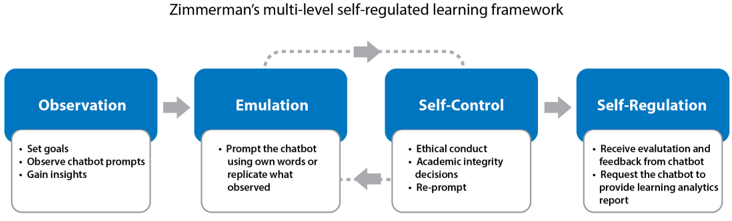
“Review of Zimmerman’s Multi-Level Self-Regulated Learning Framework Zimmerman’s multi-level SRL framework [7,8] encompasses four distinct levels: observation Zimmerman’s multi-level SRL framework [7,8] encompasses four distinct levels: observation, emulation, self-control, and self-regulation (see…”
Social Cognitive Theory: An Agentic Perspective
Bandura, A. (1999) · Asian Journal of Social Psychology · doi:10.1111/1467-839x.00024 · Cited by 2,050 · cited 1×
“For example, the social cognitive model [17] emphasizes the influence of social and environmental factors on learning, and the self-perception model suggests that individuals’ JOL is influenced by their perceptions of their abilities and self-worth [18].”
Background
Research works printed but not linked: 12
- 8. Zimmerman, B.J. Attaining Self-Regulation. In Handbook of Self-Regulation; Elsevier: Amsterdam, The Netherlands, 2000; pp. 13-39. [CrossRef]
- 19. Berkowitz, L., Ed.; Academic Press: Cambridge, MA, USA, 1972; Volume 6, pp. 1-62. [CrossRef]
- 24. Epstein, R., Roberts, G., Beber, G., Eds.; Springer: Dordrecht, The Netherlands, 2009; pp. 181-210. [CrossRef]
- 35. Castiglione, A., Pop, F., Ficco, M., Palmieri, F., Eds.; Lecture Notes in Computer Science Book Series; Springer International Publishing: Cham, Switzerland, 2018; Volume 11161, pp. 291-302. [CrossRef]
- 37. Kim, H.-S.; Kim, N.Y. Effects of AI chatbots on EFL students' communication skills. Commun. Ski. 2021, 21, 712-734.
- 41. Kompatsiaris, I., Cave, J., Satsiou, A., Carle, G., Passani, A., Kontopoulos, E., Diplaris, S., McMillan, D., Eds.; Lecture Notes in Computer Science Book Series; Springer International Publishing: Cham, Switzerland, 2017; Volume 10673, pp. 377-392. [CrossRef]
- 44. Hattie, J. The black box of tertiary assessment: An impending revolution. In Tertiary Assessment & Higher Education Student Outcomes: Policy, Practice & Research; Ako Aotearoa: Wellington, New Zealand, 2009; pp. 259-275.
- 46. Winne, P.H. Cognition and metacognition within self-regulated learning. In Handbook of Self-Regulation of Learning and Performance, 2nd ed.; Routledge: London, UK, 2017.
- 48. Shneiderman, B.; Plaisant, C. Designing the User Interface: Strategies for Effective Human-Computer Interaction, 4th ed.; Pearson: Boston, MA, USA; Addison Wesley: Hoboken, NJ, USA, 2004.
- 56. Burke, J. (Ed.) Outcomes, Learning and the Curriculum: Implications for Nvqs, Gnvqs and Other Qualifications; Routledge: London, UK, 1995. [CrossRef]
- 62. Taylor & Francis Group: Milton Park, UK, 2018.
- 75. Newman, R.S. Adaptive help seeking: A strategy of self-regulated learning. In Self-Regulation of Learning and Performance: Issues and Educational Applications; Lawrence Erlbaum Associates, Inc.: Hillsdale, NJ, USA, 1994; pp. 283-301.
Cited by
Ng, D. T. K., Tan, C. W., & Leung, J. K. L. (2024) · British Journal of Educational Technology · doi:10.1111/bjet.13454 · Cited by 362
Lin, H., & Chen, Q. (2024) · BMC Psychology · doi:10.1186/s40359-024-01979-0 · Cited by 269
“This personalized approach is crucial for supporting students’ creative and emotional development, as noted by Chang et al. [62], who found that personalized AI feedback enhances learning outcomes and student confidence.”
BackgroundDahri, N. A., Yahaya, N., Al-Rahmi, W. M., Aldraiweesh, A., Alturki, U., Almutairy, S., Shutaleva, A., & Soomro, R. B. (2024) · Heliyon · doi:10.1016/j.heliyon.2024.e29317 · Cited by 239
“Integrating Artificial Intelligence (AI) holds great promise for enhancing metacognitive self-regulated learning [2,28,29].”
BackgroundAlmogren, A. S., Al-Rahmi, W. M., & Dahri, N. A. (2024) · Heliyon · doi:10.1016/j.heliyon.2024.e31887 · Cited by 190
“However, applying these models directly to AI chatbots in education may not capture the nuances of user perceptions and interactions within this specific context [32].”
MethodAn LLM-Driven Chatbot in Higher Education for Databases and Information Systems
Neumann, A. T., Yin, Y., Sowe, S., Decker, S., & Jarke, M. (2025) · IEEE Transactions on Education · doi:10.1109/te.2024.3467912 · Cited by 161
“Deploying AI-driven chatbots, guided by pedagogical strategies, such as goal setting and personalized feedback, can enhance learners’ SRL skills [29].”
ChatGPT in Teaching and Learning: A Systematic Review
Ali, D., Fatemi, Y., Boskabadi, E., Nikfar, M., Ugwuoke, J., & Ali, H. (2024) · Education Sciences · doi:10.3390/educsci14060643 · Cited by 146
Pan, M., Lai, C., & Guo, K. (2024) · The Internet and Higher Education · doi:10.1016/j.iheduc.2024.100991 · Cited by 158
Feng, L. (2024) · Journal of Educational Computing Research · doi:10.1177/07356331241268349 · Cited by 198
“Chang et al. (2023) proposed three key pedagogical principles for integrating AI chatbots in classrooms to promote self-regulated learning.”
Sardi, J., Darmansyah, Candra, O., Yuliana, D. F., Habibullah, Yanto, D. T. P., & Eliza, F. (2025) · International Journal of Engineering Pedagogy (iJEP) · doi:10.3991/ijep.v15i1.53379 · Cited by 105
Cai, L., Msafiri, M. M., & Kangwa, D. (2025) · Education and Information Technologies · doi:10.1007/s10639-024-13112-0 · Cited by 104
Izadi, S., & Forouzanfar, M. (2024) · AI · doi:10.3390/ai5020041 · Cited by 142
“Positive feedback reinforces the responses or actions taken by the chatbot, while negative feedback prompts it to adjust its approach [90].”
BackgroundSaúde, S., Barros, J. P., & Almeida, I. (2024) · Social Sciences · doi:10.3390/socsci13080410 · Cited by 83
“As argued by Chang et al. (2023), this calls for the adoption of pedagogical and practical guidelines for implementing Gen AI in teaching and learning contexts, focusing on promoting students’ ethical, self-regulated, and instructed digital use.”
BackgroundHartley, K., Hayak, M., & Ko, U. H. (2024) · Education Sciences · doi:10.3390/educsci14020120 · Cited by 84
“With the dramatic uptick in generative AI tools, researchers have recently begun to consider design principles to support self-regulated learning broadly [26].”
BackgroundThe Impact of AI on the Personal and Collaborative Learning Environments in Higher Education
Msambwa, M. M., Wen, Z., & Daniel, K. (2025) · European Journal of Education · doi:10.1111/ejed.12909 · Cited by 76
Saihi, A., Ben-Daya, M., Hariga, M., & As'ad, R. (2024) · Computers and Education: Artificial Intelligence · doi:10.1016/j.caeai.2024.100274 · Cited by 75
Maphoto, K. B., Sevnarayan, K., Mohale, N. E., Suliman, Z., Ntsopi, T. J., & Mokoena, D. (2024) · Open Praxis · doi:10.55982/openpraxis.16.2.649 · Cited by 155
Lin, M. P.-C., & Chang, D. (2023) · Computers and Education: Artificial Intelligence · doi:10.1016/j.caeai.2023.100167 · Cited by 69
Self-citationAdeleye, O. O., Eden, C. A., & Adeniyi, I. S. (2024) · World Journal of Advanced Engineering Technology and Sciences · doi:10.30574/wjaets.2024.11.2.0091 · Cited by 125
“Similarly, tools like Carnegie Learning's MATHia and Pearson's Realize platform use AI to provide personalized learning pathways for students in various subjects, including math, science, and language arts (Bhutoria, 2022, Chang, et. al., 2023, Maghsudi, et. al., 2021).”
MethodTang, K.-S., & Putra, G. B. S. (2026) · Journal of Science Education and Technology · doi:10.1007/s10956-025-10240-1 · Cited by 65
Daniel, K., Msambwa, M. M., & Wen, Z. (2025) · European Journal of Education · doi:10.1111/ejed.70036 · Cited by 71
AbuSahyon, A. S. E., Alzyoud, A., AlShorman, O., & Al-Absi, B. (2023) · International Journal of Membrane Science and Technology · doi:10.15379/ijmst.v10i1.2829 · Cited by 136
“This approach not only enhances learners' motivation and engagement but it also fasten their progress by providing targeted and relevant language contexts and tasks [43].”
BackgroundZhang, X., Li, Z., Zhang, M., Yin, M., Yang, Z., Gao, D., & Li, H. (2025) · Journal of Affective Disorders · doi:10.1016/j.jad.2025.03.141 · Cited by 56
Aldraiweesh, A., & Alturki, U. (2025) · IEEE Access · doi:10.1109/access.2025.3534099 · Cited by 98
“Perceived Educational Support and Perceived Usefulness influence students’ attitudes and intentions to use AI in education [6], [8].”
InfluentialThe Development and Validation of an Artificial Intelligence Chatbot Dependence Scale
Zhang, X., Yin, M., Zhang, M., Li, Z., & Li, H. (2025) · Cyberpsychology, Behavior, and Social Networking · doi:10.1089/cyber.2024.0240 · Cited by 52
“16 As their popularity continues to grow, researchers are becoming increasingly concerned about potential negative effects, particularly the risk of dependence on AI chatbots.”
Lin, M. P.-C., Liu, A. L., Poitras, E., Chang, M., & Chang, D. (2024) · Sustainability · doi:10.3390/su16208992 · Cited by 83
Self-citationLuo, T., Muljana, P. S., Ren, X., & Young, D. (2024) · Educational Technology Research and Development · doi:10.1007/s11423-024-10437-y · Cited by 84
“…literature regarding the GenAI’s advantages for supporting project management, assisting in the communication process, improving design documents, and promoting professional development (Berg & du Plessis, 2023; Chang et al., 2023; Crompton & Burke, 2024; Kumar et al., 2024; Trust et al., 2023).”
Wang, W.-S., Lin, C.-J., Lee, H.-Y., Huang, Y.-M., & Wu, T.-T. (2025) · Education and Information Technologies · doi:10.1007/s10639-025-13557-x · Cited by 43
“…technology is based on advanced large language model (LLM) techniques, capable of providing targeted tutoring and real-time feedback, and has demonstrated substantial potential for learning support in traditional educational settings (Chang et al., 2023; Lee et al., 2024; Lin et al., 2023, 2024).”
Educational data mining: a 10-year review
Kalita, E., Oyelere, S. S., Gaftandzhieva, S. N., Rajesh, K. N. V. P. S., Jagatheesaperumal, S. K., Mohamed, A. S. A., Elbarawy, Y. M., Desuky, A. S., Hussain, S., Çifçi, M. A., et al. (2025) · Discover Computing · doi:10.1007/s10791-025-09589-z · Cited by 97
“Applying EDM techniques to this data supplies researchers and educators with a comprehensive view of the learning environment, enabling evidence-based improvements to curriculum and instructional design [49].”
Menéses, E. L., Catalán, L. L., Piris, N. P., & Mellado-Moreno, P. C. (2025) · Applied Sciences · doi:10.3390/app15020772 · Cited by 81
Kim, J., Detrick, R., Yu, S., Song, Y., Bol, L., & Li, N. (2025) · Education and Information Technologies · doi:10.1007/s10639-024-13187-9 · Cited by 81
“Further, a data-driven mechanism of AI agents can provide learning analytics to students to promote a reflection on their collaborative learning and develop SSRL strategies (Chang et al., 2023).”
InfluentialYi, M., & Chen, M. (2025) · Frontiers in Psychology · doi:10.3389/fpsyg.2025.1568239 · Cited by 79
Qian, K., Liu, S., Li, T., Raković, M., Li, X., Guan, R., Molenaar, I., Nawaz, S., Swiecki, Z., Yan, L., et al. (2026) · Computers & Education · doi:10.1016/j.compedu.2025.105448 · Cited by 39
“The rise of GenAI offers a promising solution to the limitations of rule-based scaffolding approaches by leveraging the capabilities of LLMs, such as GPT-4 (Bubeck et al., 2023; Lin and Chang, 2023; Li et al., 2025).”
The impact of metacognitive scaffolding on deep learning in a GenAI-supported learning environment
Wu, J., Wang, J., Lei, S., Wu, F., & Gao, X. (2025) · Interactive Learning Environments · doi:10.1080/10494820.2025.2479162 · Cited by 36
“Research has shown that learners supported by GenAI tools (ChatGPT) learn more efficiently than do learners not supported by such tools (Chang et al., 2023).”
Xia, L., Shen, K., Sun, H., An, X., & Dong, Y. (2025) · Education and Information Technologies · doi:10.1007/s10639-024-13137-5 · Cited by 38
“Firstly, educators can promote students’ self-regulation and self-reflection through generative AI-assisted pedagogy and instructional design (Chang et al., 2023).”
Pan, M., Guo, K., & Lai, C. (2025) · RELC Journal · doi:10.1177/00336882241264030 · Cited by 35
“Recent developments in generative arti fi cial intelligence (AI) show potential as a pedagogical solution to these problems (Chang et al., 2023).”
Cooper, M. M., & Klymkowsky, M. W. (2024) · Journal of Chemical Education · doi:10.1021/acs.jchemed.4c00765 · Cited by 48
Hu, Y.-H., Hsieh, C.-L., & Salac, E. S. N. (2024) · The Journal of Academic Librarianship · doi:10.1016/j.acalib.2024.102885 · Cited by 55
Uppal, K., & Hajian, S. (2024) · European Journal of Educational Research · doi:10.12973/eu-jer.14.1.199 · Cited by 36
Self-citationAl-Abri, A. (2025) · Education and Information Technologies · doi:10.1007/s10639-025-13484-x · Cited by 63
“Specific, measurable, and achievable goals serve as a roadmap that helps students stay focused and motivated throughout their learning journey (Chang et al., 2023; Wang & Lajoie, 2023).”
Comprehensive AI assessment framework: Enhancing educational evaluation with ethical AI integration
Kılınç, S. (2024) · Journal of Educational Technology and Online Learning · doi:10.31681/jetol.1492695 · Cited by 69
AI Governance in the Context of the EU AI Act
Kim, B.-J., Jeong, S., Cho, B.-K., & Chung, J. (2025) · IEEE Access · doi:10.1109/access.2025.3598023 · Cited by 64
“Over 30 studies mentioned ChatGPT or generative AI, with a significant portion focusing on how these technologies can be used to enhance students’ self-regulated learning abilities [81], [82].”
Ruwe, T., & Mayweg-Paus, E. (2024) · Frontiers in Education · doi:10.3389/feduc.2024.1461362 · Cited by 33
Almogren, A. S., Al-Rahmi, W. M., & Dahri, N. A. (2024) · IEEE Access · doi:10.1109/access.2024.3498047 · Cited by 36
“AI chatbots serve as virtual assistants, providing on-demand support and guidance to learners throughout their educational journey [133].”
Looi, C., & Jia, F. (2025) · Education and Information Technologies · doi:10.1007/s10639-025-13369-z · Cited by 60
“The tutor bot’s capacity to provide instant feedback and tailored guidance significantly aided students in understanding complex concepts and maintaining engagement with the learning material (Chang et al., 2023).”
InfluentialLiu, J., Zhang, Y., Li, W., Wang, Q., Niu, P., & Zhang, X. (2025) · Computers & Education · doi:10.1016/j.compedu.2025.105473 · Cited by 48
Self-citationDu, Q. (2025) · Education and Information Technologies · doi:10.1007/s10639-025-13602-9 · Cited by 56
A New AI Literacy For The Algorithmic Age: Prompt Engineering Or Eductional Promptization?
Haugsbakken, H., & Hagelia, M. (2024) · International Conference on Applied Artificial Intelligence (ICAPAI) · doi:10.1109/icapai61893.2024.10541229 · Cited by 46
“For example, educators are concerned that students might use them unethically [1, 2], as there is a greater chance that the mentioned tools might be doing the learning job on behalf of the students.”
BackgroundMsafiri, M. M., Kangwa, D., & Cai, L. (2024) · Social Sciences & Humanities Open · doi:10.1016/j.ssaho.2024.101203 · Cited by 92
A Collaborative Model for Integrating Teacher and GenAI into Future Education
Memon, T. D., & Kwan, P. (2025) · TechTrends · doi:10.1007/s11528-025-01105-w · Cited by 74
“Chang et al. (2023) address the challenges and opportunities presented by ChatGPT and generative AI technologies in education, particularly concerning ethical use and academic integrity.”
Inteligencia artificial (IA) en las escuelas: una revisión sistemática (2019-2023)
Bula, R. B., & Bonilla, A. C. (2024) · Enunciación · doi:10.14483/22486798.22039 · Cited by 100
Nguyen, H., & Nguyen, A. (2024) · Journal of Science Education and Technology · doi:10.1007/s10956-024-10175-z · Cited by 49
“Results also illuminate how learners need to employ new mechanisms to plan, monitor, evaluate, and reflect on learning processes (Chang et al., 2023).”
Zhang, R., Zou, D., & Cheng, G. (2024) · System · doi:10.1016/j.system.2024.103561 · Cited by 44
Algorithmic learning or learner autonomy? Rethinking AI’s role in digital education
Nopas, D.-S. (2025) · Qualitative Research Journal · doi:10.1108/qrj-11-2024-0282 · Cited by 67
Lin, M. P.-C., Chang, D., & Winne, P. H. (2024) · Educational Technology Research and Development · doi:10.1007/s11423-024-10408-3 · Cited by 41
“Studies (e.g., Chang et al., 2023; Lin & Chang, 2023; Reiners et al., 2014) suggested a chatbot acts as a mentor, oversees learners achieving learning objectives, and initiates a discussion about how to approach an objective rather than dictating how to proceed.”
InfluentialSelf-citationIntegrating CALL and AIALL for an interactive pedagogical model of language learning
Bahari, A., Han, F., & Strzelecki, A. (2025) · Education and Information Technologies · doi:10.1007/s10639-025-13388-w · Cited by 64
“AIALL systems can analyze learners’ language proficiency levels, identify areas of strengths and weaknesses, and provide tailored learning experiences that meet learners’ individual needs and prefer - ences (Chang et al., 2023).”
Dumitru, C., Muttashar Abdulsahib, G., Ibrahim Khalaf, O., & Bennour, A. (2026) · Technology and Disability · doi:10.1177/10554181251355428 · Cited by 27
“13,41 One of the key challenges in developing personalized learning systems is the creation of diverse educational content that considers the various ways students perceive and process information.”
InfluentialDental students’ learning experience: artificial intelligence vs human feedback on assignments
Jayawardena, C. K., Gunathilake, Y., & Ihalagedara, D. (2025) · International Dental Journal · doi:10.1016/j.identj.2024.12.022 · Cited by 26
Technology integration in teacher education: challenges and adaptations in the post-pandemic era
Olayinka, T. A., Waghid, Y., & Wambua, A. (2024) · Discover Education · doi:10.1007/s44217-024-00341-1 · Cited by 55
“Globally, university educators are using several technologies to support instruction, knowledge acquisition, and retention [4, 14, 98].”
Sharma, A. J., & Rathore, B. (2024) · Journal of Decision System · doi:10.1080/12460125.2024.2410030 · Cited by 35
Jukiewicz, M. (2025) · Frontiers in Education · doi:10.3389/feduc.2025.1594572 · Cited by 42
Lee, H., Huang, Y., & Wu, T. (2025) · European Journal of Education · doi:10.1111/ejed.70262 · Cited by 42
Prospects for ChatGPT Application in Higher Education: A Scoping Review of International Research
Raitskaya, L., & Lambovska, M. (2024) · Integration of Education · doi:10.15507/1991-9468.114.028.202401.010-021 · Cited by 43
UNESCO's AI Competency Framework: Challenges and Opportunities in Educational Settings
Mutawa, A. M., & Sruthi, S. (2024) · Advances in educational technologies and instructional design book series · doi:10.4018/979-8-3693-0884-4.ch004 · Cited by 40
(2024) · Journal of Applied Learning & Teaching · doi:10.37074/jalt.2024.7.1.12 · Cited by 22
How Learners’ Trust Changes in Generative AI over a Semester of Undergraduate Courses
Song, D. (2024) · International Journal of Artificial Intelligence in Education · doi:10.1007/s40593-024-00446-6 · Cited by 33
“Self-regulated learning has been identified as an essential aspect when designing AI-based learning support systems (Chang et al., 2023; Song, 2024).”
Artificial intelligence chatbots in endodontic education—Concepts and potential applications
Mohammad‐Rahimi, H., Setzer, F. C., Aminoshariae, A., Dummer, P. M. H., Duncan, H. F., & Nosrat, A. (2025) · International Endodontic Journal · doi:10.1111/iej.14231 · Cited by 33
Yang, M., Jiang, S., Li, B., Herman, K., Luo, T., Chappell, S., & Lovett, N. (2025) · British Journal of Educational Technology · doi:10.1111/bjet.13588 · Cited by 46
Zhang, X., Li, H., Yin, M., Zhang, M., Li, Z., & Chen, Z. (2026) · International Journal of Human–Computer Interaction · doi:10.1080/10447318.2025.2545464 · Cited by 21
“…and logical reasoning, AI chatbots are now widely applied in domains such as medicine (Lee, 2023; Lee et al., 2023), healthcare (Lee, 2023; Lee et al., 2023), scientific research (Fatani, 2023), business (Asha et al., 2023), social media (Asha et al., 2023), and education (Chang et al., 2023).”
Generative Artificial Intelligence in Instructional System Design
Chai, D. S., Kim, H. S., Kim, K. N., Ha, Y., Shin, S. S. H., & Yoon, S. W. (2025) · Human Resource Development Review · doi:10.1177/15344843251320256 · Cited by 20
“For example, Chang et al. (2023) and Lin (2024) demonstrated how GAI can be applied in teaching and learning using the self-directed/self-regulated learning theory.”
Abulibdeh, A. O. (2025) · Sustainable Futures · doi:10.1016/j.sftr.2025.101033 · Cited by 47
Liu, M., Wu, Z., Dai, H. M., Su, Y., Malik, L., Liao, J., Zhang, W., Guo, S., Liu, L., & Zhao, J. (2025) · British Journal of Educational Technology · doi:10.1111/bjet.70005 · Cited by 29
AI-based feedback tools in education: A comprehensive bibliometric analysis study
Donmez, M. (2024) · International Journal of Assessment Tools in Education · doi:10.21449/ijate.1467476 · Cited by 39
“This cluster highlights the diverse range of AI-based tools and methodologies utilized for educational purposes, including chatbots, analytics platforms, and automated assessment systems (Chang et al., 2023; Ding & Zou, 2024).”
Wang, M., Tlili, A., Khribi, M. K., Lo, C. K., & Huang, R. (2025) · Information Development · doi:10.1177/02666669251335655 · Cited by 38
Zhang, Q., Pan, X., & Fan, J. (2025) · European Journal of Education · doi:10.1111/ejed.70336 · Cited by 24
Shumeiko, N., & Osadchа, K. (2024) · Journal of Physics Conference Series · doi:10.1088/1742-6596/2871/1/012027 · Cited by 27
Cassany, D. (2024) · Enunciación · doi:10.14483/22486798.22891 · Cited by 43
Leveraging ChatGPT to Support Self-Regulated Learning in Online Courses
Zhu, M. (2025) · TechTrends · doi:10.1007/s11528-025-01075-z · Cited by 28
“Students can align their personal learning goals with course outcomes and their unique backgrounds, enhancing SRL (Chang et al., 2023; Zhu, 2021).”
Artificial intelligence and robotics in education: Advances, challenges, and future perspectives
Cadavieco, J. F., López, J. M. S., & Castro, S. S. (2025) · Social Sciences & Humanities Open · doi:10.1016/j.ssaho.2025.101533 · Cited by 35
Data-Driven Learning Analytics and Artificial Intelligence in Higher Education: A Systematic Review
González-Pérez, L. I., García‐Peñalvo, F. J., & Argüelles-Cruz, A.-J. (2025) · IEEE Revista Iberoamericana de Tecnologias del Aprendizaje · doi:10.1109/rita.2025.3615512 · Cited by 29
Huwer, J., Thyssen, C., Becker, S., von Kotzebue, L., Finger, A., Kremser, E., Berber, S., Brückner, M., Maurer, N., Bruckermann, T., et al. (2025) · Computers and Education Open · doi:10.1016/j.caeo.2025.100303 · Cited by 25
Reimagining healthcare education through nurturing AI-driven innovation
Mendes, J. M. (2025) · BMC Medical Education · doi:10.1186/s12909-025-08254-9 · Cited by 22
“Tools such as ChatGPT or adaptive learning systems must be assessed not only for educational value but also for their risks concerning data collection, autonomy, and equity [66, 67].”
ChatGPT in Education: Ethical Considerations and Sentiment Analysis
Yang, S., Dong, Y., & Yu, Z. G. (2024) · International Journal of Information and Communication Technology Education · doi:10.4018/ijicte.346826 · Cited by 39
Garcia, M. B., Goi, C. L., Shively, K., Maher, D., Rosak-Szyrocka, J., Happonen, A., Bozkurt, A., & Damaševičius, R. (2024) · Advances in educational technologies and instructional design book series · doi:10.4018/979-8-3693-5633-3.ch001 · Cited by 22
Xu, G., Yu, A., Xu, C., Liu, X., & Trainin, G. (2024) · Education and Information Technologies · doi:10.1007/s10639-024-12982-8 · Cited by 19
“Therefore, it is crucial for teachers to actively facilitate and emphasize the importance of interaction between students and AI systems, enhancing the effective use of personalized learning technologies (Chang et al., 2023).”
Yang, J., Qiu, H., & Yu, W. (2024) · Journal of Asian Public Policy · doi:10.1080/17516234.2024.2429046 · Cited by 18
“Educators are responsible for enhancing the design and delivery of instructional content (Chang et al., 2023; Geerling et al., 2023; West et al., 2023), integrating GAI technologies into curricula and pedagogical approaches (Duong et al., 2023; Tayan et al., 2024), guiding students to effectively…”
InfluentialAlwakid, W. N., Dahri, N. A., Humayun, M., & Alwakid, G. N. (2025) · The International Journal of Management Education · doi:10.1016/j.ijme.2025.101252 · Cited by 31
Maleki, A. (2026) · Discover Artificial Intelligence · doi:10.1007/s44163-026-00887-z · Cited by 32
“Current models also overlook the growing ambiguity introduced by generative AI—particularly the blurred boundaries between academic support and miscon-duct—and the ethical tensions related to algorithmic bias and digital inequities [10, 26].”
Student satisfaction with artificial intelligence chatbots in Ethiopian academia
Subaveerapandiyan, A., Radhakrishnan, S., Tiwary, N., & Guangul, S. M. (2024) · IFLA Journal · doi:10.1177/03400352241252974 · Cited by 21
“Despite the promise of AI chatbots, challenges and concerns persist (Chang et al., 2023).”
Ishaq, K., Alvi, A., Haq, M. I. U., Rosdi, F., Choudhry, A. N., Anjum, A., & Khan, F. A. (2024) · PeerJ Computer Science · doi:10.7717/peerj-cs.2310 · Cited by 31
Liu, M., Zhang, L. J., & Neufeld, T. J. E. (2025) · Innovation in Language Learning and Teaching · doi:10.1080/17501229.2025.2549754 · Cited by 22
Xia, L., An, X., Li, X., & Dong, Y. (2026) · Journal of Educational Computing Research · doi:10.1177/07356331251382853 · Cited by 13
“For example, Chang et al. (2023) highlighted the importance of prompting support in developing students ’ self-regulation within generative AI-supported learning contexts.”
Preliminary Systematic Review of Open-Source Large Language Models in Education
Lin, M. P.-C., Chang, D., Hall, S., & Jhajj, G. (2024) · Lecture notes in computer science · doi:10.1007/978-3-031-63028-6_6 · Cited by 25
Self-citationLi, Y., Ji, W., Liu, J., & Li, W. (2024) · International Conference on Interactive Intelligent Systems and Techniques (IIST) · doi:10.1109/iist62526.2024.00099 · Cited by 26
Saifullah, S., Yawan, H., Syafitri, N., & Nurhaliza, S. (2024) · Dharmas Education Journal (DE_Journal) · doi:10.56667/dejournal.v5i2.1605 · Cited by 27
Vera, F. S. (2024) · Education Sciences · doi:10.3390/educsci15010026 · Cited by 32
AI-Assisted Formative Assessment and Feedback
Trajkovski, G., & Hayes, H. (2025) · Digital education and learning · doi:10.1007/978-3-031-88252-4_7 · Cited by 21
Investigating AI Chatbots’ Role in Online Learning and Digital Agency Development
Engeness, I., Nohr, M., & Fossland, T. (2025) · Education Sciences · doi:10.3390/educsci15060674 · Cited by 29
“Students’ data privacy is a critical concern, particularly when chatbots collect and analyse large amounts of user data to personalise learning experiences (Chang et al., 2023).”
InfluentialAvsec, S., & Rupnik, D. (2025) · Systems · doi:10.3390/systems13070562 · Cited by 20
Mzwri, K., & Turcsányi-Szabó, M. (2025) · Journal of Computers in Education · doi:10.1007/s40692-025-00367-w · Cited by 34
“This supports prior research emphasizing AI’s role in providing personalized and adaptive support (Gligorea et al., 2023; Tapalova & Zhiyenbayeva, 2022) and fostering autonomous learning (Chang et al., 2023; Yim & Su, 2025).”
Sustainability Education in L2 Writing: AI-Based Multimodal Awareness and Engagement
Aydın Yıldız, T. (2025) · Sustainability · doi:10.3390/su17219376 · Cited by 11
Metadata
- Authors
- Chang, D. H., Lin, M. P.-C., Hajian, S., & Wang, Q. Q.
- Affiliations
- Simon Fraser University (CA)
- Mount Saint Vincent University (CA)
- Kwantlen Polytechnic University (CA)
- Corresponding author
- Chang, Daniel H.
- Venue
- Sustainability
- Publisher
- MDPI AG
- Published
- 2023-08-27
- Volume
- 15
- Issue
- 17
- Pages
- 12921
- ISSN
- 2071-1050 (ISSN-L)
- OpenAlex
- W4386221177
- Cited by
- 370
- References
- 69
- Citations by year
- 2026: 130 · 2025: 151 · 2024: 83 · 2023: 6
- FWCI
- 86.83
- Type
- journal article
- Language
- en
- Open access
- gold
- doi.org
- Licence
- Locations
- Sustainability (publishedVersion, cc-by)
- RePEc: Research Papers in Economics (submittedVersion)
- Funders
- Social Sciences and Humanities Research Council of Canada (SSHRC) (430-2023-00368)
- Topics
- Social Sciences › Education › Artificial Intelligence in Education
- Physical Sciences › Computer Science › Artificial Intelligence › Intelligent Tutoring Systems and Adaptive Learning
- Social Sciences › Psychology › Developmental and Educational Psychology › Innovative Teaching and Learning Methods
- Keywords
- AI chatbots in education, student self-regulation, goal setting, prompting, self-assessment, feedback, personalization, learning analytics, judgments of learning, generative AI in higher education, instructional design, ethical use of AI
About these checks
Registry, retraction, Cites and statistics results are computed, not judged, with one exception: a printed reference that no index lists is read once by a model before it counts as a citation error. Claims are extracted by a model and kept only when their quote appears verbatim in the text; each cited source is then checked, with a model’s help, for whether it says what the claim relies on. Those verdicts can be wrong — read the claim’s quote and the cited source before relying on one.
Statistics and arithmetic are recomputed, not judged.
Confidence bands are shown only for fields calibrated on our annotated test set. None is calibrated yet, so no band is shown.
What counts as a claim ›How we measure confidence ›How we check this ›
Are you an author, or do you see a problem with this page? Request a review
Data sources
Bibliographic data: Semantic Scholar, OpenAlex, Crossref.
Contains information from the Semantic Scholar Academic Graph Datasets, made available under the ODC Attribution License (ODC-BY 1.0).
Semantic Scholar’s data is described in: Kinney, R., et al. (2023). The Semantic Scholar Open Data Platform. arXiv:2301.10140.
