

Educational Design Principles of Using AI Chatbot That Supports Self-Regulated Learning in Education: Goal Setting, Feedback, and Personalization
Open accessThe DOI matches its Crossref record; 73 of the 74 references it cites were found in a registry or an index.
Abstract
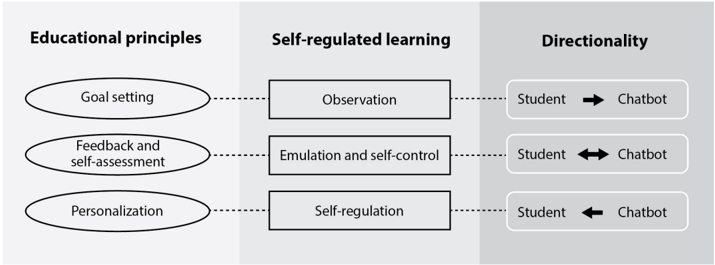
The invention of ChatGPT and generative AI technologies presents educators with significant challenges, as concerns arise regarding students potentially exploiting these tools unethically, misrepresenting their work, or gaining academic merits without active participation in the learning process. To effectively navigate this shift, it is crucial to embrace AI as a contemporary educational trend and establish pedagogical principles for properly utilizing emerging technologies like ChatGPT to promote self-regulation. Rather than suppressing AI-driven tools, educators should foster collaborations among stakeholders, including educators, instructional designers, AI researchers, and developers. This paper proposes three key pedagogical principles for integrating AI chatbots in classrooms, informed by Zimmerman’s Self-Regulated Learning (SRL) framework and Judgment of Learning (JOL). We argue that the current conceptualization of AI chatbots in education is inadequate, so we advocate for the incorporation of goal setting (prompting), self-assessment and feedback, and personalization as three essential educational principles. First, we propose that teaching prompting is important for developing students’ SRL. Second, configuring reverse prompting in the AI chatbot’s capability will help to guide students’ SRL and monitoring for understanding. Third, developing a data-driven mechanism that enables an AI chatbot to provide learning analytics helps learners to reflect on learning and develop SRL strategies. By bringing in Zimmerman’s SRL framework with JOL, we aim to provide educators with guidelines for implementing AI in teaching and learning contexts, with a focus on promoting students’ self-regulation in higher education through AI-assisted pedagogy and instructional design.
Overview
The claims and statistics of this paper haven’t been checked yet.
Free: it reads the open-access text and checks the first 5 claims that cite a source we can check. Create a free account to check every claim.
Integrity signals
Registry
Cites
Statistics
Figures
Verification
Claims the paper makes
The claims and statistics of this paper haven’t been checked yet.
Free: it reads the open-access text and checks the first 5 claims that cite a source we can check. Create a free account to check every claim.
Claims other papers make about this one
Each is checked against this paper’s own text: does it say what the citing paper says it does?
The source backs part of the claim, not all of it — or backs it for a different population, condition or comparison.
In the citing paper
“Empirical studies have shown that learners who effectively integrate digital tools into their study routines demonstrate higher levels of metacognitive awareness and learning regulation, particularly in complex or information-rich contexts (Chang et al., 2023; Chiu, 2023; Lee and Hwang, 2022).”
From Cognitive offloading through digital tools and its relationship with critical thinking, task persistence, and learning depth (2026) · cites this paper as Chang et al., 2023
Experimental — accuracy not yet measured
Self-check
Percentages, sums and reported differences re-computed from the paper’s own numbers.
The self-check needs the paper’s full text.
Citations
Cites
I.—COMPUTING MACHINERY AND INTELLIGENCE
TURING, A. M. (1950) · Mind · doi:10.1093/mind/lix.236.433 · Cited by 10,290 · cited 1×
“The history of chatbots can be extended back to the early 1950s [20].”
BackgroundA revision of bloom's taxonomy: an overview
Krathwohl, D. R. (2002) · Theory Into Practice · doi:10.1207/s15430421tip4104_2 · Cited by 8,132 · cited 1×
“To better understand this, we can break prompts down into two types: cognitive prompts and metacognitive prompts, by drawing on Bloom’s Taxonomy [62].”
MethodBem, D. J. (1972) · Advances in Experimental Social Psychology · doi:10.1016/s0065-2601(08)60024-6 · Cited by 5,241 · cited 1×
“For example, the social cognitive model [17] emphasizes the influence of social and environmental factors on learning, and the self-perception model suggests that individuals’ JOL is influenced by their perceptions of their abilities and self-worth [18].”
BackgroundDwivedi, Y. K., Kshetri, N., Hughes, L., Slade, E. L., Jeyaraj, A., Kar, A. K., Baabdullah, A. M., Koohang, A., Raghavan, V., Ahuja, M., et al. (2023) · International Journal of Information Management · doi:10.1016/j.ijinfomgt.2023.102642 · Cited by 4,584
ELIZA—a computer program for the study of natural language communication between man and machine
Weizenbaum, J. (1966) · Communications of the ACM · doi:10.1145/365153.365168 · Cited by 4,452 · cited 1×
“In particular, ELIZA [21] and A.L.I.C.E. [22] were well-known early chatbot systems simulating real human communication.”
BackgroundBAİDOO-ANU, D., & OWUSU ANSAH, L. (2023) · Journal of AI · doi:10.61969/jai.1337500 · Cited by 3,939
A Conceptual Framework for Assessing Motivation and Self-Regulated Learning in College Students
Pintrich, P. R. (2004) · Educational Psychology Review · doi:10.1007/s10648-004-0006-x · Cited by 3,269
Baidoo-Anu, D., & Owusu Ansah, L. (2023) · doi:10.2139/ssrn.4337484 · Cited by 3,004 · cited 2×
“Baidoo-Anu and Ansa [79] underscore that the efficacy of generative AI tools is intricately Baidoo-Anu and Ansa [79] under-score that the e ffi cacy of generative AI tools is intricately linked to the training data that were fed into the tool, wherein the composition of training data can inadvertently…”
BackgroundA Review of Self-regulated Learning: Six Models and Four Directions for Research
Panadero, E. (2017) · Frontiers in Psychology · doi:10.3389/fpsyg.2017.00422 · Cited by 2,915 · cited 1×
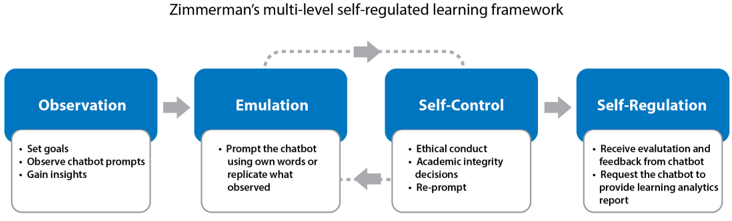
“Review of Zimmerman’s Multi-Level Self-Regulated Learning Framework Zimmerman’s multi-level SRL framework [7,8] encompasses four distinct levels: observation Zimmerman’s multi-level SRL framework [7,8] encompasses four distinct levels: observation, emulation, self-control, and self-regulation (see…”
Social Cognitive Theory: An Agentic Perspective
Bandura, A. (1999) · Asian Journal of Social Psychology · doi:10.1111/1467-839x.00024 · Cited by 2,050 · cited 1×
“For example, the social cognitive model [17] emphasizes the influence of social and environmental factors on learning, and the self-perception model suggests that individuals’ JOL is influenced by their perceptions of their abilities and self-worth [18].”
Background
Research works printed but not linked: 12
- 8. Zimmerman, B.J. Attaining Self-Regulation. In Handbook of Self-Regulation; Elsevier: Amsterdam, The Netherlands, 2000; pp. 13-39. [CrossRef]
- 19. Berkowitz, L., Ed.; Academic Press: Cambridge, MA, USA, 1972; Volume 6, pp. 1-62. [CrossRef]
- 24. Epstein, R., Roberts, G., Beber, G., Eds.; Springer: Dordrecht, The Netherlands, 2009; pp. 181-210. [CrossRef]
- 35. Castiglione, A., Pop, F., Ficco, M., Palmieri, F., Eds.; Lecture Notes in Computer Science Book Series; Springer International Publishing: Cham, Switzerland, 2018; Volume 11161, pp. 291-302. [CrossRef]
- 37. Kim, H.-S.; Kim, N.Y. Effects of AI chatbots on EFL students' communication skills. Commun. Ski. 2021, 21, 712-734.
- 41. Kompatsiaris, I., Cave, J., Satsiou, A., Carle, G., Passani, A., Kontopoulos, E., Diplaris, S., McMillan, D., Eds.; Lecture Notes in Computer Science Book Series; Springer International Publishing: Cham, Switzerland, 2017; Volume 10673, pp. 377-392. [CrossRef]
- 44. Hattie, J. The black box of tertiary assessment: An impending revolution. In Tertiary Assessment & Higher Education Student Outcomes: Policy, Practice & Research; Ako Aotearoa: Wellington, New Zealand, 2009; pp. 259-275.
- 46. Winne, P.H. Cognition and metacognition within self-regulated learning. In Handbook of Self-Regulation of Learning and Performance, 2nd ed.; Routledge: London, UK, 2017.
- 48. Shneiderman, B.; Plaisant, C. Designing the User Interface: Strategies for Effective Human-Computer Interaction, 4th ed.; Pearson: Boston, MA, USA; Addison Wesley: Hoboken, NJ, USA, 2004.
- 56. Burke, J. (Ed.) Outcomes, Learning and the Curriculum: Implications for Nvqs, Gnvqs and Other Qualifications; Routledge: London, UK, 1995. [CrossRef]
- 62. Taylor & Francis Group: Milton Park, UK, 2018.
- 75. Newman, R.S. Adaptive help seeking: A strategy of self-regulated learning. In Self-Regulation of Learning and Performance: Issues and Educational Applications; Lawrence Erlbaum Associates, Inc.: Hillsdale, NJ, USA, 1994; pp. 283-301.
Cited by
Items 301–369 of 369
He, Y. (2026) · International Conference on Recent Trends in Computer Science and Technology (ICRTCST) · doi:10.1109/icrtcst68392.2026.11545277
“The studies indicate that chatbots achieve superior outcomes based on instant feedback and individual assistance to every student [6].”
Junior high school student perspectives on the use of ChatGPT in music education
Weng, S. S., & Chiang, H.-C. (2026) · Computers and Education Open · doi:10.1016/j.caeo.2026.100387
Fang, Y., An, R., & Fang, C. (2026) · Springer eBooks · doi:10.1007/978-3-032-18443-6_20
Tamene, S., Gemechu, D., & Gebiretsadik (2026) · Research Square · doi:10.21203/rs.3.rs-10015459/v1
Aghonebarin, D. E. (2025) · International Journal of Education and Training (InjET) · doi:10.47836/injet.11.3.01
Suprihatiningrum, J., & Syaripudin, A. (2026) · Texto Livre Linguagem e Tecnologia · doi:10.1590/1983-3652.2026.61658 · Cited by 4
Worden, E., Dang, L., Lim, W.-C. I., Miller, S., Zhang, J., Haim, A., Sales, A., Gurung, A., & Heffernan, N. T. (2026) · ACM Conference on Learning @ Scale (L@S) · doi:10.1145/3774398.3811594 · Cited by 1
Investigating the Use of AI Chatbots Among University Students: A Qualitative Study
Han, Y., Xiao, Y.-Y., Lin, X. L., Man, S. S., & Chan, A. H. S. (2026) · Lecture notes in computer science · doi:10.1007/978-3-032-29842-3_22
Park, S.-J., & Nguyen, H. (2026) · Communications in computer and information science · doi:10.1007/978-3-032-29788-4_20
Perspectives on AI-Enabled Education for Sustainable Development
Chand, A., Sarthi, S., Aanchal, & R., G. C. (2026) · Springer eBooks · doi:10.1007/978-3-032-28217-0_11
Entre el juicio humano y el algoritmo: Retos de la evaluación formativa con Inteligencia Artificial
Alonso, S. L. N., Ferradás-González, A., & García, C. F. (2026) · Edutec Revista Electrónica de Tecnología Educativa · doi:10.21556/edutec.2026.96.4629
An Agentic AI Educational Framework Integrating Self-Regulated Learning and Learning AnalyticsPreprint
Chang, D., Lin, M. P.-C., Huang, J.-Y., & Ryoo, J. (2026) · SSRN Electronic Journal · doi:10.2139/ssrn.7037863
Self-citationTamene, S., Gemechu, D., & Gebiretsadik, T. (2026) · Research Square · doi:10.21203/rs.3.rs-9833270/v1
Liang, T., Lei, X., Wu, X., Chen, F., Li, N., & Cai, R. (2026) · Lecture notes in computer science · doi:10.1007/978-3-032-30784-2_3
Your brain on ChatGPT, but whose brain? The missing adolescent in AI-cognition research
Campos, J. P., & Koff, T. (2026) · Frontiers in Developmental Psychology · doi:10.3389/fdpys.2026.1885225 · Cited by 1
Olalere, P. M., & Adewojo, A. A. (2026) · Digital Education Review · doi:10.1344/der.2026.49.208-221 · Cited by 2
Yılmaz, H. A., & Er, G. (2026) · Language learning & technology · doi:10.64152/10125/73698 · Cited by 1
A Conceptual Model of Hybrid Intelligent Assessment Systems for Higher Education
Rakić, S., Leoste, J., Kivisalu, E., Pöial, J., & Tomusk, V. (2026) · Education Sciences · doi:10.3390/educsci16071109
Course Management and AI Models in Educational Program Design
Serikov, A., & Biloshchytskyi, A. (2026) · IEEE International Conference on Smart Information Systems and Technologies (SIST) · doi:10.1109/sist61674.2026.11596205
“In the educational field, their application opens up new possibilities for both teachers and students, including personalized learning and support for learning in another language [2].”
Generative AI Agents in Personalized Learning and Assessment: A Systematic Bibliometric Review
Zrigui, F., Cheniti‐Belcadhi, L., Guyeux, C., & Laiymani, D. (2026) · IEEE International Conference on Smart Sustainable Systems for Computer and Engineering Applications (3SCEA) · doi:10.1109/3scea68071.2026.11603193 · Cited by 1
“Notably, [17] (Rank 4) is critical, as it explicitly bridges AI chatbots with self-regulated learning and personalization, validating the core premise of this review that educational research is increasingly grounding its work in established learning theories.”
Designing for Self-Regulated Learning in AI-Assisted Quizzing: A Classroom Pilot Study
Lin, M. P.-C., Chang, D., Janarthanan, V., Hsiao, M. S., Ho, M., & Ryoo, J. (2026) · International Journal of Emerging Technologies in Learning (iJET) · doi:10.3991/ijet.v21i03.61437
Self-citationIbrahim, A., & Nemt-allah, M. A. (2026) · Scientific Reports · doi:10.1038/s41598-026-62798-4 · Cited by 4
Durak, H. Y., & Onan, A. (2026) · Thinking Skills and Creativity · doi:10.1016/j.tsc.2026.102322
Sitinjak, C., Ober, J., Fahrudin, A., Kristiyani, V., & Donatrin, Y. (2026) · IGI Global eBooks · doi:10.4018/979-8-3373-9509-8.ch010
Wang, K., Qin, S., Shen, Y., Guo, J., Ruan, Q., & Jia, T. (2026) · British Journal of Educational Technology · doi:10.1111/bjet.70079 · Cited by 2
Ma, X., Wang, D., & Chen, G. (2026) · The Journal of Educational Research · doi:10.1080/00220671.2026.2710208
Chen, S., & Zhou, T. (2026) · Cogent Arts and Humanities · doi:10.1080/23311983.2026.2716449
Aliyeva, N. (2026) · Springer eBooks · doi:10.1007/978-981-95-9563-1_4
Hu, L., Cao, E., & Hu, W. (2026) · Interactive Learning Environments · doi:10.1080/10494820.2026.2691902
Chang, D., Lin, M. P.-C., Huang, J.-Y., & Ryoo, J. (2026) · Frontiers in Education · doi:10.3389/feduc.2026.1826174 · Cited by 5
Self-citationMapping the Research Landscape of AI Pedagogy: A Bibliometric Analysis Using Scopus Data
Wang, C.-W., & Sung, H.-T. (2026) · International Conference on Information Technology and Education Technology (ITET) · doi:10.1109/itet70052.2026.11651002
“Educational technology researchers have further argued that effective AI pedagogy emerges through the convergence of technology, mobility, interactivity, and learner-centered instructional design [13][14].”
Sun, J., Cai, H., Xie, G., & Han, B. (2026) · International Conference on Computer Science and Technologies in Education (CSTE) · doi:10.1109/cste69562.2026.11649709
“…teachers with knowledge-based feedback [24], explanatory feedback [25], prompting feedback [25], guiding feedback [26], reflective feedback [27], and divergent feedback [28], thereby offering functionally aligned cognitive feedback support across different cognitive stages of collaborative…”
Zhan, Z., Yu, B., Huang, Z., Zhong, W., & Cai, R. (2026) · International Conference on Computer Science and Technologies in Education (CSTE) · doi:10.1109/cste69562.2026.11649642
“On one hand, LLMs such as GPT-4, Qwen, and Kimi demonstrate remarkable fluency in generating instructional content across disciplines [1][2]; on the other, empirical assessments consistently reveal deficiencies in professional specificity, dimensional completeness, and contextual alignment when…”
Personalized AI literacy enhancement learning strategies driven by positive psychological capital
Wang, P., & Wei, G. (2026) · Progress in Artificial Intelligence · doi:10.1007/s13748-026-00500-5
Yetkin, R. (2026) · European Journal of Education · doi:10.1111/ejed.70850
Visualizing the Knowledge Mapping of Chatbots in Education: A Bibliometric Analysis in CiteSpace
Ling, K.-H., & Zhang, S. (2026) · International Conference on Education and Training Technologies (ICETT) · doi:10.1109/icett70124.2026.11666085
“Traditionally, student support relied on human instructors, whose availability is limited by time constraints and resource limitations [2].”
Modeling Behavioral Intention to Use Artificial Intelligence Applications Using SmartPLS Approach
Alamsyah, D. P., Bako, D. S., Cahya, M., & Tarikh, A. M. A. (2026) · IEEE International Conference on Instrumentation, Networks, Future Sustainability, Information Theory, Transportation, and Systems (INFINITYS) · doi:10.1109/infinitys69204.2026.11666033
“Consistent with previous theories, AI dependency, trust toward AI, and AI enjoyment appear to impact students' behavioral intention to use AI [5][7][8].”
Emotional Intelligence as a Predictor of Academic Performance in AI-Based Learning Environments
Alamsyah, D. P., Mohamad, S. H., ABDULLAH, N., Makmor, N. B., & Setiyati, E. A. (2026) · IEEE International Conference on Instrumentation, Networks, Future Sustainability, Information Theory, Transportation, and Systems (INFINITYS) · doi:10.1109/infinitys69204.2026.11666113
“Self-regulated learning generally limits students' interaction with AI-based learning [32], this is reflected in the indicators used, including aim of study, time of study, methods of study, self-monitoring and effort regulation [5][21][31].”
InfluentialLearning, memory, and belonging: how older adults use conversational AI beyond information seeking
Gómez, J. E. A., Hernández, J. I. S., Chiappe, A., & Mella-Norambuena, J. (2026) · Cogent Education · doi:10.1080/2331186x.2026.2720995
Guillén-Yparrea, N., & García-López, I. M. (2026) · Communications in computer and information science · doi:10.1007/978-3-032-37438-7_12
Song, L. (2026) · Frontiers in Psychology · doi:10.3389/fpsyg.2026.1929520
“Chang et al. (2023) presented design principles for AI chatbots designed for supporting SRL, which explicitly included three functions: goal setting, feedback provision, and personalization, thus providing theoretical coherence to this study’s main hypotheses in the context of music.”
Papadimitriou, A., & Pan, Z. (2026) · The International Journal of Management Education · doi:10.1016/j.ijme.2026.101538 · Cited by 1
AI-Generated Feedback as a Pedagogical Tool: Opportunities and Design Principles
Kayyali, M. (2026) · Advances in computational intelligence and robotics book series · doi:10.4018/979-8-3373-9089-5.ch009
Setiawan, G., Jacob, G. S., & Yoenanto, N. H. (2026) · Learning and Motivation · doi:10.1016/j.lmot.2026.102358
ENHANCING ASSESSMENT LITERACY: A SYSTEMATIC REVIEW OF AI TOOLS IN EDUCATION
Pongkendek, J. J., Rochintaniawati, D., Nahadi, N., Nugroho, E. P., Suana, W., Suparman, A., Saefullah, A., Dewi, W. S., Uliyandari, M., & Lestari, A. K. (2026) · F1000Research · doi:10.12688/f1000research.188623.1
Arwadi, F., Nurhikmah, H., & Rahman, M. S. (2026) · Eurasia Journal of Mathematics Science and Technology Education · doi:10.29333/ejmste/19421
“Learner presence is theoretically central in AI-supported settings, where learners must decide how to use, interrogate, or resist algorithmic guidance; recent work on AI chatbots similarly emphasizes self-regulated learning as a mechanism of effective use (Chang et al., 2023).”
InfluentialPampel, B., Martin, S., & Padó, U. (2026) · Communications in computer and information science · doi:10.1007/978-3-032-39106-3_14 · Cited by 1
Zarkadoulas, D., & Virvou, M. (2026) · International Conference on Information, Intelligence, Systems & Applications (IISA) · doi:10.1109/iisa71656.2026.11705614
Enhancing Children’s Artistic Skills through AI-Generated Visual Feedback: A Study Using SORA
ŞEN, Ş. N., & Şen, M. (2026) · The Elementary School Journal · doi:10.1086/743344
Exter, M., & Ashby, I. (2026) · Educational Technology Research and Development · doi:10.1007/s11423-026-10727-7
The experience–intention disconnect in AI chatbot feedback: evidence from higher education
Moryossef, I. G., Emmanouil, C., & Nathan, D. (2026) · Frontiers in Education · doi:10.3389/feduc.2026.1942006
Alamsyah, D. P., Ishak, N. N. M., & Ongowarsito, H. (2026) · International Conference on ICT for Smart Society (ICISS) · doi:10.1109/iciss71466.2026.11715377
“Students need to be more discerning in managing the information conveyed by generative AI to avoid misuse, such as plagiarism [8].”
Jemetz, M., & Motschnig, R. (2026) · Frontiers in Education · doi:10.3389/feduc.2026.1893589
Li, C.-H. (2026) · International Journal of Interactive Mobile Technologies (iJIM) · doi:10.3991/ijim.v20i18.62472
Jony, A. I., Navarra, P. L., & Serradell-López, E. (2026) · Emerald Group Publishing Limited eBooks · doi:10.1108/978-1-83662-878-120261009
Dong, X., Liu, Q., Li, Y., Zheng, X., Liu, X., Duan, Y., & Xiao, X. (2026) · International Conference on Artificial Intelligence, Digital Media and Education · doi:10.1145/3839592.3839598
Yang, M., Chen, Q., Chiu, M. M., Lin, A. M. Y., & Ma, S. (2026) · Language Teaching Research · doi:10.1177/13621688261487634
Torab-Miandoab, A., Ghafourifard, M., Habibi-Chenaran, S., & Maghalian, M. (2026) · Journal of Medical Education and Curricular Development · doi:10.1177/23821205261491865
The Role Model Effect in Self-Regulated Learning Development: A Review Study
Karaca, M., & Bektaş, O. (2026) · Cognitive technologies · doi:10.1007/978-981-92-0658-2_4
Mapping generative AI in higher education teaching and learning: a scoping review
Lin, M. P.-C., Chang, D., Winne, P. H., Bowen, G. M., & Ryoo, J. (2026) · International Journal of Educational Technology in Higher Education · doi:10.1186/s41239-026-00630-9 · Cited by 5
“Artificial intelligence (AI) is increasingly reshaping education regarding how students learn, how instructors teach, and how institutions organize educational practice (Chang et al., 2023; Ouyang & Jiao, 2021).”
InfluentialSelf-citationExploring foreign language learners' GenAI-coexisted peer argumentation
Zhou, Q. (2026) · Learning Culture and Social Interaction · doi:10.1016/j.lcsi.2026.101070
Bae, S., Trenfield, M., Zhao, M., Bauer, G., & Young, L. (2026) · Acta Psychologica · doi:10.1016/j.actpsy.2026.107980
Chen, S. C., Schunn, C. D., Cao, J., Banihashem, S. K., Gašević, D., & Fan, Y. (2026) · Computers & Education · doi:10.1016/j.compedu.2026.105767
Diordiev, E.-A., Stenberdt, V. A., & Makransky, G. (2026) · British Journal of Educational Technology · doi:10.1111/bjet.70094
Kozan, K., Sengupta, S., Joo, S., & Ozturk, L. (2026) · Information · doi:10.3390/info17101033
AI Integration in Learning: Its Impact on Students' Metacognitive Awareness and Regulation
Salim, Mustaji, M., Kholidya, C. F., Alam, B. T., Jannah, N., & Kusen, M. (2026) · Jurnal Penelitian dan Pengembangan Pendidikan · doi:10.23887/jppp.v10i2.107898
Is Gen AI an editor or a revision tool? A case study of EFL students in AI-assisted revision
Zhang, H., 艾姗姗, Zhang, L., & Lin, Y. (2026) · PLoS ONE · doi:10.1371/journal.pone.0359661
“This finding is consistent with research linking effective revision to self-monitoring and strategic regulation [47].”
Shepard, M. (2026) · Journal of School Leadership · doi:10.1177/10526846261503615
Yang, G. (2026) · International Journal of Web-Based Learning and Teaching Technologies · doi:10.4018/ijwltt.426375
Metadata
- Authors
- Chang, D. H., Lin, M. P.-C., Hajian, S., & Wang, Q. Q.
- Affiliations
- Simon Fraser University (CA)
- Mount Saint Vincent University (CA)
- Kwantlen Polytechnic University (CA)
- Corresponding author
- Chang, Daniel H.
- Venue
- Sustainability
- Publisher
- MDPI AG
- Published
- 2023-08-27
- Volume
- 15
- Issue
- 17
- Pages
- 12921
- ISSN
- 2071-1050 (ISSN-L)
- OpenAlex
- W4386221177
- Cited by
- 370
- References
- 69
- Citations by year
- 2026: 130 · 2025: 151 · 2024: 83 · 2023: 6
- FWCI
- 86.83
- Type
- journal article
- Language
- en
- Open access
- gold
- doi.org
- Licence
- Locations
- Sustainability (publishedVersion, cc-by)
- RePEc: Research Papers in Economics (submittedVersion)
- Funders
- Social Sciences and Humanities Research Council of Canada (SSHRC) (430-2023-00368)
- Topics
- Social Sciences › Education › Artificial Intelligence in Education
- Physical Sciences › Computer Science › Artificial Intelligence › Intelligent Tutoring Systems and Adaptive Learning
- Social Sciences › Psychology › Developmental and Educational Psychology › Innovative Teaching and Learning Methods
- Keywords
- AI chatbots in education, student self-regulation, goal setting, prompting, self-assessment, feedback, personalization, learning analytics, judgments of learning, generative AI in higher education, instructional design, ethical use of AI
About these checks
Registry, retraction, Cites and statistics results are computed, not judged, with one exception: a printed reference that no index lists is read once by a model before it counts as a citation error. Claims are extracted by a model and kept only when their quote appears verbatim in the text; each cited source is then checked, with a model’s help, for whether it says what the claim relies on. Those verdicts can be wrong — read the claim’s quote and the cited source before relying on one.
Statistics and arithmetic are recomputed, not judged.
Confidence bands are shown only for fields calibrated on our annotated test set. None is calibrated yet, so no band is shown.
What counts as a claim ›How we measure confidence ›How we check this ›
Are you an author, or do you see a problem with this page? Request a review
Data sources
Bibliographic data: Semantic Scholar, OpenAlex, Crossref.
Contains information from the Semantic Scholar Academic Graph Datasets, made available under the ODC Attribution License (ODC-BY 1.0).
Semantic Scholar’s data is described in: Kinney, R., et al. (2023). The Semantic Scholar Open Data Platform. arXiv:2301.10140.
