

Quorum Sensing and Toxin Production in Staphylococcus aureus Osteomyelitis: Pathogenesis and Paradox
The DOI matches its Crossref record; 153 of the 153 references it cites were found in a registry or an index.
Abstract
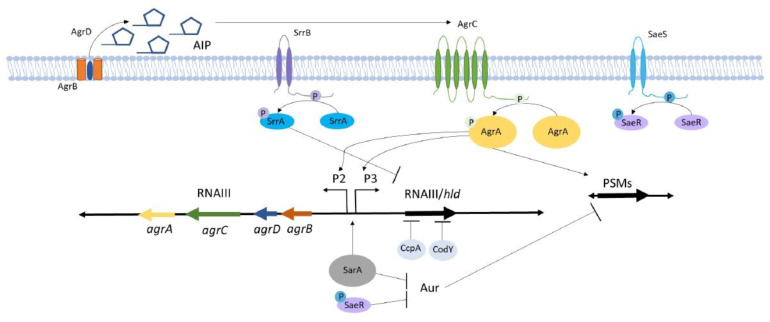
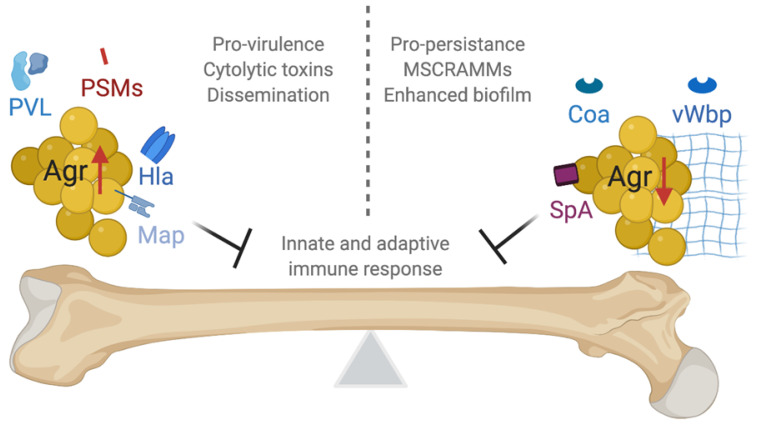
Staphylococcus aureus is a Gram-positive pathogen capable of infecting nearly every vertebrate organ. Among these tissues, invasive infection of bone (osteomyelitis) is particularly common and induces high morbidity. Treatment of osteomyelitis is notoriously difficult and often requires debridement of diseased bone in conjunction with prolonged antibiotic treatment to resolve infection. During osteomyelitis, S. aureus forms characteristic multicellular microcolonies in distinct niches within bone. Virulence and metabolic responses within these multicellular microcolonies are coordinated, in part, by quorum sensing via the accessory gene regulator (agr) locus, which allows staphylococcal populations to produce toxins and adapt in response to bacterial density. During osteomyelitis, the Agr system significantly contributes to dysregulation of skeletal homeostasis and disease severity but may also paradoxically inhibit persistence in the host. Moreover, the Agr system is subject to complex crosstalk with other S. aureus regulatory systems, including SaeRS and SrrAB, which can significantly impact the progression of osteomyelitis. The objective of this review is to highlight Agr regulation, its implications on toxin production, factors that affect Agr activation, and the potential paradoxical influences of Agr regulation on disease progression during osteomyelitis.
Overview
The claims and statistics of this paper haven’t been checked yet.
Free: it reads the open-access text and checks the first 5 claims that cite a source we can check. Create a free account to check every claim.
Integrity signals
Registry
Cites
Statistics
Figures
Verification
Claims the paper makes
The claims and statistics of this paper haven’t been checked yet.
Free: it reads the open-access text and checks the first 5 claims that cite a source we can check. Create a free account to check every claim.
Claims other papers make about this one
Each is checked against this paper’s own text: does it say what the citing paper says it does?
In the citing paper
“However, the mere presence of a pathogenicity factor gene does not always equate to its expression, which is subject to one or more regulatory systems present in the bacterial cell, such as the Agr/Sar system [10]”
From Molecular Mechanisms of Drug Resistance in Staphylococcus aureus (2022) · cites this paper as [10]
Self-check
Percentages, sums and reported differences re-computed from the paper’s own numbers.
The self-check needs the paper’s full text.
Citations
Cites
Staphylococcus aureus Infections
Lowy, F. D. (1998) · New England Journal of Medicine · doi:10.1056/nejm199808203390806 · Cited by 6,005
Two-Component Signal Transduction
Stock, A. M., Robinson, V. L., & Goudreau, P. N. (2000) · Annual Review of Biochemistry · doi:10.1146/annurev.biochem.69.1.183 · Cited by 3,650
Lew, D. P., & Waldvogel, F. A. (2004) · The Lancet · doi:10.1016/s0140-6736(04)16727-5 · Cited by 1,883
Synthesis of staphylococcal virulence factors is controlled by a regulatory RNA molecule.
Novick, R. P., Ross, H. F., Projan, S. J., Kornblum, J., Kreiswirth, B., & Moghazeh, S. (1993) · The EMBO Journal · doi:10.1002/j.1460-2075.1993.tb06074.x · Cited by 1,072
agr-Mediated Dispersal of Staphylococcus aureus Biofilms
Boles, B. R., & Horswill, A. R. (2008) · PLoS Pathogens · doi:10.1371/journal.ppat.1000052 · Cited by 963
Bacterial Interference Caused by Autoinducing Peptide Variants
Ji, G., Beavis, R., & Novick, R. P. (1997) · Science · doi:10.1126/science.276.5321.2027 · Cited by 817
Cell density control of staphylococcal virulence mediated by an octapeptide pheromone.
Ji, G., Beavis, R. C., & Novick, R. P. (1995) · Proceedings of the National Academy of Sciences · doi:10.1073/pnas.92.26.12055 · Cited by 664
Dunman, P. M., Murphy, E., Haney, S., Palacios, D., Tucker-Kellogg, G., Wu, S., Brown, E. L., Zagursky, R. J., Shlaes, D., & Projan, S. J. (2001) · Journal of Bacteriology · doi:10.1128/jb.183.24.7341-7353.2001 · Cited by 648
How Staphylococcus aureus biofilms develop their characteristic structure
Periasamy, S., Joo, H.-S., Duong, A. C., Bach, T.-H. L., Tan, V. Y., Chatterjee, S. S., Cheung, G. Y. C., & Otto, M. (2012) · Proceedings of the National Academy of Sciences · doi:10.1073/pnas.1115006109 · Cited by 640
Staphylococcus aureus α-Toxin: Nearly a Century of Intrigue
Berube, B., & Wardenburg, J. (2013) · Toxins · doi:10.3390/toxins5061140 · Cited by 613
Research works printed but not linked: 6
- Hatzenbuehler J. Pulling T.J. Diagnosis and management of osteomyelitis Am. Fam. Physician 2011 84 1027 1033 22046943
- Haag A.F. Bagnoli F. The role of two-component signal transduction systems in Staphylococcus aureus virulence regulation Curr. Top. Microbiol. 2017 409 145 198 10.1007/82_2015_5019 26728068 · DOI
- Rajasree K. Fasim A. Gopal B. Conformational features of the Staphylococcus aureus AgrA-promoter interactions rationalize quorum-sensing triggered gene expression Biochem. Biophys. Rep. 2016 6 124 134 10.1016/j.bbrep.2016.03.012 28955870 PMC5600425 · DOI
- Phonimdaen P. O’Reilly M. O’Toole P.W. Foster T.J. Molecular cloning and expression of the coagulase gene of Staphylococcus aureus 8325-4 J. Gen. Microbiol. 1988 134 75 83 10.1099/00221287-134-1-75 3183615 · DOI
- Krishna Mannala G. Koettnitz J. Mohamed W. Sommer U. Lips K.S. Sproer C. Bunk B. Overmann J. Hain T. Heiss C. Whole-genome comparison of high and low virulent Staphylococcus aureus isolates inducing implant-associated bone infections Int. J. Med. Microbiol. 2018 208 505 513 10.1016/j.ijmm.2018.04.005 29739668 · DOI
- Dossett J.H. Kronvall G. Williams R.C. Quie P.G. RNAIII of the Staphylococcus aureus agr system activates global regulator MgrA by stabilizing mRNA J. Immunol. 1969 103 1405 1410 · DOI · Paper page
Cited by
Molecular Mechanisms of Drug Resistance in Staphylococcus aureus
Mlynarczyk-Bonikowska, B., Kowalewski, C., Krolak-Ulinska, A., & Marusza, W. (2022) · International Journal of Molecular Sciences · doi:10.3390/ijms23158088 · Cited by 412
Mechanisms of Antibiotic Failure During Staphylococcus aureus Osteomyelitis
Gimza, B. D., & Cassat, J. E. (2021) · Frontiers in Immunology · doi:10.3389/fimmu.2021.638085 · Cited by 158
Self-citationMetabolic Adaptations During Staphylococcus aureus and Candida albicans Co-Infection
Eichelberger, K. R., & Cassat, J. E. (2021) · Frontiers in Immunology · doi:10.3389/fimmu.2021.797550 · Cited by 67
Self-citationWang, D., Wang, L., Liu, Q., & Zhao, Y. (2025) · Animals and Zoonoses · doi:10.1016/j.azn.2024.11.003 · Cited by 57
Metadata
- Authors
- Butrico, C. E., & Cassat, J. E.
- Venue
- Toxins
- Publisher
- MDPI AG
- Published
- 2020-08-12
- Volume
- 12
- Issue
- 8
- Pages
- 516
- ISSN
- 2072-6651
- PMC
- PMC7471978
- Semantic Scholar
- 75d538d041bfc67e418f9a8ef1547bf1389d3e30
- Cited by
- 65
- References
- 153
- Language
- en
- Funders
- National Institute of Allergy and Infectious Diseases (R01AI132560, T32AI11254)
- Burroughs Wellcome Fund (1013348)
About these checks
Registry, retraction, Cites and statistics results are computed, not judged, with one exception: a printed reference that no index lists is read once by a model before it counts as a citation error. Claims are extracted by a model and kept only when their quote appears verbatim in the text; each cited source is then checked, with a model’s help, for whether it says what the claim relies on. Those verdicts can be wrong — read the claim’s quote and the cited source before relying on one.
Statistics and arithmetic are recomputed, not judged.
Confidence bands are shown only for fields calibrated on our annotated test set. None is calibrated yet, so no band is shown.
What counts as a claim ›How we measure confidence ›How we check this ›
Are you an author, or do you see a problem with this page? Request a review
Data sources
Bibliographic data: Semantic Scholar, OpenAlex, Crossref.
Contains information from the Semantic Scholar Academic Graph Datasets, made available under the ODC Attribution License (ODC-BY 1.0).
Semantic Scholar’s data is described in: Kinney, R., et al. (2023). The Semantic Scholar Open Data Platform. arXiv:2301.10140.
