

A Saccharomyces cerevisiae Wine Strain Inhibits Growth and Decreases Ochratoxin A Biosynthesis by Aspergillus carbonarius and Aspergillus ochraceus
Open accessThe DOI matches its Crossref record; 37 of the 37 references it cites were found in a registry or an index.
Abstract
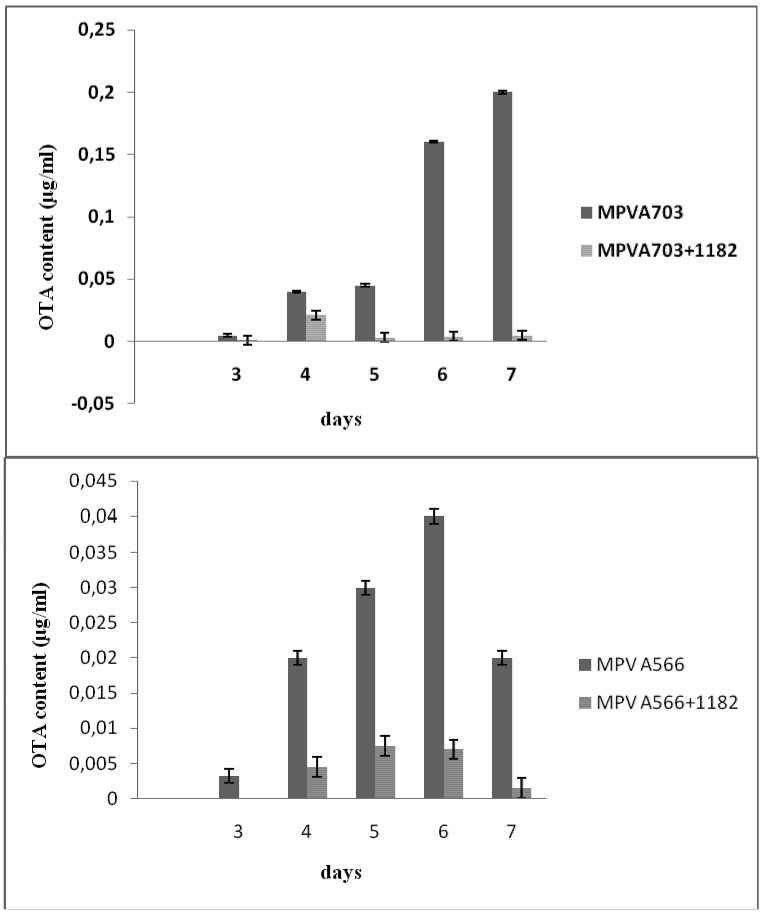
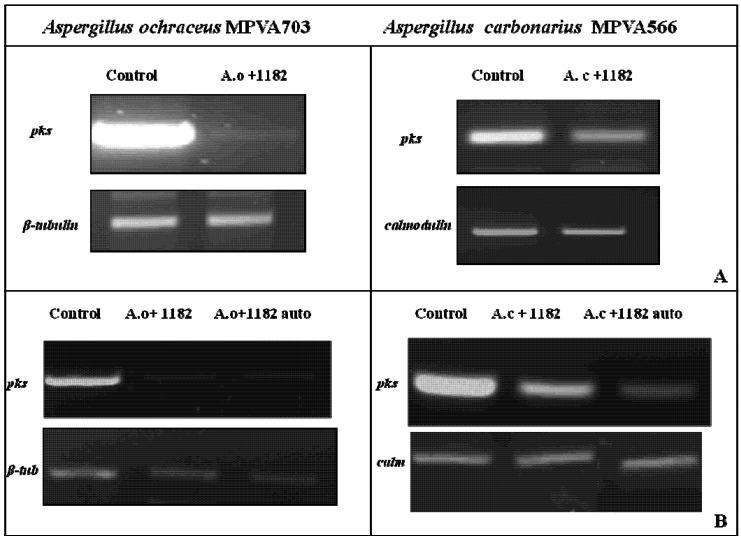
The aim of this study was to select wine yeast strains as biocontrol agents against fungal contaminants responsible for the accumulation of ochratoxin A (OTA) in grape and wine and to dissect the mechanism of OTA detoxification by a Saccharomyces cerevisiae strain (DISAABA1182), which had previously been reported to reduce OTA in a synthetic must. All of the yeast strains tested displayed an ability to inhibit the growth of Aspergillus carbonarius both in vivo and in vitro and addition of culture filtrates from the tested isolates led to complete inhibition of OTA production. S. cerevisiae DISAABA1182 was selected and further tested for its capacity to inhibit OTA production and pks (polyketide synthase) transcription in A. carbonarius and Aspergillus ochraceus in vitro. In order to dissect the mechanism of OTA detoxification, each of these two fungi was co-cultured with living yeast cells exposed to yeast crude or to autoclaved supernatant: S. cerevisiae DISAABA1182 was found to inhibit mycelial growth and OTA production in both Aspergilli when co-cultured in the OTA-inducing YES medium. Moreover, a decrease in pks transcription was observed in the presence of living cells of S. cerevisiae DISAABA1182 or its supernatant, while no effects were observed on transcription of either of the constitutively expressed calmodulin and β-tubulin genes. This suggests that transcriptional regulation of OTA biosynthetic genes takes place during the interaction between DISAABA1182 and OTA-producing Aspergilli.
Overview
The claims and statistics of this paper haven’t been checked yet.
Free: it reads the open-access text and checks the first 5 claims that cite a source we can check. Create a free account to check every claim.
Integrity signals
Registry
Cites
Statistics
Figures
Verification
Claims the paper makes
The claims and statistics of this paper haven’t been checked yet.
Free: it reads the open-access text and checks the first 5 claims that cite a source we can check. Create a free account to check every claim.
Claims other papers make about this one
Each is checked against this paper’s own text: does it say what the citing paper says it does?
The source backs part of the claim, not all of it — or backs it for a different population, condition or comparison.
In the citing paper
“The mycotoxin-removing activity is due to adsorption to S. cerevisiae cell walls, stress responses to the toxin (e.g., changes in plasma membrane composition following patulin exposure), as well as direct transcriptional downregulation of polyketide synthesis (Armando et al. 2012b; Cubaiu et al. 2012; Oporto et al. 2019).”
From Biocontrol yeasts: mechanisms and applications (2019) · cites this paper as Cubaiu et al. 2012
Experimental — accuracy not yet measuredThe cited source says what the claim attributes to it.
In the citing paper
“A number of S. cerevisiae strains (e.g., DISAABA1182, RC008, RC009, RC012, and RC016) reduced the growth of plant pathogens such as A. carbonarius, A. ochraceus, A. parasiticus or Fusarium graminearum and also inhibited mycotoxin (e.g., aflatoxin, ochratoxin A, zearalenone, deoxynivalenol) production by these species (Armando et al. 2012a, 2013; Cubaiu et al. 2012).”
From Biocontrol yeasts: mechanisms and applications (2019) · cites this paper as Cubaiu et al. 2012
Self-check
Percentages, sums and reported differences re-computed from the paper’s own numbers.
The self-check needs the paper’s full text.
Citations
Cites
Twenty years of postharvest biocontrol research: Is it time for a new paradigm?
Droby, S., Wisniewski, M., Macarisin, D., & Wilson, C. (2009) · Postharvest Biology and Technology · doi:10.1016/j.postharvbio.2008.11.009 · Cited by 758 · cited 1×
“long periods under dry conditions coupled with an ability to display multiple mechanisms of antagonism [11].”
BackgroundCiani, M., Comitini, F., Mannazzu, I., & Domizio, P. (2010) · FEMS Yeast Research · doi:10.1111/j.1567-1364.2009.00579.x · Cited by 559 · cited 1×
“In addition, yeasts have a long history of proven safe use as fermentative starters in food and beverages [13–15].”
BackgroundFleet, G. H. (2008) · FEMS Yeast Research · doi:10.1111/j.1567-1364.2008.00427.x · Cited by 518 · cited 1×
“In addition, yeasts have a long history of proven safe use as fermentative starters in food and beverages [13–15].”
BackgroundOchratoxin A in table wine and grape‐juice: Occurrence and risk assessment∗
Zimmerli, B., & Dick, R. (1996) · Food Additives and Contaminants · doi:10.1080/02652039609374451 · Cited by 510 · cited 1×
“OTA was first detected in wine by Zimmerli and Dick [2], where its presence is commonly ascribed to infection of wine grapes by Aspergillus carbonarius and some strains of Aspergilli section nigri.”
BackgroundSaccharomyces cerevisiae and lactic acid bacteria as potential mycotoxin decontaminating agents
Shetty, P. H., & Jespersen, L. (2006) · Trends in Food Science & Technology · doi:10.1016/j.tifs.2005.10.004 · Cited by 442 · cited 2×
“During the wine making process, OTA levels are known to decrease, an effect which is believed to be mediated by the activity of the resident microbial flora, particularly of lactic acid bacteria and yeasts [10,16–18].”
BackgroundPesticide Residues in Grapes, Wine, and Their Processing Products
Cabras, P., & Angioni, A. (2000) · Journal of Agricultural and Food Chemistry · doi:10.1021/jf990727a · Cited by 372 · cited 1×
“Fungicide treatments at either the pre-harvest or post-harvest stage are however not practical, due to the risk of contamination of the wine by toxic residues [4].”
BackgroundDroby, S., Vinokur, V., Weiss, B., Cohen, L., Daus, A., Goldschmidt, E. E., & Porat, R. (2002) · Phytopathology® · doi:10.1094/phyto.2002.92.4.393 · Cited by 325 · cited 2×
“According to related pathosystems, other possible mechanisms may include biofilm formation on the wound surface [26], the inhibition of fungal secondary metabolism [27], the production of antifungal enzymes [28] or the induction of resistance in the fruit tissues [12,29].”
BackgroundYeasts and their possible beneficial and negative effects on the quality of dairy products
Jakobsen, M., & Narvhus, J. (1996) · International Dairy Journal · doi:10.1016/0958-6946(95)00071-2 · Cited by 287 · cited 1×
“In addition, yeasts have a long history of proven safe use as fermentative starters in food and beverages [13–15].”
BackgroundWisniewski, M., Biles, C., Droby, S., McLaughlin, R., Wilson, C., & Chalutz, E. (1991) · Physiological and Molecular Plant Pathology · doi:10.1016/0885-5765(91)90033-e · Cited by 274
Bejaoui, H., Mathieu, F., Taillandier, P., & Lebrihi, A. (2004) · Journal of Applied Microbiology · doi:10.1111/j.1365-2672.2004.02385.x · Cited by 250 · cited 1×
“and yeasts [6–10].”
Soden, D. M., & Dobson, A. D. W. (2001) · Microbiology · doi:10.1099/00221287-147-7-1755 · Cited by 235
Self-citationImmunochemical detection of ochratoxin A in black Aspergillus strains
Téren, J., Varga, J., Hamari, Z., Rinyu, E., & Kevei, F. (1996) · Mycopathologia · doi:10.1007/bf00436726 · Cited by 225 · cited 1×
“[23] have suggested that Aspergilli are capable of assimilating the phenylalanine moiety from the OTA molecule, as a nitrogen source in nutrient replete culture medium.”
BackgroundA simple method for extraction of fungal genomic DNA
Al-Samarrai, T. H., & Schmid, J. (2000) · Letters in Applied Microbiology · doi:10.1046/j.1472-765x.2000.00664.x · Cited by 224 · cited 3×
“Fungal DNA was extracted according to Al-Samarrai and Schmid [37].”
MethodBleve, G., Grieco, F., Cozzi, G., Logrieco, A., & Visconti, A. (2006) · International Journal of Food Microbiology · doi:10.1016/j.ijfoodmicro.2005.12.004 · Cited by 188 · cited 1×
“methodologies, which have been proposed as an environmentally sound approach to prevent infection caused by OTA-producing fungi [5].”
BackgroundXu, X., Monger, W. A., Ritieni, A., & Nicholson, P. (2007) · Plant Pathology · doi:10.1111/j.1365-3059.2007.01650.x · Cited by 138 · cited 1×
“shown for other mycotoxins [20].”
Influence of yeast strain on ochratoxin A content during fermentation of white and red must
Cecchini, F., Morassut, M., García-Moruno, E., & Stefano, R. D. (2005) · Food Microbiology · doi:10.1016/j.fm.2005.08.003 · Cited by 125 · cited 1×
“During the wine making process, OTA levels are known to decrease, an effect which is believed to be mediated by the activity of the resident microbial flora, particularly of lactic acid bacteria and yeasts [10,16–18].”
BackgroundLEONG, S.-L., HOCKING, A. D., & PITT, J. I. (2008) · Australian Journal of Grape and Wine Research · doi:10.1111/j.1755-0238.2004.tb00010.x · Cited by 124 · cited 1×
“99 aw, respectively [25].”
Grape berry skin features related to ontogenic resistance to Botrytis cinerea
Deytieux-Belleau, C., Gény, L., Roudet, J., Mayet, V., Donèche, B. B., & Fermaud, M. (2009) · European Journal of Plant Pathology · doi:10.1007/s10658-009-9503-6 · Cited by 95 · cited 1×
“Differences in grape varieties are known to affect fungal invasion, with skin hardness and thickness as well as tannin content known to be a hurdle for penetration by the pathogen [24].”
BackgroundO’Callaghan, J., Stapleton, P., & Dobson, A. D. W. (2006) · Fungal Genetics and Biology · doi:10.1016/j.fgb.2005.11.005 · Cited by 91
Self-citationGiobbe, S., Marceddu, S., Scherm, B., Zara, G., Mazzarello, V. L., Budroni, M., & Migheli, Q. (2007) · FEMS Yeast Research · doi:10.1111/j.1567-1364.2007.00301.x · Cited by 83 · cited 1×
“According to related pathosystems, other possible mechanisms may include biofilm formation on the wound surface [26], the inhibition of fungal secondary metabolism [27], the production of antifungal enzymes [28] or the induction of resistance in the fruit tissues [12,29].”
BackgroundSelf-citationGil-Serna, J., Patiño, B., Cortés, L., González-Jaén, M. T., & Vázquez, C. (2011) · International Journal of Food Microbiology · doi:10.1016/j.ijfoodmicro.2011.08.012 · Cited by 82 · cited 1×
“have to date described the effects of biocontrol agents on the expression of mycotoxin biosynthetic genes [34,35].”
BackgroundAtoui, A., Mathieu, F., & Lebrihi, A. (2007) · International Journal of Food Microbiology · doi:10.1016/j.ijfoodmicro.2006.11.006 · Cited by 77 · cited 1×
“ochraceus is dependent on the growth medium [30] and that production is concomitant with increases in pks gene transcript”
BackgroundSchmidt‐Heydt, M., Baxter, E., Geisen, R. M., & Magan, N. (2007) · International Journal of Food Microbiology · doi:10.1016/j.ijfoodmicro.2007.08.008 · Cited by 77 · cited 2×
“A correlation has also been reported between physiological stress factors and the expression of genes responsible for ochratoxin A production in Penicillium verrucosum [33].”
BackgroundPotential of yeast antagonists on invitro biodegradation of ochratoxin A
Patharajan, S., Reddy, K. R. N., Karthikeyan, V., Spadaro, D., Lore, A., Gullino, M. L., & Garibaldi, A. (2010) · Food Control · doi:10.1016/j.foodcont.2010.07.024 · Cited by 73
Angioni, A., Caboni, P., Garau, A., Farris, A., Orro, D., Budroni, M., & Cabras, P. (2007) · Journal of Agricultural and Food Chemistry · doi:10.1021/jf062768u · Cited by 68 · cited 2×
“Moreover, Angioni and co-workers have reported that OTA residues do not affect the fermentative process and that reduction of OTA content is a strain-related peculiarity [6].”
BackgroundSelf-citationReduction of ochratoxin A during the fermentation of Italian red wine Moscato
Meca, G., Blaiotta, G., & Ritieni, A. (2009) · Food Control · doi:10.1016/j.foodcont.2009.08.008 · Cited by 66 · cited 1×
“and yeasts [6–10].”
Gallo, A., Perrone, G., Solfrizzo, M., Epifani, F., Abbas, A., Dobson, A. D. W., & Mulè, G. (2008) · International Journal of Food Microbiology · doi:10.1016/j.ijfoodmicro.2008.10.022 · Cited by 62
Self-citationAbbas, A., Valez, H., & Dobson, A. D. W. (2009) · International Journal of Food Microbiology · doi:10.1016/j.ijfoodmicro.2009.07.014 · Cited by 58 · cited 3×
“ochraceus has been shown to be dependent on nutrient content [21], as well as a variety of nutritional based factors such as various carbon and nitrogen sources [22].”
BackgroundSelf-citationIsmail, Y., McCormick, S. P., & Hijri, M. (2011) · PLoS ONE · doi:10.1371/journal.pone.0017990 · Cited by 48 · cited 2×
“have to date described the effects of biocontrol agents on the expression of mycotoxin biosynthetic genes [34,35].”
BackgroundSibanda, L., Saeger, S. D., & Peteghem, C. V. (2002) · Journal of Chromatography A · doi:10.1016/s0021-9673(02)00408-9 · Cited by 47
MICROBIAL INTERACTIONS WITH MYCOTOXIGENIC FUNGI AND MYCOTOXINS
Palumbo, J. D., O’Keeffe, T. L., & Abbas, H. K. (2008) · Toxin Reviews · doi:10.1080/15569540802416301 · Cited by 46 · cited 1×
“According to related pathosystems, other possible mechanisms may include biofilm formation on the wound surface [26], the inhibition of fungal secondary metabolism [27], the production of antifungal enzymes [28] or the induction of resistance in the fruit tissues [12,29].”
BackgroundSelf-citationHACCP to control microbial safety hazards during winemaking: Ochratoxin A
Martínez-Rodríguez, A. J., & Carrascosa, A. V. (2008) · Food Control · doi:10.1016/j.foodcont.2008.07.015 · Cited by 46 · cited 2×
“immediately prior to or during harvesting, transportation and storage of grapes is considered to be a critical point in OTA contamination of wine [3].”
BackgroundKapetanakou, A. E., Kollias, J. N., Drosinos, E. H., & Skandamis, P. N. (2011) · International Journal of Food Microbiology · doi:10.1016/j.ijfoodmicro.2011.09.010 · Cited by 42 · cited 1×
“During the wine making process, OTA levels are known to decrease, an effect which is believed to be mediated by the activity of the resident microbial flora, particularly of lactic acid bacteria and yeasts [10,16–18].”
BackgroundMonitoring of ochratoxin A fate during alcoholic fermentation of wine-must
Esti, M., Benucci, I., Liburdi, K., & Acciaro, G. (2012) · Food Control · doi:10.1016/j.foodcont.2012.02.030 · Cited by 40
A Convenient Method for Assessing Mycotoxin Production in Cultures of Aspergilli and Penicillia
Abramson, D., & Clear, R. M. (1996) · Journal of Food Protection · doi:10.4315/0362-028x-59.6.642 · Cited by 23 · cited 2×
“Abramson and Clear [19] have suggested that this could be related to differences in the overall sucrose content of each medium: YES (15% sucrose)/CYB (3% sucrose); while CYB may also represent a less hydrophilic layer making it more permeable to lipophilic solvents used in OTA extraction.”
BackgroundCrespo-Sempere, A., González-Candelas, L., & Martínez‐Culebras, P. V. (2010) · International Journal of Food Microbiology · doi:10.1016/j.ijfoodmicro.2010.06.019 · Cited by 20 · cited 1×
“In order to examine a possible correlation between reduced OTA production and pks gene expression [30–33] two OTA-producing strains namely A.”
BackgroundYu, T., & Zheng, X. (2007) · International Journal of Food Science & Technology · doi:10.1111/j.1365-2621.2006.01321.x · Cited by 11 · cited 1×
“According to related pathosystems, other possible mechanisms may include biofilm formation on the wound surface [26], the inhibition of fungal secondary metabolism [27], the production of antifungal enzymes [28] or the induction of resistance in the fruit tissues [12,29].”
Background
Research works printed but not linked: 2
- 1. International Agency for Research on Cancer (IARC) IARCS Monographs on the Evaluation of Carcinogenic risks to Humans. Vol. 56. IARC; Lyon, France: 1993. Ochratoxin A; pp. 489–452.
- 38. Sambrook J., Russell D.W. Molecular Cloning. 3rd. Cold Spring Harbor Laboratory Press; Cold Spring Harbor, New York, NY, USA: 2001.
Cited by
Biocontrol yeasts: mechanisms and applications
Freimoser, F. M., Rueda-Mejia, M. P., Tilocca, B., & Migheli, Q. (2019) · World Journal of Microbiology and Biotechnology · doi:10.1007/s11274-019-2728-4 · Cited by 462
Self-citationWine microbiome: A dynamic world of microbial interactions
Liu, Y., Rousseaux, S., Tourdot-Maréchal, R., Sadoudi, M., Gougeon, R., Schmitt-Kopplin, P., & Alexandre, H. (2017) · Critical Reviews in Food Science and Nutrition · doi:10.1080/10408398.2014.983591 · Cited by 226
“Note that various strains of yeast have been reported to produce compounds inhibiting filamentous fungi (Fleet, 2003; Bleve et al., 2006; Ponsone et al., 2011; Cubaiu et al., 2012; Kapetanakou et al., 2012).”
BackgroundFarbo, M. G., Urgeghe, P. P., Fiori, S., Marcello, A., Oggiano, S., Balmas, V., Hassan, Z. U., Jaoua, S., & Migheli, Q. (2018) · International Journal of Food Microbiology · doi:10.1016/j.ijfoodmicro.2018.06.023 · Cited by 128
Self-citationMycotoxins – prevention and decontamination by yeasts
Pfliegler, W. P., Pusztahelyi, T., & Pócsi, I. (2015) · Journal of Basic Microbiology · doi:10.1002/jobm.201400833 · Cited by 140
“ochraceus through repression of the pks (polyketide synthase) biosynthetic gene [38].”
BackgroundFiori, S., Urgeghe, P. P., Hammami, W., Razzu, S., Jaoua, S., & Migheli, Q. (2014) · International Journal of Food Microbiology · doi:10.1016/j.ijfoodmicro.2014.07.020 · Cited by 107
“to remove OTA (Cubaiu et al., 2012).”
Self-citation
Metadata
- Authors
- Cubaiu, L., Abbas, H., Dobson, A., Budroni, M., & Migheli, Q.
- Affiliations
- University of Sassari (IT)
- University College Cork (IE)
- Corresponding author
- Migheli, Quirico
- Venue
- Toxins
- Publisher
- MDPI AG
- Published
- 2012-12-10
- Volume
- 4
- Issue
- 12
- Pages
- 1468-1481
- ISSN
- 2072-6651 (ISSN-L)
- PMC
- PMC3528257
- OpenAlex
- W2144520823
- Cited by
- 53
- References
- 37
- Citations by year
- 2026: 2 · 2025: 5 · 2024: 3 · 2023: 5 · 2022: 3 · 2021: 2 · 2020: 5 · 2019: 7 · 2018: 5 · 2017: 5 · 2016: 1 · 2015: 4 · 2014: 3 · 2013: 3
- FWCI
- 3.65
- Type
- journal article
- Language
- en
- Open access
- gold
- doi.org
- Licence
- Locations
- Toxins (publishedVersion, cc-by)
- Europe PMC (PubMed Central) (publishedVersion, cc-by)
- PubMed Central (publishedVersion, cc-by)
- PubMed (publishedVersion)
- UnissResearch (Università degli Studi di Sassari) (submittedVersion)
- UnissResearch (Università degli Studi di Sassari) (submittedVersion, cc-by)
- DOAJ (DOAJ: Directory of Open Access Journals) (submittedVersion, cc-by-sa)
- Funders
- Qatar Foundation (NPRP 4)
- Fonds National de la Recherche Luxembourg
- Qatar National Research Fund (NPRP 4, NPRP 4-259-2-083)
- Topics
- Life Sciences › Agricultural and Biological Sciences › Plant Science › Mycotoxins in Agriculture and Food
- Life Sciences › Immunology and Microbiology › Applied Microbiology and Biotechnology › Microbial Natural Products and Biosynthesis
- Life Sciences › Agricultural and Biological Sciences › Food Science › Fermentation and Sensory Analysis
- Keywords
- ochratoxin A, Saccharomyces cerevisiae, Aspergillus carbonarius, Aspergillus ochraceus, biological control, wine yeast, polyketide synthase, transcriptional regulation, co-culture, mycelial growth inhibition
- MeSH terms
- Aspergillus, Carcinogens, Ochratoxins, Saccharomyces cerevisiae, Wine, Kloeckera, Biological Control Agents
About these checks
Registry, retraction, Cites and statistics results are computed, not judged, with one exception: a printed reference that no index lists is read once by a model before it counts as a citation error. Claims are extracted by a model and kept only when their quote appears verbatim in the text; each cited source is then checked, with a model’s help, for whether it says what the claim relies on. Those verdicts can be wrong — read the claim’s quote and the cited source before relying on one.
Statistics and arithmetic are recomputed, not judged.
Confidence bands are shown only for fields calibrated on our annotated test set. None is calibrated yet, so no band is shown.
What counts as a claim ›How we measure confidence ›How we check this ›
Are you an author, or do you see a problem with this page? Request a review
Data sources
Bibliographic data: Semantic Scholar, OpenAlex, Crossref.
Contains information from the Semantic Scholar Academic Graph Datasets, made available under the ODC Attribution License (ODC-BY 1.0).
Semantic Scholar’s data is described in: Kinney, R., et al. (2023). The Semantic Scholar Open Data Platform. arXiv:2301.10140.
