

Has Kronos Devoured Planet Nine and Its Epigones?
Open accessThe DOI matches its Crossref record; 58 of the 69 references it cites were found in a registry or an index; 14 of the 28 sources its claims cite were checked for support.
Abstract
The Planet Nine hypothesis encompasses a body of about 5–8 Earth’s masses whose orbital plane would be inclined to the ecliptic by one or two tens of degrees and whose perihelion distance would be as large as about 240–385 astronomical units. Recently, a couple of his epigones have appeared: Planet X and Planet Y. The former is similar to a minor version of Planet Nine in that all its physical and orbital parameters would be smaller. Instead, the latter would have a mass ranging from that of Mercury to Earth’s and a semimajor axis within 100–200 astronomical units. By using realistic upper bounds for the orbital precessions of Saturn, one can obtain insights on their position which, for Planet Nine, appears approximately confined around its aphelion. Planet Y can only be a Mercury-sized object at no less than about 125 astronomical units, while Planet X appears to be ruled out. Dedicated data reductions by modeling such perturber(s) are required to check the present conclusions, to be intended as hints of what might be detectable should planetary ephemerides include them. A probe on the same route of Voyager 1 would be perturbed by Planet Nine by about 20–40 km after some decades.
Overview
CoChat Summary
TL;DR
Iorio analytically computes the long-term orbital precessions that distant pointlike perturbers would induce on Saturn and uses current Saturn ephemeris uncertainties to constrain Planet Nine, Planet X, and Planet Y. The latest Planet X is ruled out, an Earth-mass Planet Y is ruled out, a Mercury-sized Planet Y survives only at \(a_Y \gtrsim 125\) au, and Planet Nine remains allowed mainly near aphelion.
Key findings
- Planet X is “completely ruled out” by the combined orbital precessions of Saturn, even after rescaling the formal uncertainties by a factor of 10.
- Planet Y: no allowed regions exist for either an Earth-mass or Mercury-sized body with the originally envisaged orbital characteristics; after rescaling uncertainties by 10, only a Mercury-mass Planet Y with \(a_Y \gtrsim 125\) au is not discarded, while a one-Earth-mass Planet Y is ruled out.
- Planet Nine is not ruled out. For \(m_9 = 4.9\,m_\oplus\), allowed regions occur only for \(a_9 = 520\) au, with true anomaly \(f_9\) confined between \(140^\circ\) and \(220^\circ\); for \(m_9 = 8.4\,m_\oplus\), allowed regions exist only for \(a_9 = 520\) au and \(e_9 \simeq 0.5\), with \(f_9\) constrained within about \(160^\circ\)–\(200^\circ\).
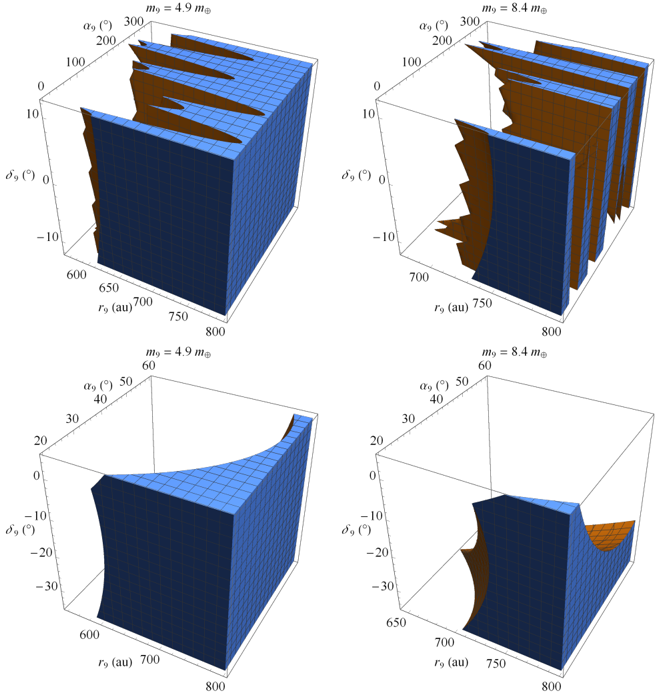
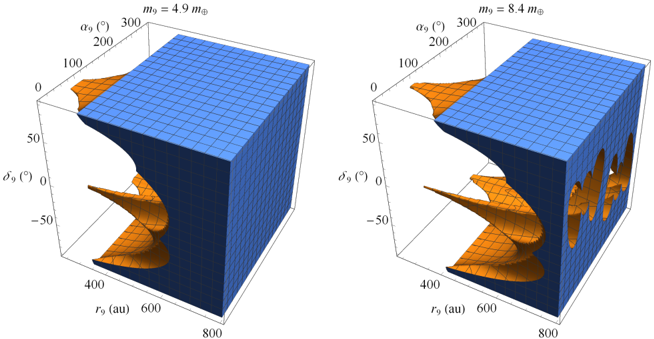
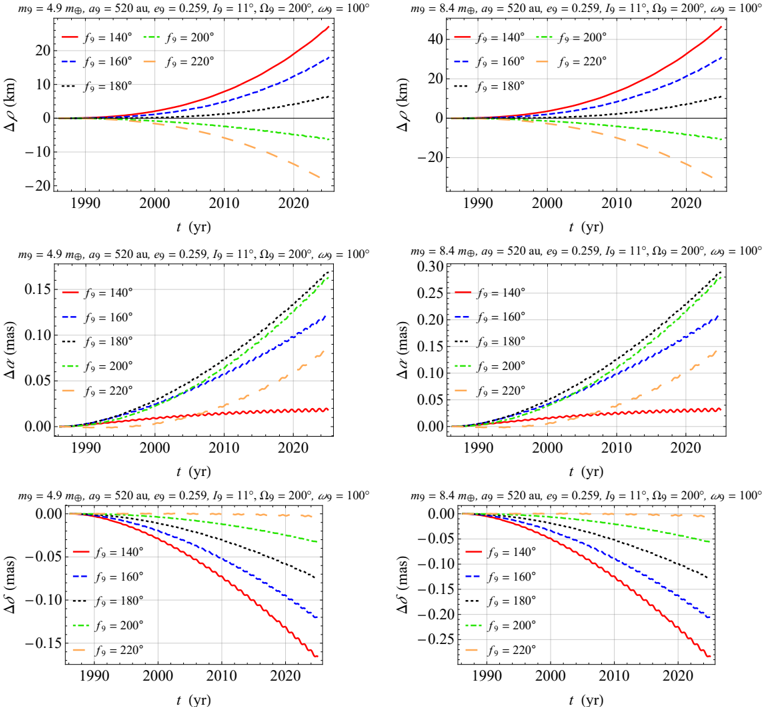
- In the \(\{r_9,\alpha_9,\delta_9\}\) parameter space, allowed regions start at heliocentric distances as large as 600 au for \(4.9\,m_\oplus\) and 700 au for \(8.4\,m_\oplus\). A Voyager 1-like probe would be perturbed by Planet Nine by about 20–40 km after some decades, with sub-mas astrometric signatures.
Methods
- The paper analytically calculates the long-term rates of change of Keplerian orbital elements induced by a distant pointlike perturber to Newtonian tidal quadrupolar order, first for small eccentricity and inclination and then for arbitrary inclination, averaging over one orbital period of the disturbed planet.
- It uses Saturn’s observationally inferred orbital-rate uncertainties from EPM2017-based work: \(\sigma_{\dot e}=0.0023\), \(\sigma_{\dot I}=0.063\), \(\sigma_{\dot\Omega}=1.806\), and \(\sigma_{\dot\varpi}=0.067\) mas cty\(^{-1}\), imposing \(|\Delta\kappa| \le \sigma_\kappa\) and conservatively rescaling these formal errors by a factor of 10.
- For the deep-space-probe illustration, it numerically integrates the barycentric equations of motion of Voyager 1 and the eight known planets with and without Planet Nine over March 1986 to the present.
Limitations
- The paper states that the allowed zones “may not be viewed as actual constraints” because they come from planetary ephemerides produced without modeling any additional planet; the sought signal could be absorbed into solved-for parameters, yielding unrealistically tight constraints. It therefore calls them hints and says dedicated data reductions modeling the perturber(s) are required.
- The paper notes that Uranus’s orbit is currently constrained poorly, Neptune’s record does not cover a full orbital revolution, and a Voyager-like probe would be limited by much larger non-gravitational acceleration uncertainties, especially from thrusters.
- Evident from the text: no new data were generated or analyzed, and the constraints rely on Saturn’s precessions alone, so the results are preliminary and not a detection.
Model-written summary. Check it against the paper before relying on it.
Integrity signals
Registry
Cites
Statistics
Figures
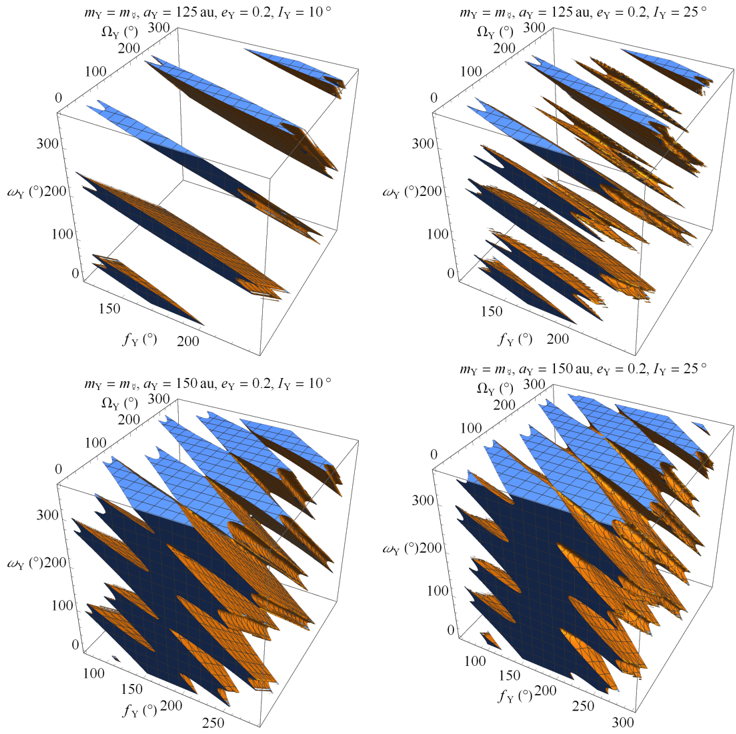
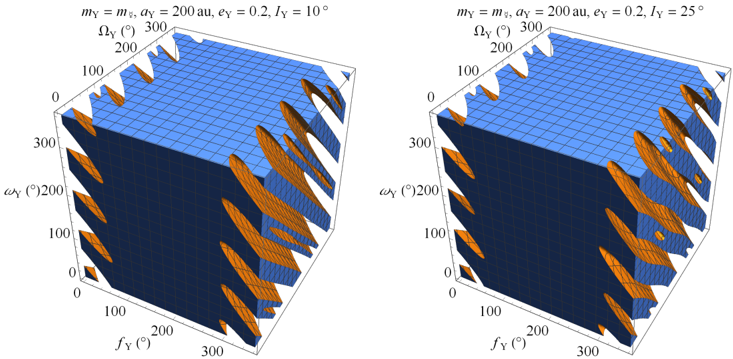
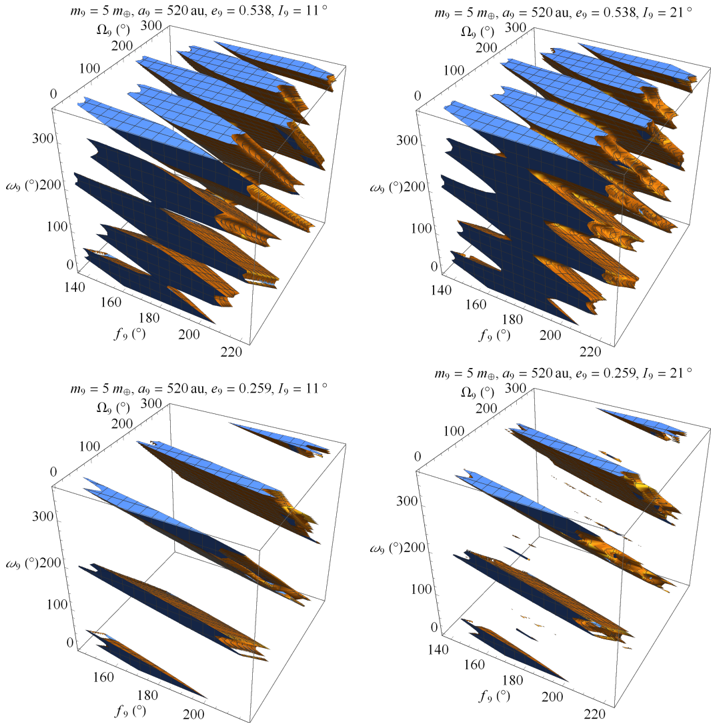
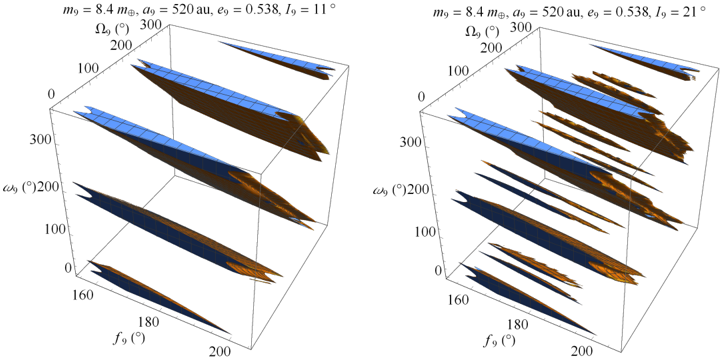
Verification
Claims the paper makes
9 Valid · 5 Not valid · 11 Not checked · 57 Own results and interpretations
At least one cited source doesn’t support this claim or points to a different paper, and none confirmed it — see the verdicts below.
In the paper
“although most of them, in particular the 'best fit case', have already been ruled out by Fienga et al. [19].”
§ Has Kronos Devoured Planet Nine and Its Epigones? > 1. Introduction
What the sources say
- Disputedcites [19] 19. Fienga, A.; Laskar, J.; Manche, H.; Gastineau, M. Constraints on the location of a possible 9th planet derived from the Cassini data. Astron. Astrophys. 2016, 587, L8. https://doi.org/10.1051/0004-6361/201628227. sourceExperimental — accuracy not yet measured
Section 4 (Results; page unavailable) identifies two forbidden true-anomaly intervals, totaling 180° of the 360° orbit tested—not most of it. It places the strongest reduction in Cassini residuals at 117.8°, and Section 6 (Conclusions; page unavailable) calls that the most probable position rather than ruling it out. The paper does not identify a separate configuration called the “best fit case.” (LLM, conf=0.88)
Checked by a reasoning model — may be wrong.
plain- Asserted: passes — The authors put it forward as true.
- Checkable: passes — It can be checked against evidence.
- Load-bearing: passes — The paper’s conclusions depend on it.
- Based: passes — The paper gives a reason why it holds.
- Disputed
Some cited sources support this claim and some don’t — read each source’s verdict below.
In the paper
“Be that as it may, in a previous analysis [2] the present method did not provide constraints in contrast to those inferred by reprocessing the data record by including P9 in the dynamical force models [19].”
§ Has Kronos Devoured Planet Nine and Its Epigones? > 3. Using the Orbital Precessions of a Disturbed Planet to Constrain the Position of a Distant Perturber
What the sources say
- Disputedcites [2] 2. Iorio, L. Preliminary constraints on the location of the recently hypothesized new planet of the Solar System from planetary orbital dynamics. Astrophys. Space Sci. 2017, 362, 11. https://doi.org/10.1007/s10509-016-2993-8. sourceExperimental — accuracy not yet measured
Our copy of Iorio (2017) states the opposite of 'did not provide constraints': the Summary and conclusions (Section 8, p. 18) say that combining the supplementary perihelion/node rates of Saturn with his analytical formulas 'allows us to tentatively constrain its position along its orbit' and that 'the preliminary bounds resulting from our analysis are reasonable'. Section 5.2 (p. 14) explicitly contrasts his allowed region 130 deg <= f_X <= 240 deg with the regions inferred by Fienga et al. (2016a) from reprocessing the 2004-2014 Cassini ranging data with PX explicitly modeled (85-235 deg and 260-295 deg, most probable 117.8 +11/-10 deg) — i.e. both approaches yield constraints, and Iorio's method is not constraint-free. What Iorio does concede is narrower: the node/orientation of the orbital plane is 'left substantially undetermined' (Section 8, p. 18; Section 4.3, p. 12) and only upper limits on the mass are obtainable (Section 6, p. 16), and Section 5.1 (p. 12) calls for the complementary explicit-modeling covariance analysis of the kind done by Fienga et al. — but none of this supports attributing 'no constraints' to this paper. (LLM, conf=0.80)
Checked by a reasoning model — may be wrong.
- Supportedcites [19] 19. Fienga, A.; Laskar, J.; Manche, H.; Gastineau, M. Constraints on the location of a possible 9th planet derived from the Cassini data. Astron. Astrophys. 2016, 587, L8. https://doi.org/10.1051/0004-6361/201628227. source
The citation to this paper is attached to the constraints inferred by reprocessing the data with P9 in the dynamical model, not to the preceding statement about a method that found no constraints. Section 3.2 describes adding P9 to the INPOP dynamical model and refitting the observations; Section 4 identifies forbidden ranges of P9's true anomaly from the resulting Cassini residuals. (LLM, conf=0.93)
plain- Asserted: passes — The authors put it forward as true.
- Checkable: passes — It can be checked against evidence.
- Load-bearing: unclear — It is unclear whether the paper’s conclusions depend on it.
- Based: passes — The paper gives a reason why it holds.
- Disputed
The cited sources that could be checked couldn’t confirm or dispute this claim.
In the paper
“On the other hand, it is unlikely that PY may have a completely circular orbit because of its assumed process of formation 5 [22].”
§ Has Kronos Devoured Planet Nine and Its Epigones? > 4. Tentative Constraints on Planet Y, Planet X and Planet Nine
What the sources say
- Could not verifycites [22] 22. Siraj, A.; Chyba, C.F.; Tremaine, S. Measuring the mean plane of the distant Kuiper belt. Mon. Not. R. Astron. Soc. 2025, 543, L27-L33. https://doi.org/10.1093/mnrasl/slaf091. sourceExperimental — accuracy not yet measured
The Discussion (p. unavailable) says a Planet Y-like body could plausibly have formed early in solar-system history, but does not connect its formation to orbital eccentricity. Searches for a circular orbit and Planet Y’s eccentricity found no passage saying a completely circular orbit is unlikely. (LLM, conf=0.73)
hedgedstates a possible cause- Asserted: passes — The authors put it forward as true.
- Checkable: passes — It can be checked against evidence.
- Load-bearing: unclear — It is unclear whether the paper’s conclusions depend on it.
- Based: passes — The paper gives a reason why it holds.
- Could not verify
The cited sources support only part of this claim — read each source’s verdict below.
In the paper
“In particular, the orbit of Saturn is adopted since it was recently constrained to metre-level accuracy [23,24] thanks to a long record of radio tracking data transmitted by the Cassini probe”
§ Has Kronos Devoured Planet Nine and Its Epigones? > 1. Introduction
What the sources say
- Not matchedcites [23] 23. Folkner, W.M.; Jacobson, R.A.; Jones, D. Improved orbits of Saturn and Jupiter from the Cassini and Juno missions. IAU Gen. Assem. 2015, 29, 2244873.
We searched by its title and found no matching paper.
- Supportedcites [24] 24. Di Ruscio, A.; Fienga, A.; Durante, D.; Iess, L.; Laskar, J.; Gastineau, M. Analysis of Cassini radio tracking data for the construction of INPOP19a: A new estimate of the Kuiper belt mass. Astron. Astrophys. 2020, 640, A7. https://doi.org/10.1051/0004-6361/20 2037920. source
The Introduction says Cassini’s radiometric measurements allow Saturn’s position relative to Earth to be constrained with metre-level accuracy. The Dataset section describes the radio tracking data collected during Cassini’s tour of the Saturnian system. (LLM, conf=0.91)
plainstates a cause- Asserted: passes — The authors put it forward as true.
- Checkable: passes — It can be checked against evidence.
- Load-bearing: unclear — It is unclear whether the paper’s conclusions depend on it.
- Based: passes — The paper gives a reason why it holds.
- Not matched
Every source the paper cites for this claim was checked and supports it.
In the paper
“Also, Holman and Payne [32] were not able to spot a unique position of P9 in space but only a set of allowed regions in the {α 9 , δ 9 } parameter space.”
§ Has Kronos Devoured Planet Nine and Its Epigones? > 4. Tentative Constraints on Planet Y, Planet X and Planet Nine
What the sources say
- Supportedcites [32] 32. Holman, M.J.; Payne, M.J. Observational Constraints on Planet Nine: Cassini Range Observations. Astron. J. 2016, 152, 94. https://doi.org/10.3847/0004-6256/152/4/94. source
Section 5.1 describes best-fit locations as small regions of the sky and identifies two equal-and-opposite regions. Section 7 describes a confined search region with 1σ, 2σ, and 3σ contours, rather than a unique position in right ascension and declination. (LLM, conf=0.93)
plain- Asserted: passes — The authors put it forward as true.
- Checkable: passes — It can be checked against evidence.
- Load-bearing: unclear — It is unclear whether the paper’s conclusions depend on it.
- Based: passes — The paper gives a reason why it holds.
- Supported
49 more claims · 1 with their cited sources checked
Create a free account to see all 82 claims and to verify the 9 references still open.
- Probably not a substantial claim. 15
- It may state two separate claims as one. 16
- The quote only partly states this claim. 1
Self-check
Percentages, sums and reported differences re-computed from the paper’s own numbers.
Each contradiction between two passages listed here was confirmed by an independent check.
Rated minor: it would not touch a result — a value no result rests on, a p-value that stays on the same side of the significance level, or a conflict that is clerical, resolved elsewhere in the paper, or outside its own findings.
In the paper
§ Has Kronos Devoured Planet Nine and Its Epigones? > 2. The Orbital Perturbations Induced by a Distant, Pointlike Perturber
“l = {cos Ω, sin Ω, 0},(12) m = {cos I sin Ω, cos I cos Ω, sin I}, ĥ = {sin I sin Ω,sin I cos Ω, cos I}.”
§ Has Kronos Devoured Planet Nine and Its Epigones? > 2. The Orbital Perturbations Induced by a Distant, Pointlike Perturber
“Finally, m, lying in the orbital plane, is defined such that the relation l × m = ĥ holds.”
Citations
Cites
The JPL Planetary and Lunar Ephemerides DE440 and DE441
Park, R. S., Folkner, W. M., Williams, J. G., & Boggs, D. H. (2021) · The Astronomical Journal · doi:10.3847/1538-3881/abd414 · Cited by 520 · cited 1×
“From the definition of Θ µν and using equation (2), we have In other words, Θ µν will depend on the Lagrangian of matter, that is, this can refer to the case of the electromagnetic field, the massless scalar field, the case of the perfect fluid, among others.”
Evidence for a Distant Giant Planet in the Solar System
Batygin, K., & Brown, M. E. (2016) · The Astronomical Journal · doi:10.3847/0004-6256/151/2/22 · Cited by 432 · cited 1×
“The simplest candidate for such a dark energy is a positive cosmological constant Λ, but such an identification raises some difficult questions, such as why Λ is so small (in particle physics) [15–17].”
ALLIA, P. M. E. I., Coïsson, M., Chiolerio, A., Sangermano, M., Marchegiani, G., Tiberto, P., Celegato, F., Vinai, F., & Suber, L. (2011) · LA Referencia (Red Federada de Repositorios Institucionales de Publicaciones Científicas) · doi:10.1007/s1 · Cited by 381
A Sedna-like body with a perihelion of 80 astronomical units
Trujillo, C. A., & Sheppard, S. S. (2014) · Nature · doi:10.1038/nature13156 · Cited by 303 · cited 1×
“The Dark Energy [7–14] component ( ρ x ) is characterized by a negative effective pressure, p x − ρ x / 3.”
Evidence for an Extended Scattered Disk
Gladman, B., Holman, M., Grav, T., Kavelaars, J., Nicholson, P., Aksnes, K., & Petit, J.-M. (2002) · Icarus · doi:10.1006/icar.2002.6860 · Cited by 194 · cited 1×
“Another important problem is why Λ = ρ x 0 in present epoch (where ρ x 0 is the present value of the dark energy density of the Universe, in Planck units).”
Batygin, K., Adams, F. C., Brown, M. E., & Becker, J. C. (2019) · Physics Reports · doi:10.1016/j.physrep.2019.01.009 · Cited by 181 · cited 1×
“In this context, we assume that at large scales the Einstein gravity model breaks down.”
Support for the Thermal Origin of the Pioneer Anomaly
Turyshev, S. G., Toth, V. T., Kinsella, G., Lee, S.-C., Lok, S. M., & Ellis, J. (2012) · Physical Review Letters · doi:10.1103/physrevlett.108.241101 · Cited by 175 · cited 1×
“In this frame the string effective action is also minimally coupled to perfect fluid sources.”
Scientific rationale for Uranus and Neptune in situ explorations
Mousis, O. J., Atkinson, D. H., Cavalié, T., Fletcher, L. N., Amato, M. J., Aslam, S., Ferri, F., Renard, J., Spilker, T. R., Venkatapathy, E., et al. (2017) · Planetary and Space Science · doi:10.1016/j.pss.2017.10.005 · Cited by 110 · cited 1×
“From the definition of Θ µν and using equation (2), we have In other words, Θ µν will depend on the Lagrangian of matter, that is, this can refer to the case of the electromagnetic field, the massless scalar field, the case of the perfect fluid, among others.”
New Extreme Trans-Neptunian Objects: Toward a Super-Earth in the Outer Solar System
Sheppard, S. S., & Trujillo, C. (2016) · The Astronomical Journal · doi:10.3847/1538-3881/152/6/221 · Cited by 92 · cited 1×
“The Dark Energy [7–14] component ( ρ x ) is characterized by a negative effective pressure, p x − ρ x / 3.”
Arridge, C. S., Achilleos, N., Agarwal, J., Agnor, C. B., Ambrosi, R. M., André, N., Badman, S. V., Baines, K. H., Banfield, D., Barthélémy, M., et al. (2014) · Planetary and Space Science · doi:10.1016/j.pss.2014.08.009 · Cited by 87
Ice Giant Systems: The scientific potential of orbital missions to Uranus and Neptune
Fletcher, L. N., Helled, R., Roussos, E., Jones, G. H., Charnoz, S., André, N., Andrews, D. J., Bannister, M. T., Bunce, E. J., Cavalié, T., et al. (2020) · Planetary and Space Science · doi:10.1016/j.pss.2020.105030 · Cited by 78 · cited 1×
“From the definition of Θ µν and using equation (2), we have In other words, Θ µν will depend on the Lagrangian of matter, that is, this can refer to the case of the electromagnetic field, the massless scalar field, the case of the perfect fluid, among others.”
Constraints on the location of a possible 9th planet derived from the Cassini data
Fienga, A., Laskar, J., Manche, H., & Gastineau, M. (2016) · Astronomy & Astrophysics · doi:10.1051/0004-6361/201628227 · Cited by 76 · cited 2×
“Quintessence issues by taking into account generic models with actions containing f ( R ) terms were addressed in Ref.”
The Voyager 2 Encounter with the Uranian System
Stone, E. C., & Miner, E. D. (1986) · Science · doi:10.1126/science.233.4759.39 · Cited by 75 · cited 1×
“From the definition of Θ µν and using equation (2), we have In other words, Θ µν will depend on the Lagrangian of matter, that is, this can refer to the case of the electromagnetic field, the massless scalar field, the case of the perfect fluid, among others.”
GENERATION OF HIGHLY INCLINED TRANS-NEPTUNIAN OBJECTS BY PLANET NINE
Batygin, K., & Brown, M. E. (2016) · The Astrophysical Journal Letters · doi:10.3847/2041-8205/833/1/l3 · Cited by 72 · cited 1×
“On the other hand, we can try to reconcile the observational data with the acceleration of the Universe through modifications of the theory of gravity.”
Uranus and Neptune missions: A study in advance of the next Planetary Science Decadal Survey
Hofstadter, M., Simon, A. A., Atreya, S. K., Banfield, D., Fortney, J. J., Hayes, A. G., Hedman, M. M., Hospodarsky, G. B., Mandt, K. E., Masters, A., et al. (2019) · Planetary and Space Science · doi:10.1016/j.pss.2019.06.004 · Cited by 71
A distant planetary-mass solar companion may have produced distant detached objects
GOMES, R., MATESE, J., & LISSAUER, J. (2006) · Icarus · doi:10.1016/j.icarus.2006.05.026 · Cited by 70 · cited 1×
“Another important problem is why Λ = ρ x 0 in present epoch (where ρ x 0 is the present value of the dark energy density of the Universe, in Planck units).”
Cassini-Huygens’ exploration of the Saturn system: 13 years of discovery
Spilker, L. (2019) · Science · doi:10.1126/science.aat3760 · Cited by 65 · cited 1×
“This is possible with an exponentially suppressed (non-perturbative) potential.”
Uranus Pathfinder: exploring the origins and evolution of Ice Giant planets
Arridge, C. S., Agnor, C. B., André, N., Baines, K. H., Fletcher, L. N., Gautier, D., Hofstadter, M., Jones, G. H., Lamy, L., Langevin, Y., et al. (2011) · Experimental Astronomy · doi:10.1007/s10686-011-9251-4 · Cited by 63
Turrini, D., Politi, R., Peron, R., Grassi, D., Plainaki, C., Barbieri, M., Lucchesi, D. M., Magni, G., Altieri, F., Cottini, V., et al. (2014) · Planetary and Space Science · doi:10.1016/j.pss.2014.09.005 · Cited by 59 · cited 1×
“From the definition of Θ µν and using equation (2), we have In other words, Θ µν will depend on the Lagrangian of matter, that is, this can refer to the case of the electromagnetic field, the massless scalar field, the case of the perfect fluid, among others.”
Brown, M. E., & Batygin, K. (2021) · The Astronomical Journal · doi:10.3847/1538-3881/ac2056 · Cited by 57 · cited 3×
“(32) can be rewritten in terms of different density parameters for each component of the Universe where are the density parameters of radiation, dark matter, baryonic matter and dilaton field, respectively.”
Dynamical limits on dark mass in the outer solar system
Hogg, D. W., Quinlan, G. D., & Tremaine, S. (1991) · The Astronomical Journal · doi:10.1086/115849 · Cited by 57
Masses of the Main Asteroid Belt and the Kuiper Belt from the Motions of Planets and Spacecraft
Pitjeva, E. V., & Pitjev, N. P. (2018) · Astronomy Letters · doi:10.1134/s1063773718090050 · Cited by 57 · cited 1×
“From the definition of Θ µν and using equation (2), we have In other words, Θ µν will depend on the Lagrangian of matter, that is, this can refer to the case of the electromagnetic field, the massless scalar field, the case of the perfect fluid, among others.”
QUEST: A New Frontiers Uranus orbiter mission concept study
Jarmak, S., Leonard, E. J., Akins, A. B., Dahl, E., Cremons, D. R., Cofield, S. M., Curtis, A. G., Dong, C., Dunham, E. T., Journaux, B., et al. (2020) · Acta Astronautica · doi:10.1016/j.actaastro.2020.01.030 · Cited by 54 · cited 1×
“From the definition of Θ µν and using equation (2), we have In other words, Θ µν will depend on the Lagrangian of matter, that is, this can refer to the case of the electromagnetic field, the massless scalar field, the case of the perfect fluid, among others.”
Gomes, R., Deienno, R., & Morbidelli, A. (2017) · The Astronomical Journal · doi:10.3847/1538-3881/153/1/27 · Cited by 49 · cited 1×
“On the other hand, we can try to reconcile the observational data with the acceleration of the Universe through modifications of the theory of gravity.”
Testing theories of gravity with planetary ephemerides
Fienga, A., & Minazzoli, O. (2024) · Living Reviews in Relativity · doi:10.1007/s41114-023-00047-0 · Cited by 45
China's Planning for Deep Space Exploration and Lunar Exploration before 2030
Xu, L., Zou, Y., & Yingzhuo, J. I. A. (2018) · Chinese Journal of Space Science · doi:10.11728/cjss2018.05.591 · Cited by 45 · cited 1×
“From the definition of Θ µν and using equation (2), we have In other words, Θ µν will depend on the Lagrangian of matter, that is, this can refer to the case of the electromagnetic field, the massless scalar field, the case of the perfect fluid, among others.”
Observational Constraints on Planet Nine: Cassini Range Observations
Holman, M. J., & Payne, M. J. (2016) · The Astronomical Journal · doi:10.3847/0004-6256/152/4/94 · Cited by 44 · cited 2×
“(32) can be rewritten in terms of different density parameters for each component of the Universe where are the density parameters of radiation, dark matter, baryonic matter and dilaton field, respectively.”
Observational Constraints on Planet Nine: Cassini Range Observations
Holman, M. J., & Payne, M. J. (2016) · arXiv · doi:10.48550/arxiv.1604.03180 · Cited by 44
Voyager orbit determination at Jupiter
Campbell, J., Synnott, S., & Bierman, G. (1983) · IEEE Transactions on Automatic Control · doi:10.1109/tac.1983.1103223 · Cited by 43 · cited 1×
“The gravitational and dilatonic “charge densities”, T µν and σ , are defined as When σ ̸ = 0, the effective gravidilaton theory is very different from a typical scalar-tensor gravity model of the Jordan-Brans-Dicke type.”
Consequences of a Distant Massive Planet on the Large Semimajor Axis Trans-Neptunian Objects
Shankman, C., Kavelaars, J. J., Lawler, S. M., Gladman, B. J., & Bannister, M. T. (2017) · The Astronomical Journal · doi:10.3847/1538-3881/153/2/63 · Cited by 42
A Flagship-class Uranus Orbiter and Probe mission concept using aerocapture
Girija, A. P. (2022) · Acta Astronautica · doi:10.1016/j.actaastro.2022.10.005 · Cited by 41 · cited 1×
“From the definition of Θ µν and using equation (2), we have In other words, Θ µν will depend on the Lagrangian of matter, that is, this can refer to the case of the electromagnetic field, the massless scalar field, the case of the perfect fluid, among others.”
OBSERVATIONAL SIGNATURES OF A MASSIVE DISTANT PLANET ON THE SCATTERING DISK
Lawler, S. M., Shankman, C., Kaib, N., Bannister, M. T., Gladman, B., & Kavelaars, J. J. (2017) · The Astronomical Journal · doi:10.3847/1538-3881/153/1/33 · Cited by 39 · cited 1×
“A promising way to solve the above problems is to introduce a single scalar field, dubbed the quintessence [19], whose potential goes asymptotically to zero.”
A new class of trans-Neptunian objects in high-eccentricity orbits
Emel'yanenko, V. V., Asher, D. J., & Bailey, M. E. (2003) · Monthly Notices of the Royal Astronomical Society · doi:10.1046/j.1365-8711.2003.06066.x · Cited by 37 · cited 1×
“Another important problem is why Λ = ρ x 0 in present epoch (where ρ x 0 is the present value of the dark energy density of the Universe, in Planck units).”
Uranus and Neptune are key to understand planets with hydrogen atmospheres
Guillot, T. (2021) · Experimental Astronomy · doi:10.1007/s10686-021-09812-x · Cited by 34 · cited 1×
“From the definition of Θ µν and using equation (2), we have In other words, Θ µν will depend on the Lagrangian of matter, that is, this can refer to the case of the electromagnetic field, the massless scalar field, the case of the perfect fluid, among others.”
New constraints on the location of P9 obtained with the INPOP19a planetary ephemeris
Fienga, A., Di Ruscio, A., Bernus, L., Deram, P., Durante, D., Laskar, J., & Iess, L. (2020) · Astronomy & Astrophysics · doi:10.1051/0004-6361/202037919 · Cited by 32
Observational Constraints on Planet Nine: Astrometry of Pluto and Other Trans-Neptunian Objects
Holman, M. J., & Payne, M. J. (2016) · The Astronomical Journal · doi:10.3847/0004-6256/152/4/80 · Cited by 32 · cited 1×
“From the definition of Θ µν and using equation (2), we have In other words, Θ µν will depend on the Lagrangian of matter, that is, this can refer to the case of the electromagnetic field, the massless scalar field, the case of the perfect fluid, among others.”
Cohen, I. J., Beddingfield, C. B., Chancia, R., DiBraccio, G. A., Hedman, M. M., MacKenzie, S., Mauk, B. H., Sayanagi, K. M., Soderlund, K. M., Turtle, E. P., et al. (2022) · The Planetary Science Journal · doi:10.3847/psj/ac5113 · Cited by 31 · cited 1×
“From the definition of Θ µν and using equation (2), we have In other words, Θ µν will depend on the Lagrangian of matter, that is, this can refer to the case of the electromagnetic field, the massless scalar field, the case of the perfect fluid, among others.”
Neptune Odyssey: A Flagship Concept for the Exploration of the Neptune–Triton System
Rymer, A. M., Runyon, K. D., Clyde, B., Núñez, J. I., Nikoukar, R., Soderlund, K. M., Sayanagi, K. M., Hofstadter, M., Quick, L. C., Stern, S. A., et al. (2021) · The Planetary Science Journal · doi:10.3847/psj/abf654 · Cited by 30
Entry System Technology Readiness for Ice-Giant Probe Missions
Venkatapathy, E., Ellerby, D., Gage, P. J., et al. (2020) · Space Science Reviews · doi:10.1007/s11214-020-0638-2 · Cited by 29 · cited 1×
“From the definition of Θ µν and using equation (2), we have In other words, Θ µν will depend on the Lagrangian of matter, that is, this can refer to the case of the electromagnetic field, the massless scalar field, the case of the perfect fluid, among others.”
Iorio, L. (2019) · The Astronomical Journal · doi:10.3847/1538-3881/ab19bf · Cited by 25 · cited 1×
“From the definition of Θ µν and using equation (2), we have In other words, Θ µν will depend on the Lagrangian of matter, that is, this can refer to the case of the electromagnetic field, the massless scalar field, the case of the perfect fluid, among others.”
Self-citationDi Ruscio, A., Fienga, A., Durante, D., Iess, L., Laskar, J., & Gastineau, M. (2020) · Astronomy & Astrophysics · doi:10.1051/0004-6361/202037920 · Cited by 24 · cited 2×
“String theory dilaton may provide a natural implementation of the coupled quintessence scenario, provided the cosmological running of the dilaton does not stop after entering the weak coupling regime e ϕ ≪ 1, as ϕ → −∞ .”
One EURO for Uranus: the Elliptical Uranian Relativity Orbiter mission
Iorio, L., Girija, A. P., & Durante, D. (2023) · Monthly Notices of the Royal Astronomical Society · doi:10.1093/mnras/stad1446 · Cited by 24 · cited 1×
“From the definition of Θ µν and using equation (2), we have In other words, Θ µν will depend on the Lagrangian of matter, that is, this can refer to the case of the electromagnetic field, the massless scalar field, the case of the perfect fluid, among others.”
Self-citationIorio, L. (2017) · Astrophysics and Space Science · doi:10.1007/s10509-016-2993-8 · Cited by 21 · cited 1×
“From the definition of Θ µν and using equation (2), we have In other words, Θ µν will depend on the Lagrangian of matter, that is, this can refer to the case of the electromagnetic field, the massless scalar field, the case of the perfect fluid, among others.”
Self-citationAerocapture Assessment for NASA Ice Giants Pre-Decadal Survey Mission Study
Saikia, S. J., Millane, J., Lu, Y., et al. (2021) · Journal of Spacecraft and Rockets · doi:10.2514/1.a34703 · Cited by 20 · cited 1×
“From the definition of Θ µν and using equation (2), we have In other words, Θ µν will depend on the Lagrangian of matter, that is, this can refer to the case of the electromagnetic field, the massless scalar field, the case of the perfect fluid, among others.”
Sayanagi, K. M., Dillman, R. A., Atkinson, D. H., Li, J., Saikia, S. J., Simon, A. A., Spilker, T. R., Wong, M. H., Edwards, W. C., Hope, D. J., et al. (2020) · Space Science Reviews · doi:10.1007/s11214-020-00686-7 · Cited by 20 · cited 1×
“From the definition of Θ µν and using equation (2), we have In other words, Θ µν will depend on the Lagrangian of matter, that is, this can refer to the case of the electromagnetic field, the massless scalar field, the case of the perfect fluid, among others.”
Testing long-distance modifications of gravity to 100 astronomical units
Buscaino, B., DeBra, D., Graham, P. W., Gratta, G., & Wiser, T. D. (2015) · Physical Review D · doi:10.1103/physrevd.92.104048 · Cited by 19 · cited 1×
“The gravitational and dilatonic “charge densities”, T µν and σ , are defined as When σ ̸ = 0, the effective gravidilaton theory is very different from a typical scalar-tensor gravity model of the Jordan-Brans-Dicke type.”
Gomes, D. C. H., Murray, Z., Gomes, R. C. H., Holman, M. J., & Bernstein, G. M. (2023) · The Planetary Science Journal · doi:10.3847/psj/acc7a2 · Cited by 14 · cited 1×
“From the definition of Θ µν and using equation (2), we have In other words, Θ µν will depend on the Lagrangian of matter, that is, this can refer to the case of the electromagnetic field, the massless scalar field, the case of the perfect fluid, among others.”
MUSE – Mission to the Uranian system: Unveiling the evolution and formation of ice giants
Bocanegra-Bahamón, T., Bracken, C. P., Costa, M., Dirkx, D., Gerth, I., Konstantinidis, K., Labrianidis, C., Laneuville, M., Luntzer, A., MacArthur, J. L., et al. (2015) · Advances in Space Research · doi:10.1016/j.asr.2015.01.037 · Cited by 14
The Voyager 2 encounter with Uranus
Stone, E. C. (1987) · Journal of Geophysical Research: Space Physics · doi:10.1029/ja092ia13p14873 · Cited by 14 · cited 1×
“From the definition of Θ µν and using equation (2), we have In other words, Θ µν will depend on the Lagrangian of matter, that is, this can refer to the case of the electromagnetic field, the massless scalar field, the case of the perfect fluid, among others.”
The first dedicated ice giants mission
Mandt, K. E. (2023) · Science · doi:10.1126/science.ade8446 · Cited by 14 · cited 1×
“From the definition of Θ µν and using equation (2), we have In other words, Θ µν will depend on the Lagrangian of matter, that is, this can refer to the case of the electromagnetic field, the massless scalar field, the case of the perfect fluid, among others.”
Jacobson, R. A., & Park, R. S. (2025) · The Astronomical Journal · doi:10.3847/1538-3881/ad99d1 · Cited by 13
Oceanus: A multi-spacecraft flagship mission concept to explore Saturn and Uranus
Mansell, J. R., Kolencherry, N., Hughes, K. M., Arora, A., Chye, H. S., Coleman, K., Elliott, J. R., Fulton, S., Hobar, N., Libben, B., et al. (2017) · Advances in Space Research · doi:10.1016/j.asr.2017.02.012 · Cited by 12 · cited 1×
“From the definition of Θ µν and using equation (2), we have In other words, Θ µν will depend on the Lagrangian of matter, that is, this can refer to the case of the electromagnetic field, the massless scalar field, the case of the perfect fluid, among others.”
Generation of Low-inclination, Neptune-crossing Trans-Neptunian Objects by Planet Nine
Batygin, K., Morbidelli, A., Brown, M. E., & Nesvorný, D. (2024) · The Astrophysical Journal Letters · doi:10.3847/2041-8213/ad3cd2 · Cited by 11 · cited 1×
“In this context, we assume that at large scales the Einstein gravity model breaks down.”
The Search for a Planet beyond Neptune
Grosser, M. (1964) · Isis · doi:10.1086/349825 · Cited by 9
Siraj, A., Chyba, C. F., & Tremaine, S. (2025) · The Astrophysical Journal · doi:10.3847/1538-4357/ad98f6 · Cited by 8
Prospects for localizing Planet 9 with a future Uranus mission
Bucko, J., Soyuer, D., & Zwick, L. (2023) · Monthly Notices of the Royal Astronomical Society Letters · doi:10.1093/mnrasl/slad067 · Cited by 8 · cited 1×
“From the definition of Θ µν and using equation (2), we have In other words, Θ µν will depend on the Lagrangian of matter, that is, this can refer to the case of the electromagnetic field, the massless scalar field, the case of the perfect fluid, among others.”
On the dynamical origins of retrograde Jupiter Trojans and their connection to high-inclination TNOs
Köhne, T., & Batygin, K. (2020) · Celestial Mechanics and Dynamical Astronomy · doi:10.1007/s10569-020-09985-1 · Cited by 7 · cited 1×
“On the other hand, we can try to reconcile the observational data with the acceleration of the Universe through modifications of the theory of gravity.”
Exploration Strategy for the Outer Planets 2023–2032: Goals and Priorities
Moore, J. M., Spilker, L. J., Bowman, J., et al. (2021) · doi:10.3847/25c2cfeb.1f297498 · Cited by 7 · cited 1×
“From the definition of Θ µν and using equation (2), we have In other words, Θ µν will depend on the Lagrangian of matter, that is, this can refer to the case of the electromagnetic field, the massless scalar field, the case of the perfect fluid, among others.”
Measuring the mean plane of the distant Kuiper belt
Siraj, A., Chyba, C. F., & Tremaine, S. (2025) · Monthly Notices of the Royal Astronomical Society: Letters · doi:10.1093/mnrasl/slaf091 · Cited by 5
Zwick, L., Soyuer, D., D’Orazio, D. J., et al. (2025) · Physical review. D/Physical review. D. · doi:10.1103/qp2h-y4b2 · Cited by 4 · cited 1×
“From the definition of Θ µν and using equation (2), we have In other words, Θ µν will depend on the Lagrangian of matter, that is, this can refer to the case of the electromagnetic field, the massless scalar field, the case of the perfect fluid, among others.”
Next stop, Uranus? Icy planet tops priority list for next big NASA mission
Witze, A. (2022) · Nature · doi:10.1038/d41586-022-01087-2 · Cited by 4 · cited 1×
“From the definition of Θ µν and using equation (2), we have In other words, Θ µν will depend on the Lagrangian of matter, that is, this can refer to the case of the electromagnetic field, the massless scalar field, the case of the perfect fluid, among others.”
Destination Uranus! Rare chance to reach ice giants excites scientists
Gibney, E. (2020) · Nature · doi:10.1038/d41586-020-00619-y · Cited by 3 · cited 1×
“From the definition of Θ µν and using equation (2), we have In other words, Θ µν will depend on the Lagrangian of matter, that is, this can refer to the case of the electromagnetic field, the massless scalar field, the case of the perfect fluid, among others.”
No Evidence for Orbital Clustering in the Extreme Trans-Neptunian Objects
Napier, K. J., Gerdes, D. W., Lin 林, H. W. 省., Hamilton, S. J., Bernstein, G. M., Bernardinelli, P. H., Abbott, T. M. C., Aguena, M., Annis, J., Avila, S., et al. (2021) · The Planetary Science Journal · doi:10.3847/psj/abe53e · Cited by 1 · cited 1×
“A promising way to solve the above problems is to introduce a single scalar field, dubbed the quintessence [19], whose potential goes asymptotically to zero.”
A Modest Proposal for Naming a Hypothetical Distant Planet in the Solar System
Iorio, L. (2025) · Universe · doi:10.3390/universe11120405 · Cited by 1
Self-citationBarbero (2014) · doi:10.1016/j · Cited by 1
Means, H. H. (2024) · Physics Today · doi:10.1063/pt.rtmi.ithf
Improved orbits of Saturn and Jupiter from the Cassini and Juno missions
Folkner (2015) · IAU Gen. Assem.
UnresolvedFienga, A., Deram, P., Di Ruscio, A., Viswanathan, V., Camargo, J.I.B., Bernus, L., Gastineau, M., and Laskar, J. (2021). INPOP21a Planetary Ephemerides, Institut de mécaníque céleste et de calculs des éphémérides. Notes Scientifiques et Techniques de l’Institut de Mecanique Celeste S110.
(n.d.)
UnresolvedExploration Strategy for the Outer Planets 2023-2032: Goals and Priorities
Moore (2021) · Bull. Am. Astron. Soc.
Unresolved
Cited by
Investigating the H0 − r tension in f(R,T) gravity using cosmological observations
Dubey, S., Beesham, A., Sofuoğlu, D., Shukla, B. K., & Agrawal, S. (2025) · Nuclear Physics B · doi:10.1016/j.nuclphysb.2025.116938 · Cited by 5
Intermediate Coupling Regime in Dilatonic f(R,T) Inflationary Universe
Brito, F. A., Borges, C. H. A. B., Campos, J. A. V., & Costa, F. G. (2025) · Universe · doi:10.3390/universe11020065 · Cited by 1
“Let us now assume a homogeneous and isotropic Universe described by the Friedmann-Lemaitre-Robertson-Walker (FLRW) metric whose line element is written as The specific f ( R, T ) model is f ( R, T ) = R + αT which is the same covered in [33] and was first studied by Harko et al. in [34].”
Editorial to the Special Issue “Universe: Feature Papers 2023—Cosmology”
Bamba, K. (2024) · Universe · doi:10.3390/universe10100380
Metadata
- Authors
- Iorio, L.
- Affiliations
- Ministero dell'Istruzione e del Merito (IT)
- Corresponding author
- Iorio, Lorenzo
- ORCID
- Iorio, Lorenzo
- Venue
- Universe
- Publisher
- MDPI AG
- Published
- 2026-01-31
- Volume
- 12
- Issue
- 2
- Pages
- 42
- ISSN
- 2218-1997 (ISSN-L)
- OpenAlex
- W7126406784
- Cited by
- 0
- References
- 65
- FWCI
- 0.00
- Type
- journal article
- Language
- en
- Open access
- gold
- doi.org
- Licence
- Locations
- Universe (publishedVersion, cc-by)
- arXiv (Cornell University) (submittedVersion)
- DOAJ (DOAJ: Directory of Open Access Journals) (submittedVersion)
- arXiv (Cornell University)
- Topics
- Physical Sciences › Earth and Planetary Sciences › Space and Planetary Science › Astro and Planetary Science
- Physical Sciences › Physics and Astronomy › Astronomy and Astrophysics › Stellar, planetary, and galactic studies
- Physical Sciences › Engineering › Aerospace Engineering › Space Satellite Systems and Control
- Keywords
- Planet Nine, Planet X, orbital precession, Saturn, aphelion, orbital perturbations, planetary ephemerides, outer solar system, trans-Neptunian objects
About these checks
Registry, retraction, Cites and statistics results are computed, not judged, with one exception: a printed reference that no index lists is read once by a model before it counts as a citation error. Claims are extracted by a model and kept only when their quote appears verbatim in the text; each cited source is then checked, with a model’s help, for whether it says what the claim relies on. Those verdicts can be wrong — read the claim’s quote and the cited source before relying on one.
The claim verdicts this report counts are experimental: their accuracy is not yet measured.
A language model drew the claims from the paper on 2026-10-10, under version 3 of the claim definition (model deepseek-v4.1-flash, prompt extract-v3).
A second model labelled each claim on 2026-10-10 (model jev-1.13-20260917, definition revision gold-guideline-v0.2).
Cited sources are checked with a language model’s help (gpt-6-sol and qwen3.8-omni-flash).
Statistics and arithmetic are recomputed, not judged.
Confidence bands are shown only for fields calibrated on our annotated test set. None is calibrated yet, so no band is shown.
What counts as a claim ›How we measure confidence ›How we check this ›
Are you an author, or do you see a problem with this page? Request a review
Data sources
Bibliographic data: Semantic Scholar, OpenAlex, Crossref.
Contains information from the Semantic Scholar Academic Graph Datasets, made available under the ODC Attribution License (ODC-BY 1.0).
Semantic Scholar’s data is described in: Kinney, R., et al. (2023). The Semantic Scholar Open Data Platform. arXiv:2301.10140.
