

The Glasgow Norms: Ratings of 5,500 words on nine scales
Open accessThe DOI matches its Crossref record; 65 of the 69 references it cites were found in a registry or an index.
Abstract
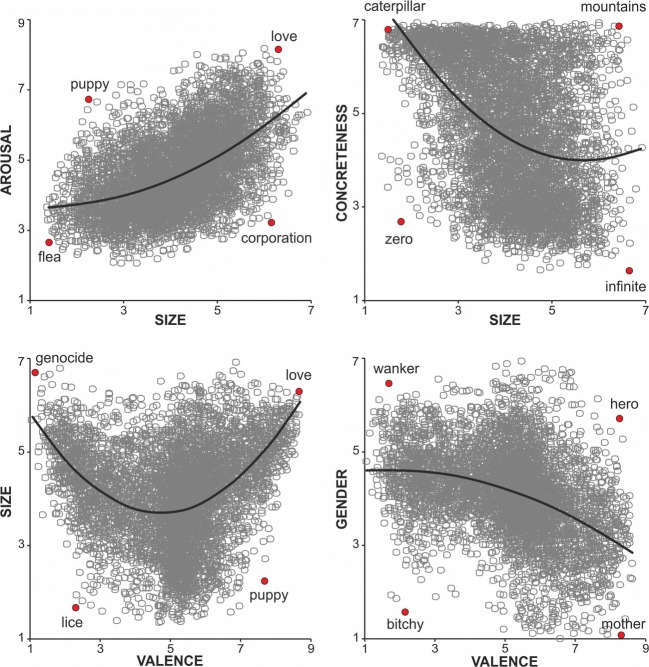
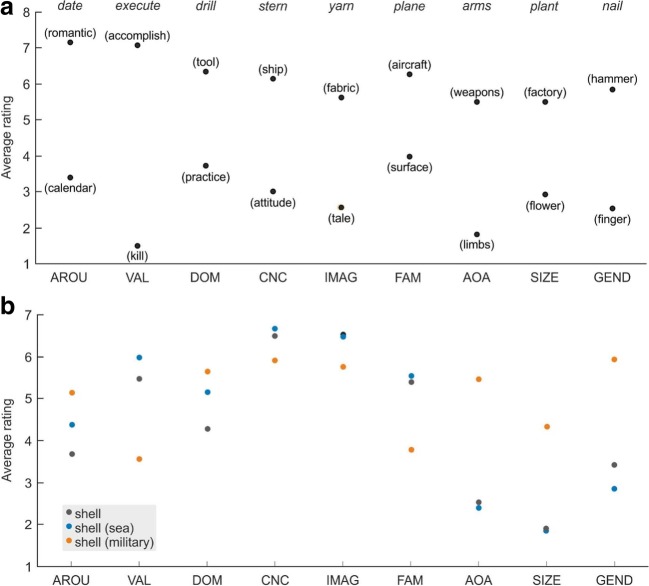
The Glasgow Norms are a set of normative ratings for 5,553 English words on nine psycholinguistic dimensions: arousal, valence, dominance, concreteness, imageability, familiarity, age of acquisition, semantic size, and gender association. The Glasgow Norms are unique in several respects. First, the corpus itself is relatively large, while simultaneously providing norms across a substantial number of lexical dimensions. Second, for any given subset of words, the same participants provided ratings across all nine dimensions (33 participants/word, on average). Third, two novel dimensions-semantic size and gender association-are included. Finally, the corpus contains a set of 379 ambiguous words that are presented either alone (e.g., toast) or with information that selects an alternative sense (e.g., toast (bread), toast (speech)). The relationships between the dimensions of the Glasgow Norms were initially investigated by assessing their correlations. In addition, a principal component analysis revealed four main factors, accounting for 82% of the variance (Visualization, Emotion, Salience, and Exposure). The validity of the Glasgow Norms was established via comparisons of our ratings to 18 different sets of current psycholinguistic norms. The dimension of size was tested with megastudy data, confirming findings from past studies that have explicitly examined this variable. Alternative senses of ambiguous words (i.e., disambiguated forms), when discordant on a given dimension, seemingly led to appropriately distinct ratings. Informal comparisons between the ratings of ambiguous words and of their alternative senses showed different patterns that likely depended on several factors (the number of senses, their relative strengths, and the rating scales themselves). Overall, the Glasgow Norms provide a valuable resource-in particular, for researchers investigating the role of word recognition in language comprehension.
Overview
The claims and statistics of this paper haven’t been checked yet.
Free: it reads the open-access text and checks the first 5 claims that cite a source we can check. Create a free account to check every claim.
Integrity signals
Registry
Cites
Statistics
Figures
Verification
Claims the paper makes
The claims and statistics of this paper haven’t been checked yet.
Free: it reads the open-access text and checks the first 5 claims that cite a source we can check. Create a free account to check every claim.
Claims other papers make about this one
Each is checked against this paper’s own text: does it say what the citing paper says it does?
The cited source says what the claim attributes to it.
In the citing paper
“Figure 3 shows the mean–SD relationships observed in the Likert judgements of words on three different semantic variables from the Glasgow Norms (Scott et al., 2019): Dominance, Familiarity, and Gender.”
From Rating norms should be calculated from cumulative link mixed effects models (2022) · cites this paper as Scott et al., 2019
Self-check
Percentages, sums and reported differences re-computed from the paper’s own numbers.
The self-check needs the paper’s full text.
Citations
Cites
Statistical Power Analysis for the Behavioral Sciences
Muller, K. (1989) · Technometrics · doi:10.1080/00401706.1989.10488618 · Cited by 99,167
Statistical power analysis for the behavioral sciences
(1990) · Computers, Environment and Urban Systems · doi:10.1016/0198-9715(90)90050-4 · Cited by 65,269
Russell, J. A. (1980) · Journal of Personality and Social Psychology · doi:10.1037/h0077714 · Cited by 16,334 · cited 1×
“In the psycholinguistic literature, emotion is generally represented within a two-dimensional framework (e.g., Osgood, Suci, & Tannenbaum, 1957; Russell, 1980), with greater emotionality associated with higher arousal and extreme valence.”
BackgroundThe application of electronic computers to factor analysis
Kaiser, H. F. (1960) · Educational and Psychological Measurement · doi:10.1177/001316446002000116 · Cited by 12,459 · cited 1×
“Factors with eigenvalues greater than 1 were included in the factor solution (Kaiser, 1960).”
BackgroundOsgood, C. E., Suci, G. J., & Tannenbaum, P. H. (1957) · Cited by 9,433
Harman, H. H. (1960) · Cited by 5,148
Concreteness, imagery, and meaningfulness values for 925 nouns.
Paivio, A., Yuille, J. C., & Madigan, S. A. (1968) · Journal of Experimental Psychology · doi:10.1037/h0025327 · Cited by 2,827
Balota, D. A., Yap, M. J., Hutchison, K. A., Cortese, M. J., Kessler, B., Loftis, B., Neely, J. H., Nelson, D. L., Simpson, G. B., & Treiman, R. (2007) · Behavior Research Methods · doi:10.3758/bf03193014 · Cited by 2,742
Merrifield, P. R., & Harman, H. (1969) · American Educational Research Journal · doi:10.2307/1161864 · Cited by 2,574
Norms of valence, arousal, and dominance for 13,915 English lemmas
Warriner, A. B., Kuperman, V., & Brysbaert, M. (2013) · Behavior Research Methods · doi:10.3758/s13428-012-0314-x · Cited by 1,959
Cited by
Lynott, D., Connell, L., Brysbaert, M., Brand, J., & Carney, J. (2020) · Behavior Research Methods · doi:10.3758/s13428-019-01316-z · Cited by 370
Gender stereotypes are reflected in the distributional structure of 25 languages
Lewis, M., & Lupyan, G. (2019) · Nature Human Behaviour · doi:10.1038/s41562-020-0918-6 · Cited by 144
Rating norms should be calculated from cumulative link mixed effects models
Taylor, J. E., Rousselet, G. A., Scheepers, C., & Sereno, S. C. (2022) · Behavior Research Methods · doi:10.3758/s13428-022-01814-7 · Cited by 126
Self-citationSize sound symbolism in the English lexicon
Winter, B., & Perlman, M. (2021) · Glossa a journal of general linguistics · doi:10.5334/gjgl.1646 · Cited by 113
Sound symbolism shapes the English language: The maluma/takete effect in English nouns
Sidhu, D. M., Westbury, C. F., Hollis, G., & Pexman, P. M. (2021) · Psychonomic Bulletin & Review · doi:10.3758/s13423-021-01883-3 · Cited by 104
Diveica, V., Pexman, P. M., & Binney, R. J. (2022) · Behavior Research Methods · doi:10.3758/s13428-022-01810-x · Cited by 101
“…might be of interest in future research (e.g., Calgary Semantic Decision Project (Pexman et al., 2017), the Lancaster Sensorimotor Norms (Lynott et al., 2020), the Glasgow norms (Scott et al., 2019), word association norms (De Deyne et al., 2019), word prevalence norms (Brysbaert et al., 2018)).”
BackgroundSCOPE: The South Carolina psycholinguistic metabase
Gao, C., Shinkareva, S. V., & Desai, R. H. (2022) · Behavior Research Methods · doi:10.3758/s13428-022-01934-0 · Cited by 91
“The degree of effort involved in generating a mental image of something on a 1 (unimageable) to 7 (imageable) scale (Scott et al., 2019).”
BackgroundInfluentialRobus, C. M., Hand, C. J., Filik, R., & Pitchford, M. (2020) · Computers in Human Behavior · doi:10.1016/j.chb.2020.106361 · Cited by 78
Xu, Q., Peng, Y., Nastase, S. A., Chodorow, M. S., Wu, M., & Li, P. (2025) · Nature Human Behaviour · doi:10.1038/s41562-025-02203-8 · Cited by 112
“The validity of the Glasgow and Lancaster Norms has been well established 1,2 , and the validity of model responses to them is reported in the ‘Validation of results’ section in Results.”
InfluentialLexOPS: An R package and user interface for the controlled generation of word stimuli
Taylor, J. E., Beith, A., & Sereno, S. C. (2020) · Behavior Research Methods · doi:10.3758/s13428-020-01389-1 · Cited by 63
“Here, two levels (A1, A2) are being specified for the variable of Familiarity from the Glasgow Norms (Scott et al., 2019).”
BackgroundSelf-citationNeural patterns differentiate traumatic from sad autobiographical memories in PTSD
Perl, O., Duek, O. A., Kulkarni, K. R., Kelmendi, B., Amen, S. L., Gordon, C., Krystal, J. H., Levy, I., Harpaz‐Rotem, I., & Schiller, D. (2023) · Nature Neuroscience · doi:10.1038/s41593-023-01483-5 · Cited by 66
What Might Books Be Teaching Young Children About Gender?
Lewis, M. L., Borkenhagen, M. J. C., Converse, E., Lupyan, G., & Seidenberg, M. S. (2021) · Psychological Science · doi:10.1177/09567976211024643 · Cited by 70
“As a first step, we asked adult English speakers to rate the genderedness of words in these books using a 5-point scale ranging from masculine to feminine (Scott et al., 2019).”
BackgroundInteractions between text content and emoji types determine perceptions of both messages and senders
Hand, C. J., Burd, K., Oliver, A., & Robus, C. M. (2022) · Computers in Human Behavior Reports · doi:10.1016/j.chbr.2022.100242 · Cited by 72
Can large language models help augment English psycholinguistic datasets?
Trott, S. (2024) · Behavior Research Methods · doi:10.3758/s13428-024-02337-z · Cited by 87
“There have been some efforts to collect semantic norms in context (Scott et al., 2019; Trott & Bergen, 2021; Haber & Poesio, 2021; Trott & Bergen, 2022).”
BackgroundMethodInfluentialsubs2vec: Word embeddings from subtitles in 55 languages
van Paridon, J., & Thompson, B. (2020) · Behavior Research Methods · doi:10.3758/s13428-020-01406-3 · Cited by 73
Schnepf, J., & Christmann, U. (2021) · International Journal of Psychology · doi:10.1002/ijop.12797 · Cited by 69
Martínez, G., Molero, J. D., González, S., Conde, J., Brysbaert, M., & Reviriego, P. (2024) · Behavior Research Methods · doi:10.3758/s13428-024-02515-z · Cited by 74
“The latter was obtained by combining the list of Brysbaert et al. (2019) with the lists of Gao et al. (2023), Scott et al. (2019), and Hollis et al. (2017).”
The Multilingual Picture Database
Duñabeitia, J. A., Baciero, A., Antoniou, K., Antoniou, M., Ataman, E., Baus, C., Ben‐Shachar, M., ÇAĞLAR, O. C., Chromý, J., Comesaña, M., et al. (2022) · Scientific Data · doi:10.1038/s41597-022-01552-7 · Cited by 52
“To this end, the name agreement in the 4 different varieties of English that were included in the dataset (i.e., American English, Australian English, British English, and Malaysian English) were analysed.”
BackgroundInfluentialChapman, C. A., Hasan, O., Schulz, P. E., & Martin, R. C. (2020) · Psychonomic Bulletin & Review · doi:10.3758/s13423-019-01706-6 · Cited by 50
Presenting KAPODI – The Searchable Database of Emotional Stimuli Sets
Diconne, K., Kountouriotis, G. K., Paltoglou, A. E., Parker, A., & Hostler, T. (2022) · Emotion Review · doi:10.1177/17540739211072803 · Cited by 52
Bromberek-Dyzman, K., Jończyk, R., Vasileanu, M., Niculescu-Gorpin, A.-G., & Bąk, H. (2021) · International Journal of Bilingualism · doi:10.1177/1367006920987306 · Cited by 48
“…growing number of affective language databases compiled in a variety of languages and containing broad selection of words evaluated for the core dimensions of valence, arousal, and dominance (e.g. Bradley & Lang, 1994; Imbir, 2016; Riegel et al., 2015; Scott et al., 2019; Warriner et al., 2013).”
BackgroundStella, M., Citraro, S., Rossetti, G., Marinazzo, D., Kenett, Y. N., & Vitevitch, M. S. (2024) · Psychonomic Bulletin & Review · doi:10.3758/s13423-024-02473-9 · Cited by 52
Differential emotional processing in concrete and abstract words.
Yao, B., Keitel, A., Bruce, G., Scott, G. G., O'Donnell, P. J., & Sereno, S. C. (2018) · Journal of Experimental Psychology Learning Memory and Cognition · doi:10.1037/xlm0000464 · Cited by 44
Self-citationMULTIMAP: Multilingual picture naming test for mapping eloquent areas during awake surgeries
Gisbert‐Muñoz, S., Quiñones, I., Amoruso, L., Timofeeva, P., Geng, S., Boudelaa, S., Pomposo, I., Robles, S. G., & Carreiras, M. (2020) · Behavior Research Methods · doi:10.3758/s13428-020-01467-4 · Cited by 35
Identifying and exploiting homogeneous communities in labeled networks
Citraro, S., & Rossetti, G. (2020) · Applied Network Science · doi:10.1007/s41109-020-00302-1 · Cited by 41
How Polysemy Affects Concreteness Ratings: The Case of Metaphor
Reijnierse, W. G., Burgers, C. F., Bolognesi, M., & Krennmayr, T. (2019) · Cognitive Science · doi:10.1111/cogs.12779 · Cited by 41
Large Language Models and the Wisdom of Small Crowds
Trott, S. (2024) · Open Mind · doi:10.1162/opmi_a_00144 · Cited by 40
“As “ gold standard ” datasets, we used RAW-C (Trott & Bergen, 2021), a portion of the Glasgow Norms (Scott et al., 2019), and a subset of a recently published dataset of iconicity judgments (Winter et al., 2024).”
BackgroundMethodResultInfluentialBrysbaert, M., Martínez, G., & Reviriego, P. (2024) · Behavior Research Methods · doi:10.3758/s13428-024-02561-7 · Cited by 42
“The AoA measure came from the same Glasgow norms as the familiarity ratings (Scott et al., 2019) and indicated the age at which people believe they acquired the words.”
InfluentialEmotion processing in concrete and abstract words: evidence from eye fixations during reading
Yao, B., Scott, G. G., Bruce, G., Monteith-Hodge, E., & Sereno, S. C. (2024) · Cognition & Emotion · doi:10.1080/02699931.2024.2367062 · Cited by 32
“Emotion (valence) and concreteness values for targets were obtained from the Glasgow Norms (Scott et al., 2019).”
MethodSelf-citationFamiliarity ratings for 24,325 simplified Chinese words
Su, Y., Li, Y., & Li, H. (2022) · Behavior Research Methods · doi:10.3758/s13428-022-01878-5 · Cited by 35
Hofmann, R., Rozgonjuk, D., Soto, C. J., Ostendorf, F., & Mõttus, R. (2025) · Journal of Research in Personality · doi:10.1016/j.jrp.2025.104582 · Cited by 33
IDEST: International Database of Emotional Short Texts
Kaakinen, J. K., Werlen, E., Kammerer, Y., Acartürk, C., Aparicio, X., Baccino, T., Ballenghein, U., Bergamin, P. B., Castells, N., Costa, A., et al. (2022) · PLoS ONE · doi:10.1371/journal.pone.0274480 · Cited by 30
Shared and modality-specific brain regions that mediate auditory and visual word comprehension
Keitel, A., Groß, J., & Kayser, C. (2020) · eLife · doi:10.7554/elife.56972 · Cited by 24
“Similarly, the encoding of the acoustic speech envelope is seen widespread in the brain, but correct word comprehension correlates only with focal activity in temporal and motor regions (Scott, 2019; Keitel et al., 2018).”
BackgroundSelf-citationQuantifying Valence and Arousal in Text with Multilingual Pre-trained Transformers
Mendes, G. A., & Martins, B. (2023) · Lecture notes in computer science · doi:10.1007/978-3-031-28244-7_6 · Cited by 48
The neural basis of naturalistic semantic and social cognition
Thye, M. D., Hoffman, P., & Mirman, D. (2024) · Scientific Reports · doi:10.1038/s41598-024-56897-3 · Cited by 24
“Candidate words were derived from the Glasgow norms study, which includes normative psycholinguistic ratings for over 5000 individual words 65 .”
MethodWeaker than you might imagine: Determining imageability effects on word recognition
Dymarska, A., Connell, L., & Banks, B. (2022) · Journal of Memory and Language · doi:10.1016/j.jml.2022.104398 · Cited by 23
The Role of Semantic Associations as a Metacognitive Cue in Creative Idea Generation
Kenett, Y. N., Gooz, N., & Ackerman, R. (2023) · Journal of Intelligence · doi:10.3390/jintelligence11040059 · Cited by 26
Duality of Smell: Route-Dependent Effects on Olfactory Perception and Language
Pellegrino, R., Hörberg, T., Olofsson, J., & Luckett, C. R. (2021) · Chemical Senses · doi:10.1093/chemse/bjab025 · Cited by 24
Memory enhancement for emotional words is attributed to both valence and arousal
Gao, C., Ren, J., Sakaki, M., & Jia, X. (2024) · Acta Psychologica · doi:10.1016/j.actpsy.2024.104249 · Cited by 28
Linking norms, ratings, and relations of words and concepts across multiple language varieties
Tjuka, A., Forkel, R., & List, J. (2021) · Behavior Research Methods · doi:10.3758/s13428-021-01650-1 · Cited by 31
Argyropoulos, G. P. D., Dell’Acqua, C., Butler, E., Loane, C., Roca‐Fernández, A., Almozel, A., Drummond, N., Lage-Martinez, C., Cooper, E., Henson, R. N., et al. (2021) · Cerebral Cortex · doi:10.1093/cercor/bhab290 · Cited by 23
Zhang, W., Jończyk, R., Wu, Y. J., Lan, Y., Gao, Z., Hu, J., Thierry, G., & Gao, S. (2023) · Cerebral Cortex · doi:10.1093/cercor/bhad161 · Cited by 22
Su, Y., Li, Y., & Li, H. (2022) · Current Psychology · doi:10.1007/s12144-022-03404-4 · Cited by 21
“The reliability and validity of our imageability ratings are overall well supported by the high intraclass correlation coefficients and inter-rater reliability of each word list and the high correlations between our ratings and those in Yee (2017). We note the absence of a significant correlation between our imageabil…”
BackgroundMethodInfluentialSun, K., Liu, H., & Xiong, W. (2020) · Scientometrics · doi:10.1007/s11192-020-03816-8 · Cited by 23
Brainerd, C. J., Chang, M., Bialer, D. M., & Toglia, M. P. (2021) · Journal of Memory and Language · doi:10.1016/j.jml.2021.104286 · Cited by 19
Imageability- and Length-Controllable Image Captioning
Kastner, M. A., Umemura, K., Ide, I., Kawanishi, Y., Hirayama, T., Doman, K., Deguchi, D., Murase, H., & Satoh, S. (2021) · IEEE Access · doi:10.1109/access.2021.3131393 · Cited by 21
“Existing im-ageability dictionaries such as [6], [31], [33], [42] describe imageability on a Lickert scale (e.g., on an interval of [1,7] or [1,5]) from very unimaginable to very imaginable.”
BackgroundMethodDefinite and indefinite article accuracy in learner English: A multifactorial analysis
Derkach, K., & Alexopoulou, T. (2023) · Studies in Second Language Acquisition · doi:10.1017/s0272263123000463 · Cited by 21
“Noun type (Ntype) count singular count plural mass Considered context: “ cake ” count in “ they ate a cake, ” mass in “ they ate cake ” Abstractness abstract/concrete Codedasbinary,butweacknowledgeitisagradientcharacteristic(Scottetal., 2019).”
Gauvin, H. S., McMahon, K. L., & de Zubicaray, G. I. (2020) · Language Cognition and Neuroscience · doi:10.1080/23273798.2020.1762904 · Cited by 17
“(Balota et al., 2007; Scott et al., 2019), including log frequency (SUBTLEX; Brysbaert et al.”
BackgroundImplicit consequentiality bias in English: A corpus of 300+ verbs
Garnham, A., Vorthmann, S., & Kaplanova, K. (2020) · Behavior Research Methods · doi:10.3758/s13428-020-01507-z · Cited by 17
Age-Related Differences in Affective Norms for Chinese Words (AANC)
Liu, P., Lu, Q., Zhang, Z., Tang, J., & Han, B. (2021) · Frontiers in Psychology · doi:10.3389/fpsyg.2021.585666 · Cited by 22
A long time ago in a galaxy far, far away: How temporal are episodic contents?
Mahr, J. B., Greene, J. D., & Schacter, D. L. (2021) · Consciousness and Cognition · doi:10.1016/j.concog.2021.103224 · Cited by 20
Neurocognitive correlates of semantic memory navigation in Parkinson’s disease
Toro-Hernández, F. D., Migeot, J., Marchant, N., Olivares, D., Ferrante, F. J., González-Gómez, R., Campo, C. G., Fittipaldi, S., Rojas-Costa, G. M., Moguilner, S., et al. (2024) · npj Parkinson's Disease · doi:10.1038/s41531-024-00630-4 · Cited by 19
Kearney, E., McMahon, K. L., Guenther, F. H., Arciuli, J., & de Zubicaray, G. I. (2024) · Cognition · doi:10.1016/j.cognition.2024.105972 · Cited by 18
“…that are often used interchangeably in the literature (Reilly & Kean, 2007; Westbury et al., 2016). concreteness ratings from the Glasgow Norms (Scott et al., 2019) and our measure of concreteness form typicality, concreteness from the Brysbaert et al. (2014) norms, and imageability from the…”
BackgroundMethodResultInfluentialConnected speech markers of amyloid burden in primary progressive aphasia
Slegers, A., Chafouleas, G., Montembeault, M., Bedetti, C., Welch, A. E., Rabinovici, G. D., Langlais, P., Gorno‐Tempini, M. L., & Brambati, S. M. (2021) · Cortex · doi:10.1016/j.cortex.2021.09.010 · Cited by 20
Ku, L.-C., Allen, J. J. B., & Lai, V. T. (2022) · Brain and Language · doi:10.1016/j.bandl.2022.105086 · Cited by 19
Speakers of different languages remember visual scenes differently
Fernández-Duque, M., Hayakawa, S. L., & Marian, V. (2023) · Science Advances · doi:10.1126/sciadv.adh0064 · Cited by 17
Murthy, S. K., Griffiths, T. L., & Hawkins, R. D. (2022) · Cognition · doi:10.1016/j.cognition.2022.105152 · Cited by 23
Blott, L. M., Hartopp, O., Nation, K., & Rodd, J. M. (2022) · PeerJ · doi:10.7717/peerj.14070 · Cited by 15
It’s All in the Interaction: Early Acquired Words Are Both Frequent and Highly Imageable
Coffey, J., Zeitlin, M., Crawford, J., & Snedeker, J. (2024) · Open Mind · doi:10.1162/opmi_a_00130 · Cited by 16
“These two kinds of ratings are very highly correlated (see Methods) and appear to tap into the same underlying psychological construct (e.g., Scott et al., 2019).”
BackgroundLemos, M., Cardoso, P. J. S., & Rodrigues, J. M. F. (2024) · Multimodal Technologies and Interaction · doi:10.3390/mti8070056 · Cited by 17
“Speech sentiment analysis (e.g., [27,29]) The Glasgow Norms [106] A set of normative ratings for 5553 words on 9 psycholinguistic dimensions: arousal, valence, dominance, concreteness, imageability, familiarity, age, semantic size, and gender association.”
MethodSantosa, P. P. P. (2017) · DEIKSIS · doi:10.30998/deiksis.v9i02.1823 · Cited by 24
The famous melodies stimulus set
Belfi, A. M., & Kacirek, K. (2020) · Behavior Research Methods · doi:10.3758/s13428-020-01411-6 · Cited by 34
A Chinese Conceptual Semantic Feature Dataset (CCFD)
Deng, Y., Wang, Y., Qiu, C., Hu, Z., Sun, W., Gong, Y., Zhao, X. Z., He, W., & Cao, L. (2021) · Behavior Research Methods · doi:10.3758/s13428-020-01525-x · Cited by 14
Mnemicity versus temporality: Distinguishing between components of episodic representations.
Mahr, J. B., & Schacter, D. L. (2022) · Journal of Experimental Psychology General · doi:10.1037/xge0001215 · Cited by 15
Simulating background settings during spoken and written sentence comprehension
Horchak, O. V., & Garrido, M. V. (2022) · Psychonomic Bulletin & Review · doi:10.3758/s13423-022-02061-9 · Cited by 13
“00 on a 7-point scale) from the Glasgow Norms ratings (Scott et al., 2019).”
MethodTrott, S., & Bergen, B. K. (2026) · Behavior Research Methods · doi:10.3758/s13428-026-03134-6 · Cited by 13
“This approach has been extended to French (Miceli, Wauthia, Lefebvre, Ris, & Simoes Loureiro, 2021) and Dutch (Speed & Brybaert, 2021).”
The acceptability and validity of AI-generated psycholinguistic stimuli
Alzahrani, A. A. (2025) · Heliyon · doi:10.1016/j.heliyon.2025.e42083 · Cited by 13
The compositionality of English phrasal verbs in terms of imageability
Lindstromberg, S. (2022) · Lingua · doi:10.1016/j.lingua.2022.103373 · Cited by 13
Cursed Concepts: New insights on combinatorial processing from ERP correlates of swearing in context
Donahoo, S. A., Pfeifer, V. A., & Lai, V. T. (2022) · Brain and Language · doi:10.1016/j.bandl.2022.105079 · Cited by 16
Thye, M. D., Hoffman, P., & Mirman, D. (2023) · NeuroImage · doi:10.1016/j.neuroimage.2023.120204 · Cited by 12
“The candidate words came from a study on the social-desirability of personality terms and the Glasgow norms (Hampson et al., 1987; Scott et al., 2018).”
BackgroundSpecificity ratings for English data
Ravelli, A. A., Bolognesi, M., & Caselli, T. (2024) · Cognitive Processing · doi:10.1007/s10339-024-01239-4 · Cited by 11
Semantic distance predicts metaphoricity and creativity judgments in synesthetic metaphors
Winter, B., & Lievers, F. S. (2023) · Metaphor and the Social World · doi:10.1075/msw.00029.win · Cited by 11
ANCW: Affective norms for 4030 Chinese words
Ying, L., Ruyang, Y., Ni, C., Yeqing, W., Liu, Q., Yufan, Z., & Gao, F. (2023) · Behavior Research Methods · doi:10.3758/s13428-023-02226-x · Cited by 15
“…mean valence was 3.90, mean arousal was 3.87, and mean dominance was 3.89; Spanish’s (Sarli & Justel, 2021) mean valence was 4.00, and mean arousal was 3.91; Glasgow’s (Scott et al., 2018) mean arousal valence was 4.08, mean arousal was 3.72, mean dominance was 4.05, and mean concreteness was 4.64.”
InfluentialFarrar, S. T., Davis, T., & Papies, E. K. (2024) · Food Quality and Preference · doi:10.1016/j.foodqual.2024.105212 · Cited by 12
Silas, S. J., Baker, D. J., & Müllensiefen, D. (2024) · Journal of Advertising Research · doi:10.2501/jar-2024-013 · Cited by 11
Auditory Verb Generation Performance Patterns Dissociate Variants of Primary Progressive Aphasia
Lukic, S., Licata, A. E., Weis, E., Bogley, R., Ratnasiri, B. M., Welch, A. E., Hinkley, L. B. N., Miller, Z., García, A. M., Houde, J. F., et al. (2022) · Frontiers in Psychology · doi:10.3389/fpsyg.2022.887591 · Cited by 12
HEROÍNA: Drug or hero? Meaning-dependent valence norms for ambiguous Spanish words
Huete‐Pérez, D., Haro, J., Fraga, I., & Ferré, P. (2019) · Applied Psycholinguistics · doi:10.1017/s014271641900050x · Cited by 10
Sidhu, D. M., & Pexman, P. M. (2022) · Quarterly Journal of Experimental Psychology · doi:10.1177/17470218221078299 · Cited by 12
“Also, since completing this research, a large database of size ratings have been published (Scott et al., 2019).”
BackgroundSemantic gender: Norms for 24,000 Dutch words and its role in word meaning
Vankrunkelsven, H., Yang, Y., Brysbaert, M., Deyne, S. D., & Storms, G. (2022) · Behavior Research Methods · doi:10.3758/s13428-022-02032-x · Cited by 10
“Finally, Scott et al. (2019) gathered ratings for gender association as part of the Glasgow norms.”
Dymarska, A., Connell, L., & Banks, B. (2023) · Journal of Experimental Psychology Learning Memory and Cognition · doi:10.1037/xlm0001265 · Cited by 12
Blott, L. M., Gowenlock, A., Kievit, R., Nation, K., & Rodd, J. M. (2023) · Journal of Cognition · doi:10.5334/joc.317 · Cited by 10
Wu, M.-H., Anderson, A. J., Jacobs, R. A., & Raizada, R. D. S. (2022) · Neurobiology of Language · doi:10.1162/nol_a_00045 · Cited by 11
“Imageability norms from the available words were retrieved from the Glasgow Norms (Scott et al., 2019).”
MethodHow does attribute ambiguity improve memory?
Brainerd, C. J., Chang, M., Bialer, D. M., & Liu, X. (2022) · Memory & Cognition · doi:10.3758/s13421-022-01343-w · Cited by 11
“The individual words in each word pool were rated by an average of 43 subjects, which is comparable to the numbers of subjects who rated individual words in the Toglia and Battig (1978) norms and 30% larger than the numbers of subjects who rated individual words in the Scott et al. (2019) norms.”
BackgroundMethodResultInfluentialThe Flickr frequency norms: What 17 years of images tagged online tell us about lexical processing
Petilli, M. A., Günther, F., & Marelli, M. (2022) · Behavior Research Methods · doi:10.3758/s13428-022-02031-y · Cited by 10
“Given the relatively small size of the Glasgow Norms dataset and the affective database by Warriner et al. (2013), regression analyses were separately conducted for “larger-scale" datasets, excluding Imageability and affective variables (i.e., valence, dominance, and arousal), and “smaller-scale” datasets, including a…”
InfluentialConde, J., Grandury, M., Fu, T., Arriaga, C., Martínez, G., Clark, T. H., Trott, S., Green, C., Reviriego, P., & Brysbaert, M. (2026) · Behavior Research Methods · doi:10.3758/s13428-026-03129-3 · Cited by 9
“In contrast, a word is abstract if it represents more of a concept or idea” (Scott et al., 2019).”
What can size tell us about abstract conceptual processing?
Yao, B., Taylor, J. E., & Sereno, S. C. (2022) · Journal of Memory and Language · doi:10.1016/j.jml.2022.104369 · Cited by 11
Self-citationVerbs Are Associated With Agency: Evidence From Word Ratings and Natural Language Use
Pietraszkiewicz, A., & Formanowicz, M. (2023) · Social Psychology · doi:10.1027/1864-9335/a000522 · Cited by 10
The role of morphemic knowledge during novel word learning
Behzadnia, A., Ziegler, J. C., Colenbrander, D., Bürki, A., & Beyersmann, E. (2023) · Quarterly Journal of Experimental Psychology · doi:10.1177/17470218231216369 · Cited by 12
“In addition, we extracted concreteness scores from a database by Brysbaert and colleagues (2014) and imageability scores from the Glasgow Norms (Scott et al., 2019) to ensure that the pictures representing the first and second constituents were matched (see Table 1).”
MethodSalomé, F., Commissaire, É., & Casalis, S. (2024) · Journal of Experimental Child Psychology · doi:10.1016/j.jecp.2024.105978 · Cited by 9
Brock, K. L., Zolkoske, J., Cummings, A. E., & Ogiela, D. A. (2022) · Journal of Speech Language and Hearing Research · doi:10.1044/2022_jslhr-22-00022 · Cited by 9
de Zubicaray, G. I., Arciuli, J., Guenther, F. H., McMahon, K. L., & Kearney, E. (2023) · Quarterly Journal of Experimental Psychology · doi:10.1177/17470218231184940 · Cited by 9
“In this study, our goal was to investigate systematic form-meaning associations for size using a large set of monosyl-labic and multisyllabic words from the Glasgow norms (Scott et al., 2019).”
BackgroundMethodResultInfluentialBestgen, Y. (2021) · Workshop on Cognitive Modeling and Computational Linguistics (CMCL) · doi:10.18653/v1/2021.cmcl-1.10 · Cited by 9
Conde, J., Martínez, G., Grandury, M., Arriaga, C., Haro, J., Schroeder, S., Hintz, F., Reviriego, P., & Brysbaert, M. (2026) · Journal of Cognition · doi:10.5334/joc.482 · Cited by 8
“Familiarity estimates were obtained with the following prompt, based on the instructions used for the Glasgow norms (Scott et Geben Sie nur eine Zahl zwischen 1 und 7 an.”
Prediction ability in bilingual individuals: an eye tracking study with younger and older adults
Ribu, I. S., Simonsen, H. G., Norvik, M. I., Lehtonen, M., Murstad, J., Theimann, A., Nygreen, T., & Goral, M. (2024) · Journal of Cultural Cognitive Science · doi:10.1007/s41809-024-00155-5 · Cited by 9
“Frequency and imageability ratings for Norwegian were taken from the database Norwegian Words (Lind et al., 2015), English frequency data came from the SUBTLEXus database (Brysbaert et al., 2012) and imageability ratings in English were obtained from the Glasgow norms (Scott et al., 2019).”
The recognition effects of attribute ambiguity
Chang, M., & Brainerd, C. J. (2023) · Psychonomic Bulletin & Review · doi:10.3758/s13423-023-02291-5 · Cited by 8
“To test this hypothesis, we obtained the trial-level raw data of for seven attributes in the Scott et al. (2019) norms (valence, arousal, concreteness, dominance, familiarity, imageability, and semantic size) 2 and 11 attributes of the Lynott et al. (2020) norms (auditory, gustatory, haptic,…”
InfluentialMultisensory Concept Learning Framework Based on Spiking Neural Networks
Wang, Y., & Zeng, Y. (2022) · Frontiers in Systems Neuroscience · doi:10.3389/fnsys.2022.845177 · Cited by 11
“…are a set of normative assessments on nine psycholinguistic dimensions: arousal (AROU), valence (VAL), dominance (DOM), concreteness (CNC), imageability (IMAG), familiarity (FAM), age of acquisition (AOA), semantic size (SIZE), and gender association (GEND) for 5,553 concepts (Scott et al., 2019).”
BackgroundSemantic Norm Extrapolation is a Missing Data ProblemPreprint
Snefjella, B., & Blank, I. (2020) · PsyArXiv (OSF Preprints) · doi:10.31234/osf.io/y2gav · Cited by 8
Maschio, N. D., Sulpizio, S., Bellini, C., Mauro, G. D., Giannachi, M., Buğa, D., Fedeli, D., Perani, D., & Abutalebi, J. (2024) · Frontiers in Behavioral Neuroscience · doi:10.3389/fnbeh.2024.1392005 · Cited by 8
Towards hypergraph cognitive networks as feature-rich models of knowledge
Citraro, S., Deyne, S. D., Stella, M., & Rossetti, G. (2023) · EPJ Data Science · doi:10.1140/epjds/s13688-023-00409-2 · Cited by 8
“Data overview We gain patterns for 3586 English words present both in the SWoW [18] and in the Glasgow norms [3] projects.”
BackgroundMethodInfluentialA generic self-learning emotional framework for machines
Hernández-Marcos, A., & Ros, E. (2024) · Scientific Reports · doi:10.1038/s41598-024-72817-x · Cited by 9
Metadata
- Authors
- Scott, G. G., Keitel, A., Becirspahic, M., Yao, B., & Sereno, S. C.
- Affiliations
- University of the West of Scotland (GB)
- University of Glasgow (GB)
- University of Manchester (GB)
- Corresponding author
- Sereno, Sara C.
- Venue
- Behavior Research Methods
- Published
- 2018-09-11
- Volume
- 51
- Issue
- 3
- Pages
- 1258-1270
- ISSN
- 1554-351X (ISSN-L)
- 1554-3528
- PMC
- PMC6538586
- OpenAlex
- W2889870962
- Cited by
- 237
- References
- 69
- Citations by year
- 2026: 25 · 2025: 39 · 2024: 43 · 2023: 30 · 2022: 47 · 2021: 28 · 2020: 18 · 2019: 5 · 2018: 1
- FWCI
- 7.74
- Type
- journal article
- Language
- en
- Open access
- hybrid
- doi.org
- Licence
- cc-by
- creativecommons.org/licenses/by/4.0 (tdm)
- Locations
- Behavior Research Methods (publishedVersion, cc-by)
- PubMed Central (publishedVersion, cc-by)
- PubMed (publishedVersion)
- Discovery Research Portal (University of Dundee) (publishedVersion, cc-by)
- The UWS Academic Portal (University of the West of Scotland) (publishedVersion, cc-by-nc-nd)
- Research Explorer (The University of Manchester) (publishedVersion, other-oa)
- ENLIGHTEN (Jurnal Bimbingan dan Konseling Islam) (acceptedVersion, cc-by-sa)
- Lancaster EPrints (Lancaster University) (submittedVersion)
- Funders
- Economic and Social Research Council (RES-062-23-1900)
- Carnegie Trust for the Universities of Scotland (50084)
- Topics
- Life Sciences › Neuroscience › Cognitive Neuroscience › Neurobiology of Language and Bilingualism
- Social Sciences › Psychology › Developmental and Educational Psychology › Reading and Literacy Development
- Social Sciences › Psychology › Experimental and Cognitive Psychology › Categorization, perception, and language
- Keywords
- word ratings, arousal, valence, dominance, concreteness, imageability, familiarity, age of acquisition, gender associations, ambiguous words, word sense disambiguation, word recognition, language comprehension
- MeSH terms
- Adolescent, Adult, Arousal, Emotions, Female, Humans, Male, Psycholinguistics, Semantics, Speech, Recognition, Psychology, Young Adult
About these checks
Registry, retraction, Cites and statistics results are computed, not judged, with one exception: a printed reference that no index lists is read once by a model before it counts as a citation error. Claims are extracted by a model and kept only when their quote appears verbatim in the text; each cited source is then checked, with a model’s help, for whether it says what the claim relies on. Those verdicts can be wrong — read the claim’s quote and the cited source before relying on one.
Statistics and arithmetic are recomputed, not judged.
Confidence bands are shown only for fields calibrated on our annotated test set. None is calibrated yet, so no band is shown.
What counts as a claim ›How we measure confidence ›How we check this ›
Are you an author, or do you see a problem with this page? Request a review
Data sources
Bibliographic data: Semantic Scholar, OpenAlex, Crossref.
Contains information from the Semantic Scholar Academic Graph Datasets, made available under the ODC Attribution License (ODC-BY 1.0).
Semantic Scholar’s data is described in: Kinney, R., et al. (2023). The Semantic Scholar Open Data Platform. arXiv:2301.10140.
