

The Glasgow Norms: Ratings of 5,500 words on nine scales
Open accessThe DOI matches its Crossref record; 65 of the 69 references it cites were found in a registry or an index.
Abstract
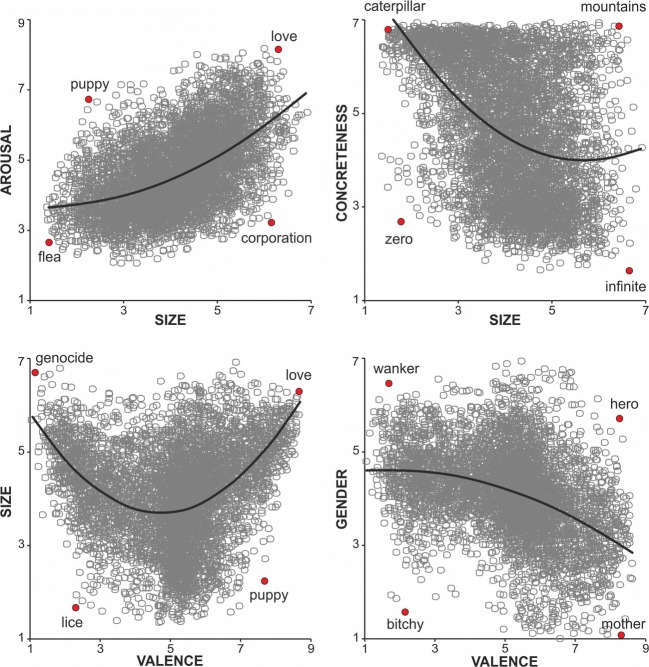
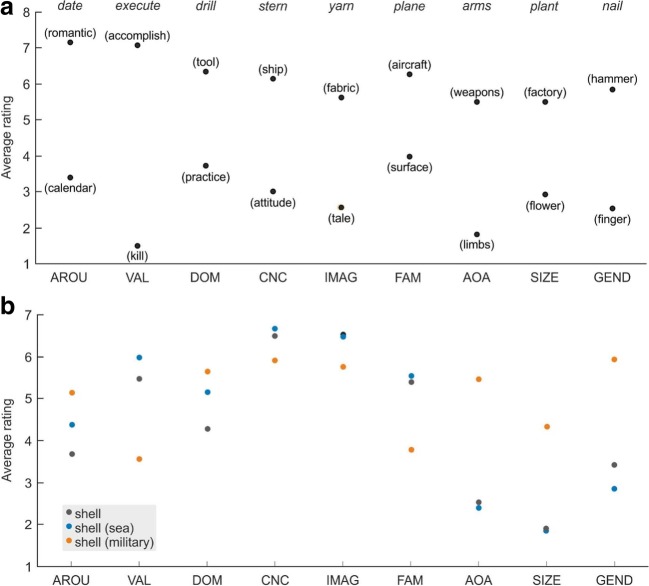
The Glasgow Norms are a set of normative ratings for 5,553 English words on nine psycholinguistic dimensions: arousal, valence, dominance, concreteness, imageability, familiarity, age of acquisition, semantic size, and gender association. The Glasgow Norms are unique in several respects. First, the corpus itself is relatively large, while simultaneously providing norms across a substantial number of lexical dimensions. Second, for any given subset of words, the same participants provided ratings across all nine dimensions (33 participants/word, on average). Third, two novel dimensions-semantic size and gender association-are included. Finally, the corpus contains a set of 379 ambiguous words that are presented either alone (e.g., toast) or with information that selects an alternative sense (e.g., toast (bread), toast (speech)). The relationships between the dimensions of the Glasgow Norms were initially investigated by assessing their correlations. In addition, a principal component analysis revealed four main factors, accounting for 82% of the variance (Visualization, Emotion, Salience, and Exposure). The validity of the Glasgow Norms was established via comparisons of our ratings to 18 different sets of current psycholinguistic norms. The dimension of size was tested with megastudy data, confirming findings from past studies that have explicitly examined this variable. Alternative senses of ambiguous words (i.e., disambiguated forms), when discordant on a given dimension, seemingly led to appropriately distinct ratings. Informal comparisons between the ratings of ambiguous words and of their alternative senses showed different patterns that likely depended on several factors (the number of senses, their relative strengths, and the rating scales themselves). Overall, the Glasgow Norms provide a valuable resource-in particular, for researchers investigating the role of word recognition in language comprehension.
Overview
The claims and statistics of this paper haven’t been checked yet.
Free: it reads the open-access text and checks the first 5 claims that cite a source we can check. Create a free account to check every claim.
Integrity signals
Registry
Cites
Statistics
Figures
Verification
Claims the paper makes
The claims and statistics of this paper haven’t been checked yet.
Free: it reads the open-access text and checks the first 5 claims that cite a source we can check. Create a free account to check every claim.
Claims other papers make about this one
Each is checked against this paper’s own text: does it say what the citing paper says it does?
The cited source says what the claim attributes to it.
In the citing paper
“Figure 3 shows the mean–SD relationships observed in the Likert judgements of words on three different semantic variables from the Glasgow Norms (Scott et al., 2019): Dominance, Familiarity, and Gender.”
From Rating norms should be calculated from cumulative link mixed effects models (2022) · cites this paper as Scott et al., 2019
Self-check
Percentages, sums and reported differences re-computed from the paper’s own numbers.
The self-check needs the paper’s full text.
Citations
Cites
Statistical Power Analysis for the Behavioral Sciences
Muller, K. (1989) · Technometrics · doi:10.1080/00401706.1989.10488618 · Cited by 99,167
Statistical power analysis for the behavioral sciences
(1990) · Computers, Environment and Urban Systems · doi:10.1016/0198-9715(90)90050-4 · Cited by 65,269
Russell, J. A. (1980) · Journal of Personality and Social Psychology · doi:10.1037/h0077714 · Cited by 16,334 · cited 1×
“In the psycholinguistic literature, emotion is generally represented within a two-dimensional framework (e.g., Osgood, Suci, & Tannenbaum, 1957; Russell, 1980), with greater emotionality associated with higher arousal and extreme valence.”
BackgroundThe application of electronic computers to factor analysis
Kaiser, H. F. (1960) · Educational and Psychological Measurement · doi:10.1177/001316446002000116 · Cited by 12,459 · cited 1×
“Factors with eigenvalues greater than 1 were included in the factor solution (Kaiser, 1960).”
BackgroundOsgood, C. E., Suci, G. J., & Tannenbaum, P. H. (1957) · Cited by 9,433
Harman, H. H. (1960) · Cited by 5,148
Concreteness, imagery, and meaningfulness values for 925 nouns.
Paivio, A., Yuille, J. C., & Madigan, S. A. (1968) · Journal of Experimental Psychology · doi:10.1037/h0025327 · Cited by 2,827
Balota, D. A., Yap, M. J., Hutchison, K. A., Cortese, M. J., Kessler, B., Loftis, B., Neely, J. H., Nelson, D. L., Simpson, G. B., & Treiman, R. (2007) · Behavior Research Methods · doi:10.3758/bf03193014 · Cited by 2,742
Merrifield, P. R., & Harman, H. (1969) · American Educational Research Journal · doi:10.2307/1161864 · Cited by 2,574
Norms of valence, arousal, and dominance for 13,915 English lemmas
Warriner, A. B., Kuperman, V., & Brysbaert, M. (2013) · Behavior Research Methods · doi:10.3758/s13428-012-0314-x · Cited by 1,959
Cited by
Items 201–269 of 269
Imageability norms for 90 English spatio-temporal prepositions and semantically similar expressions
Lindstromberg, S. (2023) · Lingua · doi:10.1016/j.lingua.2023.103653 · Cited by 1
The Greek-Cypriot Word Pool: Normative Data for Concreteness and Imageability for 2,950 WordsPreprint
Traikapi, A., Michael, M., & Konstantinou, N. (2024) · OSF Preprints (OSF Preprints) · doi:10.31219/osf.io/g7n8t · Cited by 1
Stimulus specificity in combined action observation and motor imagery of typing
Woodrow-Hill, C., Gowen, E., Vogt, S., Edmonds, E., & Poliakoff, E. (2024) · Quarterly Journal of Experimental Psychology · doi:10.1177/17470218241241502
“Arousal, valence (G. G. Scott et al., 2019), age of acquisition (Kuperman et al., 2012), concreteness (Brysbaert et al., 2014), and imageability (Cortese & Fugett, 2004; Schock et al., 2011) were also controlled between conditions.”
Emergent Mental Lexicon Functions in ChatGPTPreprint
Kello, C. T., & Bruna, P. (2024) · PsyArXiv (OSF Preprints) · doi:10.31234/osf.io/gka2j
When Thinking About Themselves and God, People Believe Truth Matters More Than Control
Nakkawita, E., Heiphetz, L., & Higgins, E. T. (2026) · Social Cognition · doi:10.1521/soco.2026.44.2.193
Specificity Ratings for English DataPreprint
Ravelli, A. A., Bolognesi, M., & Caselli, T. (2024) · OSF Preprints (OSF Preprints) · doi:10.31219/osf.io/75x2e
Ethics-testing an eating disorder recovery memoir: a pre-publication experiment
Troscianko, E. T., Riestra-Camacho, R., & Carney, J. (2024) · Journal of Eating Disorders · doi:10.1186/s40337-024-01060-6 · Cited by 2
“Concreteness and imageability of words used were measured using the ratings collected in [31], where concreteness captures sensory salience of the word and imageability the ease with which a mental image of the word’s referent can be generated.”
MethodCompatible Effects Enhance Short-Term Action-Effect BindingPreprint
Mocke, V., Kunde, W., & Schreiner, M. R. (2024) · OSF Preprints (OSF Preprints) · doi:10.31219/osf.io/2g36z
Vladimirova, V. E., Сергеевна, К. И., & Rezanova, Z. I. (2023) · Voprosy leksikografii · doi:10.17223/22274200/29/5
A psycholinguistic analysis of clinical list-learning tests
Lansue, B., & Buchanan, L. (2024) · The Mental Lexicon · doi:10.1075/ml.24023.lan
Early Educational Experiences Contribute to Measurement Bias in Verbal Memory AssessmentPreprint
Goette, W. F. (2025) · PsyArXiv (OSF Preprints) · doi:10.31234/osf.io/phy9t_v1
Sensorimotor effects in surprise word memory – A registered report
Dymarska, A., & Connell, L. (2025) · Cortex · doi:10.1016/j.cortex.2025.03.010
“Familiarity Stadthagen-Gonzales & Davis (2006); Scott et al. (2018); Wilson (1988) How subjectively familiar a word seems (ratings) +Frequency”
Miller, M., Klingner, S., Meyer, A.-K., & Aude, R. (2024) · International Conference on Affective Computing and Intelligent Interaction and workshops · doi:10.1109/acii63134.2024.00021
“[30] 1077 2889 [13] [31] 1033 2712 [11] [30] 1688 2062 [11] [31] 1139 3694 [23] [30] 1564 2273 [23] [31] 951 3951 [10] [30] 1166 3757 [10] [31] 1053 3856 [20] [30] 1338 8249 [20] [31] 749 9882 [25] [30] 1077 2889 [25] [31] 1033 2712 [15] [30] 1071 3362 [15] [31] 1033 3176 [21] [30] 1077 2889 [21]…”
The memory palace architect: effect of valence on loci-dependent recall accuracyPreprint
Chiang, N., & Bakkour, A. (2025) · PsyArXiv (OSF Preprints) · doi:10.31234/osf.io/jrm9e_v2
Effect of cue distinctiveness on naming: Evidence from a verbally cued naming paradigm
Dugas, C. S., Motes, M. A., Chiang, H., Spence, J. S., Lucas-Mendoza, K., Diesing, S., Keltner-Dorman, E., & Hart, J. (2025) · Cognitive Neuropsychology · doi:10.1080/02643294.2025.2515859
“…frequency, orthographic neighbourhood density (OND) of cues (i.e., stimuli) and phonological neighbourhood density (PND), concept familiarity, concept, phoneme length, and syllable length for targets (e.g., response; Becker, 1979; Brysbaert et al., 2018; Buchanan et al., 2019; Scott et al., 2019).”
Memory for language and modality in bilinguals: Dependencies and frequency effects
Francis, W. S., & Baca, P. A. (2025) · Psychonomic Bulletin & Review · doi:10.3758/s13423-025-02724-3 · Cited by 1
“…decisions were more accurate for low-frequency than for high-frequency (Brysbaert & New, 2009) b From SUBTLEX-ESP (Cuetos et al., 2011) c From Brysbaert et al. (2014) d From Glasgow Norms (Scott et al., 2019) e FromVan Orden (1987) words, F (1, 95) = 9.665, MSE = 0.562, p = 0.002, η p2 = 0.09.”
InfluentialImage-Based Word Frequency Norms
Petilli, M. A., & Günther, F. (2025) · Elsevier eBooks · doi:10.1016/b978-0-323-95504-1.00859-0
Macaulay, C., & Scheepers, C. (2025) · PsyArXiv (OSF Preprints) · doi:10.31234/osf.io/54jgd_v1
Gagné, C. L., Auch, L., & Spalding, T. L. (2025) · Morphology · doi:10.1007/s11525-025-09448-z · Cited by 1
“Age of acquisition (AoA) was obtained from two studies: Brysbaert and Biemiller (2017) and the Glasgow norms (Scott et al., 2019).”
LLM Estimates of Word Characteristics
Conde, J., Martínez, G., Arriaga, C., Trott, S., & Reviriego, P. (2025) · Elsevier eBooks · doi:10.1016/b978-0-323-95504-1.00989-3
Quantitative analysis of lexical psycholinguistic properties in aphasia discourse production
Chen, J., & Chang, H. (2025) · International Journal of Speech-Language Pathology · doi:10.1080/17549507.2025.2557501
“…in our corpus, we selected four large-scale norms (see Table II) from several existing norms: one for each psycholinguistic property, i.e. age of acquisition (Kuperman et al., 2012), concrete-ness (Brysbaert et al., 2014), imageability (Scott et al., 2019), and familiarity (Scott et al., 2019).”
Ahmed, R., Reinders, A., Svaldi, C., Kingma, A., Persson, K., Thomsen, D. B., Grønbæk, J. K., Laustsen, A. F., Mathiasen, R., Pizer, B. L., et al. (2026) · The Cerebellum · doi:10.1007/s12311-026-02026-x · Cited by 2
Contextual assembly of lexical functions in large language models
Kello, C. T., Bruna, P., & Thao, K. (2025) · Behavior Research Methods · doi:10.3758/s13428-025-02898-7 · Cited by 1
“Trott (2024) collected GPT-4 ratings for 379 ambiguous words along nine psycholinguistic dimensions from the Glasgow norms (Scott et al., 2019) and for 112 words in different sentence contexts along 11 sensorimotor dimensions.”
Pundole, A., Duport, S., Fleming, V., Beeke, S., & Varley, R. A. (2025) · Clinical Rehabilitation · doi:10.1177/02692155251403995
“Items were selected from the Glasgow Norms, 33 a database that provides ratings of words on nine psycholinguistic dimensions (including concreteness, imageability and familiarity).”
Discorso d'odio e lessico connotato. Un'applicazione del modello VAD al corpus HaSpeeDe
Tenchini, M. P., & Frigerio, A. (2023) · Lingue e linguaggi · doi:10.1285/i22390359v59p413
The role of language and sensorimotor information in memory for concepts
Dymarska, A. (2022) · Lancaster EPrints (Lancaster University) · doi:10.17635/lancaster/thesis/1537
‘Not my kind of food’: Dietary polarisation on the transition towards sustainable diets
Davis, T. A. (2023) · Enlighten: Theses (The University of Glasgow) · doi:10.5525/gla.thesis.83563
The Role of Sensorimotor and Linguistic Distributional Information in Categorisation
van Hoef, R. (2022) · Lancaster EPrints (Lancaster University) · doi:10.17635/lancaster/thesis/1581
Validering van een mentaal lexicon afgeleid van een grootschalig woordassociatieproject
Vankrunkelsven, H. (2022) · Lirias (KU Leuven)
Attentional Modulation of Emotional Lateralization Biases with Verbal and Nonverbal Stimuli
Wang, G. (2021) · TSpace (University of Toronto)
Kuviteltavuuden ja iän vaikutus sana-assosiaatiovastauksiin
Hänninen, U. (2022) · UTUPub (University of Turku)
A generic self-learning emotional framework for Reinforcement Learning agents
Hernández-Marcos, A. (2025) · Institutional Repository of the University of Granada (University of Granada)
Impact of varying cognitive resources on memory recall
Zhang, R.-C. (2023) · Nottingham ePrints (University of Nottingham)
PREDICTORS OF VERBAL FLUENCY PERFORMANCE IN PERISYLVIAN APHASIA
Goehring, G., & Goehring, G. (2023) · UA Campus Repository (The University of Arizona)
Factors affecting the utility of emotional stimuli in research
Diconne, K. (2023) · e-space (Manchester Metropolitan University)
The Cognitive and Neural Mechanisms Underlying Learning from Errors
Khoo, J. K. M. (2023) · Nottingham ePrints (University of Nottingham)
Preference for Gender Stereotypicality in Artificial Intelligence
Spielmann, J., & Stern, C. (2021) · Illinois Digital Environment for Access to Learning and Scholarship (University of Illinois at Urbana-Champaign) · doi:10.17605/osf.io/zfwne
Janjić, P. (2025) · UEA Digital Repository (University of East Anglia) · Cited by 1
Gutiérrez-Cordero, I., Berthier, M. L., Torres‐Prioris, M. J., & García-Orza, J. (2026) · Aphasiology · doi:10.1080/02687038.2026.2613004
Pretesting effects for facts reflect lexical over semantic or structural features
Pan, S. C., & Siauw, F. A. (2026) · Memory & Cognition · doi:10.3758/s13421-025-01823-9
“Owing to the high proportion of proper nouns, normed data for concreteness, imageability, and familiarity were available for only 6% of subjects and 41% of predicative key terms in the Scott et al. (2019) Glasgow norms, which include approximately 5,000 English words.”
InfluentialSocial associations between voices and words affect learning
Zellou, G., Rácz, P., & Barreda, S. (2026) · Glossa Psycholinguistics · doi:10.5070/g6011.47021
Cortical Tracking of Speech and Music Predicts Reading Ability in AdultsPreprint
Allen, S. C., Koukouvinis, S., Varjopuro, S. M., & Keitel, A. (2026) · bioRxiv (Cold Spring Harbor Laboratory) · doi:10.64898/2026.02.18.706526
“The words and non-words used in this task were taken from a previous study (Yao et al., 2018) and are part of the corpus of Glasgow Norms (Scott et al., 2019).”
Self-citationRussian grammatical gender through the prism of bilingual perception
Vladimirova, V. E. (2023) · Digital library (repository) of Tomsk State University · doi:10.17223/18572685/71/12
Wang, G., & Meltzer, J. A. (2026) · Laterality Asymmetries of Body Brain and Cognition · doi:10.1080/1357650x.2026.2644266
“The 280 regular English words (Table S2-1) were selected from multiple word normative databases (Brys-baert et al., 2014; Brysbaert & New, 2009; Ljubešić et al., 2018; Lynott et al., 2020; Scott et al., 2019; Warriner et al., 2013).”
Ahmad, S., Mujitaba, A., Shaheen, A., & Naeem, H. (2026) · Research Journal of Psychology · doi:10.59075/rjs.v4i1.342
“It was further expected that valence would be positively associated with dominance and that arousal would remain distinguishable from both valence and dominance, reflecting the multidimensional structure reported in established norming studies (Scott et al., 2019; Warriner et al., 2013).”
InfluentialBrand, J., Šmolík, F., Chromý, J., Smolík, F., & Chromý, J. (2026) · Behavior Research Methods · doi:10.3758/s13428-026-03217-4
Mémoire des mots émotionnels : études inter-tâches des effets de valence et d'arousal
Laulan, P. (2021) · theses.fr (ABES) · doi:10.70675/34a89046z72b9z474czbc61z9bf933a9c28e
Enactment and Embodiment Impact the Recall of Object-Location Associations
Cognitive Science Society 2025, Kohler, S., MacRae, S., & McRae, K. (2025) · eScholarship (California Digital Library) · doi:10.48448/pbgr-a510
Wang, A., Brysbaert, M., & Günther, F. (2026) · Behavior Research Methods · doi:10.3758/s13428-026-03051-8
“These familiarity estimates are highly correlated with existing human familiarity ratings such as the Glasgow norms (Scott et al., 2019) at r =.76, similar to correlations observed between different sets of human familiarity ratings themselves.”
A Short Primer on Historical Natural Language Processing
Hills, T. T., & Miani, A. (2026) · Cambridge University Press eBooks · doi:10.1017/9781108939010.029 · Cited by 1
Pogrebna, G., & Hills, T. T. (2026) · Cambridge University Press eBooks · doi:10.1017/9781108939010.024
COCA as a Representative Corpus for the Study of Basic Emotions in Contemporary English
Бобер, Н. (2026) · Studia Philologica · doi:10.28925/2412-2491.2026.262
Rethinking how we measure gender associations: An updated norming method for nouns and adjectives
Davenport, C., & Ronai, E. (2026) · Proceedings of the Linguistic Society of America · doi:10.3765/plsa.v11i1.6103
“We are aware of only one study that includes gender association ratings for adjectives, Scott et al. (2019), which provides ratings for 5,553 English nouns, adjectives, verbs, and adverbs across nine different psycholinguistic dimensions.”
InfluentialGe, X., & Dong, Y. (2026) · Language Cognition and Neuroscience · doi:10.1080/23273798.2026.2687032
“…Frequency: frequency per million in SUBTLEX-US (Brysbaert & New, 2009); concreteness, imageability, and familiarity 1 : rated by the Glasgow norms (Scott et al., 2019); exclusivity: rated by the modality exclusivity (Lynott & Connell, 2009); familiarity 2 : rated by 42 Chinese EFL learners aged…”
PhDGPT: Measuring bias in academic mental health across quantised and uncensored LLMs
Duro, E. S. D., Taietta, E., D’Alfonso, S., Bentenuto, A., Rossetti, G., & Stella, M. (2026) · Information Processing & Management · doi:10.1016/j.ipm.2026.105173
Predicting the Memorability of Brand Slogans
Aka, A., & McCoy, J. (2026) · Journal of Marketing Research · doi:10.1177/00222437261481110
Examining the Memory Effects of Emotional Ambiguity via the Lens of Emotional Context Variability
Chang, M., Mak, M. H., Giries, E., & Baker, A. (2026) · Quarterly Journal of Experimental Psychology · doi:10.1177/17470218261484462
Are emotion-label words more memorable than other abstract words?
Mason, C., Hameau, S., & Nickels, L. (2026) · Language Cognition and Neuroscience · doi:10.1080/23273798.2026.2718888
“Values for frequency were drawn from Subtlex (Brysbaert & New, 2009), familiarity from the Glasgow Norms (Scott et al., 2019), number of senses from Miller et al. (1990) and concrete-ness from Brysbaert et al. (2014).”
Mumtaz, H. (n.d.) · UWE Research Repository (UWE Bristol)
Synchronic and Diachronic Models of Motivation Ratings of English Words
Shevlyakova, A. V., Bochkarev, V. V., & Savinkov, A. V. (2026) · Lecture notes in computer science · doi:10.1007/978-3-032-37867-5_23
Iida, H., & Hori, R. (2026) · eScholarship (California Digital Library)
The neglected role of lexical ambiguity in embodied cognition models
Božić, S., & Đurđević, D. F. (2026) · Applied Psycholinguistics · doi:10.1017/s0142716426100952
“…of obtaining concreteness ratings for both words and word senses — some focusing on the metaphor (Reijnierse et al., 2019), some on the stability of the ratings (Montefinese et al., 2023), and some collecting ratings but not performing any formal comparative analysis on them (Scott et al., 2019).”
Age of acquisition and language embodiment across the lifespan
O’Donnell, K., Commins, S., & GOUGH, P. M. (2026) · Language and Cognition · doi:10.1017/langcog.2026.10117
“An imageability norm for each word was established using a combination of MRC (Coltheart, 1981), Bristol (Stadthagen-Gonzalez & Davis, 2006), Glasgow (Scott et al., 2019) and Cortese (Cortese & Fugett, 2004; Schock et al., 2012) databases.”
Collostructional analysis: a Bayesian approach
Monakhov, S. (2026) · Linguistics · doi:10.1515/ling-2025-0079
“In the fi rst step, I retrieved all verbs encountered in the Glasgow norms database (Scott et al. 2019).”
Speech Tracking in fMRI Reveals a Distinct Response to Sentence Boundaries During ComprehensionPreprint
Levy, O., Tikochinski, R., Reichart, R., Golumbic, E. Z., Deschamps, I., & Agmon, G. (2026) · bioRxiv (Cold Spring Harbor Laboratory) · doi:10.64898/2026.10.13.758938
“The package integrates normative concreteness ratings from the Brysbaert concreteness norms (Brysbaert et al., 2014), the Glasgow Norms (Scott et al., 2019), and the MRC Psycholinguistic Database (Coltheart, 1981).”
Carney, J. (2026) · Journal of Alzheimer s Disease · doi:10.1177/13872877261498421
Обзор современных баз данных с оценками эмоциональной окраски слов
Анатольевна, С. Т. (n.d.) · CyberLeninK (CyberLeninka)
Reinders, A., Svaldi, C., Kingma, A., Grønbæk, J. K., Thomsen, D. B., Persson, K., Mathiasen, R., Dahl, C., Carai, A., Andreozzi, B., et al. (2026) · Research Square · doi:10.21203/rs.3.rs-11430483/v1
Metadata
- Authors
- Scott, G. G., Keitel, A., Becirspahic, M., Yao, B., & Sereno, S. C.
- Affiliations
- University of the West of Scotland (GB)
- University of Glasgow (GB)
- University of Manchester (GB)
- Corresponding author
- Sereno, Sara C.
- Venue
- Behavior Research Methods
- Published
- 2018-09-11
- Volume
- 51
- Issue
- 3
- Pages
- 1258-1270
- ISSN
- 1554-351X (ISSN-L)
- 1554-3528
- PMC
- PMC6538586
- OpenAlex
- W2889870962
- Cited by
- 237
- References
- 69
- Citations by year
- 2026: 25 · 2025: 39 · 2024: 43 · 2023: 30 · 2022: 47 · 2021: 28 · 2020: 18 · 2019: 5 · 2018: 1
- FWCI
- 7.74
- Type
- journal article
- Language
- en
- Open access
- hybrid
- doi.org
- Licence
- cc-by
- creativecommons.org/licenses/by/4.0 (tdm)
- Locations
- Behavior Research Methods (publishedVersion, cc-by)
- PubMed Central (publishedVersion, cc-by)
- PubMed (publishedVersion)
- Discovery Research Portal (University of Dundee) (publishedVersion, cc-by)
- The UWS Academic Portal (University of the West of Scotland) (publishedVersion, cc-by-nc-nd)
- Research Explorer (The University of Manchester) (publishedVersion, other-oa)
- ENLIGHTEN (Jurnal Bimbingan dan Konseling Islam) (acceptedVersion, cc-by-sa)
- Lancaster EPrints (Lancaster University) (submittedVersion)
- Funders
- Economic and Social Research Council (RES-062-23-1900)
- Carnegie Trust for the Universities of Scotland (50084)
- Topics
- Life Sciences › Neuroscience › Cognitive Neuroscience › Neurobiology of Language and Bilingualism
- Social Sciences › Psychology › Developmental and Educational Psychology › Reading and Literacy Development
- Social Sciences › Psychology › Experimental and Cognitive Psychology › Categorization, perception, and language
- Keywords
- word ratings, arousal, valence, dominance, concreteness, imageability, familiarity, age of acquisition, gender associations, ambiguous words, word sense disambiguation, word recognition, language comprehension
- MeSH terms
- Adolescent, Adult, Arousal, Emotions, Female, Humans, Male, Psycholinguistics, Semantics, Speech, Recognition, Psychology, Young Adult
About these checks
Registry, retraction, Cites and statistics results are computed, not judged, with one exception: a printed reference that no index lists is read once by a model before it counts as a citation error. Claims are extracted by a model and kept only when their quote appears verbatim in the text; each cited source is then checked, with a model’s help, for whether it says what the claim relies on. Those verdicts can be wrong — read the claim’s quote and the cited source before relying on one.
Statistics and arithmetic are recomputed, not judged.
Confidence bands are shown only for fields calibrated on our annotated test set. None is calibrated yet, so no band is shown.
What counts as a claim ›How we measure confidence ›How we check this ›
Are you an author, or do you see a problem with this page? Request a review
Data sources
Bibliographic data: Semantic Scholar, OpenAlex, Crossref.
Contains information from the Semantic Scholar Academic Graph Datasets, made available under the ODC Attribution License (ODC-BY 1.0).
Semantic Scholar’s data is described in: Kinney, R., et al. (2023). The Semantic Scholar Open Data Platform. arXiv:2301.10140.
