

The Glasgow Norms: Ratings of 5,500 words on nine scales
Open accessThe DOI matches its Crossref record; 65 of the 69 references it cites were found in a registry or an index.
Abstract
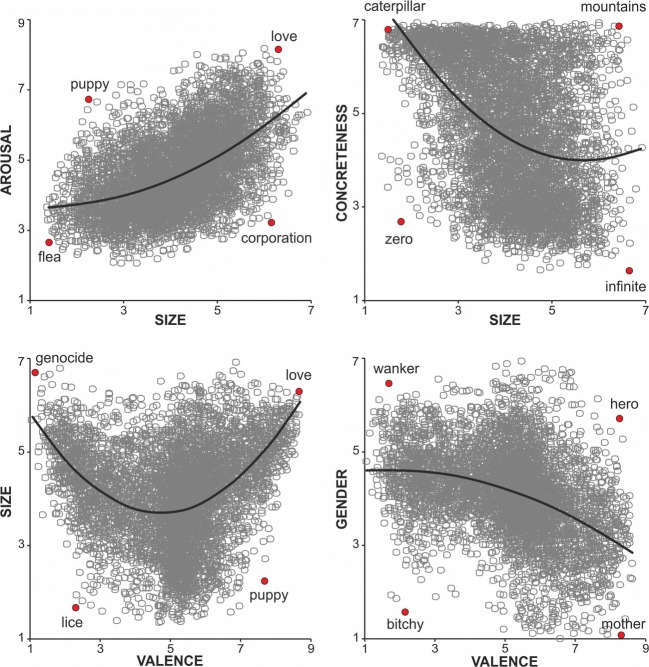
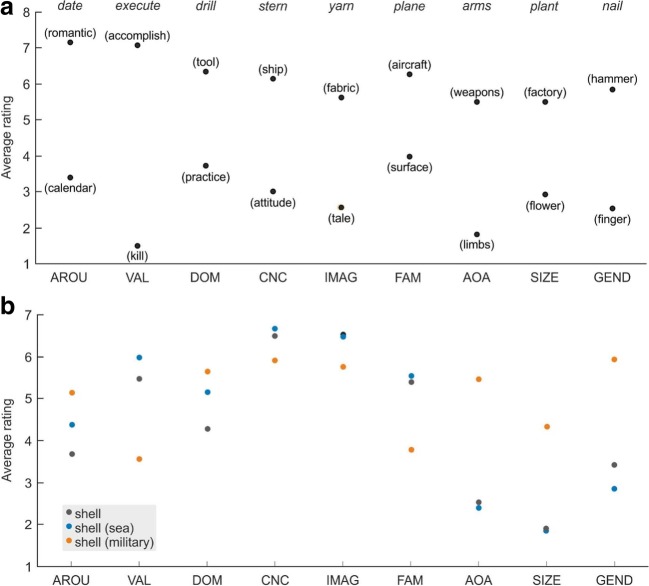
The Glasgow Norms are a set of normative ratings for 5,553 English words on nine psycholinguistic dimensions: arousal, valence, dominance, concreteness, imageability, familiarity, age of acquisition, semantic size, and gender association. The Glasgow Norms are unique in several respects. First, the corpus itself is relatively large, while simultaneously providing norms across a substantial number of lexical dimensions. Second, for any given subset of words, the same participants provided ratings across all nine dimensions (33 participants/word, on average). Third, two novel dimensions-semantic size and gender association-are included. Finally, the corpus contains a set of 379 ambiguous words that are presented either alone (e.g., toast) or with information that selects an alternative sense (e.g., toast (bread), toast (speech)). The relationships between the dimensions of the Glasgow Norms were initially investigated by assessing their correlations. In addition, a principal component analysis revealed four main factors, accounting for 82% of the variance (Visualization, Emotion, Salience, and Exposure). The validity of the Glasgow Norms was established via comparisons of our ratings to 18 different sets of current psycholinguistic norms. The dimension of size was tested with megastudy data, confirming findings from past studies that have explicitly examined this variable. Alternative senses of ambiguous words (i.e., disambiguated forms), when discordant on a given dimension, seemingly led to appropriately distinct ratings. Informal comparisons between the ratings of ambiguous words and of their alternative senses showed different patterns that likely depended on several factors (the number of senses, their relative strengths, and the rating scales themselves). Overall, the Glasgow Norms provide a valuable resource-in particular, for researchers investigating the role of word recognition in language comprehension.
Overview
The claims and statistics of this paper haven’t been checked yet.
Free: it reads the open-access text and checks the first 5 claims that cite a source we can check. Create a free account to check every claim.
Integrity signals
Registry
Cites
Statistics
Figures
Verification
Claims the paper makes
The claims and statistics of this paper haven’t been checked yet.
Free: it reads the open-access text and checks the first 5 claims that cite a source we can check. Create a free account to check every claim.
Claims other papers make about this one
Each is checked against this paper’s own text: does it say what the citing paper says it does?
The cited source says what the claim attributes to it.
In the citing paper
“Figure 3 shows the mean–SD relationships observed in the Likert judgements of words on three different semantic variables from the Glasgow Norms (Scott et al., 2019): Dominance, Familiarity, and Gender.”
From Rating norms should be calculated from cumulative link mixed effects models (2022) · cites this paper as Scott et al., 2019
Self-check
Percentages, sums and reported differences re-computed from the paper’s own numbers.
The self-check needs the paper’s full text.
Citations
Cites
Statistical Power Analysis for the Behavioral Sciences
Muller, K. (1989) · Technometrics · doi:10.1080/00401706.1989.10488618 · Cited by 99,167
Statistical power analysis for the behavioral sciences
(1990) · Computers, Environment and Urban Systems · doi:10.1016/0198-9715(90)90050-4 · Cited by 65,269
Russell, J. A. (1980) · Journal of Personality and Social Psychology · doi:10.1037/h0077714 · Cited by 16,334 · cited 1×
“In the psycholinguistic literature, emotion is generally represented within a two-dimensional framework (e.g., Osgood, Suci, & Tannenbaum, 1957; Russell, 1980), with greater emotionality associated with higher arousal and extreme valence.”
BackgroundThe application of electronic computers to factor analysis
Kaiser, H. F. (1960) · Educational and Psychological Measurement · doi:10.1177/001316446002000116 · Cited by 12,459 · cited 1×
“Factors with eigenvalues greater than 1 were included in the factor solution (Kaiser, 1960).”
BackgroundOsgood, C. E., Suci, G. J., & Tannenbaum, P. H. (1957) · Cited by 9,433
Harman, H. H. (1960) · Cited by 5,148
Concreteness, imagery, and meaningfulness values for 925 nouns.
Paivio, A., Yuille, J. C., & Madigan, S. A. (1968) · Journal of Experimental Psychology · doi:10.1037/h0025327 · Cited by 2,827
Balota, D. A., Yap, M. J., Hutchison, K. A., Cortese, M. J., Kessler, B., Loftis, B., Neely, J. H., Nelson, D. L., Simpson, G. B., & Treiman, R. (2007) · Behavior Research Methods · doi:10.3758/bf03193014 · Cited by 2,742
Merrifield, P. R., & Harman, H. (1969) · American Educational Research Journal · doi:10.2307/1161864 · Cited by 2,574
Norms of valence, arousal, and dominance for 13,915 English lemmas
Warriner, A. B., Kuperman, V., & Brysbaert, M. (2013) · Behavior Research Methods · doi:10.3758/s13428-012-0314-x · Cited by 1,959
Cited by
Items 101–200 of 269
Marco, M. D., Wright, L., & Makovac, E. (2025) · Neuropsychology Review · doi:10.1007/s11065-024-09657-z · Cited by 8
Winterbottom, T. M., Xiao, S. H., McLean, A., & Moubayed, N. A. (2022) · PeerJ Computer Science · doi:10.7717/peerj-cs.974 · Cited by 10
“, 1982), Chinese Word Norm Corpus (Yee, 2017), MEGAHR-Crossling (Ljubešić, Fišer & Peti-Stantić, 2018), Glasgow Norms (Scott et al., 2017; Reilly & Kean, 2007), and (Sianipar, Groenestijn & Dijkstra, 2016).”
Imageability-Based Multi-modal Analysis of Urban Environments for Architects and Artists
Pistola, T., Georgakopoulou, N., Shvets, A., Chatzistavros, K., Xefteris, V.-R., García, A. T., Koulalis, I., Diplaris, S., Wanner, L., Vrochidis, S., et al. (2022) · Lecture notes in computer science · doi:10.1007/978-3-031-13321-3_18 · Cited by 10
Experience-driven meaning affects lexical choices during language production
Vogt, A., Kaup, B., & Rahman, R. A. (2022) · Quarterly Journal of Experimental Psychology · doi:10.1177/17470218221125425 · Cited by 8
“The complete set of produced words was reduced to a set of 1,056 rated words implemented similarly to Díez-Álamo et al. (2018) and Scott et al. (2019).”
BackgroundTell as You Imagine: Sentence Imageability-Aware Image Captioning
Umemura, K., Kastner, M. A., Ide, I., Kawanishi, Y., Hirayama, T., Doman, K., Deguchi, D., & Murase, H. (2021) · Lecture notes in computer science · doi:10.1007/978-3-030-67835-7_6 · Cited by 7
“Existing dictionaries [6, 23, 24] used in Psycholinguistics are typically created through labor-intensive experiments, often resulting in rather small corpora.”
BackgroundMethodGreen, C., Kong, A. P., Brysbaert, M., & Keogh, K. (2025) · Behavior Research Methods · doi:10.3758/s13428-025-02843-8 · Cited by 10
“The AoE and Glasgow Norms correlate well with Kuperman and slightly better than the new print norms.”
Metaphor and gender: are words associated with source domains perceived in a gendered way?
Ahrens, K., Zeng, W. H., Burgers, C. F., & Huang, C. (2024) · Linguistics Vanguard · doi:10.1515/lingvan-2024-0021 · Cited by 8
Affective Norms for German as a Second Language (ANGL2)
Xu, Z., Liu, J., & Fan, L. (2024) · Behavior Research Methods · doi:10.3758/s13428-024-02539-5 · Cited by 7
“Velez-Uribe and Rosselli (2019), meanwhile, reported that the Spanish–English bilinguals gave more extreme ratings on emotional valence in L2 than in L1 from a word rating task of a set of 120 words.”
InfluentialModelling General Properties of Nouns by Selectively Averaging Contextualised Embeddings
Li, N., Bouraoui, Z., Camacho-Collados, J., Espinosa-Anke, L., Gu, Q., & Schockaert, S. (2021) · International Joint Conference on Artificial Intelligence · doi:10.24963/ijcai.2021/530 · Cited by 11
Rodríguez‐Cuadrado, S., Hinojosa, J. A., Guasch, M., Romero-Rivas, C., Sabater, L., Suárez‐Coalla, P., & Ferré, P. (2022) · Behavior Research Methods · doi:10.3758/s13428-022-02026-9 · Cited by 6
“All 1604 words were shared between our sample and Scott et al.’s (2019).”
BackgroundResultInfluentialInvestigating the Frequency Distortion of Word Embeddings and Its Impact on Bias Metrics
Valentini, F., Sosa, J., Slezak, D. F., & Altszyler, E. (2023) · Findings of the Association for Computational Linguistics: EMNLP (Findings of EMNLP) · doi:10.18653/v1/2023.findings-emnlp.9 · Cited by 9
“The Glasgow Norms (Scott et al., 2019) comprise a set of 5,553 English words rated by subjects who were asked to measure the degree to which each word is associated with male or female behavior on a scale from 1 (feminine) to 7 (masculine).”
BackgroundMethodInfluentialEmotion words in lexical decision and reading aloud
Mason, C., Hameau, S., & Nickels, L. (2025) · Language Cognition and Neuroscience · doi:10.1080/23273798.2024.2444582 · Cited by 8
“There were high correlations between our ratings for the word stimuli and existing arousal, valence and imageability norms (all > .80) (ima-geability: Bristol Norms, Stadthagen-Gonzalez & Davis, 2006; valence and arousal: Glasgow norms, Scott et al., 2019).”
Diveica, V., Pexman, P. M., & Binney, R. J. (2021) · PsyArXiv (OSF Preprints) · doi:10.31234/osf.io/6xnzg · Cited by 6
A semantotopic map in human hippocampusPreprint
Mickiewicz, E. A., Franch, M. C., Katlowitz, K. A., Chavez, A. G., Zhu, H., Chericoni, A., Yan, X., Belanger, J. L., Ismail, T., Paulo, D. L., et al. (2025) · bioRxiv (Cold Spring Harbor Laboratory) · doi:10.1101/2025.10.31.685959 · Cited by 6
“More medial sites also preferred more gendered words (Scott et al., 2019)”
Development of L1-L2 naming skills in a monolingual context: Evidence from children and adolescents
Iniesta, A., Rivera, M., Paolieri, D., & Bajo, M. T. (2024) · Cognitive Development · doi:10.1016/j.cogdev.2024.101492 · Cited by 5
van der Walle, H. A., Wu, W., Margulis, E. H., & Jakubowski, K. (2025) · Behavior Research Methods · doi:10.3758/s13428-025-02724-0 · Cited by 5
“Considering the number and range of validated sets of other stimulus types, such as words (e.g. De Deyne et al., 2019; Scott et al., 2019) and voices (e.g. Darcy & Fontaine, 2020; Lassalle et al., 2019) that are frequently employed in psychological research, music research is rather behind.”
Reward as a facet of word meaning: Ratings of motivation for 8,601 English words
Giurgea, D.-I., Pexman, P. M., & Binney, R. J. (2025) · Behavior Research Methods · doi:10.3758/s13428-025-02762-8 · Cited by 6
“A large majority of these words have also been rated on other semantic dimensions, including those comprising the Lancaster Sensorimotor Norms (Lynott et al., 2019) and word association norms (De Deyne et al., 2019), amongst others (Brysbaert et al., 2019; Scott et al., 2019).”
McElroy, T. (2024) · Journal of Behavioral Decision Making · doi:10.1002/bdm.2412 · Cited by 5
Sun, K., & Lu, X. (2021) · Frontiers in Psychology · doi:10.3389/fpsyg.2021.672243 · Cited by 5
Souter, N. E., Stampacchia, S., Hallam, G., Thompson, H. E., Smallwood, J., & Jefferies, E. (2022) · Journal of Neuropsychology · doi:10.1111/jnp.12272 · Cited by 5
“Sources for imageability ratings included the MRC Psycholinguistic Database (Coltheart, 1981), N-Watch (Davis, 2005), The Glasgow Norms (Scott et al., 2019), Bird et al. (2001a; 2001b), Cortese and Fugett (2004a; 2004b), and Davey et al. (2015).”
MethodSun, K., & Wang, R. (2022) · SAGE Open · doi:10.1177/21582440211069386 · Cited by 5
“An in-house experimental platform was used to collect the imageability data database (Scott et al., 2019).”
BackgroundMethodInfluentialOn the Interpretability and Significance of Bias Metrics in Texts: a PMI-based Approach
Valentini, F., Rosati, G., Blasí, D. E., Slezak, D. F., & Altszyler, E. (2023) · Proceedings of the conference - Association for Computational Linguistics. Meeting · doi:10.18653/v1/2023.acl-short.44 · Cited by 10
“Norms-gender (Lewis and Lupyan, 2020): textual gender bias is compared to the Glasgow Norms, a set of ratings for 5,500 English words which summarize the answers of participants who were asked to rate the gender association of each word (Scott et al., 2019).”
MethodPiloting a novel web-based paradigm to measure disambiguation skill in adultsPreprint
Blott, L. M., Gowenlock, A., Nation, K., & Rodd, J. M. (2022) · PsyArXiv (OSF Preprints) · doi:10.31234/osf.io/ufnzd · Cited by 5
Janjić, P., Spencer, J. P., & Coventry, K. R. (2025) · Cognition · doi:10.1016/j.cognition.2025.106381 · Cited by 4
Gaze‐speech coordination during social interaction in Parkinson's disease
Hodgson, T. L., Hermens, F., & Ezard, G. (2023) · International Journal of Language & Communication Disorders · doi:10.1111/1460-6984.12960 · Cited by 5
Kilpatrick, A., & Bundgaard-Nielsen, R. L. (2025) · PLoS ONE · doi:10.1371/journal.pone.0321294 · Cited by 5
“The Glasgow Norms [72] model confirmed these trends, with surprisal positively ( β = 6.624, p .001) and iconicity negatively correlated with age of acquisition ( β = -6.892, p .001).”
InfluentialKalimah norms: Ratings for 2,467 modern standard Arabic words on two scales
Alzahrani, A. A., Aljuaythin, W., Alshumrani, H. A., Saleh, A. M., & Mostafa, M. M. (2025) · Behavior Research Methods · doi:10.3758/s13428-025-02692-5 · Cited by 5
“…typically collect 30 independent ratings per word to ensure statistical reliability (e.g., Brysbaert et al., 2014a, 2014b; Gilhooly & Logie, 1980; Scott et al., 2019; Warriner et al., 2013), although some studies have reported obtaining less than 20 ratings per word (e.g., Kuperman et al., 2012).”
InfluentialThe effects of symbol format and symbol placement on identification accuracy and activation time
Brock, K. L., Jenkins, H., & Dukhovny, E. (2025) · Augmentative and Alternative Communication · doi:10.1080/07434618.2025.2495901 · Cited by 4
“…mean word frequency was 121.55 (range = 8.47 − 320.41) (Van heuven et al., 2014), while the mean imageability rating was 5.23 (range = 3.96 − 8) (scott et al., 2019). paired samples t-tests confirmed no significant ( p value range = .13 to 1.00) differences with respect to age of acquisition,…”
InfluentialNorming studies of European Portuguese words: A literature review
Félix, S. B., & Pandeirada, J. N. S. (2021) · Análise Psicológica · doi:10.14417/ap.1823 · Cited by 6
“Some examples of that are: goodness, meaningfulness (Rubin & Friendly, 1986), pleasantness (Clark & Paivio, 2004), gender association / ladenness (Scott et al., 2019), number of senses / meanings (Miller, 1995), sensory experience (Juhasz & Yap, 2013), and body-object interaction (Pexman et al.,…”
BackgroundBad news or good news when recognizing emotional valence using phonemic content
Slavova, V., & Andonov, F. (2022) · International Symposium INFOTEH-JAHORINA (INFOTEH) · doi:10.1109/infoteh53737.2022.9751339 · Cited by 4
Li, R., Chen, S., & Kiran, S. (2024) · Journal of Speech Language and Hearing Research · doi:10.1044/2024_jslhr-23-00705 · Cited by 4
Brand, J., Preininger, M., Kříž, A., & Ceháková, M. (2025) · Language and Cognition · doi:10.1017/langcog.2025.3 · Cited by 5
“Such experiments aim to provide normative estimates of how feminine, neutral, or masculine a word is, simply by asking participants to rate those words using a Likert scale (e.g. Scott et al., 2019).”
InfluentialBrainerd, C. J., Bialer, D. M., & Chang, M. (2020) · Journal of Memory and Language · doi:10.1016/j.jml.2020.104143 · Cited by 4
Bestgen, Y. (2021) · International Workshop on Semantic Evaluation (SemEval) · doi:10.18653/v1/2021.semeval-1.71 · Cited by 4
Jebahi, F., Nickels, K. V., & Kielar, A. (2024) · Journal of Communication Disorders · doi:10.1016/j.jcomdis.2024.106405 · Cited by 4
Stereotypically thinking: Norms for stereotypical gender nouns in Polish and English
Jankowiak, K., Naranowicz, M., Skałba, A., Drążkowski, D., & Pawelczyk, J. (2024) · PLoS ONE · doi:10.1371/journal.pone.0312405 · Cited by 5
Brysbaert, M., Reviriego, P., & Martinez, G. (2024) · PsyArXiv (OSF Preprints) · doi:10.31234/osf.io/w94x3 · Cited by 4
Noun imageability and the processing of sensory-based information
Gerwien, J., Filip, M., & Šmolík, F. (2023) · Quarterly Journal of Experimental Psychology · doi:10.1177/17470218231216304 · Cited by 3
“…should be noted that imageability ratings are normally elicited as sensory ratings, rather than visual, and that words that score highest in imageability usually have a multimodal nature (visual, tactile, olfactory, . . . ; Connell & Lynott, 2012), for example, names of foods (Scott et al., 2019).”
BackgroundParafoveal preview benefits magnified
Yao, B., Hand, C. J., Miellet, S., & Sereno, S. C. (2025) · Cognition · doi:10.1016/j.cognition.2025.106149 · Cited by 3
Self-citationMultilingual prediction of semantic norms with language models: a study on English and Chinese
Peng, B., Hsu, Y.-Y., Chersoni, E., Le, Q., & Huang, C. (2025) · Language Resources and Evaluation · doi:10.1007/s10579-025-09866-9 · Cited by 3
“The Binder-zh 2.0 norms dataset comprises 535 Chinese words translated from the original English words, including 242 words from the Knowledge Representation in Neural Systems project (Glasgow et al., 2016 ) (141 nouns, 62 verbs, and 39 adjec - tives) and 293 additional abstract nouns.”
InfluentialSound symbolism highlights relative distinctiveness: Evidence from English vocabulary
Lev‐Ari, S. (2025) · Cognition · doi:10.1016/j.cognition.2025.106360 · Cited by 3
The word “bed” looks like a bed: Orthographic iconicity in English
Sidhu, D. M. (2026) · Cognition · doi:10.1016/j.cognition.2026.106550 · Cited by 3
Does visualisation help or hinder concrete word processing?
Malhi, S. K., Kost, C., & Buchanan, L. (2020) · Quarterly Journal of Experimental Psychology · doi:10.1177/1747021820956462 · Cited by 3
“96, and familiarity (Scott et al., 2018), F(1, 123) = 2.”
BackgroundInfluentialMemory effects of semantic attributes: A method of controlling attribute contamination
Brainerd, C. J., Bialer, D. M., & Chang, M. (2022) · Behavior Research Methods · doi:10.3758/s13428-022-01945-x · Cited by 3
“Considering that the words in our main data base were a subset of larger pools of words in Toglia–Battig, Glasgow, and ANEW norms, it is reasonable to ask whether they are broadly representative of the words in those norms.”
BackgroundMethodInfluentialThe role of pointing gestures and eye gaze in second language vocabulary learning
Janjić, P., Arikan, G., Gudde, H. B., Murphy, J. J. C., Sivaram, L., & Coventry, K. R. (2024) · Discourse Processes · doi:10.1080/0163853x.2024.2343625 · Cited by 3
“…based on psycholinguistic properties of the 108 remaining words, matching them based on frequency, age of acquisition, familiarity, imageability, and concreteness taken from available norms (SUBTLEX-UK; van Heuven et al., 2014) for frequency and The Glasgow Norms (Scott et al., 2019) (Table 1).”
A generative approach to extrapolate word concreteness ratings
Wang, T., & Xu, X. (2025) · Quarterly Journal of Experimental Psychology · doi:10.1177/17470218251320641 · Cited by 3
Individual differences in mental imagery do not moderate the animacy advantage in memory
Serra, M. J., Keiner, J. N., Villalobos, N. C., Kortenhoeven, A., & Scolari, M. (2025) · Journal of Memory and Language · doi:10.1016/j.jml.2025.104638 · Cited by 3
Unveiling Affective Polarization Trends in Parliamentary Proceedings
Goldin, G., Rabinovich, E., & Wintner, S. (2025) · Computational Linguistics · doi:10.1162/coli.a.600 · Cited by 1
“…languages, mainly based on the eight prototypical emotions defined by Plutchik (1980): joy, sadness, anger, fear, disgust, trust, anticipation and surprise (Mohammad and Turney 2010; Mohammad and Yang 2011; Warriner, Kuperman, and Brysbaert 2013; Mohammad and Turney 2013; Scott et al. 2019).”
Archer, L. C., Standley, C. J., & Molnár, P. K. (2022) · BioScience · doi:10.1093/biosci/biac017 · Cited by 3
An explorer’s journal for machines: Exploring the case of Cyberpunk 2077
Gómez-Maureira, M. A., Kniestedt, I., Barbero, G., Yu, H., & Preuß, M. (2022) · Journal of Gaming & Virtual Worlds · doi:10.1386/jgvw_00054_1 · Cited by 4
Larrañaga, D., & Sereno, A. B. (2023) · Quarterly Journal of Experimental Psychology · doi:10.1177/17470218231186582 · Cited by 3
“Scott et al. (2019) expanded on this by including size and seven principal component scores (derived from 10 different covariate dimensions) simultaneously in one regression model.”
BackgroundMethodResultInfluentialMeaning creation in novel noun-noun compounds: humans and language models
Chen, P., Poeppel, D., & Zuanazzi, A. (2023) · Language Cognition and Neuroscience · doi:10.1080/23273798.2023.2254865 · Cited by 5
“All words are included in three corpora containing word features that we subsequently used in our analyses: the Glasgow Norms (Scott et al., 2019); the University of South Florida Free Association Norms (Nelson et al., 2004); and a corpus that we created where each word was assigned an agentivity…”
BackgroundMethodInfluentialMultidimensional and Multilingual Emotional Analysis
Aparicio, S., Aparício, J. T., & Aparício, M. (2024) · Lecture notes in networks and systems · doi:10.1007/978-3-031-45651-0_2 · Cited by 2
A conceptual replication of an implicit test of grammatical gender effects on inanimate concepts
Mahajan, D., & Durgin, F. H. (2025) · Language and Cognition · doi:10.1017/langcog.2024.76 · Cited by 2
“In contrast to these observations from personification, published norms for explicit measures of perceived semantic gender of nouns in English (Scott et al., 2019) and in Dutch (Vankrunkelsven et al., 2024) do not show such differences.”
Juhasz, B. J., Devanny, G., Frankenberg, A., Galdenzi, A., Hirwa, L. C., Nawabutsitthirat, W., & Shao, M. (2025) · Behavior Research Methods · doi:10.3758/s13428-025-02765-5 · Cited by 2
“In other studies, participants are asked to rate words more broadly on how familiar they seem overall (Gerns-bacher, 1984; Juhasz et al., 2015; Scott et al., 2019).”
InfluentialHow Do They Feel? Processing Others’ Emotions in Second Language Discourse
Aldariz, A. G., Moreno, E. M., & Foucart, A. (2025) · Language Learning · doi:10.1111/lang.70016 · Cited by 2
“Target words are indicated in bold. against English affective norms databases: the original ANEW (Bradley & Lang, 1999), the Glasgow Norms (Scott et al., 2019), and Warriner (2013).”
Predictors of Spelling and Reading Performance in Logopenic Variant Primary Progressive Aphasia
Nickels, K. V., & Kielar, A. (2025) · Journal of Speech Language and Hearing Research · doi:10.1044/2025_jslhr-25-00250 · Cited by 2
Preininger, M., Brand, J., Kříž, A., & Ceháková, M. (2025) · Behavior Research Methods · doi:10.3758/s13428-025-02907-9 · Cited by 2
“However, with the renewed attention to collecting mega-study datasets, there are now conceptual/semantic gender ratings available for 5,500 (Scott et al., 2019) and 2,373 (Lewis et al., 2022) English words, as well as 24,000 Dutch words (Vankrunkelsven et al., 2024).”
InfluentialReinders, A., Svaldi, C., Kingma, A., Grønbæk, J. K., Thomsen, D. B., Persson, K., Mathiasen, R., Dahl, C., Carai, A., Andreozzi, B., et al. (2026) · The Cerebellum · doi:10.1007/s12311-026-01987-3 · Cited by 3
“For example, semantic representations may be easier to retrieve depending on how easily a concept evokes a mental image (imageability) [41] or how concrete/ abstract it is [42], so patients with semantic disorders may be biased to use the words which are highly imageable and concrete (e.g. [13,…”
On the Geometry of Concreteness
Wartena, C. (2022) · Workshop on Representation Learning for NLP (RepL4NLP) · doi:10.18653/v1/2022.repl4nlp-1.21 · Cited by 5
“These are, as far as we know, (Gilhooly and Logie, 1980) for English, (Hager, 1994) for German, and more recently (Ðurd̄ević et al., 2017) for Serbian and both (Reijnierse et al., 2019) and (Scott et al., 2019) for English words.”
BackgroundLukic, S., Krauska, A. B., Yoshida, M., & Thompson, C. K. (2023) · Frontiers in Human Neuroscience · doi:10.3389/fnhum.2023.1028378 · Cited by 2
How Deeply are Emotions Encoded in Language Communication and is This Detectable in Text
Slavova, V., & Andonov, F. (2021) · Information Theories and Applications · doi:10.54521/ijita28-03-p04 · Cited by 3
“The word-based estimations, using Glasgow Norms and NVAD, gave much less clear groupings and correlations with the emotional tone announced in the headlines.”
BackgroundMethodInfluentialEffects of emotional ambiguity and emotional intensity on true and false memory
Chang, M., & Brainerd, C. J. (2024) · Memory & Cognition · doi:10.3758/s13421-024-01559-y · Cited by 3
“Many large-scale studies have collected normed values of valence and arousal for various stimuli, with words being the most prevalent (e.g., Bradley & Lang, 1999; Moors et al., 2013; Scott et al., 2019; Warriner et al., 2013).”
Bąk, H., & Altarriba, J. (2024) · Cognition & Emotion · doi:10.1080/02699931.2024.2406347 · Cited by 6
“Two (Grühn, 2016; Scott et al., 2019) contained both concreteness and imageability measures; two (Brysbaert et al., 2014, Eilola & Havelka, 2010) only the concreteness measures; and three (Bellezza et al., 1986; Citron et al., 2014; Janschewitz, 2008) only the imageability measures.”
Loria, R. N., Pugel, J., Goldberg, M. H., Halla, D. A., Bascom, R., Scott, T., Crowley, D. M., & Long, E. C. (2025) · Communications Earth & Environment · doi:10.1038/s43247-025-02055-0 · Cited by 2
“Themoderateemotionconditionincludedwordstypicallyratedasnega-tivelyvalencedbutdidnotattempttoincreasearousal 46 .”
The negativity bias is encoded in language
Kilpatrick, A. (2025) · JASA Express Letters · doi:10.1121/10.0035924 · Cited by 2
The role of compatibility in long-term action-effect binding and effect memory
Schreiner, M. R., Mocke, V., & Kunde, W. (2025) · Memory & Cognition · doi:10.3758/s13421-025-01741-w · Cited by 2
“Words were 120 English nouns taken from the Glasgow Norms (Scott et al., 2019).”
Bodo Winter, Sensory linguistics: Language, perception and metaphor
Rong, W., & Sun, K. (2020) · Folia Linguistica · doi:10.1515/flin-2020-2036 · Cited by 2
Statistical Analysis of Multisensory and Text-Derived Representations on Concept Learning
Wang, Y., & Zeng, Y. (2022) · Frontiers in Computational Neuroscience · doi:10.3389/fncom.2022.861265 · Cited by 3
“…ratings for 5,553 concepts on nine psycholinguistic dimensions: arousal, valence, dominance, concreteness, imageability, familiarity, age of acquisition, semantic size, and gender association, and they are the most comprehensive psycholinguistic materials ever created (Scott et al., 2019).”
BackgroundBogunović, I., Ćoso, B., Guasch, M., Vilus, E. P., Ferré, P., & Hinojosa, J. A. (2024) · International Journal of Bilingualism · doi:10.1177/13670069241280355 · Cited by 1
“Finally, familiarity ratings for English loan-words were compared with the ratings from Scott et al. (2019).”
Counterfactual imaginative culture as evidence hallucination in support of anxiety reduction
Carney, J. (2025) · New Ideas in Psychology · doi:10.1016/j.newideapsych.2025.101179 · Cited by 1
Compton, D. L., Rueckl, J. G., Steacy, L. M., Siegelman, N., Edwards, A., Petscher, Y., Terry, N. P., Borkenhagen, M. J. C., & Starke, C. (2026) · Behavior Research Methods · doi:10.3758/s13428-026-03222-7 · Cited by 1
Learning novel complex words in a second language: Effects of morpheme training and family size
Li, J., Behzadnia, A., & Beyersmann, E. (2025) · Studies in Second Language Acquisition · doi:10.1017/s0272263125101393 · Cited by 1
“(2014)andtheGlasgowNorms(Scottetal., 2019).”
Elsherif, M. M., Kirkden, R. D., & Catling, J. C. (2026) · Attention Perception & Psychophysics · doi:10.3758/s13414-026-03267-y · Cited by 1
“Furthermore, we intentionally avoided using existing large-scale databases for these variables, as many such datasets consist primarily of monomorphemic words or merge monomorphemic and compound ratings (e.g., Scott et al., 2019).”
Yang, X., Tilwani, D., O’Reilly, C., & Shinkareva, S. V. (2026) · IEEE Transactions on Affective Computing · doi:10.1109/taffc.2026.3696891 · Cited by 3
Language-Dependent Expression of Anxiety and Depression Symptoms in Japanese-English Bilinguals
Williams, A. I., Rochanavibhata, S., & Marian, V. (2026) · Clinical Psychological Science · doi:10.1177/21677026251385547 · Cited by 2
“…English loanwords (e.g., ドア , pronounced do-ah for door) was replaced with Japanese items of similar frequency (NINJAL-LWP, National Institute for Japanese Language and Linguistics, 2021; SUBTLEXUS, Brysbaert & New, 2009), concreteness (Scott et al., 2019), and phonetic length (e.g., 門 , or gate).”
Browsing Visual Sentiment Datasets Using Psycholinguistic Groundings
Kastner, M. A., Ide, I., Kawanishi, Y., Hirayama, T., Deguchi, D., & Murase, H. (2019) · Lecture notes in computer science · doi:10.1007/978-3-030-37734-2_56 · Cited by 1
Comprensión de oraciones de esfuerzo en jóvenes y adultos mayores desde una perspectiva corpórea
Salas-Herrera, J. L., Urrutia, M., Araneda, R. M., & Véliz, M. (2021) · Universitas Psychologica · doi:10.11144/javeriana.upsy19.coej · Cited by 1
Exploration of the Usage of Color Terms by Color-blind Participants in Online Discussion Platforms
Rabinovich, E., & Carmeli, B. (2022) · Conference on Empirical Methods in Natural Language Processing (EMNLP) · doi:10.18653/v1/2022.emnlp-main.447 · Cited by 1
A Dataset of 108 Novel Noun-Noun Compound Words with Active and Passive Interpretation
Chen, P., Poeppel, D., & Zuanazzi, A. (2023) · Journal of Open Psychology Data · doi:10.5334/jopd.93 · Cited by 2
“Novel NNCs were built as follows: (1) From the Glasgow Norms (Scott et al., 2019) and the University of South Florida Free Association Norms (Nelson et al., 2004) corpora, we selected nouns with similar bigram frequencies, word frequency, and number of syllables (2 to 3, 45 words); (2) we computed the likelihood of a…”
MethodInfluentialUsing artificial intelligence to explore sound symbolic expressions of gender in American English
Kilpatrick, A., & Ćwiek, A. (2024) · PeerJ Computer Science · doi:10.7717/peerj-cs.1811 · Cited by 1
“The data for the nouns, verbs, adjectives, and adverbs were taken from the Glasgow norms ( Scott et al., 2019 ), a list of 5,553 English words which have been assigned Likert scale scores according to different psycholinguistic domains.”
MethodBarua, N. U., Mumtaz, H., Mariotti, S., Cree, M., Mikhalkova, A., Fellows, G., & Piasecki, A. E. (2024) · Acta Neurochirurgica · doi:10.1007/s00701-024-06358-7 · Cited by 1
“This list was then filtered using norming data from native British participants [12].”
MULTIMAP: Multilingual picture naming test for mapping eloquent areas during awake surgeriesPreprint
Gisbert‐Muñoz, S., Quiñones, I., Amoruso, L., Timofeeva, P., Geng, S., Boudelaa, S., Pomposo, I., Gil-Robles, S., & Carreiras, M. (2020) · bioRxiv (Cold Spring Harbor Laboratory) · doi:10.1101/2020.02.20.957282 · Cited by 1
Mnemicity vs. Temporality: Distinguishing between components of episodic representationsPreprint
Mahr, J. B., & Schacter, D. L. (2021) · PsyArXiv (OSF Preprints) · doi:10.31234/osf.io/xawp8 · Cited by 1
Shatek, S. M., & Carlson, T. A. (2024) · PsyArXiv (OSF Preprints) · doi:10.31234/osf.io/rbjmx · Cited by 1
Compatible Effects Enhance Short-Term Action-Effect BindingPreprint
Mocke, V., Kunde, W., & Schreiner, M. R. (2025) · OSF Preprints (OSF Preprints) · doi:10.31219/osf.io/2g36z_v2 · Cited by 1
Can GPT replace human raters? Validity and reliability of machine-generated norms for metaphorsPreprint
Mangiaterra, V., Al-Azary, H., Pietro, C. B. D. S., Canal, P., & Bambini, V. (2025) · arXiv (Cornell University) · doi:10.48550/arxiv.2512.12444 · Cited by 4
“Consequently, many normed datasets of words along a variety of dimensions were created (Stadthagen-Gonzalez and Davis 2006; Brysbaert et al. 2014; Scott et al. 2019; Lynott et al. 2020), allowing the scientific community to rely on pre-collected norms, with benefits from the perspective of…”
Clark, T. H., Arriaga, C., Conde, J., Martínez, G., & Reviriego, P. (2026) · arXiv (Cornell University) · doi:10.48550/arxiv.2603.12105 · Cited by 1
“In contrast to past work Conde et al. [2025a], Trott [2024], which has considered word-level features such as the Glasgow word norms Scott et al. [2019] or the Lancaster sensorimotor word norms Lynott et al. [2020], the domains of sentence memorability and reading times pose a distinct challenge…”
Machine individuality: Separating genuine idiosyncrasy from response bias in large language modelsPreprint
Kriegmair, V., & Wulff, D. U. (2026) · arXiv (Cornell University) · doi:10.48550/arxiv.2604.16755 · Cited by 1
“Gender Association and Arousal show the strongest variation (34.0% and 22.6%), while Gustatory ratings show the least (9.7%); Morality is distinguished by substantial Bias; and Valence, Socialness, Concreteness, and Age of Acquisition are dominated by shared Trait variance, reflecting strong cross-model consensus.”
InfluentialNonlinearity of Concreteness and Semantic Depth: The Logistic CurvePreprint
Roy, B. (2020) · PsyArXiv (OSF Preprints) · doi:10.31234/osf.io/2xzju
Are emotional memories harder to intentionally forget? A meta-analysis
Hall, K. (2020) · Memorial University Research Repository (Memorial University) · doi:10.48336/1rv3-yf47
Gender bias in morphological inferences
FINLEY, S. C., Charania, S. A., Lewis, T., Millward, B., & Wang, S. Q. (2021) · Language and Cognition · doi:10.1017/langcog.2021.21 · Cited by 1
(2022) · Linköping electronic conference proceedings · doi:10.3384/ecp190 · Cited by 1
Affective norms for 1,558 Chinese words rated by children
Li, Y., Xu, Y., & Liu, P. (2022) · International Conference on Education, Knowledge and Information Management (ICEKIM) · doi:10.1109/icekim55072.2022.00100
What effect does short term Study Abroad (SA) have on learners’ vocabulary knowledge?
Caton, T. (2023) · Cronfa (Swansea University) · doi:10.23889/suthesis.64893
Hachez, S. (2023) · Carleton University's Institutional Repository (MacOdrum Library, Carleton University) · doi:10.22215/etd/2023-15729
Metadata
- Authors
- Scott, G. G., Keitel, A., Becirspahic, M., Yao, B., & Sereno, S. C.
- Affiliations
- University of the West of Scotland (GB)
- University of Glasgow (GB)
- University of Manchester (GB)
- Corresponding author
- Sereno, Sara C.
- Venue
- Behavior Research Methods
- Published
- 2018-09-11
- Volume
- 51
- Issue
- 3
- Pages
- 1258-1270
- ISSN
- 1554-351X (ISSN-L)
- 1554-3528
- PMC
- PMC6538586
- OpenAlex
- W2889870962
- Cited by
- 237
- References
- 69
- Citations by year
- 2026: 25 · 2025: 39 · 2024: 43 · 2023: 30 · 2022: 47 · 2021: 28 · 2020: 18 · 2019: 5 · 2018: 1
- FWCI
- 7.74
- Type
- journal article
- Language
- en
- Open access
- hybrid
- doi.org
- Licence
- cc-by
- creativecommons.org/licenses/by/4.0 (tdm)
- Locations
- Behavior Research Methods (publishedVersion, cc-by)
- PubMed Central (publishedVersion, cc-by)
- PubMed (publishedVersion)
- Discovery Research Portal (University of Dundee) (publishedVersion, cc-by)
- The UWS Academic Portal (University of the West of Scotland) (publishedVersion, cc-by-nc-nd)
- Research Explorer (The University of Manchester) (publishedVersion, other-oa)
- ENLIGHTEN (Jurnal Bimbingan dan Konseling Islam) (acceptedVersion, cc-by-sa)
- Lancaster EPrints (Lancaster University) (submittedVersion)
- Funders
- Economic and Social Research Council (RES-062-23-1900)
- Carnegie Trust for the Universities of Scotland (50084)
- Topics
- Life Sciences › Neuroscience › Cognitive Neuroscience › Neurobiology of Language and Bilingualism
- Social Sciences › Psychology › Developmental and Educational Psychology › Reading and Literacy Development
- Social Sciences › Psychology › Experimental and Cognitive Psychology › Categorization, perception, and language
- Keywords
- word ratings, arousal, valence, dominance, concreteness, imageability, familiarity, age of acquisition, gender associations, ambiguous words, word sense disambiguation, word recognition, language comprehension
- MeSH terms
- Adolescent, Adult, Arousal, Emotions, Female, Humans, Male, Psycholinguistics, Semantics, Speech, Recognition, Psychology, Young Adult
About these checks
Registry, retraction, Cites and statistics results are computed, not judged, with one exception: a printed reference that no index lists is read once by a model before it counts as a citation error. Claims are extracted by a model and kept only when their quote appears verbatim in the text; each cited source is then checked, with a model’s help, for whether it says what the claim relies on. Those verdicts can be wrong — read the claim’s quote and the cited source before relying on one.
Statistics and arithmetic are recomputed, not judged.
Confidence bands are shown only for fields calibrated on our annotated test set. None is calibrated yet, so no band is shown.
What counts as a claim ›How we measure confidence ›How we check this ›
Are you an author, or do you see a problem with this page? Request a review
Data sources
Bibliographic data: Semantic Scholar, OpenAlex, Crossref.
Contains information from the Semantic Scholar Academic Graph Datasets, made available under the ODC Attribution License (ODC-BY 1.0).
Semantic Scholar’s data is described in: Kinney, R., et al. (2023). The Semantic Scholar Open Data Platform. arXiv:2301.10140.
