

The DOI matches its Crossref record; 7 of the 7 references it cites were found in a registry or an index.
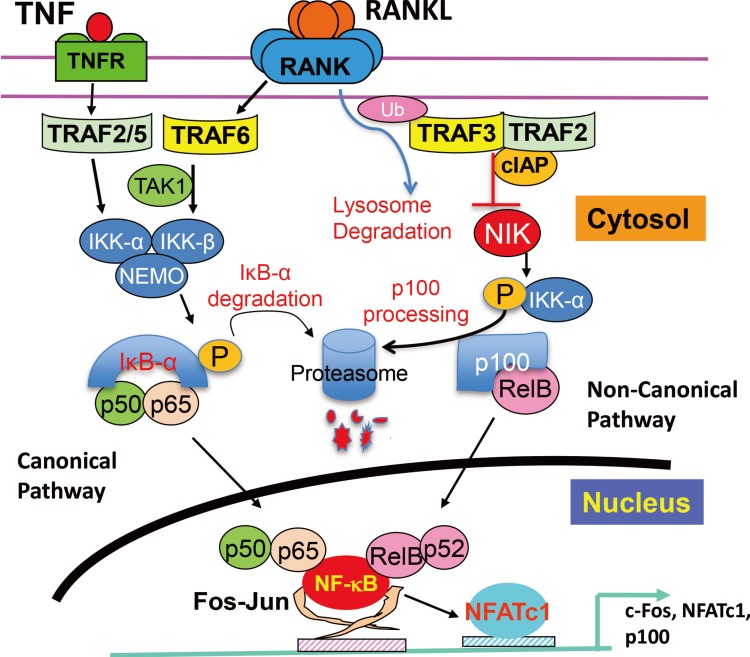
NF-κB-Mediated Regulation of Osteoclastogenesis
Overview
The claims and statistics of this paper haven’t been checked yet.
Run the check — free, no account needed. It reads the open-access text and checks the sources it cites.
Integrity signals
Registry
Cites
Statistics
Figures
Verification
Claims the paper makes
The claims and statistics of this paper haven’t been checked yet.
Run the check — free, no account needed. It reads the open-access text and checks the sources it cites.
Claims other papers make about this one
Each is checked against this paper’s own text: does it say what the citing paper says it does?
In the citing paper
“In addition to the MAPK pathways, the NF-κB signaling pathway, a critical participant in inflammatory and immune responses, plays a central role downstream of RANKL in osteoclastogenesis [33,34].”
From Anti-Osteoporotic Potential of Water Extract of Anethum graveolens L. Seeds (2023) · cites this paper as [33]
Self-check
Percentages, sums and reported differences re-computed from the paper’s own numbers.
The self-check needs the paper’s full text.
Citations
Cites
Takayanagi, H., Kim, S., Koga, T., Nishina, H., Isshiki, M., Yoshida, H., Saiura, A., Isobe, M., Yokochi, T., Inoue, J.-I., et al. (2002) · Developmental Cell · doi:10.1016/s1534-5807(02)00369-6 · Cited by 2,701
Yoshida, H., Hayashi, S.-I., Kunisada, T., Ogawa, M., Nishikawa, S., Okamura, H., Sudo, T., Shultz, L. D., & Nishikawa, S.-I. (1990) · Nature · doi:10.1038/345442a0 · Cited by 1,789
Li, J., Sarosi, I., Yan, X.-Q., Morony, S., Capparelli, C., Tan, H.-L., McCabe, S., Elliott, R., Scully, S., Van, G., et al. (2000) · Proceedings of the National Academy of Sciences · doi:10.1073/pnas.97.4.1566 · Cited by 1,119
Self-citationAutoamplification of NFATc1 expression determines its essential role in bone homeostasis
Asagiri, M., Sato, K., Usami, T., Ochi, S., Nishina, H., Yoshida, H., Morita, I., Wagner, E. F., Mak, T. W., Serfling, E., et al. (2005) · The Journal of Experimental Medicine · doi:10.1084/jem.20051150 · Cited by 849
Peli1 promotes microglia-mediated CNS inflammation by regulating Traf3 degradation
Xiao, Y., Jin, J., Chang, M., Chang, J.-H., Hu, H., Zhou, X., Brittain, G. C., Stansberg, C., Torkildsen, Ø., Wang, X., et al. (2013) · Nature Medicine · doi:10.1038/nm.3111 · Cited by 184
Zhao, B., Grimes, S. N., Li, S., Hu, X., & Ivashkiv, L. B. (2012) · Journal of Experimental Medicine · doi:10.1084/jem.20111566 · Cited by 182
Chloroquine reduces osteoclastogenesis in murine osteoporosis by preventing TRAF3 degradation
Xiu, Y., Xu, H., Zhao, C., Li, J., Morita, Y., Yao, Z., Xing, L., & Boyce, B. F. (2014) · Journal of Clinical Investigation · doi:10.1172/jci66947 · Cited by 164
Self-citation
Research works printed but not linked: 57
- Boyce, 2013, J Bone Miner Res, 28, 711, 10.1002/jbmr.1885 · DOI
- Karin, 2005, Nat Rev Immunol, 5, 749, 10.1038/nri1703 · DOI
- Courtois, 2006, Oncogene, 25, 6831, 10.1038/sj.onc.1209939 · DOI
- Vallabhapurapu, 2009, Annu Rev Immunol, 27, 693, 10.1146/annurev.immunol.021908.132641 · DOI
- Boyce, 2007, Arthritis Res Ther, 9, S1, 10.1186/ar2165 · DOI
- Novack, 2003, J Exp Med, 198, 771, 10.1084/jem.20030116 · DOI
- Hayden, 2008, Cell, 132, 344, 10.1016/j.cell.2008.01.020 · DOI · Paper page
- Dobrzanski, 1995, Oncogene, 10, 1003
- Liou, 1992, EMBO J, 11, 3003, 10.1002/j.1460-2075.1992.tb05370.x · DOI
- Palombella, 1994, Cell, 78, 773, 10.1016/S0092-8674(94)90482-0 · DOI
- Madge, 2011, Cell Cycle, 10, 6, 10.4161/cc.10.1.14291 · DOI
- Shibata, 2007, J Immunol, 179, 2681, 10.4049/jimmunol.179.5.2681 · DOI
- Basak, 2012, Immunol Rev, 246, 221, 10.1111/j.1600-065X.2011.01092.x · DOI
- Yao, 2009, J Clin Invest, 119, 3024, 10.1172/JCI38716 · DOI
- Zarnegar, 2008, Nat Immunol, 9, 1371, 10.1038/ni.1676 · DOI
- Bonizzi, 2004, Trends Immunol, 25, 280, 10.1016/j.it.2004.03.008 · DOI · Paper page
- Senftleben, 2001, Science, 293, 1495, 10.1126/science.1062677 · DOI
- Fusco, 2008, J Biol Chem, 283, 12324, 10.1074/jbc.M707898200 · DOI
- Chang, 2009, Nat Med, 15, 682, 10.1038/nm.1954 · DOI
- Yao, 2014, J Bone Miner Res, 29, 866, 10.1002/jbmr.2108 · DOI
- Xing, 2013, Bone Res, 4, 336, 10.4248/BR201304004 · DOI
- Beg, 1995, Nature, 376, 167, 10.1038/376167a0 · DOI
- Franzoso, 1997, Genes Dev, 11, 3482, 10.1101/gad.11.24.3482 · DOI · Paper page
- Iotsova, 1997, Nat Med, 3, 1285, 10.1038/nm1197-1285 · DOI
- Lacey, 1998, Cell, 93, 165, 10.1016/S0092-8674(00)81569-X · DOI · Paper page
- Yasuda, 1998, Proc Natl Acad Sci U S A, 95, 3597, 10.1073/pnas.95.7.3597 · DOI
- Xing, 2002, J Bone Miner Res, 17, 1200, 10.1359/jbmr.2002.17.7.1200 · DOI · Paper page
- Xing, 2003, J Bone Miner Res, 18, 260, 10.1359/jbmr.2003.18.2.260 · DOI
- Fuller, 1993, J Exp Med, 178, 1733, 10.1084/jem.178.5.1733 · DOI
- Tanaka, 1993, J Clin Invest, 91, 257, 10.1172/JCI116179 · DOI
- Park-Min, 2013, J Bone Miner Res, 28, 135, 10.1002/jbmr.1739 · DOI
- Vaira, 2008, J Clin Invest, 118, 2088
- Vaira, 2008, Proc Natl Acad Sci U S A, 105, 3897, 10.1073/pnas.0708576105 · DOI
- Novack, 2011, Adv Exp Med Biol, 691, 163, 10.1007/978-1-4419-6612-4_17 · DOI
- Zhao, 2011, Arthritis Res Ther, 13, 234, 10.1186/ar3379 · DOI · Paper page
- Yamashita, 2007, J Biol Chem, 282, 18245, 10.1074/jbc.M610701200 · DOI
- Miyauchi, 2010, J Exp Med, 207, 751, 10.1084/jem.20091957 · DOI
- Darnay, 2007, Adv Exp Med Biol, 597, 152, 10.1007/978-0-387-70630-6_12 · DOI
- Otero, 2008, J Biol Chem, 283, 24546, 10.1074/jbc.M800434200 · DOI
- Ruocco, 2005, J Exp Med, 201, 1677, 10.1084/jem.20042081 · DOI · Paper page
- Otero, 2010, J Bone Miner Res, 25, 1282, 10.1002/jbmr.4 · DOI
- Jimi, 2004, Nat Med, 10, 617, 10.1038/nm1054 · DOI
- Aya, 2005, J Clin Invest, 115, 1848, 10.1172/JCI23763 · DOI
- Zhao, 2012, Stem Cells, 30, 709, 10.1002/stem.1050 · DOI · Paper page
- Taniguchi, 2014, J Biol Chem, 289, 7349, 10.1074/jbc.M113.538314 · DOI
- Weih, 1995, Cell, 80, 331, 10.1016/0092-8674(95)90416-6 · DOI
- Burkly, 1995, Nature, 373, 531, 10.1038/373531a0 · DOI
- Nakhaei, 2009, PLoS Pathog, 5, e1000650, 10.1371/journal.ppat.1000650 · DOI
- Hu, 2013, Nature, 494, 371, 10.1038/nature11831 · DOI
- Gonzalez-Noriega, 1980, J Cell Biol, 85, 839, 10.1083/jcb.85.3.839 · DOI
- Ben-Zvi, 2012, Clin Rev Allergy Immunol, 42, 145, 10.1007/s12016-010-8243-x · DOI
- Miller, 2012, Med Clin North Am, 96, 475, 10.1016/j.mcna.2012.04.003 · DOI
- He, 2006, J Exp Med, 203, 2413, 10.1084/jem.20061166 · DOI
- Chaisson, 2004, J Biol Chem, 279, 54841, 10.1074/jbc.M406392200 · DOI
- Zhao, 2009, Nat Med, 15, 1066, 10.1038/nm.2007 · DOI · Paper page
- Nishikawa, 2015, Nat Med, 21, 281, 10.1038/nm.3774 · DOI
- Li, 2014, J Clin Invest, 124, 5057, 10.1172/JCI71882 · DOI
Cited by
RANKL as the master regulator of osteoclast differentiation
Takayanagi, H. (2021) · Journal of Bone and Mineral Metabolism · doi:10.1007/s00774-020-01191-1 · Cited by 175
TGFβ-induced degradation of TRAF3 in mesenchymal progenitor cells causes age-related osteoporosis
Li, J., Ayoub, A., Xiu, Y., Yin, X., Sanders, J. O., Mesfin, A., Xing, L., Yao, Z., & Boyce, B. F. (2019) · Nature Communications · doi:10.1038/s41467-019-10677-0 · Cited by 86
Self-citationHSP90β promotes osteoclastogenesis by dual-activation of cholesterol synthesis and NF-κB signaling
Cheng, H.-M., Xing, M., Zhou, Y.-P., Zhang, W., Liu, Z., Li, L., Zheng, Z., Ma, Y., Li, P., Liu, X., et al. (2023) · Cell Death & Differentiation · doi:10.1038/s41418-022-01071-3 · Cited by 34
Unexpected Bone Formation Produced by RANKL Blockade
Portal-Núñez, S., Mediero, A., Esbrit, P., Sánchez-Pernaute, O., Largo, R., & Herrero-Beaumont, G. (2017) · Trends in Endocrinology & Metabolism · doi:10.1016/j.tem.2017.06.003 · Cited by 32
Jo, Y., Sarkar, N., & Bose, S. (2023) · Journal of Materials Chemistry B · doi:10.1039/d2tb02210a · Cited by 22
Anti-Osteoporotic Potential of Water Extract of Anethum graveolens L. Seeds
Jang, S.-A., Lee, S.-J., Hwang, Y.-H., & Ha, H. (2023) · Nutrients · doi:10.3390/nu15194302 · Cited by 2
Metadata
- Authors
- Boyce, B. F., Xiu, Y., Li, J., Xing, L., & Yao, Z.
- Affiliations
- Department of Pathology and Laboratory Medicine, University of Rochester Medical Center, Rochester, NY, USA.
- Venue
- Endocrinology and Metabolism
- Publisher
- Korean Endocrine Society
- Published
- 2015
- Volume
- 30
- Issue
- 1
- Pages
- 35
- ISSN
- 2093-596X
- 2093-5978
- PMC
- PMC4384681
- Cited by
- 299
- References
- 7
- Language
- en
- Funders
- National Institute of Health PHS (AR043510, AR48697, AR63650)
About these checks
Registry, retraction, Cites and statistics results are computed, not judged, with one exception: a printed reference that no index lists is read once by a model before it counts as a citation error. Claims are extracted by a model and kept only when their quote appears verbatim in the text; each cited source is then checked, with a model’s help, for whether it says what the claim relies on. Those verdicts can be wrong — read the claim’s quote and the cited source before relying on one.
Statistics and arithmetic are recomputed, not judged.
Confidence bands are shown only for fields calibrated on our annotated test set. None is calibrated yet, so no band is shown.
What counts as a claim ›How we measure confidence ›How we check this ›
Are you an author, or do you see a problem with this page? Request a review
Data sources
Bibliographic data: Semantic Scholar, OpenAlex, Crossref.
Contains information from the Semantic Scholar Academic Graph Datasets, made available under the ODC Attribution License (ODC-BY 1.0).
Semantic Scholar’s data is described in: Kinney, R., et al. (2023). The Semantic Scholar Open Data Platform. arXiv:2301.10140.
