

The DOI matches its Crossref record; 166 of the 166 references it cites were found in a registry or an index.
Serine, glycine and one‑carbon metabolism in cancer (Review)
Open accessAbstract
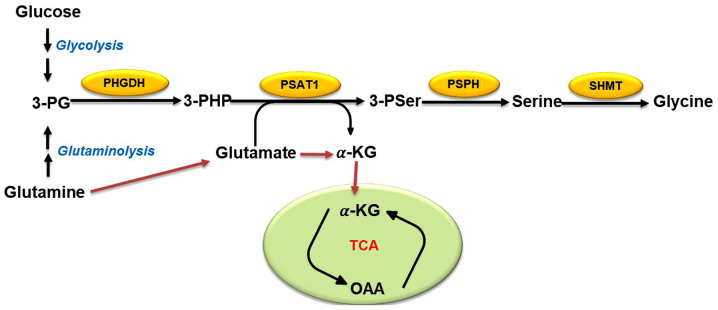
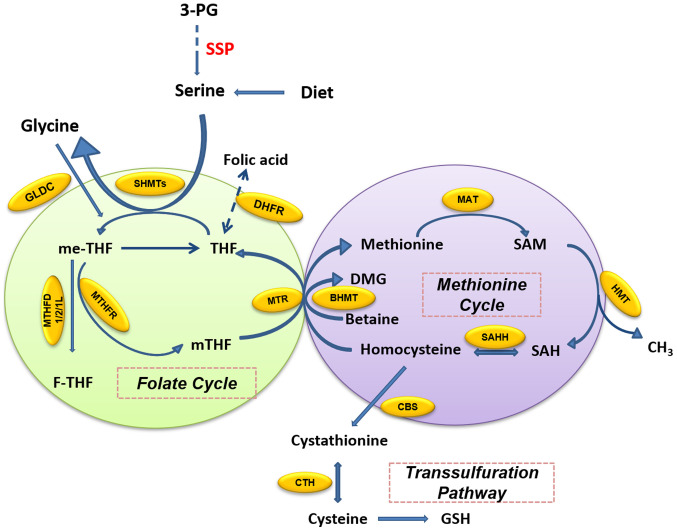
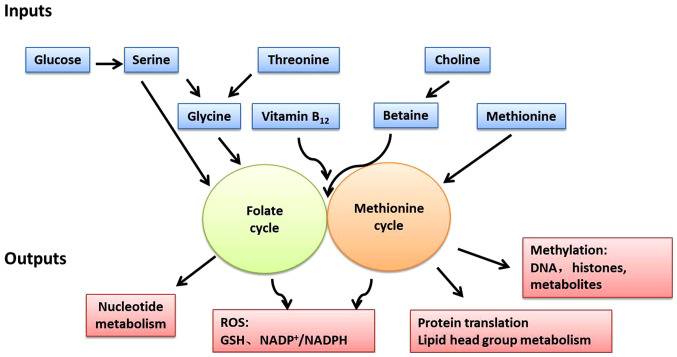
Serine/glycine biosynthesis and one‑carbon metabolism are crucial in sustaining cancer cell survival and rapid proliferation, and of high clinical relevance. Excessive activation of serine/glycine biosynthesis drives tumorigenesis and provides a single carbon unit for one‑carbon metabolism. One‑carbon metabolism, which is a complex cyclic metabolic network based on the chemical reaction of folate compounds, provides the necessary proteins, nucleic acids, lipids and other biological macromolecules to support tumor growth. Moreover, one‑carbon metabolism also maintains the redox homeostasis of the tumor microenvironment and provides substrates for the methylation reaction. The present study reviews the role of key enzymes with tumor‑promoting functions and important intermediates that are physiologically relevant to tumorigenesis in serine/glycine/one‑carbon metabolism pathways. The related regulatory mechanisms of action of the key enzymes and important intermediates in tumors are also discussed. It is hoped that investigations into these pathways will provide new translational opportunities for human cancer drug development, dietary interventions, and biomarker identification.
Overview
The claims and statistics of this paper haven’t been checked yet.
Run the check — free, no account needed. It reads the open-access text and checks the sources it cites.
Integrity signals
Registry
Cites
Statistics
Figures
Verification
Claims the paper makes
The claims and statistics of this paper haven’t been checked yet.
Run the check — free, no account needed. It reads the open-access text and checks the sources it cites.
Claims other papers make about this one
Each is checked against this paper’s own text: does it say what the citing paper says it does?
In the citing paper
“Glycolysis supplies one-carbon metabolism through serine biosynthesis from 3-phosphoglycerate [37,49].”
From 20-Hydroxyecdysone Boosts Energy Production and Biosynthetic Processes in Non-Transformed Mouse Cells (2024) · cites this paper as [49]
In the citing paper
“The serine biosynthesis mediated by three enzymes—PSAT1, PHGDH, and PSAT1—“opens the gates” to one-carbon metabolism, whereas its central part—the folate cycle—mediates the re-distribution of one-carbon groups to acceptors [46] (Figure 11).”
From 20-Hydroxyecdysone Confers Antioxidant and Antineoplastic Properties in Human Non-Small Cell Lung Cancer Cells (2023) · cites this paper as [46]
In the citing paper
“Different oncogenes and oncosupressors have a critical impact on these metabolic pathways [20,40,46,47,75,76].”
From 20-Hydroxyecdysone Confers Antioxidant and Antineoplastic Properties in Human Non-Small Cell Lung Cancer Cells (2023) · cites this paper as [46]
In the citing paper
“Transcription factors c-Myc and ATF4 are two master-regulators of glycolysis, respiration, and one-carbon metabolism [44,45,46,49].”
From 20-Hydroxyecdysone Confers Antioxidant and Antineoplastic Properties in Human Non-Small Cell Lung Cancer Cells (2023) · cites this paper as [46]
Self-check
Percentages, sums and reported differences re-computed from the paper’s own numbers.
The self-check needs the paper’s full text.
Citations
Cites
2 retracted
Samanta, D., Park, Y., Andrabi, S. A., Shelton, L. M., Gilkes, D. M., & Semenza, G. L. (2016) · Cancer Research · doi:10.1158/0008-5472.can-16-0530 · Cited by 242
RetractedmiR-424 targets AKT3 and PSAT1 and has a tumor-suppressive role in human colorectal cancer
Fang, Y., Liang, X. H., Xu, J., & Cai, X. (2018) · Cancer Management and Research · doi:10.2147/cmar.s185789 · Cited by 57
RetractedWarburg, O. (1956) · Science · doi:10.1126/science.123.3191.309 · Cited by 13,425
The emerging hallmarks of cancer metabolism
Pavlova, N. N., & Thompson, C. B. (2016) · Cell Metabolism · doi:10.1016/j.cmet.2015.12.006 · Cited by 5,926
5-Fluorouracil: mechanisms of action and clinical strategies
Longley, D. B., Harkin, D. P., & Johnston, P. G. (2003) · Nature Reviews Cancer · doi:10.1038/nrc1074 · Cited by 5,332
Fundamentals of Cancer Metabolism
DeBerardinis, R. J., & Chandel, N. S. (2016) · Science Advances · doi:10.1126/sciadv.1600200 · Cited by 3,013
The integrated stress response
Pakos‐Zebrucka, K., Koryga, I., Mnich, K., Ljujic, M., Samali, A., & Gorman, A. M. (2016) · The EMBO Reports · doi:10.15252/embr.201642195 · Cited by 2,659
Understanding the Intersections between Metabolism and Cancer Biology
Heiden, M. G. V., & DeBerardinis, R. J. (2017) · Cell · doi:10.1016/j.cell.2016.12.039 · Cited by 2,369
One-Carbon Metabolism in Health and Disease
Ducker, G. S., & Rabinowitz, J. D. (2017) · Cell Metabolism · doi:10.1016/j.cmet.2016.08.009 · Cited by 2,239
Chemotherapy and the war on cancer
Chabner, B. A., & Roberts, T. G. (2005) · Nature reviews. Cancer · doi:10.1038/nrc1529 · Cited by 2,231
Cited by
Sorted by citations
Mechanisms of Metabolic Reprogramming in Cancer Cells Supporting Enhanced Growth and Proliferation
Schiliro, C., & Firestein, B. L. (2021) · Cells · doi:10.3390/cells10051056 · Cited by 659
Metabolic reprogramming in cholangiocarcinoma
Raggi, C., Taddei, M. L., Rae, C. J., Braconi, C., & Marra, F. (2022) · Journal of Hepatology · doi:10.1016/j.jhep.2022.04.038 · Cited by 179
Serine Metabolism in Health and Disease and as a Conditionally Essential Amino Acid
Holeček, M. (2022) · Nutrients · doi:10.3390/nu14091987 · Cited by 159
Serine signaling governs metabolic homeostasis and health
He, L., Ding, Y., Zhou, X., Li, T., & Yin, Y. (2023) · Trends in Endocrinology and Metabolism · doi:10.1016/j.tem.2023.03.001 · Cited by 100
Mathew, M., Nguyen, N. T. H., Bhutia, Y. D., Sivaprakasam, S., & Ganapathy, V. (2024) · Cancers · doi:10.3390/cancers16030504 · Cited by 84
Metadata
- Authors
- Pan, S., Fan, M., Liu, Z., Li, X., & Wang, H.
- Affiliations
- Henan University (CN)
- Corresponding author
- Li, Xia
- Wang, Huijuan
- ORCID
- Venue
- International Journal of Oncology
- Publisher
- Spandidos Publications
- Published
- 2020-12-11
- Volume
- 58
- Issue
- 2
- Pages
- 158-170
- ISSN
- 1019-6439 (ISSN-L)
- 1791-2423
- PMC
- PMC7864012
- OpenAlex
- W3112083241
- Cited by
- 227
- References
- 166
- Citations by year
- 2026: 58 · 2025: 64 · 2024: 37 · 2023: 36 · 2022: 23 · 2021: 9
- FWCI
- 1.73
- Type
- journal article
- Language
- en
- Open access
- hybrid
- doi.org
- Licence
- cc-by-nc-nd
- Locations
- International Journal of Oncology (publishedVersion, cc-by-nc-nd)
- PubMed Central (publishedVersion, cc-by-nc-nd)
- PubMed (publishedVersion)
- Funders
- National Natural Science Foundation of China (81872023)
- China Postdoctoral Science Foundation (2018M642742, 81872023)
- Topics
- Life Sciences › Biochemistry, Genetics and Molecular Biology › Cancer Research › Cancer, Hypoxia, and Metabolism
- Health Sciences › Nursing › Nutrition and Dietetics › Folate and B Vitamins Research
- Life Sciences › Biochemistry, Genetics and Molecular Biology › Cancer Research › Cancer, Lipids, and Metabolism
- Keywords
- serine biosynthesis, glycine synthesis, one-carbon metabolism, folate metabolism, cancer metabolism, carcinogenesis, DNA methylation, anticancer drug development, dietary intervention, biomarkers
- MeSH terms
- Warburg Effect, Oncologic, Animals, Antineoplastic Agents, Carbon, Disease Models, Animal, Glycine, Humans, Methylation, Neoplasms, Oxidation-Reduction, Serine, Mice, Metabolic Networks and Pathways, Tumor Microenvironment, Carcinogenesis
About these checks
Registry, retraction, Cites and statistics results are computed, not judged, with one exception: a printed reference that no index lists is read once by a model before it counts as a citation error. Claims are extracted by a model and kept only when their quote appears verbatim in the text; each cited source is then checked, with a model’s help, for whether it says what the claim relies on. Those verdicts can be wrong — read the claim’s quote and the cited source before relying on one.
Statistics and arithmetic are recomputed, not judged.
Confidence bands are shown only for fields calibrated on our annotated test set. None is calibrated yet, so no band is shown.
What counts as a claim ›How we measure confidence ›How we check this ›
Are you an author, or do you see a problem with this page? Request a review
