

The DOI matches its Crossref record; 52 of the 53 references it cites were found in a registry or an index.
Sex differences in the effect of fish-oil supplementation on the adaptive response to resistance exercise training in older people: a randomized controlled trial
Open accessAbstract
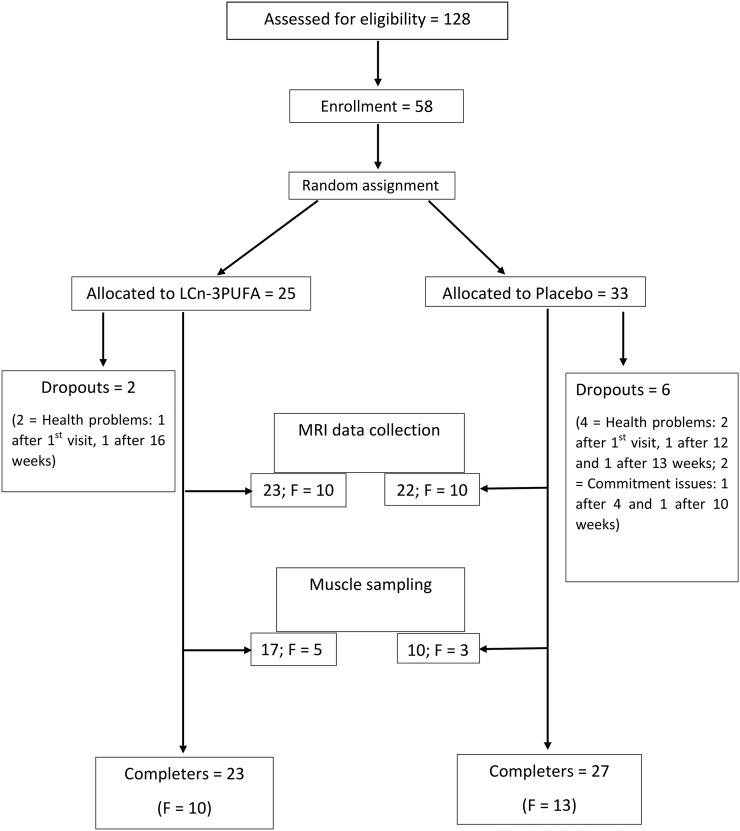
BACKGROUND: Resistance exercise increases muscle mass and function in older adults, but responses are attenuated compared with younger people. Data suggest that long-chain n-3 polyunsaturated fatty acids (PUFAs) may enhance adaptations to resistance exercise in older women. To our knowledge, this possibility has not been investigated in men. OBJECTIVE: We sought to determine the effects of long-chain n-3 PUFA supplementation on resistance exercise training-induced increases in muscle mass and function and whether these effects differ between older men and women. DESIGN: ): 25.6 ± 4.2; women: n = 23, mean ± SD age: 70.7 ± 3.3 y, mean ± SD BMI: 25.3 ± 4.7] were randomly assigned to either long-chain n-3 PUFA (n = 23; 3 g fish oil/d) or placebo (n = 27; 3 g safflower oil/d) and participated in lower-limb resistance exercise training twice weekly for 18 wk. Muscle size, strength, and quality (strength per unit muscle area), functional abilities, and circulating metabolic and inflammatory markers were measured before and after the intervention. RESULTS: , 4-m walk time, chair-rise time, muscle anatomic cross-sectional area, and muscle fat did not differ (P > 0.05) between groups. There was a greater (P < 0.05) increase in muscle quality in women after exercise training in the long-chain n-3 PUFA group than in the placebo group, with no such differences in men (P > 0.05). Long-chain n-3 PUFAs resulted in a greater decrease (P < 0.05) than the placebo in plasma triglyceride concentrations in both sexes, with no differences (P > 0.05) in glucose, insulin, or inflammatory markers. CONCLUSION: Long-chain n-3 PUFA supplementation augments increases in muscle function and quality in older women but not in older men after resistance exercise training. This trial was registered at clinicaltrials.gov as NCT02843009.
Overview
The claims and statistics of this paper haven’t been checked yet.
Run the check — free, no account needed. It reads the open-access text and checks the sources it cites.
Integrity signals
Registry
Cites
Statistics
Figures
Verification
Claims the paper makes
The claims and statistics of this paper haven’t been checked yet.
Run the check — free, no account needed. It reads the open-access text and checks the sources it cites.
Claims other papers make about this one
Each is checked against this paper’s own text: does it say what the citing paper says it does?
In the citing paper
“Da Boit et al. described an increased muscle function in older women but not in men [52] after receiving fish oil supplements.”
From Identification of factors associated with sarcopenic obesity development: Literature review and expert panel voting (2024) · cites this paper as [52]
In the citing paper
“Despite their purported anti-inflammatory effects, which are thought to underlie the beneficial effects of n-3 PUFAs in muscle, Da Boit, et al. [78] and others [33,47], were unable to detect any differences in plasma TNF-α or IL-6 between the placebo and n-3 PUFA treatment groups post-intervention in both older and younger men and women.”
From Potential Roles of n-3 PUFAs during Skeletal Muscle Growth and Regeneration (2018) · cites this paper as [78]
In the citing paper
“There is also evidence to suggest that older women may respond better than men to combined n-3 PUFA supplementation and resistance exercise training.”
From Potential Roles of n-3 PUFAs during Skeletal Muscle Growth and Regeneration (2018) · cites this paper as [78]
In the citing paper
“For example, when compared to both male and female placebo groups, Da Boit and co-workers observed greater improvement in muscle quality (strength/unit of muscle area) in the quadriceps of older women following combined resistance exercise and fish-oil supplementation [78].”
From Potential Roles of n-3 PUFAs during Skeletal Muscle Growth and Regeneration (2018) · cites this paper as [78]
In the citing paper
“In older individuals sex differences in muscle quality have been observed following n-3 PUFA supplementation [78].”
From Potential Roles of n-3 PUFAs during Skeletal Muscle Growth and Regeneration (2018) · cites this paper as [78]
Self-check
Percentages, sums and reported differences re-computed from the paper’s own numbers.
The self-check needs the paper’s full text.
Citations
Cites
Goodpaster, B. H., Park, S. W., Harris, T. B., Kritchevsky, S. B., Nevitt, M., Schwartz, A. V., Simonsick, E. M., Tylavsky, F. A., Visser, M., Newman, A. B., et al. (2006) · The Journals of Gerontology Series A: Biological Sciences and Medical Sciences · doi:10.1093/gerona/61.10.1059 · Cited by 3,083 · cited 1×
“Several studies have shown that in older adults the decline in muscle strength is w2–4-fold more rapid than the reduction in muscle mass, indicating a decline in muscle quality (strength generated per unit of muscle mass) (3, 4).”
Guralnik, J. M., Ferrucci, L., Pieper, C. F., Leveille, S. G., Markides, K. S., Ostir, G. V., Studenski, S., Berkman, L. F., & Wallace, R. B. (2000) · The Journals of Gerontology Series A: Biological Sciences and Medical Sciences · doi:10.1093/gerona/55.4.m221 · Cited by 2,898
Sarcopenia: origins and clinical relevance
Rosenberg, I. H. (1997) · The Journal of Nutrition · doi:10.1093/jn/127.5.990s · Cited by 2,399
High-Intensity Strength Training in Nonagenarians: Effects on Skeletal Muscle
Fiatarone, M. A. (1990) · JAMA · doi:10.1001/jama.1990.03440220053029 · Cited by 1,593
Longitudinal study of muscle strength, quality, and adipose tissue infiltration
Delmonico, M. J., Harris, T. B., Visser, M., Park, S. W., Conroy, M. B., Velasquez-Mieyer, P., Boudreau, R., Manini, T. M., Nevitt, M., Newman, A. B., et al. (2009) · The American Journal of Clinical Nutrition · doi:10.3945/ajcn.2009.28047 · Cited by 1,446
Mitchell, W. K., Williams, J., Atherton, P., Larvin, M., Lund, J., & Narici, M. (2012) · Frontiers in Physiology · doi:10.3389/fphys.2012.00260 · Cited by 1,377
Omega-3 Fatty Acids and Inflammatory Processes
Calder, P. C. (2010) · Nutrients · doi:10.3390/nu2030355 · Cited by 1,116
Lauritzen, L. (2001) · Progress in Lipid Research · doi:10.1016/s0163-7827(00)00017-5 · Cited by 1,066
Mechanisms of action of docosahexaenoic acid in the nervous system
Salem, N., Litman, B., Kim, H., & Gawrisch, K. (2001) · Lipids · doi:10.1007/s11745-001-0805-6 · Cited by 919 · cited 1×
“Indeed, DHA is involved in numerous neural functions such as receptor affinity, modulation of signal transduction, and cell membrane fluidity (40); to our knowledge, however, its effects have not yet been explored in older adults.”
Mammalian Motor Units: Physiological-Histochemical Correlation in Three Types in Cat Gastrocnemius
Burke, R. E., Levine, D. N., Zajac, F. E., Tsairis, P., & Engel, W. K. (1971) · Science · doi:10.1126/science.174.4010.709 · Cited by 790
Cited by
Sorted by citations
The Role of Inflammation in Age-Related Sarcopenia
Dalle, S., Rossmeislova, L., & Koppo, K. (2017) · Frontiers in Physiology · doi:10.3389/fphys.2017.01045 · Cited by 668
Omega-3 fatty acids in obesity and metabolic syndrome: A mechanistic update
Albracht-Schulte, K., Kalupahana, N. S., Ramalingam, L., Wang, S., Rahman, S. M., Robert-McComb, J., & Moustaid-Moussa, N. (2018) · The Journal of Nutritional Biochemistry · doi:10.1016/j.jnutbio.2018.02.012 · Cited by 355
“Furthermore, the addition of n-3 PUFA to resistance training without dietary intervention resulted in increases in lean mass [88] and improved muscle quality [89].”
BackgroundNutrition and Sarcopenia—What Do We Know?
Ganapathy, A., & Nieves, J. W. (2020) · Nutrients · doi:10.3390/nu12061755 · Cited by 355
McGlory, C., Calder, P. C., & Nunes, E. A. (2019) · Frontiers in Nutrition · doi:10.3389/fnut.2019.00144 · Cited by 242
The role of omega-3 in the prevention and treatment of sarcopenia
Dupont, J., Dedeyne, L., Dalle, S., Koppo, K., & Gielen, E. (2019) · Aging Clinical and Experimental Research · doi:10.1007/s40520-019-01146-1 · Cited by 219
Metadata
- Authors
- Da Boit, M., Sibson, R., Sivasubramaniam, S., Meakin, J. R., Greig, C. A., Aspden, R. M., Thies, F., Jeromson, S., Hamilton, D. L., Speakman, J. R., Hambly, C., Mangoni, A. A., Preston, T., & Gray, S. R.
- Affiliations
- Institute of Medical Sciences (IN)
- University of Exeter (GB)
- University of Birmingham (GB)
- University of Stirling (GB)
- University of Aberdeen (GB)
- Flinders University (AU)
- Scottish Universities Environmental Research Centre (GB)
- Corresponding author
- Gray, Stuart R
- ORCID
- Venue
- The American Journal of Clinical Nutrition
- Publisher
- Elsevier BV
- Published
- 2017-01
- Volume
- 105
- Issue
- 1
- Pages
- 151-158
- ISSN
- 0002-9165 (ISSN-L)
- PMC
- PMC5183731
- OpenAlex
- W2556298806
- Cited by
- 185
- References
- 53
- Citations by year
- 2026: 7 · 2025: 21 · 2024: 17 · 2023: 16 · 2022: 18 · 2021: 24 · 2020: 26 · 2019: 23 · 2018: 20 · 2017: 13
- FWCI
- 19.50
- Type
- journal article
- Language
- en
- Open access
- hybrid
- doi.org
- Licence
- Locations
- American Journal of Clinical Nutrition (publishedVersion, cc-by)
- PubMed Central (publishedVersion, cc-by)
- PubMed (publishedVersion)
- ENLIGHTEN (Jurnal Bimbingan dan Konseling Islam) (acceptedVersion)
- Aberdeen University Research Archive (Aberdeen University) (submittedVersion)
- DMU Open Research Archive (De Montfort University) (submittedVersion)
- Deakin Research Online (Deakin University) (submittedVersion)
- Stirling Online Research Repository (University of Stirling) (submittedVersion, cc-by)
- Figshare (submittedVersion, cc-by)
- University of Birmingham Research Portal (University of Birmingham) (submittedVersion, cc-by)
- Funders
- Medical Research Council (MR/K00414X/1, MR/P021220/1)
- Biotechnology and Biological Sciences Research Council (BB/J015911/1)
- Topics
- Health Sciences › Nursing › Nutrition and Dietetics › Fatty Acid Research and Health
- Health Sciences › Nursing › Nutrition and Dietetics › Muscle metabolism and nutrition
- Health Sciences › Medicine › Physiology (medical) › Nutrition and Health in Aging
- Keywords
- fish oil supplementation, n-3 long-chain polyunsaturated fatty acids, resistance training, older adults, sex differences, muscle quality, muscle strength, muscle mass, muscle function, muscle fat, plasma triglycerides, inflammatory markers, insulin
- MeSH terms
- Adaptation, Physiological, Adipose Tissue, Aged, Body Composition, Dietary Fats, Female, Fish Oils, Humans, Male, Movement, Sex Factors, Triglycerides, Exercise, Fatty Acids, Omega-3, Body Mass Index, Muscle, Skeletal, Torque, Dietary Supplements, Lower Extremity, Muscle Strength, Resistance Training
About these checks
Registry, retraction, Cites and statistics results are computed, not judged, with one exception: a printed reference that no index lists is read once by a model before it counts as a citation error. Claims are extracted by a model and kept only when their quote appears verbatim in the text; each cited source is then checked, with a model’s help, for whether it says what the claim relies on. Those verdicts can be wrong — read the claim’s quote and the cited source before relying on one.
Statistics and arithmetic are recomputed, not judged.
Confidence bands are shown only for fields calibrated on our annotated test set. None is calibrated yet, so no band is shown.
What counts as a claim ›How we measure confidence ›How we check this ›
Are you an author, or do you see a problem with this page? Request a review
