

The Effects of Content Likeability, Content Credibility, and Social Media Engagement on Users’ Acceptance of Product Placement in Mobile Social Networks
The DOI matches its Crossref record; 13 of the 13 references it cites were found in a registry or an index.
Abstract
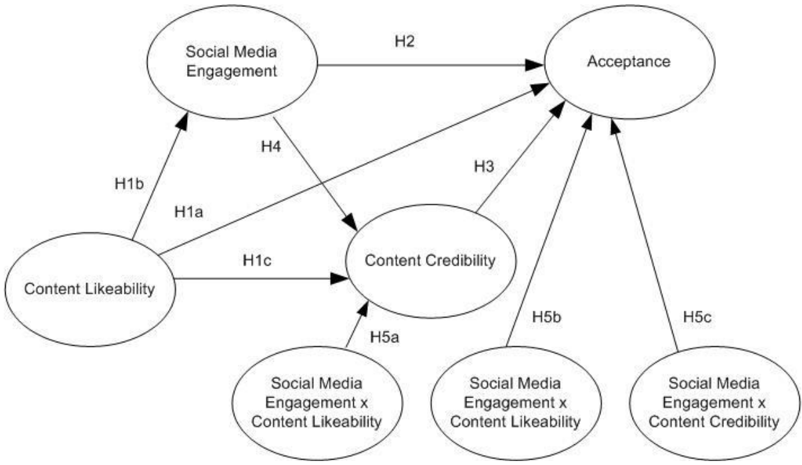
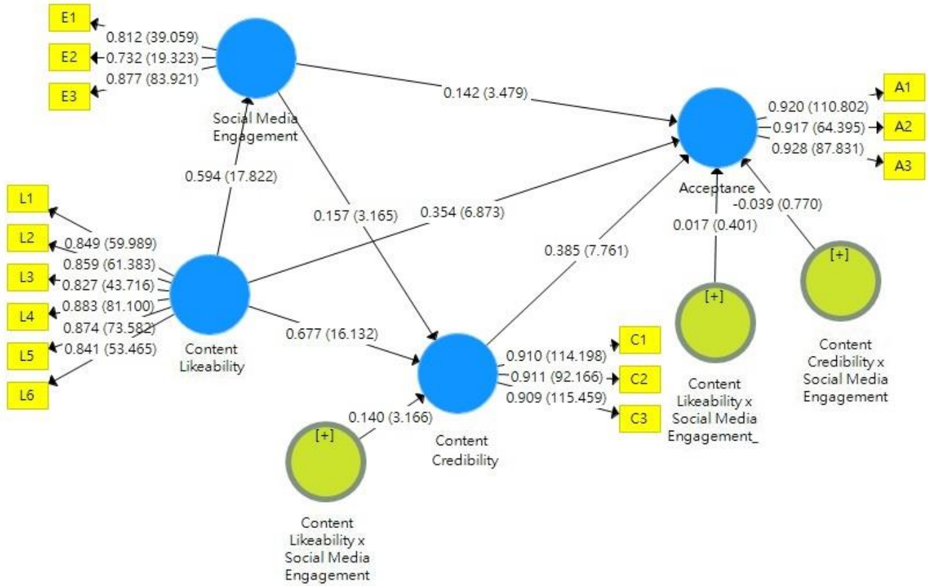
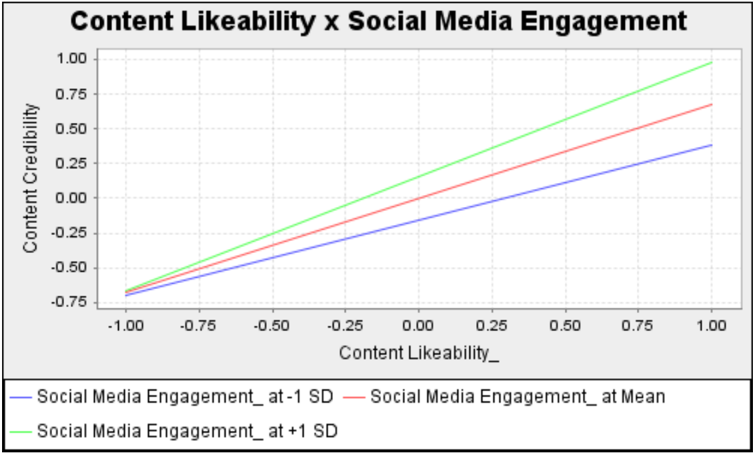
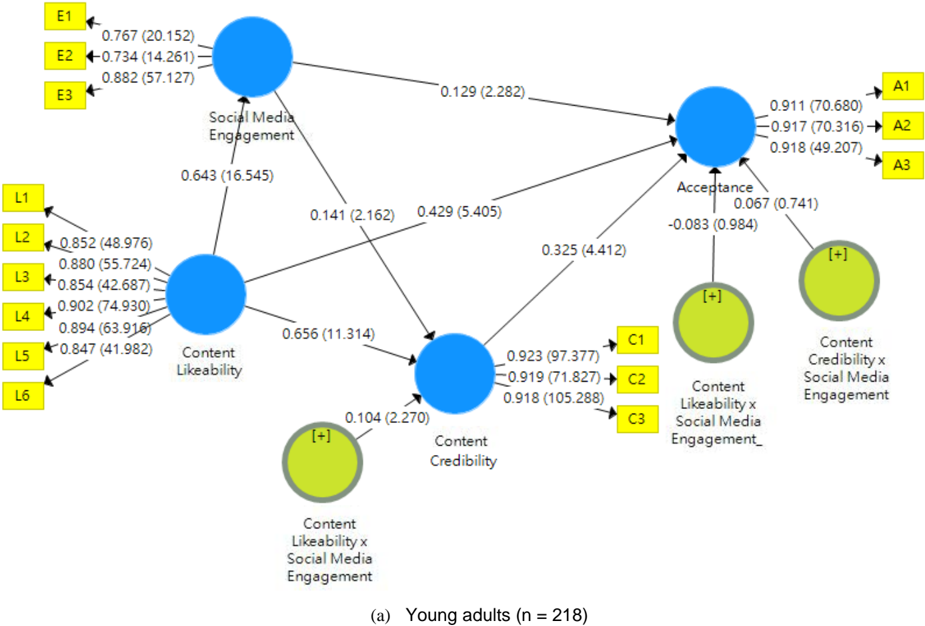
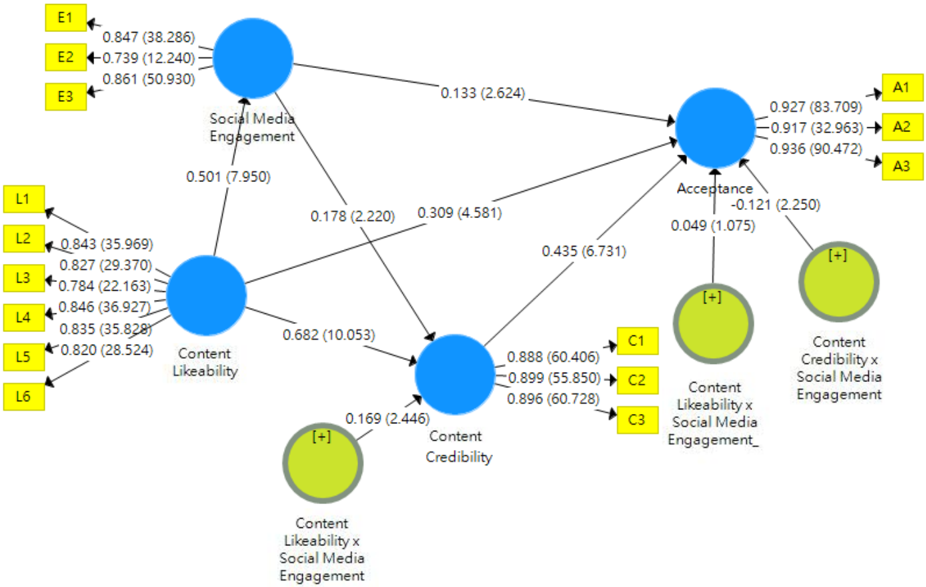
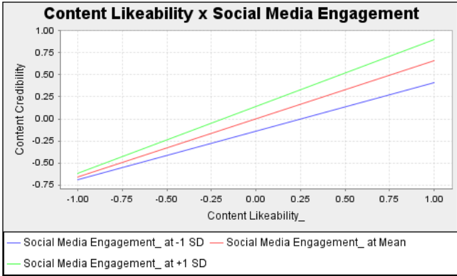
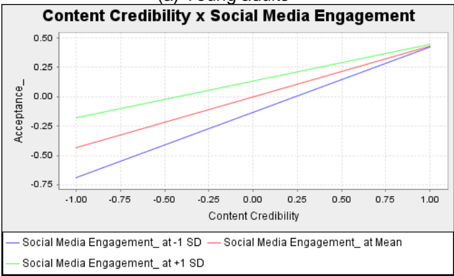
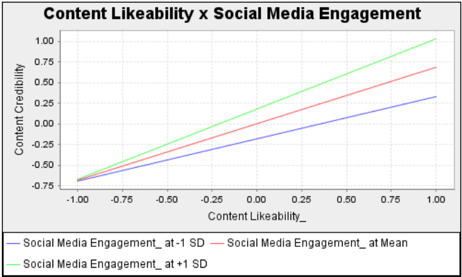
Nowadays, product placements are commonly presented on mobile social media but related studies are rare.The main purpose of the study is to investigate the effects of content likeability, content credibility, and social media engagement on users' acceptance of product placement in mobile social networks.The results of the online survey indicate that content likeability is an antecedent of social media engagement and content credibility; social media engagement has an influence on content credibility; and content likeability, content credibility, and social media engagement both directly affect user acceptance of product placement in mobile social networks.Furthermore, social media engagement has an interaction effect with content likeability on the content credibility of mobile social networks.The results of the multi-group analysis indicate that young adults show differences with middle-aged adults in the direct effect of content likeability on social media engagement and in the interaction effect of content credibility and social media engagement on the acceptance of product placement in mobile social networks.The implications for practitioners are discussed on the basis of the empirical findings.
Overview
The claims and statistics of this paper haven’t been checked yet.
Free: it reads the open-access text and checks the first 5 claims that cite a source we can check. Create a free account to check every claim.
Integrity signals
Registry
Cites
Statistics
Figures
Verification
Claims the paper makes
The claims and statistics of this paper haven’t been checked yet.
Free: it reads the open-access text and checks the first 5 claims that cite a source we can check. Create a free account to check every claim.
Claims other papers make about this one
Each is checked against this paper’s own text: does it say what the citing paper says it does?
In the citing paper
“Meanwhile, negative feedback can create doubts and skepticism about the information presented, prompting students to exercise caution and seek additional verification.”
From Exploring fake news awareness and trust in the age of social media among university student TikTok users (2024) · cites this paper as Wai lai & liu, 2020
Self-check
Percentages, sums and reported differences re-computed from the paper’s own numbers.
The self-check needs the paper’s full text.
Citations
Cites
Texas A&M International University, Kock, N., Lynn, G., & Stevens Institute of Technology (2012) · Journal of the Association for Information Systems · doi:10.17705/1jais.00302 · Cited by 3,783 · cited 1×
“3, there is no multicollinearity issue [46].”
Customer Engagement: Conceptual Domain, Fundamental Propositions, and Implications for Research
Brodie, R. J., Hollebeek, L. D., Jurić, B., & Ilić, A. (2011) · Journal of Service Research · doi:10.1177/1094670511411703 · Cited by 3,622
Consumer Brand Engagement in Social Media: Conceptualization, Scale Development and Validation
Hollebeek, L. D., Glynn, M. S., & Brodie, R. J. (2014) · Journal of Interactive Marketing · doi:10.1016/j.intmar.2013.12.002 · Cited by 3,276
de Vries, L., Gensler, S., & Leeflang, P. S. H. (2012) · Journal of Interactive Marketing · doi:10.1016/j.intmar.2012.01.003 · Cited by 2,060
The like economy: Social buttons and the data-intensive web
Gerlitz, C., & Helmond, A. (2013) · New Media & Society · doi:10.1177/1461444812472322 · Cited by 871 · cited 1×
“After Facebook introducing the like button, researchers began to study the rise of like economy [22].”
BackgroundCustomer engagement with tourism social media brands
Harrigan, P., Evers, U., Miles, M., & Daly, T. (2017) · Tourism Management · doi:10.1016/j.tourman.2016.09.015 · Cited by 813 · cited 1×
“Previous studies about customer engagement are mainly focused on the interactions between a customer and an organization [32], [65], a customer and a product [64], and a customer and a brand [31], [73].”
BackgroundOnline shopping drivers and barriers for older adults: Age and gender differences
Lian, J.-W., & Yen, D. C. (2014) · Computers in Human Behavior · doi:10.1016/j.chb.2014.04.028 · Cited by 660 · cited 1×
“The previous studies on internet research have heavily focused on the youth segment [49].”
BackgroundDe Vries, N. J., & Carlson, J. (2014) · Journal of Brand Management · doi:10.1057/bm.2014.18 · Cited by 418 · cited 1×
“Coker and Altobello [12] found that interaction enhances recall of placed brands among friend dyads.”
BackgroundFactors Influencing Information credibility on Social Media Platforms: Evidence from Facebook Pages
Li, R., & Suh, A. (2015) · Procedia Computer Science · doi:10.1016/j.procs.2015.12.146 · Cited by 225 · cited 8×
“People will give a like if they prefer a message on the Facebook.”
BackgroundInfluentialBelieve it or not: Credibility of blogs in tourism
Mack, R. W., Blose, J. E., & Pan, B. (2008) · Journal of Vacation Marketing · doi:10.1177/1356766707087521 · Cited by 222 · cited 1×
“Over the years, a number of studies have attempted to assess consumers’ perceptions of credibility of various online social media such as websites [18], [51], blogs [54], Twitter [71], and Facebook [48].”
Background
Research works printed but not linked: 66
- E. Babacan, S.I. Akcalu and E.P. Baytekin, Product placement as a rising marketing communication activity: Assessment on television serials, Procedia-Social and Behavioral Sciences, vol. 62, pp. 1319-1331, 2012.
- J. Bardzell, S. Bardzell, T. Pace, and J. Karnell, Intuitive interaction applied to interface design, in Proceedings of the International Design Congress, IASDR 2005, Douliou, Taiwan, 2005, pp. 1-10.
- V. Barger, J.W. Peltier and D.E. Schultz, Social media and consumer engagement: A review and research agenda, Journal of Research in Interactive Marketing, vol. 10, no. 4, pp. 268-287, 2016.
- P.M. Bentler and C.P. Chou, Practical issues in structural modelling, Sociological Methods and Research, vol. 16, no. 1, pp. 78-117, 1987.
- R.J. Brodie, A. Ilic, B. Juric, and L.D. Hollebeek, Consumer engagement in a virtual brand community: An exploratory analysis, Journal of Business Research, vol. 66, no. 1, pp. 105-114, 2013.
- S.L. Brodsky, T.M.S. Neal, R.J. Cramer, and M.H. Ziemke, Credibility in the courtroom: How likeable should an expert witness be?, Journal of the American Academy of Psychiatry and the Law, vol. 37, no. 4, pp. 525-532, 2009.
- B.J. Calder and E.C. Malthouse, Media engagement and advertising effectiveness, in Kellogg on Advertising and Media (B.J. Calder, Ed.). Hoboken, NJ: Wiley, 2008, pp. 1-36.
- C.M.K. Cheung, M.K.O. Lee and X.L. Jin, Customer engagement in an online platform: A conceptual model and scale development, in Proceedings of the Thirty-Second International Conference on Information Systems (ICIS), Shanghai, China, 2011, pp. 3105-3112.
- R.B. Cialdini, Influence: Science and Practice (3rd ed.). New York: Harper Collins, 1993.
- K.K. Coker and S.A. Altobello, Product placements in social settings: The impact of coviewing on the recall of placed brands, Journal of Business Research, vol. 87, pp. 128-136, 2018.
- L. Dessart, C. Veloutsou and A. Morgan-Thomas, Consumer engagement in online brand communities, The Journal of Product and Brand Management, vol. 24, no. 1, pp. 28-42, 2015.
- V. Devika and S. Sreejesh, Effects of brand placement strength, prior game playing experience and game involvement on brand recall in advergames, Journal of Indian Business Research, vol. 7, no. 3, pp. 292-312, 2015.
- P.M. Di Gangi and M.M. Wasko, Social media engagement theory: Exporing the influence of user engagement on social media usage, Journal of Organizational and End User Computing, vol. 28 no. 2, pp. 53-73, 2016.
- J.A. Dias, J.G. Dias and C. Lages, Can negative characters in soap operas be positive for product placement?, Journal of Business Research, vol. 71, pp. 125-132, 2017.
- U. Evers and P. Harrigan, Consumer brand engagement with tourism organisations on social media, in Proceedings of Australian and New Zealand Marketing Association Conference, Sydney, Australia, 2015, pp. 898-904.
- L. Gageler and J. van der Schee, Product placement on social media: A study on how generation Y's brand perception and purchase intention are influenced, M.S. Thesis, Jonkoping International Business School, Jonkoping University, Jonkoping, 2016.
- H. Gangadharbatla, A comparison of in-game brand placement for active versus passive players, Journal of Interactive Advertising, vol. 16, no. 2, pp. 117-132, 2016.
- R. Gommans, M.J. Sandstrom, G.W.J.M. Stevens, T.F.M. ter Bogt, and A.H.N. Cillessen, Popularity, likeability, and peer conformity: Four field experiments, Journal of Experimental Social Psychology, vol. 73, pp. 279-289, 2017.
- Y.W. Ha, M.C. Park and E. Lee, A framework for mobile SNS advertising effectiveness: User perceptions and behaviour perspective, Behaviour and Information Technology, vol. 33, no. 12, pp. 1333-1346, 2014.
- J.F. Jr. Hair, M. Sarstedt, C.M. Ringle, and J.A. Mena, An assessment of the use of partial least squares structural equation modeling in marketing research, Journal of the Academy of Marketing Science, vol. 40, no. 3, pp. 414-433, 2012.
- J.F. Jr. Hair, G.T.M. Hult, C.M. Ringle, and M. Sarstedt, A Primer on Partial Least Squares Structural Equation Modeling (PLS-SEM), 2nd Edition. Thousand Oaks: Sage, 2017.
- K.N. Hampton, L.S. Goulet, C. Marlow, and L. Rainie. (2012) Why most Facebook users get more than they give: The effect of Facebook power users on everybody else. Pew Research Center. [Online]. Available: https://www.academia.edu/2449652/Why_Most_Facebook_Users_Get_More_Than_They_Give_The_Effect_of _Facebook_Power_Users_on_Everybody_Else
- H. Han and S. Trimi, Social commerce design: A framework and application, Journal of Theoretical and Applied Electronic Commerce Research, vol. 12, no. 3, pp. 50-68, 2017.
- M.G. Hughes, J.A. Griffith, T.A. Zeni, M.L. Arsenault, O.D. Cooper, G. Johnson, J.H. Hardy, S. Connelly, and M.D. Mumford, Discrediting in a message board forum: The effects of social support and attacks on expertise and trustworthiness, Journal of Computer-Mediated Communication, vol. 19, no. 3, pp. 325-341, 2014.
- Y.L. Hwong, C. Oliver, M.V. Kranendonk, C. Sammut, and Y. Seroussi, What makes you tick? The psychology of social media engagement in space science communication, Computers in Human Behavior, vol. 68, pp. 480- 492, 2017.
- J. Ihm, Network measures to evaluate stakeholder engagement with nonprofit organizations on social networking sites, Public Relations Review, vol. 41, no. 4, pp. 501-503, 2015.
- T.J. Johnson and B.K. Kaye, Reasons to believe: Influence of credibility on motivations for using social networks, Computers in Human Behavior, vol. 50, pp. 544-555, 2015.
- T.J. Johnson and B.K. Kaye, Some like it lots: The influence of interactivity and reliance on credibility, Computers in Human Behavior, vol. 61, pp. 136-145, 2016.
- A.M. Kaplan and M. Haenlein Users of the world, unite! The challenges and opportunities of social media, Business Horizons, vol. 53, no. 1, pp. 59-68, 2010.
- W. Kahn, Psychological conditions of personal engagement and disengagement at work, Academy of Management Journal, vol. 33, no. 4, pp. 629-724, 1990.
- P. Kardos, Z. Unoka, C. Pleh, and P. Soltesz, Your mobile phone indeed means your social network: Priming mobile phone activates relationship related concepts, Computer in Human Behavior, vol. 88, pp. 84-88, 2018.
- V.J. Karisik, 20 years of research on product placement in movie, television and video game media, Journal of Economic and Social Studies, vol. 4, no. 2, pp. 253-283, 2014
- J.A. Karrh, Brand placement: A review, Journal of Current Issues and Research in Advertising, vol. 20, no. 2, pp. 31-49, 1998.
- D.T. Kenrick, S.L. Neuberg and R.B. Cialdini, Social Psychology: Unraveling the Mystery. (2nd ed.). Boston, MA: Allyn & Bacon, 2002.
- E. Kim, J.S. Lin and Y. Sung, To app or not to app: Engaging consumers via branded mobile apps, Journal of Interactive Advertising, vol. 113, no. 1, pp. 54-65, 2013.
- S. Kiousis, Public trust or mistrust? Perceptions of media credibility in the information age, Mass Communication & Society, vol. 4, no. 3, pp. 381-403, 2001.
- H. Lee, S.Y. Choi and Y.S. Kang, Formation of e-satisfaction and repurchase intention: moderating roles of computer self-efficacy and computer anxiety, Expert Systems with Applications, vol. 36, no. 4, pp. 7848-7859, 2009.
- A.R.D. Liang, T.Y. Hsiao and C.H. Cheng, The effects of product placement and television drama types on the consumer responses of college students, Asia Pacific Journal of Tourism Research, vol. 20, no. 11, pp. 1212- 1233, 2015.
- Z. Liu, Perceptions of credibility of scholarly information on the web, Information Processing and Management, vol. 40, no. 6, pp. 1027-1038, 2004.
- S.H. Liu, C.H. Chou and H.L. Liao, An exploratory study of product placement in social media, Internet Research, vol. 25, no. 2, pp. 300-316, 2015.
- R.J. Lutz, Affective and cognitive antecedents of attitude toward the ad: A conceptual framework, in Psychological Processes and Advertising Effects (L. Alwitt and A. Mitchell, Eds.). Hillsdale, NJ: Erlbaum, 1985, pp. 45-63.
- K. Makri and B.B. Schlegelmilch, Time orientation and engagement with social networking sites: A cross- cultural study in Austria, China and Uruguay, Journal of Business Research, vol. 80, pp. 155-163, 2017.
- A. Marchand, T. Hennig-Thurau and S. Best, When James Bond shows off his Omega: Does product placement affect its media host?, European Journal of Marketing, vol. 49, no. 9/10, pp. 1666-1685, 2015.
- J. Martí-Parreño, J. Bermejo-Berros and J. Aldás-Manzano, Product placement in video games: The effect of brand familiarity and repetition on consumers' memory, Journal of Interactive Marketing, vol. 38, pp. 55-63, 2017.
- D.H. McKnight and C.J. Kacmar, Factors and effects of information credibility, in Proceedings of the 9th International Conference on Electronic Commerce, ACM Press, New York, 2007, pp. 423-432.
- J. Meyer, R. Song and K. Ha, The effect of product placements on the evaluation of movies, European Journal of Marketing, vol. 50, no. 3/4, pp. 530-549, 2016.
- J.L. Monahan, I don't know it but I like you-the influence of non-conscious affect on person perception, Human Communication Research, vol. 24, no. 4, pp. 480-500, 1998.
- V. Noguti and C.A. Russell, Normative influences on product placement effects: Alcohol brands in television series and the influence of presumed influence, Journal of Advertising, vol. 43, no. 1, pp. 46-62, 2014.
- Oxford Living Dictionaries. (2017) Definition of likeable in English. Lexico. [Online]. Available: https://en.oxford dictionaries.com/definition/likeable
- M. Pagani and A. Mirabello, The influence of personal and social-interactive engagement in social TV web sites, International Journal of Electronic Commerce, vol. 16, no. 2, pp. 41-67, 2012.
- S. Papagiannidis, E. See-To and M. Bourlakis, Virtual test-driving: The impact of simulated products on purchase intention, Journal of Retailing and Consumer Services, vol. 21, no. 5, pp. 877-887, 2014.
- C.W. Phang, C. Zhang and J. Sutanto, The influence of user interaction and participation in social media on the consumption intention of niche products, Information & Management, vol. 50, no. 8, pp. 661-672, 2013.
- G. Prendergast, P.Y. Liu and D.T.Y. Poon, A Hong Kong study of advertising credibility, Journal of Consumer Marketing, vol. 26, no. 5, pp. 320-329, 2009.
- V. Raghupathi and J. Fogel, The impact of opinion leadership on purchases through social networking websites, Journal of Theoretical and Applied Electronic Commerce Research, vol. 10, no. 3, pp. 18-29, 2015.
- S. Reysen, Construction of a new scale: The Reysen likeability scale, Social Behavior and Personality, vol. 33, no. 2, pp. 201-208, 2005.
- T. Robbins and A. DeNisi, A closer look at interpersonal affect as a distinct influence on cognitive processing in performance evaluations, Journal of Applied Psychology, vol. 79, no. 3, pp. 341-353, 1994.
- K.K.F. So, C. King and B. Sparks, Customer engagement with tourism Brands: Scale development and validation, Journal of Hospitality & Tourism Research, vol. 38, no. 3, pp. 304-329, 2014.
- I. Spero and M. Stone, Agents of change: How young consumers are changing the world of marketing, Qualitative Market Research: An International Journal, vol. 7, no. 2, pp. 153-159, 2004.
- A.T. Stephen and L.V. Coote, Brands in action: The role of brand placements in building consumer-brand identification, in Proceedings of the American Marketing Association Conference, Chicago, IL, USA, vol. 16, 2005, p. 28.
- S.S. Sundar, Social psychology of interactivity in human-website interaction, in The Oxford Handbook of Internet Psychology (A.N. Joinson, Ed.). Oxford, United Kingdom: Oxford University Press, 2007, pp. 89-104.
- R. Thakur, Understanding customer engagement and loyalty: A case of mobile devices for shopping, Journal of Retailing and Consumer Services, vol. 32, pp. 151-163, 2016.
- K.B. Tompkins, D.M. Martz, C.A. Rocheleau, and D.G. Bazzini, Social likeability, conformity, and body talk: Does fat talk have a normative rival in female body image conversations? Body Image, vol. 6 no. 4, pp. 292- 298, 2009.
- S. Tseng and B.J. Fogg, Credibility and computing technology, Communication of the ACM, vol. 42 no. 5, pp. 39-44, 1999.
- R. Wang, J. Kim, A. Xiao, and Y.J. Jung, Networked narratives on Humans of New York: A content analysis of social media engagement on Facebook, Computers in Human Behavior, vol. 22, pp. 149-153, 2017.
- L. Wu, Understanding the impact of media engagement on the perceived value and acceptance of advertising within mobile social networks, Journal of Interactive Marketing, vol. 16, no. 1, pp. 59-73, 2016.
- M. Zhang, L. Guo, M. Hu, and W. Liu, Influence of customer engagement with company social networks on stickiness: Mediating effect of customer value creation, International Journal of Information Management, vol. 37, no. 3, pp. 229-240, 2017.
Cited by
Cao, D., Meadows, M., Wong, D., & Xia, S. (2021) · Journal of Business Research · doi:10.1016/j.jbusres.2020.06.025 · Cited by 294
Lan, D. H., & Tung, T. M. (2024) · Cogent Social Sciences · doi:10.1080/23311886.2024.2302216 · Cited by 134
Aydin, G., Uray, N., & Silahtaroglu, G. (2021) · Journal of Theoretical and Applied Electronic Commerce Research · doi:10.3390/jtaer16040044 · Cited by 70
“to lead to improved impressions, interactions and attitudes towards brands on social media [13,16,59,63] and the likeability of the content was found to influence social media engagement [64].”
Background
Metadata
- Authors
- Wai Lai, I. K., & Liu, Y.
- Venue
- Journal of theoretical and applied electronic commerce research
- Publisher
- MDPI AG
- Published
- 2020-09
- Volume
- 15
- Issue
- 3
- Pages
- 1-19
- ISSN
- 0718-1876
- Cited by
- 43
- References
- 13
- Language
- en
About these checks
Registry, retraction, Cites and statistics results are computed, not judged, with one exception: a printed reference that no index lists is read once by a model before it counts as a citation error. Claims are extracted by a model and kept only when their quote appears verbatim in the text; each cited source is then checked, with a model’s help, for whether it says what the claim relies on. Those verdicts can be wrong — read the claim’s quote and the cited source before relying on one.
Statistics and arithmetic are recomputed, not judged.
Confidence bands are shown only for fields calibrated on our annotated test set. None is calibrated yet, so no band is shown.
What counts as a claim ›How we measure confidence ›How we check this ›
Are you an author, or do you see a problem with this page? Request a review
Data sources
Bibliographic data: Semantic Scholar, OpenAlex, Crossref.
Contains information from the Semantic Scholar Academic Graph Datasets, made available under the ODC Attribution License (ODC-BY 1.0).
Semantic Scholar’s data is described in: Kinney, R., et al. (2023). The Semantic Scholar Open Data Platform. arXiv:2301.10140.
