

The DOI matches its Crossref record; 27 of the 29 references it cites were found in a registry or an index.
Effect of an online mindfulness program on stress in Indian adults during COVID-19 pandemic: A randomized controlled preliminary study
Open accessAbstract
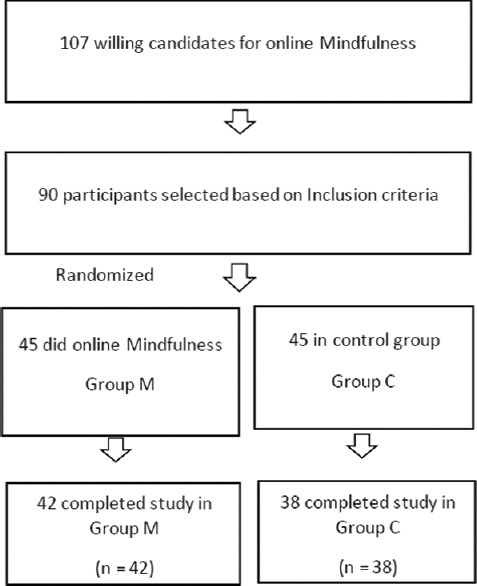
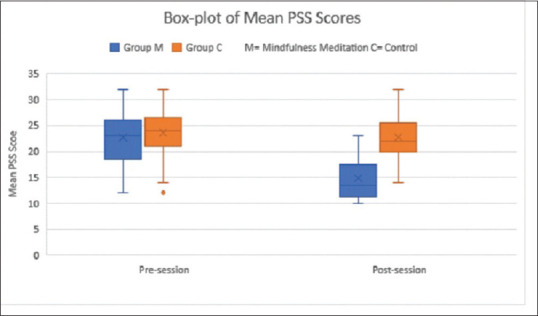
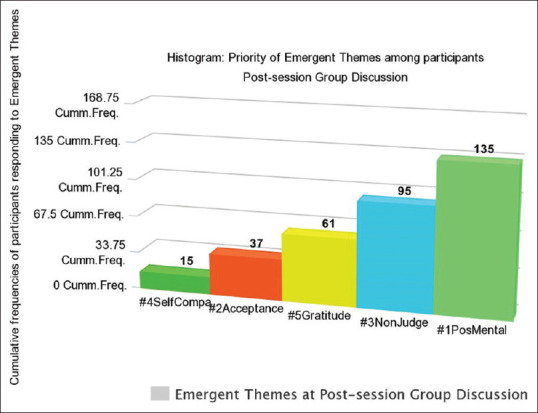
Background: The Indian population is suffering from a high prevalence of mental stress and the situation has been worsened by the COVID-19 pandemic. Mindfulness, which can also be conducted online, has been used as a stress-relieving therapy in the Western world. There is not much experience with mindfulness in the Indian population. The COVID-19 pandemic demands the development of alternative therapies which can reach out to the masses at a minimal cost, avoiding direct personal contact. The researchers wanted to explore the potential of mindfulness as a stress-relieving therapy. Aim: To note any improvement in perceived stress of the participants compared to the controls. Methods: = 38 (group C). The perceived stress was measured using the perceived stress scale before and after the program. Qualitative data was collected in the form of written responses to the question "Which aspect of mindfulness meditation appealed to you the most for stress relief?" and some themes were formed. Results: There was a significant decrease in perceived stress scale scores on completion of the program in group M. "Positive mental state" and "non-judgmental" were the most prominent emergent themes suggested by the participants, as per the qualitative data analysis. Conclusion: This preliminary study sees potential in an online mindfulness program as an alternative stress-relieving therapy. Further research is suggested to substantiate the results and optimize the implementation.
Overview
The claims and statistics of this paper haven’t been checked yet.
Run the check — free, no account needed. It reads the open-access text and checks the sources it cites.
Integrity signals
Registry
Cites
Statistics
Figures
Verification
Claims the paper makes
The claims and statistics of this paper haven’t been checked yet.
Run the check — free, no account needed. It reads the open-access text and checks the sources it cites.
Claims other papers make about this one
Each is checked against this paper’s own text: does it say what the citing paper says it does?
The source backs part of the claim, not all of it — or backs it for a different population, condition or comparison.
In the citing paper
“A study by present researchers found mindfulness to decrease perceived stress in the general Indian population (non-pain patients).[27]”
From Mindfulness influences the psycho-social dimension of chronic pain: A randomized controlled clinical trial in Indian context (2023) · cites this paper as [27]
Experimental — accuracy not yet measured
Self-check
Percentages, sums and reported differences re-computed from the paper’s own numbers.
The self-check needs the paper’s full text.
Citations
Cites
A Global Measure of Perceived Stress
Cohen, S., Kamarck, T., & Mermelstein, R. (1983) · Journal of Health and Social Behavior · doi:10.2307/2136404 · Cited by 32,807 · cited 1×
“We searched for alternative therapies in the form of online mindfulness and see its effect on perceived stress scores (PSS) [10] in the apparently healthy Indian adults during the COVID-19 pandemic.”
Mindfulness-based interventions in context: Past, present, and future
Kabat-Zinn, J. (2003) · Clinical Psychology: Science and Practice · doi:10.1093/clipsy.bpg016 · Cited by 8,615 · cited 1×
“[18] Some systemic reviews infer MBSR as a promising therapy for stress management [19] and improvement in psychological functioning.”
Impact of COVID-19 pandemic on mental health in the general population: a systematic review
Xiong, J., Lipsitz, O., Nasri, F., Lui, L. M. W., Gill, H., Phan, L., Chen-Li, D., Iacobucci, M., Ho, R., Majeed, A., et al. (2020) · Journal of Affective Disorders · doi:10.1016/j.jad.2020.08.001 · Cited by 5,204 · cited 1×
“[6] Online group therapies provide additional advantages, can be attended by a large number of people at a time, reach out to remote areas, delivered at a minimal cost, and accessed from the convenience of one’s home.”
Kabat-Zinn, J. (1982) · General Hospital Psychiatry · doi:10.1016/0163-8343(82)90026-3 · Cited by 4,255 · cited 1×
“[7] It was found to be useful to decrease stress levels in an apparently healthy population.”
COVID-19 and mental health: A review of the existing literature
Rajkumar, R. P. (2020) · Asian Journal of Psychiatry · doi:10.1016/j.ajp.2020.102066 · Cited by 3,574
Online mental health services in China during the COVID-19 outbreak
Liu, S., Yang, L., Zhang, C., Xiang, Y.-T., Liu, Z., Hu, S., & Zhang, B. (2020) · The Lancet Psychiatry · doi:10.1016/s2215-0366(20)30077-8 · Cited by 1,992 · cited 1×
“[17] Internet and smartphone application–based interventions were suggested to address the problem.”
Roy, D., Tripathy, S., Kar, S. K., Sharma, N., Verma, S. K., & Kaushal, V. (2020) · Asian Journal of Psychiatry · doi:10.1016/j.ajp.2020.102083 · Cited by 1,759 · cited 1×
“[4] Important considerations during the pandemic are minimizing direct face-to-face interactions, availability at community level and easy accessibility.”
Chiesa, A., & Serretti, A. (2009) · The Journal of Alternative and Complementary Medicine · doi:10.1089/acm.2008.0495 · Cited by 1,681 · cited 1×
“[8] Mindfulness has gained popularity in the Western world and MBSR programs have been modified into more convenient forms called mindfulness-based interventions (MBI).”
Spijkerman, M. P. J., Pots, W. T. M., & Bohlmeijer, E. T. (2016) · Clinical Psychology Review · doi:10.1016/j.cpr.2016.03.009 · Cited by 975 · cited 1×
“[9] But mindfulness has been rarely used for stress relief in the apparently healthy Indian population, which was evident from a paucity of research studies in the Indian context.”
Sagar, R., Dandona, R., Gururaj, G., Dhaliwal, R. S., Singh, A., Ferrari, A., Dua, T., Ganguli, A., Varghese, M., Chakma, J. K., et al. (2020) · The Lancet Psychiatry · doi:10.1016/s2215-0366(19)30475-4 · Cited by 886
Mindfulness-Based Interventions for Anxiety and Depression
Hofmann, S. G., & Gómez, A. F. (2017) · Psychiatric Clinics of North America · doi:10.1016/j.psc.2017.08.008 · Cited by 756 · cited 1×
“[21] One of the fascinating aspects of MBIs was that it could also be conducted through an online platform and could be provided at a lesser cost.”
Depression, anxiety and stress among indians in times of Covid-19 lockdown.
Rehman, U., Shahnawaz, M. G., Khan, N. H., Kharshiing, K. D., Khursheed, M., Gupta, K., Kashyap, D., & Uniyal, R. (2021) · Community Mental Health Journal · doi:10.1007/s10597-020-00664-x · Cited by 579 · cited 2×
“[2] A recent study on the Indian population during the COVID-19 pandemic reported a prevalence of moderate level of stress in 74.1% of its participants.”
InfluentialParsons, C. E., Crane, C., Parsons, L. J., Fjorback, L. O., & Kuyken, W. (2017) · Behaviour Research and Therapy · doi:10.1016/j.brat.2017.05.004 · Cited by 550 · cited 1×
“[12] The daily practice of formal, informal and mindfulness activities was self-reported by participants and monitored through a social media application.”
Hewitt, P., Flett, G., & Mosher, S. (1992) · Journal of Psychopathology and Behavioral Assessment · doi:10.1007/bf00962631 · Cited by 437 · cited 2×
“[13] On the completion of the program, qualitative data was collected from the candidates of group M ( n = 42).”
Psychological impact of COVID-19 lockdown: An online survey from India
Grover, S., Sahoo, S., Mehra, A., Avasthi, A., Tripathi, A., Subramanyan, A., Pattojoshi, A., Rao, G., Saha, G., Mishra, K., et al. (2020) · Indian Journal of Psychiatry · doi:10.4103/psychiatry.indianjpsychiatry_427_20 · Cited by 428 · cited 2×
“[3] The pandemic has created an utmost need for perceived mental health care services in India.”
Effects of Mindfulness-Based Stress Reduction on employees’ mental health: A systematic review
Janssen, M., Heerkens, Y., Kuijer, W., van der Heijden, B., & Engels, J. (2018) · PLOS ONE · doi:10.1371/journal.pone.0191332 · Cited by 415
Verma, S., & Mishra, A. (2020) · International Journal of Social Psychiatry · doi:10.1177/0020764020934508 · Cited by 356 · cited 1×
“[15] An online survey from India suggested the need for mental health services to reach out to everyone in society to address this major problem.”
Sharma, M., & Rush, S. E. (2014) · Journal of Evidence-Based Complementary & Alternative Medicine · doi:10.1177/2156587214543143 · Cited by 342 · cited 1×
“[18] Some systemic reviews infer MBSR as a promising therapy for stress management [19] and improvement in psychological functioning.”
Krusche, A., Cyhlarova, E., & Williams, J. M. G. (2013) · BMJ Open · doi:10.1136/bmjopen-2013-003498 · Cited by 192 · cited 1×
“We calculated our sample size from the previous studies [11] to detect a minimum expected difference of means ( μ 1 − μ 2 ) of 3.13 at least with a standard deviation (SD) of 4.6 with a power of >80% and Type I Error (alpha) of 5% using Welch’s t test to compare the difference of means between two…”
InfluentialJayawardene, W. P., Lohrmann, D. K., Erbe, R. G., & Torabi, M. R. (2017) · Preventive Medicine Reports · doi:10.1016/j.pmedr.2016.11.013 · Cited by 185
Feasibility of an Online Mindfulness Program for Stress Management—A Randomized, Controlled Trial
Morledge, T. J., Allexandre, D., Fox, E., Fu, A. Z., Higashi, M. K., Kruzikas, D. T., Pham, S. V., & Reese, P. R. (2013) · Annals of Behavioral Medicine · doi:10.1007/s12160-013-9490-x · Cited by 176 · cited 1×
“[22] Meta-analysis on online MBIs suggested that they may act as a better alternative in the busy, hard-to-reach and digitally-accessible populations.”
Cavanagh, K., Churchard, A., O’Hanlon, P., Mundy, T., Votolato, P., Jones, F., Gu, J., & Strauss, C. (2018) · Mindfulness · doi:10.1007/s12671-017-0856-1 · Cited by 120 · cited 1×
“[24] In contrast to the original eight-week MBSR, we chose a shorter version of online MBI of five weeks because of limited experience of mindfulness in the Indian population and anticipated difficulty in keeping participants engaged for such a long time.”
Querstret, D., Cropley, M., & Fife-Schaw, C. (2018) · Mindfulness · doi:10.1007/s12671-018-0925-0 · Cited by 103 · cited 1×
“[14] In our study, the participants chose “positive mental state” and “non-judgmental” as the most prominent themes for stress relief.”
Muthukrishnan, S. (2016) · JOURNAL OF CLINICAL AND DIAGNOSTIC RESEARCH · doi:10.7860/jcdr/2016/16463.7679 · Cited by 62
Prevalence of harm in mindfulness-based stress reduction
Hirshberg, M. J., Goldberg, S. B., Rosenkranz, M., & Davidson, R. J. (2022) · Psychological Medicine · doi:10.1017/s0033291720002834 · Cited by 62 · cited 1×
“[28] In the COVID-19 pandemic scenario, avoiding exposure, social distancing and home isolation are important considerations.”
Kumaravel, S. K., Subramani, R. K., Sivakumar, T. K. J., Elavarasan, R. M., Vetrichelvan, A. M., Annam, A., & Subramaniam, U. (2020) · 3 Biotech · doi:10.1007/s13205-020-02382-3 · Cited by 43 · cited 1×
“[5] As in-person hospital-based services are limited or delayed, additional online services can be of definite advantage.”
Mindfulness-based Intervention for Perinatal Grief after Stillbirth in Rural India
Roberts, L. R., & Montgomery, S. (2015) · Issues in Mental Health Nursing · doi:10.3109/01612840.2014.962676 · Cited by 42 · cited 1×
“[25] In a study of 74 Indian pregnant women, it was found that mindfulness could significantly decrease perceived stress.”
Research works printed but not linked: 1
- Nehra, 2012, Efficacy of MBSR program in treating depression, anxiety and perceived stress in coronary heart disease patients, Indian J Posit Psychol, 3, 91
Cited by
Sorted by citations
Hao, X., Qin, Y., Lv, M., Zhao, X., Wu, S., & Li, K. (2023) · International Journal of Mental Health Nursing · doi:10.1111/inm.13126 · Cited by 16
Pal, A., Mukhopadhyay, P., Biswas, R., & Bhattacharya, D. (2023) · Indian Journal of Psychiatry · doi:10.4103/indianjpsychiatry.indianjpsychiatry_393_23 · Cited by 3
“[27] In this study, mindfulness made a significant decrease in perceived stress [F(1,326) = 13.2788; P = 0.0003122] of the chronic pain patients post session comparable to studies done in the past.”
InfluentialSelf-citationPal, A., Mukhopadhyay, P., & Pal, N. D. (2023) · International Journal of Contemporary Pediatrics · doi:10.18203/2349-3291.ijcp20231495 · Cited by 2
Self-citationPal, A., Mukhopadhyay, P., & Pal, N. D. (2024) · Journal of the Association of Physicians of India · doi:10.59556/japi.72.0767 · Cited by 2
“7 This study does not look into the varied risk factors or psychological effects of the COVID-19 pandemic on the Indian healthcare community.”
Self-citationTong, M., Qiu, Y., Liu, J., Yue, Y., Gu, J., Zeng, L., Yu, Y., & Yang, F. (2026) · General Hospital Psychiatry · doi:10.1016/j.genhosppsych.2026.03.022 · Cited by 1
Metadata
- Authors
- Pal, A., Mukhopadhyay, P., Datta, S., & Pal, N. D.
- Affiliations
- Apollo Gleneagles Hospitals (IN)
- Corresponding author
- Pal, Anirban
- Pal, Nidhi Dawar
- Venue
- Indian Journal of Psychiatry
- Published
- 2022-07
- Volume
- 64
- Issue
- 4
- Pages
- 401-407
- ISSN
- 0019-5545 (ISSN-L)
- PMC
- PMC9435616
- OpenAlex
- W4285413097
- Cited by
- 6
- References
- 29
- Citations by year
- 2026: 1 · 2024: 1 · 2023: 4
- FWCI
- 1.14
- Type
- journal article
- Language
- en
- Open access
- diamond
- doi.org
- Licence
- cc-by-nc-sa
- Locations
- Indian Journal of Psychiatry (publishedVersion, cc-by-nc-sa)
- PubMed Central (publishedVersion, cc-by-nc-sa)
- PubMed (publishedVersion)
- DOAJ (DOAJ: Directory of Open Access Journals) (submittedVersion)
- Topics
- Social Sciences › Psychology › Clinical Psychology › Mindfulness and Compassion Interventions
- Social Sciences › Psychology › Clinical Psychology › COVID-19 and Mental Health
- Social Sciences › Psychology › Applied Psychology › Digital Mental Health Interventions
- Keywords
- mindfulness meditation, perceived stress, stress reduction, COVID-19 pandemic, Indian adults, non-judgmental attitude, digital mental health interventions
About these checks
Registry, retraction, Cites and statistics results are computed, not judged, with one exception: a printed reference that no index lists is read once by a model before it counts as a citation error. Claims are extracted by a model and kept only when their quote appears verbatim in the text; each cited source is then checked, with a model’s help, for whether it says what the claim relies on. Those verdicts can be wrong — read the claim’s quote and the cited source before relying on one.
Statistics and arithmetic are recomputed, not judged.
Confidence bands are shown only for fields calibrated on our annotated test set. None is calibrated yet, so no band is shown.
What counts as a claim ›How we measure confidence ›How we check this ›
Are you an author, or do you see a problem with this page? Request a review
