

The effectiveness of acceptance and commitment therapy in reducing the symptoms of complicated grief, corona disease anxiety, and improving the quality of life in the survivors of the deceased due to COVID-19
Open accessThe DOI matches its Crossref record; 43 of the 57 references it cites were found in a registry or an index, and 2 are not checked yet; none of the 4 sources its claims cite is checked for support yet.
Abstract
BACKGROUND: COVID-19 is an infectious disease that has threatened the physical and mental health of people and in many cases leads to death. The present study investigated the effectiveness of acceptance and commitment therapy (ACT) in reducing the symptoms of complicated grief, and corona disease anxiety, and improving the quality of life in the survivors of the deceased due to COVID-19. MATERIALS AND METHODS: The research method was an experimental design with pre-test, post-test, and follow-up with a control group and random assignment to the intervention and the control groups. Thirty-eight people who met the study criteria were selected as a sample and assigned to the two intervention and control groups using a simple randomization method (19 people in each group). Measures included the complex grief scale, the coronavirus anxiety scale, and the short form of the World Health Organization quality of life scale. Then, mixed analysis of variance was used to compare the average variables between the two groups. Also, the independent t-test was used to compare the mean quantitative outcomes between the two groups. RESULTS: The results showed that there were significant changes over time between the experimental and control groups (with a small effect coefficient) in complicated grief symptoms (P < 0.05), corona disease anxiety (P = 0.001), and quality of life (P = 0.001). Also, the results of all three variables showed that there were significant differences between pre-test and post-test (P < 0.05) and between pre-test and follow-up (P value < 0.05), but the difference between post-test and follow-up was insignificant. CONCLUSIONS: ACT has significant effects on reducing the symptoms of complicated grief and corona disease anxiety as well as on improving the quality of life in the survivors of the deceased due to COVID-19. Copyright © 2024 Journal of Education and Health Promotion.
Checked 2026-11-22 · 2 references not checked yet
Overview
CoChat Summary
TL;DR
In a randomized experimental study of 38 survivors bereaved by COVID-19, ten weekly 120-minute ACT sessions reduced complicated grief and corona disease anxiety and improved quality of life versus control. These benefits persisted at 3-month follow-up, with the paper describing the effects as significant and generally small in effect size.
Key findings
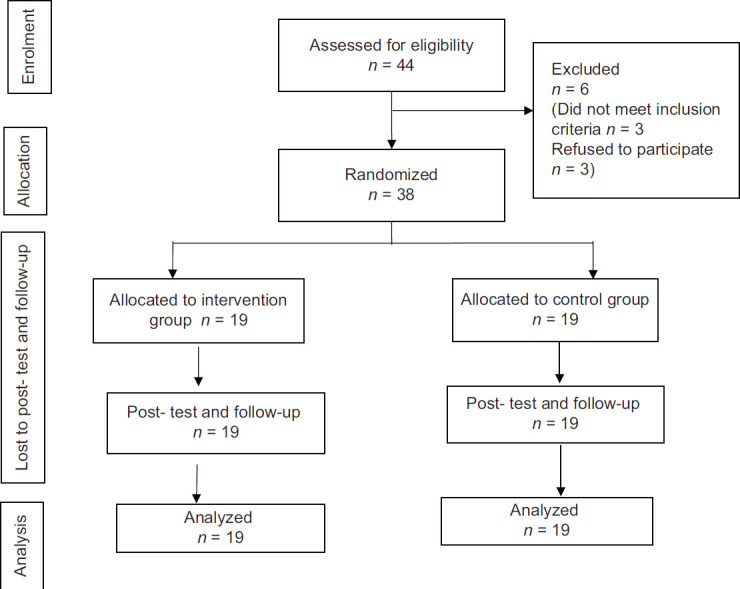
- The study included 38 people (19 experimental, 19 control); the groups did not differ significantly on demographic variables (age, gender, marital status, education; P > 0.05).
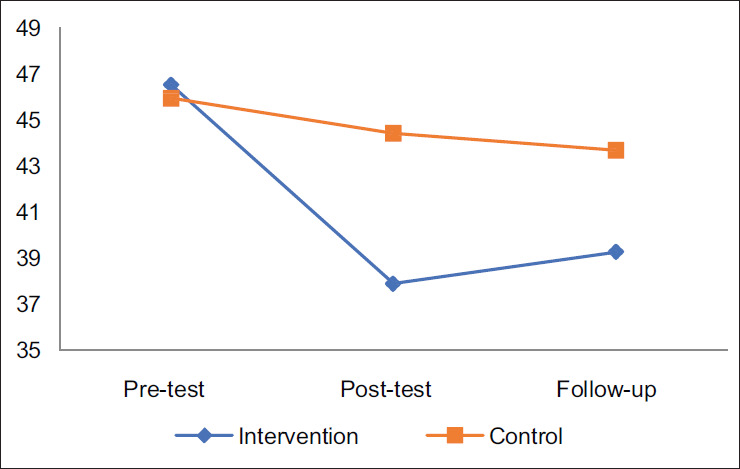
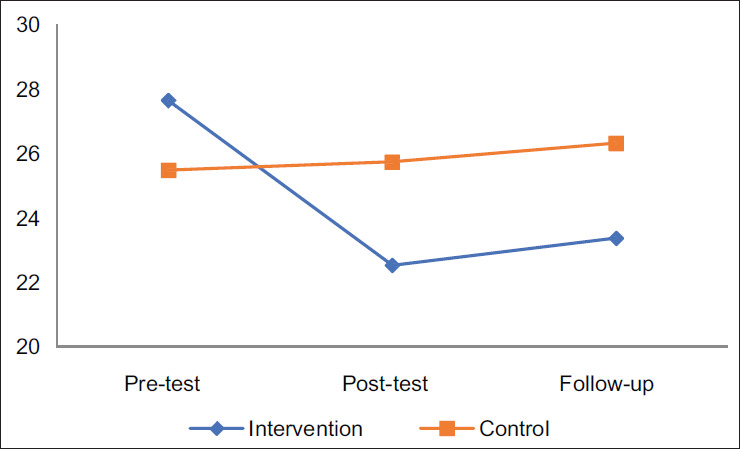
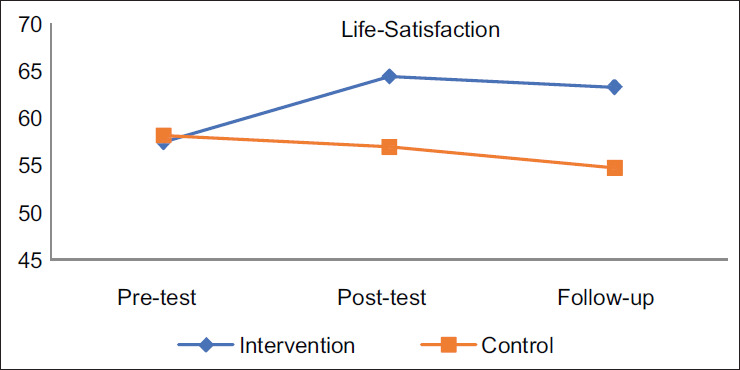
- ACT produced significant time-by-group changes in all three outcomes: complicated grief (P < 0.05), corona disease anxiety (P = 0.001), and quality of life (P = 0.001), with the paper reporting a small effect coefficient for these between-group changes.
- For all three outcomes, there were significant differences from pre-test to post-test and from pre-test to follow-up (P < 0.05 or P = 0.001 as reported), while the post-test vs follow-up difference was insignificant.
- The authors conclude that ACT had significant effects on reducing complicated grief and corona disease anxiety and improving quality of life in survivors of those deceased due to COVID-19.
Methods
- Design: Experimental study with pre-test, post-test, and 3-month follow-up, using a control group and random assignment; the paper states it was double-blind with evaluator and statistical analyst blinded.
- Sample/data: 38 volunteers recruited via calls and advertisements in treatment/counseling centers; inclusion required loss of a loved one due to COVID-19, at least 3 months since the death, age 18 years or older, and at least 9 years of education.
- Analysis: Outcomes were measured with the Complex Grief Scale, Coronavirus Anxiety Scale, and WHOQOL-BRIEF; analysis used mixed ANOVA and independent t-tests in SPSS 26, with P < 0.05 as significant.
Limitations
- The paper explicitly states the follow-up period was relatively short, so generalization to longer time horizons should be cautious.
- The paper states the sample was 18 years old; this appears to mean adults only, so the findings are limited for people under 18.
- Evident from the text: the sample was small (n = 38) and drawn from volunteers in counseling/treatment centers, which may limit generalizability.
Model-written summary. Check it against the paper before relying on it.
Integrity signals
Registry
Cites
Statistics
Figures
Verification
Claims the paper makes
0 Valid · 0 Not valid · 4 Not checked · 26 Own results and interpretations
A result the paper reports from its own data — it cites no other source for it, so there is none to check. The quote shows it is in the paper.
In the paper
“According to Table 2, there was a significant difference (P value < 0.05) between the two intervention and control groups (with a small effect coefficient) in the average changes of complex grief symptoms over time”
§ The effectiveness of acceptance and commitment therapy in reducing the symptoms of complicated grief, corona disease anxiety, and improving the quality of life in the survivors of the deceased due to COVID-19 > Results
plain- Asserted: passes — The authors put it forward as true.
- Checkable: passes — It can be checked against evidence.
- Load-bearing: passes — The paper’s conclusions depend on it.
- Based: passes — The paper gives a reason why it holds.
A result the paper reports from its own data — it cites no other source for it, so there is none to check. The quote shows it is in the paper.
In the paper
“Changes in the average quality of life over time between the two intervention and control groups (with a small effect coefficient) had a significant difference (P value = 0.001)”
§ The effectiveness of acceptance and commitment therapy in reducing the symptoms of complicated grief, corona disease anxiety, and improving the quality of life in the survivors of the deceased due to COVID-19 > Results
plain- Asserted: passes — The authors put it forward as true.
- Checkable: passes — It can be checked against evidence.
- Load-bearing: passes — The paper’s conclusions depend on it.
- Based: passes — The paper gives a reason why it holds.
A result the paper reports from its own data — it cites no other source for it, so there is none to check. The quote shows it is in the paper.
In the paper
“Also, there was a significant difference (P value = 0.001) between the intervention and control groups (with a small effect coefficient) over time, the changes in the average of corona disease anxiety”
§ The effectiveness of acceptance and commitment therapy in reducing the symptoms of complicated grief, corona disease anxiety, and improving the quality of life in the survivors of the deceased due to COVID-19 > Results
plain- Asserted: passes — The authors put it forward as true.
- Checkable: passes — It can be checked against evidence.
- Load-bearing: passes — The paper’s conclusions depend on it.
- Based: passes — The paper gives a reason why it holds.
A result the paper reports from its own data — it cites no other source for it, so there is none to check. The quote shows it is in the paper.
In the paper
“The results of the independent t-test to compare the average symptoms of complicated grief between the intervention and control groups in three stages before the intervention, after the intervention, and follow-up indicated that the average symptoms of complicated grief after the intervention and in the follow-up in the experimental group were less than the control group (P value > 0.001).”
§ The effectiveness of acceptance and commitment therapy in reducing the symptoms of complicated grief, corona disease anxiety, and improving the quality of life in the survivors of the deceased due to COVID-19 > Discussion
hedged- Asserted: passes — The authors put it forward as true.
- Checkable: passes — It can be checked against evidence.
- Load-bearing: passes — The paper’s conclusions depend on it.
- Based: passes — The paper gives a reason why it holds.
A result the paper reports from its own data — it cites no other source for it, so there is none to check. The quote shows it is in the paper.
In the paper
“Additionally, the results of the independent t-test to compare the average quality of life between the intervention and control groups in three stages of pre-test, post-test, and follow-up indicated that quality of life after the intervention and in the follow-up was significantly lower in the intervention group than in the control group (P value > 0.001).”
§ The effectiveness of acceptance and commitment therapy in reducing the symptoms of complicated grief, corona disease anxiety, and improving the quality of life in the survivors of the deceased due to COVID-19 > Discussion
hedged- Asserted: passes — The authors put it forward as true.
- Checkable: passes — It can be checked against evidence.
- Load-bearing: passes — The paper’s conclusions depend on it.
- Based: passes — The paper gives a reason why it holds.
6 more claims
Create a free account to see all 30 claims and every source verdict.
- It may state two separate claims as one. 14
- The quote only partly states this claim. 3
- Probably not a substantial claim. 7
Self-check
Percentages, sums and reported differences re-computed from the paper’s own numbers.
Each contradiction between two passages listed here was confirmed by an independent check.
Rated major: it would touch a result — a value a result rests on, reported and recomputed p-values on opposite sides of the significance level, two passages that conflict with no sign which is right, or a cited work retracted before this paper was published.
In the paper
§ The effectiveness of acceptance and commitment therapy in reducing the symptoms of complicated grief, corona disease anxiety, and improving the quality of life in the survivors of the deceased due to COVID-19 > Results
“but there was an insignificant difference between the post-test and follow-up (P value = 0.011).”
§ The effectiveness of acceptance and commitment therapy in reducing the symptoms of complicated grief, corona disease anxiety, and improving the quality of life in the survivors of the deceased due to COVID-19 > Materials and Methods > Data analysis
“In all the analyses, P value <0.05 was considered statistically significant.”
Rated minor: it would not touch a result — a value no result rests on, a p-value that stays on the same side of the significance level, or a conflict that is clerical, resolved elsewhere in the paper, or outside its own findings.
In the paper
§ The effectiveness of acceptance and commitment therapy in reducing the symptoms of complicated grief, corona disease anxiety, and improving the quality of life in the survivors of the deceased due to COVID-19 > Abstract > CONCLUSIONS:
“ACT has significant effects on reducing the symptoms of complicated grief and corona disease anxiety as well as on improving the quality of life in the survivors of the deceased due to COVID-19.”
§ The effectiveness of acceptance and commitment therapy in reducing the symptoms of complicated grief, corona disease anxiety, and improving the quality of life in the survivors of the deceased due to COVID-19 > Discussion
“quality of life after the intervention and in the follow-up was significantly lower in the intervention group than in the control group (P value > 0.001).”
Cited works that were retracted
Works this paper cites that were later retracted, from the retraction notices publishers deposit. Major when the notice came out before this paper was published.
Rated major: it would touch a result — a value a result rests on, reported and recomputed p-values on opposite sides of the significance level, two passages that conflict with no sign which is right, or a cited work retracted before this paper was published.
In the paper
“Afshari, 2020, Study of dialectical behavior therapy versus cognitive behavior therapy on emotion regulation and mindfulness in patients with generalized anxiety disorder, J Contemp Psychother, 50, 305, 10.1007/s10879-020-09461-9”
Cited work 10.1007/s10879-020-09461-9 · retracted 2024-08-27 · notice 10.1007/s10879-024-09644-8 · this paper published 2024-10
Rated major: it would touch a result — a value a result rests on, reported and recomputed p-values on opposite sides of the significance level, two passages that conflict with no sign which is right, or a cited work retracted before this paper was published.
In the paper
“Afshari, 2020, Effects of dialectical behavior therapy on executive functions, emotion regulation, and mindfulness in bipolar disorder, J Contemp Psychother, 50, 123, 10.1007/s10879-019-09442-7”
Cited work 10.1007/s10879-019-09442-7 · retracted 2024-08-08 · notice 10.1007/s10879-024-09643-9 · this paper published 2024-10
Citations
Cites
2 retracted
Afshari, B., & Hasani, J. (2020) · Journal of Contemporary Psychotherapy · doi:10.1007/s10879-020-09461-9 · Cited by 45
RetractedAfshari, B., Omidi, A., & Ahmadvand, A. (2020) · Journal of Contemporary Psychotherapy · doi:10.1007/s10879-019-09442-7 · Cited by 38
RetractedA pneumonia outbreak associated with a new coronavirus of probable bat origin
Zhou, P., Yang, X.-L., Wang, X.-G., Hu, B., Zhang, L., Zhang, W., Si, H.-R., Zhu, Y., Li, B., Huang, C.-L., et al. (2020) · Nature · doi:10.1038/s41586-020-2012-7 · Cited by 21,969
Acceptance and commitment therapy: model, processes and outcomes
Hayes, S. C., Luoma, J. B., Bond, F. W., Masuda, A., & Lillis, J. (2006) · Behaviour Research and Therapy · doi:10.1016/j.brat.2005.06.006 · Cited by 6,587
Inventory of complicated grief: a scale to measure maladaptive symptoms of loss.
Prigerson, H. G., Maciejewski, P. K., Reynolds, C. F., Bierhals, A. J., Newsom, J. T., Fasiczka, A., Frank, E., Doman, J., & Miller, M. (1995) · Psychiatry Research · doi:10.1016/0165-1781(95)02757-2 · Cited by 1,582
COVID-19 anxiety symptoms associated with problematic smartphone use severity in Chinese adults
Elhai, J. D., Yang, H., McKay, D., & Asmundson, G. J. G. (2020) · Journal of Affective Disorders · doi:10.1016/j.jad.2020.05.080 · Cited by 325
Shankman, S. A., Funkhouser, C. J., Klein, D. N., Davila, J., Lerner, D., & Hee, D. (2018) · International Journal of Methods in Psychiatric Research · doi:10.1002/mpr.1590 · Cited by 258
Acceptance and Commitment Therapy in the treatment of anxiety: A systematic review
Swain, J., Hancock, K., Hainsworth, C., & Bowman, J. (2013) · Clinical Psychology Review · doi:10.1016/j.cpr.2013.07.002 · Cited by 207
Persons Evaluated for 2019 Novel Coronavirus — United States, January 2020
Bajema, K. L., Oster, A. M., McGovern, O. L., Lindstrom, S., Stenger, M. R., Anderson, T. C., Isenhour, Clarke, K. R., Evans, M. E., Chu, V. T., et al. (2020) · MMWR. Morbidity and Mortality Weekly Report · doi:10.15585/mmwr.mm6906e1 · Cited by 200
Purba, F. D., Hunfeld, J. A. M., Iskandarsyah, A., Fitriana, T. S., Sadarjoen, S. S., Passchier, J., & Busschbach, J. J. V. (2018) · PLOS ONE · doi:10.1371/journal.pone.0197098 · Cited by 170
Preliminary validation of the Corona Disease Anxiety Scale (CDAS) in the Iranian sample
(2020) · Hospital Pharmacy · doi:10.30473/hpj.2020.52023.4756 · Cited by 146
Shabani, A., Masoumian, S., Zamirinejad, S., Hejri, M., Pirmorad, T., & Yaghmaeezadeh, H. (2021) · Brain and Behavior · doi:10.1002/brb3.1894 · Cited by 133
Crane, R. S., & Kuyken, W. (2013) · Mindfulness · doi:10.1007/s12671-012-0121-6 · Cited by 120
Cognitive Behaviour Therapy for Health Anxiety: A Systematic Review and Meta-Analysis
Cooper, K., Gregory, J. D., Walker, I., Lambe, S., & Salkovskis, P. M. (2017) · Behavioural and Cognitive Psychotherapy · doi:10.1017/s1352465816000527 · Cited by 118
Psychological flexibility in the context of COVID-19 adversity: Associations with distress
Kroska, E. B., Roche, A. I., Adamowicz, J. L., & Stegall, M. S. (2020) · Journal of Contextual Behavioral Science · doi:10.1016/j.jcbs.2020.07.011 · Cited by 108
Telemedicine in India: A tool for transforming health care in the era of COVID-19 pandemic
Agarwal, N., Jain, P., Pathak, R., & Gupta, R. (2020) · Journal of Education and Health Promotion · doi:10.4103/jehp.jehp_472_20 · Cited by 107
Folke, F., Parling, T., & Melin, L. (2012) · Cognitive and Behavioral Practice · doi:10.1016/j.cbpra.2012.01.002 · Cited by 100
Prolonged grief disorder: clinical utility of ICD-11 diagnostic guidelines
Mauro, C., Reynolds, C. F., Maercker, A., Skritskaya, N., Simon, N., Zisook, S., Lebowitz, B., Cozza, S. J., & Shear, M. K. (2019) · Psychological Medicine · doi:10.1017/s0033291718001563 · Cited by 73
Hertenstein, E., Thiel, N., Lüking, M., Külz, A. K., Schramm, E., Baglioni, C., Spiegelhalder, K., Riemann, D., & Nissen, C. (2014) · Psychotherapy and Psychosomatics · doi:10.1159/000365173 · Cited by 63
Grief and COVID-19: Mourning our bygone lives
Weir, K. (2020) · PsycEXTRA Dataset · doi:10.1037/e502612020-001 · Cited by 58
Caletti, E., Massimo, C., Magliocca, S., Moltrasio, C., Brambilla, P., & Delvecchio, G. (2022) · Journal of Affective Disorders · doi:10.1016/j.jad.2022.05.008 · Cited by 54
Han, A., & Kim, T. H. (2022) · Journal of Medical Internet Research · doi:10.2196/39727 · Cited by 50
Afshari, B., Dehkordi, F. J., Farid, A. A. A., Aramfar, B., Balagabri, Z., Mohebi, M., Mardi, N., & Amiri, P. (2022) · Trends in Psychiatry and Psychotherapy · doi:10.47626/2237-6089-2020-0156 · Cited by 42
Rezaie, Z., Afshari, B., & Balagabri, Z. (2025) · Journal of Contemporary Psychotherapy · doi:10.1007/s10879-020-09487-z · Cited by 33
Saji, J. A., Babu, B. P., & Sebastian, S. R. (2020) · Journal of Education and Health Promotion · doi:10.4103/jehp.jehp_650_20 · Cited by 31
The Need for Psychosocial Interventions to Manage the Coronavirus Crisis
Javadi, S. M. H., Arian, M., & Qorbani-Vanajemi, M. (2020) · Iranian Journal of Psychiatry and Behavioral Sciences · doi:10.5812/ijpbs.102546 · Cited by 27
Afshari, B., Shiri, N., Ghoreishi, F. S., & Valianpour, M. (2020) · Depression Research and Treatment · doi:10.1155/2020/2543541 · Cited by 26
Han, J., Zhang, L., Liu, Y., Zhang, C., Zhang, Y., Tang, R., & Bi, L. (2022) · Journal of Nursing Management · doi:10.1111/jonm.13696 · Cited by 25
Narges, F. A., Doost, H. T. N., Manshaee, G., & Nadi, M. A. (2016) · ranian Journal of Health Education and Health Promotion · doi:10.18869/acadpub.ihepsaj.4.1.31 · Cited by 19
Ganesan, S., Thulasingam, M., Gunaseelan, K., Kalaiarasi, R., Penumadu, P., Ravichandran, S., Alexander, A., & Rogers, S. N. (2019) · Asian Pacific Journal of Cancer Prevention · doi:10.31557/apjcp.2019.20.12.3649 · Cited by 16
Psychometric Properties of the Persian Version of the Inventory of Complicated Grief
Yousefi, S., Mayeli, P., & Ashouri, A. (2022) · OMEGA - Journal of Death and Dying · doi:10.1177/00302228221102687 · Cited by 16
Afshari, B., Rasouli‐Azad, M., & Ghoreishi, F. S. (2018) · Personality and Individual Differences · doi:10.1016/j.paid.2018.10.026 · Cited by 15
Afshari, B. (2020) · Current Issues in Personality Psychology · doi:10.5114/cipp.2020.95148 · Cited by 14
Effectiveness of Acceptance and Commitment Therapy compared to CBT+: Preliminary results
Pleger, M., Treppner, K., Diefenbacher, A., Schade, C., Dambacher, C., & Fydrich, T. (2018) · The European Journal of Psychiatry · doi:10.1016/j.ejpsy.2018.03.003 · Cited by 11
Effectiveness of Trauma-Focused Behavioral Method on Post-Traumatic Growth among Abused Children
Salami, S., Naami, A., Zargar, Y., & Davoodi, I. (2017) · نشریه روان پرستاری · doi:10.21859/ijpn-05013 · Cited by 10
VALIDATION AND RELIABILITY ASSESSMENT OF THE PERSIAN VERSION OF OBSESSIVE BELIEFS QUESTIONNAIRE-44
Shams, G., Karamghadiri, N., Torkanbori, Y. E., et al. (2004) · Advances in Cognitive Science · Cited by 8
Afshari, B., Khezrian, K., & Faghihi, A. (2019) · DOAJ (DOAJ: Directory of Open Access Journals) · doi:10.22122/jims.v37i520.11149 · Cited by 7
Prolonged grief disorder treatment: An approach to COVID-19 grief
Martínez-Medina, C. B., & Rodríguez-Orozco, A. R. (2023) · Salud Mental · doi:10.17711/sm.0185-3325.2023.021 · Cited by 5
Medina-Reina, D. P., & Ruiz, F. J. (2022) · Revista de Psicoterapia · doi:10.33898/rdp.v33i122.1149 · Cited by 5
Rafii, M., skandari, H., Borjali, A., & Farokhi, N. (2019) · DOAJ (DOAJ: Directory of Open Access Journals) · doi:10.22054/qccpc.2019.28112.1707 · Cited by 4
Abtahi, N., & rakhshan, P. (2022) · Psychology of Woman Journal · doi:10.52547/psychowoman.3.4.79 · Cited by 4
Joharifard, R., Nouri, R., Hazrati, S., & Arani, S. F. (2022) · International Journal of Body, Mind and Culture · doi:10.22122/ijbmc.v9i2.350 · Cited by 3
Aslāni, K., Hajihaidary, M., Rajabi, G., et al. (2019) · Cited by 2
Manesh, N. E., Shibani, K. A., & Javanmard, G. (2020) · DOAJ (DOAJ: Directory of Open Access Journals) · doi:10.22051/psy.2020.24025.1828 · Cited by 1
Foroshani, N. A., & Rakhshan, P. (2022) · The psychology of woman journal · doi:10.61838/kman.pwj.3.4.6
Research works printed but not linked: 11
- Farnoosh G Alishiri G Zijoud S Dorostkar R Farahani AJ Understanding the 2019-novel coronavirus (2019-nCoV) and coronavirus disease (COVID-19) based on available evidence-A narrative review J Mil Med 2020 22 1 11
- Fathi Ashtiani A Rahnejat AM Ahmadi Tahour Soltani M Taghva A Ebrahimi MR Donyavi V Psychological consequences and interventions during the COVID-19 pandemic: Narrative review J Mar Med 2020 2 1 11
- Afshari B Valianpour M Balagabri Z Aramfar B Vaseghi N Mohebi M Personality psychology behind social anxiety disorder: Revisiting past and present researches Adv Psychol Res 2022 149
- Afshari B Keyhani A Balagabri Z Aramfar B Vaseghi N Vaseghi F emotion regulation psychotherapies: Revisiting past and present researches and moving toward future directions Understanding emotions 1
- Nematipour Z Golzari M The effectiveness of group grief counseling and grief therapy using a religious approach on improving the quality of life in bereaved mothers Research in Clinical Psychology and Counseling 2015 5 52 69
- Nejat S Montazeri A Holakouie Naieni K Mohammad K Majdzadeh S The World Health Organization quality of life (WHOQOL-BREF) questionnaire: Translation and validation study of the Iranian version J Sch Public Health Inst Public Health Res 2006 4 1 12
- Roshani M The effectiveness of acceptance and commitment-based therapy on corona anxiety in the elderly Clin Health Psychol 2022 1 43 52
- Talebi M Teymuri H The Effectiveness of Online Training in Acceptance and Commitment Therapy on Psychological Distress and Resilience of Nurses with Covid-19 3 JNE 2022 11 2 1 11
- Dinarvand N Barghi Irani Z Forstmeier S The comparison of the effectiveness of positive therapy and acceptance and commitment therapy on the anxiety and depression of the elderly living in nursing homes Aging Psychol 2022 8 189 203
- Afshari B Hasani J Hanzaii MM Nasrollahizadeh H Amiri P A systematic review of current psychological interventions for bipolar disorder Adv Psychol Res 2023 150 115 36
- Afshari B Valianpour M Rezaie Z Balagabri Z Mardi N Keyhani A Executive function and therapy of mental disorders: Move toward future directions Advances in Psychology Research 2021 144 61 121
Cited by
Barrett, M. E., & Welsh, D. P. (2025) · Clinical Case Studies · doi:10.1177/15346501251368809 · Cited by 1
Coronavirus anxiety and its relationship to mood and cognition in post-acute sequelae of COVID-19
Darwazah, H., Hammond, J. B., Aita, S. L., Moncrief, G. G., Thompson, R. C., Lichtenstein, J. D., & Roth, R. M. (2025) · Applied Neuropsychology Adult · doi:10.1080/23279095.2025.2469247
Nzeadibe, A. C., Egara, F. O., Eseadi, C., Madu, B. C., Mosia, M. S., & Chukwuorji, J. C. (2025) · Social Sciences & Humanities Open · doi:10.1016/j.ssaho.2025.102190 · Cited by 2
Rajabi, M., Pourshahbaz, A., Taremian, F., & Asl, E. M. (2026) · Journal of Education and Health Promotion · doi:10.4103/jehp.jehp_69_25
Tsipper, I., & Ifrah, K. (2026) · Death Studies · doi:10.1080/07481187.2026.2704572
Metadata
- Authors
- Alkasir, E., Masjedi-Arani, A., Bakhtiyari, M., & Isfeedvajani, M. S.
- Affiliations
- Shahid Beheshti University (IR)
- Department of Clinical Psychology, School of Medicine, Shahid Beheshti University of Medical Sciences, Tehran, Iran
- Baqiyatallah University of Medical Sciences (IR)
- Venue
- Journal of Education and Health Promotion
- Published
- 2024-10
- Volume
- 13
- Issue
- 1
- Pages
- 406-406
- ISSN
- 2277-9531 (ISSN-L)
- 2319-6440
- PMC
- PMC11658037
- OpenAlex
- W4404110409
- Cited by
- 6
- References
- 57
- Citations by year
- 2026: 3 · 2025: 3
- FWCI
- 3.00
- Type
- journal article
- Language
- en
- Open access
- gold
- doi.org
- Licence
- cc-by-nc-sa
- Locations
- Journal of Education and Health Promotion (publishedVersion, cc-by-nc-sa)
- PubMed Central (publishedVersion, cc-by-nc-sa)
- PubMed (publishedVersion)
- DOAJ (DOAJ: Directory of Open Access Journals) (submittedVersion)
- Funders
- Shahid Beheshti University of Medical Sciences
- Topics
- Social Sciences › Psychology › Clinical Psychology › Mindfulness and Compassion Interventions
- Social Sciences › Psychology › Clinical Psychology › Grief, Bereavement, and Mental Health
- Social Sciences › Psychology › Clinical Psychology › COVID-19 and Mental Health
- Keywords
- acceptance and commitment therapy, complicated grief, COVID-19 anxiety, quality of life, bereavement, COVID-19 survivors, grief intervention
About these checks
Registry, retraction, Cites and statistics results are computed, not judged, with one exception: a printed reference that no index lists is read once by a model before it counts as a citation error. Claims are extracted by a model and kept only when their quote appears verbatim in the text; each cited source is then checked, with a model’s help, for whether it says what the claim relies on. Those verdicts can be wrong — read the claim’s quote and the cited source before relying on one.
A language model drew the claims from the paper on 2026-10-11, under version 3 of the claim definition (model deepseek-v4.1-flash, prompt extract-v3).
A second model labelled each claim on 2026-10-11 (model jev-1.13-20260917, definition revision gold-guideline-v0.2).
Statistics and arithmetic are recomputed, not judged.
Confidence bands are shown only for fields calibrated on our annotated test set. None is calibrated yet, so no band is shown.
What counts as a claim ›How we measure confidence ›How we check this ›
Are you an author, or do you see a problem with this page? Request a review
Data sources
Bibliographic data: Semantic Scholar, OpenAlex, Crossref.
Contains information from the Semantic Scholar Academic Graph Datasets, made available under the ODC Attribution License (ODC-BY 1.0).
Semantic Scholar’s data is described in: Kinney, R., et al. (2023). The Semantic Scholar Open Data Platform. arXiv:2301.10140.
