

Randomized trial of the efficacy of trial-based cognitive therapy for obsessive-compulsive disorder: preliminary findings
Open accessThe DOI matches its Crossref record; 54 of the 58 references it cites were found in a registry or an index; none of the 24 sources its claims cite is checked for support yet.
Abstract
Introduction: Obsessive-compulsive disorder (OCD) is the fourth most prevalent mental disorder and is a disabling condition. OCD is associated with anatomical and functional changes in the brain, in addition to dysfunctional cognitions. The treatments of choice are selective serotonin reuptake inhibitors, cognitive-behavioral therapy (CBT), and exposure and response prevention (ERP). Trial-based cognitive therapy (TBCT) is a recent and empirically validated psychotherapy with a focus on restructuring dysfunctional negative core beliefs (CBs). The objective of this study was to evaluate the efficacy of TBCT relative to ERP for treatment of OCD. Methods: A randomized, single-blind clinical trial was conducted, randomizing 26 patients for individual treatment with TBCT (n = 12) or ERP (n = 14). The groups were evaluated at baseline, at the end of 3 months (12 sessions), and at 3, 6, and 12-month follow-ups. Results: Both approaches reduced the severity of symptoms with large effect sizes. These results were maintained at the 12-month follow-up assessment. Conclusion: TBCT may be a valid and promising treatment for this disorder. © 2023, Sociedade de Psiquiatria do Rio Grande do Sul. All rights reserved.
Overview
CoChat Summary
## TL;DR
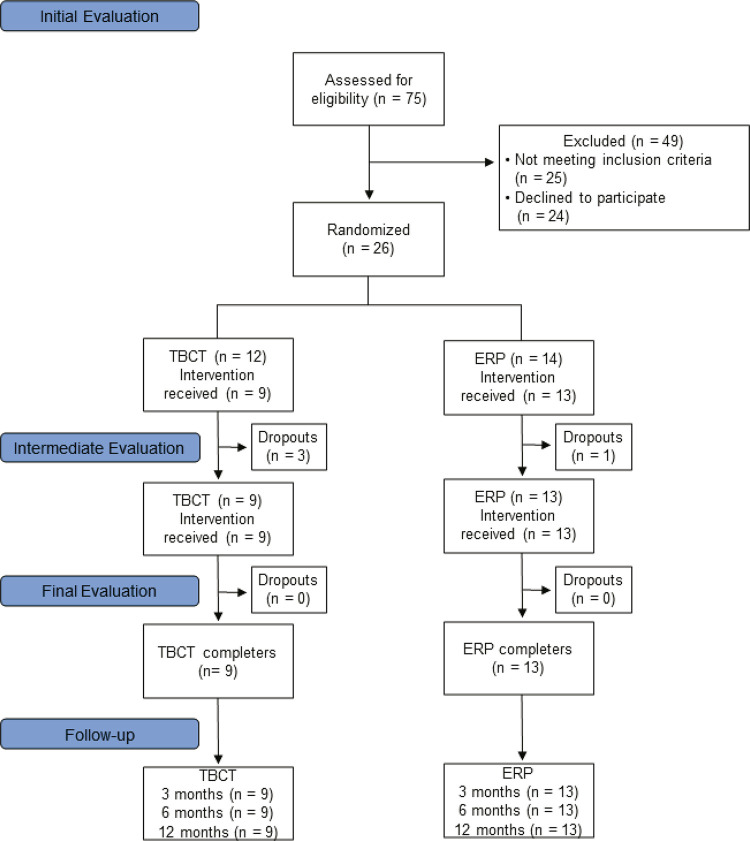
This randomized, single-blind trial compared trial-based cognitive therapy (TBCT) with exposure and response prevention (ERP) for OCD in 26 patients. Both treatments reduced OCD, depression, and anxiety symptoms, but TBCT did not outperform ERP on symptom reduction; it did yield more recovered patients at 12-month follow-up.
## Key findings
- Of 26 randomized patients, 22 completed treatment (TBCT = 9, ERP = 13); the sample was 61.54% women and had a mean age of 32.8 years (SD = 11.3).
- Total Y-BOCS scores decreased significantly over time in both groups (β = -11.678, p < 0.001), with no significant difference between TBCT and ERP (β = -1.194, p = 0.45) and no time × group interaction (β = -0.109, p = 0.97).
- Depression and anxiety also improved in both groups: BDI (β = -13.148, p < 0.001) and BAI (β = -16.943, p < 0.001), again with no evidence TBCT differed from ERP on these outcomes.
- At 12-month follow-up, 55.6% (5/9) of TBCT completers met recovery criteria versus 7.7% (1/13) of ERP completers (Fisher’s exact test: p = 0.02); improvement rates were 66.7% (6/9) for TBCT and 23.1% (3/13) for ERP (p = 0.07).
## Methods
- Randomized, single-blind clinical trial comparing individual TBCT versus ERP over 12 weekly 1-hour sessions, with assessments at baseline, post-treatment, and 3-, 6-, and 12-month follow-ups.
- Participants: 26 adults with DSM-IV OCD and Y-BOCS ≥ 16, recruited from public health services, health professionals’ offices, and publicity; 75 were screened and 22 completed treatment.
- Primary outcome was Y-BOCS; secondary outcomes were BDI and BAI. Analyses used intention-to-treat with multiple imputation and generalized estimating equations, plus effect sizes and clinically significant change criteria.
## Limitations
- The paper’s stated main limitation was small sample size: the required size was 32 patients per arm, but the study included fewer patients than ideal.
- The authors also stated four additional limitations: sensory phenomena were not measured; medication stability was requested but not monitored; satisfaction with the interventions was not evaluated; and there was no detailed quantitative method to measure protocol fidelity.
- Evident from the text: only 22 of 26 randomized patients completed treatment, and the paper reports that it is a preliminary study, so precision and generalizability are limited.
Model-written summary. Check it against the paper before relying on it.
Integrity signals
Registry
Cites
Statistics
Figures
Verification
Claims the paper makes
0 Valid · 0 Not valid · 14 Not checked · 44 Own results and interpretations
A result the paper reports from its own data — it cites no other source for it, so there is none to check. The quote shows it is in the paper.
In the paper
“results showed that there was no effect of time × group on Y-BOCS total scores (β = -0.109, p = 0.97)”
§ Randomized trial of the efficacy of trial-based cognitive therapy for obsessive-compulsive disorder: preliminary findings > Results > Main results
plain- Asserted: passes — The authors put it forward as true.
- Checkable: passes — It can be checked against evidence.
- Load-bearing: passes — The paper’s conclusions depend on it.
- Based: passes — The paper gives a reason why it holds.
- Rests on an assumption not shown here.
A result the paper reports from its own data — it cites no other source for it, so there is none to check. The quote shows it is in the paper.
In the paper
“There were statistically significant reductions in total Y-BOCS scores over time in both the TBCT and the ERP groups (β = -11.678, p < 0.001).”
§ Randomized trial of the efficacy of trial-based cognitive therapy for obsessive-compulsive disorder: preliminary findings > Results > Main results
plainstates a cause- Asserted: passes — The authors put it forward as true.
- Checkable: passes — It can be checked against evidence.
- Load-bearing: passes — The paper’s conclusions depend on it.
- Based: passes — The paper gives a reason why it holds.
- Rests on an assumption not shown here.
A result the paper reports from its own data — it cites no other source for it, so there is none to check. The quote shows it is in the paper.
In the paper
“At the 12-month follow-up, 66.7% (six out of nine) patients in the TBCT arm met the improvement criteria, relative to 23.1% (three out of 13) in the ERP group (Fisher’s exact test: p = 0.07).”
§ Randomized trial of the efficacy of trial-based cognitive therapy for obsessive-compulsive disorder: preliminary findings > Clinically significant changes
plain- Asserted: passes — The authors put it forward as true.
- Checkable: passes — It can be checked against evidence.
- Load-bearing: passes — The paper’s conclusions depend on it.
- Based: passes — The paper gives a reason why it holds.
A result the paper reports from its own data — it cites no other source for it, so there is none to check. The quote shows it is in the paper.
In the paper
“there was a lack of evidence of difference between TBCT and ERP concerning Y-BOCS-obsessions: (β = -1.572, p = 0.25).”
§ Randomized trial of the efficacy of trial-based cognitive therapy for obsessive-compulsive disorder: preliminary findings > Results > Main results
plain- Asserted: passes — The authors put it forward as true.
- Checkable: passes — It can be checked against evidence.
- Load-bearing: passes — The paper’s conclusions depend on it.
- Based: passes — The paper gives a reason why it holds.
- Rests on an assumption not shown here.
A result the paper reports from its own data — it cites no other source for it, so there is none to check. The quote shows it is in the paper.
In the paper
“results showed that there was no effect of time × group (β = -0.811, p = 0.65).”
§ Randomized trial of the efficacy of trial-based cognitive therapy for obsessive-compulsive disorder: preliminary findings > Results > Main results
plain- Asserted: passes — The authors put it forward as true.
- Checkable: passes — It can be checked against evidence.
- Load-bearing: passes — The paper’s conclusions depend on it.
- Based: passes — The paper gives a reason why it holds.
- Rests on an assumption not shown here.
28 more claims
Create a free account to see all 58 claims and to verify the 15 references still open.
- It may state two separate claims as one. 18
- Probably not a substantial claim. 11
Citations
Cites
An inventory for measuring depression
BECK, A. T. (1961) · Archives of General Psychiatry · doi:10.1001/archpsyc.1961.01710120031004 · Cited by 38,032 · cited 6×
“The primary outcome measure was the Y-BOCS, 44 and secondary outcome measures were the Beck Depression Inventory (BDI) 46 and the Beck Anxiety Inventory (BAI).”
InfluentialAn inventory for measuring clinical anxiety: Psychometric properties.
Beck, A. T., Epstein, N., Brown, G., & Steer, R. A. (1988) · Journal of Consulting and Clinical Psychology · doi:10.1037/0022-006x.56.6.893 · Cited by 14,407 · cited 1×
“The primary outcome measure was the Yale-Brown Obsessive-Compulsive Scale (Y-BOCS),(44) and the secondary ones were Beck Depression Inventory (BDI)(46) and Beck Anxiety Inventory (BAI).(47) The evaluations took place at baseline, after”
Depression and quality of life in older persons: A review
Sivertsen, H., Bjørkløf, G. H., Engedal, K., Selbæk, G., & Helvik, A.-S. (2015) · Dementia and Geriatric Cognitive Disorders · doi:10.1159/000437299 · Cited by 14,152
Moher, D., Hopewell, S., Schulz, K. F., Montori, V., Gotzsche, P. C., Devereaux, P. J., Elbourne, D., Egger, M., & Altman, D. G. (2010) · BMJ · doi:10.1136/bmj.c869 · Cited by 8,883
Development of the World Health Organization WHOQOL-BREF Quality of Life Assessment
THE WHOQOL GROUP (1998) · Psychological Medicine · doi:10.1017/s0033291798006667 · Cited by 7,933 · cited 2×
“TBCT and BA were also better than TAU in reducing disability and quality of life physical domain scores, according to WHOQoL.(38) The dropout rate was higher in the”
Jacobson, N. S., & Truax, P. (1991) · Journal of Consulting and Clinical Psychology · doi:10.1037/0022-006x.59.1.12 · Cited by 7,770 · cited 2×
“Clinically significant changes We replicated the analysis conducted by Belloch et al,(52) who used the criteria proposed by Jacobson and Truax.(39) Patient improvement”
InfluentialThe Yale-Brown Obsessive Compulsive Scale: I. Development, Use, and Reliability
Goodman, W. K. (1989) · Archives of General Psychiatry · doi:10.1001/archpsyc.1989.01810110048007 · Cited by 7,712 · cited 9×
“The primary outcome measure was the Y-BOCS, 44 and secondary outcome measures were the Beck Depression Inventory (BDI) 46 and the Beck Anxiety Inventory (BAI).”
InfluentialScoville, W. B. (1949) · Journal of neurosurgery · doi:10.3171/jns.1949.6.1.0065 · Cited by 7,381
The practice of behavior therapy
Wolpe, J. (1969) · Cited by 2,343
Intention-to-treat concept: A review
Gupta, S. (2011) · Perspectives in Clinical Research · doi:10.4103/2229-3485.83221 · Cited by 1,921
Moher, D., Hopewell, S., Schulz, K. F., Montori, V., Gøtzsche, P. C., Devereaux, P. J., Elbourne, D., Egger, M., & Altman, D. G. (2010) · Journal of Clinical Epidemiology · doi:10.1016/j.jclinepi.2010.03.004 · Cited by 1,858
Multiple Imputation for Nonresponse in Surveys.
King, B., & Rubin, D. B. (1989) · Journal of the American Statistical Association · doi:10.2307/2289952 · Cited by 744
Small studies: strengths and limitations
Hackshaw, A. (2008) · European Respiratory Journal · doi:10.1183/09031936.00136408 · Cited by 496 · cited 1×
“Small-sample studies may produce false-positive results or overestimate the magnitude of an association.(64) Although it is not a problem that could invalidate the study, the reduced sample requires more caution in its interpretation.”
Whittal, M. L., Thordarson, D. S., & McLean, P. D. (2005) · Behaviour Research and Therapy · doi:10.1016/j.brat.2004.11.012 · Cited by 397 · cited 1×
“Thus, both TBCT and ERP Y-BOCS mean scores were in the ranges observed in previous studies regarding changes from baseline.(24,40,41) Whittal et al’s study(40) compared CBT with ERP delivered in”
Del-Ben, C. M., Vilela, J. A. A., Crippa, J. A. D. S., Hallak, J. E. C., Labate, C. M., & Zuardi, A. W. (2001) · Revista Brasileira de Psiquiatria · doi:10.1590/s1516-44462001000300008 · Cited by 386
Foa, E. B., & McLean, C. P. (2016) · Annual Review of Clinical Psychology · doi:10.1146/annurev-clinpsy-021815-093533 · Cited by 360
Cognitive therapy and exposure in vivo in the treatment of obsessive–compulsive disorder
Van Oppen, P., De Haan, E., Van Balkom, A. J. L. M., Spinhoven, P., Hoogduin, K., & Van Dyck, R. (1995) · Behaviour Research and Therapy · doi:10.1016/0005-7967(94)00052-l · Cited by 350 · cited 1×
“17,23,62 So, when the patient is exposed to stimuli that produce obsessions and anxious responses, resisting them, habituation occurs.”
Cognitive versus behavior therapy in the group treatment of obsessive–compulsive disorder
McLean, P. D., Whittal, M. L., Thordarson, D. S., Taylor, S., Söchting, I., Koch, W. J., Paterson, R., & Anderson, K. W. (2001) · Journal of Consulting and Clinical Psychology · doi:10.1037/0022-006x.69.2.205 · Cited by 332
Cottraux, J., Note, I., Yao, S. N., Lafont, S., Note, B., Mollard, E., Bouvard, M., Sauteraud, A., Bourgeois, M., & Dartigues, J.-F. (2001) · Psychotherapy and Psychosomatics · doi:10.1159/000056269 · Cited by 298
Efficacy of cognitive-behavioral therapy for obsessive-compulsive disorder
McKay, D., Sookman, D., Neziroglu, F., Wilhelm, S., Stein, D. J., Kyrios, M., Matthews, K., & Veale, D. (2015) · Psychiatry Research · doi:10.1016/j.psychres.2014.11.058 · Cited by 283
Reid, J. E., Laws, K. R., Drummond, L., Vismara, M., Grancini, B., Mpavaenda, D., & Fineberg, N. A. (2021) · Comprehensive Psychiatry · doi:10.1016/j.comppsych.2021.152223 · Cited by 266 · cited 1×
“10,11 12-14 ERP consists of directly exposing patients to stimuli that evoke obsessions and sensory phenomena while preventing them from executing compulsions.”
VAN BALKOM, A. J. L. M., DE HAAN, E., VAN OPPEN, P., SPINHOVEN, P., HOOGDUIN, K. A. L., & VAN DYCK, R. (1998) · The Journal of Nervous & Mental Disease · doi:10.1097/00005053-199808000-00007 · Cited by 250 · cited 1×
“39-42 11 ; and (3) TBCT was characterized as a transdiagnostic approach, effective in the treatment of SAD, 31 MDD, 21 and PTSD 33 ; we decided to compare the efficacy of TBCT relative to ERP in the treatment of OCD.”
Mind over mood: A cognitive therapy treatment manual for clients.
Greenberger, D., & Padesky, C. A. (1995) · Cited by 219
A 60-Year Evolution of Cognitive Theory and Therapy
Beck, A. T. (2019) · Perspectives on Psychological Science · doi:10.1177/1745691618804187 · Cited by 167 · cited 1×
“11,14 Cognitive therapy (CT) was proposed by Aaron Beck, 19 in the early 1960s, as a structured psychotherapy model whose focus is modification of dysfunctional thoughts and beliefs.”
Exposure and response prevention for obsessive-compulsive disorder: A review and new directions
Simpson, H., & Hezel, D. (2019) · Indian Journal of Psychiatry · doi:10.4103/psychiatry.indianjpsychiatry_516_18 · Cited by 161 · cited 3×
“On the other hand, ERP does not act directly in modifying the cognitive contents of obsessions but proposes to confront them, preventing the performance of rituals.(17,23,62) So, when the patient is”
Clinical Predictors of Drug Nonresponse in Obsessive-Compulsive Disorder
Shetti, C. N., Reddy, Y. C. J., Kandavel, T., Kashyap, K., Singisetti, S., Hiremath, A. S., Siddequehusen, M. U.-F., & Raghunandanan, S. (2005) · The Journal of Clinical Psychiatry · doi:10.4088/jcp.v66n1204 · Cited by 139 · cited 2×
“47626/2237-6089-2021-0247 presentation, our sample was composed of “mixed” OCD subjects, namely, those having both obsessions and compulsions and score ≥16 on the Y-BOCS severity scale according to criteria proposed by Shetti et al.(45)”
InfluentialEfficacy of cognitive-behavioral therapy for obsessive–compulsive disorder
McKay, D., Sookman, D., Neziroglu, F. A., Wilhelm, S., Stein, D. J., Kyrios, M., Matthews, K., & Veale, D. M. (2015) · Psychiatry Research · doi:10.1016/j.psychres.2015.02.004 · Cited by 112 · cited 1×
“is associated with extensive disability that covers all aspects of functioning, increased healthcare use, and diminished quality of life.(9)”
Simpson, H. B., Zuckoff, A. M., Maher, M. J., Page, J. R., Franklin, M. E., Foa, E. B., Schmidt, A. B., & Wang, Y. (2010) · Behaviour Research and Therapy · doi:10.1016/j.brat.2010.05.026 · Cited by 100 · cited 1×
“17,18 Findings show that there is low adherence to the treatment, because of the high level of anxiety produced by exposure.”
Albert, U., Marazziti, D., Di Salvo, G., Solia, F., Rosso, G., & Maina, G. (2019) · Current Medicinal Chemistry · doi:10.2174/0929867325666171222163645 · Cited by 90 · cited 1×
“the treatment due to the high level of anxiety produced by exposure.(11,14) Cognitive therapy (CT) was proposed by Aaron Beck, in the early 1960s, as a structured psychotherapy model whose focus is the modification of dysfunctional thoughts and beliefs.”
Lenhard, F., Ssegonja, R., Andersson, E., Feldman, I., Rück, C., Mataix-Cols, D., & Serlachius, E. (2017) · BMJ Open · doi:10.1136/bmjopen-2016-015246 · Cited by 67
Psychosocial Function and Economic Costs of Obsessive-Compulsive Disorder
Hollander, E., Stein, D. J., Kwon, J. H., Rowland, C., Wong, C. M., Broatch, J., & Himelein, C. (1998) · CNS Spectrums · doi:10.1017/s1092852900007239 · Cited by 58
de Lima Osório, F., Crippa, J. A. S., & Loureiro, S. R. (2011) · International Journal of Psychiatry in Clinical Practice · doi:10.3109/13651501.2011.605955 · Cited by 54
Patient Preferences for Obsessive-Compulsive Disorder Treatment
Patel, S. R., & Simpson, H. B. (2010) · The Journal of Clinical Psychiatry · doi:10.4088/jcp.09m05537blu · Cited by 53
Rosa-Alcázar, Á., Olivares-Olivares, P. J., Martínez-Esparza, I. C., Parada-Navas, J. L., Rosa-Alcázar, A. I., & Olivares-Rodríguez, J. (2020) · International Journal of Clinical and Health Psychology · doi:10.1016/j.ijchp.2019.07.006 · Cited by 53
Functional neural mechanisms of sensory phenomena in obsessive-compulsive disorder
Brown, C., Shahab, R., Collins, K., Fleysher, L., Goodman, W. K., Burdick, K. E., & Stern, E. R. (2019) · Journal of Psychiatric Research · doi:10.1016/j.jpsychires.2018.11.018 · Cited by 52
Standard criteria for relapse are needed in obsessive-compulsive disorder
Simpson, H. B., Franklin, M. E., Cheng, J., Foa, E. B., & Liebowitz, M. R. (2005) · Depression and Anxiety · doi:10.1002/da.20052 · Cited by 50 · cited 1×
“17,23,62 So, when the patient is exposed to stimuli that produce obsessions and anxious responses, resisting them, habituation occurs.”
Fineberg, N. A., Baldwin, D. S., Drummond, L. M., Wyatt, S., Hanson, J., Gopi, S., Kaur, S., Reid, J., Marwah, V., Sachdev, R. A., et al. (2018) · International Clinical Psychopharmacology · doi:10.1097/yic.0000000000000237 · Cited by 47
Lovell, K., Bower, P., Gellatly, J., Byford, S., Bee, P., McMillan, D., Arundel, C., Gilbody, S., Gega, L., Hardy, G., et al. (2017) · PLOS Medicine · doi:10.1371/journal.pmed.1002337 · Cited by 40
de Oliveira, I. R., Powell, V. B., Wenzel, A., Caldas, M., Seixas, C., Almeida, C., Bonfim, T., Grangeon, M. C., Castro, M., Galvão, A., et al. (2012) · Journal of Clinical Pharmacy and Therapeutics · doi:10.1111/j.1365-2710.2011.01299.x · Cited by 39 · cited 2×
“TBCT's main techniques are analogous to a legal trial, in which the patient plays the roles of the defendant, the defense attorney, the prosecutor, the juror, the witnesses, and the judge.28 Trends Psychiatry Psychother - Pre-Proof - http://dx.doi.org/10.47626/2237-6089-2021-0247 Although TBCT is a new CBT model, it h…”
InfluentialSelf-citationA terapia cognitivo-comportamental no transtorno obsessivo-compulsivo
Cordioli, A. V. (2008) · Brazilian Journal of Psychiatry · doi:10.1590/s1516-44462008000600003 · Cited by 39
Individual versus group cognitive behavioral treatment for obsessive–compulsive disorder: Follow up
Jaurrieta, N., Jiménez‐Murcia, S., Alonso, P., Granero, R., Segalàs, C., Labad, J., & Menchón, J. M. (2008) · Psychiatry and Clinical Neurosciences · doi:10.1111/j.1440-1819.2008.01873.x · Cited by 34
Neufeld, C. B., Palma, P. C., Caetano, K. A. S., Brust-Renck, P. G., Curtiss, J., & Hofmann, S. G. (2020) · International Journal of Clinical and Health Psychology · doi:10.1016/j.ijchp.2019.11.004 · Cited by 33
Oliveira, I. R. D. (2008) · Revista Brasileira de Psiquiatria · doi:10.1590/s1516-44462008000100003 · Cited by 32 · cited 2×
“23-25 Trial-based cognitive therapy (TBCT) is one of the most recent approaches under the CBT umbrella, 26,27 inspired by Franz Kafka’s novel, “The Trial.””
Self-citationSouza, F. P., Foa, E. B., Meyer, E., Niederauer, K. G., & Cordioli, A. V. (2011) · Revista Brasileira de Psiquiatria · doi:10.1590/s1516-44462011000200008 · Cited by 32
Treatment of obsessive-compulsive disorders (OCD) and obsessive-compulsive-related disorders (OCRD)
Krzyszkowiak, W., Kuleta-Krzyszkowiak, M., & Krzanowska, E. (2019) · Psychiatria Polska · doi:10.12740/pp/105130 · Cited by 22
Powell, V. B., Oliveira, O. H. D., Seixas, C., Almeida, C., Grangeon, M. C., Caldas, M., Bonfim, T. D., Castro, M., Almeida, A. G.-D., Moraes, R. D. O., et al. (2013) · Revista Brasileira de Psiquiatria · doi:10.1590/1516-4446-2012-0863 · Cited by 21 · cited 2×
“21,29 TBCT is an empirically validated therapy, with evidence of efficacy for treatment of social anxiety disorder (SAD), 30-32 post-traumatic stress disorder (PTSD), 33 major depressive disorder (MDD), 21 and possibly other disorders.”
Hemanny, C., Carvalho, C., Maia, N., Reis, D., Botelho, A. C., Bonavides, D., Seixas, C., & de Oliveira, I. R. (2020) · CNS Spectrums · doi:10.1017/s1092852919001457 · Cited by 18
Self-citationChanging negative core beliefs with trial-based thought record
Delavechia, T. R., Velasquez, M. L., Duran, É. P., Matsumoto, L. S., & Oliveira, I. R. D. (2016) · Archives of Clinical Psychiatry (São Paulo) · doi:10.1590/0101-60830000000078 · Cited by 16 · cited 3×
“34 Moreover, it has also been used as a preventive approach for adolescents in schools.”
Self-citationRück, C., Lundström, L., Flygare, O., Enander, J., Bottai, M., Mataix‐Cols, D., & Andersson, E. (2018) · BMJ Open · doi:10.1136/bmjopen-2018-022254 · Cited by 13
Duran, É. P., Corchs, F., Vianna, A., Araújo, Á. C., Del Real, N., Silva, C., Ferreira, A. P., De Vitto Francez, P., Godói, C., Silveira, H., et al. (2021) · CNS Spectrums · doi:10.1017/s1092852920001455 · Cited by 13 · cited 5×
“However, significant differences in depressive symptoms in favor of Trends Psychiatry Psychother - Pre-Proof - http://dx.doi.org/10.47626/2237-6089-2021-0247 TBCT were observed, and the dropout rate was lower in the TBCT group relative to the PE group, suggesting that TBCT may be an effective alternative for treating…”
InfluentialCaetano, K. A. S., Depreeuw, B., Papenfuss, I., Curtiss, J., Langwerden, R. J., Hofmann, S. G., & Neufeld, C. B. (2018) · International Journal of Cognitive Therapy · doi:10.1007/s41811-018-0028-7 · Cited by 11 · cited 2×
“The TBCT protocol(27) was used to evaluate TBCT efficacy for generalized SAD compared to a waitlist condition in a sample with high rates of comorbid depression.(30) Reductions in social anxiety, social avoidance, and depression, all associated with a large effect size, were observed in the TBCT arm, whereas, no diffe…”
de Oliveira, I. R., Matos, A. C. S., Ribeiro, M. G., et al. (2015) · Current Psychiatry Reviews · doi:10.2174/1573400511666150930233251 · Cited by 9 · cited 1×
“Moreover, it has been used as a preventive approach for adolescents in schools.(35)”
Self-citationTrial-Based Cognitive Therapy: Distinctive features
de Oliveira, I. R. (2016) · Cited by 7
Self-citationCognitive behavioral therapy for obsessive-compulsive disorder
Jun-mian, X. (2010) · World Clinical Drugs · Cited by 3
Research works printed but not linked: 7
- [1]American Psychiatric Association Diagnostic and Statistical Manual of Mental Disorders, Fifth Edition (DSM-5) Arlington American Psychiatric Publishing 2013
- [22]Wenzel A Innovations in cognitive behavioral therapy: strategic interventions for creative practice New York Taylor & Francis 2017
- [27]De Oliveira IR Trial-based cognitive therapy: a manual for clinicians New York Routledge 2015
- [29]De Oliveira IR Trial-based therapy (TBT): a new cognitive-behavior therapy approach De-Oliveira IR Schwartz T Stahl SM editors Integrating psychotherapy and psychopharmacology: a handbook for clinicians New York Routledge 2014
- [43]American Psychiatry Association Diagnostic and Statistical Manual of Mental Disorders, Fourth Edtion (DSM-IV-TR) Washington American Psychiatry Press 1994
- [48]First MB Spitzer RL Gibbon M Williams JB Structured Clinical Interview for DSM-IV Axis I Disorders-Patient Edition. SCID-I/P, Version 2.0. Biometrics Research Department New York New York State Psychiatric Institute 1996
- [56]Foa EB Kozak MJ Mastery of obsessive-compulsive disorder: a cognitive-behavioral approach therapist guide Oxford Oxford University Press 2004
Cited by
Santos, S. M. C. B., Huang, B., de Oliveira, I. R., & Demarzo, M. (2024) · MethodsX · doi:10.1016/j.mex.2024.103021 · Cited by 2
Self-citationExperiential therapies including Chairwork: a systematic review of randomized controlled trials
Ottingerová, L., Halamová, J., & Szitás, D. (2026) · Frontiers in Psychology · doi:10.3389/fpsyg.2025.1692630 · Cited by 3
Hemanny, C., dos Santos, C. O., Moris, F. T. L., & Melnik, T. (2023) · Journal of Mood and Anxiety Disorders · doi:10.1016/j.xjmad.2023.100005 · Cited by 1
“We then narrowed down to 5 RCTs [6–10], involving 330 patients (133 received TBCT), for our meta-analysis.”
Self-citationVieira, F. F. P. (2025) · Research Square · doi:10.21203/rs.3.rs-7835365/v1 · Cited by 1
Widening the Reach of Cognitive Therapy with Trial-Based Cognitive Therapy Techniques
de Oliveira, I. R. (2024) · Springer eBooks · doi:10.1007/978-3-031-63494-9_7
Self-citation
Metadata
- Authors
- Rodrigues, E. P., Fechine, A. J. B., Oliveira, A. C., Matos, C. F. F., Passarela, C. D. M., Hemanny, C., Dias, F. D. M., Batista, J. W., Albuquerque, L. D. C. N., Soares, M. S., Coelho Neto, P. E., Araújo, V. P., Ayres, Z. M., & Oliveira, I. R. D.
- Affiliations
- Universidade Federal da Bahia (BR)
- Universidade Estadual do Piauí (BR)
- Venue
- Trends in Psychiatry and Psychotherapy
- Publisher
- EDITORA SCIENTIFIC
- Published
- 2023
- Volume
- 45
- Pages
- e20210247-e20210247
- ISSN
- 2237-6089 (ISSN-L)
- 2238-0019
- PMC
- PMC10597383
- OpenAlex
- W4225371898
- Cited by
- 6
- References
- 58
- Citations by year
- 2026: 1 · 2025: 1 · 2024: 2 · 2023: 1
- FWCI
- 1.14
- Type
- journal article
- Language
- en
- Open access
- diamond
- doi.org
- Licence
- cc-by
- Locations
- Trends in Psychiatry and Psychotherapy (publishedVersion, cc-by)
- PubMed Central (publishedVersion, cc-by)
- PubMed (publishedVersion)
- DOAJ (DOAJ: Directory of Open Access Journals) (submittedVersion, cc-by-sa)
- Topics
- Social Sciences › Psychology › Clinical Psychology › Obsessive-Compulsive Spectrum Disorders
- Social Sciences › Psychology › Experimental and Cognitive Psychology › Anxiety, Depression, Psychometrics, Treatment, Cognitive Processes
- Social Sciences › Psychology › Clinical Psychology › Psychoanalysis and Psychopathology Research
- Keywords
- obsessive-compulsive disorder, exposure and response prevention, cognitive restructuring, psychotherapy efficacy, treatment comparison
- MeSH terms
- Combined Modality Therapy, Humans, Obsessive-Compulsive Disorder, Cognitive Behavioral Therapy, Single-Blind Method, Treatment Outcome, Selective Serotonin Reuptake Inhibitors
About these checks
Registry, retraction, Cites and statistics results are computed, not judged, with one exception: a printed reference that no index lists is read once by a model before it counts as a citation error. Claims are extracted by a model and kept only when their quote appears verbatim in the text; each cited source is then checked, with a model’s help, for whether it says what the claim relies on. Those verdicts can be wrong — read the claim’s quote and the cited source before relying on one.
A language model drew the claims from the paper on 2026-10-11, under version 3 of the claim definition (model deepseek-v4.1-flash, prompt extract-v3).
A second model labelled each claim on 2026-10-11 (model jev-1.13-20260917, definition revision gold-guideline-v0.2).
Statistics and arithmetic are recomputed, not judged.
Confidence bands are shown only for fields calibrated on our annotated test set. None is calibrated yet, so no band is shown.
What counts as a claim ›How we measure confidence ›How we check this ›
Are you an author, or do you see a problem with this page? Request a review
Data sources
Bibliographic data: Semantic Scholar, OpenAlex, Crossref.
Contains information from the Semantic Scholar Academic Graph Datasets, made available under the ODC Attribution License (ODC-BY 1.0).
Semantic Scholar’s data is described in: Kinney, R., et al. (2023). The Semantic Scholar Open Data Platform. arXiv:2301.10140.
