

Del liderazgo a la organización que aprende: una revisión sistemática desde la transcomplejidad en educación superior
Open accessThe DOI matches its Crossref record; 24 of the 24 references it cites were found in a registry or an index; 8 of the 49 sources its claims cite were checked for support.
Abstract
El estudio analizó de manera sistemática la relación entre el liderazgo transcomplejo y el aprendizaje organizacional...
Overview
CoChat Summary
TL;DR
This systematic review synthesizes 25 studies (2020–2025) to argue that transcomplex leadership—integrating ethics, emotion, and systemic reflection—drives organizational learning in higher education. It identifies ten thematic axes linking distributed, inclusive, sustainable, humble, and relational leadership to adaptive learning, institutional reflexivity, and transcomplex humanism.
Key findings
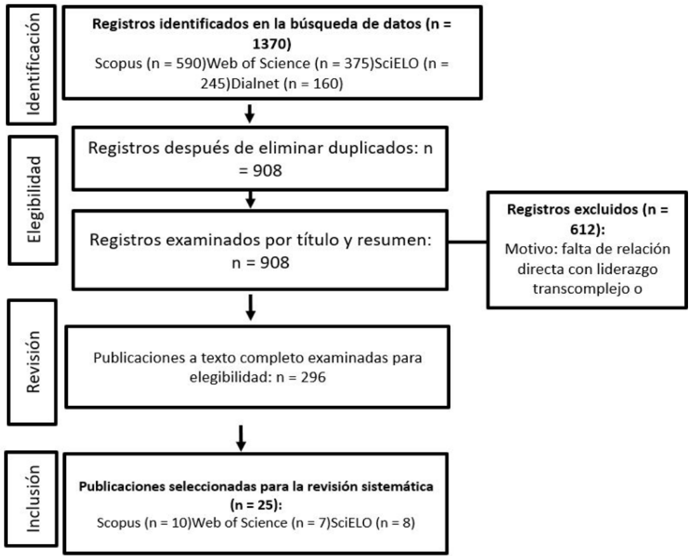
- From 1,370 initial records, 908 unique documents after duplicate removal, and 25 articles in the final corpus, the review generated 10 thematic axes: distributed leadership, inclusive leadership, sustainable leadership, humble/secure-base leadership, learning culture, adaptive organizational learning, relational ethics, university governance, institutional innovation, and educational transcomplexity.
- The review concludes that organizational learning is “the heart” of institutional change, emerging from collective reflection, dialogue, and the capacity to convert error and chaos into useful knowledge; universities are described as living systems capable of learning, reinterpreting, and creating meaning.
- Transcomplex leadership is presented as integrating reason in decision-making, emotion amid chaos, and ethics in conscious conduct; authority shifts toward mediation, and shared reflection becomes a motor of institutional action.
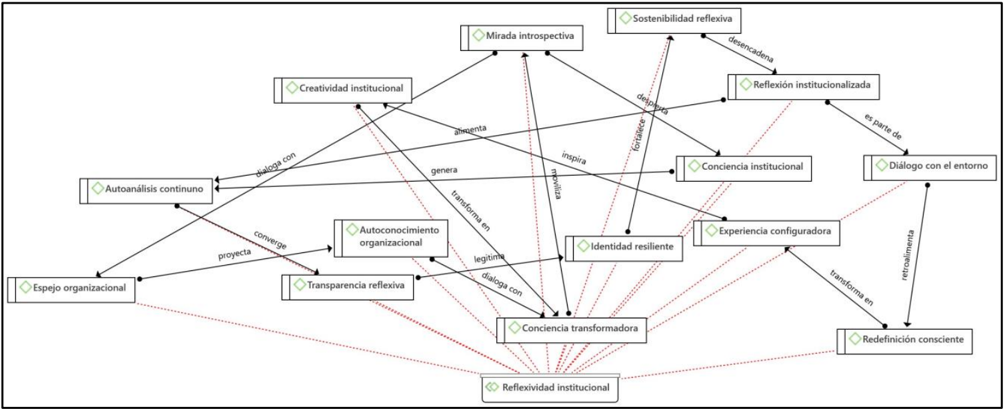
- The discussion identifies institutional reflexivity as a condition for learning and leadership renewal, and transcomplex humanism as an ethical base; it proposes transcomplex governance models, leadership training, and future indicators of transcomplexity.
Methods
- Qualitative interpretative systematic literature review following the SPIDER design and PRISMA 2020; searches in Scopus, Web of Science, SciELO, and Dialnet using Boolean operators and truncation with keywords in English, Spanish, and Portuguese. Inclusion criteria included thematic relevance to leadership and organizational learning, publication 2020–2025, explicit theoretical framework, and full-text availability; exclusions included opinion pieces, reviews without method, institutional reports, and non-higher-education studies.
- Three phases: documentary search (1,370 records; 908 unique after duplicates), title/abstract screening, and full-text reading yielding 25 articles; data were organized in an analytic matrix and processed with Atlas.ti23 using open and axial coding.
Limitations
- The paper does not include a dedicated limitations section; it acknowledges theoretical gaps such as the lack of comparative frameworks and explicit conceptualizations of transcomplex leadership, scarce empirical studies on how leaders manage collective learning under uncertainty or crisis, and limitations to consolidating transcomplex leadership as a distinct field.
- Evident from the text: the final corpus is only 25 articles from four databases and a 2020–2025 window, and the synthesis is qualitative-interpretative without meta-analysis; these choices may constrain coverage and generalizability.
Model-written summary. Check it against the paper before relying on it.
Integrity signals
Registry
Cites
Statistics
Figures
Verification
Claims the paper makes
5 Valid · 2 Not valid · 34 Not checked · 40 Own results and interpretations
The cited sources support only part of this claim — read each source’s verdict below.
In the paper
“Liderazgo humilde o de base segura Promueve la confianza, la escucha y la creatividad como condiciones del compromiso organizacional.”
§ Del liderazgo a la organización que aprende: una revisión sistemática desde la transcomplejidad en educación superior From leadership to the learning organization: a systematic review from the > 3.1. Resultados descriptivos
What the sources say
- Partly supportedcites Zhang & Chi (2025) matched to “Enhancing creative process engagement in university students: the mediating role of trust and empowerment and the moderating effect of proactive personality in humble teacher leadership” (2025) sourceExperimental — accuracy not yet measured
La revisión teórica describe la disposición de los líderes humildes a escuchar; la Discusión (Hallazgos generales, sin paginación) señala que los docentes humildes fortalecen la confianza y la participación creativa de sus estudiantes. Sin embargo, el estudio trata del compromiso con el proceso creativo en estudiantes universitarios, no del compromiso organizacional, y no identifica el «liderazgo de base segura» como equivalente al liderazgo humilde. (LLM, conf=0.88)
- Partly supportedcites Laguía et al. (2025) matched to “Liderazgo de Base Segura: Teoría e Investigación” (2025) sourceExperimental — accuracy not yet measured
Our copy supports the secure-base part of the claim: the DISCUSIÓN states that leadership as a secure base provides 'un anclaje emocional que fomenta la confianza' and creates an environment where employees 'pueden desarrollar su potencial, expresar sus ideas', and the structural model links liderazgo de base segura to work engagement (.43***), team identification (.39***) and lower turnover intention (-.40***), i.e. engagement/commitment-related outcomes. However, the paper never equates it with 'liderazgo humilde' — humility/humble leadership does not appear anywhere in our copy (searched: liderazgo humilde/humildad) — and neither 'escucha' (listening) nor 'creatividad' (creativity) is reported as a consequence: the 'El líder como base segura para los seguidores' review lists psychological safety climate, identification, engagement, satisfaction, resilience, performance, OCB, burnout and stress as the correlates, not creativity or listening. So the trust-and-commitment element is supported while the humble-leadership equation and the listening/creativity conditions are not. (LLM, conf=0.78)
plainstates a cause- Asserted: passes — The authors put it forward as true.
- Checkable: passes — It can be checked against evidence.
- Load-bearing: passes — The paper’s conclusions depend on it.
- Based: passes — The paper gives a reason why it holds.
- Partly supported
The cited sources support only part of this claim — read each source’s verdict below.
In the paper
“Liderazgo distribuido Fomenta cohesión y adaptabilidad institucional mediante la corresponsabilidad y el aprendizaje en red.”
§ Del liderazgo a la organización que aprende: una revisión sistemática desde la transcomplejidad en educación superior From leadership to the learning organization: a systematic review from the > 3.1. Resultados descriptivos
What the sources say
- Could not verifycites Steffens et al. (2021) matched to “Knowing me, knowing us: Personal and collective self-awareness enhances authentic leadership and leader endorsement” (2021) sourceExperimental — accuracy not yet measured
The ‘Putting Collective Self-Awareness in Authentic Leadership’ and ‘Discussion’ sections address how leaders’ awareness of group identity relates to perceived authenticity and follower support. Searches for distributed leadership, shared responsibility, network learning, cohesion, and institutional adaptability found no passage addressing the cited claim; page numbers were not available in our copy. (LLM, conf=0.73)
- Could not verifycites Tintoré & Gairín (2022) matched to “Tres Décadas de Investigación sobre Liderazgo Educativo en España. Un Mapeo Sistemático” (2022) sourceExperimental — accuracy not yet measured
Nuestra copia es un mapeo sistemático de la producción española sobre liderazgo educativo: trata el liderazgo distribuido solo como modelo temático (n = 16, 2010-2019, §3.3.4 Temáticas y Cuadro 5) y como subtema dentro de 'Liderazgo del director para el aprendizaje' (Cuadro 1, §2.2), sin afirmar efectos institucionales del mismo. Ningún pasaje sostiene que fomente cohesión o adaptabilidad mediante corresponsabilidad o aprendizaje en red; busqué 'corresponsabilidad', 'cohesión', 'adaptabilidad', 'aprendizaje en red' y 'efectos/beneficios del liderazgo distribuido' sin resultado. Además, la §4 (Discusión y conclusiones) constata que son escasos los estudios sobre relación entre liderazgo y resultados (n = 2), por lo que la copia no aborda el punto atribuido (ni lo contradice). (LLM, conf=0.72)
- Partly supportedcites Rojas León et al. (2023) matched to “Liderazgo inclusivo como elemento clave del desarrollo educativo” (2023) sourceExperimental — accuracy not yet measured
En «Promoción de la inclusión estratégica» (página no indicada), el artículo vincula el liderazgo inclusivo con la responsabilidad compartida y con redes que ayudan a servir a la comunidad escolar. Sin embargo, no atribuye al liderazgo distribuido una mayor cohesión o adaptabilidad institucional, ni describe el aprendizaje en red como el mecanismo de esos efectos. (LLM, conf=0.82)
plainstates a cause- Asserted: passes — The authors put it forward as true.
- Checkable: passes — It can be checked against evidence.
- Load-bearing: passes — The paper’s conclusions depend on it.
- Based: passes — The paper gives a reason why it holds.
- Could not verify
The cited sources support only part of this claim — read each source’s verdict below.
In the paper
“Liderazgo inclusivo La equidad y la participación fortalecen la cultura de aprendizaje y la innovación compartida.”
§ Del liderazgo a la organización que aprende: una revisión sistemática desde la transcomplejidad en educación superior From leadership to the learning organization: a systematic review from the > 3.1. Resultados descriptivos
What the sources say
- Partly supportedcites Rojas León et al. (2023) matched to “Liderazgo inclusivo como elemento clave del desarrollo educativo” (2023) sourceExperimental — accuracy not yet measured
En «Aprendizaje crítico reflexivo», el artículo relaciona el diálogo y las decisiones inclusivas con la equidad y el aprendizaje continuo. En «Promoción de la inclusión estratégica», defiende una cultura participativa y considera importante el pensamiento colaborativo e inventivo, pero no afirma que la equidad y la participación fortalezcan una innovación compartida. (LLM, conf=0.82)
- Not checked yetcites Quishpe-Mosquera & Cevallos-Benavides (2025) matched to “Liderazgo: análisis del desempeño profesional directivo en instituciones educativas” (2025) source
plainstates a cause- Asserted: passes — The authors put it forward as true.
- Checkable: passes — It can be checked against evidence.
- Load-bearing: passes — The paper’s conclusions depend on it.
- Based: passes — The paper gives a reason why it holds.
- Partly supported
The cited sources support only part of this claim — read each source’s verdict below.
In the paper
“Aprendizaje organizacional adaptativo Permite a las universidades responder a la incertidumbre mediante la memoria colectiva y la innovación contextual.”
§ Del liderazgo a la organización que aprende: una revisión sistemática desde la transcomplejidad en educación superior From leadership to the learning organization: a systematic review from the > 3.1. Resultados descriptivos
What the sources say
- Partly supportedcites Primahendra et al. (2024) matched to “The Influence of Transformative Learning, Affective Commitment, Digital Transformation, Capability Dynamic, Ambidexterity, and Education Policy Toward Educational Leadership: A Case from Indonesia” (2024) sourceExperimental — accuracy not yet measured
Section 2.6, “Dynamic Capability” (page not identified in our copy), says organizations can respond to turbulent environments by reconfiguring resources and routines. That supports the general idea of adaptation to uncertainty, but the paper studies Jakarta secondary schools, not universities, and the passages do not identify collective memory or contextual innovation as the means of adaptation. (LLM, conf=0.84)
- Not matchedcites Bracho-Fuenmayor (2023)
An author–year citation the paper’s reference list doesn’t settle. We don’t search these by name.
plainstates a cause- Asserted: passes — The authors put it forward as true.
- Checkable: passes — It can be checked against evidence.
- Load-bearing: passes — The paper’s conclusions depend on it.
- Based: passes — The paper gives a reason why it holds.
- Partly supported
The cited sources support only part of this claim — read each source’s verdict below.
In the paper
“Cultura de aprendizaje Impulsa la reflexión crítica, la autoevaluación y la mejora continua en la vida universitaria.”
§ Del liderazgo a la organización que aprende: una revisión sistemática desde la transcomplejidad en educación superior From leadership to the learning organization: a systematic review from the > 3.1. Resultados descriptivos
What the sources say
- Not matchedcites Treviño (2023)
An author–year citation the paper’s reference list doesn’t settle. We don’t search these by name.
- Partly supportedcites Romero et al. (2025) matched to “Adaptación del cuadro de mando integral (CMI) para evaluar el desempeño organizacional en las universidades públicas mexicanas” (2025) sourceExperimental — accuracy not yet measured
Nuestra copia apoya solo parte de la atribución: la sección 'Perspectiva aprendizaje y crecimiento' vincula el aprendizaje continuo y una cultura de innovación/desarrollo de profesores, personal y estudiantes, y la DISCUSIÓN (p. ~7) reporta un coeficiente de 0,721 (p<0,001) entre aprendizaje y crecimiento y procesos internos, lo que respalda que la cultura de aprendizaje impulsa la mejora de los procesos (incluida la 'mejora continua' mencionada en 'Perspectiva de procesos internos'). Sin embargo, ni 'reflexión crítica' ni 'autoevaluación' aparecen en ninguna paso de nuestra copia (buscado: reflexión crítica, autoevaluación, cultura de aprendizaje, autodiagnóstico); lo más cercano es 'desarrollar habilidades críticas' (atribuido a Mason y Dunens, 2019) y 'evaluación interna ... evaluaciones entre pares', que el propio texto acredita a Kauppila et al. (2015), no a este paper. La parte no respaldada por esta fuente es, por tanto, el par reflexión crítica + autoevaluación. (LLM, conf=0.68)
plainstates a cause- Asserted: passes — The authors put it forward as true.
- Checkable: passes — It can be checked against evidence.
- Load-bearing: passes — The paper’s conclusions depend on it.
- Based: passes — The paper gives a reason why it holds.
- Not matched
31 more claims
Create a free account to see all 81 claims and to verify the 11 references still open.
- It may state two separate claims as one. 28
- Probably not a substantial claim. 31
Self-check
Percentages, sums and reported differences re-computed from the paper’s own numbers.
Each contradiction between two passages listed here was confirmed by an independent check.
Rated minor: it would not touch a result — a value no result rests on, a p-value that stays on the same side of the significance level, or a conflict that is clerical, resolved elsewhere in the paper, or outside its own findings.
In the paper
§ Del liderazgo a la organización que aprende: una revisión sistemática desde la transcomplejidad en educación superior From leadership to the learning organization: a systematic review from the > 2. METODOLOGÍA
“24 Román Acosta, D. (2024) 2022/ Argentina”
§ Del liderazgo a la organización que aprende: una revisión sistemática desde la transcomplejidad en educación superior From leadership to the learning organization: a systematic review from the > References
“Román Acosta, D. (2024). Liderazgo educativo: Impacto en la gestión y la toma de decisiones. Parte 2.”
Citations
Cites
Steffens, N. K., Wolyniec, N., Okimoto, T. G., Mols, F., Haslam, S. A., & Kay, A. A. (2021) · The Leadership Quarterly · doi:10.1016/j.leaqua.2021.101498 · Cited by 61
Thien, L. M., Lim, H. L., Shabudin, A. F. A., Aman, R. C., Ismail, A. B., Zuharah, W. F., & Muftahu, M. (2025) · Humanities and Social Sciences Communications · doi:10.1057/s41599-024-04278-6 · Cited by 58
Tintoré, M. (2024) · Educar · doi:10.5565/rev/educar.1776 · Cited by 17
Figueroa-Céspedes, I., CARCAMO, J. S., & Yáñez-Urbina, C. (2021) · Revista latinoamericana de educación inclusiva · doi:10.4067/s0718-73782021000200155 · Cited by 15
Zhang, X., & Chi, J. (2025) · BMC Psychology · doi:10.1186/s40359-025-02382-z · Cited by 14
Evaluación de liderazgo para el cambio educativo: un estudio de casos
Rodríguez, L. F. D. L. V., & Espinoza, K. (2022) · Revista Meta Avaliação · doi:10.22347/2175-2753v14i43.3668 · Cited by 13
Vargas, D. J. D., & Cornejo, A. M. G. (2024) · European Public & Social Innovation Review · doi:10.31637/epsir-2024-916 · Cited by 12
Liderazgo inclusivo como elemento clave del desarrollo educativo
Rojas León, C. R., Pongo Aguila, O. E., Huaman Ccanto, F., & Orosco Gavilán, J. C. (2023) · Revista Venezolana de Gerencia · doi:10.52080/rvgluz.28.e9.8 · Cited by 8
Zhang, S. (2025) · BMC Psychology · doi:10.1186/s40359-025-02595-2 · Cited by 8
Pérez, O. (2022) · ACADEMO Revista de Investigación en Ciencias Sociales y Humanidades · doi:10.30545/academo.2022.ene-jun.3 · Cited by 7
Tres Décadas de Investigación sobre Liderazgo Educativo en España. Un Mapeo Sistemático
Tintoré, M., & Gairín, J. (2022) · REICE. Revista Iberoamericana sobre Calidad, Eficacia y Cambio en Educación · doi:10.15366/reice2022.20.3.001 · Cited by 6
Liderazgo integral educativo innovador en las escuelas normales superiores de Colombia
Novoa-Palacios, A. (2020) · Revista Electrónica Educare · doi:10.15359/ree.24-3.2 · Cited by 6
Effective Leadership Strategies: Bridging Gaps in the Latin American Educational System
Rodriguez-Barboza, J. R., Bartra-Rivero, K. R., Pablo-Huamani, R., Sandoval-Lara, E., & Ramos-Ventura, C. G. (2023) · Salud Ciencia y Tecnología - Serie de Conferencias · doi:10.56294/sctconf2023531 · Cited by 6
Liderazgo de Base Segura: Teoría e Investigación
Laguia, A., Edú-Valsania, S., Navas-Jiménez, M. D. C., Molero, F., & Moriano, J. (2025) · Anuario de Psicología/The UB Journal of Psychology · doi:10.1344/anpsic2025.55.2.3 · Cited by 5
Pérez, M. L. O. (2023) · RIDE Revista Iberoamericana para la Investigación y el Desarrollo Educativo · doi:10.23913/ride.v13i26.1438 · Cited by 5
Habilidades de liderazgo en tiempos de cambio: Una mirada en las universidades del Zulia-Venezuela
(2023) · Revista de Ciencias Sociales · doi:10.31876/rcs.v29i3.40736 · Cited by 4
Schall, C. M. C. (2025) · Innovaciones educativas · doi:10.22458/ie.v27i42.5409 · Cited by 4
Primahendra, R., Purba, J. T., Ugut, G. S. S., & Budiono, S. (2024) · Revista de Gestão Social e Ambiental · doi:10.24857/rgsa.v18n8-037 · Cited by 4
(2025) · doi:10.1007/s43621-025-01185-x · Cited by 4
Liderazgo: análisis del desempeño profesional directivo en instituciones educativas
Quishpe-Mosquera, K., & Cevallos-Benavides, D. (2025) · Cátedra · doi:10.29166/catedra.v8i1.4529 · Cited by 3
Pedraja-Rejas, L., Ancoma, C., & Oneto, S. (2025) · doi:10.31876/rcs.v31i2.43782 · Cited by 3
Leadership in education: impact on management and decision making. Part 2
Román-Acosta, D. (2024) · Seminars in Medical Writing and Education · doi:10.56294/mw2024631 · Cited by 2
Romero, M. V., Machorro, F., Muñiz, I., & Correa, F. R. (2025) · Formación universitaria · doi:10.4067/s0718-50062025000100121 · Cited by 2
Yang, H.-M., & Kim, H. (2025) · Social medicine · doi:10.71164/socialmedicine.v18i3.2025.1785 · Cited by 1
Research works printed but not linked: 1
- Fernández Mijares, E., García González, M., & Rubio Vargas, I. (2024). Planificación estratégica, gestión por resultados y aprendizaje organizacional: contextualización a las instituciones de educación superior. EduSol, 24(86), 1-15. http://scielo.sld.cu/scielo.php?script=sci_arttext&pid=S1729- 80912024000100168&lng=es&tlng=es.
Cited by
Innovación y cambio en la enseñanza en las universidades que aprenden
Ríos, L. (2026) · Experior · doi:10.56880/experior52.5
“Examinando dos revisiones, García (2026) presentó una de 25 artículos publicados entre el 2020 y el 2025, donde encontró que el liderazgo, caracterizado por su capacidad para integrar múltiples perspectivas y abordar la complejidad institucional, promueve una cultura de reflexión, innovación y…”
Cultura organizacional en el contexto educativo: Una revisión sistemática
Avila, Z. H. M. (2026) · Revista Simón Rodríguez · doi:10.62319/simonrodriguez.v.6i12.229
Romero, S. D. C., & Ortega, C. G. T. (2026) · Sinergia Académica · doi:10.51736/sa1017
Noroña-Caiza, M. A., Pallo-Iza, M. D. L. A., & Poveda, A. E. R. (2026) · MQRInvestigar · doi:10.56048/mqr.2026.e462
Azure, Y. C., Cecilio, C. P. J., & Oscar, A. R. (2026) · Journal of Research in Education and Pedagogy. · doi:10.70232/jrep.v3i4.234
Metadata
- Authors
- GARCIA, M. A.
- Affiliations
- Universidad Cesar Vallejo - ORCID: 0000-0003-0574-057X
- Venue
- Espacios
- Publisher
- Editorial Espacios
- Published
- 2026-01-30
- Volume
- 47
- Issue
- 1
- Pages
- 283-296
- ISSN
- 0798-1015 (ISSN-L)
- 2739-0071
- OpenAlex
- W7131397088
- Cited by
- 2
- References
- 24
- Citations by year
- 2026: 2
- FWCI
- 18.90
- Type
- journal article
- Language
- es
- Open access
- diamond
- doi.org
- Licence
- Locations
- ESPACIOS (publishedVersion, cc-by-nc)
- Topics
- Social Sciences › Business, Management and Accounting › Organizational Behavior and Human Resource Management › Organizational Learning and Leadership
- Social Sciences › Education › Chaos, Complexity, and Education
- Social Sciences › Education › Education, Leadership, and Health Research
- Keywords
- organizational learning, higher education institutions, university administration, reflective culture, innovation, sustainability, collective learning, adaptive organizations, ethical leadership
About these checks
Registry, retraction, Cites and statistics results are computed, not judged, with one exception: a printed reference that no index lists is read once by a model before it counts as a citation error. Claims are extracted by a model and kept only when their quote appears verbatim in the text; each cited source is then checked, with a model’s help, for whether it says what the claim relies on. Those verdicts can be wrong — read the claim’s quote and the cited source before relying on one.
The claim verdicts this report counts are experimental: their accuracy is not yet measured.
A language model drew the claims from the paper on 2026-11-11, under version 3 of the claim definition (model deepseek-v4.1-flash, prompt extract-v3).
A second model labelled each claim on 2026-11-11 (model jev-1.13-20260917, definition revision gold-guideline-v0.2).
Cited sources are checked with a language model’s help (gpt-6-sol and qwen3.8-omni-flash).
Statistics and arithmetic are recomputed, not judged.
Confidence bands are shown only for fields calibrated on our annotated test set. None is calibrated yet, so no band is shown.
What counts as a claim ›How we measure confidence ›How we check this ›
Are you an author, or do you see a problem with this page? Request a review
Data sources
Bibliographic data: Semantic Scholar, OpenAlex, Crossref.
Contains information from the Semantic Scholar Academic Graph Datasets, made available under the ODC Attribution License (ODC-BY 1.0).
Semantic Scholar’s data is described in: Kinney, R., et al. (2023). The Semantic Scholar Open Data Platform. arXiv:2301.10140.
