

The DOI matches its DataCite record; 118 of the 120 references it cites were found in a registry or an index, and 2 are not checked yet.
Replica wormholes and the black hole interior
Open accessAbstract
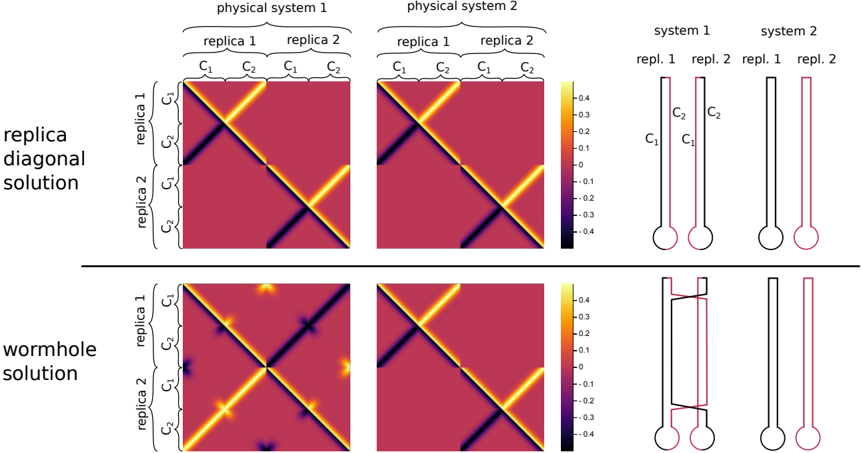
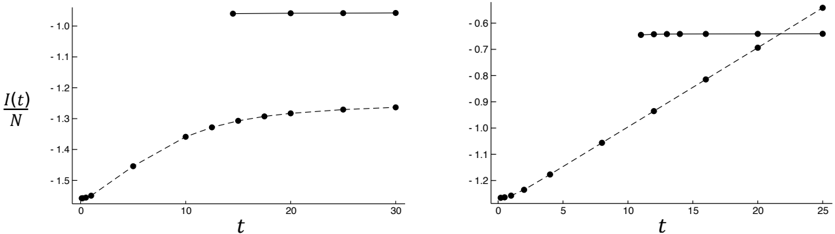
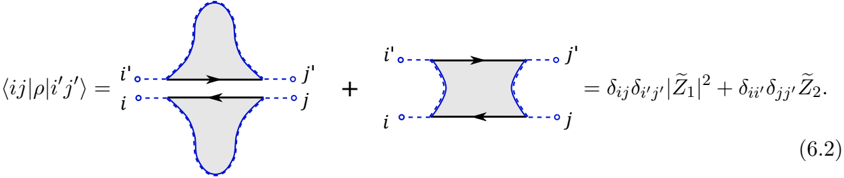
Recent work has shown how to obtain the Page curve of an evaporating black hole from holographic computations of entanglement entropy. We show how these computations can be justified using the replica trick, from geometries with a spacetime wormhole connecting the different replicas. In a simple model, we study the Page transition in detail by summing replica geometries with different topologies. We compute related quantities in less detail in more complicated models, including JT gravity coupled to conformal matter and the SYK model. Separately, we give a direct gravitational argument for entanglement wedge reconstruction using an explicit formula known as the Petz map; again, a spacetime wormhole plays an important role. We discuss an interpretation of the wormhole geometries as part of some ensemble average implicit in the gravity description.
Overview
The claims and statistics of this paper haven’t been checked yet.
Run the check — free, no account needed. It reads the open-access text and checks the sources it cites.
Integrity signals
Registry
Cites
Statistics
Figures




Verification
Claims the paper makes
The claims and statistics of this paper haven’t been checked yet.
Run the check — free, no account needed. It reads the open-access text and checks the sources it cites.
Claims other papers make about this one
Each is checked against this paper’s own text: does it say what the citing paper says it does?
The source backs part of the claim, not all of it — or backs it for a different population, condition or comparison.
In the citing paper
“It also shows in this model that results analogous to the Rényi entropy computations of [48,49] will hold not just for typical members of the ensemble defined by the Hartle-Hawking no-boundary state, but in fact for all allowed α-states.”
From Transcending the ensemble: baby universes, spacetime wormholes, and the order and disorder of black hole information (2020) · cites this paper as [49]
Experimental — accuracy not yet measuredThe source backs part of the claim, not all of it — or backs it for a different population, condition or comparison.
In the citing paper
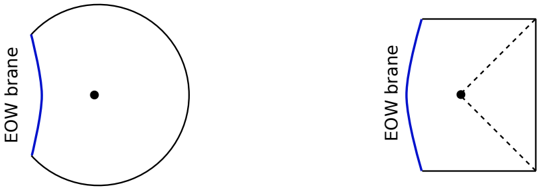
“We then explored this construction in detail in simple topological models inspired by Jackiw-Teitelboim gravity with and without end-of-the-world branes (EOW branes, see e.g.[49,104]), and perhaps also with an extra boundary degree of freedom.Without EOW branes, there is a single asymptotically AdS boundary condition Z, for which the associated operator Z is naturally interpreted as the dimension”
From Transcending the ensemble: baby universes, spacetime wormholes, and the order and disorder of black hole information (2020) · cites this paper as [49]
Experimental — accuracy not yet measuredThe source backs part of the claim, not all of it — or backs it for a different population, condition or comparison.
In the citing paper
“Indeed, in order to explain the Rényi computations of [49] for typical members of the Hartle-Hawking ensemble some version of this compression must occur whenever the number of a priori independent states inside a quantum extremal surface exceeds the generalized entropy defined by the region outside.”
From Transcending the ensemble: baby universes, spacetime wormholes, and the order and disorder of black hole information (2020) · cites this paper as [49]
Experimental — accuracy not yet measuredThe source backs part of the claim, not all of it — or backs it for a different population, condition or comparison.
In the citing paper
“The minimum of the two dominates the path integral and gives the unitary Page curve, see [70,71] (see also [24,84]).”
From The entropy of Hawking radiation (2021) · cites this paper as [70]
Experimental — accuracy not yet measuredThe source backs part of the claim, not all of it — or backs it for a different population, condition or comparison.
In the citing paper
“More recently, it has been shown that a Petz-like map can be used to demonstrate bulk reconstruction in random tensor network toy models [52,185] of holography.”
From Holographic spacetime, black holes and quantum error correcting codes: a review (2022) · cites this paper as [52]
Experimental — accuracy not yet measured
The source backs part of the claim, not all of it — or backs it for a different population, condition or comparison.
In the citing paper
“In this Euclidean model, we represent the state of the B ∪ R system in the maximally entangled form”
From Holographic spacetime, black holes and quantum error correcting codes: a review (2022) · cites this paper as [52]
Experimental — accuracy not yet measuredThe cited source says what the claim attributes to it.
In the citing paper
“A starting point for such further investigation is the observation of [49] that the above replica trick results appear to be inconsistent with one might normally call a single welldefined theory.”
From Transcending the ensemble: baby universes, spacetime wormholes, and the order and disorder of black hole information (2020) · cites this paper as [49]
The cited source says what the claim attributes to it.
In the citing paper
“In particular, rather than taking single well-defined values, partitionfunction-like quantities seem to have both a mean value and a non-zero variance.”
From Transcending the ensemble: baby universes, spacetime wormholes, and the order and disorder of black hole information (2020) · cites this paper as [49]
The cited source says what the claim attributes to it.
In the citing paper
“Critically, [48,49] then pointed out that -at least in some contexts -this seeminglyhybrid recipe in fact follows from replica trick calculations of S rad using the gravitational path integral (and in particular that this was implicit in earlier derivations of the quantum corrected Ryu-Takayanagi [50,51] and Hubeny-Rangamani-Takayanagi [52] entropy formulae [53,54]).”
From Transcending the ensemble: baby universes, spacetime wormholes, and the order and disorder of black hole information (2020) · cites this paper as [49]
The cited source says what the claim attributes to it.
In the citing paper
“As in [49], as and discussed further in section 4, this is a version of the semiclassical Page curve [1].”
From Transcending the ensemble: baby universes, spacetime wormholes, and the order and disorder of black hole information (2020) · cites this paper as [49]
The cited source says what the claim attributes to it.
In the citing paper
“But the result is deeply related to recent successes [42,43,48,49] in reproducing various forms of the Page curve associated with the black hole information problem.”
From Transcending the ensemble: baby universes, spacetime wormholes, and the order and disorder of black hole information (2020) · cites this paper as [49]
The cited source says what the claim attributes to it.
In the citing paper
“It was then derived without holography from the gravitational path integral in [13,14], using the gravitational replica method developed earlier in [5,30].”
From Replica wormholes for an evaporating 2D black hole (2021) · cites this paper as [14]
The cited source says what the claim attributes to it.
In the citing paper
“This argument is equivalent to the derivation of the entropy in [13,14] from the defect action, but easier in practice.”
From Replica wormholes for an evaporating 2D black hole (2021) · cites this paper as [14]
The cited source says what the claim attributes to it.
In the citing paper
“This has been derived by including replica wormholes in the gravitational path integral”
From Replica wormholes for an evaporating 2D black hole (2021) · cites this paper as [14]
The cited source says what the claim attributes to it.
In the citing paper
“The island formula [1,2,9,14,29] states that the true von Neumann entropy of region R is given not by Hawking's calculation, but by an extremum of the generalized entropy,”
From Replica wormholes for an evaporating 2D black hole (2021) · cites this paper as [14]
The cited source says what the claim attributes to it.
In the citing paper
“This can be calculated directly from the action of the defect, and the result [13,14] is the island formula (2.47).”
From Replica wormholes for an evaporating 2D black hole (2021) · cites this paper as [14]
The cited source says what the claim attributes to it.
In the citing paper
“For n ∼ 1, the dynamical twist fields obey an equation of motion that extremizes the generalized entropy.Thus the twist fields become the endpoints of the island.A general argument for this based on the effective action for twist defects appears in [5,13,14,51], but in the island context, only the eternal black hole has been treated in detail [13,14].”
From Replica wormholes for an evaporating 2D black hole (2021) · cites this paper as [14]
The cited source says what the claim attributes to it.
In the citing paper
“To derive the island rule, we also need to show that the entropy derived from the replica method is equal to the generalized entropy associated to the QES.This was demonstrated from the effective action for twist defects in [13,14].”
From Replica wormholes for an evaporating 2D black hole (2021) · cites this paper as [14]
The cited source says what the claim attributes to it.
In the citing paper
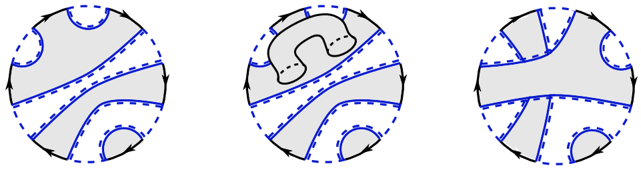
“The second crucial difference is that higher topologies can contribute to the gravitational path integral.The topologies responsible for the island rule are Z n -symmetric replica wormholes [13,14].”
From Replica wormholes for an evaporating 2D black hole (2021) · cites this paper as [14]
The cited source says what the claim attributes to it.
In the citing paper
“there are other cases where non-replica-symmetric contributions to the path integral are important [14,38,64,65].”
From Replica wormholes for an evaporating 2D black hole (2021) · cites this paper as [14]
The cited source says what the claim attributes to it.
In the citing paper
“We focus on the island formula (8.2) for the entropy of the Hawking radiation [70,71].”
From The entropy of Hawking radiation (2021) · cites this paper as [70]
The cited source says what the claim attributes to it.
In the citing paper
“The idea is that very complex computations in the radiation can create wormholes that reach into that interior and pull out the information stored there [70], see also [85,86].”
From The entropy of Hawking radiation (2021) · cites this paper as [70]
The cited source says what the claim attributes to it.
In the citing paper
“Although the replica wormhole saddles produce results which are compatible with unitarity, there are crucial subtleties which are explicitly brought out by the Euclidean (Penington, Shenker, Stanford and Yang) PSSY toy model [52]”
From Holographic spacetime, black holes and quantum error correcting codes: a review (2022) · cites this paper as [52]
The cited source says what the claim attributes to it.
In the citing paper
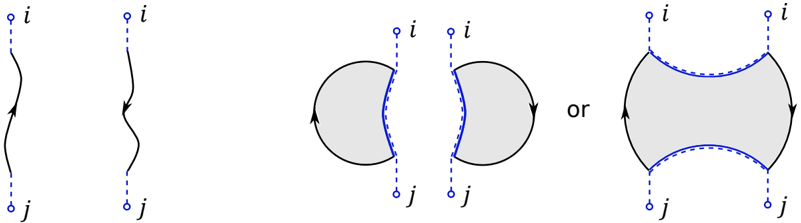
“After this paper first appeared on arXiv, these replica trick calculations were done explicitly in [50, 51], where it was shown that the relevant topologies for the second half of the Page curve involve spacetime wormholes connecting different replicas.”
From Entanglement wedge reconstruction and the information paradox (2020) · cites this paper as [50]
The cited source says what the claim attributes to it.
In the citing paper
“The QRT prescription can be motivated via a replica trick involving Euclidean wormholes, as explored in [16-20].”
From Page curve for an evaporating black hole (2020) · cites this paper as [17]
The cited source says what the claim attributes to it.
In the citing paper
“There is a more generic derivation of the island rule (5.1) based on Euclidean replica trick techniques. This approach was investigated by two groups Almheiri et al. (2020); Penington et al. (2019).”
From Solvable models of quantum black holes: a review on Jackiw–Teitelboim gravity (2023) · cites this paper as Penington et al. (2019)
The cited source says what the claim attributes to it.
In the citing paper
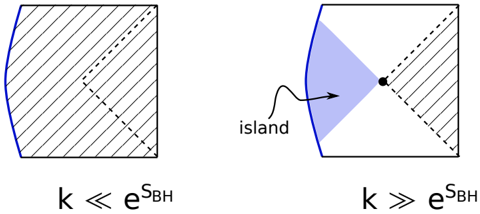
“The above island formula resolves the issue with the entropy of Hawking radiation: when the semiclassical radiation entropy grows larger than the Bekenstein–Hawking entropy , the entropy is computed by choosing X to be a surface slightly in the interior of the black hole.”
From Solvable models of quantum black holes: a review on Jackiw–Teitelboim gravity (2023) · cites this paper as Penington et al. 2019
The cited source says what the claim attributes to it.
In the citing paper
“The result of this discussion is the following proposal for a formula that computes the radiation entanglement entropy in a gravitating system (Penington 2020; Almheiri et al. 2019; Penington et al. 2019; Almheiri et al. 2020):5.1”
From Solvable models of quantum black holes: a review on Jackiw–Teitelboim gravity (2023) · cites this paper as Penington et al. 2019
The cited source says what the claim attributes to it.
In the citing paper
“There have been several distinct indications (Harlow and Jafferis 2018; Penington et al. 2019; Almheiri et al. 2020; Giddings and Turiaci 2020; Stanford 2020; Engelhardt et al. 2021; Johnson 2021; Saad et al. 2021a) that the gravitational path integral is not equivalent to an ordinary quantum mechanical system (where we interpret the boundary circles as representing Euclidean time).”
From Solvable models of quantum black holes: a review on Jackiw–Teitelboim gravity (2023) · cites this paper as Penington et al. 2019
The check wasn’t confident either way, so it gives no verdict — never disputed.
In the citing paper
“With hindsight one can say that it was implicit in all of these works, and in fact moderately explicit in [49].”
From Transcending the ensemble: baby universes, spacetime wormholes, and the order and disorder of black hole information (2020) · cites this paper as [49]
Experimental — accuracy not yet measured
Self-check
Percentages, sums and reported differences re-computed from the paper’s own numbers.
The self-check needs the paper’s full text.
Citations
Cites
Particle creation by black holes
Hawking, S. W. (1975) · Communications In Mathematical Physics · doi:10.1007/bf02345020 · Cited by 13,106
Ryu, S., & Takayanagi, T. (2006) · Physical Review Letters · doi:10.1103/physrevlett.96.181602 · Cited by 4,302
Cosmological event horizons, thermodynamics, and particle creation
Gibbons, G. W., & Hawking, S. W. (1977) · Physical Review D · doi:10.1103/physrevd.15.2738 · Cited by 3,192
Hartle, J. B., & Hawking, S. W. (1983) · Physical Review D · doi:10.1103/physrevd.28.2960 · Cited by 3,027
Non-gaussian features of primordial fluctuations in single field inflationary models
Maldacena, J. (2003) · Journal of High Energy Physics · doi:10.1088/1126-6708/2003/05/013 · Cited by 2,906
Gapless spin-fluid ground state in a random quantum Heisenberg magnet
Sachdev, S., & Ye, J. (1993) · Physical Review Letters · doi:10.1103/physrevlett.70.3339 · Cited by 1,910
A covariant holographic entanglement entropy proposal
Hubeny, V. E., Rangamani, M., & Takayanagi, T. (2007) · Journal of High Energy Physics · doi:10.1088/1126-6708/2007/07/062 · Cited by 1,822 · cited 1×
“This resonates with the longstanding suspicion that some small corrections to the Hawking calculation (of order e−SBH) could be responsible for making black (1)For example [4, 5, 6, 7, 8, 9]; for a review see [10].”
BackgroundEntanglement entropy and conformal field theory
Calabrese, P., & Cardy, J. (2009) · Journal of Physics A: Mathematical and Theoretical · doi:10.1088/1751-8113/42/50/504005 · Cited by 1,688 · cited 1×
“[68])”
Average entropy of a subsystem
Page, D. N. (1993) · Physical Review Letters · doi:10.1103/physrevlett.71.1291 · Cited by 1,578
Eternal black holes in anti-de Sitter
Maldacena, J. (2003) · Journal of High Energy Physics · doi:10.1088/1126-6708/2003/04/021 · Cited by 1,555
Research works printed but not linked: 1
- C. Akers, T. Faulkner, S. Lin and P. Rath, Reflected entropy in random tensor networks, arXiv:2112.09122 [INSPIRE]. · arXiv
Cited by
Sorted by citations
Items 101–200 of 812
Islands in Kaluza–Klein black holes
Lu, Y., & Lin, J. (2022) · The European Physical Journal C · doi:10.1140/epjc/s10052-022-10074-w · Cited by 50
Entropy of Hawking radiation for two-sided hyperscaling violating black branes
Omidi, F. (2022) · Journal of High Energy Physics · doi:10.1007/jhep04(2022)022 · Cited by 49
Wormholes and holography: an introduction
Kundu, A. (2022) · The European Physical Journal C · doi:10.1140/epjc/s10052-022-10376-z · Cited by 48
Coarse graining pure states in AdS/CFT
Chandra, J., & Hartman, T. (2023) · Journal of High Energy Physics · doi:10.1007/jhep10(2023)030 · Cited by 76
Defect extremal surface for reflected entropy
Li, T., Yuan, M.-K., & Zhou, Y. (2022) · Journal of High Energy Physics · doi:10.1007/jhep01(2022)018 · Cited by 47
Islands in flat-space cosmology
Azarnia, S., Fareghbal, R., Naseh, A., & Zolfi, H. (2021) · Physical review. D/Physical review. D. · doi:10.1103/physrevd.104.126017 · Cited by 53
Real-time gravitational replicas: formalism and a variational principle
Colin-Ellerin, S., Dong, X., Marolf, D., Rangamani, M., & Wang, Z. (2021) · eScholarship (California Digital Library) · doi:10.1007/jhep05%282021%29117 · Cited by 50
von Neumann algebras in JT gravity
Kolchmeyer, D. K. (2023) · Journal of High Energy Physics · doi:10.1007/jhep06(2023)067 · Cited by 46
Microscopic Origin of the Entropy of Black Holes in General Relativity
Balasubramanian, V., Lawrence, A., Magán, J. M., & Sasieta, M. (2024) · Physical Review X · doi:10.1103/physrevx.14.011024 · Cited by 137
Semi-classical thermodynamics of quantum extremal surfaces in Jackiw-Teitelboim gravity
Pedraza, J. F., Svesko, A., Sybesma, W., & Visser, M. R. (2021) · Journal of High Energy Physics · doi:10.1007/jhep12(2021)134 · Cited by 50
The Page curve for reflected entropy
Akers, C., Faulkner, T., Lin, S., & Rath, P. (2022) · Journal of High Energy Physics · doi:10.1007/jhep06(2022)089 · Cited by 51
Holographic spacetime, black holes and quantum error correcting codes: a review
Kibe, T., Mandayam, P., & Mukhopadhyay, A. (2022) · The European Physical Journal C · doi:10.1140/epjc/s10052-022-10382-1 · Cited by 44
Finding pythons in unexpected places
Engelhardt, N., Penington, G., & Shahbazi-Moghaddam, A. (2021) · Classical and Quantum Gravity · doi:10.1088/1361-6382/ac3e75 · Cited by 57
Self-citationIsland for gravitationally prepared state and pseudo entanglement wedge
Miyaji, M. (2021) · Journal of High Energy Physics · doi:10.1007/jhep12(2021)013 · Cited by 45
Island finder and entropy bound
Bousso, R., & Shahbazi-Moghaddam, A. (2021) · Physical Review D · doi:10.1103/physrevd.103.106005 · Cited by 44
No Page curves for the de Sitter horizon
Kames-King, J., Verheijden, E., & Verlinde, E. (2022) · Journal of High Energy Physics · doi:10.1007/jhep03(2022)040 · Cited by 53
Causal structures and nonlocality in double holography
Omiya, H., & Wei, Z. (2022) · Journal of High Energy Physics · doi:10.1007/jhep07(2022)128 · Cited by 35
Bootstrapping boundaries and branes
Collier, S., Mazáč, D., & Wang, Y. (2023) · Journal of High Energy Physics · doi:10.1007/jhep02(2023)019 · Cited by 42
Holography for people with no time
Lin, H. W., MALDACENA, J. M., Rozenberg, L., & Shan, J. (2023) · SciPost Physics · doi:10.21468/scipostphys.14.6.150 · Cited by 76
Channeling Quantum Criticality
Zou, Y., Sang, S., & Hsieh, T. H. (2023) · Physical Review Letters · doi:10.1103/physrevlett.130.250403 · Cited by 55
On the non-perturbative bulk Hilbert space of JT gravity
Iliesiu, L. V., Levine, A., Lin, H. W., Maxfield, H., & Mezei, M. (2024) · Journal of High Energy Physics · doi:10.1007/jhep10(2024)220 · Cited by 46
Improved effective dynamics of loop-quantum-gravity black hole and Nariai limit
Han, M., & Liu, H. (2021) · Classical and Quantum Gravity · doi:10.1088/1361-6382/ac44a0 · Cited by 41
On the assumptions leading to the information loss paradox
Buoninfante, L., Filippo, F. D., & Shinji Mukohyama, A. (2021) · Journal of High Energy Physics · doi:10.1007/jhep10(2021)081 · Cited by 44
An integrable road to a perturbative plateau
Blommaert, A., Kruthoff, J., & Yao, S. (2023) · Journal of High Energy Physics · doi:10.1007/jhep04(2023)048 · Cited by 41
Probing phase transitions of holographic entanglement entropy with fixed area states
Marolf, D. M., Wang, S., & Wang, Z. (2020) · eScholarship (California Digital Library) · Cited by 39
Cosmology from random entanglement
Antonini, S., Sasieta, M., & Swingle, B. (2023) · Journal of High Energy Physics · doi:10.1007/jhep11(2023)188 · Cited by 43
Enhanced corrections near holographic entanglement transitions: a chaotic case study
Dong, X., & Wang, H. (2020) · eScholarship (California Digital Library) · Cited by 38
Disorder averaging and its UV discontents
Heckman, J. J., Turner, A. P., & Yu, X. (2022) · Physical review. D/Physical review. D. · doi:10.1103/physrevd.105.086021 · Cited by 38
Wormholes from heavy operator statistics in AdS/CFT
Sasieta, M. (2023) · Journal of High Energy Physics · doi:10.1007/jhep03(2023)158 · Cited by 43
Distinguishing Random and Black Hole Microstates
Kudler-Flam, J., Narovlansky, V., & Ryu, S. (2021) · PRX Quantum · doi:10.1103/prxquantum.2.040340 · Cited by 44
Effective models of nonsingular quantum black holes
Cadoni, M., Oi, M., & Sanna, A. P. (2022) · Physical review. D/Physical review. D. · doi:10.1103/physrevd.106.024030 · Cited by 43
Ensemble from coarse graining: Reconstructing the interior of an evaporating black hole
Langhoff, K., & Yasunori Nomura, A. (2020) · Physical review. D/Physical review. D. · doi:10.1103/physrevd.102.086021 · Cited by 36
Hawking radiation correlations of evaporating black holes in JT gravity
Hollowood, T. J., Kumar, S. P., & Legramandi, A. (2020) · Journal of Physics A: Mathematical and Theoretical · doi:10.1088/1751-8121/abbc51 · Cited by 36
ER = EPR revisited: On the Entropy of an Einstein-Rosen BridgePreprint
Verlinde, H. (2020) · arXiv (Cornell University) · doi:10.48550/arxiv.2003.13117 · Cited by 73
Fun with replicas: tripartitions in tensor networks and gravity
Penington, G., Walter, M., & Witteveen, F. (2023) · Journal of High Energy Physics · doi:10.1007/jhep05(2023)008 · Cited by 35
Self-citationA principle of maximum ignorance for semiclassical gravity
Jan De Boer, A., Liška, D., Post, B., & Sasieta, M. (2024) · Journal of High Energy Physics · doi:10.1007/jhep02(2024)003 · Cited by 58
Approximate CFTs and random tensor models
Belin, A., Jan De Boer, A., Jafferis, D. L., Nayak, P., & Sonner, J. (2024) · Journal of High Energy Physics · doi:10.1007/jhep09(2024)163 · Cited by 51
Spectral fluctuations in the Sachdev-Ye-Kitaev model
Jia, Y., & Verbaarschot, J. J. M. (2020) · Journal of High Energy Physics · doi:10.1007/jhep07(2020)193 · Cited by 35
Alpha states demystified — towards microscopic models of AdS2 holography
Blommaert, A., Iliesiu, L. V., & Kruthoff, J. (2022) · Journal of High Energy Physics · doi:10.1007/jhep08(2022)071 · Cited by 35
Entanglement asymmetry study of black hole radiation
Ares, F., Murciano, S., Piroli, L., & Calabrese, P. (2024) · Physical review. D/Physical review. D. · doi:10.1103/physrevd.110.l061901 · Cited by 34
Looking at shadows of entanglement wedges
Kusuki, Y., Suzuki, Y.-K., Takayanagi, T., & Umemoto, K. (2020) · Institutional Repositories DataBase (IRDB) · Cited by 34
Jackiw-Teitelboim gravity in the second order formalism
Moitra, U., Sake, S. K., & Trivedi, S. P. (2021) · Journal of High Energy Physics · doi:10.1007/jhep10(2021)204 · Cited by 39
Relative Entropy of Random States and Black Holes
Kudler-Flam, J. (2021) · Physical Review Letters · doi:10.1103/physrevlett.126.171603 · Cited by 36
Looking for (and not finding) a bulk brane
Reeves, W., Moshe Rozali, A., Simidzija, P., Sully, J., Waddell, C., & Wakeham, D. (2021) · Journal of High Energy Physics · doi:10.1007/jhep12(2021)002 · Cited by 34
Mutual information, islands in black holes and the Page curve
Saha, A., Gangopadhyay, S., & Saha, J. P. (2022) · The European Physical Journal C · doi:10.1140/epjc/s10052-022-10426-6 · Cited by 34
Jackiw-Teitelboim supergravity as a double-cut matrix model
Johnson, C. V., Rosso, F., & Svesko, A. (2021) · Physical review. D/Physical review. D. · doi:10.1103/physrevd.104.086019 · Cited by 35
Replica wormholes and holographic entanglement negativity
Dong, X., McBride, S., & Weng, W. W. (2022) · Journal of High Energy Physics · doi:10.1007/jhep06(2022)094 · Cited by 36
Island and Page curve for one-sided asymptotically flat black hole
Gan, W.-C., Du, D.-H., & Shu, F.-W. (2022) · Journal of High Energy Physics · doi:10.1007/jhep07(2022)020 · Cited by 42
Small Schwarzschild de Sitter black holes, quantum extremal surfaces and islands
Goswami, K., & Narayan, K. (2022) · Journal of High Energy Physics · doi:10.1007/jhep10(2022)031 · Cited by 34
Multi-Fold Black Holes: Entropy, Evolution and Quantum ExtremaPreprint
Maes, S. H. (2023) · doi:10.31219/osf.io/gqtf7 · Cited by 35
Late time physics of holographic quantum chaos
Altland, A., & Sonner, J. (2021) · Kölner Universitäts PublikationsServer (Universität zu Köln) · Cited by 32
Entangled universes in dS wedge holography
Aguilar-Gutierrez, S. E., Patra, A., & Pedraza, J. F. (2023) · Journal of High Energy Physics · doi:10.1007/jhep10(2023)156 · Cited by 36
A universe field theory for JT gravity
Post, B., van der Heijden, J., & Verlinde, E. (2022) · Journal of High Energy Physics · doi:10.1007/jhep05(2022)118 · Cited by 32
Quantum Extremal Surfaces and the Holographic Entropy Cone
Akers, C., Hernández-Cuenca, S., & Rath, P. (2021) · Journal of High Energy Physics · doi:10.1007/jhep11(2021)177 · Cited by 32
The dilaton gravity hologram of double-scaled SYK
Blommaert, A., Mertens, T. G., & Papalini, J. (2025) · Journal of High Energy Physics · doi:10.1007/jhep06(2025)050 · Cited by 31
Holographic scattering requires a connected entanglement wedge
May, A. (2023) · OSTI OAI (U.S. Department of Energy Office of Scientific and Technical Information) · doi:10.1007/jhep08%282020%29132 · Cited by 33
Kruthoff, J., Mahajan, R., & Murdia, C. (2021) · SciPost Physics · doi:10.21468/scipostphys.11.3.063 · Cited by 30
Raphael Bousso, A., & Penington, G. (2023) · Physical review. D/Physical review. D. · doi:10.1103/physrevd.108.046007 · Cited by 47
Self-citationGravity dual of Connes cocycle flow
Raphael Bousso, A., Chandrasekaran, V., Rath, P., & Shahbazi-Moghaddam, A. (2020) · Physical review. D/Physical review. D. · doi:10.1103/physrevd.102.066008 · Cited by 30
Ubaldo, G. D., & Perlmutter, E. (2023) · Journal of High Energy Physics · doi:10.1007/jhep12(2023)179 · Cited by 29
End of the world brane in double scaled SYK
Okuyama, K. (2023) · Journal of High Energy Physics · doi:10.1007/jhep08(2023)053 · Cited by 29
A convergent genus expansion for the plateau
Saad, P., Stanford, D., Yang, Z., & Yao, S. (2024) · Journal of High Energy Physics · doi:10.1007/jhep09(2024)033 · Cited by 41
Self-citationFree energy for deformed Jackiw-Teitelboim gravity
Alishahiha, M., Faraji Astaneh, A., Jafari, G., Naseh, A., & Taghavi, B. (2021) · Physical Review D · doi:10.1103/physrevd.103.046005 · Cited by 29
Spin structures and baby universes
Balasubramanian, V. (2023) · OSTI OAI (U.S. Department of Energy Office of Scientific and Technical Information) · doi:10.1007/jhep09%282020%29192 · Cited by 29
Cosmological and black hole islands in multi-event horizon spacetimes
Yadav, G., & Joshi, N. (2023) · Physical review. D/Physical review. D. · doi:10.1103/physrevd.107.026009 · Cited by 35
Toward random tensor networks and holographic codes in CFT
Chandra, J., & Hartman, T. (2023) · Journal of High Energy Physics · doi:10.1007/jhep05(2023)109 · Cited by 47
Towards a classification of holographic multi-partite entanglement measures
Gadde, A., Krishna, V., & Sharma, T. (2023) · Journal of High Energy Physics · doi:10.1007/jhep08(2023)202 · Cited by 29
Universal construction of black hole microstates
Climent, A., Emparan, R., Magán, J. M., Sasieta, M., & López, A. V. (2024) · Physical review. D/Physical review. D. · doi:10.1103/physrevd.109.086024 · Cited by 42
Negativity spectra in random tensor networks and holography
Kudler-Flam, J., Narovlansky, V., & Ryu, S. (2022) · Journal of High Energy Physics · doi:10.1007/jhep02(2022)076 · Cited by 33
Estimating global charge violating amplitudes from wormholes
Bah, I., Chen, Y., & MALDACENA, J. M. (2023) · Journal of High Energy Physics · doi:10.1007/jhep04(2023)061 · Cited by 31
Krylov complexity of modular Hamiltonian evolution
Caputa, P., Magán, J. M., Patramanis, D., & Erik Tonni, C. (2024) · Physical review. D/Physical review. D. · doi:10.1103/physrevd.109.086004 · Cited by 27
Learnability Transitions in Monitored Quantum Dynamics via Eavesdropper’s Classical Shadows
Ippoliti, M., & Khemani, V. (2024) · PRX Quantum · doi:10.1103/prxquantum.5.020304 · Cited by 27
More on black holes perceiving the dark dimension
Anchordoqui, L. A., Ignatios Antoniadis, A., & Lüst, D. (2024) · Physical review. D/Physical review. D. · doi:10.1103/physrevd.110.015004 · Cited by 28
Quantum Ergodicity in the Many-Body Localization Problem
Monteiro, F., Tezuka, M., Altland, A., Huse, D. A., & Micklitz, T. (2021) · Physical Review Letters · doi:10.1103/physrevlett.127.030601 · Cited by 29
Page curve for entanglement negativity through geometric evaporation
Basak, J. K., Basu, D., Malvimat, V., Parihar, H., & Sengupta, G. (2022) · SciPost Physics · doi:10.21468/scipostphys.12.1.004 · Cited by 27
Information transfer with a twist
Uhlemann, C. F. (2022) · Journal of High Energy Physics · doi:10.1007/jhep01(2022)126 · Cited by 27
The PEE aspects of entanglement islands from bit threads
Lin, Y.-Y., Sun, J.-R., Sun, Y., & Jin, J.-C. (2022) · Journal of High Energy Physics · doi:10.1007/jhep07(2022)009 · Cited by 27
Random Tensor Networks with Non-trivial Links
Cheng, N., Lancien, C., Penington, G., Walter, M., & Witteveen, F. (2023) · Annales Henri Poincaré · doi:10.1007/s00023-023-01358-2 · Cited by 27
Self-citationRole of mutual information in the Page curve
Chowdhury, A. R., Saha, A., & Gangopadhyay, S. (2022) · Physical review. D/Physical review. D. · doi:10.1103/physrevd.106.086019 · Cited by 28
Holographic BCFT with a Defect on the End-of-the-World brane
Miyaji, M., & Murdia, C. (2022) · Journal of High Energy Physics · doi:10.1007/jhep11(2022)123 · Cited by 27
Supergroup structure of Jackiw-Teitelboim supergravity
Fan, Y., & Mertens, T. G. (2022) · Journal of High Energy Physics · doi:10.1007/jhep08(2022)002 · Cited by 33
Islands with gravitating baths: towards ER = EPR
Anderson, L. E., Parrikar, O., & Soni, R. M. (2021) · Journal of High Energy Physics · doi:10.1007/jhep10(2021)226 · Cited by 65
Microcanonical action and the entropy of Hawking radiation
Pedraza, J. F., Svesko, A., Sybesma, W., & Visser, M. R. (2022) · Physical review. D/Physical review. D. · doi:10.1103/physrevd.105.126010 · Cited by 29
Homology conditions for RT surfaces in double holography
Neuenfeld, D. (2022) · Classical and Quantum Gravity · doi:10.1088/1361-6382/ac51e7 · Cited by 25
Holographic local operator quenches in BCFTs
Kawamoto, T., Mori, T., Suzuki, Y.-K., Takayanagi, T., & Ugajin, T. (2022) · Journal of High Energy Physics · doi:10.1007/jhep05(2022)060 · Cited by 26
Planar black holes in holographic axion gravity: Islands, Page times, and scrambling times
Mansoori, S. A. H., Luongo, O., Mancini, S., Mirjalali, M., Rafiee, M., & Tavanfar, A. (2022) · Physical review. D/Physical review. D. · doi:10.1103/physrevd.106.126018 · Cited by 26
Spectrum of end of the world branes in holographic BCFTs
Miyaji, M., Takayanagi, T., & Ugajin, T. (2021) · Institutional Repositories DataBase (IRDB) · doi:10.1007/jhep06%282021%29023 · Cited by 26
Replica wormholes and entanglement islands in the Karch-Randall braneworld
Geng, H. (2025) · Journal of High Energy Physics · doi:10.1007/jhep01(2025)063 · Cited by 33
An entropic puzzle in periodic dilaton gravity and DSSYK
Blommaert, A., Levine, A., Mertens, T. G., Papalini, J., & Parmentier, K. (2025) · Journal of High Energy Physics · doi:10.1007/jhep07(2025)093 · Cited by 46
Black hole microstate counting from the gravitational path integral
Iliesiu, L. V., Murthy, S., & Turiaci, G. J. (2025) · Journal of High Energy Physics · doi:10.1007/jhep08(2025)152 · Cited by 74
Scrambling and decoding the charged quantum information
Liu, J. (2020) · Physical Review Research · doi:10.1103/physrevresearch.2.043164 · Cited by 25
Black hole interior in unitary gauge construction
Yasunori Nomura, A. (2021) · Physical review. D/Physical review. D. · doi:10.1103/physrevd.103.066011 · Cited by 26
Complexity from spinning primaries
Koch, R. D. M., Kim, M., & Zyl, H. J. R. V. (2021) · Journal of High Energy Physics · doi:10.1007/jhep12(2021)030 · Cited by 25
Akers, C., Faulkner, T., Lin, S., & Rath, P. (2023) · Journal of High Energy Physics · doi:10.1007/jhep01(2023)067 · Cited by 25
Accelerating Cosmology from a Holographic Wormhole
Antonini, S., Simidzija, P., Swingle, B. G., & Mark Van Raamsdonk, B. (2023) · Physical Review Letters · doi:10.1103/physrevlett.130.221601 · Cited by 39
Unruh detectors and quantum chaos in JT gravity
Blommaert, A., Mertens, T. G., & Verschelde, H. (2021) · Journal of High Energy Physics · doi:10.1007/jhep03(2021)086 · Cited by 24
Coarse-graining holographic states: A semiclassical flow in general spacetimes
Murdia, C., Yasunori Nomura, A., & Rath, P. (2020) · Physical review. D/Physical review. D. · doi:10.1103/physrevd.102.086001 · Cited by 25
Islands and Page curves in 4d from Type IIB
Uhlemann, C. F. (2022) · OSTI OAI (U.S. Department of Energy Office of Scientific and Technical Information) · doi:10.1007/jhep08%282021%29104 · Cited by 24
Subregion spectrum form factor via pseudoentropy
Goto, K., Masahiro Nozaki, A., & Tamaoka, K. (2021) · Physical review. D/Physical review. D. · doi:10.1103/physrevd.104.l121902 · Cited by 24
Metadata
- Authors
- Penington, G., Shenker, S. H., Stanford, D., & Yang, Z.
- Affiliations
- Stanford University (US)
- Corresponding author
- Yang, Zhenbin
- Venue
- arXiv
- Publisher
- arXiv
- Published
- 2019
- Volume
- 2022
- Issue
- 3
- ISSN
- 1029-8479 (ISSN-L)
- arXiv
- 1911.11977
- OpenAlex
- W2991561483
- Cited by
- 809
- References
- 119
- Citations by year
- 2026: 62 · 2025: 139 · 2024: 127 · 2023: 148 · 2022: 132 · 2021: 145 · 2020: 54 · 2019: 2
- FWCI
- 17.10
- Type
- journal article
- Language
- en
- Open access
- diamond
- doi.org
- Licence
- Locations
- Journal of High Energy Physics (publishedVersion, cc-by)
- arXiv (Cornell University) (submittedVersion)
- OSTI OAI (U.S. Department of Energy Office of Scientific and Technical Information) (submittedVersion, cc-by)
- DOAJ (DOAJ: Directory of Open Access Journals) (submittedVersion)
- arXiv (Cornell University)
- Funders
- National Science Foundation (1720397)
- U.S. Department of Energy (DESC0019380)
- Simons Foundation
- Air Force Office of Scientific Research (FA9550-, FA9550-16-1-0082, FA9550-16, -16-1-, FA9550-16-1)
- Topics
- Physical Sciences › Physics and Astronomy › Nuclear and High Energy Physics › Black Holes and Theoretical Physics
- Physical Sciences › Physics and Astronomy › Nuclear and High Energy Physics › Noncommutative and Quantum Gravity Theories
- Physical Sciences › Physics and Astronomy › Atomic and Molecular Physics, and Optics › Quantum many-body systems
- Keywords
- replica wormholes, black hole evaporation, entanglement entropy, replica method, entanglement wedge reconstruction, JT gravity, conformal matter, SYK model, holography, black hole interior, ensemble average
About these checks
Registry, retraction, Cites and statistics results are computed, not judged, with one exception: a printed reference that no index lists is read once by a model before it counts as a citation error. Claims are extracted by a model and kept only when their quote appears verbatim in the text; each cited source is then checked, with a model’s help, for whether it says what the claim relies on. Those verdicts can be wrong — read the claim’s quote and the cited source before relying on one.
Statistics and arithmetic are recomputed, not judged.
Confidence bands are shown only for fields calibrated on our annotated test set. None is calibrated yet, so no band is shown.
What counts as a claim ›How we measure confidence ›How we check this ›
Are you an author, or do you see a problem with this page? Request a review
