

The DOI matches its DataCite record; 57 of the 59 references it cites were found in a registry or an index, and 2 are not checked yet.
Large Language Models Can Self-Improve
Open accessAbstract
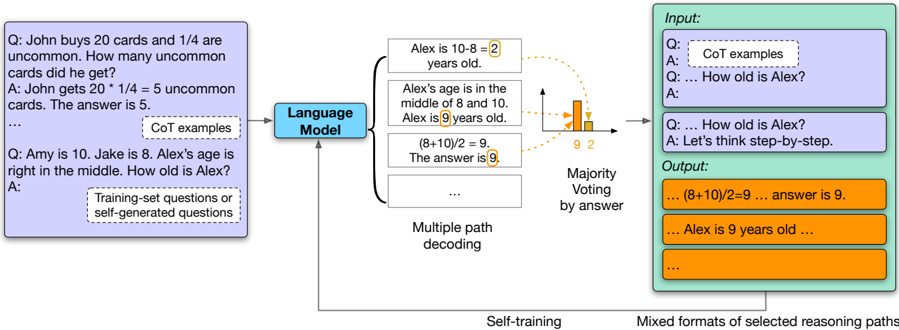
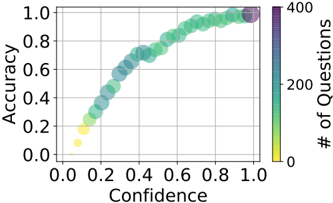
Large Language Models (LLMs) have achieved excellent performances in various tasks. However, fine-tuning an LLM requires extensive supervision. Human, on the other hand, may improve their reasoning abilities by self-thinking without external inputs. In this work, we demonstrate that an LLM is also capable of self-improving with only unlabeled datasets. We use a pre-trained LLM to generate "high-confidence" rationale-augmented answers for unlabeled questions using Chain-of-Thought prompting and self-consistency, and fine-tune the LLM using those self-generated solutions as target outputs. We show that our approach improves the general reasoning ability of a 540B-parameter LLM (74.4%->82.1% on GSM8K, 78.2%->83.0% on DROP, 90.0%->94.4% on OpenBookQA, and 63.4%->67.9% on ANLI-A3) and achieves state-of-the-art-level performance, without any ground truth label. We conduct ablation studies and show that fine-tuning on reasoning is critical for self-improvement.
Overview
The claims and statistics of this paper haven’t been checked yet.
Run the check — free, no account needed. It reads the open-access text and checks the sources it cites.
Integrity signals
Registry
Cites
Statistics
Figures
Verification
Claims the paper makes
The claims and statistics of this paper haven’t been checked yet.
Run the check — free, no account needed. It reads the open-access text and checks the sources it cites.
Claims other papers make about this one
Each is checked against this paper’s own text: does it say what the citing paper says it does?
The source backs part of the claim, not all of it — or backs it for a different population, condition or comparison.
In the citing paper
“Researchers are starting to apply discrete optimization and RL to find effective prompts, generally for a single logical LM call (Guo et al., 2023; Pryzant et al., 2023; Huang et al., 2022; Yang et al., 2023).”
From DSPy: Compiling Declarative Language Model Calls into Self-Improving Pipelines (2023) · cites this paper as Huang et al., 2022
Experimental — accuracy not yet measured
Self-check
Percentages, sums and reported differences re-computed from the paper’s own numbers.
The self-check needs the paper’s full text.
Citations
Cites
Language Models are Few-Shot Learners
Brown, T. B., Mann, B., Ryder, N., Subbiah, M., Kaplan, J., Dhariwal, P., Neelakantan, A., Shyam, P., Sastry, G., Askell, A., et al. (2020) · arXiv · doi:10.48550/arxiv.2005.14165 · Cited by 23,372
Distilling the Knowledge in a Neural Network
Hinton, G., Vinyals, O., & Dean, J. (2015) · arXiv · doi:10.48550/arxiv.1503.02531 · Cited by 14,204
SQuAD: 100,000+ Questions for Machine Comprehension of Text
Rajpurkar, P., Zhang, J., Lopyrev, K., & Liang, P. (2016) · Proceedings of the 2016 Conference on Empirical Methods in Natural Language Processing · doi:10.18653/v1/d16-1264 · Cited by 6,208
Chain-of-Thought Prompting Elicits Reasoning in Large Language Models
Wei, J., Wang, X., Schuurmans, D., Bosma, M., Ichter, B., Xia, F., Chi, E., Le, Q., & Zhou, D. (2022) · arXiv · doi:10.48550/arxiv.2201.11903 · Cited by 4,263
Self-citationGLUE: A Multi-Task Benchmark and Analysis Platform for Natural Language Understanding
Wang, A., Singh, A., Michael, J., Hill, F., Levy, O., & Bowman, S. (2018) · Proceedings of the 2018 EMNLP Workshop BlackboxNLP: Analyzing and Interpreting Neural Networks for NLP · doi:10.18653/v1/w18-5446 · Cited by 4,222
Training language models to follow instructions with human feedback
Ouyang, L., Wu, J., Jiang, X., Almeida, D., Wainwright, C. L., Mishkin, P., Zhang, C., Agarwal, S., Slama, K., Ray, A., et al. (2022) · arXiv · doi:10.48550/arxiv.2203.02155 · Cited by 4,208
A Broad-Coverage Challenge Corpus for Sentence Understanding through Inference
Williams, A., Nangia, N., & Bowman, S. (2018) · Proceedings of the 2018 Conference of the North American Chapter of the Association for Computational Linguistics: Human Language Technologies, Volume 1 (Long Papers) · doi:10.18653/v1/n18-1101 · Cited by 3,342
PaLM: Scaling Language Modeling with Pathways
Chowdhery, A., Narang, S., Devlin, J., Bosma, M., Mishra, G., Roberts, A., Barham, P., Chung, H. W., Sutton, C., Gehrmann, S., et al. (2022) · arXiv · doi:10.48550/arxiv.2204.02311 · Cited by 2,590
Self-citationSelf-Training With Noisy Student Improves ImageNet Classification
Xie, Q., Luong, M.-T., Hovy, E., & Le, Q. V. (2020) · 2020 IEEE/CVF Conference on Computer Vision and Pattern Recognition (CVPR) · doi:10.1109/cvpr42600.2020.01070 · Cited by 2,393
Large language models are zero-shot reasoners
Kojima, T., Gu, S. (., Reid, M., Matsuo, Y., & Iwasawa, Y. (2022) · Advances in Neural Information Processing Systems 35 · doi:10.52202/068431-1613 · Cited by 2,013
Self-citation
Research works printed but not linked: 7
- Xiaokang Chen, Yuhui Yuan, Gang Zeng, and Jingdong Wang. 2021. Semi-supervised semantic segmenta- tion with cross pseudo supervision. In IEEE Confer- ence on Computer Vision and Pattern Recognition (CVPR).
- Anoop Korattikara Balan, Vivek Rathod, Kevin P Mur- phy, and Max Welling. 2015. Bayesian dark knowl- edge. Advances in neural information processing systems, 28.
- Aitor Lewkowycz, Anders Andreassen, David Dohan, Ethan Dyer, Henryk Michalewski, Vinay Venkatesh Ramasesh, Ambrose Slone, Cem Anil, Imanol Schlag, Theo Gutman-Solo, Yuhuai Wu, Behnam Neyshabur, Guy Gur-Ari, and Vedant Misra. 2022. Solving quantitative reasoning problems with lan- guage models. ArXiv, abs/2206.14858. · arXiv
- Yifei Li, Zeqi Lin, Shizhuo Zhang, Qiang Fu, Bei Chen, Jian-Guang Lou, and Weizhu Chen. 2022b. On the advance of making language models better reasoners. ArXiv, abs/2206.02336. · arXiv
- Wang Ling, Dani Yogatama, Chris Dyer, and Phil Blun- som. 2017b. Program induction by rationale gener- ation: Learning to solve and explain algebraic word problems. In ACL.
- Timo Schick and Hinrich Schütze. 2020a. Exploiting cloze-questions for few-shot text classification and natural language inference. In Conference of the Eu- ropean Chapter of the Association for Computational Linguistics.
- Jason Wei, Yi Tay, Rishi Bommasani, Colin Raffel, Barret Zoph, Sebastian Borgeaud, Dani Yogatama, Maarten Bosma, Denny Zhou, Donald Metzler, et al. 2022b. Emergent abilities of large language models. arXiv preprint arXiv:2206.07682. · arXiv
Cited by
Sorted by citations
Items 101–200 of 254
Leveraging Training Data in Few-Shot Prompting for Numerical Reasoning
Jie, Z., & Lu, W. (2023) · Findings of the Association for Computational Linguistics: ACL (Findings of ACL) · doi:10.18653/v1/2023.findings-acl.668 · Cited by 15
ChatAdp: ChatGPT-powered Adaptation System for Human-Robot Interaction
Su, Z., & Sheng, W. (2024) · Proceedings - IEEE International Conference on Robotics and Automation/Proceedings · doi:10.1109/icra57147.2024.10611520 · Cited by 9
Al-Omar, Z., Guo, M., & Bland, T. (2025) · Technologies · doi:10.3390/technologies13060217 · Cited by 7
Context-aware chatbot for personal healthcare assistance using LLMs and LangChain
Fatima, S. K., Arshad, S., Awais, M., Iqbal, F., Altaf, A., Aziz, I., Ashraf, I., & Samee, N. M. A. (2025) · Journal of Intelligent Information Systems · doi:10.1007/s10844-025-00970-4 · Cited by 7
Enhancing intent understanding for ambiguous prompt: A human–machine co-adaption strategy
Wang, Y., He, Y., Wang, J., Li, K., Sun, L., Yin, J., Zhang, M., & Wang, X. (2025) · Neurocomputing · doi:10.1016/j.neucom.2025.130415 · Cited by 16
Self-citationUniversal Self-Adaptive Prompting
Wan, X., Sun, R., Nakhost, H., Dai, H., Eisenschlos, J. M., Arık, S. Ö., & Pfister, T. (2023) · Conference on Empirical Methods in Natural Language Processing (EMNLP) · doi:10.18653/v1/2023.emnlp-main.461 · Cited by 21
Explanation Selection Using Unlabeled Data for Chain-of-Thought Prompting
Ye, X., & Durrett, G. (2023) · Conference on Empirical Methods in Natural Language Processing (EMNLP) · doi:10.18653/v1/2023.emnlp-main.41 · Cited by 11
Learning from Mistakes via Cooperative Study Assistant for Large Language Models
Wang, D., & Li, L. (2023) · Conference on Empirical Methods in Natural Language Processing (EMNLP) · doi:10.18653/v1/2023.emnlp-main.659 · Cited by 17
Evaluation of Medium-large Language Models at Zero-shot Closed Book Generative Question Answering
Peinl, R., & Wirth, J. (2024) · doi:10.5121/csit.2024.140106 · Cited by 8
AI-Powered Test Question Generation in Medical Education: The DailyMed ApproachPreprint
van Uhm, J., van Haelst, M. V., & Jansen, P. R. (2024) · medRxiv · doi:10.1101/2024.11.11.24317087 · Cited by 4
CQuAE: A new Contextualized QUestion Answering corpus on Education domain
Gerald, T., Tamames, L., Ettayeb, S., Le, H.-Q., Paroubek, P., & Vilnat, A. (2024) · Data & Knowledge Engineering · doi:10.1016/j.datak.2024.102305 · Cited by 6
LoRA fine-tuning of Llama3 large model for intelligent fishery field
Song, Y., Lv, C., Zhu, K. P., & Qiu, X. (2025) · Discover Computing · doi:10.1007/s10791-025-09663-6 · Cited by 7
The Rise of Large Language Models: Evolution, Applications, and Future Directions
Rahmani, A. M., Hemmati, A., & Abbasi, S. (2025) · Engineering Reports · doi:10.1002/eng2.70368 · Cited by 7
Decentralized Multi-Agent System with Trust-Aware Communication
Ding, Y., Twabi, A., Yu, J., Zhang, L., Kondo, T., & Satō, H. (2025) · IEEE International Symposium on Parallel and Distributed Processing with Applications (ISPA) · doi:10.1109/ispa67752.2025.00198 · Cited by 6
Metacognitive symbolic distillation framework for multi-choice machine reading comprehension
Yao, J., Xu, X., & He, G. (2025) · Knowledge-Based Systems · doi:10.1016/j.knosys.2025.113130 · Cited by 7
Kang, D., Park, J., Jo, Y., & Bak, J. (2023) · Conference on Empirical Methods in Natural Language Processing (EMNLP) · doi:10.18653/v1/2023.emnlp-main.961 · Cited by 17
Huang, D., Ge, M., Xiang, K., Zhang, X.-L., & Yang, H. (2024) · International Journal of Network Management · doi:10.1002/nem.2292 · Cited by 6
How rationals boost textual entailment modeling: Insights from large language models
Pham, D.-H., Le, T., & Nguyen, H. T. (2024) · Computers & Electrical Engineering · doi:10.1016/j.compeleceng.2024.109517 · Cited by 7
Complex QA and language models hybrid architectures, SurveyPreprint
Daull, X., Bellot, P., Bruno, E., Martin, V., & Murisasco, É. (2023) · arXiv (Cornell University) · doi:10.48550/arxiv.2302.09051 · Cited by 32
Darwin Godel Machine: Open-Ended Evolution of Self-Improving Agents
Zhang, J., Hu, S., Lu, C., Lange, R., & Clune, J. (2025) · arXiv · doi:10.48550/arxiv.2505.22954 · Cited by 344
Do Models Explain Themselves? Counterfactual Simulatability of Natural Language Explanations
Chen, Y., Zhong, R., Ri, N., Zhao, C., He, H., Steinhardt, J., Yu, Z., & McKeown, K. (2023) · arXiv · doi:10.48550/arxiv.2307.08678 · Cited by 5
CRT-QA: A Dataset of Complex Reasoning Question Answering over Tabular Data
Zhang, Z., Li, X., Gao, Y., & Lou, J. (2023) · Conference on Empirical Methods in Natural Language Processing (EMNLP) · doi:10.18653/v1/2023.emnlp-main.132 · Cited by 10
Test-Time Self-Adaptive Small Language Models for Question Answering
Jeong, S., Baek, J., Cho, S., Hwang, S., & Park, J. (2023) · Findings of the Association for Computational Linguistics: EMNLP (Findings of EMNLP) · doi:10.18653/v1/2023.findings-emnlp.1033 · Cited by 6
Initial Seeds Generation Using LLM for IoT Device Fuzzing
Nakanishi, H., Hisafuru, K., Hasegawa, K., Hidano, S., Fukushima, K., Hashimoto, K., & Togawa, N. (2024) · International Conference on Internet of Things: Systems, Management and Security (IOTSMS) · doi:10.1109/iotsms62296.2024.10710191 · Cited by 5
Alfirević, N., Rendulić, D., Fošner, M., & Fošner, A. (2024) · Informatics · doi:10.3390/informatics11040078 · Cited by 10
An Educational Trading Card Game for a Medical Immunology Course
Singleton, V., Bordeaux, C., Ferguson, E., & Bland, T. (2025) · Education Sciences · doi:10.3390/educsci15060768 · Cited by 7
Handa, K., Clapper, M., Boyle, J., Wang, R., Yang, D., Yeager, D. S., & Demszky, D. (2023) · Conference on Empirical Methods in Natural Language Processing (EMNLP) · doi:10.18653/v1/2023.emnlp-main.549 · Cited by 13
Appraising Success of LLM-based Dialogue Agents
Wason, R., Arora, P., Arora, D., Kaur, J., Singh, S. P., & Hoda, M. N. (2024) · International Conference on Computing for Sustainable Global Development · doi:10.23919/indiacom61295.2024.10498880 · Cited by 7
ZARA: Improving Few-Shot Self-Rationalization for Small Language Models
Chen, W., Yen, A.-Z., Wu, C.-K., Huang, H., & Chen, H. (2023) · Findings of the Association for Computational Linguistics: EMNLP (Findings of EMNLP) · doi:10.18653/v1/2023.findings-emnlp.310 · Cited by 9
Towards human-centric intelligent treatment planning for radiation therapy
Jafar, A., & Jia, X. (2026) · npj Digital Medicine · doi:10.1038/s41746-026-02339-5 · Cited by 4
A survey of large language models in transportation planning: modelling, design and decision-making
Jin, Y., & Ma, J. (2026) · Transportmetrica A Transport Science · doi:10.1080/23249935.2026.2631152 · Cited by 9
ArEntail: manually-curated Arabic natural language inference dataset from news headlines
Obeidat, R., Alharahsheh, Y., Al‐Ayyoub, M., & Gharaibeh, M. (2024) · Language Resources and Evaluation · doi:10.1007/s10579-024-09731-1 · Cited by 8
A Large Language Model-Based Approach for Data Lineage Parsing
Li, Z., Guo, W., Gao, Y., Yang, D., & Kang, L. (2025) · Electronics · doi:10.3390/electronics14091762 · Cited by 4
Importance Weighting Can Help Large Language Models Self-Improve
Jiang, C., Chan, C.-M., Xue, W., Liu, Q., & Guo, Y. (2025) · Proceedings of the AAAI Conference on Artificial Intelligence · doi:10.1609/aaai.v39i23.34602 · Cited by 14
CoTEVer: Chain of Thought Prompting Annotation Toolkit for Explanation Verification
Kim, S., Joo, S. J., Jang, Y., Chae, H., & Yeo, J. (2023) · Conference of the European Chapter of the Association for Computational Linguistics · doi:10.18653/v1/2023.eacl-demo.23 · Cited by 5
Li, Y., Song, Z., & Li, W. (2024) · Research Square · doi:10.21203/rs.3.rs-3858549/v1 · Cited by 4
Gao, H.-A., Geng, J., Hua, W., Hu, M., Juan, X., Liu, H., Liu, S., Qiu, J., Qi, X., Wu, Y., et al. (2025) · arXiv · doi:10.48550/arxiv.2507.21046 · Cited by 3
Self-citationContext-dependent neuro-symbolic AI through self-supervised learning with large language models
Honda, H., & Hagiwara, M. (2025) · Neurocomputing · doi:10.1016/j.neucom.2025.131269 · Cited by 7
Self-Knowledge Distillation and Its Application: A Survey
Xu, K., Wang, L., Zhang, H., & Yin, B. (2026) · IEEE Transactions on Knowledge and Data Engineering · doi:10.1109/tkde.2026.3675811 · Cited by 4
Crystal: Introspective Reasoners Reinforced with Self-Feedback
Liu, J., Pasunuru, R., Hajishirzi, H., Choi, Y., & Çelikyılmaz, A. (2023) · Conference on Empirical Methods in Natural Language Processing (EMNLP) · doi:10.18653/v1/2023.emnlp-main.708 · Cited by 4
It Ain’t Over: A Multi-aspect Diverse Math Word Problem Dataset
Kim, J., Kim, Y., Baek, I., Bak, J., & Lee, J. (2023) · Conference on Empirical Methods in Natural Language Processing (EMNLP) · doi:10.18653/v1/2023.emnlp-main.927 · Cited by 7
INFORM : Information eNtropy based multi-step reasoning FOR large language Models
Zhou, C., You, W., Li, J., Ye, J., Chen, K., & Zhang, M. (2023) · Conference on Empirical Methods in Natural Language Processing (EMNLP) · doi:10.18653/v1/2023.emnlp-main.216 · Cited by 4
Assessing Logical Puzzle Solving in Large Language Models: Insights from a Minesweeper Case Study
Li, Y., Wang, H., & Zhang, C. (2024) · Conference of the North American Chapter of the Association for Computational Linguistics: Human Language Technologies (NAACL-HLT) · doi:10.18653/v1/2024.naacl-long.4 · Cited by 11
Large language models: assessment for singularity
Ishizaki, R., & Sugiyama, M. (2025) · AI & Society · doi:10.1007/s00146-025-02271-4 · Cited by 9
Njeh, C., Nakouri, H., & Jaafar, F. (2025) · International Journal of Information Security · doi:10.1007/s10207-025-01066-4 · Cited by 3
VisionCube: 3D-Aware Vision-Language Model for Multi-Step Spatial Reasoning
Wang, F., Luo, N., & Wu, W. (2025) · IEEE/CVF Conference on Computer Vision and Pattern Recognition Workshops (CVPRW) · doi:10.1109/cvprw67362.2025.00309 · Cited by 4
Exploring the Frontier of Generative AI: Evolution, Applications, and Future Trends
Sun, X., & He, W. (2025) · International Journal of Crowd Science · doi:10.26599/ijcs.2024.9100032 · Cited by 3
SAM-RAG: An Self-adaptive Framework for Multimodal Retrieval-Augmented Generation
Zhai, W. (2025) · International Joint Conference on Neural Networks (IJCNN) · doi:10.1109/ijcnn64981.2025.11227819 · Cited by 4
Self-Taught Optimizer (STOP): Recursively Self-Improving Code Generation
Zelikman, E., Lorch, E., Mackey, L., & Kalai, A. T. (2023) · arXiv · doi:10.48550/arxiv.2310.02304 · Cited by 4
“RSI was suggested by Minsky (1966) and Good (1966), as cited by Yampolskiy (2015).”
BackgroundDarwinX: Evolving Agent Harnesses Through Natural Selection
Zhang, Y., Dai, Y., Tan, J., Yang, L., Mullur, R., Hoang, T., Hu, Z., Zhu, J., Mui, P., Savarese, S., et al. (2026) · arXiv · doi:10.48550/arxiv.2608.07545 · Cited by 1
R-U-SURE? Uncertainty-Aware Code Suggestions By Maximizing Utility Across Random User Intents
Johnson, D. D., Tarlow, D., & Walder, C. (2023) · arXiv · doi:10.48550/arxiv.2303.00732 · Cited by 3
SDZRE: A semantic distillation method for zero-shot relation extraction
Zhou, Y., Lu, L. C., Li, H., Liu, X., Huang, D., & Chen, Y. (2025) · Expert Systems with Applications · doi:10.1016/j.eswa.2025.127609 · Cited by 2
Prabhu, O., & Navada, S. G. (2025) · Systems Science & Control Engineering · doi:10.1080/21642583.2025.2600795 · Cited by 3
Tian, Y., Huynh, L., Christhilf, K., Chakraborty, S., Watanabe, M., Arner, T., & McNamara, D. S. (2026) · Electronics · doi:10.3390/electronics15061209 · Cited by 5
Designing Tomorrow's Aqueous Batteries: A Holistic Blueprint for Performance and Scalability
Balcioğlu, Y. S., & Tekin, B. (2026) · The Chemical Record · doi:10.1002/tcr.70125 · Cited by 2
DialCoT Meets PPO: Decomposing and Exploring Reasoning Paths in Smaller Language Models
Han, C., Du, X., Che, Z., Lian, Y., Li, X., Gao, M. Y., & Wang, B. (2023) · Conference on Empirical Methods in Natural Language Processing (EMNLP) · doi:10.18653/v1/2023.emnlp-main.501 · Cited by 6
The investigation of progress and application related to chatbot in psychology
Li, Z. (2024) · Applied and Computational Engineering · doi:10.54254/2755-2721/37/20230501 · Cited by 2
Evaluation of Medium-Sized Language Models in German and English Language
Peinl, R., & Wirth, J. (2024) · International Journal on Natural Language Computing · doi:10.5121/ijnlc.2024.13101 · Cited by 2
Janowski, A., & Renigier‐Biłozor, M. (2024) · Applied Sciences · doi:10.3390/app14146135 · Cited by 2
Analytics Models for Customer-Centric Service-Based Supply Chains
Kang, P. S., Wang, X., Son, J. Y., & Jat, M. N. (2024) · SpringerBriefs in service science · doi:10.1007/978-3-031-63875-6_3 · Cited by 4
Self-citationDistributional Legacy: The Unreasonable Effectiveness of Harris’s Distributional Program
Sahlgren, M. (2024) · WORD · doi:10.1080/00437956.2024.2414515 · Cited by 2
Initial Seeds Generation Based on Communication Logs Using LLM for IoT Device Fuzzing
NAKANISHI, H., Hasegawa, K., Hidano, S., Fukushima, K., HASHIMOTO, K., & Togawa, N. (2025) · IEICE Transactions on Information and Systems · doi:10.1587/transinf.2024edp7305 · Cited by 2
TT-SI: Self-Improving LLM Agents with Test-Time Training
Acikgoz, E. C., Qian, C., Ji, H., Hakkani-Tür, D., & Tur, G. (2026) · Findings of the Association for Computational Linguistics: ACL 2026 · doi:10.18653/v1/2026.findings-acl.462 · Cited by 1
“Among valid candidates, we adopt the majority-agreed function as a pseudo-label under self-consistency (Zuo et al., 2025; Huang et al., 2023; Yuan et al., 2024), since agreement across independent samples is less likely to arise from stochastic or formatting errors.”
The Red Queen Gödel Machine: Co-Evolving Agents and Their Evaluators
Iacob, A., Jovanović, A., Shen, W. F., Burkhardt, D., Kurmanji, M., Tastan, N., Sani, L., Venanzi, N. A. E., Nie, J., Odonnat, A., et al. (2026) · arXiv · doi:10.48550/arxiv.2606.26294 · Cited by 1
“The node representation is the metacognitive workspace of HyperAgents [4]: each archive node is a shared workspace 𝑤 𝑎 with 𝐾 role agents plus a meta-agent that can edit the node’s code and coordination, while HGM search decides which lineage receives expansion and evaluation budget (App.”
Gibson, D., & Ifenthaler, D. (2024) · Advances in analytics for learning and teaching · doi:10.1007/978-3-031-65898-3_2 · Cited by 1
Enhancing Free-Form Table Question Answering Models by Distilling Relevant-Cell-Based Rationales
Yang, Z., Wang, S., Yan, Y., Liu, P., & Yu, D. (2024) · Lecture notes in computer science · doi:10.1007/978-981-97-8367-0_1 · Cited by 2
Inference Retrieval-Augmented Multi-Modal Chain-of-Thoughts Reasoning for Language Models
He, Q., Qian, S., Zhang, J., & Wang, C. (2025) · IEEE International Conference on Acoustics Speech and Signal Processing · doi:10.1109/icassp49660.2025.10888701 · Cited by 2
Hidayaturrahman, H., & Prawira, I. (2024) · International Conference on Informatics, Multimedia, Cyber and Information System (ICIMCIS) · doi:10.1109/icimcis63449.2024.10956237 · Cited by 3
Self-Regeneration: Step-Level Regeneration Improves the LLM's Causal Reasoning Ability
Jiang, W., Zhao, S., & Dai, H.-W. (2025) · International Conference on Computer Supported Cooperative Work in Design · doi:10.1109/cscwd64889.2025.11033548
Mozafari, J., Abdallah, A., Piryani, B., & Jatowt, A. (2025) · International ACM SIGIR Conference on Research and Development in Information Retrieval (SIGIR) · doi:10.1145/3726302.3730299 · Cited by 3
Financial Inclusion and Large Language Models
Ozili, P. K., Obiora, K. I., & Onuzo, C. (2025) · Advances in computational intelligence and robotics book series · doi:10.4018/979-8-3373-1250-7.ch010 · Cited by 1
Lee, H., Yoo, S., Loh, W.-K., & Jeong, O. (2025) · Knowledge-Based Systems · doi:10.1016/j.knosys.2025.114390 · Cited by 1
Human–AI Collaboration for Identifying Health Information Wants
Li, Z., Luo, Z., Zou, N., Xie, B., & He, D. (2025) · Cambridge University Press eBooks · doi:10.1017/9781009587877.010 · Cited by 1
MATATA: Weakly Supervised End-to-End MAthematical Tool-Augmented Reasoning for Tabular Applications
Vinayagame, V., Senay, G., & Martí, L. (2025) · Lecture notes in computer science · doi:10.1007/978-3-032-04614-7_24 · Cited by 1
FEAM: a dynamic prompting framework for sentiment analysis with hierarchical convolutional attention
Lin, Z., Wu, D., Yang, X., Li, L., & Qin, Z. (2025) · Frontiers in Physics · doi:10.3389/fphy.2025.1674949 · Cited by 1
Content Safety and Response Quality in LLMs: A Data-Centric Refinement Approach
Njeh, C., Nakouri, H., & Jaafar, F. (2025) · Procedia Computer Science · doi:10.1016/j.procs.2025.09.549 · Cited by 1
Wang, T., Xie, X., Jin, Z., Geng, M., Deng, J., Li, Z., Hu, S., Hu, S., Li, G., Cui, M., et al. (2025) · IEEE Transactions on Audio Speech and Language Processing · doi:10.1109/taslpro.2025.3633090 · Cited by 1
Fras, T., & Pawlowski, P. (2026) · Journal of Dynamic Behavior of Materials · doi:10.1007/s40870-025-00506-5 · Cited by 2
Auditing unauthorized training data from AI generated content using information isotopes
Qi, T., Yin, J., Cai, D., Xie, Y., Wang, H., Hu, Z., Yang, P., Nan, G., Zhou, Z., Wu, C., et al. (2026) · Nature Communications · doi:10.1038/s41467-026-68862-x · Cited by 3
Research Process of Likelihood-based Mitigation of Evaluation Bias in Large Language Models
Oi, M. (2026) · Journal of Natural Language Processing · doi:10.5715/jnlp.33.1027 · Cited by 1
Sudmann, A., Echterhölter, A., Ramsauer, M., Retkowski, F., Schröter, J., & Waibel, A. (2023) · AI critique · doi:10.1515/9783839467664 · Cited by 5
Improving LLM and Generative Model Efficiency using Predictive Analysis
Anbumani, P., Vasantharaja, R., P, G. M., Roopesh, V. S., & Hareesh, S. (2024) · International Conference on IoT, Communication and Automation Technology (ICICAT) · doi:10.1109/icicat62666.2024.10923492 · Cited by 1
Wei, Y., & Fan, J. (2025) · Journal Of Big Data · doi:10.1186/s40537-025-01236-0 · Cited by 1
Advances in reasoning by prompting large language models: A survey
Hong, R., Pang, X., & Zhang, C. (2026) · Cybernetics and Intelligence · doi:10.26599/cai.2024.9390004 · Cited by 3
Not Explainable but Verifiable
Burgess, P., & Shareghi, E. (2025) · Oxford University Press eBooks · doi:10.1093/9780198945215.003.0093 · Cited by 1
ReVISE: Learning to Refine at Test-Time via Intrinsic Self-Verification
Lee, H., Oh, S., Kim, J., Shin, J., & Tack, J. (2025) · arXiv · doi:10.48550/arxiv.2502.14565 · Cited by 26
“Structured reasoning meth-ods, including self-consistency (Wang et al., 2022) and Tree-of-Thought (ToT) (Yao et al., 2024), enhance multi-step problem-solving by exploring various reasoning paths.”
Process Supervision via Verbal Critique Improves Reasoning in Large Language Models
Chen, H.-Y. (2026) · arXiv · doi:10.48550/arxiv.2604.21611 · Cited by 1
“[2023], STaR Zelikman et al. [2022], and self-improvement Huang et al. [2022] all allocate more compute at test time.”
Zhou, C., Zhang, X., Song, D., Chen, X., Gu, W., Ma, H., Tian, Y., Zhang, M., & Hu, L. (2025) · arXiv · doi:10.48550/arxiv.2502.09183 · Cited by 18
“One line of research (Huang et al., 2023b; Madaan et al., 2023; Hu et al., 2024) focuses on enabling self-correction during the inference stage by iteratively calling LLMs and incorporating external signals.”
Self-Improving LLM Agents at Test-Time
Acikgoz, E. C., Qian, C., Ji, H., Hakkani-Tür, D., & Tur, G. (2025) · arXiv
“Recent studies suggest that LLMs can self-improve their capabilities (Huang et al., 2023; Wang et al., 2023; Chen et al., 2024a; Pang et al., 2024; Yuan et al., 2024; Shafayat et al., 2025; Huang et al., 2025), i.e., they can refine their own output distribution using internal signals derived from…”
Sudmann, A., Echterhölter, A., Ramsauer, M., Retkowski, F., & Schröter, J. (2023) · AI critique · doi:10.1515/9783839467664-003
Stepping Stones for Self-Learning
Hai-Jew, S. (2023) · Advances in educational technologies and instructional design book series · doi:10.4018/979-8-3693-0074-9.ch005
Srivastava, N., & Kim, S. (2024) · SSRN Electronic Journal · doi:10.2139/ssrn.4790013
OrphaGPT: An Adapted Large Language Model for Orphan Diseases Classification
Pokhrel, K., Sanín, C., Islam, M. R., Sakib, M. K. H., Ulhaq, A., & Szczerbicki, E. (2024) · Lecture notes in computer science · doi:10.1007/978-981-97-4982-9_16
A Complex Hierarchical Framework of Learning
Gibson, D., & Ifenthaler, D. (2024) · Advances in analytics for learning and teaching · doi:10.1007/978-3-031-65898-3_3
Al-Omar, Z., Guo, M., & Bland, T. (2024) · doi:10.2196/preprints.68289
Cheng, L., Chunhong, Z., & Tang, X. (2024) · Lecture notes in computer science · doi:10.1007/978-981-96-0814-0_25
Inoshita, K. (2024) · IEEE International Conference on Internet of Things and Intelligence Systems (IoTaIS) · doi:10.1109/iotais64014.2024.10799461
Adaptive Industrial Edge Intelligence: A Reinforcement Learning Approach
Ren, Y., Fan, L., Li, X., Wang, P., Yuan, S., & Yao, W. (2024) · International Conference on Computing, Communication, Perception and Quantum Technology (CCPQT) · doi:10.1109/ccpqt64497.2024.00074
Zhang, Y., Zhang, B., Li, Z., Li, M., Cheng, N., Chen, M., Wei, T., Ma, J., Wang, S., & Xiao, J. (2025) · IEEE International Conference on Acoustics Speech and Signal Processing · doi:10.1109/icassp49660.2025.10887840 · Cited by 1
Identification and Verification of Authorship Using Machine and Deep Learning Methods
Ovasapyan, T. D., Tolgorenko, E. M., & Zubkov, E. A. (2024) · Automatic Control and Computer Sciences · doi:10.3103/s0146411624700925
Metadata
- Authors
- Huang, J., Gu, S. S., Hou, L., Wu, Y., Wang, X., Yu, H., & Han, J.
- Affiliations
- University of Illinois Urbana-Champaign (US)
- Google (United States) (US)
- Venue
- arXiv
- Publisher
- arXiv
- Published
- 2022
- Pages
- 1051-1068
- arXiv
- 2210.11610
- OpenAlex
- W4389523706
- Cited by
- 230
- References
- 59
- Citations by year
- 2026: 36 · 2025: 77 · 2024: 63 · 2023: 53 · 2022: 1
- FWCI
- 40.57
- Type
- conference paper
- Language
- en
- Open access
- hybrid
- doi.org
- Licence
- Locations
- Conference on Empirical Methods in Natural Language Processing (EMNLP) (publishedVersion, cc-by)
- arXiv (Cornell University) (submittedVersion)
- arXiv (Cornell University)
- Topics
- Physical Sciences › Computer Science › Artificial Intelligence › Topic Modeling
- Physical Sciences › Computer Science › Artificial Intelligence › Natural Language Processing Techniques
- Physical Sciences › Computer Science › Artificial Intelligence › Domain Adaptation and Few-Shot Learning
- Keywords
- large language models, human development, self-supervised fine-tuning, unlabeled data, chain-of-thought prompting, self-consistency, reasoning skills, low-resource languages, Arecaceae, GSM8K, OpenBookQA
About these checks
Registry, retraction, Cites and statistics results are computed, not judged, with one exception: a printed reference that no index lists is read once by a model before it counts as a citation error. Claims are extracted by a model and kept only when their quote appears verbatim in the text; each cited source is then checked, with a model’s help, for whether it says what the claim relies on. Those verdicts can be wrong — read the claim’s quote and the cited source before relying on one.
Statistics and arithmetic are recomputed, not judged.
Confidence bands are shown only for fields calibrated on our annotated test set. None is calibrated yet, so no band is shown.
What counts as a claim ›How we measure confidence ›How we check this ›
Are you an author, or do you see a problem with this page? Request a review
