

The DOI matches its DataCite record; 57 of the 59 references it cites were found in a registry or an index, and 2 are not checked yet.
Large Language Models Can Self-Improve
Open accessAbstract
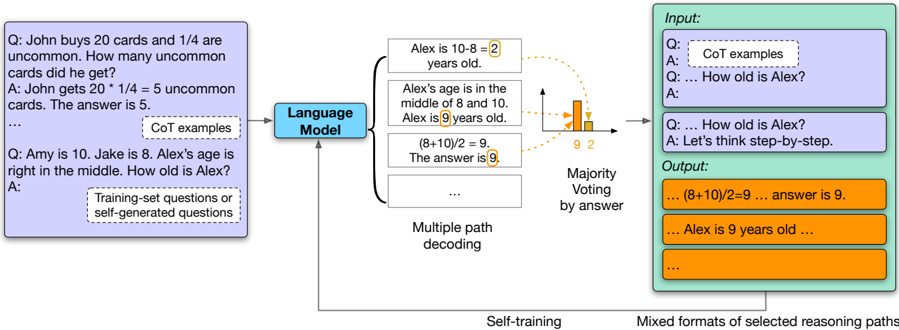
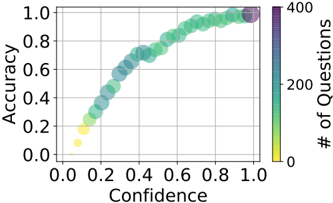
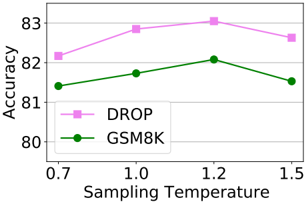
Large Language Models (LLMs) have achieved excellent performances in various tasks. However, fine-tuning an LLM requires extensive supervision. Human, on the other hand, may improve their reasoning abilities by self-thinking without external inputs. In this work, we demonstrate that an LLM is also capable of self-improving with only unlabeled datasets. We use a pre-trained LLM to generate "high-confidence" rationale-augmented answers for unlabeled questions using Chain-of-Thought prompting and self-consistency, and fine-tune the LLM using those self-generated solutions as target outputs. We show that our approach improves the general reasoning ability of a 540B-parameter LLM (74.4%->82.1% on GSM8K, 78.2%->83.0% on DROP, 90.0%->94.4% on OpenBookQA, and 63.4%->67.9% on ANLI-A3) and achieves state-of-the-art-level performance, without any ground truth label. We conduct ablation studies and show that fine-tuning on reasoning is critical for self-improvement.
Overview
The claims and statistics of this paper haven’t been checked yet.
Run the check — free, no account needed. It reads the open-access text and checks the sources it cites.
Integrity signals
Registry
Cites
Statistics
Figures
Verification
Claims the paper makes
The claims and statistics of this paper haven’t been checked yet.
Run the check — free, no account needed. It reads the open-access text and checks the sources it cites.
Claims other papers make about this one
Each is checked against this paper’s own text: does it say what the citing paper says it does?
The source backs part of the claim, not all of it — or backs it for a different population, condition or comparison.
In the citing paper
“Researchers are starting to apply discrete optimization and RL to find effective prompts, generally for a single logical LM call (Guo et al., 2023; Pryzant et al., 2023; Huang et al., 2022; Yang et al., 2023).”
From DSPy: Compiling Declarative Language Model Calls into Self-Improving Pipelines (2023) · cites this paper as Huang et al., 2022
Experimental — accuracy not yet measured
Self-check
Percentages, sums and reported differences re-computed from the paper’s own numbers.
The self-check needs the paper’s full text.
Citations
Cites
Language Models are Few-Shot Learners
Brown, T. B., Mann, B., Ryder, N., Subbiah, M., Kaplan, J., Dhariwal, P., Neelakantan, A., Shyam, P., Sastry, G., Askell, A., et al. (2020) · arXiv · doi:10.48550/arxiv.2005.14165 · Cited by 23,372
Distilling the Knowledge in a Neural Network
Hinton, G., Vinyals, O., & Dean, J. (2015) · arXiv · doi:10.48550/arxiv.1503.02531 · Cited by 14,204
SQuAD: 100,000+ Questions for Machine Comprehension of Text
Rajpurkar, P., Zhang, J., Lopyrev, K., & Liang, P. (2016) · Proceedings of the 2016 Conference on Empirical Methods in Natural Language Processing · doi:10.18653/v1/d16-1264 · Cited by 6,208
Chain-of-Thought Prompting Elicits Reasoning in Large Language Models
Wei, J., Wang, X., Schuurmans, D., Bosma, M., Ichter, B., Xia, F., Chi, E., Le, Q., & Zhou, D. (2022) · arXiv · doi:10.48550/arxiv.2201.11903 · Cited by 4,263
Self-citationGLUE: A Multi-Task Benchmark and Analysis Platform for Natural Language Understanding
Wang, A., Singh, A., Michael, J., Hill, F., Levy, O., & Bowman, S. (2018) · Proceedings of the 2018 EMNLP Workshop BlackboxNLP: Analyzing and Interpreting Neural Networks for NLP · doi:10.18653/v1/w18-5446 · Cited by 4,222
Training language models to follow instructions with human feedback
Ouyang, L., Wu, J., Jiang, X., Almeida, D., Wainwright, C. L., Mishkin, P., Zhang, C., Agarwal, S., Slama, K., Ray, A., et al. (2022) · arXiv · doi:10.48550/arxiv.2203.02155 · Cited by 4,208
A Broad-Coverage Challenge Corpus for Sentence Understanding through Inference
Williams, A., Nangia, N., & Bowman, S. (2018) · Proceedings of the 2018 Conference of the North American Chapter of the Association for Computational Linguistics: Human Language Technologies, Volume 1 (Long Papers) · doi:10.18653/v1/n18-1101 · Cited by 3,342
PaLM: Scaling Language Modeling with Pathways
Chowdhery, A., Narang, S., Devlin, J., Bosma, M., Mishra, G., Roberts, A., Barham, P., Chung, H. W., Sutton, C., Gehrmann, S., et al. (2022) · arXiv · doi:10.48550/arxiv.2204.02311 · Cited by 2,590
Self-citationSelf-Training With Noisy Student Improves ImageNet Classification
Xie, Q., Luong, M.-T., Hovy, E., & Le, Q. V. (2020) · 2020 IEEE/CVF Conference on Computer Vision and Pattern Recognition (CVPR) · doi:10.1109/cvpr42600.2020.01070 · Cited by 2,393
Large language models are zero-shot reasoners
Kojima, T., Gu, S. (., Reid, M., Matsuo, Y., & Iwasawa, Y. (2022) · Advances in Neural Information Processing Systems 35 · doi:10.52202/068431-1613 · Cited by 2,013
Self-citation
Research works printed but not linked: 7
- Xiaokang Chen, Yuhui Yuan, Gang Zeng, and Jingdong Wang. 2021. Semi-supervised semantic segmenta- tion with cross pseudo supervision. In IEEE Confer- ence on Computer Vision and Pattern Recognition (CVPR).
- Anoop Korattikara Balan, Vivek Rathod, Kevin P Mur- phy, and Max Welling. 2015. Bayesian dark knowl- edge. Advances in neural information processing systems, 28.
- Aitor Lewkowycz, Anders Andreassen, David Dohan, Ethan Dyer, Henryk Michalewski, Vinay Venkatesh Ramasesh, Ambrose Slone, Cem Anil, Imanol Schlag, Theo Gutman-Solo, Yuhuai Wu, Behnam Neyshabur, Guy Gur-Ari, and Vedant Misra. 2022. Solving quantitative reasoning problems with lan- guage models. ArXiv, abs/2206.14858. · arXiv
- Yifei Li, Zeqi Lin, Shizhuo Zhang, Qiang Fu, Bei Chen, Jian-Guang Lou, and Weizhu Chen. 2022b. On the advance of making language models better reasoners. ArXiv, abs/2206.02336. · arXiv
- Wang Ling, Dani Yogatama, Chris Dyer, and Phil Blun- som. 2017b. Program induction by rationale gener- ation: Learning to solve and explain algebraic word problems. In ACL.
- Timo Schick and Hinrich Schütze. 2020a. Exploiting cloze-questions for few-shot text classification and natural language inference. In Conference of the Eu- ropean Chapter of the Association for Computational Linguistics.
- Jason Wei, Yi Tay, Rishi Bommasani, Colin Raffel, Barret Zoph, Sebastian Borgeaud, Dani Yogatama, Maarten Bosma, Denny Zhou, Donald Metzler, et al. 2022b. Emergent abilities of large language models. arXiv preprint arXiv:2206.07682. · arXiv
Cited by
Sorted by citations
Items 201–254 of 254
Insight generation and complex datasets analysis with LLMs in AdTech
Moskovets, A., & Serras, M. (2024) · Global Congress on Emerging Technologies (GCET) · doi:10.1109/gcet64327.2024.10934405
Researcher, S. V. C.-O. A., & Arslan, A. K. (2025) · Engineering and Technology Journal · doi:10.47191/etj/v10i03.31
Fine-Tuning of Large Language Models for Solving DSA Problems Using QLoRA
Pavan Kalyan, S., R, A. K. B., Kumar, T. S., Prem Raj, S., Patil, P. B., & Harshini, P. (2025) · International Conference on Computing for Sustainability and Intelligent Future (COMP-SIF) · doi:10.1109/comp-sif65618.2025.10969969
Jiang, N., Liu, C., & Liu, X. (2025) · International Symposium on Computer Applications and Information Systems (ISCAIS) · doi:10.1109/iscait64916.2025.11010665
DRILL: Dual-Reasoning Large Language Models for Phishing Email Detection with Limited Data
Greenewald, C., Ashmore, B., Poon, C.-S., & Chen, L. (2025) · Communications in computer and information science · doi:10.1007/978-981-96-6966-0_18
Bu, Y., Melatos, A., & Evans, R. (2025) · Physica A Statistical Mechanics and its Applications · doi:10.1016/j.physa.2025.130792
Preference-Strength-Aware Self-Improving Alignment with Generative Preference Models
Zhai, Y., Zhang, Z., Yang, C., Xu, K., Yu, Y., Li, W., Wang, H., Xu, Z., Feng, D., Ding, B., et al. (2025) · International ACM SIGIR Conference on Research and Development in Information Retrieval (SIGIR) · doi:10.1145/3726302.3730063
Self-Improvement: Large Language Models Can Self-Improve Generation with External Tools
Liu, D. Y., Ma, C., & Feng, Y. (2025) · Communications in computer and information science · doi:10.1007/978-981-96-9994-0_2
Balz, T., Yao, S., & Mirandu, C. (2025) · IEEE Geoscience and Remote Sensing Magazine · doi:10.1109/mgrs.2025.3574703
Iterative Self-Improvement of Vision Language Models for Image Scoring and Self-Explanation
Tanji, N., & Yamasaki, T. (2025) · Proceedings - International Conference on Image Processing · doi:10.1109/icip55913.2025.11084643
AI Behavioral SciencePreprint
Jackson, M. O., Mei, Q., Wang, S., Xie, Y., Yuan, W., Benzell, S. G., Brynjolfsson, E., Evans, J. A., Jabarian, B., Kleinberg, J. M., et al. (2025) · SSRN Electronic Journal · doi:10.2139/ssrn.5395006 · Cited by 2
Kalyan Chakravarthy, K. (2025) · SSRN Electronic Journal · doi:10.2139/ssrn.5393117
GAMeta-Prompt: A Generative Adversarial Prompt-Based Meta-language Reasoning Enhancement Method
Qin, X., Hu, Y. J., Ma, C., & Tian, M. (2025) · Lecture notes in computer science · doi:10.1007/978-3-032-04630-7_11
Self-improvement for Computerized Adaptive Testing
Rudolph, Y., Neubauer, K., & Brefeld, U. (2025) · Lecture notes in computer science · doi:10.1007/978-3-032-05981-9_5 · Cited by 1
Transforming natural language into code: advancing automated code synthesis for software development
shboul, B. A., Qaqour, A., Bani-Salameh, H., & Almakadmeh, K. (2025) · Cluster Computing · doi:10.1007/s10586-025-05688-0
ToP: a Structured Pathway for Document-level Information Extraction with Large Language Models
Yin, P., Ren, Y., Fang, F., Hu, B., & Bai, X. (2025) · International Joint Conference on Neural Networks (IJCNN) · doi:10.1109/ijcnn64981.2025.11227926
Park, J. H., Kang, S., Lee, S. J., Park, S., Kim, J., Jin, J. H., & Cho, K. (2025) · IEEE International Conference on Consumer Electronics-Asia (ICCE-Asia) · doi:10.1109/icce-asia67487.2025.11263774
Mohammadi, F., Maghool, S., & Ceravolo, P. (2025) · IEEE/ACS International Conference on Computer Systems and Applications (AICCSA) · doi:10.1109/aiccsa66935.2025.11315321
Conducting Innovative Thought Experiments and Simulations With Large Language Models
Niftiyev, İ. (2026) · IGI Global eBooks · doi:10.4018/979-8-3373-5017-2.ch004
Management of Emergency Surgical Flow and Operating Rooms with AI Support
Catena, R., & Okpala, D. A. (2026) · Hot topics in acute care surgery and trauma · doi:10.1007/978-3-032-09357-8_23
Efficient Learning for Product Attributes with Compact Multimodal Models
Kulkarni, M. (2025) · IEEE International Conference on Computer Vision Workshops · doi:10.1109/iccvw69036.2025.00714
Evaluating Robustness and Generalization in LLMs under Adversarial and Real-World Conditions
Demirsan, Y., & Yıldız, O. T. (2026) · IEEE International Conference on Big Data and Smart Computing (BigComp) · doi:10.1109/bigcomp68355.2026.00058
LLM-Based IoT Fuzzing with Format Consistency and Vulnerability-Aware Test Case Generation
Nakanishi, H., Hasegawa, K., Hidano, S., Fukushima, K., Hashimoto, K., & Togawa, N. (2025) · International Conference on Internet of Things: Systems, Management and Security (IOTSMS) · doi:10.1109/iotsms68530.2025.11408435
Li, R., Sun, K., Shi, B., & Dong, B. (2025) · IEEE International Conference on Big Data (BigData) · doi:10.1109/bigdata66926.2025.11401932
Yağci, H. E., Dikmen, A., Gürel, C. M., Akgun, O. B., Şafak, I., Kara, N., Metinkaya, Ö. Ö., & Özgür, A. (2025) · IEEE International Conference on Big Data (BigData) · doi:10.1109/bigdata66926.2025.11401843
A Multi Disaster Command and Scheduling Model Based on Fine tuning and RAG Construction
Guo, Y., Yang, S., Zhang, Y., & Qiu, Z. (2025) · International Academic Exchange Conference on Science and Technology Innovation (IAECST) · doi:10.1109/iaecst68792.2025.11415132
CLAIM: Mitigating Catastrophic Forgetting in Continual Instruction Fine-Tuning Large Language Models
Qiu, X., Shi, S., Hao, T., & Tan, X. (2026) · IEEE Transactions on Cognitive and Developmental Systems · doi:10.1109/tcds.2026.3674105
Федосов, С. В., Bakanov, M. O., & Кузнецов, И. А. (2026) · НАУЧНЫЙ ЖУРНАЛ СТРОИТЕЛЬСТВА И АРХИТЕКТУРЫ · doi:10.36622/2541-7592.2026.81.1.004
Yenikaya, M. A., & Odabaşoğlu, M. L. (2026) · 3 SEKTÖR SOSYAL EKONOMİ DERGİSİ · doi:10.63556/tisej.2026.1731
Zhen, Z., Ling, C., Mi, L., & Zhang, H. (2026) · Computing · doi:10.1007/s00607-026-01641-0
Wang, Z., Zhu, Q., Chen, X., Sim, M. Y., Zhou, W., Hao, S., & Fu, J. (2026) · Synthesis lectures on human language technologies · doi:10.1007/978-3-032-06264-2_6
Qian, L., Zhang, H., Wu, Y., Li, Y., Zhu, M., Liu, L., & Wu, J. (2026) · International World Wide Web Conference (WWW) · doi:10.1145/3774904.3792306
Self-citationImproving control of neural networks facing visual perturbations
Cordier, T. (2025) · theses.fr (ABES) · doi:10.70675/a4edd425ze27ez4df1z890dz111029659b3b
Self-Chill: A Divergence-Convergence Framework for Multi-Path Generation in LLMs
Li, Y., Chen, Y., Li, D., Wang, W. B., & Zhang, Y. (2026) · IEEE International Conference on Acoustics Speech and Signal Processing · doi:10.1109/icassp55912.2026.11464445
Talamo, L., Steuer, J., & Verkerk, A. (2026) · Linguistics · doi:10.1515/ling-2024-0122
EvoCap: Enhancing video captioning via self-evolving video-LLMs with knowledge consolidation
Hu, Y., Wu, M., Yu, J., Chen, Y. P., & Yang, W. (2026) · Knowledge-Based Systems · doi:10.1016/j.knosys.2026.116075
Dynamic Normativity: Learning Human Preferences
Corrêa, N. K. (2026) · The International library of ethics, law and technology · doi:10.1007/978-3-032-22150-6_5
AGI, Existential Risks, and the Control Problem
Corrêa, N. K. (2026) · The International library of ethics, law and technology · doi:10.1007/978-3-032-22150-6_2
Development of a domain-tailored on-premise dialogue system for accelerated materials analysis
Goto, S., Kamiyama, M., Sudo, E., & Kimura, H. (2026) · Neural Computing and Applications · doi:10.1007/s00521-026-12254-1
Prompt Optimization with Verifiable Rewards for Synthetic Essay Generation
Nam, S. (2026) · Lecture notes in computer science · doi:10.1007/978-3-032-29744-0_9
Self-Improving Code Generation via Semantic Entropy and Behavioral Consensus
Zhang, H., Cheng, W., & Hu, W. P. (2026) · IEEE International Conference on Program Comprehension (ICPC) · doi:10.1145/3794763.3794798 · Cited by 2
Fine-Tuning LLMs with Extracted Rationales for Attributed Text Generation
Cao, Z., Zhao, B., Wang, Y., Cheng, P., & Lin, B. (2026) · Lecture notes in computer science · doi:10.1007/978-3-032-31397-3_39
Carrasco, P., & Esteves, P. (2026) · European journal of tourism, hospitality and recreation · doi:10.2478/ejthr-2026-0001
Zhang, J., Yuan, B., & Zhang, Q. (2026) · Entropy · doi:10.3390/e28090951 · Cited by 2
AI in Science: Early Insights *Preprint
Codreanu, M. A., Imas, A., Mateos-Garcia, J. C., Emmens, J., Muiruri, E., Turrell, A., Jacobs, J., Kasirzadeh, A., Trišović, A., Chen, Y., et al. (2026) · SSRN Electronic Journal · doi:10.2139/ssrn.7465898 · Cited by 3
Almeida, G. R. D., de Souza, A. D., & Drummond, I. N. (2026) · International Conference on Information, Intelligence, Systems & Applications (IISA) · doi:10.1109/iisa71656.2026.11705441
Jin, X., Du, Y., & Han, H. (2026) · The Journal of Supercomputing · doi:10.1007/s11227-026-08909-4
Video Reasoning Without Training
Sridhar, D., Bhardwaj, K., Jeyaraj, J. P., Vasconcelos, N. M., Nayak, A., & Teague, H. (2026) · doi:10.1109/cvprf71909.2026.00600
Ni, L., Yang, G., & Peng, X. (2026) · Electronics · doi:10.3390/electronics15204601
Beyond Semantic Similarity: Multi-Stage Calibration for In-Context Learning
Xi, C., & Liang, D. (2026) · International Joint Conference on Neural Networks (IJCNN) · doi:10.1109/ijcnn69854.2026.11729913
Arithmetic Reasoning with LLM: Prolog Generation & Permutation
Yang, X., Chen, B., & Tam, Y.-C. (2024) · arXiv · doi:10.48550/arxiv.2405.17893
“Afterwards, advancements have been made in LLMs’ reasoning capacity via step-by-step meth-ods (Zhou et al., 2023; Zhu et al., 2023; Huang et al., 2022; Liang et al., 2023).”
MethodZweiger, A., Pari, J., Guo, H., Akyürek, E., Kim, Y., & Agrawal, P. (2025) · arXiv · Cited by 3
“Other recent works improve performance on mathematical tasks by using majority-vote or model confidence as reinforcement learning rewards, enabling performance improvement without access to ground-truth labels [61, 62, 63, 64, 65].”
Can LLMs Correct Themselves? A Benchmark of Self-Correction in LLMs
Tie, G., Yuan, Z., Zhao, Z., Hu, C., Gu, T., Zhang, R., Zhang, S., Wu, J., Tu, X., Jin, M., et al. (2025) · arXiv · doi:10.48550/arxiv.2510.16062 · Cited by 16
“[73] enhance reasoning by selecting outputs based on ground-truth final answers, whereas [24] emphasize self-consistency as a method for refining reasoning.”
TTRL: Test-Time Reinforcement Learning
Zuo, Y., Zhang, K., Sheng, L., Qu, S., Cui, G., Zhu, X., Li, H., Zhang, Y., Long, X., Hua, E., et al. (2025) · arXiv · Cited by 7
“This upper bound is also the performance limit of traditional self-training methods [17], which select self-generated CoT through majority voting for supervised fine-tuning (SFT).”
Metadata
- Authors
- Huang, J., Gu, S. S., Hou, L., Wu, Y., Wang, X., Yu, H., & Han, J.
- Affiliations
- University of Illinois Urbana-Champaign (US)
- Google (United States) (US)
- Venue
- arXiv
- Publisher
- arXiv
- Published
- 2022
- Pages
- 1051-1068
- arXiv
- 2210.11610
- OpenAlex
- W4389523706
- Cited by
- 230
- References
- 59
- Citations by year
- 2026: 36 · 2025: 77 · 2024: 63 · 2023: 53 · 2022: 1
- FWCI
- 40.57
- Type
- conference paper
- Language
- en
- Open access
- hybrid
- doi.org
- Licence
- Locations
- Conference on Empirical Methods in Natural Language Processing (EMNLP) (publishedVersion, cc-by)
- arXiv (Cornell University) (submittedVersion)
- arXiv (Cornell University)
- Topics
- Physical Sciences › Computer Science › Artificial Intelligence › Topic Modeling
- Physical Sciences › Computer Science › Artificial Intelligence › Natural Language Processing Techniques
- Physical Sciences › Computer Science › Artificial Intelligence › Domain Adaptation and Few-Shot Learning
- Keywords
- large language models, human development, self-supervised fine-tuning, unlabeled data, chain-of-thought prompting, self-consistency, reasoning skills, low-resource languages, Arecaceae, GSM8K, OpenBookQA
About these checks
Registry, retraction, Cites and statistics results are computed, not judged, with one exception: a printed reference that no index lists is read once by a model before it counts as a citation error. Claims are extracted by a model and kept only when their quote appears verbatim in the text; each cited source is then checked, with a model’s help, for whether it says what the claim relies on. Those verdicts can be wrong — read the claim’s quote and the cited source before relying on one.
Statistics and arithmetic are recomputed, not judged.
Confidence bands are shown only for fields calibrated on our annotated test set. None is calibrated yet, so no band is shown.
What counts as a claim ›How we measure confidence ›How we check this ›
Are you an author, or do you see a problem with this page? Request a review
