

InternVL3: Exploring Advanced Training and Test-Time Recipes for Open-Source Multimodal Models
Open accessThe DOI matches its DataCite record; 145 of the 145 references it cites were found in a registry or an index; none of the 38 sources its claims cite is checked for support yet.
Abstract
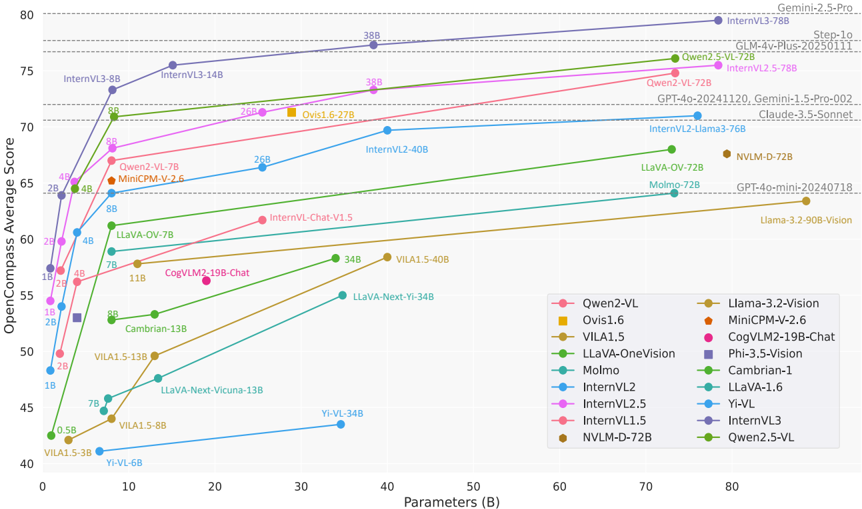
We introduce InternVL3, a significant advancement in the InternVL series featuring a native multimodal pre-training paradigm. Rather than adapting a text-only large language model (LLM) into a multimodal large language model (MLLM) that supports visual inputs, InternVL3 jointly acquires multimodal and linguistic capabilities from both diverse multimodal data and pure-text corpora during a single pre-training stage. This unified training paradigm effectively addresses the complexities and alignment challenges commonly encountered in conventional post-hoc training pipelines for MLLMs. To further improve performance and scalability, InternVL3 incorporates variable visual position encoding (V2PE) to support extended multimodal contexts, employs advanced post-training techniques such as supervised fine-tuning (SFT) and mixed preference optimization (MPO), and adopts test-time scaling strategies alongside an optimized training infrastructure. Extensive empirical evaluations demonstrate that InternVL3 delivers superior performance across a wide range of multi-modal tasks. In particular, InternVL3-78B achieves a score of 72.2 on the MMMU benchmark, setting a new state-of-the-art among open-source MLLMs. Its capabilities remain highly competitive with leading proprietary models, including ChatGPT-4o, Claude 3.5 Sonnet, and Gemini 2.5 Pro, while also maintaining strong pure-language proficiency. In pursuit of open-science principles, we will publicly release both the training data and model weights to foster further research and development in next-generation MLLMs.
Overview
CoChat Summary
TL;DR
InternVL3 introduces a native multimodal pre-training paradigm that jointly learns language and multimodal capabilities in one stage, plus V2PE, SFT/MPO post-training, test-time scaling, and infrastructure optimizations. InternVL3-78B reaches 72.2 on MMMU, setting a new state of the art among open-source MLLMs while remaining competitive with proprietary models.
Key findings
- InternVL3-78B achieves 72.2 on MMMU, 906 on OCRBench, 96.0/98.6 on VCR-EN-Easy (EM/Jaccard), and 89.0/88.7 on MMBench English/Chinese; the paper reports it as a new open-source MLLM state of the art and competitive with ChatGPT-4o, Claude 3.5 Sonnet, and Gemini 2.5 Pro.
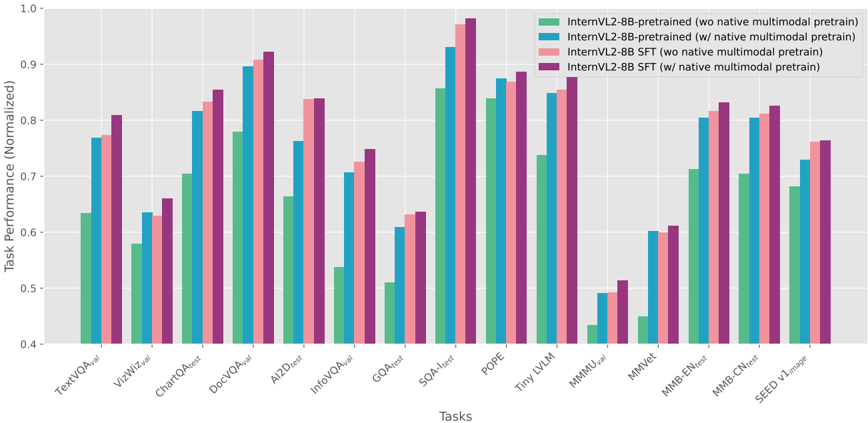
- Native multimodal pre-training is effective: replacing InternVL2-8B’s MLP warmup with native multimodal pre-training yields performance on most benchmarks comparable to the fully multi-stage-trained InternVL2-8B baseline, with further gains after instruction tuning on higher-quality data.
- MPO improves multimodal reasoning across seven benchmarks: InternVL3-78B and InternVL3-38B outperform their non-MPO counterparts by 4.1 and 4.5 points overall, respectively, even though MPO training data is a subset of SFT data.
- Test-time scaling with Best-of-8 and VisualPRM improves reasoning: on the Vision-Only split of MathVerse, best-of-8 gives increases of approximately 6.0 and 3.2 percentage points for InternVL3-38B and InternVL3-78B, respectively.
Methods
- Architecture follows “ViT-MLP-LLM”: vision encoder options are InternViT-300M and InternViT-6B; language models are pre-trained Qwen2.5 series and InternLM3-8B base models; the MLP is a two-layer randomly initialized network; pixel unshuffle reduces each 448×448 image tile to 256 visual tokens.
- Native multimodal pre-training jointly optimizes all parameters on multimodal and pure-language corpora, computes loss only on text tokens, and uses square averaging for token weights. Data combines InternVL2.5 pre-training corpus with GUI, tool usage, 3D scene, and video data, plus InternLM2.5 and open-source text data; the chosen language:multimodal ratio is 1:3, totaling about 200B tokens (50B language, 150B multimodal).
- Post-training uses SFT followed by MPO. SFT grows from 16.3M samples in InternVL2.5 to 21.7M in InternVL3; MPO uses about 300K preference samples and combines DPO preference loss, BCO quality loss, and LM generation loss. Test-time scaling uses Best-of-N with VisualPRM-8B as critic; infrastructure extends InternEVO, yielding a 50% to 200% training speedup for comparable-size models under the same compute budget.
Limitations
- The paper states a noticeable performance gap remains between InternVL3 and models like Qwen2.5-VL on certain benchmarks, such as MuirBench, implying future work may need better training data curation and model refinements.
- The paper reports minor declines on some benchmarks, such as MMHal, and states that optimizing data and training strategies for more consistent improvements remains an important future direction.
- The paper states visual grounding gains plateau at larger scales: InternVL2.5-78B reaches an average score of 92.3 while InternVL3-78B shows 91.4; it speculates this is because InternVL3’s training data expansion did not include additional grounding-specific data and the relative reduction in grounding-targeted data may have restricted localization capabilities.
Model-written summary. Check it against the paper before relying on it.
Integrity signals
Registry
Cites
Statistics
Figures
Verification
Claims the paper makes
0 Valid · 1 Not valid · 14 Not checked · 83 Own results and interpretations
A result the paper reports from its own data — it cites no other source for it, so there is none to check. The quote shows it is in the paper.
In the paper
“When compared with other competitive models, such as Qwen2-VL-72B and Qwen2.5-VL-72B, the InternVL3 series-especially the 78B variant-offers a consistent performance advantage on the multimodal understanding benchmarks.”
§ InternVL3: Exploring Advanced Training and Test-Time Recipes for Open-Source Multimodal Models > 3.6 Comprehensive Multimodal Evaluation
plainstates an association- Asserted: passes — The authors put it forward as true.
- Checkable: passes — It can be checked against evidence.
- Load-bearing: passes — The paper’s conclusions depend on it.
- Based: unclear — It is unclear why the paper says it holds.
A result the paper states — it cites no source for it, so there is none to check. The quote shows it is in the paper.
In the paper
“As a result, the number of training samples grows from 16.3M in InternVL2.5 to 21.7M in InternVL3.”
§ InternVL3: Exploring Advanced Training and Test-Time Recipes for Open-Source Multimodal Models > Data.
plainstates a cause- Asserted: passes — The authors put it forward as true.
- Checkable: passes — It can be checked against evidence.
- Load-bearing: unclear — It is unclear whether the paper’s conclusions depend on it.
- Based: passes — The paper gives a reason why it holds.
A result the paper states — it cites no source for it, so there is none to check. The quote shows it is in the paper.
In the paper
“while also maintaining strong pure-language proficiency.”
§ InternVL3: Exploring Advanced Training and Test-Time Recipes for Open-Source Multimodal Models > Abstract
boosted- Asserted: passes — The authors put it forward as true.
- Checkable: passes — It can be checked against evidence.
- Load-bearing: unclear — It is unclear whether the paper’s conclusions depend on it.
- Based: passes — The paper gives a reason why it holds.
A result the paper reports from its own data — it cites no other source for it, so there is none to check. The quote shows it is in the paper.
In the paper
“Compared with previous models, InternVL3 demonstrates substantial improvements across a wide range of task categories.”
§ InternVL3: Exploring Advanced Training and Test-Time Recipes for Open-Source Multimodal Models > 3.1 Overall Comparison to Other Advanced MLLMs
boosted- Asserted: passes — The authors put it forward as true.
- Checkable: passes — It can be checked against evidence.
- Load-bearing: passes — The paper’s conclusions depend on it.
- Based: passes — The paper gives a reason why it holds.
A result the paper reports from its own data — it cites no other source for it, so there is none to check. The quote shows it is in the paper.
In the paper
“Its capabilities remain highly competitive with leading proprietary models, including ChatGPT-4o, Claude 3.5 Sonnet, and Gemini 2.5 Pro, while also maintaining strong pure-language proficiency.”
§ InternVL3: Exploring Advanced Training and Test-Time Recipes for Open-Source Multimodal Models > Abstract
plain- Asserted: passes — The authors put it forward as true.
- Checkable: passes — It can be checked against evidence.
- Load-bearing: passes — The paper’s conclusions depend on it.
- Based: passes — The paper gives a reason why it holds.
45 more claims
Create a free account to see all 98 claims and every source verdict.
- It may state two separate claims as one. 42
- Probably not a substantial claim. 6
- The quote only partly states this claim. 1
Self-check
Percentages, sums and reported differences re-computed from the paper’s own numbers.
Each contradiction between two passages listed here was confirmed by an independent check.
Rated minor: it would not touch a result — a value no result rests on, a p-value that stays on the same side of the significance level, or a conflict that is clerical, resolved elsewhere in the paper, or outside its own findings.
In the paper
§ InternVL3: Exploring Advanced Training and Test-Time Recipes for Open-Source Multimodal Models > 3.8 Visual Grounding
“InternVL3-8B, InternVL3-9B, and InternVL3-14B yield average scores around 88.2-89.6,reflecting a consistent trend of performance gains as the model size increases.”
§ InternVL3: Exploring Advanced Training and Test-Time Recipes for Open-Source Multimodal Models > 3.6 Comprehensive Multimodal Evaluation
“InternVL3-8B 92.5 94.6 88.0 88.2 92.5 81.8 89.6 90.0 89.6 InternVL3-9B 91.8 93.2 86.6 86.4 91.0 79.9 88.0 88.5 88.2”
Rated minor: it would not touch a result — a value no result rests on, a p-value that stays on the same side of the significance level, or a conflict that is clerical, resolved elsewhere in the paper, or outside its own findings.
In the paper
§ InternVL3: Exploring Advanced Training and Test-Time Recipes for Open-Source Multimodal Models > GPT-4o Gemini 2.0 Claude Aguvis-72B Qwen2.5-VL-72B UI-TARS-72B InternVL3-8B -38B -72B
“The 8B variant (81.4%) already surpasses UI-TARS-72B”
§ InternVL3: Exploring Advanced Training and Test-Time Recipes for Open-Source Multimodal Models > GPT-4o Gemini 2.0 Claude Aguvis-72B Qwen2.5-VL-72B UI-TARS-72B InternVL3-8B -38B -72B
“InternVL3-72B achieves 90.9%, outperforming UI-TARS-72B (90.3%).”
Citations
Cites
Fei-Fei, L., Fergus, R., & Perona, P. (2005) · 2004 Conference on Computer Vision and Pattern Recognition Workshop · doi:10.1109/cvpr.2004.383 · Cited by 2,502
Liu, H., Li, C., Wu, Q., & Lee, Y. J. (2023) · Advances in Neural Information Processing Systems 36 · doi:10.52202/075280-1516 · Cited by 2,428
Making the V in VQA Matter: Elevating the Role of Image Understanding in Visual Question Answering
Goyal, Y., Khot, T., Summers-Stay, D., Batra, D., & Parikh, D. (2017) · 2017 IEEE Conference on Computer Vision and Pattern Recognition (CVPR) · doi:10.1109/cvpr.2017.670 · Cited by 2,287
Chen, Z., Wang, W., Cao, Y., Liu, Y., Gao, Z., Cui, E., Zhu, J., Ye, S., Tian, H., Liu, Z., et al. (2024) · arXiv · doi:10.48550/arxiv.2412.05271 · Cited by 2,204
Self-citationGrounding DINO: Marrying DINO with Grounded Pre-training for Open-Set Object Detection
Liu, S., Zeng, Z., Ren, T., Li, F., Zhang, H., Yang, J., Jiang, Q., Li, C., Yang, J., Su, H., et al. (2025) · Lecture Notes in Computer Science · doi:10.1007/978-3-031-72970-6_3 · Cited by 2,074
Self-citationNatural Questions: A benchmark for question answering research
Kwiatkowski, T., Palomaki, J., Redfield, O., Collins, M., Parikh, A., Alberti, C., Epstein, D., Polosukhin, I., Devlin, J., Lee, K., et al. (2019) · Transactions of the Association for Computational Linguistics · doi:10.1162/tacl_a_00276 · Cited by 2,069
MiniCPM-V: A GPT-4V Level MLLM on Your PhonePreprint
Yao, Y., Yu, T., Zhang, A., Wang, C., Cui, J., Zhu, H., Cai, T., Li, H., Zhao, W., He, Z., et al. (2024) · arXiv · doi:10.48550/arxiv.2408.01800 · Cited by 1,695
Self-citationTriviaQA: A Large Scale Distantly Supervised Challenge Dataset for Reading Comprehension
Joshi, M., Choi, E., Weld, D., & Zettlemoyer, L. (2017) · Proceedings of the 55th Annual Meeting of the Association for Computational Linguistics (Volume 1: Long Papers) · doi:10.18653/v1/p17-1147 · Cited by 1,690
Math-Shepherd: Verify and Reinforce LLMs Step-by-step without Human Annotations
Wang, P., Li, L., Shao, Z., Xu, R., Dai, D., Li, Y., Chen, D., Wu, Y., & Sui, Z. (2024) · Proceedings of the conference - Association for Computational Linguistics. Meeting · doi:10.18653/v1/2024.acl-long.510 · Cited by 1,665
TriviaQA: A Large Scale Distantly Supervised Challenge Dataset for Reading Comprehension
Joshi, M., Choi, E., Weld, D. S., & Zettlemoyer, L. (2017) · arXiv · doi:10.48550/arxiv.1705.03551 · Cited by 1,650
Research works printed but not linked: 6
- Anonymous. CG-bench: Clue-grounded question answering benchmark for long video understanding. In Submitted to The Thirteenth International Conference on Learning Representations, 2024. under review. 14, 15
- Shuai Bai, Keqin Chen, Xuejing Liu, Jialin Wang, Wenbin Ge, Sibo Song, Kai Dang, Peng Wang, Shijie Wang, Jun Tang, et al. Qwen2.5-vl technical report. arXiv preprint arXiv:2502.13923, 2025. 1, 2, 9, 10, 15 · arXiv
- Jie Cao and Jing Xiao. An augmented benchmark dataset for geometric question answering through dual parallel text encoding. In Proceedings of the 29th International Conference on Computational Linguistics, pages 1511-1520, 2022. 6
- Zhe Chen, Weiyun Wang, Hao Tian, Shenglong Ye, Zhangwei Gao, Erfei Cui, Wenwen Tong, Kongzhi Hu, Jiapeng Luo, Zheng Ma, et al. How far are we to gpt-4v? closing the gap to commercial multimodal models with open-source suites. arXiv preprint arXiv:2404.16821, 2024. 2, 3 · arXiv
- Hunter Lightman, Vineet Kosaraju, Yuri Burda, Harrison Edwards, Bowen Baker, Teddy Lee, Jan Leike, John Schulman, Ilya Sutskever, and Karl Cobbe. Let's verify step by step. In The Twelfth International Conference on Learning Representations, 2023. 7
- Minesh Mathew, Viraj Bagal, Rubèn Tito, Dimosthenis Karatzas, Ernest Valveny, and CV Jawahar. Infographicvqa. In Proceedings of the IEEE/CVF Winter Conference on Applications of Computer Vision, pages 1697-1706, 2022. 6, 7, 8, 10
Cited by
Items 1,901–2,000 of 2,641
GeoVP: A Unified Visual Prompting Framework for Multisource Remote-Sensing Image Understanding
Yu, L., Wang, Y., & Qi, X. (2026) · IEEE Journal of Selected Topics in Applied Earth Observations and Remote Sensing · doi:10.1109/jstars.2026.3719361
Self-citationPROBE: VLM-Guided Discrete Structural Reconfiguration for Customized and Efficient Video Retrieval
Gu, Y., Liu, K., Zhe, T., Chen, B., Fan, J., Yang, J., Liu, Z., Xiao, Z., Chen, C., Luo, X., et al. (2026) · ACM SIGKDD Conference on Knowledge Discovery and Data Mining (KDD) · doi:10.1145/3770855.3818016
“We adopt InternVL3-8B [50] as the frozen VLM to produce prompt-conditioned embeddings.”
Self-citationText-Guided Visual Representation Learning for Robust Multimodal E-Commerce Recommendation
Guo, Y., Ma, J., Dong, Y., Zhang, T., Yang, S., Zang, Y., Ding, W., Gong, P., & Han, J. (2026) · ACM SIGKDD Conference on Knowledge Discovery and Data Mining (KDD) · doi:10.1145/3770855.3818176
RM-MLLM: Robust scene understanding in adverse weather with RGB-multispectral fusion
Ju, H., Yeo, S. D., Park, I., Jin, Y., Nalçakan, Y., & Kim, S. (2026) · Results in Engineering · doi:10.1016/j.rineng.2026.112317
Jung, C., Fitzgerald, J., Seefried, E., Bradford, M., & Blanchard, N. (2026) · Lecture notes in computer science · doi:10.1007/978-3-032-37261-1_32
Benchmarking Vietnamese image captioning: A spatially-aware transformer and the HDUCap dataset
Hoang, A. C., Nguyen, H. L., Pham, T.-A., & Nguyen, D. C. (2026) · Journal of Visual Communication and Image Representation · doi:10.1016/j.jvcir.2026.104963
PixelThink: Towards Efficient Chain-of-Pixel Reasoning
Wang, S., Fang, G., Kong, L., Li, X., Xu, J., Yang, S., Li, Q., Zhu, J., & Wang, X. (2025) · arXiv · doi:10.48550/arxiv.2505.23727
Self-citationSalas-Cáceres, J., Lorenzo-Navarro, J., Castrillón-Santana, M., Peral, P. P., & Gil, S. M. (2026) · Frontiers in Artificial Intelligence · doi:10.3389/frai.2026.1800342
Beyond Final Answers: CRYSTAL Benchmark for Transparent Multimodal Reasoning Evaluation
Barrios, W., & Jin, S. (2026) · Lecture notes in computer science · doi:10.1007/978-3-032-37020-4_25
Cine-shot Director: Native Cinema-Grade Multi-Shot Video Generation Framework
Han, J., Ye, X., Zhen, Z., Song, L., Wang, Q., Li, L., Deng, C., & Feng, J. (2026) · IEEE International Conference on Acoustics Speech and Signal Processing · doi:10.1109/icassp55912.2026.11464190
ElecThinker: A Three-Stage Framework to Enhance Electronic Diagram Reasoning in Multimodal LLMs
Chen, Q., Bai, Q., Jin, D., Li, J., Chen, J., Chen, S. F., Ye, S., & Li, W. (2026) · IEEE International Symposium on Circuits and Systems proceedings · doi:10.1109/iscas66217.2026.11561947
“5-VL [27] and InternVL3 [34].”
Self-citationEvoJail: Jailbreaking Text-to-Image Models via Semantic Evolution
Xu, Z., Li, Z. D., Liu, Y., Ma, X. C., Zhang, Y., & Chen, Y. (2026) · Lecture notes in computer science · doi:10.1007/978-981-92-3423-3_33
Self-citationMarineEVT: Advancing Event-Centric Marine Video Understanding via Visual Tool Reasoning
To, T.-A., Wong, Y. K., Vu, T.-A., Zheng, Z., & Yeung, S.-K. (2026) · Lecture notes in computer science · doi:10.1007/978-3-032-37429-5_16
Zhang, H., Xu, H., Zhang, H., Huang, Y., Huang, H., Huang, Y., Ding, X., & Lin, H. (2026) · IEEE Transactions on Aerospace and Electronic Systems · doi:10.1109/taes.2026.3719218
Self-citationOrdering Matters: Rank-Aware Selective Fusion for Blended Emotion Recognition
Lee, J., Kim, H., Jang, H., & Noh, J. (2026) · International Conference on Automatic Face and Gesture Recognition · doi:10.1109/fg67764.2026.11557044
Chang, I., & Park, G.-M. (2026) · Journal of Broadcast Engineering · doi:10.5909/jbe.2026.31.1.77
Benchmark evaluation of multi-modal large language models for ophthalmic diagnosis in real world
Huang, S., Chen, J., Wang, J., Zhang, P., Du, W., Yuan, H., Kong, D., Lou, W., Lai, M., & Yang, W. (2026) · Frontiers in Medicine · doi:10.3389/fmed.2026.1842016
Self-citationYin, B., & Wen, M. (2026) · Lecture notes in computer science · doi:10.1007/978-981-92-3432-5_45
Shen, Y., Zhang, H., & Unberath, M. (2026) · Lecture notes in computer science · doi:10.1007/978-3-032-38233-7_60
Self-citationC3-Bench: A Context-Aware Change Captioning Benchmark
Kim, J.-W., Kim, H., & Kim, U.-H. (2026) · Lecture notes in computer science · doi:10.1007/978-3-032-37435-6_14
MovieTeller: Tool-augmented Movie Synopsis with ID Consistent Progressive Abstraction
Li, Y., Chen, X., Jiang, M., Tang, W., & Wang, G. (2026) · International Conference on Computer Supported Cooperative Work in Design (CSCWD) · doi:10.1109/cscwd68734.2026.11582204
“To demonstrate the versatility and generalizability of our framework, we also conduct ablation studies by replacing the core VLM with other state-of-the-art models, including InternVL3-8B [18] and WeThink-Qwen2.”
Cui, J. (2026) · SSRN Electronic Journal · doi:10.2139/ssrn.7369010
Benchmarking MLLMs on Mistake Recognition and Explanation in Single-Step Components of Cooking
Takashige, S., Hashimoto, A., & Satoh, S. (2026) · Lecture notes in computer science · doi:10.1007/978-3-032-37255-0_36
Ge, Q., Li, Y., Wu, S., & Min, X. (2026) · Displays · doi:10.1016/j.displa.2026.103543
AdaDiff-VLA: Hybrid Reasoning via Mode Policy Learning for Vision-Language-Action Models
Liu, H., Liu, P., Liu, X., & Shu, T. (2026) · Lecture notes in computer science · doi:10.1007/978-3-032-38410-2_11
Zhu, W., Yu, J., Feng, C., Dong, Z., Song, Z., Gao, J., & Huang, R. (2026) · Developments in the Built Environment · doi:10.1016/j.dibe.2026.101047
Zuo, Q., Wang, Z., Li, J., Guan, Y., Chen, J., Yang, C., & Fu, Z. (2026) · Array · doi:10.1016/j.array.2026.101139
MRCNet: Motion Reasoning Chain for Cross Modal Video Camouflaged Object Detection
Hui, W., Zhu, Z., Zheng, S., Cheng, M., Lu, H., & Zhao, Y. (2026) · IEEE Transactions on Pattern Analysis and Machine Intelligence · doi:10.1109/tpami.2026.3689767
FaithViP: A Benchmark for Hallucinations With Synthetic Visual Prompts in Large Multi-Modal Models
Gao, Y., Xu, N., Tian, H., Wei, S., & Liu, A.-A. (2026) · IEEE Transactions on Circuits and Systems for Video Technology · doi:10.1109/tcsvt.2026.3708848
“The selected open-source LMMs are: InstructBLIP [2], LLaVA [3], LLaVA-Next [27], InternVL series [4], [28], [29], and Qwen-VL series [6].”
Self-citationWang, D., Tao, X., Qu, Z., Luo, H., Gong, X., Shen, F., Zhang, Z., & Ding, G. (2026) · IEEE Transactions on Circuits and Systems for Video Technology · doi:10.1109/tcsvt.2026.3704942
Robust Grounding with MLLMs Against Occlusion and Small Objects via Language-Guided Semantic Cues
Park, B., Kim, S., Kim, H., Park, S., & Ro, Y. M. (2026) · IEEE International Conference on Acoustics Speech and Signal Processing · doi:10.1109/icassp55912.2026.11463586
Fallas-Moya, F., Xie-Li, D., & Agüero-Elizondo, N. (2026) · Genetic and Evolutionary Computation Conference Companion (GECCO Companion) · doi:10.1145/3795101.3814670
“Simultaneously, native multimodal models like InternVL3 [33] and the Qwen 3-VL / 3.5-VL series [2] have expanded capabilities to include structured counting and localized grounding via “deep thinking” reasoning modes.”
InfluentialYu, Y., Yan, K., Zhang, C., & Yang, Y. (2026) · International Conference on Image, Vision and Computing (ICIVC) · doi:10.1109/icivc70586.2026.11686654
Rashid, M. T., & Siddique, M. J. (2026) · Computers · doi:10.3390/computers15080499
Towards Efficient Keyframe Selection for News Video Captioning
Nguyen, A., Pandya, D. A., Sultana, A., García-Ruiz, M. Á., & Lin, W. (2025) · International Conference on Computer and Applications (ICCA) · doi:10.1109/icca66035.2025.11430820
“Vision-language models (VLMs) [2, 7, 9, 10, 18] are increasingly used to generate captions for videos, but the common practice of uniform frame sampling is inefficient, presenting two key issues: it may miss more informative frames that were not sampled and may result in redundancy by selecting…”
ScanFocus: A Coarse-to-Fine Framework for Spatio-Temporal Video Grounding
Chen, K., Dai, M., Cheng, W., & Yang, W. (2026) · Lecture notes in computer science · doi:10.1007/978-3-032-37356-4_15
Self-citationBackground Blurring Matters: Improving Visual Grounding by Merging Text-Irrelevant Tokens
Yao, R., Xiong, S., Yang, S., Zou, T., Xiong, S., & Rong, Y. (2026) · Lecture notes in computer science · doi:10.1007/978-3-032-37252-9_36
Towards Entity-Discriminative Large Vision-Language Models for Multimodal Entity MatchingPreprint
Cao, Y., Liang, H., Sun, C., Song, J., Wang, Y., & An, Y. (2026) · SSRN Electronic Journal · doi:10.2139/ssrn.6478518
Self-citationWang, Y., Sun, D., Cao, Y., Wang, B., Wang, Q., & Zhai, Y. (2026) · Electric Power Systems Research · doi:10.1016/j.epsr.2026.113636
Self-citationExCap: Entity-aware zero-shot image captioning via faithful synthetic image–text alignment
Jiang, Q., Liu, Z., Zhou, W., Qin, J., Huang, Q., & Wang, J. (2026) · Knowledge-Based Systems · doi:10.1016/j.knosys.2026.116639
Self-citationQiu, L., Liu, Y., Hu, D.-Y., Zeng, H.-Q., Güngör, O., Chen, C.-J., Liu, J.-Y., Wang, J.-Y., & Zheng, X.-L. (2026) · arXiv · doi:10.48550/arxiv.2610.04918
Self-citationHierarchical Compression of Vision-Language Model BenchmarksPreprint
Ok, H., Kang, S., & Lee, J. (2026) · arXiv · doi:10.48550/arxiv.2609.37515
Harnessing Image Question Dependence for Better VLM Test-time Reinforcement LearningPreprint
He, X., Li, T.-W., Wang, J., Ai, M., He, X., Tong, H., & He, J. (2026) · arXiv · doi:10.48550/arxiv.2609.13296
Self-citationAstroSpecLM: A Spectrum-Language Model for Evidence-Grounded Astronomical Spectral AnalysisPreprint
石静航, Zhang, Y., Luo, A., Li, C., & Kong, X. (2026) · arXiv · doi:10.48550/arxiv.2609.07102
“Multimodal LLMs extend this capability to non-text inputs by connecting modality encoders with language models through adapters, projection layers, or cross-attention mechanisms (Liu et al., 2023; Li et al., 2024; Dai et al., 2024; Zhu et al., 2025; Bai et al., 2025).”
Foundation and Multimodal Large Language Models for Face Presentation and Morph Attack DetectionPreprint
Shahreza, H. O., Khan, A. H., Lorenz, P., Komaty, A., & Marcel, S. (2026) · arXiv · doi:10.48550/arxiv.2608.29802
“FaceLLM [58] adapted InternVL3 [59] with the FairFaceGPT dataset for general face analysis tasks.”
InfluentialMedUAG: Unified Understanding and Generation for Medical Multimodal ModelsPreprint
Meng, Z., Zhang, Y., Wang, H., Tang, Y., Gai, X., Shen, C., Jiang, S., Cao, S., Wu, J., Wu, X., et al. (2026) · arXiv · doi:10.48550/arxiv.2608.18937
“5-VL [32], InternVL3 [44], Llama3.”
Self-citationNeuPAT: Neuron-aware Plasticity Allocation Tuning for Language-Preserving MLLMsPreprint
Jin, J., Zhang, J., Wang, C., Liu, J., & Guo, L. (2026) · arXiv · doi:10.48550/arxiv.2608.08107
“…series, DeepSeek-VL, In-ternVL3, and LLaVA-OneVision, improve multimodal perception and reasoning with stronger encoders, larger corpora, and advanced post-training (Bai et al., 2023; Wang et al., 2024; Bai et al., 2025; Lu et al., 2024; Wang et al., 2025b; Zhu et al., 2025; Li et al., 2024).”
Advantage-Guided Gate: Reshaping Open-Ended Reasoning for Vision-Based Spatial IntelligencePreprint
Lin, L., Bai, Y., Zhu, C., Shi, J., Wang, M., Long, Y., Chen, J., Shao, L., & Fu, H. (2026) · arXiv · doi:10.48550/arxiv.2608.07987
Chen, H., Li, M., Jiao, H., & Zhou, T. (2026) · arXiv · doi:10.48550/arxiv.2608.04554
“The 10-epoch setting for small InternVL models follows training-side learning curves that continued to improve after epoch 5. the augmented input.”
InfluentialDeploying Language Models on Android-Based Edge Devices: A Practical Evaluation Pipeline
Costa, S., Lima, I., Harada, W., Lucena, M., Alves, A., Valadão, M. D. M., Alves, C., Belem, R. J. S., Pimentel, A., Fabrício, R., et al. (2026) · Anais do XVIII Simpósio Brasileiro de Computação Ubíqua e Pervasiva (SBCUP 2026) · doi:10.5753/sbcup.2026.22352
Bridging Physical Reasoning and Task Generalization via Visual Action Outcome Reasoning AlignmentPreprint
Ko, H.-J., Chen, J. C., Yuan, H., Lee, H.-Y., Shen, T., Yang, M., & Wang, Y.-C. F. (2026) · arXiv · doi:10.48550/arxiv.2607.06522
“Placing the red ball at [51, 39] aligns it slightly to the left and above the green ball.”
Self-citationEvaluating Intellectual Property Guardrails of Generative Image Models: A Technical ReportPreprint
Hoag, A. T., Modas, A., Ba, Y., LaChance, J., Xue, J., Hutiri, W. T., Simson, J., Georgievski, T., Towli, A., Smith, J., et al. (2026) · arXiv · doi:10.48550/arxiv.2607.02582
“5-VL-3B, 7B, 32B, and 72B Instruct [29]; Qwen3-VL-2B, 4B, 8B, 32B, 30B-A3B, and 235B-A22B Instruct [26]; and InternVL3-8B, 14B, 38B, and 78B [30].”
MEDLAYXPLAIN: Benchmarking the Expert-Lay Gap in Medical Vision-Language ModelsPreprint
Jang, H., Lee, J., Kim, S., Lim, C. Y., Goh, H., Eum, H., & Choi, K. S. (2026) · arXiv · doi:10.48550/arxiv.2606.21194
A Pruning-based Question-Answering for Interactive Video Search: A Simple Baseline
Cheng, Y. T., Nguyen, P. A., & Ngo, C. (2026) · International Conference on Multimedia Retrieval · doi:10.1145/3805622.3810720
DAL-PCQA: Enabling Distortion-Level and Language-Driven Reasoning for Point Cloud Quality Assessment
Chakraborty, S., Araújo, G. D. C., Faria, S. T., Carvalho, M. M., & Farias, M. C. Q. (2026) · International Conference on Quality of Multimedia Experience (QoMEX) · doi:10.1109/qomex69967.2026.11618383
“We evaluated three representative VLMs: DepictQA [30], LLaVA [37] and InternVL [38].”
MedGore: An Approach and a Dataset for Identification of Sensitive Medical Images
Gayen, S., Mulcahey, R., Loane, R. F., Demner‐Fushman, D., & Gupta, D. (2026) · Language Resources and Evaluation Conference (LREC) · doi:10.63317/5f7uiuto4ph5
“A recent multimodal large language model (MLLM), InternVL (Zhu et al., 2025) model (InternVL3-1B-hf), is used in our experiments, which is built upon multimodal Pre-Training and mixed preference optimization and has shown superior performance across a variety of languages and tasks.”
Park, J., Choi, S., Seo, J., Sohn, M., Kim, Y., & Kim, J. (2026) · arXiv · doi:10.48550/arxiv.2603.28363
“5-VL 7B [4], mPLUG-Owl3 7B [53], InternVL3 8B [58], Molmo 7B [8], PaliGemma2 3B [45], SmolVLM 500M [37], LLaVA 1.5 7B [35], and BLIP [32]) to identify the visual elements represented in the sketch ( V ); and zero-shot classifiers (CLIP-ViT-L/14 [40], OpenCLIP [23], and CoCa [54]) to obtain the…”
InfluentialSPHINX: A Synthetic Environment for Visual Perception and ReasoningPreprint
Alam, M. T., Aggarwal, S., Chae, J. Y., & Rastogi, N. (2025) · arXiv · doi:10.48550/arxiv.2511.20814
“5-VL family [3], Llama 3.2 [36], InternVL3 [74], Molmo2 [13], and the Qwen3-VL family [50], covering parameter scales from 3B to 235B.”
InfluentialCoEvolve: Construct-to-Edit Visual Grounding with Bidirectional State RefinementPreprint
Sun, D., Zhang, Y., Bowen, Y., Liu, P., Yao, J., & Cao, X. (2026) · arXiv · doi:10.48550/arxiv.2610.01710
Liu, S., Tian, K., Duan, Y., He, Y., Yang, S., Zhang, J., & Shi, Y. (2026) · arXiv · doi:10.48550/arxiv.2609.39120
“Multimodal large language models (MLLMs) (Bai et al., 2025; Zhu et al., 2025) have demonstrated strong capabilities in solving tasks that require models to integrate visual information with multi-step reasoning, like visual question answering (Liu et al., 2024; Ma et al., 2026), geometry problem…”
Self-citationMIC: Explaining Image-Claim Inconsistencies in AI-Generated Multimodal MisinformationPreprint
Zeng, R., Tonglet, J., Nakov, P., & Gurevych, I. (2026) · TUbilio (Technical University of Darmstadt) · doi:10.48550/arxiv.2609.33441
“5-VL-3B-Instruct (Bai et al., 2025), Qwen3-VL variants (Team, 2025), LLaVA-OneVision-7B (Li et al., 2025), and InternVL3-8B (Zhu et al., 2025).”
Dynamic Important Example Mining for Reinforcement FinetuningPreprint
Tan, H.-R., Wu, S.-T., Chen, Y.-F., Zhao, S., Sun, Y.-T., Liu, T.-J., Chang, C.-R., Zhang, S.-F., Sun, S., Wu, X., et al. (2026) · Computer Vision and Pattern Recognition · doi:10.48550/arxiv.2608.29252
SD-MAR: Multi-image Analytical Reasoning via Synthetic Data and Reinforcement LearningPreprint
Yuan, S., Bhabesh, S. S., Wang, Z., Bespalov, D., Rose, W., & Rangwala, H. (2026) · arXiv · doi:10.48550/arxiv.2607.14333
“5-VL-7B and InternVL3-8B , GRPO-lite and its w/o BDA variant preserve performance close to their respective baselines, with only minor fluctuations across datasets.”
InfluentialVerifiable Geometry Problem Solving: Solver-Driven Autoformalization and Theorem ProposingPreprint
Li, C., Zhang, T., Zhao, J., & Huang, H. (2026) · arXiv · doi:10.48550/arxiv.2606.27926
“5-VL [ Qwen et al., 2025], QwenVL3-2B [Bai et al., 2025], InternVL [Chen et al., 2024, Zhu et al., 2025], and GPT-4o [OpenAI, 2024].”
InfluentialAIR: Adaptive Interleaved Reasoning with Code in MLLMsPreprint
Han, C., Lan, X.-H., Qiu, H.-B., & Zhong, Y.-J. (2026) · arXiv.org · doi:10.48550/arxiv.2606.23678
Xu, Q., Zhou, L., Zhong, X., Huang, X., Huang, R., & Lin, C.-W. (2026) · arXiv · doi:10.48550/arxiv.2605.03790
“These results suggest that CgRAG improves not only answer accuracy and explanation quality, but also the alignment between predicted answers and their supporting explanations, thereby enhancing reliability in explanatory VQA.”
Wang, R., Lin, Z., & Zhao, X. (2026) · arXiv · doi:10.48550/arxiv.2604.10436
“We employ and compare our approach against several open-source VLMs, including Qwen-VL-7B/72B [2], InternVL-8B/78B [43], and Pangu-MM-7B.”
Luo, M., Yang, Z., Long, J., Sun, J., Liu, Y.-C., & Mai, S.-J. (2026) · arXiv.org · doi:10.48550/arxiv.2604.00013
Self-citationLearning Consistent Taxonomic Classification through Hierarchical ReasoningPreprint
Li, Z., Zheng, K., & Ling, H. (2026) · arXiv · doi:10.48550/arxiv.2601.14610
“Today, open-source large VLMs such as LLaVA [23, 27– 29], InternVL [7–9, 58] , and”
TGRPO-SRM: Token-Aware GRPO with Semantic Reward Modeling for Referring Expression Grounding
Pei, S., Zhang, J., & Cong, K. (2025) · BigData Congress [Services Society] · doi:10.1109/bigdata66926.2025.11401791
Disc3D: Automatic Curation of High-Quality 3D Dialog Data via Discriminative Object ReferringPreprint
Wei, S., Wang, C., Liu, X., Yan, X., Zhou, Z., & Huang, R. (2025) · arXiv · doi:10.48550/arxiv.2511.18817
“We re-implement LLaVA-3D [45] on InternVL3 [46] and fine-tune the MLP projector and LLM part.”
Liu, Y., Su, S., He, Y., Wang, N., Jing, S., & Zhang, P. (2026) · SSRN Electronic Journal · doi:10.2139/ssrn.7190898
Self-citationQ-REAL: Towards Naturalness and Distortion Evaluation for AI-Generated Content
Wang, S., Zhang, Z., Li, C., Wang, W., Ma, L., Chen, F., Li, X., Cao, X., Zhai, G., & Liu, X. (2026) · Lecture notes in computer science · doi:10.1007/978-3-032-37041-9_27
Self-citationGradingBench: Evaluating End-to-End Compositional Reasoning of MLLMs for Automated Exam Grading
Wang, Y., Guo, Z., You, W., Ji, Z., Bai, J., & Zuo, W. (2026) · Lecture notes in computer science · doi:10.1007/978-3-032-37467-7_12
Self-citationReMem: Streaming Video Understanding With Long Context RetentionPreprint
Yiheng, L., Xu, H., Shaobo, W., Ling, S., & Lu, S. (2026) · arXiv · doi:10.48550/arxiv.2610.05940
MotionWeave: Learning Motion-Centered Future Dynamics for Vision-Language-Action PoliciesPreprint
Wang, J., & Wang, Y. (2026) · arXiv · doi:10.48550/arxiv.2609.39324
“5-series de-coder [26, 9], with full fine-tuning.”
Self-citationdKFD: Phase-Structured Evidence Allocation for Fixed-Budget Localized Event UnderstandingPreprint
Bagri, A., Kumar, A., Lakhchaura, C., Anand, A., Wang, Z., & Shah, R. R. (2026) · arXiv · doi:10.48550/arxiv.2609.33083
“5-VL-3B, comparable for LLaVA-OneVision [9], and worse for InternVL3-2B [27].”
Adversarial Attack Framework Against Vision-Language Model Unlearning
Liu, Y., Jiang, P., & Wang, Y. (2026) · International Joint Conference on Artificial Intelligence · doi:10.24963/ijcai.2026/510
Self-citationModeling Deep Fusion of Intra- and Inter-Modal Incongruity for Multimodal Sarcasm Detection
Lv, F., Fang, J.-F., Lin, G., & Wang, W. (2026) · IEEE Transactions on Knowledge and Data Engineering · doi:10.1109/tkde.2026.3690133
Self-citationChen, T. X., Dong, M., Cui, B., Liu, J., & Gui, J. (2026) · arXiv · doi:10.48550/arxiv.2606.29451
“2-11B-Vision [ 13], Gemma3-27B [64], Qwen3-VL-4B-Instruct [2], and InternVL3-2B [76].”
Listening makes Vision Clear for VLMsPreprint
Chen, Y., Tan, Y., & Shen, B. (2026) · arXiv · doi:10.48550/arxiv.2606.23763
A3Bench: an audience-aligned multilingual benchmark for video audience insights understanding
Lei, Y., Peng, G., Liu, Z., Qiu, H., Leng, H., Liu, S., Gao, T., Liu, Q., Li, A., & Wang, Y. (2026) · Frontiers of Computer Science · doi:10.1007/s11704-026-52159-9
Self-citationCPAgent: A Tool-Augmented Agentic Framework for Chart Parsing
Xie, C.-Y., Li, X.-H., Wang, B., Yin, F., & Liu, C.-L. (2026) · Lecture notes in computer science · doi:10.1007/978-3-032-36023-6_20
Wang, X. (2026) · Computer Vision and Image Understanding · doi:10.1016/j.cviu.2026.104764
Self-citationAn Agentic Framework for 3D Semantic Gaussian Maps
Xia, L., Yuan, S., Li, L., Chen, H., Liu, H., Li, T., & Yang, L. (2026) · Communications in computer and information science · doi:10.1007/978-981-92-1599-7_51
AI-supported extraction of functional tissue unit properties for Human Reference Atlas construction
Kong, Y., & Börner, K. (2026) · Communications Biology · doi:10.1038/s42003-026-10850-4
GME-OVSS: Training-Free Open-Vocabulary Semantic Segmentation via Dynamic Description
Chen, Y., Ding, Z., & Shang, Y. (2025) · International Congress on Image and Signal Processing (CISP) · doi:10.1109/cisp-bmei68103.2025.11259405
“We use a powerful VLM (e.g., InternVL3-14B)[18] to generate description for image.”
Shen, L., Jin, Z., Li, X., Tao, W., Li, S., Yang, Y., Han, C., Li, S., Cai, Z., & Liu, L. (2026) · ACM SIGKDD Conference on Knowledge Discovery and Data Mining (KDD) · doi:10.1145/3770854.3783931
Self-citationWang, Z., Zhao, J., Zhang, L., Wang, Z., & Hu, Y. (2025) · IEEE International Conference on Trust, Security and Privacy in Computing and Communications (TrustCom) · doi:10.1109/trustcom66490.2025.00039
“5-VL (7B and 32B) [12], Ovis2 [28], and InternVL3 [29].”
Understanding Dynamic Scenes at Gigapixel Scale: Wide-Area Spatio-Temporal Perception from UAVsPreprint
Zhu, Y., Zhu, M., Dang, Y., Li, Z., Wang, Y., Li, W., & Pan, H. (2026) · arXiv · doi:10.48550/arxiv.2609.18210
Self-citationXie, Y., Xiong, B., Rao, Z., Gan, R., Liu, C., & Ouyang, Z. (2026) · arXiv · doi:10.48550/arxiv.2609.12408
“5-VL [52], InternVL3 [53], AnomalyGPT [17], and MMAD [11] provide stronger visual or multimodal priors for inspection-oriented reasoning.”
Visual Distortion Detection in UGC Images Using Large Multimodal ModelsPreprint
Jia, Z., Liang, Y., Qian, J., & Min, X. (2026) · arXiv · doi:10.48550/arxiv.2608.09122
Chang, H., Wang, Z., Wu, L., An, W., Li, B., Lin, Z., Sheng, W., & Wang, J. (2026) · arXiv · doi:10.48550/arxiv.2601.19640
Self-citationTraining Free Stylized AbstractionPreprint
Rahman, A., Narayan, K., & Patel, V. M. (2025) · arXiv · doi:10.48550/arxiv.2505.22663
“Given an input image I ∈ R H × W × 3 , we initiate a multi-round interaction with a vision-language language model (VLLM) [59] to obtain exhaustive descriptions of identity-related features.”
Dual-Latent Memory Routing for Vision-Language Reasoning
Ma, H.-X., Qi, J., Xiao, Y.-C., & Ye, H.-J. (2026) · arXiv.org · doi:10.48550/arxiv.2609.05539
“On InternVL3-8B , DLMR similarly boosts accuracy on both general ( 73 .”
InfluentialStudying Image Tokenizers as Visual Languages in Unified Multimodal ModelsPreprint
Li, S., Wang, Z., Du, S. S., Chen, X., & Liu, Y. (2026) · arXiv · doi:10.48550/arxiv.2609.09143
“5 and recaptioned by InternVL3-1B [75]; (b) JourneyDB [50], recaptioned by GPT-3.”
Self-citationParVL: Parallel Scaling and Expandable Compute Allocation for Multimodal LLMsPreprint
Yang, Y., Zhao, Q., Chen, M., Li, X., Gu, L., Wang, W., Zhang, H., & Zhang, W. (2026) · arXiv · doi:10.48550/arxiv.2608.04010
Self-citationBetter, Stronger, Faster, and Broader: Structured All-Mask Prediction for MLLM-Based SegmentationPreprint
Liu, J., Feng, M., & Chen, L. (2026) · arXiv · doi:10.48550/arxiv.2608.02791
“Recent models further enhance visual perception through high-resolution inputs [6], dynamic-resolution processing [36], and improved visual token representations [37], leading to strong performance on general visual question answering, OCR, document understanding, chart understanding, and visual…”
Detecting Latin in Historical Books with Large Language Models: A Multimodal BenchmarkPreprint
Wu, Y., Shu, K., Fischer, J., Pivovarova, L., Rosson, D., Mäkelä, E., & Tolonen, M. (2025) · arXiv · doi:10.48550/arxiv.2510.19585
“• InternVL3 series (38B, 14B, 8B) (Zhu et al., 2025): top academic MLLMs with a two-stage visual encoder integrated into a trans-former backbone.”
Thanapatpisarn, P., Chobtham, K., Sarinnapakorn, K., & Vateekul, P. (2026) · IEEE Access · doi:10.1109/access.2026.3697005
Metadata
- Authors
- Zhu, J., Wang, W., Chen, Z., Liu, Z., Ye, S., Gu, L., Tian, H., Duan, Y., Su, W., Shao, J., Gao, Z., Cui, E., Wang, X., Cao, Y., Liu, Y., Wei, X., Zhang, H., Wang, H., Xu, W., Li, H., Wang, J., Deng, N., Li, S., He, Y., Jiang, T., Luo, J., Wang, Y., He, C., Shi, B., Zhang, X., Shao, W., He, J., Xiong, Y., Qu, W., Sun, P., Jiao, P., Lv, H., Wu, L., Zhang, K., Deng, H., Ge, J., Chen, K., Wang, L., Dou, M., Lu, L., Zhu, X., Lu, T., Lin, D., Qiao, Y., Dai, J., & Wang, W.
- Affiliations
- Shanghai Artificial Intelligence Laboratory (CN)
- Chinese University of Hong Kong (HK)
- Sensetime (China) (CN)
- Shanghai Jiao Tong University (CN)
- ORCID
- Venue
- arXiv
- Publisher
- arXiv
- Published
- 2025
- ISSN
- 2331-8422 (ISSN-L)
- arXiv
- 2504.10479
- OpenAlex
- W4416053382
- Cited by
- 2,644
- References
- 138
- Citations by year
- 2026: 1999 · 2025: 638
- Type
- posted content
- Language
- en
- Open access
- green
- arxiv.org
- Licence
- Locations
- arXiv (submittedVersion, cc-by)
- Topics
- Physical Sciences › Computer Science › Computer Vision and Pattern Recognition › Multimodal Machine Learning Applications
- Physical Sciences › Computer Science › Artificial Intelligence › Domain Adaptation and Few-Shot Learning
- Physical Sciences › Computer Science › Computer Vision and Pattern Recognition › Advanced Neural Network Applications
- Keywords
- multimodal large language models, multimodal pre-training, supervised fine-tuning, test-time scaling
About these checks
Registry, retraction, Cites and statistics results are computed, not judged, with one exception: a printed reference that no index lists is read once by a model before it counts as a citation error. Claims are extracted by a model and kept only when their quote appears verbatim in the text; each cited source is then checked, with a model’s help, for whether it says what the claim relies on. Those verdicts can be wrong — read the claim’s quote and the cited source before relying on one.
A language model drew the claims from the paper on 2026-11-28, under version 3 of the claim definition (model deepseek-v4.1-flash, prompt extract-v3).
A second model labelled each claim on 2026-11-28 (model jev-1.13-20260917, definition revision gold-guideline-v0.2).
Statistics and arithmetic are recomputed, not judged.
Confidence bands are shown only for fields calibrated on our annotated test set. None is calibrated yet, so no band is shown.
What counts as a claim ›How we measure confidence ›How we check this ›
Are you an author, or do you see a problem with this page? Request a review
Data sources
Bibliographic data: Semantic Scholar, OpenAlex, Crossref.
Contains information from the Semantic Scholar Academic Graph Datasets, made available under the ODC Attribution License (ODC-BY 1.0).
Semantic Scholar’s data is described in: Kinney, R., et al. (2023). The Semantic Scholar Open Data Platform. arXiv:2301.10140.
