

InternVL3: Exploring Advanced Training and Test-Time Recipes for Open-Source Multimodal Models
Open accessThe DOI matches its DataCite record; 145 of the 145 references it cites were found in a registry or an index; none of the 38 sources its claims cite is checked for support yet.
Abstract
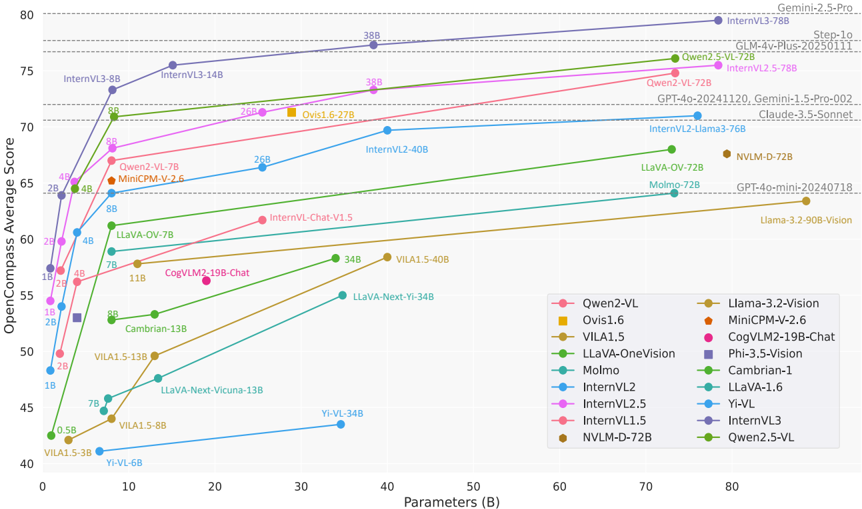
We introduce InternVL3, a significant advancement in the InternVL series featuring a native multimodal pre-training paradigm. Rather than adapting a text-only large language model (LLM) into a multimodal large language model (MLLM) that supports visual inputs, InternVL3 jointly acquires multimodal and linguistic capabilities from both diverse multimodal data and pure-text corpora during a single pre-training stage. This unified training paradigm effectively addresses the complexities and alignment challenges commonly encountered in conventional post-hoc training pipelines for MLLMs. To further improve performance and scalability, InternVL3 incorporates variable visual position encoding (V2PE) to support extended multimodal contexts, employs advanced post-training techniques such as supervised fine-tuning (SFT) and mixed preference optimization (MPO), and adopts test-time scaling strategies alongside an optimized training infrastructure. Extensive empirical evaluations demonstrate that InternVL3 delivers superior performance across a wide range of multi-modal tasks. In particular, InternVL3-78B achieves a score of 72.2 on the MMMU benchmark, setting a new state-of-the-art among open-source MLLMs. Its capabilities remain highly competitive with leading proprietary models, including ChatGPT-4o, Claude 3.5 Sonnet, and Gemini 2.5 Pro, while also maintaining strong pure-language proficiency. In pursuit of open-science principles, we will publicly release both the training data and model weights to foster further research and development in next-generation MLLMs.
Overview
CoChat Summary
TL;DR
InternVL3 introduces a native multimodal pre-training paradigm that jointly learns language and multimodal capabilities in one stage, plus V2PE, SFT/MPO post-training, test-time scaling, and infrastructure optimizations. InternVL3-78B reaches 72.2 on MMMU, setting a new state of the art among open-source MLLMs while remaining competitive with proprietary models.
Key findings
- InternVL3-78B achieves 72.2 on MMMU, 906 on OCRBench, 96.0/98.6 on VCR-EN-Easy (EM/Jaccard), and 89.0/88.7 on MMBench English/Chinese; the paper reports it as a new open-source MLLM state of the art and competitive with ChatGPT-4o, Claude 3.5 Sonnet, and Gemini 2.5 Pro.
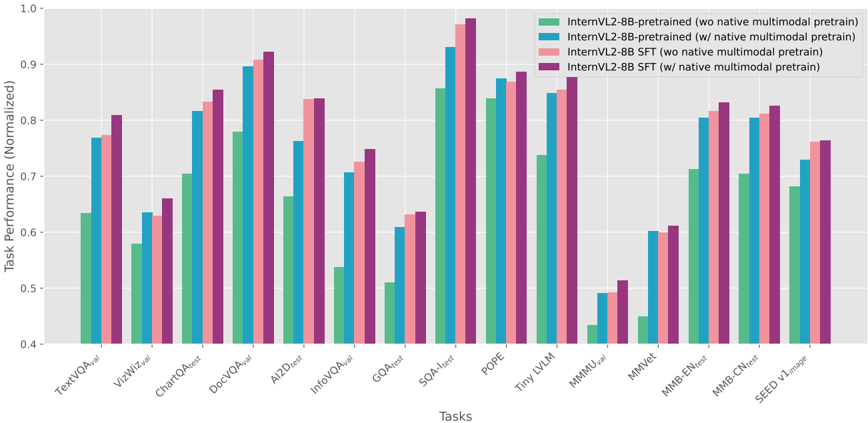
- Native multimodal pre-training is effective: replacing InternVL2-8B’s MLP warmup with native multimodal pre-training yields performance on most benchmarks comparable to the fully multi-stage-trained InternVL2-8B baseline, with further gains after instruction tuning on higher-quality data.
- MPO improves multimodal reasoning across seven benchmarks: InternVL3-78B and InternVL3-38B outperform their non-MPO counterparts by 4.1 and 4.5 points overall, respectively, even though MPO training data is a subset of SFT data.
- Test-time scaling with Best-of-8 and VisualPRM improves reasoning: on the Vision-Only split of MathVerse, best-of-8 gives increases of approximately 6.0 and 3.2 percentage points for InternVL3-38B and InternVL3-78B, respectively.
Methods
- Architecture follows “ViT-MLP-LLM”: vision encoder options are InternViT-300M and InternViT-6B; language models are pre-trained Qwen2.5 series and InternLM3-8B base models; the MLP is a two-layer randomly initialized network; pixel unshuffle reduces each 448×448 image tile to 256 visual tokens.
- Native multimodal pre-training jointly optimizes all parameters on multimodal and pure-language corpora, computes loss only on text tokens, and uses square averaging for token weights. Data combines InternVL2.5 pre-training corpus with GUI, tool usage, 3D scene, and video data, plus InternLM2.5 and open-source text data; the chosen language:multimodal ratio is 1:3, totaling about 200B tokens (50B language, 150B multimodal).
- Post-training uses SFT followed by MPO. SFT grows from 16.3M samples in InternVL2.5 to 21.7M in InternVL3; MPO uses about 300K preference samples and combines DPO preference loss, BCO quality loss, and LM generation loss. Test-time scaling uses Best-of-N with VisualPRM-8B as critic; infrastructure extends InternEVO, yielding a 50% to 200% training speedup for comparable-size models under the same compute budget.
Limitations
- The paper states a noticeable performance gap remains between InternVL3 and models like Qwen2.5-VL on certain benchmarks, such as MuirBench, implying future work may need better training data curation and model refinements.
- The paper reports minor declines on some benchmarks, such as MMHal, and states that optimizing data and training strategies for more consistent improvements remains an important future direction.
- The paper states visual grounding gains plateau at larger scales: InternVL2.5-78B reaches an average score of 92.3 while InternVL3-78B shows 91.4; it speculates this is because InternVL3’s training data expansion did not include additional grounding-specific data and the relative reduction in grounding-targeted data may have restricted localization capabilities.
Model-written summary. Check it against the paper before relying on it.
Integrity signals
Registry
Cites
Statistics
Figures
Verification
Claims the paper makes
0 Valid · 1 Not valid · 14 Not checked · 83 Own results and interpretations
A result the paper reports from its own data — it cites no other source for it, so there is none to check. The quote shows it is in the paper.
In the paper
“When compared with other competitive models, such as Qwen2-VL-72B and Qwen2.5-VL-72B, the InternVL3 series-especially the 78B variant-offers a consistent performance advantage on the multimodal understanding benchmarks.”
§ InternVL3: Exploring Advanced Training and Test-Time Recipes for Open-Source Multimodal Models > 3.6 Comprehensive Multimodal Evaluation
plainstates an association- Asserted: passes — The authors put it forward as true.
- Checkable: passes — It can be checked against evidence.
- Load-bearing: passes — The paper’s conclusions depend on it.
- Based: unclear — It is unclear why the paper says it holds.
A result the paper states — it cites no source for it, so there is none to check. The quote shows it is in the paper.
In the paper
“As a result, the number of training samples grows from 16.3M in InternVL2.5 to 21.7M in InternVL3.”
§ InternVL3: Exploring Advanced Training and Test-Time Recipes for Open-Source Multimodal Models > Data.
plainstates a cause- Asserted: passes — The authors put it forward as true.
- Checkable: passes — It can be checked against evidence.
- Load-bearing: unclear — It is unclear whether the paper’s conclusions depend on it.
- Based: passes — The paper gives a reason why it holds.
A result the paper states — it cites no source for it, so there is none to check. The quote shows it is in the paper.
In the paper
“while also maintaining strong pure-language proficiency.”
§ InternVL3: Exploring Advanced Training and Test-Time Recipes for Open-Source Multimodal Models > Abstract
boosted- Asserted: passes — The authors put it forward as true.
- Checkable: passes — It can be checked against evidence.
- Load-bearing: unclear — It is unclear whether the paper’s conclusions depend on it.
- Based: passes — The paper gives a reason why it holds.
A result the paper reports from its own data — it cites no other source for it, so there is none to check. The quote shows it is in the paper.
In the paper
“Compared with previous models, InternVL3 demonstrates substantial improvements across a wide range of task categories.”
§ InternVL3: Exploring Advanced Training and Test-Time Recipes for Open-Source Multimodal Models > 3.1 Overall Comparison to Other Advanced MLLMs
boosted- Asserted: passes — The authors put it forward as true.
- Checkable: passes — It can be checked against evidence.
- Load-bearing: passes — The paper’s conclusions depend on it.
- Based: passes — The paper gives a reason why it holds.
A result the paper reports from its own data — it cites no other source for it, so there is none to check. The quote shows it is in the paper.
In the paper
“Its capabilities remain highly competitive with leading proprietary models, including ChatGPT-4o, Claude 3.5 Sonnet, and Gemini 2.5 Pro, while also maintaining strong pure-language proficiency.”
§ InternVL3: Exploring Advanced Training and Test-Time Recipes for Open-Source Multimodal Models > Abstract
plain- Asserted: passes — The authors put it forward as true.
- Checkable: passes — It can be checked against evidence.
- Load-bearing: passes — The paper’s conclusions depend on it.
- Based: passes — The paper gives a reason why it holds.
45 more claims
Create a free account to see all 98 claims and every source verdict.
- It may state two separate claims as one. 42
- Probably not a substantial claim. 6
- The quote only partly states this claim. 1
Self-check
Percentages, sums and reported differences re-computed from the paper’s own numbers.
Each contradiction between two passages listed here was confirmed by an independent check.
Rated minor: it would not touch a result — a value no result rests on, a p-value that stays on the same side of the significance level, or a conflict that is clerical, resolved elsewhere in the paper, or outside its own findings.
In the paper
§ InternVL3: Exploring Advanced Training and Test-Time Recipes for Open-Source Multimodal Models > 3.8 Visual Grounding
“InternVL3-8B, InternVL3-9B, and InternVL3-14B yield average scores around 88.2-89.6,reflecting a consistent trend of performance gains as the model size increases.”
§ InternVL3: Exploring Advanced Training and Test-Time Recipes for Open-Source Multimodal Models > 3.6 Comprehensive Multimodal Evaluation
“InternVL3-8B 92.5 94.6 88.0 88.2 92.5 81.8 89.6 90.0 89.6 InternVL3-9B 91.8 93.2 86.6 86.4 91.0 79.9 88.0 88.5 88.2”
Rated minor: it would not touch a result — a value no result rests on, a p-value that stays on the same side of the significance level, or a conflict that is clerical, resolved elsewhere in the paper, or outside its own findings.
In the paper
§ InternVL3: Exploring Advanced Training and Test-Time Recipes for Open-Source Multimodal Models > GPT-4o Gemini 2.0 Claude Aguvis-72B Qwen2.5-VL-72B UI-TARS-72B InternVL3-8B -38B -72B
“The 8B variant (81.4%) already surpasses UI-TARS-72B”
§ InternVL3: Exploring Advanced Training and Test-Time Recipes for Open-Source Multimodal Models > GPT-4o Gemini 2.0 Claude Aguvis-72B Qwen2.5-VL-72B UI-TARS-72B InternVL3-8B -38B -72B
“InternVL3-72B achieves 90.9%, outperforming UI-TARS-72B (90.3%).”
Citations
Cites
Fei-Fei, L., Fergus, R., & Perona, P. (2005) · 2004 Conference on Computer Vision and Pattern Recognition Workshop · doi:10.1109/cvpr.2004.383 · Cited by 2,502
Liu, H., Li, C., Wu, Q., & Lee, Y. J. (2023) · Advances in Neural Information Processing Systems 36 · doi:10.52202/075280-1516 · Cited by 2,428
Making the V in VQA Matter: Elevating the Role of Image Understanding in Visual Question Answering
Goyal, Y., Khot, T., Summers-Stay, D., Batra, D., & Parikh, D. (2017) · 2017 IEEE Conference on Computer Vision and Pattern Recognition (CVPR) · doi:10.1109/cvpr.2017.670 · Cited by 2,287
Chen, Z., Wang, W., Cao, Y., Liu, Y., Gao, Z., Cui, E., Zhu, J., Ye, S., Tian, H., Liu, Z., et al. (2024) · arXiv · doi:10.48550/arxiv.2412.05271 · Cited by 2,204
Self-citationGrounding DINO: Marrying DINO with Grounded Pre-training for Open-Set Object Detection
Liu, S., Zeng, Z., Ren, T., Li, F., Zhang, H., Yang, J., Jiang, Q., Li, C., Yang, J., Su, H., et al. (2025) · Lecture Notes in Computer Science · doi:10.1007/978-3-031-72970-6_3 · Cited by 2,074
Self-citationNatural Questions: A benchmark for question answering research
Kwiatkowski, T., Palomaki, J., Redfield, O., Collins, M., Parikh, A., Alberti, C., Epstein, D., Polosukhin, I., Devlin, J., Lee, K., et al. (2019) · Transactions of the Association for Computational Linguistics · doi:10.1162/tacl_a_00276 · Cited by 2,069
MiniCPM-V: A GPT-4V Level MLLM on Your PhonePreprint
Yao, Y., Yu, T., Zhang, A., Wang, C., Cui, J., Zhu, H., Cai, T., Li, H., Zhao, W., He, Z., et al. (2024) · arXiv · doi:10.48550/arxiv.2408.01800 · Cited by 1,695
Self-citationTriviaQA: A Large Scale Distantly Supervised Challenge Dataset for Reading Comprehension
Joshi, M., Choi, E., Weld, D., & Zettlemoyer, L. (2017) · Proceedings of the 55th Annual Meeting of the Association for Computational Linguistics (Volume 1: Long Papers) · doi:10.18653/v1/p17-1147 · Cited by 1,690
Math-Shepherd: Verify and Reinforce LLMs Step-by-step without Human Annotations
Wang, P., Li, L., Shao, Z., Xu, R., Dai, D., Li, Y., Chen, D., Wu, Y., & Sui, Z. (2024) · Proceedings of the conference - Association for Computational Linguistics. Meeting · doi:10.18653/v1/2024.acl-long.510 · Cited by 1,665
TriviaQA: A Large Scale Distantly Supervised Challenge Dataset for Reading Comprehension
Joshi, M., Choi, E., Weld, D. S., & Zettlemoyer, L. (2017) · arXiv · doi:10.48550/arxiv.1705.03551 · Cited by 1,650
Research works printed but not linked: 6
- Anonymous. CG-bench: Clue-grounded question answering benchmark for long video understanding. In Submitted to The Thirteenth International Conference on Learning Representations, 2024. under review. 14, 15
- Shuai Bai, Keqin Chen, Xuejing Liu, Jialin Wang, Wenbin Ge, Sibo Song, Kai Dang, Peng Wang, Shijie Wang, Jun Tang, et al. Qwen2.5-vl technical report. arXiv preprint arXiv:2502.13923, 2025. 1, 2, 9, 10, 15 · arXiv
- Jie Cao and Jing Xiao. An augmented benchmark dataset for geometric question answering through dual parallel text encoding. In Proceedings of the 29th International Conference on Computational Linguistics, pages 1511-1520, 2022. 6
- Zhe Chen, Weiyun Wang, Hao Tian, Shenglong Ye, Zhangwei Gao, Erfei Cui, Wenwen Tong, Kongzhi Hu, Jiapeng Luo, Zheng Ma, et al. How far are we to gpt-4v? closing the gap to commercial multimodal models with open-source suites. arXiv preprint arXiv:2404.16821, 2024. 2, 3 · arXiv
- Hunter Lightman, Vineet Kosaraju, Yuri Burda, Harrison Edwards, Bowen Baker, Teddy Lee, Jan Leike, John Schulman, Ilya Sutskever, and Karl Cobbe. Let's verify step by step. In The Twelfth International Conference on Learning Representations, 2023. 7
- Minesh Mathew, Viraj Bagal, Rubèn Tito, Dimosthenis Karatzas, Ernest Valveny, and CV Jawahar. Infographicvqa. In Proceedings of the IEEE/CVF Winter Conference on Applications of Computer Vision, pages 1697-1706, 2022. 6, 7, 8, 10
Cited by
Items 2,201–2,300 of 2,641
Does Local Video Understanding Transfer Across Encounters? The EgoGears BenchmarkPreprint
Tan, Y., Qi, L., Liu, Y., Wen, D., Liu, R., Wang, X., Chen, Y., Zheng, J., Wu, C., Zhang, C., et al. (2026) · arXiv · doi:10.48550/arxiv.2609.37938
Self-citationSeek-and-View Reasoning for Multi-View Spatial UnderstandingPreprint
Chen, Q., Zhang, C., Ke, F., Fu, C., Cai, J., & Ye, J. (2026) · arXiv · doi:10.48550/arxiv.2610.11810
“6-27B [31], InternVL3-8B [58], Qwen3-VL-8B, and Qwen3-VL-4B [1].”
Chen, J. (2026) · arXiv · doi:10.48550/arxiv.2610.39331
“We also run open-weight models from seven families [3, 4, 8, 15, 27, 35, 37, 52, 55, 57], without fine-tuning.”
SIEVE: Selective attention-value Suppression for Vision-Language Models UnlearningPreprint
Goh, S. Q., Kiet, C. D. X., Cham, T., & Lam, K.-Y. (2026) · arXiv · doi:10.48550/arxiv.2610.01962
“Intern-VL3 (Zhu et al., 2025) further moves towards native multimodal pretraining, where linguistic and multimodal capa-2 bilities are jointly learned during pretraining.”
Roles of MLLMs in Visually Rich Document Retrieval for RAG: A SurveyPreprint
Zhang, X. (2026) · arXiv · doi:10.48550/arxiv.2601.03262
Self-citationVLMs can Aggregate Scattered Training Patches
Zhou, Z., Chen, L., Yang, C., & Lu, C. (2025) · neural information processing systems · doi:10.52202/085713-4645
Shi, S., & Shin, K. G. (2026) · arXiv · doi:10.48550/arxiv.2603.17980
“It significantly outperforms the SOTA 2D-input baseline (VG LLM-8B [67]), surpassing its refined scores by +3 .”
InfluentialLiu, X., Li, Y., Zhuang, X., Li, X., Li, Y., Yang, H., Lu, Z., & Xie, Y. (2026) · arXiv · doi:10.48550/arxiv.2610.41389
“5 [4]/InternVL3 [52]; (3) Training-based 3D-VLMs , including Video-3D-LLM [50], LLaVA-3D [51], VLM-3R [8], and VILASR [41], which incorporate explicit 3D representations or 3D-enhanced inference; and (4) Tool-integrated agents , including VADAR [26], pySpatial [24], GCA [5], MSSR [11], ViperGPT…”
R4DGS: Referring Segmentation in 4D Gaussian Splatting
Chen, B., Li, Y., Peng, S., Si, X., Chu, L., Cao, X., Jin, H., & Ding, J. (2026) · ACM International Conference on Multimedia (ACM MM) · doi:10.1145/3767308.3836021
“5-VL-7B [2], Qwen2-VL-7B [36], and InternVL3-8B [46] under the same pipeline.”
Liang, Z., Cheng, J., & Zeng, Z. (2026) · Findings of the Association for Computational Linguistics: EMNLP (Findings of EMNLP) · doi:10.18653/2026.findings-emnlp.125
VisLens: Single-Pass Interpretable Visual Search for Multimodal LLMsPreprint
He, J., Kim, S., & Akata, Z. (2026) · arXiv · doi:10.48550/arxiv.2608.30705
“5-VL [1], and InternVL3 [27].”
Self-citationOn the Limits of Representation-Based Test-Time Adaptation for Multimodal LLMsPreprint
Piórczyński, M., Masarczyk, W., Sójka, D., Cygert, S., & Twardowski, B. (2026) · arXiv · doi:10.48550/arxiv.2610.19892
“5-VL-3B-Instruct [2], InternVL3-2B [48], and Ovis2-4B [17] on RealWorldQA [42], a vision-centric multiple-choice question answering (MCQ) benchmark of 765 questions on real-world scenes, under the 15 common corruptions [9] at severity 5, with images resized to 896 × 896 pixels.”
Xiaomi-Lens-0 Technical ReportPreprint
Fu, P., Liu, Y., Sun, Y., Wang, H., Xi, X., Zhang, R., Zhang, S., Huang, T., Jiang, C., Li, H., et al. (2026) · arXiv · doi:10.48550/arxiv.2610.23279
“Visual grounding, which links natural-language expressions to image regions, is a foundational capability of multimodal large language models (MLLMs) [1, 79], supporting embodied intelligence [28] and multi-modal agent systems [6, 12].”
Self-citationEntropogram-guided Visual Realignment Decoding: Capturing the Rhythm of Multimodal ReasoningPreprint
Deng, J., Fu, Z., Chen, Y., Zhang, D., Wu, Z., Huang, X., Huo, H., & Xu, G. (2026) · arXiv · doi:10.48550/arxiv.2611.06415
“Multimodal large language models (MLLMs) have achieved significant progress on cross-modal reasoning tasks (Wu et al., 2024; Deitke et al., 2024; Zhu et al., 2025; Bai et al., 2025), yet they continue to suffer from hallucinated outputs that are unfaithful to the provided visual context (Li et al.,…”
Measuring Pretraining Contamination in Public Medical Vision-Language BenchmarksPreprint
Xu, B. C., Wu, L., & Ryu, A. (2026) · arXiv · doi:10.48550/arxiv.2606.10066
Self-citationThe ACM Multimedia 2025 Grand Challenge of Multimodal Conversational Aspect-based Sentiment Analysis
Luo, M., Fei, H., Li, B., Wu, S., Liu, Q., Poria, S., Cambria, E., Lee, M. L., & Hsu, W. (2025) · ACM International Conference on Multimedia (ACM MM) · doi:10.1145/3746027.3762091
SAD-GS: Learning Reliable 3D Semantic Gaussian Fields via Dynamic Geo-Semantic AnchoringPreprint
Zhang, Y., Zhan, C., Wang, G., & Wang, H. (2026) · arXiv · doi:10.48550/arxiv.2606.29376
“To further enhance semantic expressiveness, contemporary approaches incorporate descriptive contextual priors generated by modern multi-modal large language models (MLLMs) [2, 9, 8, 56, 44] or dense captioning pipelines [46].”
Self-citationQi, Y., & Wu, X. (2026) · Proceedings of the AAAI Conference on Artificial Intelligence · doi:10.1609/aaai.v40i10.37799
Liao, X., Chen, N., Shu, M., Yin, Y., Zeng, P., Wang, Z., Lin, N., & Cheng, L. (2026) · ACM International Conference on Multimedia (ACM MM) · doi:10.1145/3767308.3838654
“…audit the surviving triplets derived images, eliminating residual semantic ambiguities, alignment between visual evidence and answers, and that all distractors remain plausible under maritime . i Unresolvable triplets are permanently discarded. s h Flawed triplets are pushed to a Refinement…”
Modality Inflation: Energy Characterization and Optimization Opportunities for MLLM Inference
Moghadampanah, M., Rezaei, A. S., Amin, F., & Nikolopoulos, D. S. (2026) · IEEE International Symposium on Parallel & Distributed Processing, Workshops and Phd Forum · doi:10.1109/ipdpsw71298.2026.00035
“While in the previous section we discussed that multimodal inputs incur a substantial energy penalty, treating the model as a black box hides the specific architectural sources of this inefficiency.”
Before Thinking, Learn to Decide: Proactive Routing for Efficient Visual Reasoning
Zhou, Y., Lin, H., Wu, Y., Shan, C., Sun, Z., Chen, Y., Wang, T., Ma, C., Zhu, L., & Shan, Y. (2026) · Lecture notes in computer science · doi:10.1007/978-3-032-37086-0_19
Explore, Map, Remember, Decide: A Benchmark for VLM Readiness in Safety-Critical ScenariosPreprint
Malfa, G. L., Alon, N., Malfa, E. L., Mirsky, R., & Sarkadi, Ş. (2026) · arXiv · doi:10.48550/arxiv.2608.08077
Multi-Modal LLM based Image Captioning Algorithm in ICT: Bridging the GapPreprint
Chao, L., Zhang, K., Li, X. Q., Yin, L., Wu, S., Cai, H., & Shan, D. (2026) · SSRN Electronic Journal · doi:10.2139/ssrn.6023429
Self-citationChemExplain: A Multimodal Benchmark for Explanatory Chemical ReasoningPreprint
Chen, A., Baker, F. N., Averly, R., Zhang, S., Chen, T., Adu‐Ampratwum, D., Ning, X., & Xue, Y. (2026) · arXiv · doi:10.48550/arxiv.2610.17183
“5 (Zhu et al., 2025), Janus-Pro (Chen et al., 2025)), and one chemistry-specific model (ChemVLM (Li et al., 2025b)).”
Tao, X., Wang, Y., Cai, Y., Qu, X., & Tang, J. (2026) · arXiv · doi:10.48550/arxiv.2607.17243
Self-citationMa, Z., Li, Z., Shi, Y., Li, Z., Chen, J., & Chuai, Q. (2026) · arXiv · doi:10.48550/arxiv.2601.06169
Vision Language Model Fusion for Explainable Face RecognitionPreprint
Estrada‐Real, A., Alapatt, L., Busch, C., & Rathgeb, C. (2026) · arXiv · doi:10.48550/arxiv.2608.24430
Q-REAL: Towards Realism and Plausibility Evaluation for AI-Generated ContentPreprint
Wang, S., Zhang, Z., Li, C., Wang, W., Ma, L., Chen, F., Li, X., Cao, X., Zhai, G., & Liu, X. (2025) · arXiv · doi:10.48550/arxiv.2511.16908
“5-VL-7B [2], InternVL3-8B [44], and InternVL2.”
Self-citationMedRepBench: Benchmarking Structured Understanding of Medical Report Images
Shang, F., Yuan, X., Yang, D., Wang, Y., & Yang, B. (2026) · Lecture notes in computer science · doi:10.1007/978-3-032-37029-7_17
Self-citationGaLa: Hypergraph-Guided Visual Language Models for Procedural PlanningPreprint
Wang, K., Li, Y., Qu, M., Zhang, A., Yang, G., & Su, T. (2026) · arXiv · doi:10.48550/arxiv.2604.17241
“Our model GaLa uses InternVL3-8B as its backbone, where the visual encoder adopted the InternViT architecture, and the language model was based on InternVL3.”
InfluentialGaLa: Hypergraph-Guided Visual Language Models for Procedural Planning
Wang, K., Li, Y., Qu, M., Zhang, A., Yang, G., & Su, T. (2026) · Findings of the Association for Computational Linguistics: ACL (Findings of ACL) · doi:10.18653/v1/2026.findings-acl.980
VagueBench: Benchmarking the Robustness of Embodied Agents on Ambient Context IllusionsPreprint
Qu, Y., Fu, Q., Ying, Z., Zhao, J., Zhang, Y., Guo, J., Yang, J., Liu, A., Wang, Y., & Liu, X. (2026) · arXiv · doi:10.48550/arxiv.2611.03765
“5-VL-72B-Instruct [19], Qwen2-VL-72B-Instruct [20], InternVL-3-72B [21], GPT-4o [22], ReAct [23] and ProgPrompt [24]).”
Self-citationSun, M., Zhou, H., Luo, Z., Li, X., Zhu, J., Yan, T., & Rao, Z. (2026) · Computer Vision and Image Understanding · doi:10.1016/j.cviu.2026.105003
Self-citationVideo-HolmesV2: Can MLLMs Reason with Spatio-Temporal Audio-Visual Evidence in Long Videos?
Wei, Z., Wang, Z., Cao, Y., Qiang, C., Cheng, S., Yang, X., Nie, S., Jiang, B., Ding, W., Hao, Y., et al. (2026) · Lecture notes in computer science · doi:10.1007/978-3-032-36987-1_33
Self-citationXiao, X., Lei, Y., Zeng, H., Sun, X., Jiang, X., Tian, Y., Wu, H., Wei, K., & Zhong, J. (2026) · arXiv · doi:10.48550/arxiv.2603.08303
Xi, Y., Su, X., Feng, J., Liu, Y. L., Tarkoma, S., & Hui, P. (2026) · arXiv · doi:10.48550/arxiv.2606.15890
Self-citationLarge Language and Vision-Language Models as World Models: A Survey
Wasi, A. T., Meem, S. T., Islam, R., & Parvez, M. R. (2026) · doi:10.18653/2026.findings-aacl.80
Squeezing Capacity from Multimodal Large Language Models for Subject-driven GenerationPreprint
Zheng, S., Misraa, A. K., Li, Y.-T., Li, Y.-J., & Gilitschenski, I. (2026) · arXiv · doi:10.48550/arxiv.2605.26111
“We adopt InternVL3-8B [130] as the MLLM and FLUX.1 dev [5] as the DiT, with a LoRA rank of 512 for finetuning the DiT attention blocks.”
COMPASS: Grounding Composition-Intent Guidance in Unified Multimodal Models
Zhou, Z., Quan, W., Tan, M., Chen, Z., Zheng, D., Chen, J., Zhou, J., Dong, W., & Yan, D.-M. (2026) · Lecture notes in computer science · doi:10.1007/978-3-032-37189-8_3
Self-citationi-Design: Step-by-Step Graphic Layout Design with Progressive Aesthetic Policy Optimization
Patnaik, S., Jain, R., Krishnamurthy, B., & Sarkar, M. (2026) · Lecture notes in computer science · doi:10.1007/978-3-032-37232-1_35
Adaptive Weighted Proxy Tuning: Efficient Gray-Box Steering for Image Captioning.
Azim, N., Rahman, F., & Mohammed, N. (2026) · Proceedings of the conference - Association for Computational Linguistics. Meeting · doi:10.18653/v1/2026.acl-industry.85
Wang, H., Guan, T., Shen, W., & Yang, X. (2026) · arXiv · doi:10.48550/arxiv.2608.01211
“Recent MLLMs, such as LLaVA (Liu et al. 2023), PaliGemma (Beyer et al. 2024), Qwen-VL (Bai et al. 2023), and InternVL (Chen et al. 2024b; Zhu et al. 2025), further strengthen visual-textual alignment and reasoning over text-rich images.”
Self-citationMoR-MLLM: Mixture of Recursions for Efficient Multimodal Large Language Models
Zheng, P., Zhang, C., Yan, J., Cao, S., Zhang, J., Wang, X., Zhang, J., Lee, J., Kim, T.-H., Yang, Y., et al. (2026) · IEEE Transactions on Multimedia · doi:10.1109/tmm.2026.3744102
Self-citationMultimodal Thinking with Renderable ProgramsPreprint
Chen, S., Zhong, D., Ma, Z., Liu, J., Yang, Z., Zhang, H., Lu, L., Chai, J., & Gan, C. (2026) · arXiv · doi:10.48550/arxiv.2609.30130
Self-citationWang, T., Wang, J., Li, F., Li, J., Li, X., & Zhu, L. (2026) · arXiv · doi:10.48550/arxiv.2610.20679
Self-citationMaking Language the Low-Rate Code of Vision: Successive Refinement from Words to PixelsPreprint
Gong, R., & Gong, H. (2026) · arXiv · doi:10.48550/arxiv.2610.16552
Benchmark Evaluation of Multi-Modal Large Language Models for Ophthalmic DiagnosisPreprint
Yang, W., Huang, S., Chen, J., Wang, J. T., Zhang, P., Du, W., Yuan, H., Kong, D., Lou, W., & Chi, W. (2025) · Research Square · doi:10.21203/rs.3.rs-7186903/v1
Self-citationZhang, R., Lu, C., Li, C., Gu, H., Shen, T., Zhi, X., Wang, Q., Gao, Y., Wu, Y., Hu, Y., et al. (2026) · Findings of the Association for Computational Linguistics: EMNLP (Findings of EMNLP) · doi:10.18653/2026.findings-emnlp.122
Self-citationJia, X., Qin, S., Li, Y., Liao, J., Gao, S., Ma, K., Liu, Y., & Cao, X. (2026) · arXiv · doi:10.48550/arxiv.2610.06977
“Following [23, 45], we generate adversarial examples using five surrogate models: three CLIP variants, ViT-B/16 [40], ViT-B/32 [40], and ViT-G/14 (LAION-2B) [40], together with InternVL3-1B [64] and DI-NOv2 [38].”
Self-citationSoft Spatial ReasoningPreprint
Sultan, R. I., Chowdhury, M. S. A., Zade, S. Z., Li, C., Khanduri, P., Brocanelli, M., & Zhu, D. (2026) · arXiv · doi:10.48550/arxiv.2609.38717
InfoCausalQA:Can Models Perform Non-explicit Causal Reasoning Based on Infographic?Preprint
Ka, K., Park, J., Jeon, J., & Yu, Y. (2025) · arXiv · doi:10.48550/arxiv.2508.06220
Zhou, Z., Xue, D., Qian, S., & Xu, C. (2026) · ACM International Conference on Multimedia (ACM MM) · doi:10.1145/3767308.3835007
“Representative systems such as LLaVA [24, 25], InternVL [41, 49], Qwen-VL [1, 40], and GLM-4.”
VisMind: Stateful Synthetic Dialogue for Visual Mid-Training
Fu, X., Zhou, Z., & Wang, Q. (2026) · Findings of the Association for Computational Linguistics: EMNLP (Findings of EMNLP) · doi:10.18653/2026.findings-emnlp.1158
Knowing What Not to Answer: Selective Non-Compliance in Vision-Language Models
Kim, M., Jang, J., & Kim, H. (2026) · Conference on Empirical Methods in Natural Language Processing (EMNLP) · doi:10.18653/2026.emnlp-main.1328
“5-VL-3B/72B-Instruct (Bai et al., 2025) and InternVL3-2B/78B-Instruct (Zhu et al., 2025), as well as two closed-source models, GPT-5 6 and Gemini-2.”
ProQuant: Progressive Quantization-aware Training for Edge MLLMsPreprint
Xue, Y., Huang, Y., Shao, J., Dong, P., Tan, Y., Li, S., Cheng, K.-T., & Zhang, J. (2026) · arXiv · doi:10.48550/arxiv.2611.08216
“Extending large language models (LLMs) beyond text to additional modalities [Bai et al., 2025a; Li et al., 2024a; Xiaomi, 2025; Zhu et al., 2025; Wu et al., 2024; Team, 2026; Li et al., 2026a] has achieved remarkable successes and enabled a wide range of applications, including chatbots [Bai et…”
Self-citationLin, Z., Qin, H., Yang, M., & Zhu, H. (2026) · Findings of the Association for Computational Linguistics: EMNLP (Findings of EMNLP) · doi:10.18653/2026.findings-emnlp.68
Recasting Visual Language Models as EEG Foundation Models for Clinical NeurodiagnosticsPreprint
Zhou, X., Sergeeva, E., Bi, N., Song, W., Yin, L., & Deng, H. (2026) · arXiv · doi:10.48550/arxiv.2611.05538
“• The VLM family comprised Qwen3–VL [50], InternVL3 [51], Phi–3.5 Vision [52] and Llama–3.2 Vision [53].”
InfluentialSelf-citationRADAR: Revealing Asymmetric Development of Abilities in MLLM Pre-trainingPreprint
Nie, Y., Lin, B., Niu, M., Xiang, K., Han, J., Huang, G., Quan, X., Xu, H., Chen, B., & Liang, X. (2026) · arXiv · doi:10.48550/arxiv.2602.12892
PACE: Pareto-Adaptive Compression for Efficient Native MLLMsPreprint
Tian, L., Zhu, C., Wu, K., Zhang, Y., & Yang, H. (2026) · arXiv · doi:10.48550/arxiv.2610.24005
“Unlike ViT-based MLLMs [60; 58; 20; 119; 91; 94] that rely on an external vision encoder, they tokenize every pixel patch directly, and intuitively suffer from severe visual token redundancy that degrades performance and bottlenecks inference efficiency.”
Decoding Geometry, Not Tokens: Efficient VLMs for Robot Affordance and Trajectory PredictionPreprint
Ayanthi, A., Priyasad, D., Fernando, T., Miller, D., Sridharan, S., Fookes, C., & Moghadam, P. (2026) · arXiv · doi:10.48550/arxiv.2610.39416
“Scaling to tens of billions of parameters, for example, Flamingo-80B [1], InternVL3-78B [45], Qwen2.”
Jiang, Z., Wang, H., Liang, B., Xie, Y., Yang, M., & Li, W. (2026) · SSRN Electronic Journal · doi:10.2139/ssrn.7590071
Self-citationYu, Y., & Zhang, Y. (2026) · ACM International Conference on Multimedia (ACM MM) · doi:10.1145/3767308.3836521
Ayanzadeh, A., & Oates, T. (2026) · IEEE International Symposium on Workload Characterization · doi:10.1109/iiswc71020.2026.00067
“5-VL-3B [3], InternVL3-2B [17], or SmolVLM2-2.”
Multi-Branch Policy Optimization for Multimodal Large Language Models
Lyu, S., Gong, Y., Gao, R., Shang, X., Ou, Z., Zong, P., Zhu, Y., Sun, Y., Qin, Y., & Hu, P. (2026) · ACM International Conference on Multimedia (ACM MM) · doi:10.1145/3767308.3836564
Jia, Z., Ma, Z., & Guo, J. (2026) · Research Square · doi:10.21203/rs.3.rs-11118276/v1
Vision Inference Former: Sustaining Visual Consistency in Multimodal Large Language ModelsPreprint
Dong, X., Zhang, M., Han, K., Tan, X., Wu, F., & Kuang, K. (2026) · arXiv · doi:10.48550/arxiv.2605.18160
“For instance, InternVL-3 [49] enhances semantic integration by co-training both the vision encoder and LLM parameters, thereby enabling bidirectional adaptation between vision and language modules.”
Towards Faithful Reasoning in Comics for Small MLLMsPreprint
Feng, C., Yin, H., Jin, Y., & Huang, K. (2026) · arXiv · doi:10.48550/arxiv.2601.02991
TSHA: A Benchmark for Visual Language Models in Trustworthy Safety Hazard Assessment ScenariosPreprint
Yu, Q., Xu, R., Chen, M., Dong, J., & Tan, X. (2026) · arXiv · doi:10.48550/arxiv.2603.29759
Xu, J., Luo, H., & Liu, C. (2026) · arXiv · doi:10.48550/arxiv.2604.01010
“3B [25], InternVL3-2B [59], and Ovis2-4B [26].”
ConvCue: Complementary Visual Inductive Biases for Vision-Language ModelsPreprint
Lan, Z., & Sun, S. (2026) · arXiv · doi:10.13140/rg.2.2.25316.54406
ChartMaster: Toward Accurate Perception and Efficient Reasoning for Chart Analysis
Liu, C., Sui, D., Cao, H., Hua, Y., & Xu, L. (2026) · ACM International Conference on Multimedia (ACM MM) · doi:10.1145/3767308.3835575
“5-VL [41], InternVL3 [59], MiniCPM-V-4.”
DriveVP: Ego-Centric 3D Primitive Attention for Driving VQA
Hu, Y., Tan, Y., He, K., Cheng, H., & Ma, S. (2026) · Lecture notes in computer science · doi:10.1007/978-981-92-7198-6_20
DobotTrack: Target-Grounded Vision-Language-Action Learning for Embodied Person TrackingPreprint
Deng, S., Zhang, Y., Wei, C., Liang, L., Liu, S., Zheng, P., Zheng, Y., Zhang, Y., Tian, Y., Li, X., et al. (2026) · arXiv · doi:10.48550/arxiv.2611.09041
“We present DobotTrack , a target-grounded VLA framework built on InternVL3 [9].”
Automated facade solar retrofits using feed-forward 3D reconstruction and generative image editing
Duran, A., Waibel, C., Bickel, B., Armeni, I., & Schlueter, A. (2026) · Automation in Construction · doi:10.1016/j.autcon.2026.107294
TriGeoBench: A Multimodal Mathematical Geometry Benchmark with Figures and TikZPreprint
Wang, J., Yang, Y., Dou, H., Wu, Y., He, S., Shen, T., Wu, J., Li, J., & Wang, Y. (2026) · arXiv · doi:10.48550/arxiv.2610.27626
Self-citationDual-Pathway Geometry-Aware MLLM for Spatial IntelligencePreprint
Zheng, Y., Zhu, X., Liu, Z., Zhou, C., Wang, C., Xu, Y., Wang, Y., Liu, J., Yu, P., Zhai, W., et al. (2026) · arXiv · doi:10.48550/arxiv.2605.25334
“Recently, Multimodal Large Language Models (MLLMs) [9, 10, 11, 12, 13, 14] have emerged as the default interface for such tasks, unifying perception, language, and reasoning within a single autoregressive backbone queried via natural language.”
Self-citationWAM-Diff2: Hierarchical AR-to-Diffusion Distillation for Highly Efficient Autonomous Driving VLAPreprint
Zhu, Z., Shang, H., Xu, M., Cai, F., He, Z., Li, Y., Han, J., Xu, H., & Zhu, S. (2026) · arXiv · doi:10.48550/arxiv.2608.01035
LaSeD: Label-Semantic Self-Distillation for Visual-Only Surgical Phase RecognitionPreprint
Tao, Y., Scherl, C., & Monji-Azad, S. (2026) · arXiv · doi:10.48550/arxiv.2609.18971
Tonmoy, A. H., Ahmed, S., Syfullah, M. K., & Alam, S. M. J. (2026) · arXiv · doi:10.48550/arxiv.2609.14284
“5-VL-7B-Instruct [19], InternVL3-8B [20], Pixtral-12B [21], Donut-base [28], and a cascade, evaluated through prompting, LoRA [22], and partial or full fine-tuning.”
Beyond Omni: A Unified MLLM for Embodied Sensory UnderstandingPreprint
Xiong, S., Wu, D., Sun, P., Yang, B., Wang, J., Sun, X., Wen, M., & Yue, X. (2026) · arXiv · doi:10.48550/arxiv.2610.26751
Self-citationThink, Look, and Revise: Inconsistency-Aware Visual Self-Correction in MLLMs
Cheng, Y., Goel, A., & Bilen, H. (2026) · Conference on Empirical Methods in Natural Language Processing (EMNLP) · doi:10.18653/2026.emnlp-main.106
Li, S., Wang, P., Li, Q., Xu, H., Liu, S., Kong, J., & Sun, H. Z. (2026) · TechRxiv · doi:10.36227/techrxiv.177078125.50331761/v1
Self-citationUniGUI-Bench: A Real-World Diagnostic Benchmark — What Capabilities Do GUI Agents Most Need?
Liu, J., Sun, R., Ma, L., Chen, F., Wang, Z., & Cao, X. (2026) · Findings of the Association for Computational Linguistics: EMNLP (Findings of EMNLP) · doi:10.18653/2026.findings-emnlp.2288
Robusto-2: Benchmarking Humans & VLMs for Autonomous Driving in Lima & New York CityPreprint
Cespedes, A., Chincha, M., Cusipuma, D., Flores-Benites, V., Ortega, D., & Deza, A. (2026) · arXiv · doi:10.48550/arxiv.2606.20980
Improving VLMs on Scientific Chart Analysis via Autonomous EvolutionPreprint
Dubey, A., Goel, V., Rana, K., Mathur, S., & Chatziafratis, V. (2026) · arXiv · doi:10.48550/arxiv.2610.35077
“We finally evaluate on three differently sized open VLMs (Qwen3-VL-2B, InternVL3, SmolVLM2) and four chart benchmarks (CharXiv, ChartQA, EvoChartQA, PlotQA).”
InfluentialImproving Sample Diversity in Autoregressive Text-to-Image Generation via Cluster TruncationPreprint
Nguyen, T., Wu, S., Tan, R., & Howard, P. (2026) · arXiv · doi:10.48550/arxiv.2607.10535
“To better capture perceptual quality and semantic correctness and to provide an interpretable, human-aligned evaluation, we therefore use a vision-language model (InternVL3-14B [41]) to assign scores on a 1–5 scale to each image.”
dNaViT: Discrete Codes are General-Purpose Visual RepresentationsPreprint
Li, X., Yue, Z., Huang, X., Zou, J., Jing, M., Yan, W., Li, H., Huang, H., Zhao, B., Feng, Y., et al. (2026) · arXiv · doi:10.48550/arxiv.2611.12426
Self-citation闫乐成, Lyu, C., Sun, H., Li, W., Imam, M. F., Geng, J., Li, Q., & Jiang, S. (2026) · Interspeech (USB) · doi:10.21437/interspeech.2026-619
Analytic Score Optimization for Multi Dimension Video Quality AssessmentPreprint
Lin, B., Zhu, Y., Qin, W., Wang, M., & Wan, P. (2026) · arXiv · doi:10.48550/arxiv.2602.16856
Latent Visual Contrastive Reasoning with Multi-Branch ExplorationPreprint
Tang, K., Wang, J., Zhang, Y., Zhang, H., Ren, S., & Wang, Z. (2026) · arXiv · doi:10.48550/arxiv.2610.36809
“Recent general-purpose MLLMs further strengthen visual recognition, object localization, document understanding, and multimodal instruction following through improved visual encoders, instruction data, and scaling recipes [4], [19]–[22].”
Self-citationCCRV-Bench: Constraint-Based Evaluation of Causal Reasoning in Vision-Language ModelsPreprint
Gao, L., Wu, Y., & Chang, Y. (2026) · arXiv · doi:10.48550/arxiv.2609.30979
Decompose, Compare, and Decide: Multimodal LLMs are Implicit Few-Shot Learners
Wang, Y., Khandelwal, E., Araujo, E., Bousselham, W., Shvetsova, N., & Kuehne, H. (2026) · Lecture notes in computer science · doi:10.1007/978-3-032-37255-0_9
Self-citationTransferring Math Reasoning Abilities from LLMs to MLLMs via Causal-Aware Model Merging
Hu, Y., Yang, G., Zhou, Z., Dong, B., Huang, X., Huang, K., & Wang, Q. (2026) · Findings of the Association for Computational Linguistics: EMNLP (Findings of EMNLP) · doi:10.18653/2026.findings-emnlp.1943
Detecting Latin in Historical Books with Large Language Models: A Multimodal Benchmark
Wu, Y., Shu, K., Fischer, J., Pivovarova, L., Rosson, D., Mäkelä, E., & Tolonen, M. (2026) · Conference of the European Chapter of the Association for Computational Linguistics · doi:10.18653/v1/2026.eacl-long.245
Are VLMS Ready for Lane Topology Awareness in Autonomous Driving?
Chen, X., He, J., Li, M., Xu, D., Wang, T., Chen, Y., Lin, Z., & Yao, Y. (2026) · IEEE International Conference on Acoustics Speech and Signal Processing · doi:10.1109/icassp55912.2026.11460714
Self-citationChartographer: Counterfactual Chart Generation for Evaluating Vision-Language Models
Jiang, Y., Hwang, D. Y., Cresswell, J. C., & Shi, F. (2026) · Conference on Empirical Methods in Natural Language Processing (EMNLP) · doi:10.18653/2026.emnlp-main.580
Real Images, Worse Judgments: Evaluating Vision-Language Models on Concreteness and Imagery
Jiang, Y., Ning, R., Yao, S., & Shi, F. (2026) · Conference on Empirical Methods in Natural Language Processing (EMNLP) · doi:10.18653/2026.emnlp-main.600
TurtleAI: Benchmarking Multimodal Models for Visual Programming in Turtle GraphicsPreprint
Wen, C., Staub, J., & Singla, A. K. (2026) · arXiv · doi:10.48550/arxiv.2606.03626
How China-Origin Vision-Language Models Move from Refusal to Reframing in State AlignmentPreprint
YANG, G., Liu, F., Wang, A., Hosseinmardi, H., & Ghasemian, A. (2026) · SocArXiv (OSF Preprints) · doi:10.31235/osf.io/rxmuy_v1
Metadata
- Authors
- Zhu, J., Wang, W., Chen, Z., Liu, Z., Ye, S., Gu, L., Tian, H., Duan, Y., Su, W., Shao, J., Gao, Z., Cui, E., Wang, X., Cao, Y., Liu, Y., Wei, X., Zhang, H., Wang, H., Xu, W., Li, H., Wang, J., Deng, N., Li, S., He, Y., Jiang, T., Luo, J., Wang, Y., He, C., Shi, B., Zhang, X., Shao, W., He, J., Xiong, Y., Qu, W., Sun, P., Jiao, P., Lv, H., Wu, L., Zhang, K., Deng, H., Ge, J., Chen, K., Wang, L., Dou, M., Lu, L., Zhu, X., Lu, T., Lin, D., Qiao, Y., Dai, J., & Wang, W.
- Affiliations
- Shanghai Artificial Intelligence Laboratory (CN)
- Chinese University of Hong Kong (HK)
- Sensetime (China) (CN)
- Shanghai Jiao Tong University (CN)
- ORCID
- Venue
- arXiv
- Publisher
- arXiv
- Published
- 2025
- ISSN
- 2331-8422 (ISSN-L)
- arXiv
- 2504.10479
- OpenAlex
- W4416053382
- Cited by
- 2,644
- References
- 138
- Citations by year
- 2026: 1999 · 2025: 638
- Type
- posted content
- Language
- en
- Open access
- green
- arxiv.org
- Licence
- Locations
- arXiv (submittedVersion, cc-by)
- Topics
- Physical Sciences › Computer Science › Computer Vision and Pattern Recognition › Multimodal Machine Learning Applications
- Physical Sciences › Computer Science › Artificial Intelligence › Domain Adaptation and Few-Shot Learning
- Physical Sciences › Computer Science › Computer Vision and Pattern Recognition › Advanced Neural Network Applications
- Keywords
- multimodal large language models, multimodal pre-training, supervised fine-tuning, test-time scaling
About these checks
Registry, retraction, Cites and statistics results are computed, not judged, with one exception: a printed reference that no index lists is read once by a model before it counts as a citation error. Claims are extracted by a model and kept only when their quote appears verbatim in the text; each cited source is then checked, with a model’s help, for whether it says what the claim relies on. Those verdicts can be wrong — read the claim’s quote and the cited source before relying on one.
A language model drew the claims from the paper on 2026-11-28, under version 3 of the claim definition (model deepseek-v4.1-flash, prompt extract-v3).
A second model labelled each claim on 2026-11-28 (model jev-1.13-20260917, definition revision gold-guideline-v0.2).
Statistics and arithmetic are recomputed, not judged.
Confidence bands are shown only for fields calibrated on our annotated test set. None is calibrated yet, so no band is shown.
What counts as a claim ›How we measure confidence ›How we check this ›
Are you an author, or do you see a problem with this page? Request a review
Data sources
Bibliographic data: Semantic Scholar, OpenAlex, Crossref.
Contains information from the Semantic Scholar Academic Graph Datasets, made available under the ODC Attribution License (ODC-BY 1.0).
Semantic Scholar’s data is described in: Kinney, R., et al. (2023). The Semantic Scholar Open Data Platform. arXiv:2301.10140.
