

InternVL3: Exploring Advanced Training and Test-Time Recipes for Open-Source Multimodal Models
Open accessThe DOI matches its DataCite record; 145 of the 145 references it cites were found in a registry or an index; none of the 38 sources its claims cite is checked for support yet.
Abstract
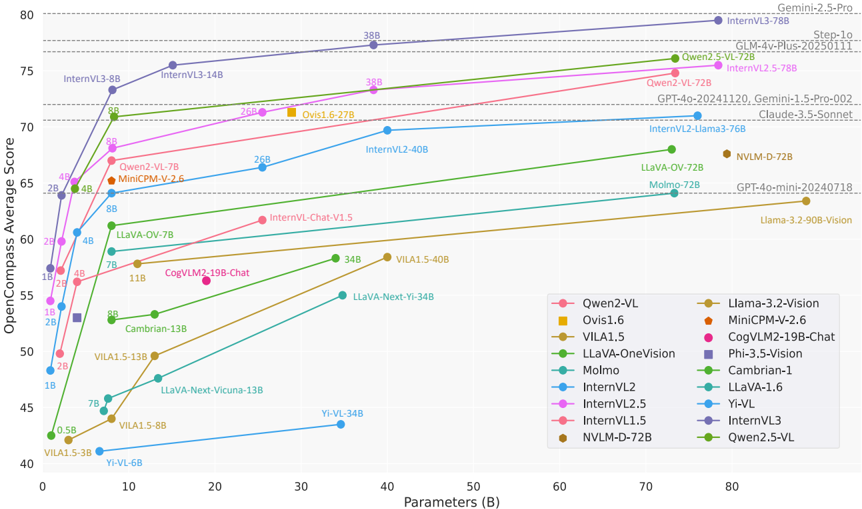
We introduce InternVL3, a significant advancement in the InternVL series featuring a native multimodal pre-training paradigm. Rather than adapting a text-only large language model (LLM) into a multimodal large language model (MLLM) that supports visual inputs, InternVL3 jointly acquires multimodal and linguistic capabilities from both diverse multimodal data and pure-text corpora during a single pre-training stage. This unified training paradigm effectively addresses the complexities and alignment challenges commonly encountered in conventional post-hoc training pipelines for MLLMs. To further improve performance and scalability, InternVL3 incorporates variable visual position encoding (V2PE) to support extended multimodal contexts, employs advanced post-training techniques such as supervised fine-tuning (SFT) and mixed preference optimization (MPO), and adopts test-time scaling strategies alongside an optimized training infrastructure. Extensive empirical evaluations demonstrate that InternVL3 delivers superior performance across a wide range of multi-modal tasks. In particular, InternVL3-78B achieves a score of 72.2 on the MMMU benchmark, setting a new state-of-the-art among open-source MLLMs. Its capabilities remain highly competitive with leading proprietary models, including ChatGPT-4o, Claude 3.5 Sonnet, and Gemini 2.5 Pro, while also maintaining strong pure-language proficiency. In pursuit of open-science principles, we will publicly release both the training data and model weights to foster further research and development in next-generation MLLMs.
Overview
CoChat Summary
TL;DR
InternVL3 introduces a native multimodal pre-training paradigm that jointly learns language and multimodal capabilities in one stage, plus V2PE, SFT/MPO post-training, test-time scaling, and infrastructure optimizations. InternVL3-78B reaches 72.2 on MMMU, setting a new state of the art among open-source MLLMs while remaining competitive with proprietary models.
Key findings
- InternVL3-78B achieves 72.2 on MMMU, 906 on OCRBench, 96.0/98.6 on VCR-EN-Easy (EM/Jaccard), and 89.0/88.7 on MMBench English/Chinese; the paper reports it as a new open-source MLLM state of the art and competitive with ChatGPT-4o, Claude 3.5 Sonnet, and Gemini 2.5 Pro.
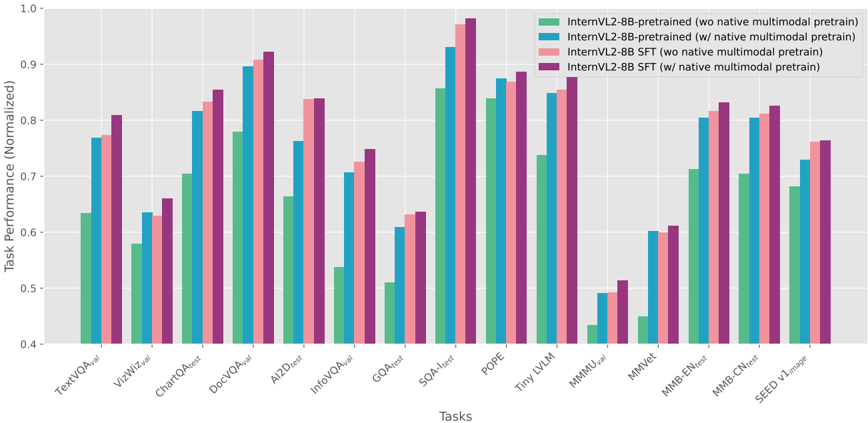
- Native multimodal pre-training is effective: replacing InternVL2-8B’s MLP warmup with native multimodal pre-training yields performance on most benchmarks comparable to the fully multi-stage-trained InternVL2-8B baseline, with further gains after instruction tuning on higher-quality data.
- MPO improves multimodal reasoning across seven benchmarks: InternVL3-78B and InternVL3-38B outperform their non-MPO counterparts by 4.1 and 4.5 points overall, respectively, even though MPO training data is a subset of SFT data.
- Test-time scaling with Best-of-8 and VisualPRM improves reasoning: on the Vision-Only split of MathVerse, best-of-8 gives increases of approximately 6.0 and 3.2 percentage points for InternVL3-38B and InternVL3-78B, respectively.
Methods
- Architecture follows “ViT-MLP-LLM”: vision encoder options are InternViT-300M and InternViT-6B; language models are pre-trained Qwen2.5 series and InternLM3-8B base models; the MLP is a two-layer randomly initialized network; pixel unshuffle reduces each 448×448 image tile to 256 visual tokens.
- Native multimodal pre-training jointly optimizes all parameters on multimodal and pure-language corpora, computes loss only on text tokens, and uses square averaging for token weights. Data combines InternVL2.5 pre-training corpus with GUI, tool usage, 3D scene, and video data, plus InternLM2.5 and open-source text data; the chosen language:multimodal ratio is 1:3, totaling about 200B tokens (50B language, 150B multimodal).
- Post-training uses SFT followed by MPO. SFT grows from 16.3M samples in InternVL2.5 to 21.7M in InternVL3; MPO uses about 300K preference samples and combines DPO preference loss, BCO quality loss, and LM generation loss. Test-time scaling uses Best-of-N with VisualPRM-8B as critic; infrastructure extends InternEVO, yielding a 50% to 200% training speedup for comparable-size models under the same compute budget.
Limitations
- The paper states a noticeable performance gap remains between InternVL3 and models like Qwen2.5-VL on certain benchmarks, such as MuirBench, implying future work may need better training data curation and model refinements.
- The paper reports minor declines on some benchmarks, such as MMHal, and states that optimizing data and training strategies for more consistent improvements remains an important future direction.
- The paper states visual grounding gains plateau at larger scales: InternVL2.5-78B reaches an average score of 92.3 while InternVL3-78B shows 91.4; it speculates this is because InternVL3’s training data expansion did not include additional grounding-specific data and the relative reduction in grounding-targeted data may have restricted localization capabilities.
Model-written summary. Check it against the paper before relying on it.
Integrity signals
Registry
Cites
Statistics
Figures
Verification
Claims the paper makes
0 Valid · 1 Not valid · 14 Not checked · 83 Own results and interpretations
A result the paper reports from its own data — it cites no other source for it, so there is none to check. The quote shows it is in the paper.
In the paper
“When compared with other competitive models, such as Qwen2-VL-72B and Qwen2.5-VL-72B, the InternVL3 series-especially the 78B variant-offers a consistent performance advantage on the multimodal understanding benchmarks.”
§ InternVL3: Exploring Advanced Training and Test-Time Recipes for Open-Source Multimodal Models > 3.6 Comprehensive Multimodal Evaluation
plainstates an association- Asserted: passes — The authors put it forward as true.
- Checkable: passes — It can be checked against evidence.
- Load-bearing: passes — The paper’s conclusions depend on it.
- Based: unclear — It is unclear why the paper says it holds.
A result the paper states — it cites no source for it, so there is none to check. The quote shows it is in the paper.
In the paper
“As a result, the number of training samples grows from 16.3M in InternVL2.5 to 21.7M in InternVL3.”
§ InternVL3: Exploring Advanced Training and Test-Time Recipes for Open-Source Multimodal Models > Data.
plainstates a cause- Asserted: passes — The authors put it forward as true.
- Checkable: passes — It can be checked against evidence.
- Load-bearing: unclear — It is unclear whether the paper’s conclusions depend on it.
- Based: passes — The paper gives a reason why it holds.
A result the paper states — it cites no source for it, so there is none to check. The quote shows it is in the paper.
In the paper
“while also maintaining strong pure-language proficiency.”
§ InternVL3: Exploring Advanced Training and Test-Time Recipes for Open-Source Multimodal Models > Abstract
boosted- Asserted: passes — The authors put it forward as true.
- Checkable: passes — It can be checked against evidence.
- Load-bearing: unclear — It is unclear whether the paper’s conclusions depend on it.
- Based: passes — The paper gives a reason why it holds.
A result the paper reports from its own data — it cites no other source for it, so there is none to check. The quote shows it is in the paper.
In the paper
“Compared with previous models, InternVL3 demonstrates substantial improvements across a wide range of task categories.”
§ InternVL3: Exploring Advanced Training and Test-Time Recipes for Open-Source Multimodal Models > 3.1 Overall Comparison to Other Advanced MLLMs
boosted- Asserted: passes — The authors put it forward as true.
- Checkable: passes — It can be checked against evidence.
- Load-bearing: passes — The paper’s conclusions depend on it.
- Based: passes — The paper gives a reason why it holds.
A result the paper reports from its own data — it cites no other source for it, so there is none to check. The quote shows it is in the paper.
In the paper
“Its capabilities remain highly competitive with leading proprietary models, including ChatGPT-4o, Claude 3.5 Sonnet, and Gemini 2.5 Pro, while also maintaining strong pure-language proficiency.”
§ InternVL3: Exploring Advanced Training and Test-Time Recipes for Open-Source Multimodal Models > Abstract
plain- Asserted: passes — The authors put it forward as true.
- Checkable: passes — It can be checked against evidence.
- Load-bearing: passes — The paper’s conclusions depend on it.
- Based: passes — The paper gives a reason why it holds.
45 more claims
Create a free account to see all 98 claims and every source verdict.
- It may state two separate claims as one. 42
- Probably not a substantial claim. 6
- The quote only partly states this claim. 1
Self-check
Percentages, sums and reported differences re-computed from the paper’s own numbers.
Each contradiction between two passages listed here was confirmed by an independent check.
Rated minor: it would not touch a result — a value no result rests on, a p-value that stays on the same side of the significance level, or a conflict that is clerical, resolved elsewhere in the paper, or outside its own findings.
In the paper
§ InternVL3: Exploring Advanced Training and Test-Time Recipes for Open-Source Multimodal Models > 3.8 Visual Grounding
“InternVL3-8B, InternVL3-9B, and InternVL3-14B yield average scores around 88.2-89.6,reflecting a consistent trend of performance gains as the model size increases.”
§ InternVL3: Exploring Advanced Training and Test-Time Recipes for Open-Source Multimodal Models > 3.6 Comprehensive Multimodal Evaluation
“InternVL3-8B 92.5 94.6 88.0 88.2 92.5 81.8 89.6 90.0 89.6 InternVL3-9B 91.8 93.2 86.6 86.4 91.0 79.9 88.0 88.5 88.2”
Rated minor: it would not touch a result — a value no result rests on, a p-value that stays on the same side of the significance level, or a conflict that is clerical, resolved elsewhere in the paper, or outside its own findings.
In the paper
§ InternVL3: Exploring Advanced Training and Test-Time Recipes for Open-Source Multimodal Models > GPT-4o Gemini 2.0 Claude Aguvis-72B Qwen2.5-VL-72B UI-TARS-72B InternVL3-8B -38B -72B
“The 8B variant (81.4%) already surpasses UI-TARS-72B”
§ InternVL3: Exploring Advanced Training and Test-Time Recipes for Open-Source Multimodal Models > GPT-4o Gemini 2.0 Claude Aguvis-72B Qwen2.5-VL-72B UI-TARS-72B InternVL3-8B -38B -72B
“InternVL3-72B achieves 90.9%, outperforming UI-TARS-72B (90.3%).”
Citations
Cites
Fei-Fei, L., Fergus, R., & Perona, P. (2005) · 2004 Conference on Computer Vision and Pattern Recognition Workshop · doi:10.1109/cvpr.2004.383 · Cited by 2,502
Liu, H., Li, C., Wu, Q., & Lee, Y. J. (2023) · Advances in Neural Information Processing Systems 36 · doi:10.52202/075280-1516 · Cited by 2,428
Making the V in VQA Matter: Elevating the Role of Image Understanding in Visual Question Answering
Goyal, Y., Khot, T., Summers-Stay, D., Batra, D., & Parikh, D. (2017) · 2017 IEEE Conference on Computer Vision and Pattern Recognition (CVPR) · doi:10.1109/cvpr.2017.670 · Cited by 2,287
Chen, Z., Wang, W., Cao, Y., Liu, Y., Gao, Z., Cui, E., Zhu, J., Ye, S., Tian, H., Liu, Z., et al. (2024) · arXiv · doi:10.48550/arxiv.2412.05271 · Cited by 2,204
Self-citationGrounding DINO: Marrying DINO with Grounded Pre-training for Open-Set Object Detection
Liu, S., Zeng, Z., Ren, T., Li, F., Zhang, H., Yang, J., Jiang, Q., Li, C., Yang, J., Su, H., et al. (2025) · Lecture Notes in Computer Science · doi:10.1007/978-3-031-72970-6_3 · Cited by 2,074
Self-citationNatural Questions: A benchmark for question answering research
Kwiatkowski, T., Palomaki, J., Redfield, O., Collins, M., Parikh, A., Alberti, C., Epstein, D., Polosukhin, I., Devlin, J., Lee, K., et al. (2019) · Transactions of the Association for Computational Linguistics · doi:10.1162/tacl_a_00276 · Cited by 2,069
MiniCPM-V: A GPT-4V Level MLLM on Your PhonePreprint
Yao, Y., Yu, T., Zhang, A., Wang, C., Cui, J., Zhu, H., Cai, T., Li, H., Zhao, W., He, Z., et al. (2024) · arXiv · doi:10.48550/arxiv.2408.01800 · Cited by 1,695
Self-citationTriviaQA: A Large Scale Distantly Supervised Challenge Dataset for Reading Comprehension
Joshi, M., Choi, E., Weld, D., & Zettlemoyer, L. (2017) · Proceedings of the 55th Annual Meeting of the Association for Computational Linguistics (Volume 1: Long Papers) · doi:10.18653/v1/p17-1147 · Cited by 1,690
Math-Shepherd: Verify and Reinforce LLMs Step-by-step without Human Annotations
Wang, P., Li, L., Shao, Z., Xu, R., Dai, D., Li, Y., Chen, D., Wu, Y., & Sui, Z. (2024) · Proceedings of the conference - Association for Computational Linguistics. Meeting · doi:10.18653/v1/2024.acl-long.510 · Cited by 1,665
TriviaQA: A Large Scale Distantly Supervised Challenge Dataset for Reading Comprehension
Joshi, M., Choi, E., Weld, D. S., & Zettlemoyer, L. (2017) · arXiv · doi:10.48550/arxiv.1705.03551 · Cited by 1,650
Research works printed but not linked: 6
- Anonymous. CG-bench: Clue-grounded question answering benchmark for long video understanding. In Submitted to The Thirteenth International Conference on Learning Representations, 2024. under review. 14, 15
- Shuai Bai, Keqin Chen, Xuejing Liu, Jialin Wang, Wenbin Ge, Sibo Song, Kai Dang, Peng Wang, Shijie Wang, Jun Tang, et al. Qwen2.5-vl technical report. arXiv preprint arXiv:2502.13923, 2025. 1, 2, 9, 10, 15 · arXiv
- Jie Cao and Jing Xiao. An augmented benchmark dataset for geometric question answering through dual parallel text encoding. In Proceedings of the 29th International Conference on Computational Linguistics, pages 1511-1520, 2022. 6
- Zhe Chen, Weiyun Wang, Hao Tian, Shenglong Ye, Zhangwei Gao, Erfei Cui, Wenwen Tong, Kongzhi Hu, Jiapeng Luo, Zheng Ma, et al. How far are we to gpt-4v? closing the gap to commercial multimodal models with open-source suites. arXiv preprint arXiv:2404.16821, 2024. 2, 3 · arXiv
- Hunter Lightman, Vineet Kosaraju, Yuri Burda, Harrison Edwards, Bowen Baker, Teddy Lee, Jan Leike, John Schulman, Ilya Sutskever, and Karl Cobbe. Let's verify step by step. In The Twelfth International Conference on Learning Representations, 2023. 7
- Minesh Mathew, Viraj Bagal, Rubèn Tito, Dimosthenis Karatzas, Ernest Valveny, and CV Jawahar. Infographicvqa. In Proceedings of the IEEE/CVF Winter Conference on Applications of Computer Vision, pages 1697-1706, 2022. 6, 7, 8, 10
Cited by
Items 2,001–2,100 of 2,641
Guan, R., Hu, R., Chen, S., Ouyang, N., Liang, S., Lin, H., Zhu, J., Shi, Y., Wu, D., Dong, J., et al. (2026) · arXiv · doi:10.48550/arxiv.2610.05274
“Transfer settings: On gRefCOCO (209,344 training expressions), InternVL3-1B [64] uses the same adapter and batch size for three epochs at a learning rate of 10 − 4 .”
Self-citationLearning Graph Rationales to Compress Long Chains of Thought in Multimodal Reasoning
Wang, Y., Yue, L., Wang, D.-B., Wei, T., & Zhang, M.-L. (2026) · ACM SIGKDD Conference on Knowledge Discovery and Data Mining (KDD) · doi:10.1145/3770855.3817627
Self-citationMedEvo: Medical Reasoning Evolution through Knowledge NavigationPreprint
Wang, X., Chen, Z., Zheng, C., Wang, Q., Lao, J., Liu, Y., Liu, J., Cao, J., Lin, H., Lu, Z., et al. (2026) · arXiv · doi:10.48550/arxiv.2610.17690
Self-citationJi, H., & Wang, R. (2026) · IEEE International Conference on Acoustics Speech and Signal Processing · doi:10.1109/icassp55912.2026.11461670
Entropy-Based Visual Re-Perception Inference for Multimodal Models
Liufu, J., Yan, Q., Kan, Z., Yang, W., Hu, H., Chen, X., & Jiang, B. (2026) · doi:10.1109/cvprf71909.2026.00935
“Similar ideas have also been explored for multimodal large language models [1–4, 7, 9, 10, 15, 18, 19, 26, 28, 33, 35, 37].”
Video Parallel Scaling: Aggregating Diverse Frame Subsets for VideoLLMs
Chung, H., Nam, H., Kim, J., Go, H., Park, B., Kim, J., Lee, J., Ha, S., & Kim, B.-H. (2026) · doi:10.1109/cvprf71909.2026.00861
“5-VL [2], Gemma3 [49], InternVL3 [63]), and benchmarks (Video-MME [12], EventHallusion [61]), we show that VPS consistently outperforms baselines, resulting in additional improvements with more parallel streams.”
InfluentialHuang, Z., Zhu, Z., Huang, Z., Zhang, Y., Zhang, H., & Wu, X. (2026) · Lecture notes in computer science · doi:10.1007/978-3-032-38059-3_30
Self-citationZhao, S., Yang, Z., Yan, T., Gong, Y., Wan, Q., Chen, S., Song, S., Wang, C., & Wang, M. (2026) · doi:10.1109/cvprf71909.2026.00225
“At the lower end, InternVL3-8B [47] attains only 36.6, with other small scale models also performing poorly, highlighting the critical role of model scale in understanding monomodal visual metaphors.”
InfluentialDIAL: Database-Informed Interactive Multi-Agent System Loop for Personalized Image Generation
Sato, T., Maeda, K., Saito, N., Ogawa, T., & Haseyama, M. (2026) · IEEE International Conference on Acoustics Speech and Signal Processing · doi:10.1109/icassp55912.2026.11463391
MMRDoc: A multi-granularity multimodal RAG framework for long-document VQA
Xu, S., & Wang, H. (2026) · Journal of Intelligent Information Systems · doi:10.1007/s10844-026-01075-2
“● End-to-end LVLM: Represented by InternVL3 (Zhu et al., 2025).”
Self-citationMAAP-VL: Modality-aware adaptive probing for reliability diagnosis of vision-language models
Wang, X., Zhan, Y., Liu, Z., Wang, K., Lian, S., & Du, J. (2026) · Image and Vision Computing · doi:10.1016/j.imavis.2026.106249
Self-citationHuang, X., Zhao, J., Liu, X., Xu, J., Zhang, Z., Luo, Z., & Chen, X. (2026) · International Joint Conference on Neural Networks (IJCNN) · doi:10.1109/ijcnn69854.2026.11729404
“5-VL [33], Qwen3-VL [17], InternVL-3 [32], and InternVL-2.”
InfluentialA Survey on Transformer-Based Long-Range Dependency Modeling in Intelligent Document Understanding
Jiang, X., Zhang, Y., & Abbasi, A. (2026) · ACM Computing Surveys · doi:10.1145/3844505
“EP-Transformer [93] propagates global context via segment-level global 416:16 X. Jiang et al. tokens and similarity-sensitive fusion blocks, enabling bidirectional inter-segment communication and reducing context fragmentation compared with recurrence-based methods.”
VoQA: Visual-Only Question Answering
An, J., Jiang, L., Luo, J., Wu, W., & Huang, L. (2026) · doi:10.1109/cvprf71909.2026.00873
Self-citationFeng, X., Tang, J. J., Lin, Z., Chen, L., Shao, S., Lu, Q., & Huang, K. X. (2026) · arXiv · doi:10.48550/arxiv.2610.25959
EmbdC: Error-Bounded Lossy Video Embedding Compression for On-Device LLM Inference
Jiang, B., Yang, T., Liu, Y., He, X., Di, S., & Jin, S. (2026) · IEEE/ACM International Symposium on Cluster, Cloud and Grid Computing (CCGrid) · doi:10.1109/ccgrid68966.2026.00022
Self-citationQuadtree Partitioning-based Visual Token Pruning for MLLMs Considering Information Density
Wei, Y., Liu, J., Zhao, S., Chen, Z., Zeng, W., & Jin, X. Y. (2025) · IEEE International Conference on Visual Communications and Image Processing (VCIP) · doi:10.1109/vcip67698.2025.11396917
“Recent multimodal LLMs [21]–[23] extend pretrained LLMs [24], [25] by inserting a vision encoder plus a pro-jector (e.g., Q-Former [26] or MLP [27]) to convert images into language-aligned tokens.”
Self-citationBai, Y., Bai, S., 冉健莉, Su, T., & Bai, Z. (2026) · IEEE International Conference on Acoustics Speech and Signal Processing · doi:10.1109/icassp55912.2026.11463161
CERA: Conflict-Explicit Reflective Agent for Multimodal Emotion Reasoning
Liu, K., Liu, Y., Wang, K., Zhang, J., Xu, L., Tang, C., Chen, Z., & Zhan, Y. (2026) · International Conference on Multimedia Retrieval · doi:10.1145/3805622.3810634
Self-citationIC2T: Embedding In‐Context Learning Into Chain of Thought for Vision‐Language Models
Liang, J., Wang, R., Hao, Y., & Guan, T. (2026) · IET Computer Vision · doi:10.1049/cvi2.70087
Xi, Y., Su, X. J., Feng, J., Liu, Y., Tarkoma, S., & Hui, P. (2026) · ACM SIGKDD Conference on Knowledge Discovery and Data Mining (KDD) · doi:10.1145/3770855.3817584
Self-citationComparative Analysis of Convolutional and Vision-Language Models for Chart Image Classification
Côme, B., Devanne, M., Weber, J., & Forestier, G. (2026) · SN Computer Science · doi:10.1007/s42979-026-05372-z
“5 [79] with super - vised fine-tuning and mixed preference optimization for InternVL3 [23].”
InfluentialKnowBench: Evaluating the Knowledge Alignment on Large Visual Language Models
Ma, Z., Yang, H.-T., Zhang, J.-B., & Chen, J.-J. (2025) · Journal of Computer Science and Technology · doi:10.1007/s11390-025-5512-y
Performance Comparison of Multimodal Vision-Language Models in Classifying Turkish Dishes
Bicakci, Y. S. (2026) · Sakarya University Journal of Computer and Information Sciences · doi:10.35377/saucis...1727583
Feng, Y., Wu, W., Sun, J., Li, C., Zhang, F., Li, Z., Ai, J., Zhou, S., Chang, Y., Gao, C., et al. (2026) · doi:10.1109/cvprf71909.2026.00217
Self-citationVision Inference Former: Sustaining Visual Consistency in Multimodal Large Language Models
Dong, X., Zhang, M., Han, K., Tan, X., Wu, F., & Kuang, K. (2026) · 2026 IEEE/CVF Conference on Computer Vision and Pattern Recognition- FINDINGS Track (CVPRF) · doi:10.1109/cvprf71909.2026.00586
“For instance, InternVL-3 [49] enhances semantic integration by co-training both the vision encoder and LLM parameters, thereby enabling bidirectional adaptation between vision and language modules.”
GROVE: Grounded Violation Evaluator for Visual InspectionPreprint
Gupta, A., Singh, S., Asari, V. K., & Nguyen, T. (2026) · SSRN Electronic Journal · doi:10.2139/ssrn.7151338
Xu, J., Zhou, H., Ma, J., 邹耀威, Dai, L., & Zhu, L. (2026) · Lecture notes in computer science · doi:10.1007/978-3-032-38091-3_53
Jadhav, A. (2026) · SSRN Electronic Journal · doi:10.2139/ssrn.7629398
When Prompts Become Pixels: Prompt-Region Grounding for Multimodal ReasoningPreprint
Wang, Y., Zhou, R., Tang, Y., Zhu, Y., Zhao, X., Chang, X., & Liang, X. (2026) · arXiv · doi:10.48550/arxiv.2608.04726
Self-citationGeoMind: Explicit Spatial Reasoning via Dual-Reference Geometric Modeling
Wei, X., Tian, A., Liu, S., Peng, J., Zhao, C., Bi, X., Lu, Y., Zhang, B., & Yang, F. (2026) · International Joint Conference on Artificial Intelligence · doi:10.24963/ijcai.2026/203
Self-citationSTACK: 3D Spatial Task Analysis in Collaborative Construction Keyframes
Jung, C., Mannan, S. A., Fitzgerald, J., Seefried, E., Venkatesha, V., Anindho, S., & Blanchard, N. (2026) · INTERNATIONAL CONFERENCE ON MULTIMODAL INTERACTION · doi:10.1145/3776574.3831227
“5-VL-72B † [4], InternVL3-8B [36], LLaVA-OneVision-7B [16]), where † denotes 4-bit NF4 quantization.”
HiSum: A Hierarchical Framework for Long Video Summarization with Temporal Enhancement
Lin, J., Zhang, C., Shao, W., Zhu, L., Qian, Y., & Li, J. (2026) · International Conference on Consumer Electronics · doi:10.1109/icce67443.2026.11449786
“Video Large Language Models (Video LLMs) leverage pre-trained LLMs to understand video content and generate coherent responses ( [1], [2], [3]).”
Self-citationDoChartDes: Fine-Grained, Automated Benchmark for Chart Description in Document Contexts
Wang, N., Wang, N., Yang, Z., Xu, Y., Peng, F., & Ma, G. (2026) · International Joint Conference on Neural Networks (IJCNN) · doi:10.1109/ijcnn69854.2026.11728958
“5-VL-72B [29], (ii) InternVL3-78B [30].”
From Glance to Focus: Mitigating Recognition Laziness in MLLMs for Fine-Grained RecognitionPreprint
Yang, Y., Liu, Z., Yang, M., & Peng, X. (2026) · arXiv · doi:10.48550/arxiv.2610.13154
“…both vanilla image-text matching and LLM-enhanced recognition; ii) MLLM-based methods, including general MLLMs from the LLaVA-OneVision [6], InternVL [7], [52], and Qwen-VL [5], [49] families, together with FGVR-oriented post-trained models, such as Finedefics [9], Fine-R1 [14], and DiVE-k [13].”
Self-citationStructured Visual Measurement and Consistency Correction for Pointer Scale Systems
Zhao, Z., Wang, J., Wang, Q., & Zhai, Y. (2026) · IEEE Transactions on Instrumentation and Measurement · doi:10.1109/tim.2026.3723445
Self-citationBeyond Visual Perception: Mitigating Multimodal Hallucination via Hybrid Preference Optimization
Yang, K., Liu, Y., Wu, J., Qian, L., & Yu, H. (2026) · Proceedings - International Conference on Image Processing · doi:10.1109/icip61757.2026.11630292
Self-citationEmotionBench: Benchmarking Facial Emotion Understanding in Multimodal Large Language Models
Xu, L., Chen, B., Gao, Y., Duan, H., Cao, Y., Wu, S., Li, Y., Min, X., & Zhai, G. (2026) · IEEE International Conference on Multimedia Information Processing and Retrieval (MIPR) · doi:10.1109/mipr70517.2026.00079
“General-purpose MLLMs, such as GPT-4o [7], Gemini [8], Qwen-VL [9], and InternVL [10], have demonstrated impressive visual understanding capabilities across a wide range of tasks.”
Self-citationSTVFocus: Query-Guided Spatio-Temporal Visual Focusing for Video LLMs
Kong, T., Park, M., & Ahn, S. (2026) · Lecture notes in computer science · doi:10.1007/978-3-032-37135-5_18
Towards Streaming Video Understanding for Embodied Scenarios
Wang, Y., Li, Z., Qian, T., Zheng, H., Wang, Z., Fu, Y., & Wang, X. (2026) · doi:10.1109/cvprf71909.2026.00903
“Most existing video MLLMs follow an offline paradigm in which sampled frames from an entire video are encoded, commonly via CLIP-based [27] vision encoders, and projected into the LLM space for downstream tasks, as seen in models such as Qwen3-VL [1], InternVL3 [43], and Video-LLaMA3 [39].”
Self-citationMipKV: A Sparsify-Then-Recover Paradigm for Accelerating Large Vision-Language Model Pre-Filling
Zhang, J., Ji, Y., Han, Y., & Zheng, Z. (2026) · 2026 IEEE/CVF Conference on Computer Vision and Pattern Recognition- FINDINGS Track (CVPRF) · doi:10.1109/cvprf71909.2026.00285
“This prop-Figure erty greatly extends their applicability and has become a fundamental feature of modern LVLMs [2, 32, 45].”
CycleCap: Improving VLMs Captioning Performance via Self-Supervised Cycle Consistency Fine-TuningPreprint
Krestenitis, M., Tzelepis, C., Ioannidis, K., Vrochidis, S., Kompatsiaris, I., Tzimiropoulos, G., Gong, S., & Patras, I. (2026) · arXiv · doi:10.48550/arxiv.2603.18282
“Table 1: Comparison of the proposed CycleCap with different baseline models (InternVL3-1B [66], Qwen2-VL-2B [57], Qwen2.”
VAttnPO: Visual Attention-Guided Policy OptimizationPreprint
Zheng, L., Shao, Z., Yu, Z., Yang, Y., Sun, H., Wang, Q., Mao, N., & Zhou, P. (2026) · arXiv · doi:10.48550/arxiv.2610.16735
Unfold The World: Factorize 4D Properties in Reinforcing Spatial Reasoning
Yang, Y.-J., Zheng, S., Li, W.-B., Liu, J.-H., Sun, H.-Z., Zhang, Y.-B., Jiang, J.-X., Song, L., Huang, H.-Y., Duan, N., et al. (2026) · European Conference on Computer Vision · doi:10.1007/978-3-032-37577-3_33
Yu, C., Li, W., Hou, L., Guo, Y., & Xue, H. (2026) · Expert Systems with Applications · doi:10.1016/j.eswa.2026.133942
Zhang, Z., Zhao, X., Xu, X., Liang, G., Wang, W., Lv, X., Li, B., & Gao, J. (2026) · arXiv · doi:10.48550/arxiv.2603.29211
“5-VL-7B [31] and InternVL3-14B [32] were used for cross-model verification and loss rescoring, enabling us to filter the corpus down to a substantially higher-purity instruction set; for example, a core set of about 70,000 high-quality samples was extracted from an 840,000-sample base corpus.”
Self-citationFineViT: Progressively Unlocking Fine-Grained Perception with Dense RecaptionsPreprint
Zhao, P., Zhang, X., Xu, M., Sun, R., Du, Z., Wang, D. Y., Zheng, G., Xu, H., Zhang, Z., Zhang, Y., et al. (2026) · arXiv · doi:10.48550/arxiv.2603.17326
“5-7B [15], Intern3-VL-8B[14], and MiniCPM-V-8B[32].”
Self-citationMM-SeR: Multimodal Self-Refinement for Lightweight Image CaptioningPreprint
Song, J., Jo, Y., Min, S. Y., Xie, Q., Kim, T.-H., Bisk, Y., & Choo, J. (2025) · arXiv · doi:10.48550/arxiv.2508.21451
SPEAR: Selective Preference Elicitation with Adaptive Rewards for VLM-Guided Robotic Manipulation
Wu, Z., Liu, R., Zhou, P., Chen, F., & Yang, Y. (2026) · IEEE/RSJ International Conference on Intelligent Robots and Systems (IROS) · doi:10.48550/arxiv.2610.21621
“For fair comparison, we employ the same open-source preference oracle, InternVL3-78B [8], and set sub-trajectory length H = 1 for both RL-VLM-F and our method.”
Ji, X., Rao, G., Zhuang, P., Xing, H., Cao, J., Cao, Y., Zhang, M., & Wang, X. (2026) · Health Information Science and Systems · doi:10.1007/s13755-026-00442-1
Self-citationExploring Cross-Dataset Generalization of Large Multimodal Models on Facial Expression Recognition
Du, H., Huang, D., Zhang, B., & Peng, X. (2025) · International Conference on Machine Learning and Computer Application (ICMLCA) · doi:10.1109/icmlca66850.2025.11336465
“In recent years, the development of Large Multimodal Models (LMMs) has opened new avenues for addressing these challenges [9, 10, 11, 12].”
Watch, Localize and Answer: Actom-Centric Video Large Language Models
Shu, Y., Qiu, Z., Long, F., Yao, T., & Mei, T. (2026) · IEEE Transactions on Multimedia · doi:10.1109/tmm.2026.3716078
Ma, J., Jin, S., Dang, L., Chen, L., & Chen, B. (2026) · IEEE Transactions on Image Processing · doi:10.1109/tip.2026.3736818
“In MLLMs [13], [14], the number of visual tokens often exceeds that of textual tokens by one to two orders of magnitude.”
PulseMind: A Multi-Modal Medical Model for Real-World Clinical Diagnosis
Xu, J., Liu, J., Lao, J., Zhu, Q., Zhao, Y., Jin, C., Liu, S., Lu, Z., Zhang, L., Chen, X., et al. (2026) · Proceedings of the AAAI Conference on Artificial Intelligence · doi:10.1609/aaai.v40i13.38106
Self-citationEvaluation of Open-Source Small Vision–Language Models for Medical Prescriptions Understanding
Lehmiani, Y., Frihi, S., & Mahmoudi, A. (2025) · International Conference on Intelligent Systems: Theories and Applications · doi:10.1109/sita67914.2025.11273485
“Previous work shows that sub-5B VLMs can reason visually [16] and that synthetic data can unlock privacy-sensitive document tasks [17], but no study unites these threads for Moroccan prescriptions typed in French under CNDP constraints.”
He, C., Zhu, X., Liao, Y., Tang, Y., & Zhou, Z. (2025) · International Conference on Computer Information Science and Artificial Intelligence (CISAI) · doi:10.1145/3773365.3773628
“The experimental results, obtained using the InternVL3-9B [12] model with both Basic-DPO and Law-DPO optimization approaches, are summarized as follows: Table 1 presents the model accuracy of scene understanding, Table 2 reports the hallucination rate of content description, and Table 3 shows the…”
Self-citationPreserving Language Capabilities in Vision-Language Models via Representation Regulation
Chen, Z., Tao, J., & Zeng, Z. (2026) · Findings of the Association for Computational Linguistics: ACL (Findings of ACL) · doi:10.18653/v1/2026.findings-acl.1210
Self-citationYin, Z., Lin, W., & Kong, X. (2026) · Discover Artificial Intelligence · doi:10.1007/s44163-026-01731-0
Learning to Wander: Improving the Global Image Geolocation Ability of LMMs via Actionable Reasoning
Zheng, Y., Duan, H., Zhang, Z., Liu, X., & Min, X. (2026) · doi:10.1109/cvprf71909.2026.00692
Xie, Y., Hua, Z., Wang, R., Ng, W. W. Y., Wang, X., & Jia, Y. (2026) · International Conference on Machine Learning · doi:10.48550/arxiv.2605.20965
Self-citationMACReD: A Multi-Agent Collaborative Reasoning Framework for Reaction Diagram Parsing
Tang, C., Lin, C., Xu, Y., Wang, H., Zhou, J., Li, X., Xiao, M., & Chen, E. (2026) · ACM SIGKDD Conference on Knowledge Discovery and Data Mining (KDD) · doi:10.1145/3770855.3818942
“5-VL-7B [38], InternVL3-8B [39], and MiMo-VL-7B [40] as open-source alternatives.”
Self-citationSTELAR-VISION: Self-Topology-Aware Efficient Learning for Aligned Reasoning in Vision
Li, C., Zhang, H., Yang, Z., Chen, F., Wang, Z., Bolimera, A., & Savvides, M. (2026) · Proceedings of the AAAI Conference on Artificial Intelligence · doi:10.1609/aaai.v40i44.41091
Self-citationAdaMoE: Adaptive MoE Loss Framework for Introducing MMLM in Image Restoration
Liu, F., Hu, J., Wang, J., Xu, N., & Fu, Z. (2026) · Data Intelligence · doi:10.3724/2096-7004.di.2026.0009
“5VL [14] and InternVL3[15] as prime examples.”
Self-citationCui, C., Ren, Y., He, Z., Li, Q., Jun, Y., & Fu, J. (2025) · doi:10.1145/3746260.3762128
CR³: Boosting Compositional Reasoning in MLLMs Through Rule-Based Reinforcement Learning
Qian, S., Liu, B., Sun, C., Xie, P., Xu, Z., & Wang, B. (2026) · Proceedings of the AAAI Conference on Artificial Intelligence · doi:10.1609/aaai.v40i29.39680
View-R1: Asymmetric Policy Optimization for Difficulty-Aware Multimodal Reinforcement Learning
Hong, M., Guo, Z., Zhang, J., Wang, Z., Zhang, Z., Jin, T., & Zhao, Z. (2026) · Findings of the Association for Computational Linguistics: ACL (Findings of ACL) · doi:10.18653/v1/2026.findings-acl.1538
Luo, Y., Wang, G., Xiao, L., Li, J., & Tang, S. (2026) · Conference on Empirical Methods in Natural Language Processing (EMNLP) · doi:10.18653/2026.emnlp-main.739
MeDocVL: Noise-Aware Post-Training of Visual Language Models for Medical Document Parsing
Wu, W., Diao, L., Zhao, Y., Wang, W., Liu, Y., & Lv, X. (2026) · Findings of the Association for Computational Linguistics: EMNLP (Findings of EMNLP) · doi:10.18653/2026.findings-emnlp.2321
Self-citationAPEX : Adaptively Balancing Off-Policy Guidance and On-Policy Exploration for LLM Reasoning
Wang, Y., Zhang, Z., Xu, D., Xu, K., Zhu, Q., Huang, W., Wu, S., Cheng, C., He, X., Yang, Y., et al. (2026) · Findings of the Association for Computational Linguistics: EMNLP (Findings of EMNLP) · doi:10.18653/2026.findings-emnlp.329
Self-citationRAISE: A Risk-Aware Multimodal Agent for Iterative Industrial Anomaly Detection
Cao, H., Sun, L., & Yuan, Z. (2026) · doi:10.1145/3841452.3841497
MGVC: MLLM-Guided Video Captioning for the IntentVC Challenge
Yu, Z., Xu, Q., Jiang, Y., Yang, P., & Huang, Q. (2025) · ACM International Conference on Multimedia (ACM MM) · doi:10.1145/3746027.3762058
BiFocus: Evidence-Grounded Patch and Query-Token Calibration for Visual Document Retrieval
Chen, J., Yao, L., Zhang, Y., & Li, X. (2026) · ACM International Conference on Information and Knowledge Management (CIKM) · doi:10.1145/3799682.3840605
“Screenshot-based retrieval benefits from general-purpose vision–language pre-training such as CLIP and ALIGN [15, 33], SigLIP [45], PaLI and PaliGemma [5, 7], and Qwen-VL and InternVL [3, 50].”
Zhang, J., Tian, Y., Liang, J., Lin, D., Cai, Y., Liu, Y., Huang, Z., Ni, J., & Jianxing, H. (2026) · ACM International Conference on Multimedia (ACM MM) · doi:10.1145/3767308.3835873
Self-citationXiang, Z., Ma, B., Chen, S., Chen, B., Deng, X., Su, Y., & Ren, J. (2026) · Sensors · doi:10.3390/s26196222
Zhang, K., Zhang, K., Han, J., Lv, X., Dong, Z., & Gao, Y. (2026) · SSRN Electronic Journal · doi:10.2139/ssrn.7541004
Self-citationNiu, F., Jiang, S., Wu, Q., Shan, S. C. Y., Hu, T., Wu, J., & Liu, Z. (2026) · Findings of the Association for Computational Linguistics: EMNLP (Findings of EMNLP) · doi:10.18653/2026.findings-emnlp.1110
Self-citationBeyond Counting: Evaluating Abstract and Emotional Reasoning in Vision-Language Models
Zhou, Y., Zhang, Y., Chang, J., Gu, X., Wang, Y., Ding, K., Yang, G., & Xiang, S. (2026) · Proceedings of the AAAI Conference on Artificial Intelligence · doi:10.1609/aaai.v40i16.38389
Self-citationBeyond the Page Break: An LLM-Based Solution for Cross-Page Table Reconstruction
Tang, Y., Li, H., Cao, Y., & Luo, P. (2026) · Lecture notes in computer science · doi:10.1007/978-3-032-36023-6_34
Self-citationEviDocVLM: Evidence-Aligned Reinforcement Learning for Multi-Page Document Question Answering
Liu, A., Cao, Z., Xie, J., Chen, F., & Wang, Z. (2026) · Findings of the Association for Computational Linguistics: EMNLP (Findings of EMNLP) · doi:10.18653/2026.findings-emnlp.1448
Sonoda, Y., Yamagishi, Y., Hirano, Y., Miki, S., Nakao, T., Hanaoka, S., Nomura, Y., Hamada, A., Kanemaru, N., Miyo, R., et al. (2026) · medRxiv · doi:10.64898/2026.07.09.26357709
Kim, M., Song, H., & Lim, C. (2026) · arXiv · doi:10.48550/arxiv.2610.17902
“We study one frozen backbone and a balanced UNK-VQA subset, so conclusions may not transfer to architectures with different visual pathways [29, 38] or naturally occurring unanswerability.”
DynThinker: Unifying Static 3D and Dynamic 4D Spatial ReasoningPreprint
Cao, Q., Li, H., Guo, Z., Gao, S., Gao, Z., Zhang, H., He, F., Han, J., Xu, H., Liang, X., et al. (2026) · arXiv · doi:10.48550/arxiv.2610.20598
Self-citationZhong, Z., Du, Y., Lin, T., Wang, H., Dai, W., Zuo, B., & Zhao, B. (2026) · arXiv · doi:10.48550/arxiv.2610.12936
“The resulting tokens provide visual and linguistic context for action generation (Lin et al., 2026d; Zhu et al., 2025).”
Self-citationSuppression Is Not Forgetting: Residual Recoverability in Visual Concept Unlearning for VLMsPreprint
Tan, Z., Zhang, Z., Liu, J., Liang, S., Tang, Y. Y., Chen, L., & Xu, C. (2026) · arXiv · doi:10.48550/arxiv.2604.03114
“We evaluate both prompts on Qwen3-VL-2B [25], InternVL3-8B [26], and Qwen2-VL-7B [27].”
IMPLICIT-Bench: Stereotyped Defaults and Prompt Following in Text-to-Image GenerationPreprint
Dai, Y., Liu, Z., Cheong, M., & Han, C. (2026) · arXiv · doi:10.48550/arxiv.2609.24228
Self-citationXu, J., Huang, X., Luo, Z., Zhang, Z., Liu, X., Wei, J., Wang, X., Zhao, J., & Chen, X. (2026) · Lecture notes in computer science · doi:10.1007/978-3-032-37372-4_35
Self-citationHumanPhys: A Human-Centric Physical-World Perception Benchmark for Real-World Visual ReasoningPreprint
Zhang, Y., Zhou, E., Lin, J., Zhou, D., Wang, W., Huang, Y., & Liu, J. (2026) · arXiv · doi:10.48550/arxiv.2610.14679
“The recent rise of spatial intelligence benchmarks has raised a natural question: can Multimodal Large Language Models (MLLMs) [2, 13, 16, 24, 63, 68], which perform strongly on 2D visual understanding, also perceive and reason about the physical world?”
Self-citationBenchmarking Visual LLMs Resilience to Unanswerable Questions on Visually Rich DocumentsPreprint
Napolitano, D., Cagliero, L., & Battiloro, F. (2025) · AAAI Publications (The Association for the Advancement of Artificial Intelligence (AAAI)) · doi:10.48550/arxiv.2511.11468
Benchmarking Visual LLMs Resilience to Unanswerable Questions on Visually Rich Documents
Napolitano, D., Cagliero, L., & Battiloro, F. (2026) · Proceedings of the AAAI Conference on Artificial Intelligence · doi:10.1609/aaai.v40i10.37759
You Only Judge Once: Multi-response Reward Modeling in a Single Forward PassPreprint
Yang, Y., Ma, Z., Ganti, M., Zhang, J., & Krishna, R. (2026) · arXiv · doi:10.48550/arxiv.2604.10966
“5-4B/8B (Zhu et al., 2025), LLaVA-Video-7B (Zhang et al., 2025d), MiniCPM-V4.”
Maailmanmallinnus ja mustan laatikon optimointi kielimalleilla
Dainese, N. (2026) · Aaltodoc (Aalto University)
FindIt: A Format-Informed Visual Detection Benchmark for Generalist Multimodal LLMsPreprint
Khandelwal, E., Pan, J., Zhang, M., Kong, Q., Garattoni, L., & Kuehne, H. (2026) · arXiv · doi:10.48550/arxiv.2606.04282
Two Streams, One Sarcasm: Orthogonal Expert Tuning for Holistic Multimodal Sarcasm Understanding
Guo, D., Cao, C., Yuan, F., Xu, P., Hu, C., Zhang, Z., Liu, Y., & Liu, Y. (2026) · Proceedings of the conference - Association for Computational Linguistics. Meeting · doi:10.18653/v1/2026.acl-long.319
Self-citationUltraViT: Latency-Optimized On-Device Vision Encoder for Large Vision-Language Models
Metaxas, I. M., Bulat, A., Baldrati, A., Zaganidis, A., Ouali, Y., Kim, H., & Tzimiropoulos, G. (2026) · Lecture notes in computer science · doi:10.1007/978-3-032-37520-9_15
Guardrail-Agnostic Societal Bias Evaluation in Large Vision-Language Models
Hirota, Y., Boone, M. R., Zachariah, A., Varghese, J. R., Wang, Y.-C. F., Li, B., & Hachiuma, R. (2026) · Lecture notes in computer science · doi:10.1007/978-3-032-37718-0_3
“Recent studies [5, 32, 40, 83, 87, 89, 90] have found that LVLMs like InternVL [100] disproportionately associate specific jobs like nurse more with women than with men, underscoring gender-occupation stereotyping.”
Self-citationLook at Where You Think: Localization-Head Alignment for Fine-Grained Perception in Thinking VLMsPreprint
Wang, Y., Wu, W., & Wang, H.-N. (2026) · arXiv · doi:10.48550/arxiv.2610.39649
“5-VL-3B and 7B (Bai et al., 2025), LLaVA-OneVision-7B (Li et al., 2024), InternVL3-8B (Zhu et al., 2025), Pixel-Reasoner (Wang et al., 2025a) and a region-supervised Qwen2.”
Self-citationAPT: Alignment-Preserving Video Tokenizer for Non-Destructive Image-to-Video Adaptation
Gao, L., Zhong, Y., Li, Y., Tan, H., Hu, J., Kang, Z., Gao, Z., & Wei, X. (2026) · ACM International Conference on Multimedia (ACM MM) · doi:10.1145/3767308.3835748
“To assess plug-and-play generalization, we integrate APT with eight heterogeneous multimodal foundation models: Aquila [19], BLIP-3 [68], InternVL2/3 [8, 79], Mipha [80], Molmo [11], and Qwen2/2.5-VL [3, 60].”
InfluentialSelf-citationSpectrumWorld: Artificial Intelligence Foundation for Spectroscopy
Yang, Z., Xie, J., Shen, S., Wang, D., Chen, Y., Gao, B., Sun, S., Qi, B., Zhou, D., Bai, L., et al. (2026) · ACM SIGKDD Conference on Knowledge Discovery and Data Mining (KDD) · doi:10.1145/3770855.3818936
“The platform currently supports benchmarking for over 20 MLLMs, including prominent open-source models such as InternVL3 [49] and proprietary models like GPT-4o [33], across 14 specific tasks.”
Skeleton-and-Strategy Prompting: Training-Free Negation Understanding for Vision-Language ModelsPreprint
Cai, Y., Rostami, M. G., & Thomason, J. (2026) · arXiv · doi:10.48550/arxiv.2610.01180
“To represent large-scale models, we evaluate GPT-4o (OpenAI et al., 2024); for 8B-level models, we evaluate InternVL3-8B (Zhu et al., 2025), Qwen3VL-8B (Bai et al., 2025), and LLaVA-OneVision2-8B (An et al., 2026); and for 2B-level models, we evaluate InternVL3-2B (Zhu et al., 2025) and Qwen3VL-2B (Bai et al., 2025).”
InfluentialChen, S. N., Chen, H., Ho, C., Mao, X., Wang, J., Zhang, Y., & Li, C. (2026) · arXiv · doi:10.48550/arxiv.2603.27259
“Recent advances in multi-modal large language models (MLLMs) have significantly enhanced their ability to integrate and interpret text, images, and videos [5, 14, 26, 43, 65, 71].”
Self-citation
Metadata
- Authors
- Zhu, J., Wang, W., Chen, Z., Liu, Z., Ye, S., Gu, L., Tian, H., Duan, Y., Su, W., Shao, J., Gao, Z., Cui, E., Wang, X., Cao, Y., Liu, Y., Wei, X., Zhang, H., Wang, H., Xu, W., Li, H., Wang, J., Deng, N., Li, S., He, Y., Jiang, T., Luo, J., Wang, Y., He, C., Shi, B., Zhang, X., Shao, W., He, J., Xiong, Y., Qu, W., Sun, P., Jiao, P., Lv, H., Wu, L., Zhang, K., Deng, H., Ge, J., Chen, K., Wang, L., Dou, M., Lu, L., Zhu, X., Lu, T., Lin, D., Qiao, Y., Dai, J., & Wang, W.
- Affiliations
- Shanghai Artificial Intelligence Laboratory (CN)
- Chinese University of Hong Kong (HK)
- Sensetime (China) (CN)
- Shanghai Jiao Tong University (CN)
- ORCID
- Venue
- arXiv
- Publisher
- arXiv
- Published
- 2025
- ISSN
- 2331-8422 (ISSN-L)
- arXiv
- 2504.10479
- OpenAlex
- W4416053382
- Cited by
- 2,644
- References
- 138
- Citations by year
- 2026: 1999 · 2025: 638
- Type
- posted content
- Language
- en
- Open access
- green
- arxiv.org
- Licence
- Locations
- arXiv (submittedVersion, cc-by)
- Topics
- Physical Sciences › Computer Science › Computer Vision and Pattern Recognition › Multimodal Machine Learning Applications
- Physical Sciences › Computer Science › Artificial Intelligence › Domain Adaptation and Few-Shot Learning
- Physical Sciences › Computer Science › Computer Vision and Pattern Recognition › Advanced Neural Network Applications
- Keywords
- multimodal large language models, multimodal pre-training, supervised fine-tuning, test-time scaling
About these checks
Registry, retraction, Cites and statistics results are computed, not judged, with one exception: a printed reference that no index lists is read once by a model before it counts as a citation error. Claims are extracted by a model and kept only when their quote appears verbatim in the text; each cited source is then checked, with a model’s help, for whether it says what the claim relies on. Those verdicts can be wrong — read the claim’s quote and the cited source before relying on one.
A language model drew the claims from the paper on 2026-11-28, under version 3 of the claim definition (model deepseek-v4.1-flash, prompt extract-v3).
A second model labelled each claim on 2026-11-28 (model jev-1.13-20260917, definition revision gold-guideline-v0.2).
Statistics and arithmetic are recomputed, not judged.
Confidence bands are shown only for fields calibrated on our annotated test set. None is calibrated yet, so no band is shown.
What counts as a claim ›How we measure confidence ›How we check this ›
Are you an author, or do you see a problem with this page? Request a review
Data sources
Bibliographic data: Semantic Scholar, OpenAlex, Crossref.
Contains information from the Semantic Scholar Academic Graph Datasets, made available under the ODC Attribution License (ODC-BY 1.0).
Semantic Scholar’s data is described in: Kinney, R., et al. (2023). The Semantic Scholar Open Data Platform. arXiv:2301.10140.
