

Multiple symptoms of total ozone recovery inside the Antarctic vortex during austral spring
Open accessPublished version of a preprint
The DOI matches its Crossref record; 40 of the 41 references it cites were found in a registry or an index.
Abstract
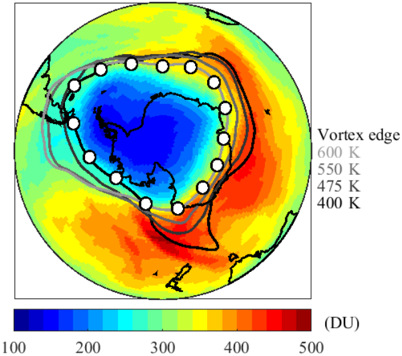
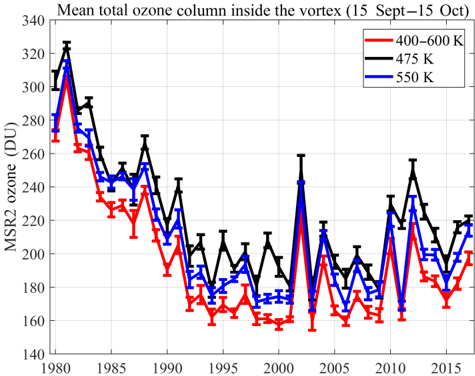
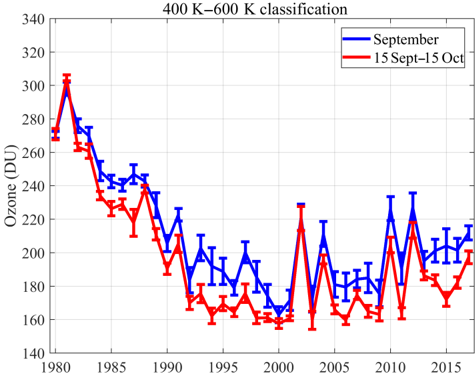
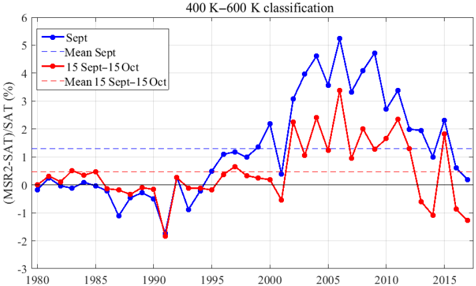
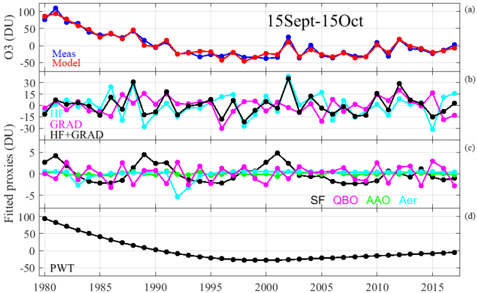
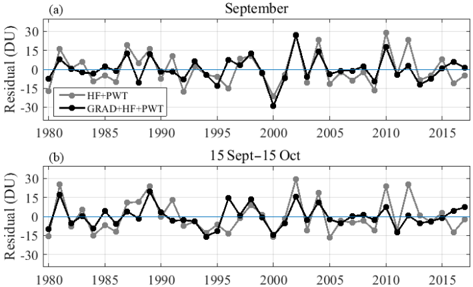
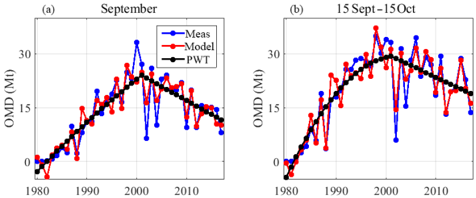
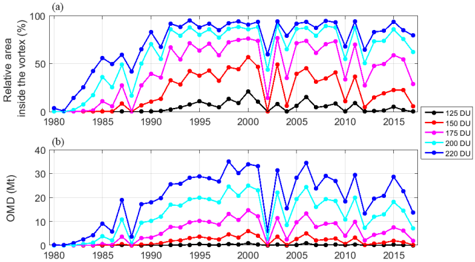
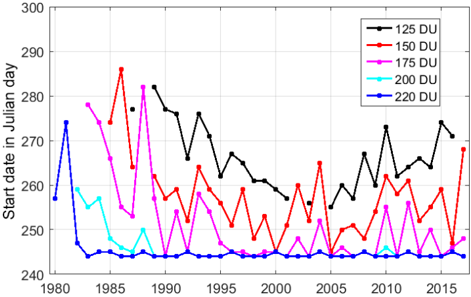
The long-term evolution of total ozone column inside the Antarctic polar vortex is investigated over the 1980–2017 period. Trend analyses are performed using a multilinear regression (MLR) model based on various proxies for the evaluation of ozone interannual variability (heat flux, quasi-biennial oscillation, solar flux, Antarctic oscillation and aerosols). Annual total ozone column measurements corresponding to the mean monthly values inside the vortex in September and during the period of maximum ozone depletion from 15 September to 15 October are used. Total ozone columns from the Multi-Sensor Reanalysis version 2 (MSR-2) dataset and from a combined record based on TOMS and OMI satellite datasets with gaps filled by MSR-2 (1993–1995) are considered in the study. Ozone trends are computed by a piece-wise trend (PWT) proxy that includes two linear functions before and after the turnaround year in 2001 and a parabolic function to account for the saturation of the polar ozone destruction. In order to evaluate average total ozone within the vortex, two classification methods are used, based on the potential vorticity gradient as a function of equivalent latitude. The first standard one considers this gradient at a single isentropic level (475 or 550 K), while the second one uses a range of isentropic levels between 400 and 600 K. The regression model includes a new proxy (GRAD) linked to the gradient of potential vorticity as a function of equivalent latitude and representing the stability of the vortex during the studied month. The determination coefficient ( R 2 ) between observations and modelled values increases by ∼ 0.05 when this proxy is included in the MLR model. Highest R 2 (0.92–0.95) and minimum residuals are obtained for the second classification method for both datasets and months. Trends in September over the 2001–2017 period are statistically significant at 2 σ level with values ranging between 1.84 ± 1.03 and 2.83 ± 1.48 DU yr −1 depending on the methods and considered proxies. This result confirms the recent studies of Antarctic ozone healing during that month. Trends from 2001 are 2 to 3 times smaller than before the turnaround year, as expected from the response to the slowly ozone-depleting substances decrease in polar regions. For the first time, significant trends are found for the period of maximum ozone depletion. Estimated trends from 2001 for the 15 September–15 October period over 2001–2017 vary from 1.21 ± 0.83 to 1.96 DU ± 0.99 yr −1 and are significant at 2 σ level. MLR analysis is also applied to the ozone mass deficit (OMD) metric for both periods, considering a threshold at 220 DU and total ozone columns south of 60 ∘ S. Significant trend values are observed for all cases and periods. A decrease of OMD of 0.86 ± 0.36 and 0.65 ± 0.33 Mt yr −1 since 2001 is observed in September and 15 September–15 October, respectively. Ozone recovery is also confirmed by a steady decrease of the relative area of total ozone values lower than 175 DU within the vortex in the 15 September–15 October period since 2010 and a delay in the occurrence of ozone levels below 125 DU since 2005.
Overview
The claims and statistics of this paper haven’t been checked yet.
Free: it reads the open-access text and checks the first 5 claims that cite a source we can check. Create a free account to check every claim.
Integrity signals
Registry
Cites
Statistics
Figures
Verification
Claims the paper makes
The claims and statistics of this paper haven’t been checked yet.
Free: it reads the open-access text and checks the first 5 claims that cite a source we can check. Create a free account to check every claim.
Claims other papers make about this one
Each is checked against this paper’s own text: does it say what the citing paper says it does?
The source backs part of the claim, not all of it — or backs it for a different population, condition or comparison.
In the citing paper
“The boundary for ozone depletion is currently only transgressed over the Antarctic and southern high latitudes and only in the 3-month Austral spring (45).”
From Earth beyond six of nine planetary boundaries (2023) · cites this paper as [45]
Experimental — accuracy not yet measuredThe source backs part of the claim, not all of it — or backs it for a different population, condition or comparison.
In the citing paper
“Following the ratification of the Montreal Protocol in 1987, the trend and global extent of ozone depletion have recovered slightly (44, 45).”
From Earth beyond six of nine planetary boundaries (2023) · cites this paper as [45]
Experimental — accuracy not yet measured
Self-check
Percentages, sums and reported differences re-computed from the paper’s own numbers.
The self-check needs the paper’s full text.
Citations
Cites
The ERA‐Interim reanalysis: configuration and performance of the data assimilation system
Dee, D. P., Uppala, S. M., Simmons, A. J., Berrisford, P., Poli, P., Kobayashi, S., Andrae, U., Balmaseda, M. A., Balsamo, G., Bauer, P., et al. (2011) · Quarterly Journal of the Royal Meteorological Society · doi:10.1002/qj.828 · Cited by 24,480
Large losses of total ozone in Antarctica reveal seasonal ClOx/NOx interaction
Farman, J. C., Gardiner, B. G., & Shanklin, J. D. (1985) · Nature · doi:10.1038/315207a0 · Cited by 3,520 · cited 1×
“The evolution of total ozone content (TOC) in Antarctica during austral spring is strongly linked to the important stratospheric ozone decline that was highlighted for the first time by Chubachi et al. (1985) and Farman et al. (1985).”
BackgroundThe ozone monitoring instrument
Levelt, P. F., van den Oord, G. H. J., Dobber, M. R., Malkki, A., Visser, H., de Vries, J., Stammes, P., Lundell, J. O. V., & Saari, H. (2006) · IEEE Transactions on Geoscience and Remote Sensing · doi:10.1109/tgrs.2006.872333 · Cited by 2,007 · cited 2×
“For each day of the studied periods, the vortex position is determined by using a 2-D quasi-conservative coordinate system (equivalent latitude–potential temperature) described by McIntyre and Palmer (1984), where the pole in equivalent latitude (EL) corresponds to the position of maximum potential vorticity (PV).”
BackgroundMethodInfluentialStratospheric aerosol optical depths, 1850–1990
Sato, M., Hansen, J. E., McCormick, M. P., & Pollack, J. B. (1993) · Journal of Geophysical Research: Atmospheres · doi:10.1029/93jd02553 · Cited by 808 · cited 4×
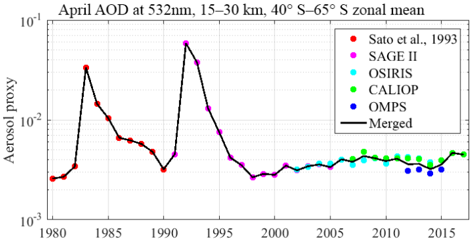
“Time series of April monthly mean AOD at 532 nm within 40–65 S and 15–30 km of normalized Sato et al. (1993) dataset (see main text) and from satellites (SAGE II, OSIRIS, CALIOP, OMPS).”
BackgroundMethodInfluentialEmergence of healing in the Antarctic ozone layer
Solomon, S., Ivy, D. J., Kinnison, D., Mills, M. J., Neely, R. R., & Schmidt, A. (2016) · Science · doi:10.1126/science.aae0061 · Cited by 734 · cited 11×
“Although pronounced decrease in total ozone is observed in September, recent publications have used ozone records obtained during this month to detect the ozone recovery (Solomon et al., 2016; Chipperfield et al., 2017; Weber et al., 2018).”
InfluentialAn objective determination of the polar vortex using Ertel's potential vorticity
Nash, E. R., Newman, P. A., Rosenfield, J. E., & Schoeberl, M. R. (1996) · Journal of Geophysical Research: Atmospheres · doi:10.1029/96jd00066 · Cited by 581 · cited 2×
“Following Nash et al. (1996), PV is evaluated as a function of EL and three particular regions are identified: inside the vortex, characterized by high PV values, at the vortex edge, corresponding to high PV gradients and outside the vortex (or surf zone) with small PV values.”
MethodThe ‘surf zone’ in the stratosphere
McIntyre, M. E., & Palmer, T. N. (1984) · Journal of Atmospheric and Terrestrial Physics · doi:10.1016/0021-9169(84)90063-1 · Cited by 457 · cited 1×
“D quasi-conservative coordinate system (equivalent latitude–potential temperature) described by McIntyre and Palmer (1984), where the pole in equivalent latitude (EL) corresponds to the position of maximum potential vorticity (PV).”
BackgroundChemistry of the 1991–1992 stratospheric winter: Three‐dimensional model simulations
(1994) · Journal of Geophysical Research: Atmospheres · doi:10.1029/93jd03476 · Cited by 320
A new formulation of equivalent effective stratospheric chlorine (EESC)
Newman, P. A., Daniel, J. S., Waugh, D. W., & Nash, E. R. (2007) · Atmospheric Chemistry and Physics · doi:10.5194/acp-7-4537-2007 · Cited by 290
Detecting recovery of the stratospheric ozone layer
Chipperfield, M. P., Bekki, S., Dhomse, S., Harris, N. R. P., Hassler, B., Hossaini, R., Steinbrecht, W., Thiéblemont, R., & Weber, M. (2017) · Nature · doi:10.1038/nature23681 · Cited by 284
Validation of the Aura Ozone Monitoring Instrument total column ozone product
McPeters, R., Kroon, M., Labow, G., Brinksma, E., Balis, D., Petropavlovskikh, I., Veefkind, J. P., Bhartia, P. K., & Levelt, P. F. (2008) · Journal of Geophysical Research: Atmospheres · doi:10.1029/2007jd008802 · Cited by 223 · cited 1×
“Total ozone column used in this work was retrieved using TV8 algorithm, hereafter referred to as OMIT in order to maintain continuity with TOMS data record (McPeters et al., 2008).”
MethodWeber, M., Coldewey-Egbers, M., Fioletov, V. E., Frith, S. M., Wild, J. D., Burrows, J. P., Long, C. S., & Loyola, D. (2018) · Atmospheric Chemistry and Physics · doi:10.5194/acp-18-2097-2018 · Cited by 211
Hauchecorne, A., Chanin, M., & Keckhut, P. (1991) · Journal of Geophysical Research: Atmospheres · doi:10.1029/91jd01213 · Cited by 200 · cited 3×
“In order to evaluate ozone recovery in Antarctica, estimation of trends before and after 2001 were calculated using a multi-regression model (Nair et al., 2013) updated from the AMOUNTS (Adaptative Model for Unambiguous Trend Survey) model (Hauchecorne et al., 1991; Kerzenmacher et al., 2006).”
MethodInfluentialSelf-citationWhen will the Antarctic ozone hole recover?
Newman, P. A., Nash, E. R., Kawa, S. R., Montzka, S. A., & Schauffler, S. M. (2006) · Geophysical Research Letters · doi:10.1029/2005gl025232 · Cited by 182 · cited 1×
“This standard value was used in different studies to evaluate the ozone depletion from the OHA (e.g. Newman et al., 2006; Solomon et al., 2016) or the OMD (e.g. de Laat and van Weele, 2011; de Laat et al., 2017) metrics.”
MethodUnusual stratospheric transport and mixing during the 2002 Antarctic winter
Allen, D. R., Bevilacqua, R. M., Nedoluha, G. E., Randall, C. E., & Manney, G. L. (2003) · Geophysical Research Letters · doi:10.1029/2003gl017117 · Cited by 165 · cited 1×
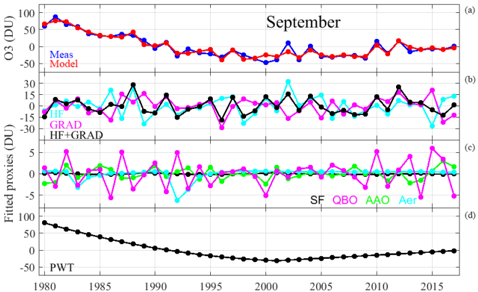
“Allen et al., 2003). Likewise, the year 2000 was characterized by a large ozone hole area (OHA) in September and yielded a relatively high value of residual of ∼ 30 DU on that year. Contributions of the different proxies are shown in the second to fourth panels of Fig. 8. Fitted HF and GRAD were added (black line in s…”
InfluentialMulti sensor reanalysis of total ozone
van der A, R. J., Allaart, M. A. F., & Eskes, H. J. (2010) · Atmospheric chemistry and physics · doi:10.5194/acp-10-11277-2010 · Cited by 154
The version 8.6 SBUV ozone data record: An overview
McPeters, R. D., Bhartia, P. K., Haffner, D., Labow, G. J., & Flynn, L. (2013) · Journal of Geophysical Research: Atmospheres · doi:10.1002/jgrd.50597 · Cited by 147
A Special Ozone Observation at Syowa Station, Antarctica from February 1982 to January 1983
Chubachi, S. (1985) · Springer eBooks · doi:10.1007/978-94-009-5313-0_58 · Cited by 144
Hauchecorne, A., Godin-Beekmann, S. M., Marchand, M., Heese, B., & Souprayen, C. (2002) · Journal of Geophysical Research Atmospheres · doi:10.1029/2001jd000491 · Cited by 141
Self-citationOn detection of turnaround and recovery in trend for ozone
Reinsel, G. C., Weatherhead, E. C., Tiao, G. C., Miller, A. J., Nagatani, R. M., Wuebbles, D. J., & Flynn, L. E. (2002) · Journal of Geophysical Research Atmospheres · doi:10.1029/2001jd000500 · Cited by 127 · cited 1×
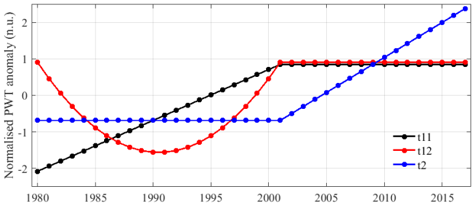
“…trends, two piece-wise linear trend (PWLT(t)= Ct1t1(t)+Ct2t2(t)) functions calculated before and after the turnaround year are usually used to estimate the change of slope in the long-term evolution of ozone due to ODSs (e.g. Reinsel et al., 2002; Kuttippurath et al., 2013; de Laat et al., 2015).”
MethodExtended and refined multi sensor reanalysis of total ozone for the period 1970–2012
van der A, R. J., Allaart, M. A. F., & Eskes, H. J. (2015) · Atmospheric Measurement Techniques · doi:10.5194/amt-8-3021-2015 · Cited by 120
Global distribution of total ozone and lower stratospheric temperature variations
Steinbrecht, W., Haßler, B., Claude, H., Winkler, P., & Stolarski, R. S. (2003) · Atmospheric chemistry and physics · doi:10.5194/acp-3-1421-2003 · Cited by 106
Khaykin, S., Godin-Beekmann, S. M., Keckhut, P. L., Hauchecorne, A., Jumelet, J., Vernier, J., Bourassa, A., Degenstein, D. A., Rieger, L., Bingen, C., et al. (2017) · Atmospheric chemistry and physics · doi:10.5194/acp-17-1829-2017 · Cited by 101
Self-citationde Laat, J., & van Weele, M. (2011) · Scientific Reports · doi:10.1038/srep00038 · Cited by 81 · cited 1×
“This standard value was used in different studies to evaluate the ozone depletion from the OHA (e.g. Newman et al., 2006; Solomon et al., 2016) or the OMD (e.g. de Laat and van Weele, 2011; de Laat et al., 2017) metrics.”
MethodFirst stage of Antarctic ozone recovery
Yang, E., Cunnold, D. M., Newchurch, M. J., Salawitch, R. J., McCormick, M. P., Russell, J. M., Zawodny, J. M., & Oltmans, S. J. (2008) · Journal of Geophysical Research Atmospheres · doi:10.1029/2007jd009675 · Cited by 78 · cited 1×
“In this work our modified PWLT model (PWT) uses an additional function in order to take into account the slower growth of ODSs near the turnaround year and the ozone loss saturation effect within the Antarctic polar vortex in October (Yang et al., 2008).”
MethodAntarctic ozone loss in 1979–2010: first sign of ozone recovery
Kuttippurath, J., Lefèvre, F., Pommereau, J.-P., Roscoe, H. K., Goutail, F., Pazmiño, A., & Shanklin, J. D. (2013) · Atmospheric Chemistry and Physics · doi:10.5194/acp-13-1625-2013 · Cited by 76 · cited 13×
“The challenge now is to assess the impact of the observed reduction in the concentration of ozone-depleting substances (ODSs) (evaluated in the polar regions to ∼ 10 % in 2013 from the peak values in 2000; WMO, 2014) on the amplitude of the ozone destruction every year.”
BackgroundMethodResultInfluentialSelf-citationLabow, G. J., McPeters, R. D., Bhartia, P. K., & Kramarova, N. A. (2013) · Journal of Geophysical Research Atmospheres · doi:10.1002/jgrd.50503 · Cited by 70
Dynamical containment of Antarctic ozone depletion
Bodeker, G. E., Struthers, H., & Connor, B. J. (2002) · Geophysical Research Letters · doi:10.1029/2001gl014206 · Cited by 66 · cited 2×
“In the case of total columns, measurements were considered inside the vortex when their corresponding EL was larger than the EL of the vortex limit at a specific isentropic level (e.g. 550 K, Bodeker et al., 2002; Pazmiño et al., 2005).”
BackgroundMethodSolomon, S., Ivy, D. J., Gupta, M., Bandoro, J., Santer, B. D., Fu, Q., Lin, P., García, R. R., Kinnison, D. E., & Mills, M. J. (2017) · Journal of Geophysical Research Atmospheres · doi:10.1002/2017jd026719 · Cited by 56 · cited 1×
“Phys., 18, 7557–7572, 2018 austral spring and summer (Solomon et al., 2017).”
Ozone trends derived from the total column and vertical profiles at a northern mid-latitude station
Nair, P. J., Godin-Beekmann, S. M., Kuttippurath, J., Ancellet, G. M., Goutail, F., Pazmiño, A., Froidevaux, L., Zawodny, J. M., Evans, R. D., Wang, H. J., et al. (2013) · Atmospheric chemistry and physics · doi:10.5194/acp-13-10373-2013 · Cited by 54 · cited 1×
“In order to evaluate ozone recovery in Antarctica, estimation of trends before and after 2001 were calculated using a multi-regression model (Nair et al., 2013) updated from the AMOUNTS (Adaptative Model for Unambiguous Trend Survey) model (Hauchecorne et al., 1991; Kerzenmacher et al., 2006).”
Self-citationChanges of the Antarctic ozone hole: Controlling mechanisms, seasonal predictability, and evolution
Salby, M. L., Titova, E. A., & Deschamps, L. (2012) · Journal of Geophysical Research: Atmospheres · doi:10.1029/2011jd016285 · Cited by 53 · cited 2×
“TOMS, OMI and MSR-2 data series have previously been used in different scientific studies of ozone recovery in the southern polar region (Salby et al., 2012; Kuttippurath et al., 2013; Solomon et al., 2016).”
BackgroundMethodPazmiño, A., Godin-Beekmann, S. M., Ginzburg, M., Bekki, S., Hauchecorne, A., Piacentini, R. D., & Quel, E. J. (2005) · Journal of Geophysical Research Atmospheres · doi:10.1029/2004jd005304 · Cited by 41
Self-citationde Laat, J., Ronald van der, A., & van Weele, M. (2015) · Atmospheric chemistry and physics · doi:10.5194/acp-15-79-2015 · Cited by 38 · cited 9×
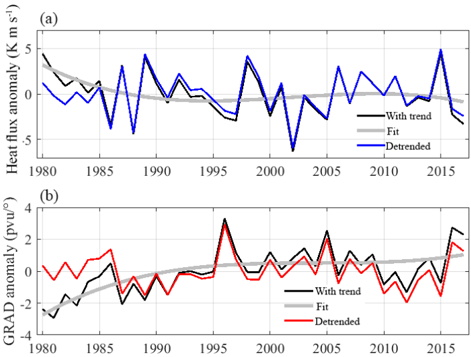
“The time window of August–September is selected for computing the mean HF, following de Laat et al. (2015) recommendation to obtain the best regression results.”
BackgroundMethodResultInfluentialGodin-Beekmann, S. M., Bergeret, V., Bekki, S., David, C., & Megie, G. J. (2001) · Journal of Geophysical Research Atmospheres · doi:10.1029/2000jd900459 · Cited by 37
Self-citationEstimation of Antarctic ozone loss from ground-based total column measurements
Kuttippurath, J., Goutail, F., Pommereau, J., Lefèvre, F., Roscoe, H. K., Pazmiño, A., Feng, W., Chipperfield, M. P., & Godin-Beekmann, S. M. (2010) · Atmospheric chemistry and physics · doi:10.5194/acp-10-6569-2010 · Cited by 36
Self-citationde Laat, J., van Weele, M., & van der A, R. J. (2017) · Journal of Geophysical Research Atmospheres · doi:10.1002/2016jd025723 · Cited by 34
Kuttippurath, J., Godin-Beekmann, S. M., Lefèvre, F., Santee, M. L., Froidevaux, L., & Hauchecorne, A. (2015) · Atmospheric chemistry and physics · doi:10.5194/acp-15-10385-2015 · Cited by 30
Self-citationMethodological uncertainties in multi-regression analyses of middle-atmospheric data series
Kerzenmacher, T. E., Keckhut, P. L., Hauchecorne, A., & Chanin, M. (2006) · Journal of Environmental Monitoring · doi:10.1039/b603750j · Cited by 23 · cited 2×
“In order to evaluate ozone recovery in Antarctica, estimation of trends before and after 2001 were calculated using a multi-regression model (Nair et al., 2013) updated from the AMOUNTS (Adaptative Model for Unambiguous Trend Survey) model (Hauchecorne et al., 1991; Kerzenmacher et al., 2006).”
MethodSelf-citationPlanetary waves in total ozone and their relation to Antarctic ozone depletion
Bodeker, G. E., & Scourfield, M. W. J. (1995) · Geophysical Research Letters · doi:10.1029/95gl01778 · Cited by 21 · cited 1×
“The total ozone columns are referenced to the 220 DU threshold value and the corresponding mass deficit of the partial column (220 DU – total ozone column) is computed at each grid point (e.g. Bodeker and Scourfield, 1995).”
MethodPazmiño, A., Godin-Beekmann, S. M., Luccini, E., Piacentini, R. D., Quel, E. J., & Hauchecorne, A. (2008) · Atmospheric chemistry and physics · doi:10.5194/acp-8-5339-2008 · Cited by 7 · cited 1×
“The Nash criterion was already used in several studies to distinguish measurements (ozone profiles and total columns) inside and outside the vortex in the Southern Hemisphere (Godin et al., 2001; Bodeker et al., 2002; Pazmiño et al., 2005, 2008; Kuttippurath et al., 2013, 2015).”
MethodSelf-citation
Cited by
Earth beyond six of nine planetary boundaries
Richardson, K., Steffen, W., Lucht, W., Bendtsen, J., Cornell, S. E., Donges, J. F., Drüke, M., Fetzer, I., Bala, G., von Bloh, W., et al. (2023) · Science Advances · doi:10.1126/sciadv.adh2458 · Cited by 3,311
Bais, A. F., Lucas, R. M., Bornman, J. F., Williamson, C. E., Sulzberger, B., Austin, A. T., Wilson, S. R., Andrady, A. L., Bernhard, G., McKenzie, R. L., et al. (2018) · Photochemical & Photobiological Sciences · doi:10.1039/c7pp90043k · Cited by 350
Ozone—climate interactions and effects on solar ultraviolet radiation
Bais, A. F., Bernhard, G., McKenzie, R. L., Aucamp, P. J., Young, P. J., Ilyas, M., Jöckel, P., & Deushi, M. (2019) · Photochemical & Photobiological Sciences · doi:10.1039/c8pp90059k · Cited by 206
Stratospheric ozone, UV radiation, and climate interactions
Bernhard, G. H., Bais, A. F., Aucamp, P. J., Klekociuk, A. R., Liley, J. B., & McKenzie, R. L. (2023) · Photochemical & Photobiological Sciences · doi:10.1007/s43630-023-00371-y · Cited by 138
Bernhard, G. H., Neale, R. E., Barnes, P. W., Neale, P. J., Zepp, R. G., Wilson, S. R., Andrady, A. L., Bais, A. F., McKenzie, R. L., Aucamp, P. J., et al. (2020) · Photochemical & Photobiological Sciences · doi:10.1039/d0pp90011g · Cited by 122
Metadata
- Authors
- Pazmiño, A., Godin-Beekmann, S., Hauchecorne, A., Claud, C., Khaykin, S., Goutail, F., Wolfram, E., Salvador, J., & Quel, E.
- Affiliations
- Centre National de la Recherche Scientifique (FR)
- National Technological University (AR)
- Corresponding author
- Godin-Beekmann, Sophie
- Hauchecorne, Alain
- Claud, Chantal
- Khaykin, Sergey
- Goutail, Florence
- Wolfram, Elian
- Salvador, Jacobo
- Quel, Eduardo
- ORCID
- Venue
- Atmospheric Chemistry and Physics
- Publisher
- Copernicus GmbH
- Published
- 2018-05-31
- Volume
- 18
- Issue
- 10
- Pages
- 7557-7572
- ISSN
- 1680-7316 (ISSN-L)
- 1680-7324
- OpenAlex
- W2771619264
- Cited by
- 64
- References
- 41
- Citations by year
- 2026: 3 · 2025: 3 · 2024: 5 · 2023: 18 · 2022: 18 · 2021: 6 · 2020: 4 · 2019: 4 · 2018: 3
- FWCI
- 2.07
- Type
- journal article
- Language
- en
- Open access
- gold
- doi.org
- Licence
- Locations
- Atmospheric chemistry and physics (publishedVersion, cc-by)
- HAL (submittedVersion, other-oa)
- HAL (submittedVersion)
- HAL (submittedVersion, cc-by)
- Americanae (AECID Library) (submittedVersion, cc-by-nc-sa)
- DOAJ (DOAJ: Directory of Open Access Journals) (submittedVersion, cc-by-sa)
- Biogeosciences (European Geosciences Union) (submittedVersion, cc-by)
- LA Referencia (Red Federada de Repositorios Institucionales de Publicaciones Científicas) (submittedVersion, cc-by-nc-sa)
- Greater South Information System
- Funders
- National Aeronautics and Space Administration
- University of Saskatchewan
- Centre National de la Recherche Scientifique
- Goddard Space Flight Center
- Institut national des sciences de l'Univers
- Topics
- Physical Sciences › Earth and Planetary Sciences › Atmospheric Science › Atmospheric Ozone and Climate
- Physical Sciences › Earth and Planetary Sciences › Space and Planetary Science › Ionosphere and magnetosphere dynamics
- Physical Sciences › Environmental Science › Global and Planetary Change › Climate variability and models
- Keywords
- Antarctic polar vortex, total ozone, ozone recovery, ozone depletion, ozone trends, potential vorticity gradient, equivalent latitude, quasi-biennial oscillation, Southern Annular Mode, ozone-depleting substances, austral spring, TOMS, OMI
About these checks
Registry, retraction, Cites and statistics results are computed, not judged, with one exception: a printed reference that no index lists is read once by a model before it counts as a citation error. Claims are extracted by a model and kept only when their quote appears verbatim in the text; each cited source is then checked, with a model’s help, for whether it says what the claim relies on. Those verdicts can be wrong — read the claim’s quote and the cited source before relying on one.
Statistics and arithmetic are recomputed, not judged.
Confidence bands are shown only for fields calibrated on our annotated test set. None is calibrated yet, so no band is shown.
What counts as a claim ›How we measure confidence ›How we check this ›
Are you an author, or do you see a problem with this page? Request a review
Data sources
Bibliographic data: Semantic Scholar, OpenAlex, Crossref.
Contains information from the Semantic Scholar Academic Graph Datasets, made available under the ODC Attribution License (ODC-BY 1.0).
Semantic Scholar’s data is described in: Kinney, R., et al. (2023). The Semantic Scholar Open Data Platform. arXiv:2301.10140.
