

What would have happened to the ozone layer if chlorofluorocarbons (CFCs) had not been regulated?
Open accessPublished version of a preprint
The DOI matches its Crossref record; 52 of the 52 references it cites were found in a registry or an index.
Abstract
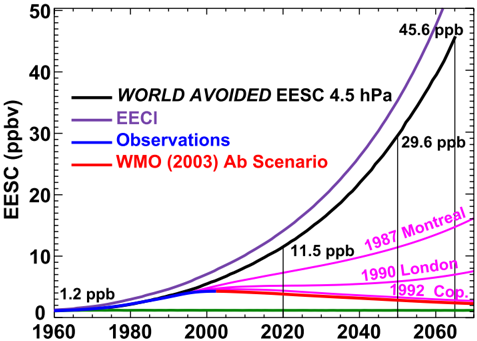
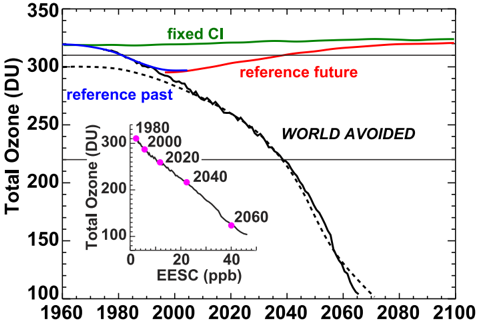
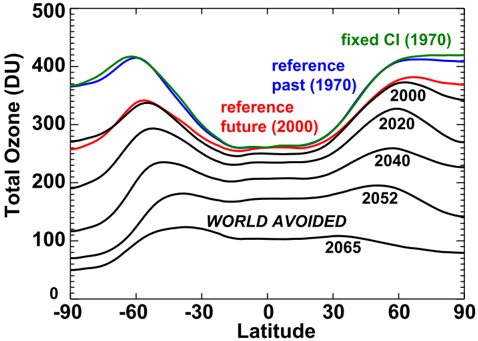
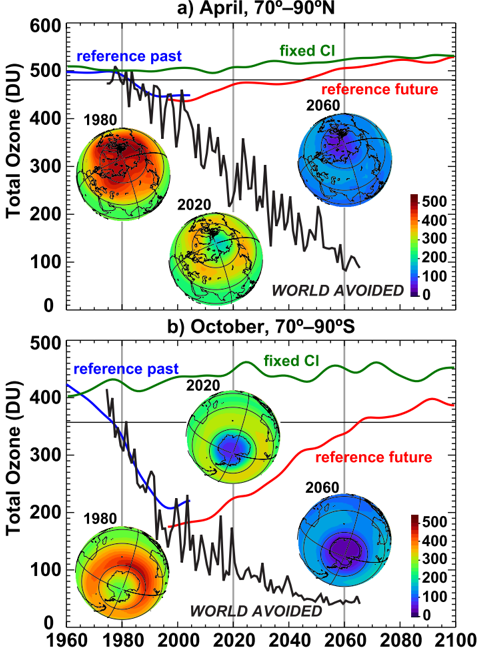
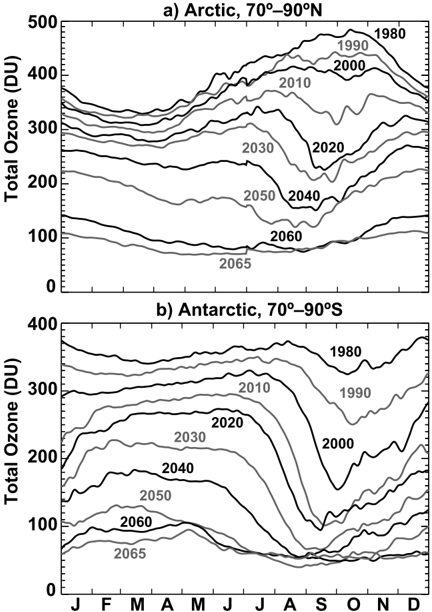
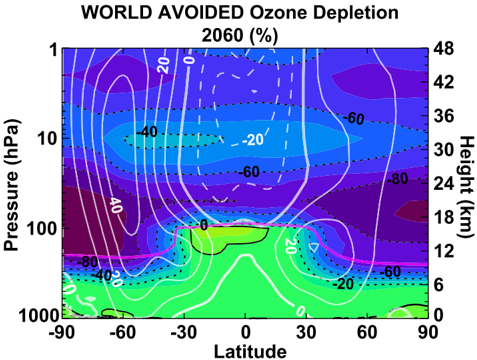
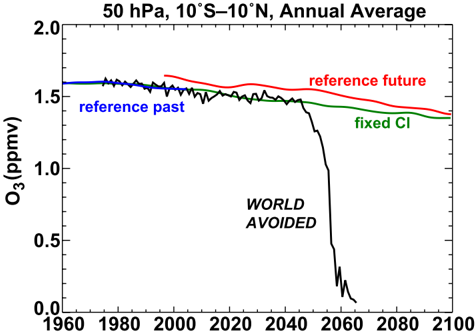
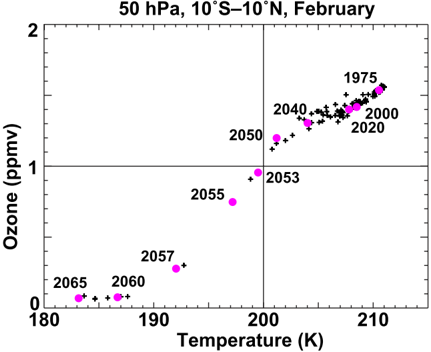
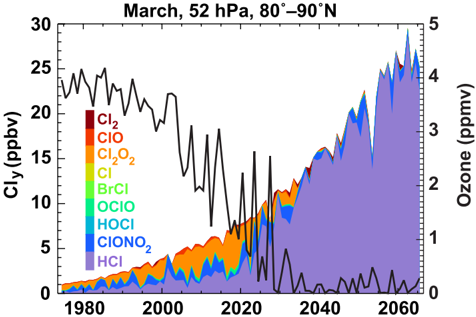
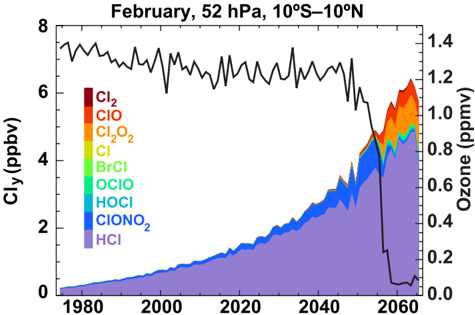
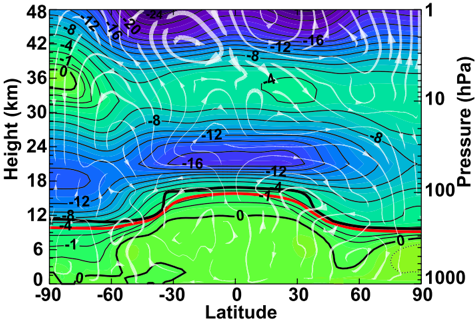
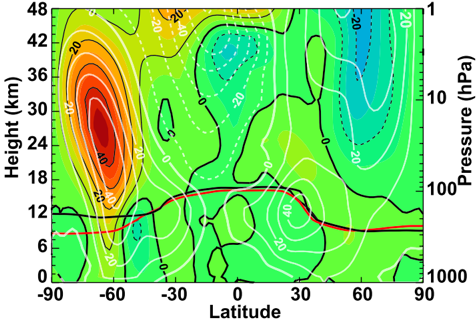
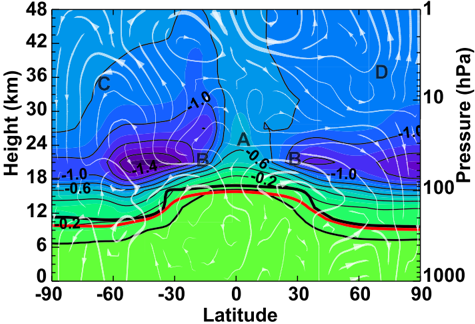
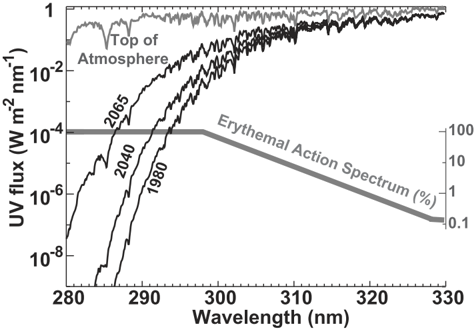
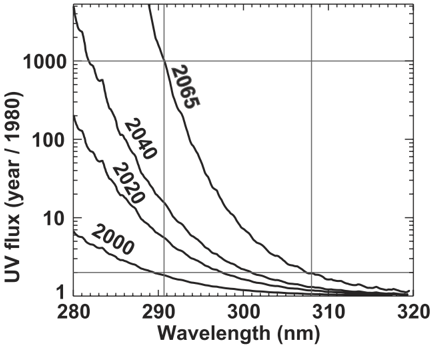
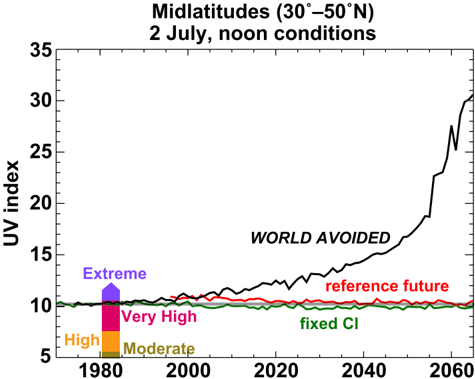
Ozone depletion by chlorofluorocarbons (CFCs) was first proposed by Molina and Rowland in their 1974 Nature paper. Since that time, the scientific connection between ozone losses and CFCs and other ozone depleting substances (ODSs) has been firmly established with laboratory measurements, atmospheric observations, and modeling studies. This science research led to the implementation of international agreements that largely stopped the production of ODSs. In this study we use a fully-coupled radiation-chemical-dynamical model to simulate a future world where ODSs were never regulated and ODS production grew at an annual rate of 3%. In this "world avoided" simulation, 17% of the globally-averaged column ozone is destroyed by 2020, and 67% is destroyed by 2065 in comparison to 1980. Large ozone depletions in the polar region become year-round rather than just seasonal as is currently observed in the Antarctic ozone hole. Very large temperature decreases are observed in response to circulation changes and decreased shortwave radiation absorption by ozone. Ozone levels in the tropical lower stratosphere remain constant until about 2053 and then collapse to near zero by 2058 as a result of heterogeneous chemical processes (as currently observed in the Antarctic ozone hole). The tropical cooling that triggers the ozone collapse is caused by an increase of the tropical upwelling. In response to ozone changes, ultraviolet radiation increases, more than doubling the erythemal radiation in the northern summer midlatitudes by 2060.
Overview
The claims and statistics of this paper haven’t been checked yet.
Free: it reads the open-access text and checks the first 5 claims that cite a source we can check. Create a free account to check every claim.
Integrity signals
Registry
Cites
Statistics
Figures
Verification
Claims the paper makes
The claims and statistics of this paper haven’t been checked yet.
Free: it reads the open-access text and checks the first 5 claims that cite a source we can check. Create a free account to check every claim.
Claims other papers make about this one
Each is checked against this paper’s own text: does it say what the citing paper says it does?
The cited source says what the claim attributes to it.
In the citing paper
“Without the Montreal Protocol (i.e., the “world avoided” scenario), emissions of ozone-depleting substances (ODS) would have continued to increase and large decreases in tropical stratospheric ozone would have occurred by the end of the twenty-first century [1, 2].”
The cited source says what the claim attributes to it.
In the citing paper
“Much larger changes would have occurred without the implementation of the Montreal Protocol (the “world avoided”), where unabated growth of emissions of CFCs would have resulted in catastrophic global loss of stratospheric O3 [24], with major impacts on UV radiation [25], incidence of skin cancer [26, 27], and reduction of the global carbon sink by damage to vegetation [28].”
From Changes in tropospheric air quality related to the protection of stratospheric ozone in a changing climate (2023) · cites this paper as [24]
Self-check
Percentages, sums and reported differences re-computed from the paper’s own numbers.
The self-check needs the paper’s full text.
Citations
Cites
Climate Change 2001: The Scientific Basis
Cooper, R. N., Houghton, J. T., McCarthy, J. J., & Metz, B. (2002) · Foreign Affairs · doi:10.2307/20033020 · Cited by 12,889
Rayner, N. A., Parker, D. E., Horton, E. B., Folland, C. K., Alexander, L. V., Rowell, D. P., Kent, E. C., & Kaplan, A. (2003) · Journal of Geophysical Research: Atmospheres · doi:10.1029/2002jd002670 · Cited by 10,991 · cited 2×
“This simulation is driven by one of the mixing ratio scenarios established in Velders et al.(2007). The ODS estimates are based upon a scenario (their MR74) wherein production of the CFC-11, CFC-12, CFC-113, CFC-114, CFC-115, carbon tetrachloride, methyl chloroform, HCFC22, HCFC-142b, halon 1301, and methyl bromide in…”
Stratospheric sink for chlorofluoromethanes: chlorine atom-catalysed destruction of ozone
Molina, M. J., & Rowland, F. S. (1974) · Nature · doi:10.1038/249810a0 · Cited by 4,332 · cited 4×
“1 Introduction Molina and Rowland (1974) were the first to propose that ozone could be depleted by the release 20 of chlorofluorocarbons (CFCs) to the atmosphere.”
InfluentialThe Community Climate System Model Version 3 (CCSM3)
Collins, W. D., Bitz, C. M., Blackmon, M. L., Bonan, G. B., Bretherton, C. S., Carton, J. A., Chang, P., Doney, S. C., Hack, J. J., Henderson, T. B., et al. (2006) · Journal of Climate · doi:10.1175/jcli3761.1 · Cited by 2,251
Chemical Kinetics and Photochemical Data for Use in Atmospheric Studies, Evaluation Number 18
Burkholder, J. B., Sander, S. P., Abbatt, J. P. D., Barker, J. R., Huie, R. E., Kolb, C. E., Kurylo, M. J., Orkin, V. L., Wilmouth, D. M., & Wine, P. H. (2015) · doi:10.13140/rg.2.1.2504.2806 · Cited by 1,928
Propagation of planetary-scale disturbances from the lower into the upper atmosphere
Charney, J. G., & Drazin, P. G. (1961) · Journal of Geophysical Research · doi:10.1029/jz066i001p00083 · Cited by 1,684
The wavelengths in sunlight effective in producing skin cancer: a theoretical analysis
Setlow, R. B. (1974) · Proceedings of the National Academy of Sciences · doi:10.1073/pnas.71.9.3363 · Cited by 1,125 · cited 1×
“In the same manner as estimating the UV index, we apply a DNA damage action spectrum to our UV spectrum calculations ( Setlow, 1974).”
The National Center for Atmospheric Research Community Climate Model: CCM3*
Kiehl, J. T., Hack, J. J., Bonan, G. B., Boville, B. A., Williamson, D. L., & Rasch, P. J. (1998) · Journal of Climate · doi:10.1175/1520-0442(1998)011<1131:tncfar>2.0.co;2 · Cited by 1,075 · cited 1×
“The model uses a flux-form semi-Lagrangian dynamical core ( Lin, 2004) and a mountain-forced gravity-wave drag scheme with a wave forcing for non-zero phase speeds ( Garcia and Boville, 1994; Kiehl et al., 1998).”
A “Vertically Lagrangian” Finite-Volume Dynamical Core for Global Models
Lin, S.-J. (2004) · Monthly Weather Review · doi:10.1175/1520-0493(2004)132<2293:avlfdc>2.0.co;2 · Cited by 1,053
Trace gas trends and their potential role in climate change
Ramanathan, V., Cicerone, R. J., Singh, H. B., & Kiehl, J. T. (1985) · Journal of Geophysical Research: Atmospheres · doi:10.1029/jd090id03p05547 · Cited by 828 · cited 2×
“I (Ramanathan et al., 1985), 3”
Research works printed but not linked: 5
- Chipperfield, M. P., Randel, W. J., (lead authors), Bodeker, G. E., Dameris, M., Fioletov, V. E., Friedl, R. R., Harris, N. R. P., Lo- gan. J. A., McPeters, R. D., Muthama, N. J., Peter, T., Shepherd, T. G., Shine, K .P., Solomon, S., Thomason, L. W., and Zawodny, J. M.: Global ozone: Past and future, Chapter 1, Scientific as- sessment of ozone depletion: 2002, Global Ozone Research and Monitoring Project, Report No. 47, Geneva, 2003.
- Daniel, J. S., Velders, G. J. M. (lead authors), Douglass, A. R., Forster, P. M. D., Hauglustaine, D. A., Isaksen, I. S. A., Kui- jpers, L. J. M., McCulloch, A., and Wallington, T. J.: Halocarbon scnarios, ozone depletion potentials, and global warming poten- tials, Chapter 8, Scientific assessment of ozone depletion: 2006, Global Ozone Research and Monitoring Project, Report No. 50, Geneva, 2007.
- Houghton, J. T., Jenkins, G. J., and Ephraums, J. J. (Eds.): Climate Change: The IPCC Scientific Assessment, Cambridge Univ. Press, Cambridge, UK, 365 pp., 1990.
- Hudson, R. D. and Reed, E. I (Eds.): The stratosphere: Present and future, NASA Ref. Pub. 1049, Washington, D.C., 432 pp., 1979.
- Montzka, S. A., Fraser, P. J., (lead authors), Butler, J. H., Connell, P. S., Cunnold, D. M., Daniel, J. S., Derwent, R. G., Lal, S., Mc- Culloch, A., Oram, D. E., Reeves, C. E., Sanhueza, E., Steele, L. P., Velders, G. J., M., Weiss, R. F., and Zander, R. J.: Con- trolled substances and other source gases, Chapter 1, Scientific assessment of ozone depletion: 2002, Global Ozone Research and Monitoring Project, Report No. 47, Geneva, 2003.
Cited by
Unprecedented Arctic ozone loss in 2011
Manney, G. L., Santee, M. L., Rex, M., Livesey, N. J., Pitts, M. C., Veefkind, P., Nash, E. R., Wohltmann, I., Lehmann, R., Froidevaux, L., et al. (2011) · Nature · doi:10.1038/nature10556 · Cited by 639
Self-citationOzone depletion and climate change: impacts on UV radiation
McKenzie, R. L., Aucamp, P. J., Bais, A. F., Björn, L. O., Ilyas, M., & Madronich, S. (2011) · Photochemical & Photobiological Sciences · doi:10.1039/c0pp90034f · Cited by 609
The MACC reanalysis: an 8 yr data set of atmospheric composition
Inness, A., Baier, F., Benedetti, A., Bouarar, I., Chabrillat, S., Clark, H., Clerbaux, C., Coheur, P., Engelen, R. J., Errera, Q., et al. (2013) · Atmospheric Chemistry and Physics · doi:10.5194/acp-13-4073-2013 · Cited by 471
Stratospheric ozone depletion due to nitrous oxide: influences of other gases
Portmann, R. W., Daniel, J. S., & Ravishankara, A. R. (2012) · Philosophical Transactions of the Royal Society B: Biological Sciences · doi:10.1098/rstb.2011.0377 · Cited by 382
Solar ultraviolet radiation in a changing climate
Williamson, C. E., Zepp, R. G., Lucas, R. M., Madronich, S., Austin, A. T., Ballaré, C. L., Norval, M., Sulzberger, B., Bais, A. F., McKenzie, R. L., et al. (2014) · Nature Climate Change · doi:10.1038/nclimate2225 · Cited by 379
“Yet the review presented here of the new knowledge and insights generated by the research response to the Montreal Protocol reveals that our understanding of the UV–ozone–climate links is far from complete.”
InfluentialOzone depletion, ultraviolet radiation, climate change and prospects for a sustainable future
Barnes, P. W., Williamson, C. E., Lucas, R. M., Robinson, S. A., Madronich, S., Paul, N. D., Bornman, J. F., Bais, A. F., Sulzberger, B., Wilson, S. R., et al. (2019) · Nature Sustainability · doi:10.1038/s41893-019-0314-2 · Cited by 360
Ozone depletion and climate change: impacts on UV radiation
Bais, A. F., McKenzie, R. L., Bernhard, G., Aucamp, P. J., Ilyas, M., Madronich, S., & Tourpali, K. (2014) · Photochemical & Photobiological Sciences · doi:10.1039/c4pp90032d · Cited by 326
Detecting recovery of the stratospheric ozone layer
Chipperfield, M. P., Bekki, S., Dhomse, S., Harris, N. R. P., Hassler, B., Hossaini, R., Steinbrecht, W., Thiéblemont, R., & Weber, M. (2017) · Nature · doi:10.1038/nature23681 · Cited by 284
Young people's burden: requirement of negative CO 2 emissions
Hansen, J., Sato, M., Kharecha, P., von Schuckmann, K., Beerling, D. J., Cao, J., Marcott, S., Masson-Delmotte, V., Prather, M. J., Rohling, E. J., et al. (2017) · Earth System Dynamics · doi:10.5194/esd-8-577-2017 · Cited by 266
Multi-model assessment of stratospheric ozone return dates and ozone recovery in CCMVal-2 models
Eyring, V., Cionni, I., Bodeker, G. E., Charlton-Perez, A. J., Kinnison, D. E., Scinocca, J. F., Waugh, D. W., Akiyoshi, H., Bekki, S., Chipperfield, M. P., et al. (2010) · Atmospheric Chemistry and Physics · doi:10.5194/acp-10-9451-2010 · Cited by 214
“Like-wise, the future ozone evolution would be different for different ODSs scenarios (see for example the extreme “world avoided” scenarios that were studied by Morgenstern et al., 2008 and Newman et al., 2009).”
BackgroundSelf-citationOzone—climate interactions and effects on solar ultraviolet radiation
Bais, A. F., Bernhard, G., McKenzie, R. L., Aucamp, P. J., Young, P. J., Ilyas, M., Jöckel, P., & Deushi, M. (2019) · Photochemical & Photobiological Sciences · doi:10.1039/c8pp90059k · Cited by 206
Global increase in UV irradiance during the past 30 years (1979–2008) estimated from satellite data
Herman, J. R. (2010) · Journal of Geophysical Research: Atmospheres · doi:10.1029/2009jd012219 · Cited by 170
Tian, H., Gao, J., Hao, J., Lu, L., Zhu, C., & Qiu, P. (2013) · Journal of Hazardous Materials · doi:10.1016/j.jhazmat.2013.02.013 · Cited by 166
Quantifying the ozone and ultraviolet benefits already achieved by the Montreal Protocol
Chipperfield, M. P., Dhomse, S. S., Feng, W., McKenzie, R. L., Velders, G. J. M., & Pyle, J. A. (2015) · Nature Communications · doi:10.1038/ncomms8233 · Cited by 150
Self-citationStratospheric ozone, UV radiation, and climate interactions
Bernhard, G. H., Bais, A. F., Aucamp, P. J., Klekociuk, A. R., Liley, J. B., & McKenzie, R. L. (2023) · Photochemical & Photobiological Sciences · doi:10.1007/s43630-023-00371-y · Cited by 138
“4b), and smaller than the “World Avoided” scenarios projected by the two CCMs (GEOSCCM12 [57] and NIWA-UKCA13 [58]), confirming that the Montreal Protocol has prevented large increases in UV radiation, in particular at southern latitudes higher than 60°.”
BackgroundLickley, M. J., Solomon, S., Fletcher, S. M., Velders, G. J. M., Daniel, J. S., Rigby, M., Montzka, S. A., Kuijpers, L. J. M., & Stone, K. A. (2020) · Nature Communications · doi:10.1038/s41467-020-15162-7 · Cited by 131
Self-citationCenturies of thermal sea-level rise due to anthropogenic emissions of short-lived greenhouse gases
Zickfeld, K., Solomon, S., & Gilford, D. M. (2017) · Proceedings of the National Academy of Sciences · doi:10.1073/pnas.1612066114 · Cited by 139
UV-B–induced forest sterility: Implications of ozone shield failure in Earth’s largest extinction
Benca, J. P., Duijnstee, I. A. P., & Looy, C. V. (2018) · Science Advances · doi:10.1126/sciadv.1700618 · Cited by 128
“Had the 1987Montreal Protocol to curb anthropogenic ozone-depleting Chlorofluorocarbons not been implemented, global stratospheric models suggest aworldwide average of 67% reduction in ozone column thickness from 1980 to 2065 (48).”
BackgroundNew Insights on the Impact of Ozone‐Depleting Substances on the Brewer‐Dobson Circulation
Abalos, M., Polvani, L., Calvo, N., Kinnison, D., Ploeger, F., Randel, W., & Solomon, S. (2019) · Journal of Geophysical Research: Atmospheres · doi:10.1029/2018jd029301 · Cited by 119
“On the other hand, some studies have examined the importance of the warming effect of ODS in terms of the future global warming that would have been expected if the Montreal Protocol had not been implemented (Garcia et al., 2012; Newman et al., 2009).”
BackgroundThe challenge to detect and attribute effects of climate change on human and natural systems
Stone, D., Auffhammer, M., Carey, M., Hansen, G., Huggel, C., Cramer, W., Lobell, D., Molau, U., Solow, A., Tibig, L., et al. (2013) · Climatic Change · doi:10.1007/s10584-013-0873-6 · Cited by 114
“The behavioural baseline can be set appropriately for any system being studied (e.g. Newman et al. 2009).”
MethodEvidence for the effectiveness of the Montreal Protocol to protect the ozone layer
Mäder, J. A., Staehelin, J., Peter, T., Brunner, D., Rieder, H. E., & Stahel, W. A. (2010) · Atmospheric Chemistry and Physics · doi:10.5194/acp-10-12161-2010 · Cited by 110
“Several other studies (e.g., Prather et al., 1996; Velders et al., 2008; Morgenstern et al., 2008; Newman et al., 2009) reported on the positive effect of the Montreal Protocol, relating the expected development to “the world avoided”, had the Montreal Protocol not been ratified.”
Background100 Years of Progress in Understanding the Stratosphere and Mesosphere
Baldwin, M., Birner, T., Brasseur, G. P., Burrows, J. P., Butchart, N., García, R. R., Geller, M. A., Gray, L. J., Hamilton, K., Harnik, N., et al. (2019) · Meteorological Monographs · doi:10.1175/amsmonographs-d-19-0003.1 · Cited by 114
Andersen, S. O., Halberstadt, M. L., & Borgford‐Parnell, N. (2013) · Journal of the Air & Waste Management Association · doi:10.1080/10962247.2013.791349 · Cited by 122
Polvani, L. M., Abalos, M., Garcia, R., Kinnison, D., & Randel, W. J. (2018) · Geophysical Research Letters · doi:10.1002/2017gl075345 · Cited by 101
A model study of the impact of source gas changes on the stratosphere for 1850–2100
Fleming, E. L., Jackman, C. H., Stolarski, R. S., & Douglass, A. R. (2011) · Atmospheric Chemistry and Physics · doi:10.5194/acp-11-8515-2011 · Cited by 93
Self-citationMcKenzie, R., Bernhard, G., Liley, B., Disterhoft, P., Rhodes, S., Bais, A., Morgenstern, O., Newman, P., Oman, L., Brogniez, C., et al. (2019) · Scientific Reports · doi:10.1038/s41598-019-48625-z · Cited by 88
Self-citationReduction in surface climate change achieved by the 1987 Montreal Protocol
Goyal, R., England, M. H., Sen Gupta, A., & Jucker, M. (2019) · Environmental Research Letters · doi:10.1088/1748-9326/ab4874 · Cited by 86
“For the No Protocol scenario, in which CFCs, HCFCs and ozone all progress as though no mitigation of ODS was ever undertaken, ozone (maroon curve in figure 1(b)) depletes further into the future in association with the assumed 3% per annum increase in ODS (Newman et al 2009).”
BackgroundMethodInfluentialThe Montreal Protocol protects the terrestrial carbon sink
Young, P. J., Harper, A., Huntingford, C., PAUL, N. D., Morgenstern, O., Newman, P. A., Oman, L. D., Madronich, S., & García, R. R. (2021) · Nature · doi:10.1038/s41586-021-03737-3 · Cited by 102
Self-citationvon Hobe, M., Bekki, S., Borrmann, S., Cairo, F., D’Amato, F., Donfrancesco, G. D., Dörnbrack, A., Ebersoldt, A., Ebert, M., Emde, C., et al. (2013) · Atmospheric chemistry and physics · doi:10.5194/acp-13-9233-2013 · Cited by 86
Robinson, S. A., & Erickson, D. J. (2015) · Global Change Biology · doi:10.1111/gcb.12739 · Cited by 78
“By 2065, two-thirds of global ozone would have been destroyed (Newman et al., 2009) and by 2100 there would be no ozone layer with severe consequences for all terrestrial and aquatic life on the planet (for details see analysis of the ‘world Correspondence: Sharon A.”
Backgroundvan Dijk, A., Slaper, H., den Outer, P. N., Morgenstern, O., Braesicke, P., Pyle, J. A., Garny, H., Stenke, A., Dameris, M., Kazantzidis, A., et al. (2013) · Photochemistry and Photobiology · doi:10.1111/j.1751-1097.2012.01223.x · Cited by 72
“Compliance scenario (related to the No Depletion scenario) of +[25–147] cases per million per year for Western Europe in the peak year.”
BackgroundGlobal increase of ozone-depleting chlorofluorocarbons from 2010 to 2020
Western, L. M., Vollmer, M. K., Krummel, P. B., Adcock, K. E., Crotwell, M., Fraser, P. J., Harth, C. M., Langenfelds, R. L., Montzka, S. A., Mühle, J., et al. (2023) · Nature Geoscience · doi:10.1038/s41561-023-01147-w · Cited by 90
Stratospheric Ozone destruction by the Bronze-Age Minoan eruption (Santorini Volcano, Greece)
Cadoux, A., Scaillet, B., Bekki, S., Oppenheimer, C., & Druitt, T. H. (2015) · Scientific Reports · doi:10.1038/srep12243 · Cited by 71
Madronich, S., Sulzberger, B., Longstreth, J. D., Schikowski, T., Andersen, M. P. S., Solomon, K. R., & Wilson, S. R. (2023) · Photochemical & Photobiological Sciences · doi:10.1007/s43630-023-00369-6 · Cited by 64
“Much larger changes would have occurred without the implementation of the Montreal Protocol (the “world avoided”), where unabated growth of emissions of CFCs would have resulted in catastrophic global loss of stratospheric O3 [24], with major impacts on UV radiation [25], incidence of skin cancer [26, 27], and reducti…”
BackgroundInness, A., Flemming, J., Heue, K.-P., Lerot, C., Loyola, D., Ribas, R., Valks, P., Roozendaël, M. V., Xu, J., & Zimmer, W. M. X. (2019) · Atmospheric chemistry and physics · doi:10.5194/acp-19-3939-2019 · Cited by 66
“Anthropogenic chlorofluorocarbons led to a global decrease in the ozone total column, with potentially catastrophic consequences avoided thanks to the Montreal Protocol (Newman et al., 2009).”
Backgrounddi Filippo, R., Bursi, O. S., & Maggio, R. D. (2022) · Energy and Buildings · doi:10.1016/j.enbuild.2022.112385 · Cited by 67
“Background and motivation Due to their capacity to deplete the ozone layer, chlorofluorocarbons (CFCs) were gradually phased out between 1995 and 2010 in accordance with the Montreal Protocol of 1989 [1; 2].”
BackgroundUV impacts avoided by the Montreal Protocol
Newman, P. A., & McKenzie, R. (2011) · Photochemical & Photobiological Sciences · doi:10.1039/c0pp00387e · Cited by 68
Self-citationEvidence of a possible turning point in solar UV-B over Canada, Europe and Japan
Zerefos, C. S., Tourpali, K., Eleftheratos, K., Kazadzis, S., Meleti, C., Feister, U., Koskela, T., & Heikkilä, A. (2012) · Atmospheric Chemistry and Physics · doi:10.5194/acp-12-2469-2012 · Cited by 57
Impact of future nitrous oxide and carbon dioxide emissions on the stratospheric ozone layer
Stolarski, R. S., Douglass, A. R., Oman, L. D., & Waugh, D. W. (2015) · Environmental Research Letters · doi:10.1088/1748-9326/10/3/034011 · Cited by 63
“GSFC2D also produced results consistent with the GEOSCCM in ‘ world avoided ’ simulations with unabated increases in anthropogenic chlorocarbons and bromocarbons (Newman et al 2009) demonstrating that the responses of both models to large perturbations are consistent.”
Self-citationAttribution of historical ozone forcing to anthropogenic emissions
Shindell, D. T., Faluvegi, G., Nazarenko, L., Bowman, K. W., Lamarque, J., Voulgarakis, A., Schmidt, G. A., Pechony, O. B., & Ruedy, R. A. (2013) · Nature Climate Change · doi:10.1038/nclimate1835 · Cited by 52
Climate change and health with an emphasis on interactions with ultraviolet radiation: a review
Thomas, P., Swaminathan, A., & Lucas, R. M. (2012) · Global Change Biology · doi:10.1111/j.1365-2486.2012.02706.x · Cited by 50
“Estimates of the ‘world avoided’ (Newman et al., 2009) remind us of the potential risks of inaction.”
BackgroundImpact of external forces on cyanophage–host interactions in aquatic ecosystems
Jassim, S. A. A., & Limoges, R. G. (2013) · World Journal of Microbiology and Biotechnology · doi:10.1007/s11274-013-1358-5 · Cited by 55
“The southern hemisphere tends to have more SUR exposure because of the ozone hole, so significant increases in UV-B can be expected at the surface over Antarctica during the summer (Newman et al. 2009; McKenzie et al. 2011).”
BackgroundInfluential“World avoided” simulations with the Whole Atmosphere Community Climate Model
Garcia, R. R., Kinnison, D. E., & Marsh, D. R. (2012) · Journal of Geophysical Research: Atmospheres · doi:10.1029/2012jd018430 · Cited by 49
Limitations of single-basket trading: lessons from the Montreal Protocol for climate policy
Daniel, J. S., Solomon, S., Sanford, T. J., McFarland, M., Fuglestvedt, J. S., & Friedlingstein, P. (2011) · Climatic Change · doi:10.1007/s10584-011-0136-3 · Cited by 47
Persistent extreme ultraviolet irradiance in Antarctica despite the ozone recovery onset
Cordero, R. R., Feron, S., Damiani, A., Redondas, A., Carrasco, J., Sepúlveda, E., Jorquera, J., Fernandoy, F., Llanillo, P., Rowe, P. M., et al. (2022) · Scientific Reports · doi:10.1038/s41598-022-05449-8 · Cited by 47
United Nations Environment Programme, E. E. A. P. (2010) · Photochemical & Photobiological Sciences · doi:10.1039/b923342n · Cited by 55
An Arctic ozone hole in 2020 if not for the Montreal Protocol
Wilka, C., Solomon, S., Kinnison, D. E., & Tarasick, D. W. (2021) · Atmospheric chemistry and physics · doi:10.5194/acp-21-15771-2021 · Cited by 46
Impact of a possible future global hydrogen economy on Arctic stratospheric ozone loss
Vogel, B., Feck, T., Grooß, J., & Riese, M. (2012) · Energy & Environmental Science · doi:10.1039/c2ee03181g · Cited by 50
Montreal Protocol Benefits simulated with CCM SOCOL
Egorova, T., Rozanov, E., Gröbner, J., Hauser, M., & Schmutz, W. (2013) · Atmospheric Chemistry and Physics · doi:10.5194/acp-13-3811-2013 · Cited by 44
Malderen, R. V., Allaart, M., Backer, H. D., Smit, H. G. J., & Muer, D. D. (2016) · Atmospheric measurement techniques · doi:10.5194/amt-9-3793-2016 · Cited by 43
Estimating uncertainties in the SBUV Version 8.6 merged profile ozone data set
Frith, S. M., Stolarski, R. S., Kramarova, N. A., & McPeters, R. D. (2017) · Atmospheric chemistry and physics · doi:10.5194/acp-17-14695-2017 · Cited by 40
Self-citationJoint inference of CFC lifetimes and banks suggests previously unidentified emissions
Lickley, M. J., Fletcher, S. M., Rigby, M., & Solomon, S. (2021) · Nature Communications · doi:10.1038/s41467-021-23229-2 · Cited by 40
“(1)–(3) is for the period 1960–2010 ðNyrs 1⁄4 51Þ, and the posterior is conditioned on observations which are available for 1980–2010, hence NObs = 31.”
BackgroundThe Importance of the Montreal Protocol in Protecting Earth’s Hydroclimate
Wu, Y., Polvani, L. M., & Seager, R. (2013) · Journal of Climate · doi:10.1175/jcli-d-12-00675.1 · Cited by 39
Ji, Y., Wang, H. H., Gao, Y., Li, G., & An, T. (2013) · Atmospheric chemistry and physics · doi:10.5194/acp-13-11277-2013 · Cited by 42
The Antarctic ozone hole: An update
Douglass, A. R., Newman, P. A., & Solomon, S. (2014) · Physics Today · doi:10.1063/pt.3.2449 · Cited by 38
Self-citationStratospheric ozone measurements at Arosa (Switzerland): history and scientific relevance
Staehelin, J., Viatte, P., Stübi, R., Tummon, F., & Peter, T. (2018) · Atmospheric chemistry and physics · doi:10.5194/acp-18-6567-2018 · Cited by 44
Biodiversity Conservation and the Earth System: Mind the Gap
Norris, K., Terry, A. C., Hansford, J. P., & Turvey, S. T. (2020) · Trends in Ecology & Evolution · doi:10.1016/j.tree.2020.06.010 · Cited by 41
“Without this treaty, the ozone layer is predicted to have collapsed by the mid-21st century [54], with hugely serious implications for human health.”
BackgroundTrends of UV Radiation in Antarctica
Bernhard, G., & Stierle, S. (2020) · Atmosphere · doi:10.3390/atmos11080795 · Cited by 37
“For example, modeling studies have projected that 67% of the globally averaged ozone column would have been destroyed without the MP by 2065 in comparison to 1980 [12].”
BackgroundAntón, M., Koukouli, M.-E., Kroon, M., McPeters, R. D., Labow, G. J., Balis, D., & Serrano, A. (2010) · Journal of Geophysical Research Atmospheres · doi:10.1029/2010jd014178 · Cited by 37
The discovery of the Antarctic ozone hole
Solomon, S. (2019) · Nature · doi:10.1038/d41586-019-02837-5 · Cited by 36
Climate Change and Atmospheric Chemistry: How Will the Stratospheric Ozone Layer Develop?
Dameris, M. (2010) · Angewandte Chemie International Edition · doi:10.1002/anie.201001643 · Cited by 38
Invention and Innovation: A Brief History of Hype and Failure
Smil, V. (2023) · The MIT Press eBooks · doi:10.7551/mitpress/15070.001.0001 · Cited by 43
Carlon, N. R., Papanastasiou, D. K., Fleming, E. L., Jackman, C. H., Newman, P. A., & Burkholder, J. B. (2010) · Atmospheric chemistry and physics · doi:10.5194/acp-10-6137-2010 · Cited by 41
Self-citationExceptional loss in ozone in the Arctic winter/spring of 2019/2020
Kuttippurath, J., Feng, W., Muller, R. H., Kumar, P., Raj, S., Gopikrishnan, G. P., & Roy, R. (2021) · Atmospheric chemistry and physics · doi:10.5194/acp-21-14019-2021 · Cited by 32
“Therefore, high chlorine activation and significant ozone loss are limited to winters with very low temperatures in December–February (Tilmes et al., 2008; Goutail et al., 2005; WMO, 2018; Newman et al., 2009; Kuttippurath et al., 2012).”
BackgroundArchibald, A. T., Folberth, G., Wade, D. C., & Scott, D. (2017) · Faraday Discussions · doi:10.1039/c7fd00004a · Cited by 31
Montreal Protocol's impact on the ozone layer and climate
Egorova, T., Sedlacek, J., Sukhodolov, T., Karagodin-Doyennel, A., Zilker, F., & Rozanov, E. (2023) · Atmospheric Chemistry and Physics · doi:10.5194/acp-23-5135-2023 · Cited by 29
Neale, P. J., Hylander, S., Banaszak, A. T., Häder, D.-P., Rose, K. C., Vione, D., Wängberg, S.-Å., Jansen, M. A. K., Busquets, R., Andersen, M. P. S., et al. (2025) · Photochemical & Photobiological Sciences · doi:10.1007/s43630-025-00687-x · Cited by 32
“Without the Montreal Protocol (i.e., the “world avoided” scenario), emissions of ozone-depleting substances (ODS) would have continued to increase and large decreases in tropical stratospheric ozone would have occurred by the end of the twenty-first century [1, 2].”
Antarctic ozone hole as observed by IASI/MetOp for 2008–2010
Scannell, C., Hurtmans, D. R., Boynard, A., Hadji‐Lazaro, J., George, M., Delcloo, A., Tuinder, O. N. E., Coheur, P., & Clerbaux, C. (2012) · Atmospheric measurement techniques · doi:10.5194/amt-5-123-2012 · Cited by 31
Lamy, K., Portafaix, T., Brogniez, C., Godin-Beekmann, S. M., Benchérif, H., Morel, B., Pazmiño, A., Metzger, J. M., Auriol, F., Deroo, C., et al. (2018) · Atmospheric chemistry and physics · doi:10.5194/acp-18-227-2018 · Cited by 30
An Insight to Atmospheric Pollution- Improper Waste Management and Climate Change Nexus
Sharma, B., Vaish, B., Srivastava, V., Singh, S., Singh, P., & Singh, R. P. (2017) · Springer eBooks · doi:10.1007/978-3-319-64501-8_2 · Cited by 31
Variability of the Antarctic Ozone Anomaly in 2011–2018
Vargin, P. N., Никифорова, М. П., & Zvyagintsev, A. M. (2020) · Russian Meteorology and Hydrology · doi:10.3103/s1068373920020016 · Cited by 27
Iodine chemistry in the chemistry–climate model SOCOL-AERv2-I
Karagodin‐Doyennel, A., Rozanov, E., Sukhodolov, T., Egorova, T. A., Saiz‐Lopez, A., Cuevas, C. A., Fernández, R. P., Sherwen, T., Volkamer, R., Koenig, T. K., et al. (2021) · Geoscientific model development · doi:10.5194/gmd-14-6623-2021 · Cited by 28
Options to accelerate ozone recovery: ozone and climate benefits
Daniel, J. S., Fleming, E. L., Portmann, R. W., Velders, G. J. M., Jackman, C. H., & Ravishankara, A. R. (2010) · Atmospheric chemistry and physics · doi:10.5194/acp-10-7697-2010 · Cited by 26
“It has 235 been estimated that in the absence of the Montreal Protocol and assuming continued 236 growth of ODSs, globally-average total ozone depletion could have reached 17% by 2020 237 and 67% by 2065 when compared to 1980 levels (Newman et al., 2009).”
BackgroundMethodSelf-citationIndicators of Antarctic ozone depletion: 1979 to 2019
Bodeker, G. E., & Kremser, S. (2021) · Atmospheric chemistry and physics · doi:10.5194/acp-21-5289-2021 · Cited by 29
Implications of a growing spaceflight industry: Climate change
Ross, M. N., & Jones, K. L. (2022) · Journal of Space Safety Engineering · doi:10.1016/j.jsse.2022.04.004 · Cited by 43
A decrease in radiative forcing and equivalent effective chlorine from hydrochlorofluorocarbons
Western, L. M., Daniel, J. S., Vollmer, M. K., Clingan, S., Crotwell, M., Fraser, P. J., Ganesan, A. L., Hall, B. D., Harth, C. M., Krummel, P. B., et al. (2024) · Nature Climate Change · doi:10.1038/s41558-024-02038-7 · Cited by 25
“While the Montreal Protocol was introduced to safeguard strato-spheric ozone through the phaseout of consumption and production of long-lived CFCs, which have high global warming potentials, it has also avoided substantial global warming 4,5 .”
Risks to the stratospheric ozone shield in the Anthropocene
Solomon, S. (2020) · AMBIO · doi:10.1007/s13280-020-01431-8 · Cited by 24
Gazeaux, J., Clerbaux, C., George, M., Hadji‐Lazaro, J., Kuttippurath, J., Coheur, P., Hurtmans, D. R., Deshler, T., Kovilakam, M., Campbell, P., et al. (2013) · Atmospheric measurement techniques · doi:10.5194/amt-6-613-2013 · Cited by 24
Torres-Sánchez, R., Sánchez-Rodas, D., de la Campa, A. M. S., & de la Rosa, J. D. (2020) · The Science of The Total Environment · doi:10.1016/j.scitotenv.2020.136891 · Cited by 24
Atmospheric science: Fixing the sky
Schiermeier, Q. (2009) · Nature · doi:10.1038/460792a · Cited by 24
Quintana-Belmares, R. O., Serrano-Lomelin, J. A., Gómez, V., de Foy, B., Miranda, J., García-Cuellar, C. M., Vega, E., Vázquez‐López, I., Molina, L. T., Manzano‐León, N., et al. (2011) · Environmental Pollution · doi:10.1016/j.envpol.2011.08.022 · Cited by 22
Antarctic ozone hole modifies iodine geochemistry on the Antarctic Plateau
Spolaor, A., Burgay, F., Fernández, R. P., Turetta, C., Cuevas, C. A., Kim, K., Kinnison, D. E., Lamarque, J., Blasi, F. D., Barbaro, E., et al. (2021) · Nature Communications · doi:10.1038/s41467-021-26109-x · Cited by 25
Carlon, N. R., Papanastasiou, D. K., Fleming, E. L., Jackman, C. H., Newman, P. A., & Burkholder, J. B. (2013) · Cited by 21
Self-citationJacobs, J. R. (2013) · Environmental Science & Policy · doi:10.1016/j.envsci.2013.09.007 · Cited by 29
The Importance of the Montreal Protocol in Mitigating the Potential Intensity of Tropical Cyclones
Polvani, L. M., Camargo, S. J., & García, R. R. (2016) · Journal of Climate · doi:10.1175/jcli-d-15-0232.1 · Cited by 23
“…understanding how the intensity of tropical cyclones might change in a warming climate is a matter of great scientific interest [see Knutson et al. (2010) for a recent review], especially in view of the major societal impacts of these powerful storms (Mendelsohn et al. 2012; Peduzzi et al. 2012).”
BackgroundOzone content over the Russian Federation in 2008
Zvyagintsev, A. M., Ivanova, N. S., Kruchenitskii, G. M., Kuznetsova, I. N., Лезина, Е. А., & Romanyuk, Y. O. (2009) · Russian Meteorology and Hydrology · doi:10.3103/s1068373909030078 · Cited by 20
“The development of the SAOA over the last decade as well as the TO change at temperate and high latitudes of the Northern Hemisphere are indicative of a gradual recovery of the global ozone layer; however, its recovery to the 1970s level, at such rates, cannot be expected before 2050 [ 8 ].”
BackgroundJanakiraman, S., Watson, S. L., Watson, W. R., & Shepardson, D. P. (2021) · Journal of Education for Sustainable Development · doi:10.1177/0973408221997844 · Cited by 23
Envisioning a sustainable future for space launches: a review of current research and policy
Brown, T. F. M., Bannister, M. T., & Revell, L. E. (2023) · Journal of the Royal Society of New Zealand · doi:10.1080/03036758.2022.2152467 · Cited by 34
“In contrast, if the Montreal Protocol had not been implemented, it is estimated that two-thirds of the ozone layer would have been destroyed by 2065 (Newman et al. 2009).”
MethodXia, Y., Hu, Y., Huang, Y., Bian, J., & Zhao, C. (2021) · Environmental Research Letters · doi:10.1088/1748-9326/ac18e9 · Cited by 24
Lickley, M. J., Daniel, J. S., Fleming, E. L., Reimann, S., & Solomon, S. (2022) · Atmospheric chemistry and physics · doi:10.5194/acp-22-11125-2022 · Cited by 17
“The Montreal Protocol regulates the production of ozonedepleting substances (ODS), and its implementation has avoided a world with catastrophic stratospheric ozone depletion (Newman et al., 2009).”
BackgroundSelf-citationLessons from the stratospheric ozone layer protection for climate
Andersen, S. O. (2015) · Journal of Environmental Studies and Sciences · doi:10.1007/s13412-014-0213-9 · Cited by 18
“In midlatitudes like New York City, ozone depletion would have caused sunburn in just 5 min (Newman et al. 2009).”
BackgroundStratospheric Ozone Depletion and Recovery
Wilmouth, D. M., Salawitch, R. J., & Canty, T. P. (2017) · Elsevier eBooks · doi:10.1016/b978-0-12-809270-5.00008-x · Cited by 22
Paul Jozef Crutzen. 3 December 1933—28 January 2021
Muller, R. H. (2022) · Biographical Memoirs of Fellows of the Royal Society · doi:10.1098/rsbm.2022.0011 · Cited by 16
“In response to such ozone changes, ultraviolet radiation at the ground also increases substantially (Newman et al. 2009).”
BackgroundEnhanced electrocaloric strength of P(VDF-TrFE-CFE) induced by edge-on lamellae
Qian, J., Guo, M., Jiang, J., Dan, Z., & Shen, Y. (2019) · Journal of Materials Chemistry C · doi:10.1039/c9tc00239a · Cited by 16
Numerical Modeling of Ozone Loss in the Exceptional Arctic Stratosphere Winter–Spring of 2020
Smyshlyaev, S. P., Vargin, P. N., & Motsakov, M. A. (2021) · Atmosphere · doi:10.3390/atmos12111470 · Cited by 16
Maracchini, G., di Filippo, R., Albatici, R., Bursi, O. S., & Maggio, R. D. (2023) · Energies · doi:10.3390/en16073276 · Cited by 17
The role and performance of ground-based networks in tracking the evolution of the ozone layer
Staehelin, J., Petropavlovskikh, I. V., Maziere, M. M. D., & Godin-Beekmann, S. M. (2018) · Comptes Rendus Géoscience · doi:10.1016/j.crte.2018.08.007 · Cited by 17
Long-term trends of total ozone column over the Iberian Peninsula for the period 1979–2008
Antón, M., Bortoli, D., Kulkarni, P. S., Costa, M. J., Domingues, A. F., Loyola, D., Silva, A. M., & Alados‐Arboledas, L. (2011) · Atmospheric Environment · doi:10.1016/j.atmosenv.2011.08.058 · Cited by 14
Virgin, J. G., & Smith, K. L. (2019) · Geophysical Research Letters · doi:10.1029/2019gl082320 · Cited by 15
“The WAVD climate scenario was initially employed by Newman et al. (2009) using the Goddard Earth Observing System Chemistry Climate Model, with prescribed sea surface temperatures (SSTs), in order to quantify what would have happened to Earth's climate if the Montreal Protocol had not been ratified.”
MethodTheoretical Study of the Reaction Mechanism and Kinetics of HO2 with XCHO (X = F, Cl)
Long, B., Tan, X., Bao, J. L., Wang, D., & Long, Z. (2016) · International Journal of Chemical Kinetics · doi:10.1002/kin.21062 · Cited by 14
Metadata
- Authors
- Newman, P. A., Oman, L. D., Douglass, A. R., Fleming, E. L., Frith, S. M., Hurwitz, M. M., Kawa, S. R., Jackman, C. H., Krotkov, N. A., Nash, E. R., Nielsen, J. E., Pawson, S., Stolarski, R. S., & Velders, G. J. M.
- Affiliations
- Goddard Space Flight Center (US)
- Johns Hopkins University (US)
- Science Systems and Applications (United States) (US)
- University of Maryland, Baltimore County (US)
- Netherlands Environmental Assessment Agency (NL)
- ORCID
- Venue
- Atmospheric Chemistry and Physics
- Publisher
- Copernicus GmbH
- Published
- 2009-03-23
- Volume
- 9
- Issue
- 6
- Pages
- 2113-2128
- ISSN
- 1680-7316 (ISSN-L)
- 1680-7324
- OpenAlex
- W2150537043
- Cited by
- 220
- References
- 52
- Citations by year
- 2026: 9 · 2025: 7 · 2024: 13 · 2023: 22 · 2022: 18 · 2021: 30 · 2020: 7 · 2019: 14 · 2018: 7 · 2017: 14 · 2016: 4 · 2015: 7 · 2014: 12 · 2013: 18 · 2012: 12
- FWCI
- 7.84
- Type
- journal article
- Language
- en
- Open access
- gold
- doi.org
- Licence
- Locations
- Atmospheric chemistry and physics (publishedVersion, cc-by)
- NASA STI Repository (National Aeronautics and Space Administration) (submittedVersion)
- DOAJ (DOAJ: Directory of Open Access Journals) (submittedVersion)
- Funders
- National Aeronautics and Space Administration
- Topics
- Physical Sciences › Earth and Planetary Sciences › Atmospheric Science › Atmospheric Ozone and Climate
- Physical Sciences › Earth and Planetary Sciences › Atmospheric Science › Atmospheric chemistry and aerosols
- Physical Sciences › Environmental Science › Global and Planetary Change › Climate variability and models
- Keywords
- ozone depletion, chlorofluorocarbons, ozone-depleting substances, Antarctic ozone hole, polar stratospheric ozone, tropical upwelling, ultraviolet radiation
About these checks
Registry, retraction, Cites and statistics results are computed, not judged, with one exception: a printed reference that no index lists is read once by a model before it counts as a citation error. Claims are extracted by a model and kept only when their quote appears verbatim in the text; each cited source is then checked, with a model’s help, for whether it says what the claim relies on. Those verdicts can be wrong — read the claim’s quote and the cited source before relying on one.
Statistics and arithmetic are recomputed, not judged.
Confidence bands are shown only for fields calibrated on our annotated test set. None is calibrated yet, so no band is shown.
What counts as a claim ›How we measure confidence ›How we check this ›
Are you an author, or do you see a problem with this page? Request a review
Data sources
Bibliographic data: Semantic Scholar, OpenAlex, Crossref.
Contains information from the Semantic Scholar Academic Graph Datasets, made available under the ODC Attribution License (ODC-BY 1.0).
Semantic Scholar’s data is described in: Kinney, R., et al. (2023). The Semantic Scholar Open Data Platform. arXiv:2301.10140.
