

What would have happened to the ozone layer if chlorofluorocarbons (CFCs) had not been regulated?
Open accessPublished version of a preprint
The DOI matches its Crossref record; 52 of the 52 references it cites were found in a registry or an index.
Abstract
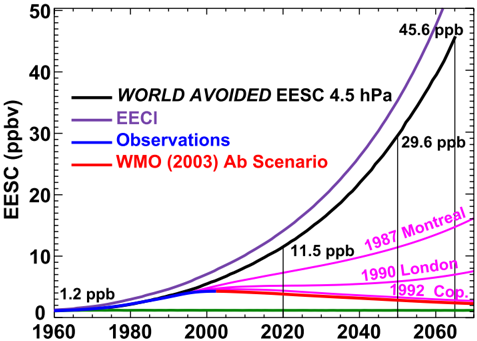
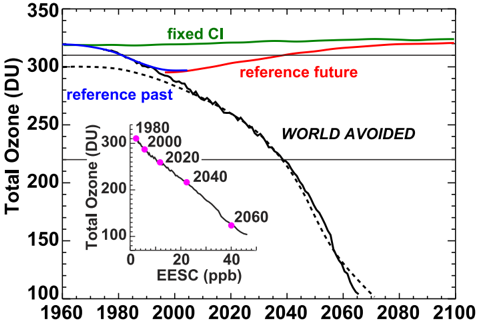
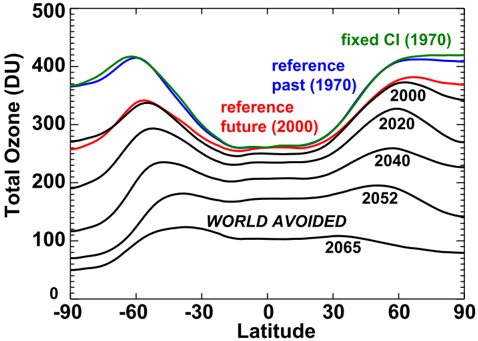
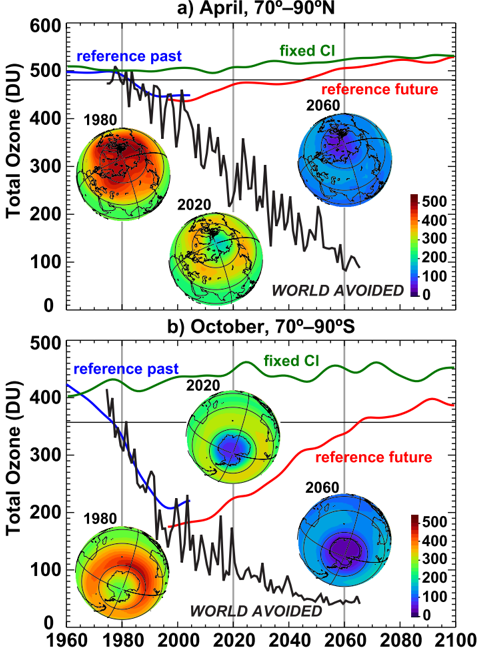
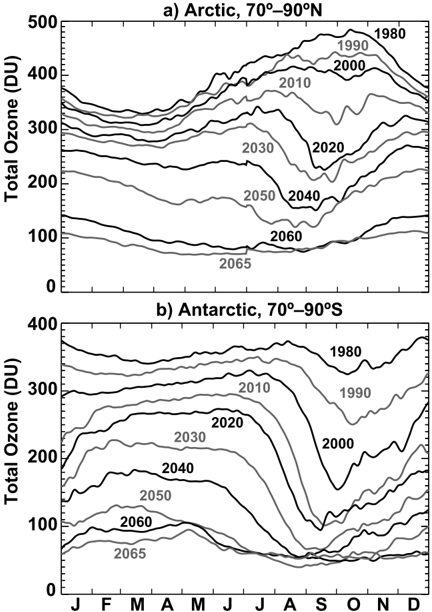
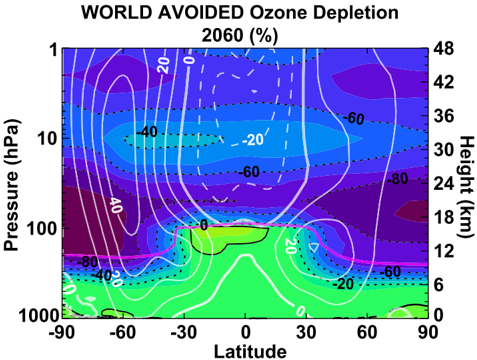
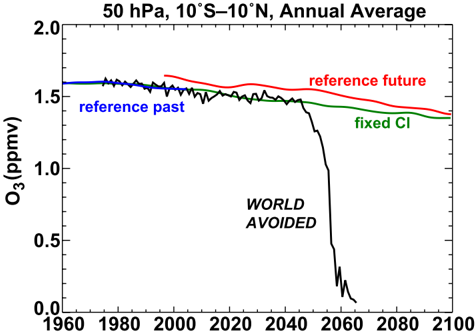
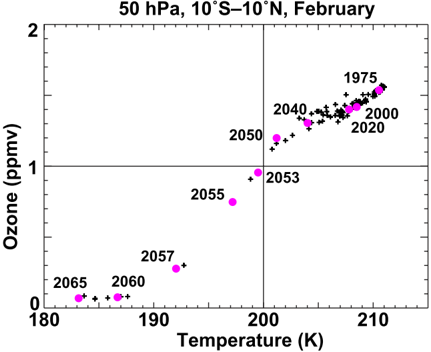
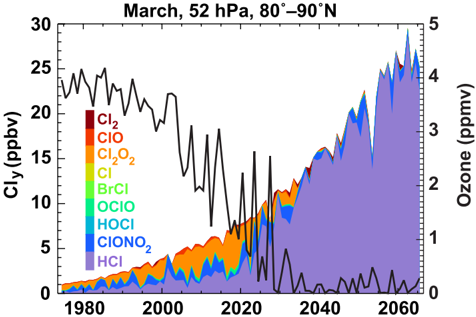
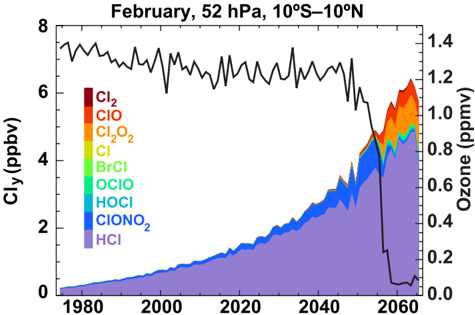
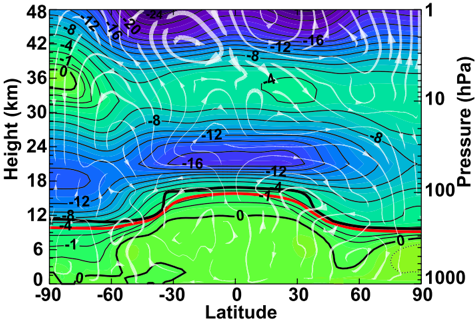
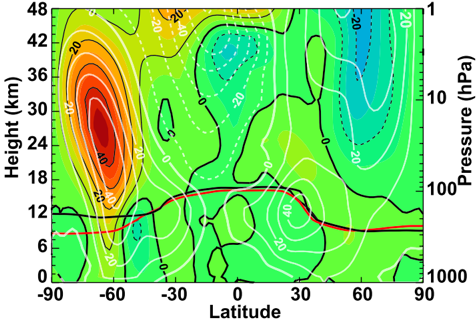
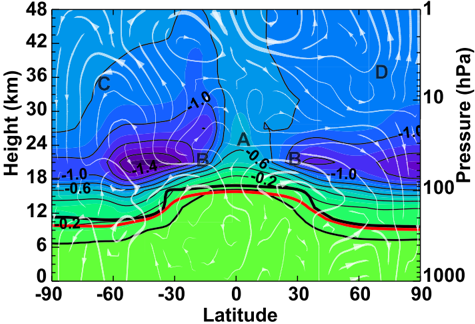
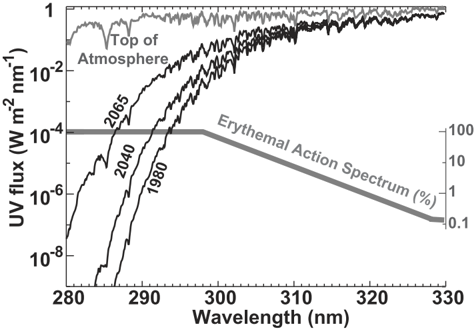
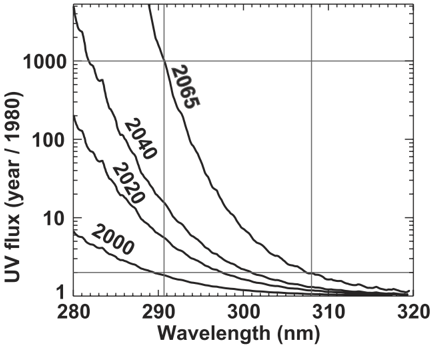
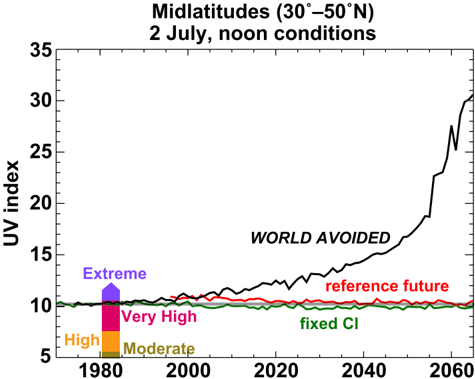
Ozone depletion by chlorofluorocarbons (CFCs) was first proposed by Molina and Rowland in their 1974 Nature paper. Since that time, the scientific connection between ozone losses and CFCs and other ozone depleting substances (ODSs) has been firmly established with laboratory measurements, atmospheric observations, and modeling studies. This science research led to the implementation of international agreements that largely stopped the production of ODSs. In this study we use a fully-coupled radiation-chemical-dynamical model to simulate a future world where ODSs were never regulated and ODS production grew at an annual rate of 3%. In this "world avoided" simulation, 17% of the globally-averaged column ozone is destroyed by 2020, and 67% is destroyed by 2065 in comparison to 1980. Large ozone depletions in the polar region become year-round rather than just seasonal as is currently observed in the Antarctic ozone hole. Very large temperature decreases are observed in response to circulation changes and decreased shortwave radiation absorption by ozone. Ozone levels in the tropical lower stratosphere remain constant until about 2053 and then collapse to near zero by 2058 as a result of heterogeneous chemical processes (as currently observed in the Antarctic ozone hole). The tropical cooling that triggers the ozone collapse is caused by an increase of the tropical upwelling. In response to ozone changes, ultraviolet radiation increases, more than doubling the erythemal radiation in the northern summer midlatitudes by 2060.
Overview
The claims and statistics of this paper haven’t been checked yet.
Free: it reads the open-access text and checks the first 5 claims that cite a source we can check. Create a free account to check every claim.
Integrity signals
Registry
Cites
Statistics
Figures
Verification
Claims the paper makes
The claims and statistics of this paper haven’t been checked yet.
Free: it reads the open-access text and checks the first 5 claims that cite a source we can check. Create a free account to check every claim.
Claims other papers make about this one
Each is checked against this paper’s own text: does it say what the citing paper says it does?
The cited source says what the claim attributes to it.
In the citing paper
“Without the Montreal Protocol (i.e., the “world avoided” scenario), emissions of ozone-depleting substances (ODS) would have continued to increase and large decreases in tropical stratospheric ozone would have occurred by the end of the twenty-first century [1, 2].”
The cited source says what the claim attributes to it.
In the citing paper
“Much larger changes would have occurred without the implementation of the Montreal Protocol (the “world avoided”), where unabated growth of emissions of CFCs would have resulted in catastrophic global loss of stratospheric O3 [24], with major impacts on UV radiation [25], incidence of skin cancer [26, 27], and reduction of the global carbon sink by damage to vegetation [28].”
From Changes in tropospheric air quality related to the protection of stratospheric ozone in a changing climate (2023) · cites this paper as [24]
Self-check
Percentages, sums and reported differences re-computed from the paper’s own numbers.
The self-check needs the paper’s full text.
Citations
Cites
Climate Change 2001: The Scientific Basis
Cooper, R. N., Houghton, J. T., McCarthy, J. J., & Metz, B. (2002) · Foreign Affairs · doi:10.2307/20033020 · Cited by 12,889
Rayner, N. A., Parker, D. E., Horton, E. B., Folland, C. K., Alexander, L. V., Rowell, D. P., Kent, E. C., & Kaplan, A. (2003) · Journal of Geophysical Research: Atmospheres · doi:10.1029/2002jd002670 · Cited by 10,991 · cited 2×
“This simulation is driven by one of the mixing ratio scenarios established in Velders et al.(2007). The ODS estimates are based upon a scenario (their MR74) wherein production of the CFC-11, CFC-12, CFC-113, CFC-114, CFC-115, carbon tetrachloride, methyl chloroform, HCFC22, HCFC-142b, halon 1301, and methyl bromide in…”
Stratospheric sink for chlorofluoromethanes: chlorine atom-catalysed destruction of ozone
Molina, M. J., & Rowland, F. S. (1974) · Nature · doi:10.1038/249810a0 · Cited by 4,332 · cited 4×
“1 Introduction Molina and Rowland (1974) were the first to propose that ozone could be depleted by the release 20 of chlorofluorocarbons (CFCs) to the atmosphere.”
InfluentialThe Community Climate System Model Version 3 (CCSM3)
Collins, W. D., Bitz, C. M., Blackmon, M. L., Bonan, G. B., Bretherton, C. S., Carton, J. A., Chang, P., Doney, S. C., Hack, J. J., Henderson, T. B., et al. (2006) · Journal of Climate · doi:10.1175/jcli3761.1 · Cited by 2,251
Chemical Kinetics and Photochemical Data for Use in Atmospheric Studies, Evaluation Number 18
Burkholder, J. B., Sander, S. P., Abbatt, J. P. D., Barker, J. R., Huie, R. E., Kolb, C. E., Kurylo, M. J., Orkin, V. L., Wilmouth, D. M., & Wine, P. H. (2015) · doi:10.13140/rg.2.1.2504.2806 · Cited by 1,928
Propagation of planetary-scale disturbances from the lower into the upper atmosphere
Charney, J. G., & Drazin, P. G. (1961) · Journal of Geophysical Research · doi:10.1029/jz066i001p00083 · Cited by 1,684
The wavelengths in sunlight effective in producing skin cancer: a theoretical analysis
Setlow, R. B. (1974) · Proceedings of the National Academy of Sciences · doi:10.1073/pnas.71.9.3363 · Cited by 1,125 · cited 1×
“In the same manner as estimating the UV index, we apply a DNA damage action spectrum to our UV spectrum calculations ( Setlow, 1974).”
The National Center for Atmospheric Research Community Climate Model: CCM3*
Kiehl, J. T., Hack, J. J., Bonan, G. B., Boville, B. A., Williamson, D. L., & Rasch, P. J. (1998) · Journal of Climate · doi:10.1175/1520-0442(1998)011<1131:tncfar>2.0.co;2 · Cited by 1,075 · cited 1×
“The model uses a flux-form semi-Lagrangian dynamical core ( Lin, 2004) and a mountain-forced gravity-wave drag scheme with a wave forcing for non-zero phase speeds ( Garcia and Boville, 1994; Kiehl et al., 1998).”
A “Vertically Lagrangian” Finite-Volume Dynamical Core for Global Models
Lin, S.-J. (2004) · Monthly Weather Review · doi:10.1175/1520-0493(2004)132<2293:avlfdc>2.0.co;2 · Cited by 1,053
Trace gas trends and their potential role in climate change
Ramanathan, V., Cicerone, R. J., Singh, H. B., & Kiehl, J. T. (1985) · Journal of Geophysical Research: Atmospheres · doi:10.1029/jd090id03p05547 · Cited by 828 · cited 2×
“I (Ramanathan et al., 1985), 3”
Research works printed but not linked: 5
- Chipperfield, M. P., Randel, W. J., (lead authors), Bodeker, G. E., Dameris, M., Fioletov, V. E., Friedl, R. R., Harris, N. R. P., Lo- gan. J. A., McPeters, R. D., Muthama, N. J., Peter, T., Shepherd, T. G., Shine, K .P., Solomon, S., Thomason, L. W., and Zawodny, J. M.: Global ozone: Past and future, Chapter 1, Scientific as- sessment of ozone depletion: 2002, Global Ozone Research and Monitoring Project, Report No. 47, Geneva, 2003.
- Daniel, J. S., Velders, G. J. M. (lead authors), Douglass, A. R., Forster, P. M. D., Hauglustaine, D. A., Isaksen, I. S. A., Kui- jpers, L. J. M., McCulloch, A., and Wallington, T. J.: Halocarbon scnarios, ozone depletion potentials, and global warming poten- tials, Chapter 8, Scientific assessment of ozone depletion: 2006, Global Ozone Research and Monitoring Project, Report No. 50, Geneva, 2007.
- Houghton, J. T., Jenkins, G. J., and Ephraums, J. J. (Eds.): Climate Change: The IPCC Scientific Assessment, Cambridge Univ. Press, Cambridge, UK, 365 pp., 1990.
- Hudson, R. D. and Reed, E. I (Eds.): The stratosphere: Present and future, NASA Ref. Pub. 1049, Washington, D.C., 432 pp., 1979.
- Montzka, S. A., Fraser, P. J., (lead authors), Butler, J. H., Connell, P. S., Cunnold, D. M., Daniel, J. S., Derwent, R. G., Lal, S., Mc- Culloch, A., Oram, D. E., Reeves, C. E., Sanhueza, E., Steele, L. P., Velders, G. J., M., Weiss, R. F., and Zander, R. J.: Con- trolled substances and other source gases, Chapter 1, Scientific assessment of ozone depletion: 2002, Global Ozone Research and Monitoring Project, Report No. 47, Geneva, 2003.
Cited by
Items 101–200 of 220
Influence of Tropospheric Ozone Control on Exposure to Ultraviolet Radiation at the Surface
Madronich, S., Wagner, M., & Groth, P. (2011) · Environmental Science & Technology · doi:10.1021/es200701q · Cited by 13
Anthropic Rock: a brief history
Cathcart, R. B. (2011) · History of geo- and space sciences · doi:10.5194/hgss-2-57-2011 · Cited by 14
Karagodin‐Doyennel, A., Rozanov, E., Sukhodolov, T., Egorova, T. A., Sedláčék, J., Ball, W. T., & Peter, T. (2022) · Atmospheric chemistry and physics · doi:10.5194/acp-22-15333-2022 · Cited by 12
Possible implications of enhanced chlorofluorocarbon-11 concentrations on ozone
Dameris, M., Jöckel, P., & Nützel, M. (2019) · Atmospheric chemistry and physics · doi:10.5194/acp-19-13759-2019 · Cited by 12
“Our scenario, described in SEN-C2-fCFC11_2050, could be taken as “what should be avoided”, somewhat in the tradition of the Newman et al. (2009) paper.”
MethodPaudyal, B. R., Somasundaram, S. G., Louwen, A., Reinders, A. H. M. E., van Sark, W. G. J. H. M., Stellbogen, D., Ulbrich, C., & Imenes, A. G. (2024) · Renewable Energy · doi:10.1016/j.renene.2024.120057 · Cited by 10
Shi, C., Zhang, Z., Xiong, S., Chen, W., Zhang, W., Zhang, Q., & Wang, X. (2024) · International Journal of Applied Earth Observation and Geoinformation · doi:10.1016/j.jag.2024.103808 · Cited by 17
di Filippo, R., Maracchini, G., Colbourne, D., Maggio, R. D., & Bursi, O. S. (2025) · International Journal of Disaster Risk Reduction · doi:10.1016/j.ijdrr.2025.105453 · Cited by 11
Das, P., Pereira, J. A., Chaklader, M., Law, A., Bagchi, K., Bhaduri, G., Chaudhuri, S., & Law, S. K. A. (2012) · Biochemistry and Cell Biology · doi:10.1139/bcb-2012-0082 · Cited by 11
“Current records suggest that the amount of UV-B radiation reaching the earth's surface has increased markedly over the last 3 decades (Newman et al. 2009; Singh et al. 2012).”
BackgroundNumerical modelling of relative contribution of planetary waves to the atmospheric circulation
Koval, A. V., Toptunova, O. N., Motsakov, M. A., Didenko, K. A., Ermakova, T. S., Gavrilov, N. M., & Rozanov, E. (2023) · Atmospheric chemistry and physics · doi:10.5194/acp-23-4105-2023 · Cited by 11
Liu, Y., Wu, D., Yi, J., Xiu, C., Shao, Y., Liu, A., Chen, J., & Li, Q. X. (2023) · Journal of Geophysical Research Atmospheres · doi:10.1029/2023jd038594 · Cited by 12
“Since the detected and quantified VOC species varied with the screened literature regarding different analysis methods, some key components are not presented in several retrieved profiles, including OVOCs and XVOCs, which have important impacts on health and climate effects (Claxton et al., 2019; Newman et al., 2009;…”
BackgroundThe Montreal Protocol is delaying the occurrence of the first ice-free Arctic summer
England, M., & Polvani, L. M. (2023) · Proceedings of the National Academy of Sciences · doi:10.1073/pnas.2211432120 · Cited by 14
“While the destruction of the ozone layer and the accompanying increase in biologically harmful ultraviolet radiation have received the greatest attention in studies of the World Avoided scenario (32, 44, 45), we here highlight the role of ODSs as powerful greenhouse gases (26, 29, 36).”
BackgroundOlejnik, A., Jóźwiak, H., Gancewski, M., Sánchez, E. Q., Dawes, R., & Wcisło, P. (2023) · The Journal of Chemical Physics · doi:10.1063/5.0169968 · Cited by 12
di Filippo, R., & Maracchini, G. (2024) · Journal of Building Engineering · doi:10.1016/j.jobe.2024.110448 · Cited by 15
Anomalously low total ozone levels over the northern Urals and Siberia in late January 2016
Никифорова, М. П., Zvyagintsev, A. M., Vargin, P. N., Ivanova, N. S., Lukyanov, A., & Kuznetsova, I. N. (2017) · Atmospheric and Oceanic Optics · doi:10.1134/s1024856017030125 · Cited by 10
Stevens, J. E., Macomber, L. D., & Davis, L. W. (2010) · The Open Physical Chemistry Journal · doi:10.2174/1874067701004010017 · Cited by 10
“The use of chlorofluorocarbons (CFCs) and Halons as refrigerant or heat transfer fluids leads to their emission into the atmosphere where they contribute to stratospheric ozone depletion [1, 2].”
BackgroundThe Effect of Lifestyle on Skin Aging
Nabila, Y. A., Damayanti, D., Handayani, S., & Setyaningrum, T. (2021) · Berkala Ilmu Kesehatan Kulit dan Kelamin · doi:10.20473/bikk.v33.2.2021.110-115 · Cited by 18
Ozone Depletion and the Effects of Ultraviolet Radiation
Björn, L. O., & McKenzie, R. (2014) · Springer eBooks · doi:10.1007/978-1-4939-1468-5_22 · Cited by 9
The impact of greenhouse gases on past changes in tropospheric ozone
Lang, C., Waugh, D. W., Olsen, M. A., Douglass, A. R., Liang, Q., Nielsen, J. E., Oman, L. D., Pawson, S., & Stolarski, R. S. (2012) · Journal of Geophysical Research Atmospheres · doi:10.1029/2012jd018293 · Cited by 10
“…a range of studies on topics including the evolution of stratospheric O 3 and role of climate change [ Li et al. , 2009; Waugh et al. , 2009], the cause of stratospheric temperature trends [ Stolarski et al. , 2010], and what would have happened without regulations of CFCs [ Newman et al. , 2009].”
Self-citationHocke, K. (2023) · Oxygen · doi:10.3390/oxygen3030019 · Cited by 8
Lickley, M. J., Daniel, J. S., McBride, L. A., Salawitch, R. J., & Velders, G. J. M. (2024) · Atmospheric chemistry and physics · doi:10.5194/acp-24-13081-2024 · Cited by 8
Self-citationA review of the ozone hole from 2008 to 2010 as observed by IASI
Scannell, C., Hurtmans, D. R., Boynard, A., Hadji‐Lazaro, J., George, M., Delcloo, A., Tuinder, O. N. E., Coheur, P.-F., & Clerbaux, C. (2011) · Atmospheric Measurement Techniques Discussions · doi:10.5194717/2011/amtd-4-4717-2011 · Cited by 7
Towards the Environmental Minimum: Environmental Protection through Human Rights
Theil, S. (2021) · Cambridge University Press eBooks · doi:10.1017/9781108891769 · Cited by 14
Launch of an Innovative Air Pollutant Sampler up to 27,000 Metres Using a Stratospheric Balloon
Toson, F., Pulice, M., Furiato, M., Pavan, M., Sandon, S., Sandu, D., & Righi, G. (2023) · Aerotecnica Missili & Spazio · doi:10.1007/s42496-023-00151-y · Cited by 10
The ozone story: A model for addressing climate change?
Brune, W. H. (2015) · Bulletin of the Atomic Scientists · doi:10.1177/0096340214563685 · Cited by 7
Linkages between ozone-depleting substances, tropospheric oxidation and aerosols
Voulgarakis, A., Shindell, D. T., & Faluvegi, G. (2013) · Atmospheric chemistry and physics · doi:10.5194/acp-13-4907-2013 · Cited by 10
“Our analysis also suggests that CFCs emissions reductions resulting from the Montreal Protocol may be translating to tropospheric composition and climate changes that have not been discussed in assessments exploring the “sideeffects” of the agreement (Velders et al., 2007).”
BackgroundResultInfluentialRaiyan, M. F., Ahamed, J. U., Rahman, M. M., & Salam, M. A. (2017) · International Journal of Automotive and Mechanical Engineering · doi:10.15282/ijame.14.2.2017.2.0331 · Cited by 7
“The general cause of ozone layer depletion is that Chlorofluorocarbons (CFCs) and Hydrochlorofluorocarbons (HCFCs) which are a large class of chlorine containing chemicals, migrate to the stratosphere where they react with the ozone [6].”
BackgroundGuillaume, B. (2013) · Revue de métaphysique et de morale · doi:10.3917/rmm.124.0491 · Cited by 7
Morozov, A. Y., Ageel, A., Bates, A., & Galyov, E. E. (2025) · Scientific Reports · doi:10.1038/s41598-025-89307-3 · Cited by 6
“The main uncertainty in the prediction of the UV index across the globe is related to distinct possible scenarios of the dynamics of the ozone layer in the atmosphere 35,36 .”
Zhang, W., Jiang, Y., & Xie, X. (2023) · Carbon Neutralization · doi:10.1002/cnl2.82 · Cited by 6
Risk and Response to Biological Catastrophe in Lower Income Countries
Luby, S. P., & Arthur, R. F. (2019) · Current topics in microbiology and immunology · doi:10.1007/82_2019_162 · Cited by 8
Date Palm Tree’s Defense Mechanisms from Viral Infection and Solar Ultraviolet Radiation
Jassim, S. A. A., & Limoges, R. G. (2014) · Advances in Microbiology · doi:10.4236/aim.2014.41001 · Cited by 6
“In general, the SUR levels have increased by 6% on average since 1979 and are projected by some estimates to increase to 650% by 2065 in mid-latitude cities [22].”
Backgroundvon Hobe, M., Bekki, S., Borrmann, S., Cairo, F., D’Amato, F., Donfrancesco, G. D., Dörnbrack, A., Ebersoldt, A., Ebert, M., Emde, C., et al. (2012) · doi:10.5194/acpd-12-30661-2012 · Cited by 7
Bourguet, S., Stone, K. A., & Lickley, M. J. (2025) · Communications Earth & Environment · doi:10.1038/s43247-025-02500-0 · Cited by 5
Tang, T., Alasgah, A. A., Ahmad, I. N., Dar, M. A., Aleksova, B., & Youssef, Y. M. (2025) · RENDICONTI LINCEI · doi:10.1007/s12210-025-01369-7 · Cited by 5
“This stability suggests a consistent trend over the years (Newman et al. 2009; Farman et al. 1985).”
Stationary Waves Weaken and Delay the Near-Surface Response to Stratospheric Ozone Depletion
Garfinkel, C. I., White, I., Gerber, E. P., Son, S., & Jucker, M. (2022) · Journal of Climate · doi:10.1175/jcli-d-21-0874.1 · Cited by 9
MUJUMDAR, A. S., & Piacentini, R. D. (2013) · Drying Technology · doi:10.1080/07373937.2013.756665 · Cited by 5
“Newman et al.([6]) made a projection of this depletion in the situation in which the contaminant gases (mainly CFCs) were not banned as per the Montreal Protocol and Amendments.”
Dameris, M. (2010) · Angewandte Chemie · doi:10.1002/ange.201001643 · Cited by 4
Monte Carlo Evaluation of Uncertainties of UV Spectra Measured With Brewer Spectroradiometers
Hernández, C. G., Vilaplana, J. M., & Serrano, A. (2023) · Journal of Geophysical Research Atmospheres · doi:10.1029/2023jd039500 · Cited by 5
Participation of Malaysia Under the Montreal Protocol and the Kyoto Protocol
Makmor, M., Ismail, Z., & Hashim, R. (2014) · Springer eBooks · doi:10.1007/978-981-4585-45-3_21 · Cited by 4
Ozone Depletion and Climate Change
Carver, G. D. (2011) · doi:10.1002/9783527635641.ch9 · Cited by 4
Zilker, F., Sukhodolov, T., Chiodo, G., Friedel, M., Egorova, T., Rozanov, E., Sedlacek, J., Seeber, S., & Peter, T. (2023) · Atmospheric Chemistry and Physics · doi:10.5194/acp-23-13387-2023 · Cited by 3
Hurwitz, M. M., & Newman, P. A. (2010) · Journal of Geophysical Research Atmospheres · doi:10.1029/2009jd013397 · Cited by 3
Self-citationErmakova, T. S., Koval, A. V., Didenko, K. A., Aniskina, O. G., & Okulicheva, A. (2024) · Atmosphere · doi:10.3390/atmos15060717 · Cited by 3
“The state of the ozone layer has recently attracted increased attention due to changes in its global content [1,2], as well as an understanding of the role of ozone not only as a protector of life on Earth from the harmful effects of hard ultraviolet solar radiation but also as a factor influencing…”
BackgroundLane, J. L. (2015) · LCA compendium · doi:10.1007/978-94-017-9744-3_4 · Cited by 6
Willi, K., Ravishankara, A. R., Velders, G. J. M., Daniel, J. S., McFarland, M., & Andersen, S. O. (2021) · ACS Earth and Space Chemistry · doi:10.1021/acsearthspacechem.1c00244 · Cited by 3
Self-citationWang, J., Fu, H., Xu, J., Wu, D., Yang, Y., Zhu, X., & Wu, J. (2022) · Sustainability · doi:10.3390/su14020806 · Cited by 3
Stratospheric ozone response to a solar irradiance reduction in a quadrupled CO2 environment
Jackman, C. H., & Fleming, E. L. (2014) · Earth s Future · doi:10.1002/2014ef000244 · Cited by 3
Self-citationAndersen, S. O., & Sherman, N. J. (2015) · Journal of Environmental Studies and Sciences · doi:10.1007/s13412-015-0230-3 · Cited by 3
Malderen, R. V., Backer, H. D., Delcloo, A., & Allaart, M. (2014) · ATMOSPHERE-OCEAN · doi:10.1080/07055900.2014.886552 · Cited by 3
“Thanks to regulation of these ODSs by the 1987 Montreal Protocol, stratospheric ozone concentrations will recover over the next decades (Newman et al., 2009; WMO, 2011).”
BackgroundAk, Ş., Aytekin, O., Kuşan, H., & Zorluer, İ. (2024) · Buildings · doi:10.3390/buildings14040889 · Cited by 2
MALTA: A Zonally Averaged Global Atmospheric Transport Model for Long‐Lived Trace Gases
Western, L. M., Bachman, S., Montzka, S. A., & Rigby, M. (2024) · Journal of Advances in Modeling Earth Systems · doi:10.1029/2023ms003909 · Cited by 5
Évolution de la couche d'ozone sous l'effet du protocole de Montréal et du changement climatique
Godin-Beekmann, S. M. (2013) · La Météorologie · doi:10.4267/2042/48795 · Cited by 2
Wang, D., Long, Z., Tan, X., Long, B., & Zhang, W. (2016) · Chinese Journal of Chemical Physics · doi:10.1063/1674-0068/29/cjcp1509187 · Cited by 2
Guo, D., Shen, P., Shi, C., Wang, M., Liu, Y., Zhang, C., & Li, W. (2020) · Frontiers in Earth Science · doi:10.3389/feart.2020.00096 · Cited by 2
Introduction of Ground-based Remote Sensing and Applications for Air Quality Monitoring
Park, S.-S., Jeong, U., & Kwon, H. (2025) · Journal of Korean Society for Atmospheric Environment · doi:10.5572/kosae.2025.41.2.254 · Cited by 1
Tang, Y., Yan, Y., Qiu, X., Li, Z., Wang, M., Li, Z., Wen, M., Jin, W., Cheng, Y., & Peng, L. (2026) · Atmospheric Environment · doi:10.1016/j.atmosenv.2026.121955 · Cited by 2
The emergence of human influence on the ozone layer by the 1960s
Guan, J., Santer, B. D., Wang, P., Fu, Q., García, R. R., Li, Y., Stone, K. A., Kinnison, D. E., Zhang, J., Chiodo, G., et al. (2026) · Proceedings of the National Academy of Sciences · doi:10.1073/pnas.2608286123 · Cited by 1
““World avoided” thought experiments estimate ozone depletion that would have happened in a world without the Montreal Protocol and have been useful for both science and science communication (7, 8).”
Etiological Factors in Skin Cancers
Naldi, L., Hufford, D., & Hall-Jordan, L. (2011) · Elsevier eBooks · doi:10.1016/b978-1-4377-1788-4.00006-x · Cited by 1
Bacteriophage Biocontrol: Deployment in Aquatic Ecosystems
Jassim, S. A. A., & Limoges, R. G. (2017) · Springer eBooks · doi:10.1007/978-3-319-54051-1_6 · Cited by 1
The Paris Agreement Is a Good Deal
O’Keefe, K. T. V. (2019) · ACS symposium series · doi:10.1021/bk-2019-1313.ch002 · Cited by 1
Impacts of UV radiation and interactions with climate change
Goutam, S. P., Kumar, A., & Kumar, D. (2022) · Elsevier eBooks · doi:10.1016/b978-0-323-90571-8.00012-2 · Cited by 1
Mathematical Analysis of the Transmission Dynamics of Skin Cancer Caused by UV Radiation
Parvin, T., Biswas, M. H. A., & Datta, B. K. (2022) · Journal of Applied Mathematics · doi:10.1155/2022/5445281 · Cited by 1
“Figure 6: Behavior of UV index with ozone layer (Source: [4]).”
BackgroundChlorinated Fluorocarbons and Other Ozone-Destroying Chemicals
Salawitch, R. J. (2017) · Elsevier eBooks · doi:10.1016/b978-0-12-809665-9.09979-1 · Cited by 1
Guardans, R., & Castro-Jiménez, J. (2013) · Atmosphere · doi:10.3390/atmos4040445
Ali, A. (2010) · UWSpace (University of Waterloo)
OZONE DEPLETION AND RELATED TOPICS | Stratospheric Ozone Recovery
Hofmann, D. J., & Muller, R. H. (2014) · Encyclopedia of Atmospheric Sciences · doi:10.1016/b978-0-12-382225-3.00298-x
Atmospheric Ozone Soundings From Space-Based Measurements
Flynn, L. E. (2017) · Elsevier eBooks · doi:10.1016/b978-0-12-409548-9.10387-2
OBSOLETE: Chlorinated fluorocarbons and other ozone-destroying chemicals
Salawitch, R. J. (2017) · Elsevier eBooks · doi:10.1016/b978-0-12-409548-9.09979-6
New Zealand's "World Avoided" by the success of the Montreal Protocol
Morgenstern, O., McKenzie, R., van Dijk, A., & Newman, P. A. (2014)
Self-citationThe Economic Value of Ozone Layer Destruction in Life Cycle Impact Assessment
Niu, J., Gong, Z., & Liu, R. (2018) · IOP Conference Series Earth and Environmental Science · doi:10.1088/1755-1315/189/5/052048
“Introduction Ozone layer destruction refers to the destruction of ozone in the stratosphere by chemicals in the atmosphere (such as chlorofluorocarbons), which makes the ozone layer thinner and even the phenomenon of emptying of the ozone layer[1].”
BackgroundPastukhova, A. S., Chubarova, N. E., Zhdanova, Y. Y., Galin, V. Y., & Smyshlyaev, S. P. (2019) · Известия Российской академии наук Физика атмосферы и океана · doi:10.31857/s0002-351555320-28 · Cited by 3
Kuttippurath, J. (2021) · Atmospheric chemistry and physics · doi:10.5194/acp-2020-1313-ac3
Wilka, C. (2021) · Atmospheric chemistry and physics · doi:10.5194/acp-2020-1297-ac1
The biosphere and the interactions between stratospheric ozone depletion and climate change
van der Leun, J. C., & Bornman, J. F. (2021) · Cambridge University Press eBooks · doi:10.1017/9780511977961.027
Karagodin‐Doyennel, A. (2021) · Geoscientific model development · doi:10.5194/gmd-2021-107-ac2
Karagodin‐Doyennel, A. (2021) · Geoscientific model development · doi:10.5194/gmd-2021-107-ac1
Kuttippurath, J. (2021) · Atmospheric chemistry and physics · doi:10.5194/acp-2020-1313-ac1
Gas Waste Management in the GCC
Mahfoodh, H., Naser, S. S. H., & Qader, M. R. (2021) · International Sustainability and Resilience Conference · doi:10.1109/ieeeconf53624.2021.9667992
(2021) · Geoscientific model development · doi:10.5194/gmd-2021-107-rc1
(2021) · Geoscientific model development · doi:10.5194/gmd-2021-107-rc2
(2013) · CRC Press eBooks · doi:10.1201/b15063-15
(2022) · Atmospheric chemistry and physics · doi:10.5194/acp-2022-240-rc1
(2022) · Atmospheric chemistry and physics · doi:10.5194/acp-2022-240-rc2
(2022) · Atmospheric chemistry and physics · doi:10.5194/acp-2022-240-rc3
Wilka, C., Solomon, S., Kinnison, D., et al. (2021) · Atmospheric chemistry and physics · doi:10.5194/acp-2020-1297-rc1
(2021) · Atmospheric chemistry and physics · doi:10.5194/acp-2020-1313-cc1
Kuttippurath, J. (2021) · Atmospheric chemistry and physics · doi:10.5194/acp-2020-1313-ac4
Wilka, C., Solomon, S., Kinnison, D., et al. (2021) · Atmospheric chemistry and physics · doi:10.5194/acp-2020-1297-rc2
Kuttippurath, J. (2021) · Atmospheric chemistry and physics · doi:10.5194/acp-2020-1313-ac2
Kuttippurath, J. (2021) · Atmospheric chemistry and physics · doi:10.5194/acp-2020-1313-ac5
(2021) · Atmospheric chemistry and physics · doi:10.5194/acp-2020-1313-rc2
Lickley, M. J. (2022) · Atmospheric chemistry and physics · doi:10.5194/acp-2022-240-ac1
Karagodin‐Doyennel, A. (2022) · doi:10.5194/egusphere-2022-701-ac2
Karagodin‐Doyennel, A. (2022) · doi:10.5194/egusphere-2022-701-ac1
(2023) · Atmospheric chemistry and physics · doi:10.5194/acp-2022-816-rc1
Koval, A. V. (2023) · Atmospheric chemistry and physics · doi:10.5194/acp-2022-816-ac1
(2023) · Atmospheric chemistry and physics · doi:10.5194/acp-2022-816-cc1
Metadata
- Authors
- Newman, P. A., Oman, L. D., Douglass, A. R., Fleming, E. L., Frith, S. M., Hurwitz, M. M., Kawa, S. R., Jackman, C. H., Krotkov, N. A., Nash, E. R., Nielsen, J. E., Pawson, S., Stolarski, R. S., & Velders, G. J. M.
- Affiliations
- Goddard Space Flight Center (US)
- Johns Hopkins University (US)
- Science Systems and Applications (United States) (US)
- University of Maryland, Baltimore County (US)
- Netherlands Environmental Assessment Agency (NL)
- ORCID
- Venue
- Atmospheric Chemistry and Physics
- Publisher
- Copernicus GmbH
- Published
- 2009-03-23
- Volume
- 9
- Issue
- 6
- Pages
- 2113-2128
- ISSN
- 1680-7316 (ISSN-L)
- 1680-7324
- OpenAlex
- W2150537043
- Cited by
- 220
- References
- 52
- Citations by year
- 2026: 9 · 2025: 7 · 2024: 13 · 2023: 22 · 2022: 18 · 2021: 30 · 2020: 7 · 2019: 14 · 2018: 7 · 2017: 14 · 2016: 4 · 2015: 7 · 2014: 12 · 2013: 18 · 2012: 12
- FWCI
- 7.84
- Type
- journal article
- Language
- en
- Open access
- gold
- doi.org
- Licence
- Locations
- Atmospheric chemistry and physics (publishedVersion, cc-by)
- NASA STI Repository (National Aeronautics and Space Administration) (submittedVersion)
- DOAJ (DOAJ: Directory of Open Access Journals) (submittedVersion)
- Funders
- National Aeronautics and Space Administration
- Topics
- Physical Sciences › Earth and Planetary Sciences › Atmospheric Science › Atmospheric Ozone and Climate
- Physical Sciences › Earth and Planetary Sciences › Atmospheric Science › Atmospheric chemistry and aerosols
- Physical Sciences › Environmental Science › Global and Planetary Change › Climate variability and models
- Keywords
- ozone depletion, chlorofluorocarbons, ozone-depleting substances, Antarctic ozone hole, polar stratospheric ozone, tropical upwelling, ultraviolet radiation
About these checks
Registry, retraction, Cites and statistics results are computed, not judged, with one exception: a printed reference that no index lists is read once by a model before it counts as a citation error. Claims are extracted by a model and kept only when their quote appears verbatim in the text; each cited source is then checked, with a model’s help, for whether it says what the claim relies on. Those verdicts can be wrong — read the claim’s quote and the cited source before relying on one.
Statistics and arithmetic are recomputed, not judged.
Confidence bands are shown only for fields calibrated on our annotated test set. None is calibrated yet, so no band is shown.
What counts as a claim ›How we measure confidence ›How we check this ›
Are you an author, or do you see a problem with this page? Request a review
Data sources
Bibliographic data: Semantic Scholar, OpenAlex, Crossref.
Contains information from the Semantic Scholar Academic Graph Datasets, made available under the ODC Attribution License (ODC-BY 1.0).
Semantic Scholar’s data is described in: Kinney, R., et al. (2023). The Semantic Scholar Open Data Platform. arXiv:2301.10140.
