

Accounting for the climate-carbon feedback in emission metrics
Open accessPublished version of a preprint
The DOI matches its Crossref record; 41 of the 41 references it cites were found in a registry or an index.
Abstract
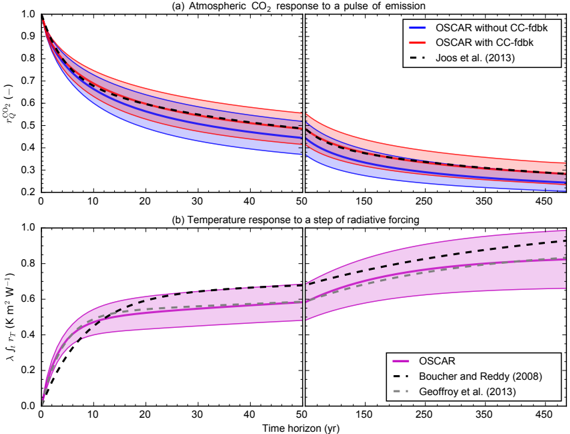
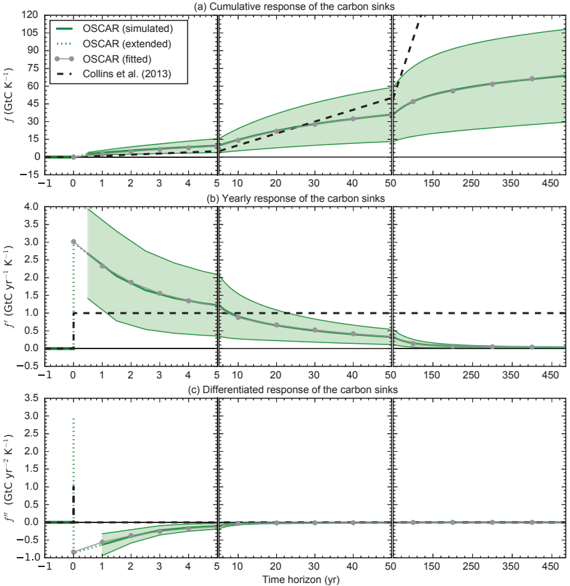
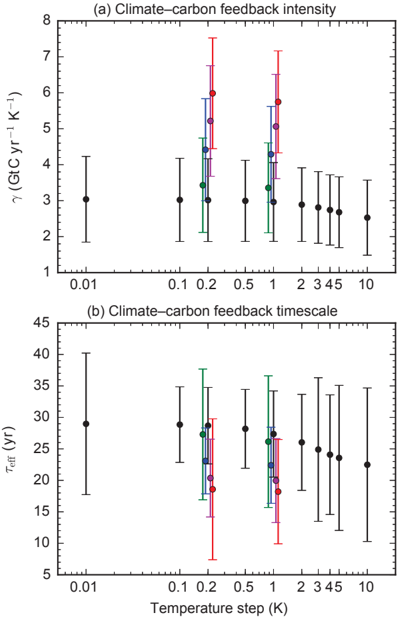
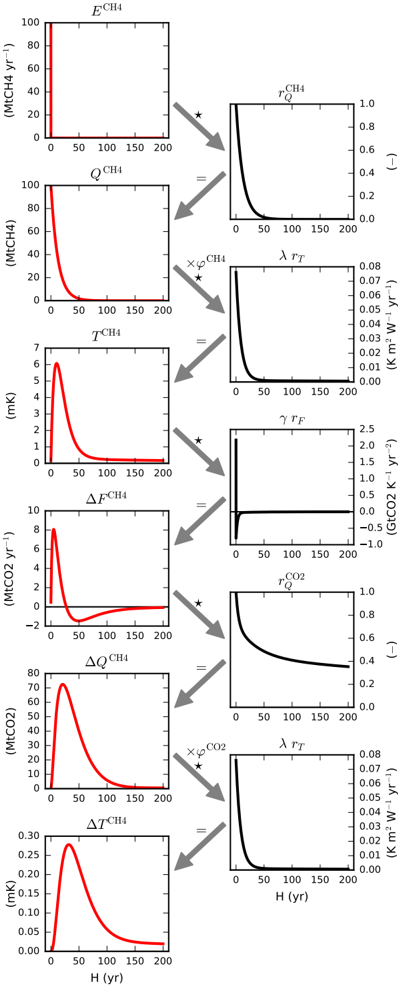
Most emission metrics have previously been inconsistently estimated by including the climate–carbon feedback for the reference gas (i.e. CO2) but not the other species (e.g. CH4). In the fifth assessment report of the IPCC, a first attempt was made to consistently account for the climate–carbon feedback in emission metrics. This attempt was based on only one study, and therefore the IPCC concluded that more research was needed. Here, we carry out this research. First, using the simple Earth system model OSCAR v2.2, we establish a new impulse response function for the climate–carbon feedback. Second, we use this impulse response function to provide new estimates for the two most common metrics: global warming potential (GWP) and global temperature-change potential (GTP). We find that, when the climate–carbon feedback is correctly accounted for, the emission metrics of non-CO2 species increase, but in most cases not as much as initially indicated by IPCC. We also find that, when the feedback is removed for both the reference and studied species, these relative metric values only have modest changes compared to when the feedback is included (absolute metrics change more markedly). Including or excluding the climate–carbon feedback ultimately depends on the user's goal, but consistency should be ensured in either case.
Overview
The claims and statistics of this paper haven’t been checked yet.
Free: it reads the open-access text and checks the first 5 claims that cite a source we can check. Create a free account to check every claim.
Integrity signals
Registry
Cites
Statistics
Figures
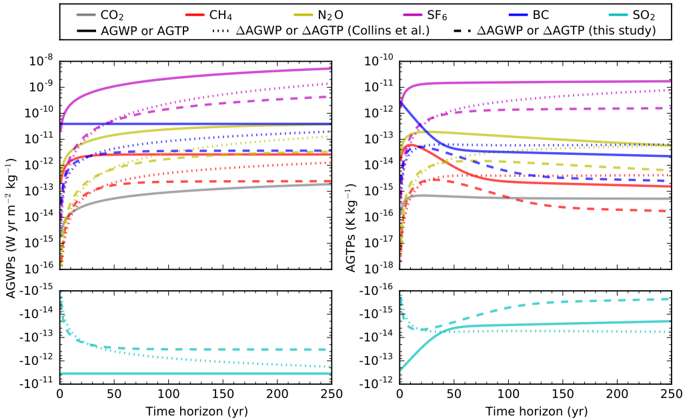
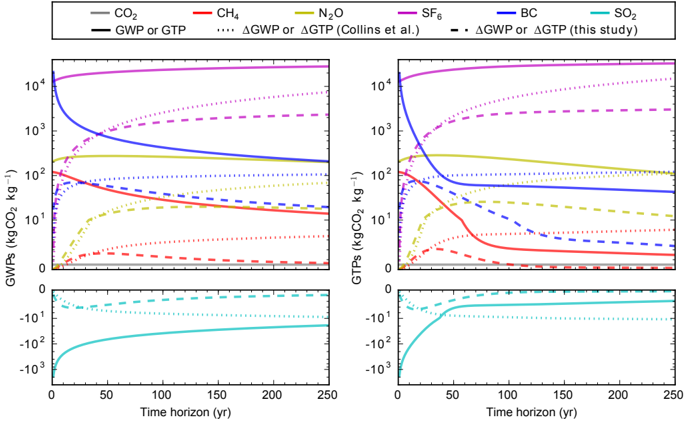
Verification
Claims the paper makes
The claims and statistics of this paper haven’t been checked yet.
Free: it reads the open-access text and checks the first 5 claims that cite a source we can check. Create a free account to check every claim.
Claims other papers make about this one
Each is checked against this paper’s own text: does it say what the citing paper says it does?
The source backs part of the claim, not all of it — or backs it for a different population, condition or comparison.
In the citing paper
“They show that when the C-cycle feedback is consistently accounted for, the non-CO2 emission metrics increase, but less so than initially suggested by Myhre et al. (2013).”
From The contribution of global aviation to anthropogenic climate forcing for 2000 to 2018 (2021) · cites this paper as Gasser et al., 2017
Experimental — accuracy not yet measuredThe source backs part of the claim, not all of it — or backs it for a different population, condition or comparison.
In the citing paper
“They also find that removing the C-cycle feed back from both numerator and denominator give similar metric values as including it in both places.”
From The contribution of global aviation to anthropogenic climate forcing for 2000 to 2018 (2021) · cites this paper as Gasser et al., 2017
Experimental — accuracy not yet measuredThe cited source says what the claim attributes to it.
In the citing paper
“Using the CO2 IRF without the C-cycle feedback provided by Gasser et al., 2017, we calculate a second set of aviation emission metrics (Table F.1a and Table F.1b), showing that the changes to the GWP100 and GTP100 values from those given in Table 5 are rather small.”
From The contribution of global aviation to anthropogenic climate forcing for 2000 to 2018 (2021) · cites this paper as Gasser et al., 2017
Self-check
Percentages, sums and reported differences re-computed from the paper’s own numbers.
The self-check needs the paper’s full text.
Citations
Cites
The RCP greenhouse gas concentrations and their extensions from 1765 to 2300
Meinshausen, M., Smith, S. J., Calvin, K., Daniel, J. S., Kainuma, M. L. T., Lamarque, J.-F., Matsumoto, K., Montzka, S. A., Raper, S. C. B., Riahi, K., et al. (2011) · Climatic Change · doi:10.1007/s10584-011-0156-z · Cited by 3,584 · cited 1×
“◦ forcing data (Meinshausen et al., 2011) from 2005 to 2100, and τ carbon sinks keep removing CO from the atmosphere during the RCP simulation while atmospheric CO is higher than today.”
Climate–Carbon Cycle Feedback Analysis: Results from the C4MIP Model Intercomparison
Friedlingstein, P., Cox, P., Betts, R., Bopp, L., von Bloh, W., Brovkin, V., Cadule, P., Doney, S., Eby, M., Fung, I., et al. (2006) · Journal of Climate · doi:10.1175/jcli3800.1 · Cited by 2,902
Hansen, J., Sato, M., Ruedy, R., Nazarenko, L., Lacis, A., Schmidt, G. A., Russell, G., Aleinov, I., Bauer, M., Bauer, S., et al. (2005) · Journal of Geophysical Research: Atmospheres · doi:10.1029/2005jd005776 · Cited by 1,486
Self-citationHurtt, G. C., Chini, L. P., Frolking, S., Betts, R. A., Feddema, J., Fischer, G., Fisk, J. P., Hibbard, K., Houghton, R. A., Janetos, A., et al. (2011) · Climatic Change · doi:10.1007/s10584-011-0153-2 · Cited by 1,284 · cited 7×
“tt′=0 Typically, the IRF for atmospheric CO2 is taken from Joos et al. (2013), those for other greenhouse gases are exponential decay functions with a constant e-folding time taken as the “perturbation lifetime” given by Myhre et al. (2013), the radiative forcing 25 functions come from Ramaswamy et al. (2001) with upd…”
BackgroundMethodInfluentialEtminan, M., Myhre, G., Highwood, E. J., & Shine, K. P. (2016) · Geophysical Research Letters · doi:10.1002/2016gl071930 · Cited by 1,027
Permafrost carbon-climate feedbacks accelerate global warming
Koven, C. D., Ringeval, B., Friedlingstein, P., Ciais, P., Cadule, P., Khvorostyanov, D., Krinner, G., & Tarnocai, C. (2011) · Proceedings of the National Academy of Sciences · doi:10.1073/pnas.1103910108 · Cited by 912 · cited 1×
“This is, however, likely unrealistic, given all the existing processes, such as vegetation migration (e.g. Jones et al., 2009) or permafrost thawing (e.g. Koven et al., 2011), that can produce some degree of irreversibility in the system but are ignored here.”
BackgroundSelf-citationImproved Attribution of Climate Forcing to Emissions
Shindell, D. T., Faluvegi, G., Koch, D. M., Schmidt, G. A., Unger, N., & Bauer, S. E. (2009) · Science · doi:10.1126/science.1174760 · Cited by 868
Self-citationNew estimates of radiative forcing due to well mixed greenhouse gases
Myhre, G., Highwood, E. J., Shine, K. P., & Stordal, F. (1998) · Geophysical Research Letters · doi:10.1029/98gl01908 · Cited by 849 · cited 1×
“The following values include the effect of any overlap between the absorption bands of CO2, CH4 and N2O (Myhre et al., 1998; Etminan et al., 2016).”
BackgroundJoos, F., Roth, R., Fuglestvedt, J. S., Peters, G. P., Enting, I. G., von Bloh, W., Brovkin, V., Burke, E. J., Eby, M., Edwards, N. R., et al. (2013) · Atmospheric Chemistry and Physics · doi:10.5194/acp-13-2793-2013 · Cited by 839
Self-citationCarbon–Concentration and Carbon–Climate Feedbacks in CMIP5 Earth System Models
Arora, V. K., Boer, G. J., Friedlingstein, P., Eby, M., Jones, C. D., Christian, J. R., Bonan, G., Bopp, L., Brovkin, V., Cadule, P., et al. (2013) · Journal of Climate · doi:10.1175/jcli-d-12-00494.1 · Cited by 666 · cited 1×
“earlier studies on the climate-carbon feedback (e.g. Friedlingstein et al., 2006; Arora et al., 2013) with new qualitative insights”
Background
Research works printed but not linked: 4
- Ciais, P., Sabine, C., Bala, G., Bopp, L., Brovkin, V., Canadell, J., Chhabra, A., DeFries, R., Galloway, J., Heimann, M., Jones, C., Le Quéré, C., Myneni, R. B., Piao, S., and Thornton, P.: Carbon and Other Biogeochemical Cycles, in: Climate Change 2013: The Physical Science Basis. Contribution of Working Group I to the Fifth Assessment Report of the Intergovernmental Panel on Climate Change, edited by: Stocker, T. F., Qin, D., Plattner, G.- K., Tignor, M., Allen, S. K., Boschung, J., Nauels, A., Xia, Y., Bex, V., and Midgley, P. M., Cambridge University Press, Cam- bridge, UK and New York, NY, USA, 2013.
- Clarke, L., Jiang, K., Akimoto, K., Babiker, M., Blanford, G., Fisher-Vanden, K., Hourcade, J.-C., Krey, V., Kriegler, E., Löschel, A., McCollum, D., Paltsev, S., Rose, S., Shukla, P. R., Tavoni, M., van der Zwaan, B. C. C., and van Vu- uren, D. P.: Assessing Transformation Pathways, in: Climate Change 2014: Mitigation of Climate Change, Contribution of Working Group III to the Fifth Assessment Report of the Inter- governmental Panel on Climate Change, edited by: Edenhofer, O., Pichs-Madruga, R., Sokona, Y., Farahani, E., Kadner, S., Sey- both, K., Adler, A., Baum, I., Brunner, S., Eickemeier, P., Krie- mann, B., Savolainen, J., Schlömer, S., von Stechow, C., Zwickel, T., and Minx, J. C., Cambridge University Press, Cambridge, UK and New York, NY, USA, 2014.
- Myhre, G., Shindell, D., Breìon, F.-M., Collins, W., Fuglestvedt, J., Huang, J., Koch, D., Lamarque, J.-F., Lee, D., Mendoza, B., Nakajima, T., Robock, A., Stephens, G., Takemura, T., and Zhang, H.: Anthropogenic and Natural Radiative Forcing, in: Climate Change 2013: The Physical Science Basis. Contribution of Working Group I to the Fifth Assessment Report of the Inter- governmental Panel on Climate Change, edited by: Stocker, T. F., Qin, D., Plattner, G.-K., Tignor, M., Allen, S. K., Boschung, J., Nauels, A., Xia, Y., Bex, V., and Midgley, P. M., Cambridge Uni- versity Press, Cambridge, UK and New York, NY, USA, 2013.
- Ramaswamy, V., Boucher, O., Haigh, J., Hauglustaine, D., Hay- wood, J., Myhre, G., Nakajima, T., Shi, G. Y., and Solomon, S.: Radiative Forcing of Climate Change, in: Climate Change 2001: The Scientific Basis, Contribution of Working Group I to the Third Assessment Report of the Intergovernmental Panel on Cli- mate Change, edited by: Houghton, J. T., Ding, Y., Griggs, D. J., Noguer, M., van der Linden, P. J., Dai, X., Maskell, K., and Johnson, C. A., Cambridge University Press, Cambridge, UK and New York, NY, USA, 2001.
Cited by
The contribution of global aviation to anthropogenic climate forcing for 2000 to 2018
Lee, D. S., Fahey, D. W., Skowron, A., Allen, M. R., Burkhardt, U., Chen, Q., Doherty, S. J., Freeman, S., Forster, P. M., Fuglestvedt, J., et al. (2021) · Atmospheric Environment · doi:10.1016/j.atmosenv.2020.117834 · Cited by 1,957
Self-citationOverriding water table control on managed peatland greenhouse gas emissions
Evans, C. D., Peacock, M., Baird, A. J., Artz, R. R. E., Burden, A., Callaghan, N., Chapman, P. J., Cooper, H. M., Coyle, M., Craig, E., et al. (2021) · Nature · doi:10.1038/s41586-021-03523-1 · Cited by 539
Jones, M. W., Peters, G. P., Gasser, T., Andrew, R. M., Schwingshackl, C., Gütschow, J., Houghton, R. A., Friedlingstein, P., Pongratz, J., & Le Quéré, C. (2023) · Scientific Data · doi:10.1038/s41597-023-02041-1 · Cited by 518
Self-citationAllen, M. R., Shine, K. P., Fuglestvedt, J. S., Millar, R. J., Cain, M., Frame, D. J., & Macey, A. H. (2018) · npj Climate and Atmospheric Science · doi:10.1038/s41612-018-0026-8 · Cited by 410
“This could be justi fi ed by carbon cycle feedbacks 34,35 and the oxidation of methane (from fossil sources) to CO 2 , but a composite metric would require more parameters, and precise agreement would depend on uncertain details of the climate response.”
BackgroundSelf-citationFAIR v1.3: a simple emissions-based impulse response and carbon cycle model
Smith, C. J., Forster, P. M., Allen, M., Leach, N., Millar, R. J., Passerello, G. A., & Regayre, L. A. (2018) · Geoscientific Model Development · doi:10.5194/gmd-11-2273-2018 · Cited by 317
“These emissions can also introduce uncertainty that is not captured in concentration-driven or CO2-only driven model experiments (Matthews and Zickfeld, 2012; Tachiiri et al., 2015; Gasser et al., 2017).”
Chang, J., Ciais, P., Gasser, T., Smith, P., Herrero, M., Havlík, P., Obersteiner, M., Guenet, B., Goll, D. S., Li, W., et al. (2021) · Nature Communications · doi:10.1038/s41467-020-20406-7 · Cited by 313
Self-citationHodnebrog, Ø., Aamaas, B., Fuglestvedt, J. S., Marston, G., Myhre, G., Nielsen, C. J., Sandstad, M., Shine, K. P., & Wallington, T. J. (2020) · Reviews of Geophysics · doi:10.1029/2019rg000691 · Cited by 200
“back also for CO2 by using the impulse response function for CO2 based on the Gasser et al. (2017) simple Earth system model (see their Appendix C); their model shows very good agreement with Joos et al.”
BackgroundMethodInfluentialSelf-citationMinx, J. C., Lamb, W. F., Andrew, R. M., Canadell, J. G., Crippa, M., Döbbeling, N., Forster, P. M., Guizzardi, D., Olivier, J., Peters, G. P., et al. (2021) · Earth System Science Data · doi:10.5194/essd-13-5213-2021 · Cited by 200
Self-citationPath-dependent reductions in CO2 emission budgets caused by permafrost carbon release
Gasser, T., Kechiar, M., Ciais, P., Burke, E. J., Kleinen, T., Zhu, D., Huang, Y., Ekici, A., & Obersteiner, M. (2018) · Nature Geoscience · doi:10.1038/s41561-018-0227-0 · Cited by 184
Self-citationClimate benefit of a future hydrogen economy
Hauglustaine, D. A., Paulot, F., Collins, W. J., Derwent, R. G., Sand, M., & Boucher, O. (2022) · Communications Earth & Environment · doi:10.1038/s43247-022-00626-z · Cited by 186
Self-citationThe contribution of carbon dioxide emissions from the aviation sector to future climate change
Terrenoire, E., Hauglustaine, D. A., Gasser, T., & Penanhoat, O. (2019) · Environmental Research Letters · doi:10.1088/1748-9326/ab3086 · Cited by 171
“The importance of the nonlinear model formulation followed by OSCAR has been extensively discussed elsewhere (Joos et al 2013, Gasser et al 2017b).”
MethodSelf-citationNicholls, Z., Meinshausen, M. A., Lewis, J., Rojas, M., Dorheim, K., Gasser, T., Gieseke, R., Hope, A. P., Leach, N. J., McBride, L. A., et al. (2021) · Earth s Future · doi:10.1029/2020ef001900 · Cited by 169
Self-citationAssessing the potential climate impact of anaesthetic gases
Andersen, M. P. S., Nielsen, O. J., & Sherman, J. D. (2023) · The Lancet Planetary Health · doi:10.1016/s2542-5196(23)00084-0 · Cited by 164
Ramaswamy, V., Collins, W. D., Haywood, J., Lean, J. L., Mahowald, N. M., Myhre, G., Naïk, V., Shine, K. P., Soden, B. J., Stenchikov, G. L., et al. (2019) · Meteorological Monographs · doi:10.1175/amsmonographs-d-19-0001.1 · Cited by 163
Self-citationChan, E., Worthy, D. E. J., Chan, D. S. T., Ishizawa, M., Moran, M. D., Delcloo, A., & Vogel, F. (2020) · Environmental Science & Technology · doi:10.1021/acs.est.0c04117 · Cited by 126
Atmospheric methane removal: a research agenda
Jackson, R. B., Abernethy, S., Canadell, J. G., Cargnello, M., Davis, S. J., Feron, S. C., Fuss, S., Heyer, A. J., Hong, C., JONES, C. D., et al. (2021) · Philosophical Transactions of the Royal Society A Mathematical Physical and Engineering Sciences · doi:10.1098/rsta.2020.0454 · Cited by 163
Asserting the climate benefits of the coal-to-gas shift across temporal and spatial scales
Tanaka, K., Cavalett, O., Collins, W. J., & Cherubini, F. (2019) · Nature Climate Change · doi:10.1038/s41558-019-0457-1 · Cited by 137
“…tested the robustness of the results to additional factors in emission metrics, such as inclusion of climate-carbon feedbacks in metric values 69 , potentially larger SO x metrics accounting for effects other than the direct effects 70 , and higher CH 4 metrics considering the effects from…”
BackgroundSelf-citationIncreased importance of methane reduction for a 1.5 degree target
Collins, W. J., Webber, C. P., Cox, P. M., Huntingford, C., Lowe, J., Sitch, S., Chadburn, S. E., Comyn-Platt, E., Harper, A. B., Hayman, G., et al. (2018) · Environmental Research Letters · doi:10.1088/1748-9326/aab89c · Cited by 120
“Recent studies (Collins et al 2013, Gasser et al 2017) estimated that the climate-carbon cycle feedbacks increase the temperature impacts of CH 4 by around 20% on 100 year timescales As a result of these typically-neglected effects, it has been argued that the total carbon budget for stabilization…”
BackgroundSelf-citationTyner, D. R., & Johnson, M. R. (2021) · Environmental Science & Technology · doi:10.1021/acs.est.1c01572 · Cited by 116
Liddicoat, S. K., Wiltshire, A., JONES, C. D., Arora, V. K., Brovkin, V. A., Cadule, P., Hajima, T., Lawrence, D. M., Pongratz, J., Schwinger, J., et al. (2020) · Journal of Climate · doi:10.1175/jcli-d-19-0991.1 · Cited by 119
Indicate separate contributions of long-lived and short-lived greenhouse gases in emission targets
Allen, M. R., Peters, G. P., Shine, K. P., Azar, C., Balcombe, P., Boucher, O., Cain, M. L., Ciais, P., Collins, W. J., Forster, P. M. D. F., et al. (2022) · npj Climate and Atmospheric Science · doi:10.1038/s41612-021-00226-2 · Cited by 136
Self-citationThe compact Earth system model OSCAR v2.2: description and first results
Gasser, T., Ciais, P., Boucher, O., Quilcaille, Y., Tortora, M., Bopp, L., & Hauglustaine, D. (2017) · Geoscientific Model Development · doi:10.5194/gmd-10-271-2017 · Cited by 101
“More concrete applications of the model or of its older versions can be found elsewhere in the literature (e.g., Gasser, 2014; Gasser et al., 2015, 2016; Li et al., 2016) and will be presented in future studies.”
MethodSelf-citationStable climate metrics for emissions of short and long-lived species—combining steps and pulses
Collins, W. J., Frame, D. J., Fuglestvedt, J. S., & Shine, K. P. (2020) · Environmental Research Letters · doi:10.1088/1748-9326/ab6039 · Cited by 101
Self-citationLynch, J. (2019) · Environmental Impact Assessment Review · doi:10.1016/j.eiar.2019.02.003 · Cited by 99
“included in standard CO2e metrics (Gasser et al., 2017), and incorporated in climate change indicators in environmental impact assessments (Jolliet et al.”
BackgroundUnintentional unfairness when applying new greenhouse gas emissions metrics at country level
Rogelj, J., & Schleussner, C.-F. (2019) · Environmental Research Letters · doi:10.1088/1748-9326/ab4928 · Cited by 96
“…and use the PRIMAP-hist database (Version 2.0) (Gütschow et al 2016) for historical emissions, noting that more recent updates of GWP100 values (Gasser et al 2017) would not affect the qualitative insights of this analysis that focus on the relative difference between the GWP-100 and GWP*…”
InfluentialThe social cost of methane: theory and applications
Shindell, D. T., Fuglestvedt, J. S., & Collins, W. J. (2017) · Faraday Discussions · doi:10.1039/c7fd00009j · Cited by 111
Self-citationMarginal climate and air quality costs of aviation emissions
Grobler, C., Wolfe, P. J., Dasadhikari, K., Dedoussi, I. C., Allroggen, F., Speth, R. L., Eastham, S. D., Agarwal, A., Staples, M. D., Sabnis, J. S., et al. (2019) · Environmental Research Letters · doi:10.1088/1748-9326/ab4942 · Cited by 123
Short-lived climate forcers have long-term climate impacts via the carbon–climate feedback
Fu, B., Gasser, T., Li, B., Tao, S., Ciais, P., Piao, S. L., Balkanski, Y. J., Li, W., Yin, T., Han, L., et al. (2020) · Nature Climate Change · doi:10.1038/s41558-020-0841-x · Cited by 88
Self-citationLaboratory study of the heterogeneous ice nucleation on black-carbon-containing aerosol
Nichman, L., Wolf, M. J., Davidovits, P., Onasch, T. B., Zhang, Y., Worsnop, D. R., Bhandari, J., Mazzoleni, C., & Cziczo, D. J. (2019) · Atmospheric chemistry and physics · doi:10.5194/acp-19-12175-2019 · Cited by 80
“, 2009), and estimates that the concentration of soot will remain high in the near future (Gasser et al., 2017) underscore the importance of understanding the efficiency of soot particles acting as INPs.”
Cost-effective implementation of the Paris Agreement using flexible greenhouse gas metrics
Tanaka, K., Boucher, O., Ciais, P., Johansson, D., & Morfeldt, J. (2021) · Science Advances · doi:10.1126/sciadv.abf9020 · Cited by 80
Self-citationEmission metrics for quantifying regional climate impacts of aviation
Lund, M. T., Aamaas, B., Berntsen, T., Bock, L., Burkhardt, U., Fuglestvedt, J. S., & Shine, K. P. (2017) · Earth System Dynamics · doi:10.5194/esd-8-547-2017 · Cited by 63
“If included, such feedbacks could increase the relative importance of non-CO 2 species (e.g., Gasser et al., 2017).”
Self-citationGlobal temperature goals should determine the time horizons for greenhouse gas emission metrics
Abernethy, S., & Jackson, R. B. (2022) · Environmental Research Letters · doi:10.1088/1748-9326/ac4940 · Cited by 72
“For most greenhouse gases, the AGTPX at time horizon t is given by AGTPX (t) = φ Xλ tˆ o rXQ (t ′) rT (t− t ′)dt ′, (3) where λrT (t− t ′), the climate response function, is given analytically in appendix C of Gasser et al [54].”
BackgroundMethodInfluentialA continued role of short-lived climate forcers under the Shared Socioeconomic Pathways
Lund, M. T., Aamaas, B., Stjern, C. W., Klimont, Z., Berntsen, T. K., & Samset, B. H. (2020) · Earth System Dynamics · doi:10.5194/esd-11-977-2020 · Cited by 79
“, 2013) (default in our study) or G17 (Gasser et al., 2017) IRFT.”
BackgroundResultInfluentialO’Connell, E., Risk, D., Atherton, E., Bourlon, É., Fougère, C., Baillie, J., Lowry, D. C., & Johnson, J. (2019) · Elementa Science of the Anthropocene · doi:10.1525/elementa.341 · Cited by 60
Bright, R. M., & Lund, M. T. (2021) · Atmospheric chemistry and physics · doi:10.5194/acp-21-9887-2021 · Cited by 64
Three considerations for modeling natural gas system methane emissions in life cycle assessment
Grubert, E. A., & Brandt, A. R. (2019) · Journal of Cleaner Production · doi:10.1016/j.jclepro.2019.03.096 · Cited by 47
“For methane, IPCC-estimated GWP values that include climate-carbon feedback are slightly higher than GWP values that do not include this feedback, which is intended to account for inconsistent estimates of GWP for the reference gas (CO2) versus other species (Gasser et al., 2017).”
BackgroundEnvironmental and Economic Evaluation of Fuel Choices for Short Sea Shipping
Spoof-Tuomi, K., & Niemi, S. A. (2019) · Clean Technologies · doi:10.3390/cleantechnol2010004 · Cited by 46
“[22] define climate-carbon feedback as “the effect that a changing climate has on the carbon cycle”.”
BackgroundRoscioli, J. R., Herndon, S. C., Yacovitch, T. I., Knighton, W. B., Zavala‐Araiza, D., Johnson, M. R., & Tyner, D. R. (2018) · Journal of the Air & Waste Management Association · doi:10.1080/10962247.2018.1436096 · Cited by 46
“We note that it is possible that there are other sources of CO2 on site, including CO2 vented from the annular stack, and the presence of gasoline combustion from on- site vehicles (e.g., the tracer release truck).”
BackgroundInfluentialEvaluating climate emulation: fundamental impulse testing of simple climate models
Schwarber, A. K., Smith, S. J., Hartin, C. A., Vega‐Westhoff, B., & Sriver, R. L. (2019) · Earth System Dynamics · doi:10.5194/esd-10-729-2019 · Cited by 44
“Both Millar et al. (2017) and Gasser et al. (2017) investigated the effects of adding carbon cycle feedbacks on these metrics produced with idealized SCMs and found that accounting for feedbacks improved model responses (at least modestly, Gasser et al. 2017).”
BackgroundOliaee, J. N., Sabourin, N. A., Festa-Bianchet, S. A., Gupta, J. A., Johnson, M. R., Thomson, K. A., Smallwood, G. J., & Lobo, P. (2022) · ACS Sensors · doi:10.1021/acssensors.1c02444 · Cited by 42
Uddin, M. E., Tricárico, J. M., & Kebreab, E. (2022) · Journal of Dairy Science · doi:10.3168/jds.2021-20988 · Cited by 38
The influence of non-CO 2 forcings on cumulative carbon emissions budgets
Tokarska, K. B., Gillett, N. P., Arora, V. K., Lee, W. G., & Zickfeld, K. (2018) · Environmental Research Letters · doi:10.1088/1748-9326/aaafdd · Cited by 34
“While we examine carbon budgets for CO2 alone under the assumption of a fixed relationship between non-CO2 forcing and cumulative carbon emissions, recent studies [20, 29, 30] propose alternative approaches to a separate consideration of”
MethodUncertainty in projected climate change arising from uncertain fossil-fuel emission factors
Quilcaille, Y., Gasser, T., Ciais, P., Lecocq, F., Janssens‐Maenhout, G., & Mohr, S. H. (2018) · Environmental Research Letters · doi:10.1088/1748-9326/aab304 · Cited by 36
Self-citationA quantitative approach to evaluating the GWP timescale through implicit discount rates
Sarofim, M. C., & Giordano, M. R. (2018) · Earth System Dynamics · doi:10.5194/esd-9-1013-2018 · Cited by 42
Tyner, D. R., & Johnson, M. R. (2018) · Environmental Science & Technology · doi:10.1021/acs.est.8b01345 · Cited by 30
Future land carbon removals in China consistent with national inventory
He, Y. L., Piao, S. L., Ciais, P., Xu, H., & Gasser, T. (2024) · Nature Communications · doi:10.1038/s41467-024-54846-2 · Cited by 35
Self-citationSpatial Patterns of Crop Yield Change by Emitted Pollutant
Shindell, D. T., Faluvegi, G., Kasibhatla, P. S., & Dingenen, R. V. (2019) · Earth s Future · doi:10.1029/2018ef001030 · Cited by 32
“We also include the “indirect”CO2 response to all other climate drivers via their impact on the carbon cycle (Gasser et al., 2017; see dashed arrows in Figure 1).”
BackgroundSelf-citationQuantifying negative radiative forcing of non-permanent and permanent soil carbon sinks
Leifeld, J., & Keel, S. G. (2022) · Geoderma · doi:10.1016/j.geoderma.2022.115971 · Cited by 32
Inhalational volatile anaesthetic agents: the atmospheric scientists' viewpoint
Nielsen, O. J., & Andersen, M. P. S. (2024) · Anaesthesia · doi:10.1111/anae.16119 · Cited by 29
A climate goal–based, multicriteria method for system evaluation in life cycle assessment
Tiruta-Barna, L. (2021) · The International Journal of Life Cycle Assessment · doi:10.1007/s11367-021-01991-1 · Cited by 24
Klenner, J., Lund, M. T., Muri, H., & Strømman, A. H. (2024) · Environmental Science & Technology · doi:10.1021/acs.est.3c08592 · Cited by 26
Mendonça, G. T., Pongratz, J., & Reick, C. H. (2021) · Nonlinear processes in geophysics · doi:10.5194/npg-28-501-2021 · Cited by 25
The effect of climate–carbon cycle feedbacks on emission metrics
Sterner, E. O., & Johansson, D. J. A. (2017) · Environmental Research Letters · doi:10.1088/1748-9326/aa61dc · Cited by 23
“Recently, Gasser et al (2016) also published a discussion paper on such an approach.”
BackgroundThe importance of an informed choice of CO 2 -equivalence metrics for contrail avoidance
Borella, A., Boucher, O., Shine, K. P., Stettler, M. E. J., Tanaka, K., Teoh, R., & Bellouin, N. (2024) · Atmospheric chemistry and physics · doi:10.5194/acp-24-9401-2024 · Cited by 38
“So this study uses the OSCAR reduced-complexity Earth system model in its version 3.1.1 (Gasser et al., 2017a, 2020) to compute for each individual flight, with a 1-year time step, the time evolution of the globally averaged radiative forcing and the globally averaged surface temperature change that…”
InfluentialAnalysis of atmospheric CH 4 in Canadian Arctic and estimation of the regional CH 4 fluxes
Ishizawa, M., Chan, D. S. T., Worthy, D. E. J., Chan, E., Vogel, F., & Maksyutov, S. S. (2019) · Atmospheric chemistry and physics · doi:10.5194/acp-19-4637-2019 · Cited by 26
“Atmospheric methane (CH4) is one of the principal greenhouse gases with a global warming potential (GWP) 34 times stronger than carbon dioxide (CO2) over a 100-year time period and 96 times stronger over a 20-year time period (Gasser et al., 2017).”
BackgroundJohansson, M. I., Vierth, I., Holmgren, K. M., & Cullinane, K. (2024) · Case Studies on Transport Policy · doi:10.1016/j.cstp.2024.101151 · Cited by 21
Mallapragada, D. S., & Mignone, B. K. (2019) · Climatic Change · doi:10.1007/s10584-019-02486-7 · Cited by 23
Ramírez-Restrepo, C. A., Vera, R. R., & Rao, I. M. (2020) · Agricultural Systems · doi:10.1016/j.agsy.2020.102892 · Cited by 20
The impact on climate and emissions of clean household cooking energy policies in Tanzania
Aamaas, B., & Grimsby, L. K. (2024) · Energy Policy · doi:10.1016/j.enpol.2024.114211 · Cited by 23
Mendonça, G. T., Pongratz, J., & Reick, C. H. (2021) · Nonlinear processes in geophysics · doi:10.5194/npg-28-533-2021 · Cited by 18
Khatri, P., Nepal, P., Sahoo, K., Bergman, R. D., Nicholls, D. G., & Gray, A. N. (2023) · The Science of The Total Environment · doi:10.1016/j.scitotenv.2023.163918 · Cited by 15
Analytically tractable climate–carbon cycle feedbacks under 21st century anthropogenic forcing
Lade, S. J., Donges, J. F., Fetzer, I., Anderies, J. M., Beer, C., Cornell, S., Gasser, T., Norberg, J., Richardson, K., Rockström, J., et al. (2018) · Earth System Dynamics · doi:10.5194/esd-9-507-2018 · Cited by 16
“We avoid models or model components constructed by purely parametric fits, such as impulse response functions, to historical data or projections of Earth system models (Kamiuto, 1994; Gasser et al., 2017b; Joos et al., 1996; Harman et al., 2011; Gregory et al., 2009; Meinshausen et al., 2011a).”
MethodSelf-citationLiu, L., Yao, S., Ge, J., Fu, T., & Yan, Y. G. (2025) · Journal of Cleaner Production · doi:10.1016/j.jclepro.2025.146638 · Cited by 18
Dynamic life cycle impact assessment (DLCIA) in a sustainable building planning process
Zong, C., Banihashemi, F., & Lang, W. (2025) · Scientific Reports · doi:10.1038/s41598-025-20599-1 · Cited by 11
“The methodology and parametrization are based on Gasser et al. 52 .”
Comment on “Climate consequences of hydrogen emissions” by Ocko and Hamburg (2022)
Duan, L., & Caldeira, K. (2023) · Atmospheric chemistry and physics · doi:10.5194/acp-23-6011-2023 · Cited by 10
“Two exponential terms (M = 2) are normally used in previous studies, with the first term associated with the response of the ocean mixed layer and the higher order associated with the response of the deep ocean (Gasser et al., 2017).”
BackgroundMethodInfluentialConsequences of equivalency metric design for energy transitions and climate change
Edwards, M. R., & Trancik, J. E. (2022) · Climatic Change · doi:10.1007/s10584-022-03442-8 · Cited by 13
Species correlation measurements in turbulent flare plumes: considerations for field measurements
Seymour, S. P., & Johnson, M. R. (2021) · Atmospheric measurement techniques · doi:10.5194/amt-14-5179-2021 · Cited by 9
Prioritize rapidly scalable methane reductions in efforts to mitigate climate change
Dunn, J. B., Salas, S. D., Chen, Q., & Allen, D. T. (2023) · Clean Technologies and Environmental Policy · doi:10.1007/s10098-023-02521-3 · Cited by 6
The local ship speed reduction effect on black carbon emissions measured at a remote marine station
Heikkilä, M., Luoma, K., Mäkelä, T., & Grönholm, T. (2024) · Atmospheric chemistry and physics · doi:10.5194/acp-24-8927-2024 · Cited by 7
Lim, H., Soh, J., Kim, M., Lee, G., Choi, S., Park, J., & Oh, J.-K. (2025) · Journal of Cleaner Production · doi:10.1016/j.jclepro.2025.146485 · Cited by 11
Estimation of natural methane emissions from the largest oil sand deposits on earth
Wei, C., Raad, S. M. J., & Hassanzadeh, H. (2023) · PNAS Nexus · doi:10.1093/pnasnexus/pgad260 · Cited by 5
Cowie, A., Koponen, K., Benoist, A., Berndes, G., Brandão, M., Gustavsson, L., Lamers, P., Marland, E., Rüter, S., Soimakallio, S., et al. (2025) · GCB Bioenergy · doi:10.1111/gcbb.70070 · Cited by 9
Gay, B. A., Mandrake, L., Miner, K. R., & Miller, C. E. (2025) · Scientific Reports · doi:10.1038/s41598-025-91195-6 · Cited by 8
Climate change metrics: bridging IPCC AR6 updates and dynamic life cycle assessments
Zieger, V., Lecompte, T., Guihéneuf, S., Guevel, Y., Bazzana, M., Gasser, T., & He, Y. L. (2025) · Earth System Dynamics · doi:10.5194/esd-16-2003-2025 · Cited by 10
“IRF CO from Joos et al. (2013) includes CCf. AR5’s attempt to include CCf for non-CO 2 species (Myhre et al., 2013a) was inconsistent (Gasser et al., 2017).”
InfluentialSelf-citationProspective Characterization Factors for Assessing Climate Change Impacts in Life Cycle Assessments
Watanabe, M. D. B., & Cherubini, F. (2026) · Environmental Science & Technology · doi:10.1021/acs.est.5c12391 · Cited by 8
“The provided REs, IRFs, and Python codes for AGWP, AGTP, pGWP 100 , pGWP 20 , pGTP 50 , and pGTP 100 enable extended calculations of pCFs of up to 2100.”
Stock change accounting overestimates the potential climate benefit of soil carbon storage
Alexander, J. R., Gamble, J. D., & Venterea, R. T. (2024) · Soil Science Society of America Journal · doi:10.1002/saj2.20643 · Cited by 4
Ramírez-Restrepo, C. A., Vera, R. R., & Rao, I. M. (2023) · Frontiers in Animal Science · doi:10.3389/fanim.2023.1103826 · Cited by 5
“The study used the horizon global warming potential (GWP)100-34 value for CH4 that includes climate-C feedbacks (Gasser et al., 2017; Mueller and Mueller, 2017; Allen et al., 2018) whilst the GWP100-298 value for N2O (Ramıŕez-Restrepo et al.”
MethodExperimental Modelling of Black Carbon Emissions from Gas Flares in the Oil and Gas Sector
Mehr, P. (2020) · Carleton University's Institutional Repository (MacOdrum Library, Carleton University) · doi:10.22215/etd/2020-14289 · Cited by 4
Warming of northern peatlands increases the global temperature overshoot challenge
Zhu, B.-Q., Qiu, C., Gasser, T., Ciais, P., Lamboll, R., Ballantyne, A. P., Chang, J.-F., Chaudhary, N., Gallego-Sala, A., Guenet, B., et al. (2025) · One Earth · doi:10.1016/j.oneear.2025.101353 · Cited by 4
“2, including its structure, equations and calibration can be found in Gasser et al. (2017).”
Self-citationUpdated radiative efficiencies and emissions metrics of halocarbons
Liu, L. H., Zhang, H., & Chen, Q. (2025) · Advances in Climate Change Research · doi:10.1016/j.accre.2025.12.004 · Cited by 3
Wang, D., Li, Y., Pu, Y., Lv, Y., Wang, M., Yang, H., Zhao, X., & Li, D. (2024) · Sensors · doi:10.3390/s24041307 · Cited by 3
Sustainable Management of Banked Fluorocarbons as a Cost-Effective Climate Action
Chen, Z., Purohit, P., Bai, F., Gasser, T., He, Y. L., Höglund-Isaksson, L., Jiang, P., Wu, J., & Hu, J. (2025) · Environmental Science & Technology · doi:10.1021/acs.est.5c02575 · Cited by 3
Self-citationCascaded high-density multipoint gas detection with branched gas chambers
Yang, J., Lin, H., He, A., & Dong, X. (2022) · Measurement · doi:10.1016/j.measurement.2022.112233 · Cited by 3
Temporary carbon dioxide removal to offset short-lived climate forcers
He, Y., Riahi, K., Gidden, M., Piao, S. L., Wang, T., & Gasser, T. (2026) · Nature · doi:10.1038/s41586-026-10607-3 · Cited by 6
“21,53–55).”
Self-citationClimate impacts of hydrogen emissions
Sand, M., Ocko, I., Sun, T., Skeie, R. B., Hauglustaine, D. A., Warwick, N. J., Stevenson, D. S., Paulot, F., Myhre, G., Archibald, A. T., et al. (2026) · Nature Reviews Earth & Environment · doi:10.1038/s43017-026-00792-0 · Cited by 6
“The dominant source of uncertainty in AGWP of CO 2 is linked to how long CO 2 stays in the atmosphere after it is emitted, and how it will affect the carbon cycle 103 .”
Ramírez-Restrepo, C. A., Vera, R. R., & Rao, I. M. (2022) · Archivos Latinoamericanos de Producción Animal · doi:10.53588/alpa.310101 · Cited by 2
Intensifying neotropical beef cattle grazing systems: Navigating complexity through modelling
Vera, R. R., Ramírez-Restrepo, C. A., & Rao, I. M. (2025) · Agricultural Systems · doi:10.1016/j.agsy.2025.104301 · Cited by 2
Spectroscopic Measurements of Path-Averaged Species Correlations in Turbulent Flare Plumes
Seymour, S. P. (2019) · doi:10.22215/etd/2019-13596 · Cited by 2
Buma, B. J., Ocko, I., Walkowiak, B., Xu, Y., Lackner, M. K., Sartzetakis, S. S., Alpert, A. E., & Dhungel, S. (2025) · npj Climate and Atmospheric Science · doi:10.1038/s41612-025-01131-8 · Cited by 4
Carbon-climate feedback responses to spatial aerosol model implementation variations
Monteiro, E. A., Tran, G., Gidden, M., & Mengis, N. (2026) · npj Climate and Atmospheric Science · doi:10.1038/s41612-026-01343-6 · Cited by 1
Adjoint-Based Optimization Scheme for Characterizing Sources of Fugitive Emissions
Brereton, C. A. (2018) · doi:10.22215/etd/2018-13366 · Cited by 1
“21 Chapter 2 Fugitive Emissions in the Oil and Gas Industry Methane is a potent greenhouse gas with a global warming potential (GWP) 34/96 times stronger than CO2 over a 100/20 year period (Gasser et al., 2017).”
BackgroundInfluentialAfwentelingen van methaan-mitigerende maatregelen in melkvee
Bannink, A., & Dijkstra, J. (2021) · doi:10.18174/547899 · Cited by 1
Resolving the land carbon accounting riddle: consistent metrics for countries and productsPreprint
Brandão, M. (2025) · Research Square · doi:10.21203/rs.3.rs-6874858/v1 · Cited by 1
Conrad, B. (2020) · Carleton University's Institutional Repository (MacOdrum Library, Carleton University) · doi:10.22215/etd/2020-14208
Mendonça, G. T. (2021) · Nonlinear processes in geophysics · doi:10.5194/npg-2021-9-ac3
Minx, J. C., Lamb, W. F., Andrew, R. M., et al. (2021) · Earth system science data · doi:10.5194/essd-2021-228-ec1
Lamb, W. F. (2021) · Earth system science data · doi:10.5194/essd-2021-228-ac1
Minx, J. C., Lamb, W. F., Andrew, R. M., et al. (2021) · Earth system science data · doi:10.5194/essd-2021-228-rc2
(2021) · Atmospheric measurement techniques · doi:10.5194/amt-2020-472-rc2
(2021) · Nonlinear processes in geophysics · doi:10.5194/npg-2021-9-cc1
Metadata
- Authors
- Gasser, T., Peters, G. P., Fuglestvedt, J. S., Collins, W. J., Shindell, D. T., & Ciais, P.
- Affiliations
- CICERO Center for International Climate Research (NO)
- Duke University (US)
- Commissariat à l'Énergie Atomique et aux Énergies Alternatives (FR)
- ORCID
- Venue
- Earth System Dynamics
- Publisher
- Copernicus GmbH
- Published
- 2017-04-10
- Volume
- 8
- Issue
- 2
- Pages
- 235-253
- ISSN
- 2190-4979 (ISSN-L)
- 2190-4987
- OpenAlex
- W2553870256
- Cited by
- 129
- References
- 40
- Citations by year
- 2026: 8 · 2025: 14 · 2024: 12 · 2023: 13 · 2022: 10 · 2021: 31 · 2020: 9 · 2019: 16 · 2018: 12 · 2017: 4
- FWCI
- 7.77
- Type
- journal article
- Language
- en
- Open access
- gold
- doi.org
- Licence
- Locations
- Earth System Dynamics (publishedVersion, cc-by)
- IIASA PURE (International Institute of Applied Systems Analysis) (acceptedVersion)
- CentAUR (University of Reading) (acceptedVersion)
- Dipòsit Digital de Documents de la UAB (Universitat Autònoma de Barcelona) (submittedVersion, cc-by)
- LA Referencia (Red Federada de Repositorios Institucionales de Publicaciones Científicas) (submittedVersion, cc-by)
- HAL (submittedVersion, other-oa)
- Funders
- Norges Forskningsråd (249972)
- Topics
- Physical Sciences › Environmental Science › Global and Planetary Change › Climate variability and models
- Social Sciences › Economics, Econometrics and Finance › Economics and Econometrics › Climate Change Policy and Economics
- Physical Sciences › Environmental Science › Global and Planetary Change › Climate Change and Environmental Impact
- Keywords
- carbon-climate feedback, global warming potential, global temperature change potential, impulse response functions, non-CO2 greenhouse gases, methane, carbon dioxide, IPCC AR5, climate change mitigation
About these checks
Registry, retraction, Cites and statistics results are computed, not judged, with one exception: a printed reference that no index lists is read once by a model before it counts as a citation error. Claims are extracted by a model and kept only when their quote appears verbatim in the text; each cited source is then checked, with a model’s help, for whether it says what the claim relies on. Those verdicts can be wrong — read the claim’s quote and the cited source before relying on one.
Statistics and arithmetic are recomputed, not judged.
Confidence bands are shown only for fields calibrated on our annotated test set. None is calibrated yet, so no band is shown.
What counts as a claim ›How we measure confidence ›How we check this ›
Are you an author, or do you see a problem with this page? Request a review
Data sources
Bibliographic data: Semantic Scholar, OpenAlex, Crossref.
Contains information from the Semantic Scholar Academic Graph Datasets, made available under the ODC Attribution License (ODC-BY 1.0).
Semantic Scholar’s data is described in: Kinney, R., et al. (2023). The Semantic Scholar Open Data Platform. arXiv:2301.10140.
