

Geogenic organic carbon in terrestrial sediments and its contribution to total soil carbon
Open accessPublished version of a preprint
The DOI matches its Crossref record; 73 of the 73 references it cites were found in a registry or an index; 19 of the 65 sources its claims cite were checked for support.
Abstract
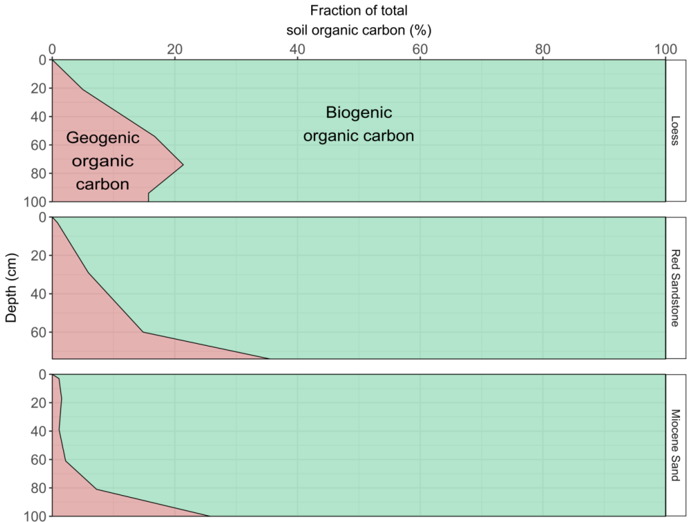
Geogenic organic carbon (GOC) from sedimentary rocks is an overlooked fraction in soils that has not yet been quantified but influences the composition, age, and stability of total organic carbon (OC) in soils. In this context, GOC is the OC in bedrock deposited during sedimentation. The contribution of GOC to total soil OC may vary, depending on the type of bedrock. However, no studies have been carried out to investigate the contribution of GOC derived from different terrestrial sedimentary rocks to soil OC contents. In order to fill this knowledge gap, 10 m long sediment cores from three sites recovered from Pleistocene loess, Miocene sand, and Triassic Red Sandstone were analysed at 1 m depth intervals, and the amount of GOC was calculated based on 14 C measurements. The 14 C ages of bulk sedimentary OC revealed that OC is comprised of both biogenic and geogenic components. The biogenic component relates to OC that entered the sediments from plant sources since soil development started. Assuming an average age for this biogenic component ranging from 1000–4000 years BP (before present), we calculated average amounts of GOC in the sediments starting at 1.5 m depth, based on measured 14 C ages. The median amount of GOC in the sediments was then taken, and its proportion of soil mass (g GOC per kg −1 fine soil) was calculated in the soil profile. All the sediments contained considerable amounts of GOC (median amounts of 0.10 g kg −1 in Miocene sand, 0.27 g kg −1 in Pleistocene loess, and 0.17 g kg −1 in Red Sandstone) compared with subsoil OC contents (between 0.53 and 15.21 g kg −1 ). Long-term incubation experiments revealed that the GOC appeared comparatively stable against biodegradation. Its possible contribution to subsoil OC stocks (0.3–1.5 m depth) ranged from 1 % to 26 % in soil developed in the Miocene sand, from 16 % to 21 % in the loess soil, and from 6 % to 36 % at the Red Sandstone site. Thus, GOC with no detectable 14 C content influenced the 14 C ages of subsoil OC and may partly explain the strong increase in 14 C ages observed in many subsoils. This could be particularly important in young soils on terrestrial sediments with comparatively low amounts of OC, where GOC can make a large contribution to total OC stocks.
Overview
CoChat Summary
TL;DR
Geogenic organic carbon (GOC) was quantified in 10 m cores from Pleistocene loess, Miocene sand, and Triassic Red Sandstone using 14C, showing median GOC contents of 0.10–0.27 g kg−1 and possible subsoil contributions up to 36% depending on bedrock. Incubations indicated sedimentary OC was comparatively stable, with low mineralisation rates, especially for intact Red Sandstone.
Key findings
- Median GOC in sediments was 0.10 g kg−1 in Miocene sand, 0.27 g kg−1 in Pleistocene loess, and 0.17 g kg−1 in Red Sandstone, compared with subsoil OC contents of 0.53–15.21 g kg−1.
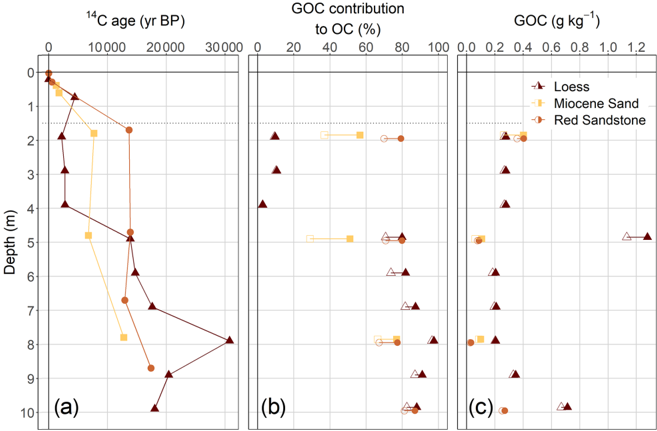
- Calculated GOC fractions in sediments were highest for Red Sandstone (67–87%, mean 77%), intermediate for Miocene sand (29–77%, mean 53%), and variable for loess (5–19% at 2–4 m but 71–98% at 5 m).
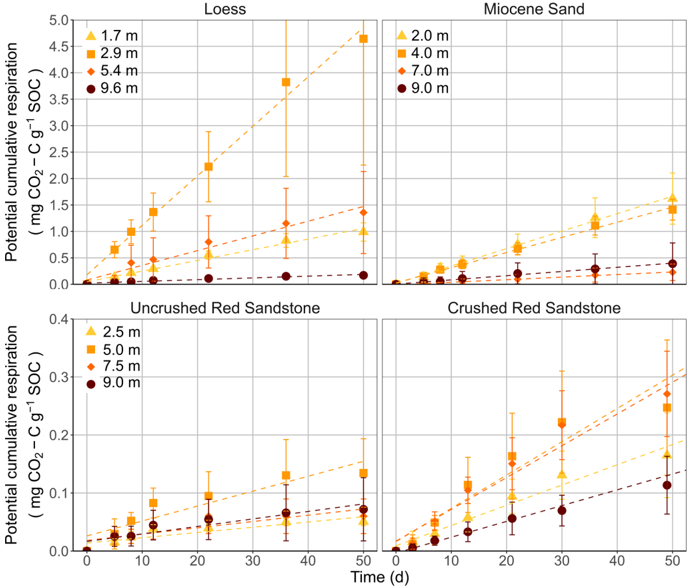
- Incubation mineralisation rate constants ranged from 1 to 34.2 mg CO2-C g−1 OC yr−1; intact Red Sandstone was 0.3–1.0, crushed Red Sandstone 1.0–2.1, with mean residence times of 29–135 years for loess, 83–556 years for Miocene sand, and 476–1000 years for crushed Red Sandstone.
- The abstract reports possible subsoil (0.3–1.5 m) GOC contributions of 1–26% in Miocene sand, 16–21% in loess, and 6–36% at Red Sandstone; Table 1 gives subsoil GOC proportions of 2–3%, 8%, and 12%, respectively.
Methods
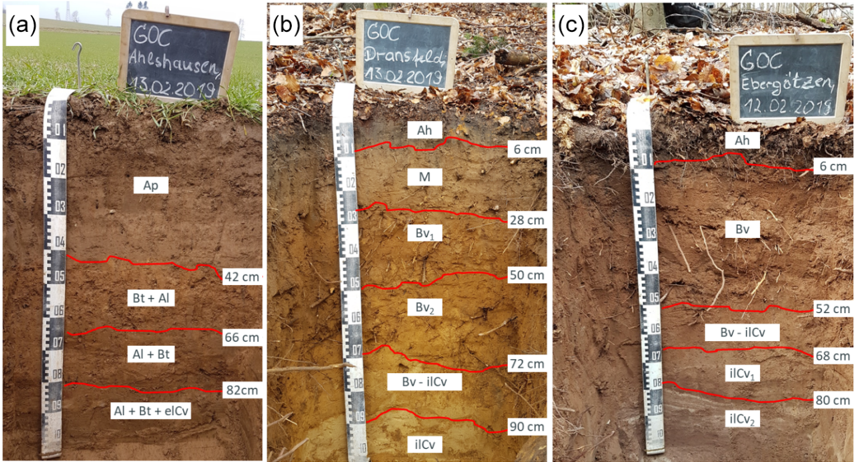
- Three sites near Göttingen were sampled: Pleistocene loess, Miocene sand, and Triassic Red Sandstone; two 10 m sediment cores per site were drilled and subdivided into 1 m increments, with additional ~1 m soil profiles, though only one loess core was analysed.
- OC was measured by dry combustion, 13C by IRMS, and 14C by AMS; GOC was calculated with a two-pool 14C mixing model assuming GOC is 14C-free and biogenic OC in sediments averaged 1000–4000 years BP, then median sedimentary GOC was applied to soil profiles.
- Incubations ran at 20°C for 50 and 63 days with intact and crushed Red Sandstone and four subsamples per sediment/depth range; CO2 was analysed by GC and IRMS, and mineralisation was fitted with linear regression.
Limitations
- Stated: GOC estimates assume biogenic OC in sediments was no older than 4000 years BP and exclude pre-latest-glacial biogenic OC; the incubation could not determine whether GOC is mineralised once it becomes part of the subsoil; statistical models showed heteroscedastic and non-normal residuals, so standard errors and significance were omitted.
- Stated/evident: 14C could not be measured for all depth increments (only three Miocene sand samples, four Red Sandstone samples, and all loess samples), loess had only one core analysed, and about one-third of incubation vessels were removed because of leakage.
- Evident: the study is based on a small number of sites and samples, and GOC quantification relies on model assumptions rather than direct isolation; data are available only on request.
Model-written summary. Check it against the paper before relying on it.
Integrity signals
Registry
Cites
Statistics
Figures
Verification
Claims the paper makes
15 Valid · 5 Not valid · 36 Not checked · 127 Own results and interpretations
The cited sources support only part of this claim — read each source’s verdict below.
In the paper
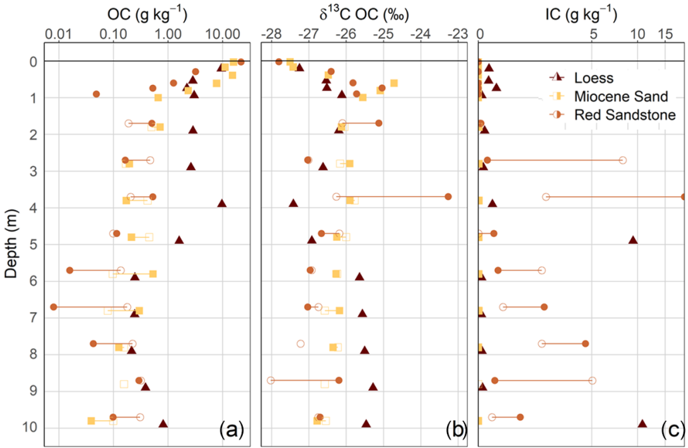
“The loess OC contents were highly variable, highlighting the changing sedimentary conditions during the past glacial and interglacial periods (Jordan and Schwartau, 1993).”
What the sources say
- Partly supportedcites Jordan and Schwartau, 1993 matched to “Das Lößprofil von Ahlshausen und weitere tiefe Quartäraufschlüsse entlang der Bundesbahn-Neubaustrecke bei Northeim, Südniedersachsen” (1993) sourceExperimental — accuracy not yet measured
Section 2.2 (page unavailable) describes deposits associated with cold conditions and separate humose basin deposits interpreted as at least partly interglacial, supporting a change in depositional conditions. It does not report highly variable organic carbon contents in loess or link such variability to those conditions; searches for organic carbon and the proposed relationship found no such passage. (LLM, conf=0.78)
plainstates a cause- Asserted: passes — The authors put it forward as true.
- Checkable: passes — It can be checked against evidence.
- Load-bearing: unclear — It is unclear whether the paper’s conclusions depend on it.
- Based: passes — The paper gives a reason why it holds.
- Partly supported
The cited sources support only part of this claim — read each source’s verdict below.
In the paper
“Direct microbial coal degradation has already been observed in incubation experiments on mine soils (Rumpel and Kögel-Knabner, 2002; Waschkies and Huttl, 1999) or shale bedrock directly exposed to the surface (Soulet et al., 2018).”
What the sources say
- Not matchedcites Rumpel and Kögel-Knabner, 2002
More than one paper fits this citation.
- Not checked — no full text of the sourcecites Waschkies and Huttl, 1999 matched to “Microbial degradation of geogenic organic C and N in mine spoils” (1999) source
- Partly supportedcites Soulet et al., 2018 matched to “Technical note: In situ measurement of flux and isotopic composition of CO 2 released during oxidative weathering of sedimentary rocks” (2018) sourceExperimental — accuracy not yet measured
The Abstract and §3.3.1 report CO₂ from oxidation of rock-derived organic carbon in exposed shale bedrock. But §2.2 describes chambers drilled into rock in the field, not incubation experiments; the paper does not establish that the oxidation was microbial or identify the organic matter as coal. This citation supports the exposed-bedrock oxidation portion, not the more specific claim of direct microbial coal degradation in incubations. (LLM, conf=0.87)
plainstates a cause- Asserted: passes — The authors put it forward as true.
- Checkable: passes — It can be checked against evidence.
- Load-bearing: passes — The paper’s conclusions depend on it.
- Based: passes — The paper gives a reason why it holds.
- Not matched
The cited sources support only part of this claim — read each source’s verdict below.
In the paper
“For all sediments, 11 out of 16 samples had a 14 C content that led to an 14 C age older than 11 600 years BP, which we assumed to be the time after the latest glacial period when soil development started (Litt et al., 2007).”
What the sources say
- Partly supportedcites Litt et al., 2007 matched to “Stratigraphische Begriffe für das Quartär des norddeutschen Vereisungsgebietes” (2007) sourceExperimental — accuracy not yet measured
The paper’s Abstract (page unavailable) places the start of the Holocene at about 11,600 years ago, supporting the dating used for the cited postglacial boundary. It does not say that soil development began then. The 11-of-16 sample result is presented as the citing authors’ own finding, not as a finding attributed to Litt et al. (LLM, conf=0.82)
plainstates a causen = 16- Asserted: passes — The authors put it forward as true.
- Checkable: passes — It can be checked against evidence.
- Load-bearing: passes — The paper’s conclusions depend on it.
- Based: passes — The paper gives a reason why it holds.
- Rests on an assumption not shown here.
- Partly supported
Every source the paper cites for this claim was checked and supports it.
In the paper
“Considering that approximately 65 % of the continental Earth's surface is covered with sediments and sedimentary rocks (Amiotte Suchet et al., 2003), a potentially large fraction of soils could contain GOC that contributes to soil OC stocks, even though a large portion might be derived from recent sedimentation processes.”
What the sources say
- Supportedcites Amiotte Suchet et al., 2003 matched to “Worldwide distribution of continental rock lithology: Implications for the atmospheric/soil CO2 uptake by continental weathering and alkalinity river transport to the oceans” (2003) source
The Conclusion states that two thirds of continental rocks are sedimentary, including sands and sandstones, shales, and carbonates. Its reported outcrop areas for those categories total 64% of continental land area, consistent with approximately 65%. (LLM, conf=0.93)
plain- Asserted: passes — The authors put it forward as true.
- Checkable: passes — It can be checked against evidence.
- Load-bearing: passes — The paper’s conclusions depend on it.
- Based: passes — The paper gives a reason why it holds.
- Supported
The cited sources that could be checked couldn’t confirm or dispute this claim.
In the paper
“the assumed range of biogenic 14 C ages from 1000-4000 years BP was within the typical range for ages of dissolved OC leaching from soils (Artinger et al., 1996; Jia et al., 2019).”
What the sources say
- Not matchedcites Artinger et al., 1996
An author–year citation the paper’s reference list doesn’t settle. We don’t search these by name.
- Could not verifycites Jia et al., 2019 matched to “14C characteristics of dissolved lignin along a forest soil profile” (2019) sourceExperimental — accuracy not yet measured
The paper reports DOC radiocarbon measurements from one forest soil profile (p. 6) and discusses young surface leachates as their likely source (pp. 3, 8). Our copy does not identify 1,000–4,000 years BP as a typical age range for DOC leaching from soils; searches for that range and for millennial DOC ages found no such passage. (LLM, conf=0.76)
plain- Asserted: passes — The authors put it forward as true.
- Checkable: passes — It can be checked against evidence.
- Load-bearing: unclear — It is unclear whether the paper’s conclusions depend on it.
- Based: passes — The paper gives a reason why it holds.
- Not matched
95 more claims · 6 with their cited sources checked
Create a free account to see all 183 claims and to verify the 2 references still open.
- Probably not a substantial claim. 25
- It may state two separate claims as one. 62
- The quote only partly states this claim. 2
Self-check
Percentages, sums and reported differences re-computed from the paper’s own numbers.
Each contradiction between two passages listed here was confirmed by an independent check.
Rated minor: it would not touch a result — a value no result rests on, a p-value that stays on the same side of the significance level, or a conflict that is clerical, resolved elsewhere in the paper, or outside its own findings.
In the paper
§ 4.1.1 Site-dependent contents of GOC · p. 9
“the loess site, with comparatively low infiltration rates, or the Red Sandstone site, with reduced possibilities for deep rooting, seemed to contain relatively constant contributions from GOC of around 80 %.”
§ 3.2 Ages of organic carbon in soils and sediments and contributions from geogenic organic carbon · p. 7
“Loess showed a sharp increase at a depth of 5 m, where the GOC contribution rises to between 71 % to 98 % while it was only 5 % to 19 % at the 2 to 4 m depth.”
Rated minor: it would not touch a result — a value no result rests on, a p-value that stays on the same side of the significance level, or a conflict that is clerical, resolved elsewhere in the paper, or outside its own findings.
In the paper
§ 3.4 Possible contribution from geogenic organic carbon to soil organic carbon · p. 9
“At 74 cm depth it would increase an age of 1453 years BP by 451-490 years BP.”
§ 2.3 Chemical analysis and calculations · p. 4
“Reducing the age by this fraction would, therefore, represent an unbiased age of soil-derived OC.”
Rated minor: it would not touch a result — a value no result rests on, a p-value that stays on the same side of the significance level, or a conflict that is clerical, resolved elsewhere in the paper, or outside its own findings.
In the paper
§ 2.1 Site description · p. 2
“The respective soils have been accordingly classified as a Haplic Luvisol and a Dystric Chromic Arenosol.”
§ 2.1 Site description · p. 2
“The associated soils are classified as a Luvisol and a Cambisol, respectively.”
Rated minor: it would not touch a result — a value no result rests on, a p-value that stays on the same side of the significance level, or a conflict that is clerical, resolved elsewhere in the paper, or outside its own findings.
In the paper
§ 2.4 Incubation experiment · p. 5
“A total of nine gas samples were taken in evacuated glass vials (20 mL)”
§ 2.4 Incubation experiment · p. 5
“0, 3, 7, 13, 21, 30, 59, and 63 d after the start of incubation.”
Citations
Cites
Total Carbon, Organic Carbon, and Organic Matter
Nelson, D. W., & Sommers, L. E. (1982) · Agronomy Monographs · doi:10.2134/agronmonogr9.2.2ed.c29 · Cited by 9,978
Discussion Reporting of 14 C Data
Stuiver, M., & Polach, H. A. (1977) · Radiocarbon · doi:10.1017/s0033822200003672 · Cited by 5,640
Characterizing aquatic dissolved organic matter.
Leenheer, J. A., & Croué, J.-P. (2003) · PubMed · Cited by 4,891
Total carbon and nitrogen in the soils of the world
BATJES, N. H. (1996) · European Journal of Soil Science · doi:10.1111/j.1365-2389.1996.tb01386.x · Cited by 3,213
Soil Water Characteristic Estimates by Texture and Organic Matter for Hydrologic Solutions
Saxton, K. E., & Rawls, W. J. (2006) · Soil Science Society of America Journal · doi:10.2136/sssaj2005.0117 · Cited by 2,582
Total carbon and nitrogen in the soils of the world
Batjes, N. H. (2014) · European Journal of Soil Science · doi:10.1111/ejss.12114_2 · Cited by 2,550
Stability of organic carbon in deep soil layers controlled by fresh carbon supply
Fontaine, S., Barot, S., Barré, P., Bdioui, N., Mary, B., & Rumpel, C. (2007) · Nature · doi:10.1038/nature06275 · Cited by 2,279
Kögel‐Knabner, I., Guggenberger, G., Kleber, M., Kandeler, E., Kalbitz, K., Scheu, S., Eusterhues, K., & Leinweber, P. (2008) · Journal of Plant Nutrition and Soil Science · doi:10.1002/jpln.200700048 · Cited by 1,332
Peer Reviewed: Characterizing Aquatic Dissolved Organic Matter
Leenheer, J. A., & Croué, J.-P. (2003) · Environmental Science & Technology · doi:10.1021/es032333c · Cited by 1,242
Radiocarbon and Soil Carbon Dynamics
Trumbore, S. (2009) · Annual Review of Earth and Planetary Sciences · doi:10.1146/annurev.earth.36.031207.124300 · Cited by 648
Amiotte Suchet, P., Probst, J., & Ludwig, W. (2003) · Global Biogeochemical Cycles · doi:10.1029/2002gb001891 · Cited by 606
The biomass and biodiversity of the continental subsurface
Magnabosco, C., Lin, L.-H., Dong, H., Bomberg, M., Ghiorse, W., Stan-Lotter, H., Pedersen, K., Kieft, T. L., van Heerden, E., & Onstott, T. C. (2018) · Nature Geoscience · doi:10.1038/s41561-018-0221-6 · Cited by 473
Food and Agriculture Organization of the United Nations
(2023) · Permanent Missions to the United Nations · doi:10.18356/9789213585009c228 · Cited by 376
Rumpel, C., Kögel-Knabner, I., & Bruhn, F. (2002) · Organic Geochemistry · doi:10.1016/s0146-6380(02)00088-8 · Cited by 374
Mapping the global distribution of deep roots in relation to climate and soil characteristics
Schenk, H. J., & Jackson, R. B. (2005) · Geoderma · doi:10.1016/j.geoderma.2004.11.018 · Cited by 369
Schrumpf, M., Kaiser, K., Guggenberger, G., Persson, T., Kögel-Knabner, I., & Schulze, E.-D. (2013) · Biogeosciences · doi:10.5194/bg-10-1675-2013 · Cited by 361
Richter, D. D., & Markewitz, D. (1995) · BioScience · doi:10.2307/1312764 · Cited by 334
Hamdi, S., Moyano, F., Sall, S., Bernoux, M., & Chevallier, T. (2013) · Soil Biology and Biochemistry · doi:10.1016/j.soilbio.2012.11.012 · Cited by 318
Mathieu, J. A., Hatté, C., Balesdent, J., & Parent, É. (2015) · Global Change Biology · doi:10.1111/gcb.13012 · Cited by 291
Alive and kicking: Why dormant soil microorganisms matter
Joergensen, R. G., & Wichern, F. (2018) · Soil Biology and Biochemistry · doi:10.1016/j.soilbio.2017.10.022 · Cited by 291
CROW, S. E., LAJTHA, K., FILLEY, T. R., SWANSTON, C. W., BOWDEN, R. D., & CALDWELL, B. A. (2009) · Global Change Biology · doi:10.1111/j.1365-2486.2009.01850.x · Cited by 289
Confined subsurface microbial communities in Cretaceous rock
Krumholz, L. R., McKinley, J. P., Ulrich, G. A., & Suflita, J. M. (1997) · Nature · doi:10.1038/386064a0 · Cited by 280
Radiocarbon Dating of Soil Organic Matter
Wang, Y., Amundson, R., & Trumbore, S. (1996) · Quaternary Research · doi:10.1006/qres.1996.0029 · Cited by 277
A field study of the chemical weathering of ancient sedimentary organic matter
Petsch, S. T., Berner, R. A., & Eglinton, T. I. (2000) · Organic Geochemistry · doi:10.1016/s0146-6380(00)00014-0 · Cited by 267
Paul, E. A., Collins, H. P., & Leavitt, S. W. (2001) · Geoderma · doi:10.1016/s0016-7061(01)00083-0 · Cited by 256
Schiff, S. L., Aravena, R., Trumbore, S. E., Hinton, M. J., Elgood, R., & Dillon, P. J. (1997) · Biogeochemistry · doi:10.1023/a:1005744131385 · Cited by 239
Bertrand, I., Delfosse, O., & Mary, B. (2007) · Soil Biology and Biochemistry · doi:10.1016/j.soilbio.2006.07.016 · Cited by 229
Storage and Turnover of Organic Matter in Soil
Torn, M. S., Swanston, C. W., Castanha, C., & Trumbore, S. E. (2009) · Biophysico‐Chemical Processes Involving Natural Nonliving Organic Matter in Environmental Systems · doi:10.1002/9780470494950.ch6 · Cited by 202
Drivers of microbial respiration and net N mineralization at the continental scale
Colman, B. P., & Schimel, J. P. (2013) · Soil Biology and Biochemistry · doi:10.1016/j.soilbio.2013.01.003 · Cited by 201
A Field Study of the Chemical Weathering of Ancient Sedimentary Organic Matter
Petsch, S. T. (1998) · Mineralogical Magazine · doi:10.1180/minmag.1998.62a.2.274 · Cited by 199
Biological degradation of pyrogenic organic matter in temperate forest soils
Santos, F., Torn, M. S., & Bird, J. A. (2012) · Soil Biology and Biochemistry · doi:10.1016/j.soilbio.2012.04.005 · Cited by 192
Mineral control of organic carbon mineralization in a range of temperate conifer forest soils
RASMUSSEN, C., SOUTHARD, R. J., & HORWATH, W. R. (2006) · Global Change Biology · doi:10.1111/j.1365-2486.2006.01132.x · Cited by 190
Soil burial contributes to deep soil organic carbon storage
Chaopricha, N. T., & Marín-Spiotta, E. (2014) · Soil Biology and Biochemistry · doi:10.1016/j.soilbio.2013.11.011 · Cited by 188
Microbial oxidation of lithospheric organic carbon in rapidly eroding tropical mountain soils
Hemingway, J. D., Hilton, R. G., Hovius, N., Eglinton, T. I., Haghipour, N., Wacker, L., Chen, M.-C., & Galy, V. V. (2018) · Science · doi:10.1126/science.aao6463 · Cited by 183
Stratigraphische Begriffe für das Quartär des norddeutschen Vereisungsgebietes
Litt, T., Behre, K.-E., Meyer, K.-D., Stephan, H.-J., & Wansa, S. (2007) · E&G Quaternary Science Journal · doi:10.3285/eg.56.1-2.02 · Cited by 177
Effects of clay mineralogy and hydrous iron oxides on labile organic carbon stabilisation
Saidy, A. R., Smernik, R. J., Baldock, J., Kaiser, K., Sanderman, J., & Macdonald, L. M. (2012) · Geoderma · doi:10.1016/j.geoderma.2011.12.030 · Cited by 160
Murton, J. B., Goślar, T., Edwards, M. E., Bateman, M. D., Петрович, Д. П., Savvinov, G. N., Gubin, S. V., Ghaleb, B., Haile, J., Kanevskiy, M., et al. (2015) · Permafrost and Periglacial Processes · doi:10.1002/ppp.1843 · Cited by 153
Tückmantel, T., Leuschner, C., Preußer, S., Kandeler, E., Angst, G., Mueller, C. W., & Meier, I. C. (2017) · Soil Biology and Biochemistry · doi:10.1016/j.soilbio.2017.01.006 · Cited by 147
Self-citationStrauß, J., Schirrmeister, L., Wetterich, S., Borchers, A., & Davydov, S. P. (2012) · Global Biogeochemical Cycles · doi:10.1029/2011gb004104 · Cited by 137
Christine, H. Y., Fontugne, M., Rousseau, D., Antoine, P., Zöller, L., Tisnérat‐Laborde, N., & Bentaleb, I. (1998) · Geology · doi:10.1130/0091-7613(1998)026<0583:cvolom>2.3.co;2 · Cited by 125
Angst, G., John, S., Mueller, C. W., Kögel-Knabner, I., & Rethemeyer, J. (2016) · Scientific Reports · doi:10.1038/srep29478 · Cited by 113
Self-citationLong-term stabilization of deep soil carbon by fire and burial during early Holocene climate change
Marin-Spiotta, E., Chaopricha, N. T., Plante, A. F., Diefendorf, A. F., Mueller, C. W., Grandy, A. S., & Mason, J. A. (2014) · Nature Geoscience · doi:10.1038/ngeo2169 · Cited by 105
Self-citationMountain glaciation drives rapid oxidation of rock-bound organic carbon
Horan, K., Hilton, R. G., Selby, D., Ottley, C. J., Gröcke, D. R., Hicks, M., & Burton, K. W. (2017) · Science Advances · doi:10.1126/sciadv.1701107 · Cited by 102
Environmental factors controlling soil organic carbon stability in French forest soils
Soucémarianadin, L. N., Cécillon, L., Guenet, B., Chenu, C., Baudin, F., Nicolas, M., Girardin, C., & Barré, P. (2018) · Plant and Soil · doi:10.1007/s11104-018-3613-x · Cited by 97
Libby, W. F. (1961) · Science · doi:10.1126/science.133.3453.621 · Cited by 95
Controlling factors for the stability of subsoil carbon in a Dystric Cambisol
Wordell‐Dietrich, P., Don, A., & Helfrich, M. (2016) · Geoderma · doi:10.1016/j.geoderma.2016.08.023 · Cited by 94
Self-citationStorage and release of fossil organic carbon related to weathering of sedimentary rocks
Copard, Y., Amiotte-Suchet, P., & Di-Giovanni, C. (2007) · Earth and Planetary Science Letters · doi:10.1016/j.epsl.2007.03.048 · Cited by 88
Evidence for preferential flow through sandstone aquifers in Southern Wisconsin
Swanson, S. K., Bahr, J. M., Bradbury, K. R., & Anderson, K. M. (2006) · Sedimentary Geology · doi:10.1016/j.sedgeo.2005.11.008 · Cited by 79
The soil skeleton, a forgotten pool of carbon and nitrogen in soil
Corti, G., Ugolini, F. C., Agnelli, A., Certini, G., Cuniglio, R., Berna, F., & Fernández Sanjurjo, M. J. (2002) · European Journal of Soil Science · doi:10.1046/j.1365-2389.2002.00442.x · Cited by 78
Head, M. J., Zhou, W., & Zhou, M. (1989) · Radiocarbon · doi:10.1017/s0033822200012285 · Cited by 75
Root-restricting layers in German agricultural soils. Part I: extent and cause
Schneider, F., & Don, A. (2019) · Plant and Soil · doi:10.1007/s11104-019-04185-9 · Cited by 68
Self-citationStability of organic matter in soils of the Belgian Loess Belt upon erosion and deposition
Wang, X., Cammeraat, L. H., Wang, Z., Zhou, J., Govers, G., & Kalbitz, K. (2013) · European Journal of Soil Science · doi:10.1111/ejss.12018 · Cited by 64
Current Sample Preparation and Analytical Capabilities of the Radiocarbon Laboratory at CologneAMS
Rethemeyer, J., Gierga, M., Heinze, S. G., Stolz, A., Wotte, A., Wischhöfer, P., Berg, S., Melchert, J. O., & Dewald, A. (2019) · Radiocarbon · doi:10.1017/rdc.2019.16 · Cited by 57
Self-citationRumpel, C., & Kögel‐Knabner, I. (2002) · Organic Geochemistry · doi:10.1016/s0146-6380(01)00169-3 · Cited by 56
Dynamics of deep soil carbon – insights from 14 C time series across a climatic gradient
van der Voort, T. S., Mannu, U., Hagedorn, F., McIntyre, C., Walthert, L., Schleppi, P., Haghipour, N., & Eglinton, T. I. (2019) · Biogeosciences · doi:10.5194/bg-16-3233-2019 · Cited by 55
Purkamo, L., Kietäväinen, R., Nuppunen-Puputti, M., Bomberg, M., & Cousins, C. (2020) · Life · doi:10.3390/life10010002 · Cited by 55
Microbial degradation of geogenic organic C and N in mine spoils
Waschkies, C., & Hüttl, R. F. (1999) · Plant and Soil · doi:10.1023/a:1004539502221 · Cited by 51
Graz, Y., Di-Giovanni, C., Copard, Y., Laggoun-Défarge, F., Boussafir, M., Lallier-Vergès, E., Baillif, P., Perdereau, L., & Simonneau, A. (2010) · International Journal of Coal Geology · doi:10.1016/j.coal.2010.08.006 · Cited by 49
Kirfel, K., Leuschner, C., Hertel, D., & Schuldt, B. (2017) · Frontiers in Plant Science · doi:10.3389/fpls.2017.01194 · Cited by 48
Soulet, G., Hilton, R. G., Garnett, M. H., Dellinger, M., Croissant, T., Ogrič, M., & Klotz, S. (2018) · Biogeosciences · doi:10.5194/bg-15-4087-2018 · Cited by 39
Identifying and quantifying geogenic organic carbon in soils – the case of graphite
Zethof, J. H. T., Leue, M., Vogel, C., Stoner, S., & Kalbitz, K. (2019) · SOIL · doi:10.5194/soil-5-383-2019 · Cited by 36
Seifert, A.-G., Trumbore, S., Xu, X., Zhang, D., Kothe, E., & Gleixner, G. (2011) · Geochimica et Cosmochimica Acta · doi:10.1016/j.gca.2011.02.037 · Cited by 34
Wagner, B. (2011) · E&G Quaternary Science Journal · doi:10.3285/eg.60.1.02 · Cited by 33
Kieft, T. L., & Rosacker, L. L. (1991) · Soil Biology and Biochemistry · doi:10.1016/0038-0717(91)90113-x · Cited by 32
Schwab, V. F., Nowak, M. E., Elder, C. D., Trumbore, S. E., Xu, X., Gleixner, G., Lehmann, R., Pohnert, G., Muhr, J., Küsel, K., et al. (2019) · Water Resources Research · doi:10.1029/2017wr022067 · Cited by 31
Frouz, J., Cajthaml, T., Kříbek, B., Schaeffer, P., Bartuška, M., Galertová, R., Rojík, P., & Krištůfek, V. (2011) · Folia Microbiologica · doi:10.1007/s12223-011-0062-9 · Cited by 31
Vertical partitioning of CO 2 production in a forest soil
Wordell-Dietrich, P., Wotte, A., Rethemeyer, J., Bachmann, J., Helfrich, M., Kirfel, K., Leuschner, C., & Don, A. (2020) · Biogeosciences · doi:10.5194/bg-17-6341-2020 · Cited by 28
Self-citationVindušková, O., Sebag, D., Cailleau, G., Brus, J., & Frouz, J. (2015) · Organic Geochemistry · doi:10.1016/j.orggeochem.2015.10.001 · Cited by 26
Bomberg, M., Raulio, M., Jylhä, S., Mueller, C. W., Höschen, C., Rajala, P., Purkamo, L., Kietäväinen, R., Ahonen, L., Itävaara, M., et al. (2017) · AIMS Microbiology · doi:10.3934/microbiol.2017.4.846 · Cited by 15
Self-citation14C characteristics of dissolved lignin along a forest soil profile
Jia, J., Feng, X., Graf Pannatier, E., Wacker, L., McIntyre, C., van der Voort, T., Montlucon, D., & Eglinton, T. (2019) · Soil Biology and Biochemistry · doi:10.1016/j.soilbio.2019.06.005 · Cited by 12
John, S., Angst, G., Kirfel, K., Preußer, S., Mueller, C. W., Leuschner, C., Kandeler, E., & Rethemeyer, J. (2016) · doi:10.5194/bg-2016-11 · Cited by 6
Self-citationJordan, H., & Schwartau, W. (1993) · E&G Quaternary Science Journal · doi:10.3285/eg.43.1.09 · Cited by 2
Cited by
Poeplau, C., Don, A., & Schneider, F. (2021) · Global Change Biology · doi:10.1111/gcb.15787 · Cited by 122
Self-citationSoil depth gradients of organic carbon-13 – A review on drivers and processes
Krüger, N., Finn, D., & Don, A. (2023) · Plant and Soil · doi:10.1007/s11104-023-06328-5 · Cited by 111
Self-citationReichenbach, M., Fiener, P., Garland, G., Griepentrog, M., Six, J., & Döetterl, S. (2021) · SOIL · doi:10.5194/soil-7-453-2021 · Cited by 79
The six rights of how and when to test for soil C saturation
Six, J., Döetterl, S., Laub, M., Müller, C. R., & de Broek, M. V. (2024) · SOIL · doi:10.5194/soil-10-275-2024 · Cited by 78
Revisiting the soil carbon saturation concept to inform a risk index in European agricultural soils
Breure, T., Rosa, D. D., Panagos, P., Cotrufo, M. F., Jones, A., & Lugato, E. (2025) · Nature Communications · doi:10.1038/s41467-025-57355-y · Cited by 60
Metadata
- Authors
- Kalks, F., Noren, G., Mueller, C. W., Helfrich, M., Rethemeyer, J., & Don, A.
- Affiliations
- Johann Heinrich von Thünen-Institut (DE)
- University of Copenhagen (DK)
- University of Cologne (DE)
- Corresponding author
- Mueller, Carsten W.
- Don, Axel
- Venue
- SOIL
- Publisher
- Copernicus GmbH
- Published
- 2021-07-06
- Volume
- 7
- Issue
- 2
- Pages
- 347-362
- ISSN
- 2199-3971 (ISSN-L)
- 2199-398X
- OpenAlex
- W3043193167
- Cited by
- 48
- References
- 66
- Citations by year
- 2026: 2 · 2025: 8 · 2024: 8 · 2023: 10 · 2022: 1 · 2021: 19
- FWCI
- 5.01
- Type
- journal article
- Language
- en
- Open access
- gold
- doi.org
- Licence
- Locations
- SOIL (publishedVersion, cc-by)
- Kölner Universitäts PublikationsServer (Universität zu Köln) (publishedVersion)
- Research at the University of Copenhagen (University of Copenhagen) (publishedVersion, cc-by)
- DOAJ (DOAJ: Directory of Open Access Journals) (submittedVersion, cc-by-sa)
- mediaTUM – the media and publications repository of the Technical University Munich (Technical University Munich) (submittedVersion, other-oa)
- OpenAgrar (submittedVersion, cc-by)
- Funders
- Deutsche Forschungsgemeinschaft (Forschergruppe SUBSOM)
- Topics
- Life Sciences › Agricultural and Biological Sciences › Soil Science › Soil Carbon and Nitrogen Dynamics
- Life Sciences › Agricultural and Biological Sciences › Soil Science › Soil and Environmental Studies
- Life Sciences › Agricultural and Biological Sciences › Soil Science › Soil erosion and sediment transport
- Keywords
- soil organic carbon, terrestrial sediment, sedimentary rock, radiocarbon ages, carbon stability, Pleistocene loess, Miocene sands, carbon sequestration
About these checks
Registry, retraction, Cites and statistics results are computed, not judged, with one exception: a printed reference that no index lists is read once by a model before it counts as a citation error. Claims are extracted by a model and kept only when their quote appears verbatim in the text; each cited source is then checked, with a model’s help, for whether it says what the claim relies on. Those verdicts can be wrong — read the claim’s quote and the cited source before relying on one.
The claim verdicts this report counts are experimental: their accuracy is not yet measured.
A language model drew the claims from the paper on 2026-10-04, under version 3 of the claim definition (model deepseek-v4.1-flash, prompt extract-v3).
A second model labelled each claim on 2026-10-04 (model jev-1.13-20260917, definition revision gold-guideline-v0.2).
Cited sources are checked with a language model’s help (gpt-6-sol).
Statistics and arithmetic are recomputed, not judged.
Confidence bands are shown only for fields calibrated on our annotated test set. None is calibrated yet, so no band is shown.
What counts as a claim ›How we measure confidence ›How we check this ›
Are you an author, or do you see a problem with this page? Request a review
Data sources
Bibliographic data: Semantic Scholar, OpenAlex, Crossref.
Contains information from the Semantic Scholar Academic Graph Datasets, made available under the ODC Attribution License (ODC-BY 1.0).
Semantic Scholar’s data is described in: Kinney, R., et al. (2023). The Semantic Scholar Open Data Platform. arXiv:2301.10140.
