

A statistical test suite for random and pseudorandom number generators for cryptographic applications
Open accessThe DOI matches its Crossref record; 33 of the 34 references it cites were found in a registry or an index; none of the 14 sources its claims cite is checked for support yet.
Abstract
The Information Technology Laboratory (ITL) at the National Institute of Standards and Technology (NIST) promotes the U.S. economy and public welfare by providing technical leadership for the nation's measurement and standards infrastructure. ITL develops tests, test methods, reference data, proof of concept implementations, and technical analysis to advance the development and productive use of information technology. ITL's responsibilities include the development of technical, physical, administrative, and management standards and guidelines for the cost-effective security and privacy of sensitive unclassified information in Federal computer systems.
Overview
CoChat Summary
TL;DR
This NIST Special Publication 800-22 Revision 1a presents a suite of 15 statistical tests for evaluating whether binary sequences produced by random or pseudorandom number generators are suitable for cryptographic applications. It provides test purposes, mathematical descriptions, examples, and guidance for interpreting P-values, while cautioning that statistical testing is only a first step and cannot replace cryptanalysis.
Key findings
- The suite consists of 15 tests: Frequency (Monobit), Frequency within a Block, Runs, Longest Run of Ones, Binary Matrix Rank, Discrete Fourier Transform (Spectral), Non-overlapping Template Matching, Overlapping Template Matching, Maurer’s “Universal Statistical,” Linear Complexity, Serial, Approximate Entropy, Cumulative Sums, Random Excursions, and Random Excursions Variant. The Frequency test is recommended first because it supplies the most basic evidence of non-randomness.
- Each test uses the null hypothesis \(H_0\) that the sequence is random; if P-value \(\ge \alpha\), the sequence is accepted as random, and if P-value \(<\alpha\), it is rejected. Examples use \(\alpha=0.01\), and NIST recommends \(\alpha\) in the range [0.001, 0.01].
- The document states that no finite set of statistical tests is “complete,” that statistical testing cannot absolutely certify a generator, and that statistical testing cannot serve as a substitute for cryptanalysis.
- Sample data files are 1,000,000 bits (binary expansions of \(e\), \(\pi\), \(\sqrt{2}\), \(\sqrt{3}\), and a G-SHA-1 sequence); reported example P-values include Frequency for \(\pi\) = 0.578211, for \(e\) = 0.953749, and for G-SHA-1 = 0.604458.
Methods
- Design: The NIST Statistical Test Suite is an ANSI C reference implementation of 15 tests; each test defines a test statistic, a reference distribution (e.g., normal, half-normal, chi-square), a P-value, and a decision rule at the 1% level.
- Data or sample: Tests apply to binary sequences from hardware or software RNGs/PRNGs; sample files are 1,000,000 bits, while many worked examples use small illustrative lengths such as \(n=100\).
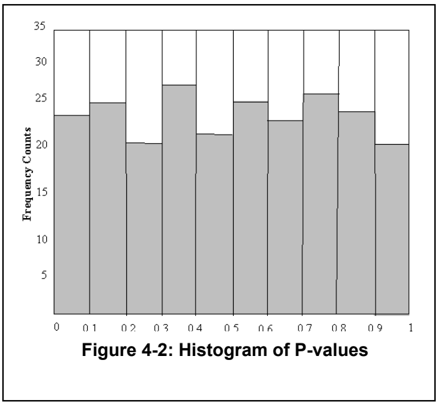
- Main analysis: For each sequence, P-values are computed and compared to \(\alpha\); empirical interpretation examines the proportion of sequences passing a test and the uniformity of P-values. A multiple-test dependence study applied 161 test P-values to Blum-Blum-Shub sequences of length 1,000,000 and used principal components/factor analysis, concluding there was no large redundancy among tests.
Limitations
- The paper states that no set of statistical tests can absolutely certify a generator as appropriate, that statistical testing cannot substitute for cryptanalysis, and that generator design and cryptanalysis are outside its scope.
- The paper states that many examples use small sample sizes for illustration only, e.g., \(n=10\), where the normal approximation is not really applicable; many tests rely on asymptotic reference distributions for large \(n\) (order \(10^3\) to \(10^7\)), and input parameter constraints apply.
- The text makes evident additional limitations: numerical precision can degrade for large incomplete gamma parameter \(a\); Maurer’s variance approximation can make the test 2.67 times more permissive than theoretically admitted; Random Excursions is discontinued if \(J<500\); and multiple tests can yield contradictory conclusions, as in the Random Excursions example where one state gave a non-random result while seven states gave random results.
Model-written summary. Check it against the paper before relying on it.
Integrity signals
Registry
Cites
Statistics
Figures

Verification
Claims the paper makes
0 Valid · 1 Not valid · 11 Not checked · 13 Own results and interpretations
A result the paper reports from its own data — it cites no other source for it, so there is none to check. The quote shows it is in the paper.
In the paper
“The asymptotic distribution of ( Ln -µ n ) / σ n along the sequence of even or odd values of n is that of a discrete random variable obtained via a mixture of two geometric random variables (one of them taking only negative values). Strictly speaking, the asymptotic distribution as such does not exist.”
A result the paper reports from its own data — it cites no other source for it, so there is none to check. The quote shows it is in the paper.
In the paper
“However, no set of statistical tests can absolutely certify a generator as appropriate for usage in a particular application, i.e., statistical testing cannot serve as a substitute for cryptanalysis.”
A result the paper reports from its own data — it cites no other source for it, so there is none to check. The quote shows it is in the paper.
In the paper
“This graph showed that there is no large redundancy among our tests.”
In the paper
“Ueli Maurer of the Department of Computer Science at Princeton University introduced this test in 1992. Maurer's test statistic relates closely to the per-bit entropy of the stream, which its author asserts is 'the correct quality measure for a secret-key source in a cryptographic application.'”
What the sources say
- Not matchedcites Maurer
This doesn’t read as a citation we can look up.
- Not matched
What the paper did — it cites no source for this, so there is none to check. The quote shows it is in the paper.
In the paper
“The test rejects the randomness hypothesis immediately if J is too small, i.e., if the following P-value is small:”
20 more claims
Create a free account to see all 25 claims and every source verdict.
Claims other papers make about this one
Each is checked against this paper’s own text: does it say what the citing paper says it does?
The source backs part of the claim, not all of it — or backs it for a different population, condition or comparison.
In the citing paper
“However, the latest version 2.1.2 [1], released in 2014, does not incorporate several modifications.”
From Checking the quality of approximation of p-values in statistical tests for random number generators by using a three-level test (2019) · cites this paper as [1]
Experimental — accuracy not yet measuredThe source backs part of the claim, not all of it — or backs it for a different population, condition or comparison.
In the citing paper
“The NIST test suite consists of 15 statistical tests for randomness of bit sequences, and its result is a list of 188 p -values.”
From Checking the quality of approximation of p-values in statistical tests for random number generators by using a three-level test (2019) · cites this paper as [1]
Experimental — accuracy not yet measuredThe cited source says what the claim attributes to it.
In the citing paper
“Note that the current implementation of the NIST test suite uses one-level or two-level tests, differently from the above experiments”
From Checking the quality of approximation of p-values in statistical tests for random number generators by using a three-level test (2019) · cites this paper as [1]
The cited source says what the claim attributes to it.
In the citing paper
“NIST SP-800.22 statistical test suite [90] and Die-hard test suite [91] and Test U01 [92] and AIS31 [93] are most common statistical test suites to evaluate their RNGs by researchers.”
From True Random Number Generators Using Electrical Noise (2019) · cites this paper as [90]
Self-check
Percentages, sums and reported differences re-computed from the paper’s own numbers.
Each contradiction between two passages listed here was confirmed by an independent check.
Rated minor: it would not touch a result — a value no result rests on, a p-value that stays on the same side of the significance level, or a conflict that is clerical, resolved elsewhere in the paper, or outside its own findings.
In the paper
§ 2.3.8 Example
“(input) τ = 0.02 (processing) π = 0.42 (processing) Vn(obs) = 52 (output) P-value = 0.500798 (conclusion) Since P-value ≥ 0.01 , accept the sequence as random.”
§ 2.3.4 Test Description
“If it can be shown that π -1 ≥τ , then the 2 Runs test need not be performed (i.e., the test should not have been run because of a failure to pass test 1, the Frequency (Monobit) test). If the test is not applicable, then the P-value is set to 0.0000.”
Rated minor: it would not touch a result — a value no result rests on, a p-value that stays on the same side of the significance level, or a conflict that is clerical, resolved elsewhere in the paper, or outside its own findings.
In the paper
§ 2.7.4 Test Description
“| 8-10 | 010 (hit) | 2 | 110 | 1 |”
§ 2.7.4 Test Description
“For the above example, if m = 3 and the template B = 001, then the examination proceeds as follows:”
Rated minor: it would not touch a result — a value no result rests on, a p-value that stays on the same side of the significance level, or a conflict that is clerical, resolved elsewhere in the paper, or outside its own findings.
In the paper
§ 2.9.3 Test Statistic and Reference Distribution
“f n : The sum of the log2 distances between matching Lbit templates, i.e., the sum of the number of digits in the distance between Lbit templates.”
§ 3.9 Maurer's 'Universal Statistical' Test
“Then it averages over all the expansion lengths by the number of test blocks.”
Rated minor: it would not touch a result — a value no result rests on, a p-value that stays on the same side of the significance level, or a conflict that is clerical, resolved elsewhere in the paper, or outside its own findings.
In the paper
§ Input Parameters:
“The parameters p , q and s are not fixed in code; thus, the user will not be able to reconstruct the original sequence because these values will vary (i.e., they are dependent on the system time).”
§ Input Parameters:
“The input parameters have been fixed so the code will reproduce the same results.”
Rated minor: it would not touch a result — a value no result rests on, a p-value that stays on the same side of the significance level, or a conflict that is clerical, resolved elsewhere in the paper, or outside its own findings.
In the paper
§ 5.5.2 Global Parameters
“| MAXNUMOFTEMPLATES | 40 | Non-overlapping Templates Test | | NUMOFTESTS | 16 | Max number of tests | | NUMOFGENERATORS | 12 | Max number of PRNGs |”
§ A.2 Configuration Information
“| 2. | #define MAXNUMOFTEMPLATES | 148 | | 3. | #define NUMOFTESTS | 15 | | 4. | #define NUMOFGENERATORS | 10 |”
2 more findings
Create a free account to see every finding of this check.
Citations
Cites
Handbook of Mathematical Functions
McQuarrie, D. A. (1966) · American Journal of Physics · doi:10.1119/1.1972842 · Cited by 40,433
Numerical recipes in C: the art of scientific computing
(1993) · Choice Reviews Online · doi:10.5860/choice.30-5638 · Cited by 17,933
Rayward-Smith, V. J. (1991) · Journal of the Operational Research Society · doi:10.1057/jors.1991.155 · Cited by 16,821
Handbook of applied cryptography
(1997) · Choice Reviews Online · doi:10.5860/choice.34-4512 · Cited by 10,357
Handbook of Mathematical Functions
(2018) · A Century of Excellence in MEASUREMENTS, STANDARDS, and TECHNOLOGY · doi:10.1201/9781351069397-39 · Cited by 9,062
A universal algorithm for sequential data compression
Ziv, J., & Lempel, A. (1977) · IEEE Transactions on Information Theory · doi:10.1109/tit.1977.1055714 · Cited by 5,456
The Art of Computer Programming
Worlton, W. J. (1968) · Nuclear Science and Engineering · doi:10.13182/nse68-a19548 · Cited by 2,251
Handbook of Applied Cryptography
Menezes, A. J., van Oorschot, P. C., & Vanstone, S. A. (2018) · CRC Press eBooks · doi:10.1201/9780429466335 · Cited by 1,770
Numerical Recipes in C-The Art of Scientific Computing.
G., W., Press, W. H., Flannery, B. P., Teukolsky, S. A., & Vetterling, W. T. (1989) · Mathematics of Computation · doi:10.2307/2008673 · Cited by 1,513
The Fourier Transform and its Applications
Cattermole, K. W. (1965) · Electronics and Power · doi:10.1049/ep.1965.0268 · Cited by 1,417
Cited by
Items 2,401–2,500 of 3,620
Simple chain automaton random number generator for IoT devices
Dömösi, P., Horváth, G., & Tihanyi, N. (2023) · Acta Informatica · doi:10.1007/s00236-023-00440-w · Cited by 4
“The National Institute of Standards and Technology (NIST) published a statistical package consisting of 15 statistical tests that were developed to test the randomness of arbitrarily long binary sequences produced by either hardware- or software-based cryptographic random or pseudorandom number generators [18].”
MethodInfluentialAn Ultra-Light PRNG for RFID Tags
Özcanhan, M. H., Dalkılıç, G., & Gürle, M. C. (2012) · Springer eBooks · doi:10.1007/978-1-4471-4594-3_24 · Cited by 3
“In testing PRNGs, the ENT [24], Diehard (versions 1, 2) [25] and NIST [26] randomness tests are used for comparison with the previous work.”
MethodA Data Confidentiality Approach to SMS on Android
Aung, T. M., Myint, K. H., & Hla, N. N. (2018) · Advances in intelligent systems and computing · doi:10.1007/978-3-030-00979-3_53 · Cited by 3
“, whether the pseudorandom number generator is (or is not) producing random values, based on the pseudorandom number sequence that was produced [4].”
BackgroundThe Impact of Post-processing Functions on Random Number Sequences
Marton, K., Parvu, L., & Suciu, A. (2018) · RoEduNet Conference: Networking in Education and Research (RoEduNet) · doi:10.1109/roedunet.2018.8514140 · Cited by 3
Design Principles for True Random Number Generators for Security Applications
Grujić, M., Rožić, V., Johnston, D., et al. (2019) · Proceedings - ACM IEEE Design Automation Conference · doi:10.1145/3316781.3323482 · Cited by 3
“, NIST SP 800-22 [12], FIPS 140-1 [9], DIEHARD [8]).”
An Efficient and Secure Variant of RC4 Stream Cipher Scheme for Emerging Networks
Noura, H., & Chehab, A. (2019) · IEEE Wireless Communications and Networking Conference · doi:10.1109/wcnc.2019.8885977 · Cited by 3
Efficient Pseudo-chaotic Number Generator for Cryptographic Applications
Qiao, Z., Taralova, I., & Assad, S. E. (2020) · International Journal of Intelligent Computing Research · doi:10.20533/ijicr.2042.4655.2020.0126 · Cited by 4
“In the NIST results report, P-value larger than = 0.01 means that the sequence would be random with a confidence of 1- ) =99% [16].”
BackgroundInfluentialRandom Number Generator Based on Skew-tent Map and Chaotic Sampling
Ergün, S., & Tanrıseven, S. (2020) · IEEE Asia Pacific Conference on Circuits and Systems (APCCAS) · doi:10.1109/apccas50809.2020.9301661 · Cited by 5
Contribución al estudio del criptoanálisis y diseño de los criptosistemas caóticos
López, A. O. (2013) · UPM Digital Archive (Technical University of Madrid) · doi:10.20868/upm.thesis.15395 · Cited by 7
Erat, M., Danışman, K., Ergün, S., Kanak, A., & Kayaoğlu, M. (2007) · Lecture notes in computer science · doi:10.1007/978-3-540-74272-2_46 · Cited by 3
“To provide this condition a test mechanism in which full NIST random number test suite[12] performing in software which is physically independent from the FPGA is added.”
MethodA Chaotic Cipher Mmohocc and Its Randomness EvaluationPreprint
Zhang, X., Tang, K., & Shu, L. (2006) · arXiv (Cornell University) · doi:10.48550/arxiv.cs/0605066 · Cited by 3
Randomness Evaluation and Hardware Implementation of Nonadditive CA-Based Stream CipherPreprint
Kim, S.-J., & Umeno, K. (2004) · arXiv (Cornell University) · doi:10.48550/arxiv.nlin/0412028 · Cited by 3
“We originally found that these CAs do not pass the linear complexity test which is one of the NIST statistical tests [14].”
BackgroundMethodCryptanalysis of the GST stream cipher
Lee, I., Simmons, S. J., & Tavares, S. E. (2004) · doi:10.1109/ccece.2003.1226257 · Cited by 3
Physical random number generators for cryptographic application in mobile devices
Yasuda, S., Tanamoto, T., Ohba, R., Abe, K., Nozaki, H., & Fujita, S. (2005) · European Solid-State Circuits Conference (ESSCIRC) · doi:10.1109/esscir.2005.1541644 · Cited by 3
Developing pseudo random number generator based on neural networks and neurofuzzy systems
Tirdad, K. (2021) · doi:10.32920/ryerson.14644767 · Cited by 4
Pseudo Random test of prime numbersPreprint
Wang, L., & Yan, H. (2006) · arXiv (Cornell University) · doi:10.48550/arxiv.math/0603450 · Cited by 3
Network analysis of the state space of chaotic map in digital domain.Preprint
Li, C. (2014) · arXiv (Cornell University) · Cited by 3
The KISS principle in Software-Defined Networking: An architecture for Keeping It Simple and SecurePreprint
Kreutz, D., Yu, J., Esteves-Verissimo, P., et al. (2017) · arXiv (Cornell University) · doi:10.48550/arxiv.1702.04294 · Cited by 3
Quantifying Studies of (Pseudo) Random Number Generation for Cryptography
Roeck, A., & Sendrier, N. (2009) · OpenGrey (Institut de l'Information Scientifique et Technique) · Cited by 3
Controlling false discoveries in Bayesian gene networks with lasso regression p-valuesPreprint
Wang, L., & Michoel, T. (2018) · bioRxiv (Cold Spring Harbor Laboratory) · doi:10.1101/288217 · Cited by 5
“Although the possible feature space has infinite dimensions, there are typical bias features which network inference methods tend to produce, and therefore should be tested, as for random number generators [28].”
BackgroundTesting Randomness in Quantum MechanicsPreprint
Martinez-Becerril, A. C., Solís, A., Rojas, R. D. H., et al. (2018) · arXiv (Cornell University) · doi:10.48550/arxiv.1810.08718 · Cited by 3
“Although a myriad of methods exist which permit testing the quality of random number generators, for example the NIST benchmark [9], we focus solely on two recently introduced approaches: the first one is based on algorithmic complexity theory evaluating incompressibility and bias at the same time, since a incompressi…”
MethodNoise-immunity Kazan quantum line at 143 km regular fiber linkPreprint
Bannik, O. I., Gilyazov, L. R., Gleim, A. V., Perminov, N. S., Melnik, K. S., Arslanov, N. M., Litvinov, A. A., Yafarov, A. R., & Moiseev, S. A. (2019) · arXiv (Cornell University) · doi:10.48550/arxiv.1910.10011 · Cited by 5
“However, it is well known that the quantitative proof of the randomness of the number generator, which is the most significant primitive of any true quantum crypto-system, uses at least 20-30 different statistical tests (NIST, U1) [75, 87, 88].”
Deep Learning-based Physical-Layer Secret Key Generation for FDD SystemsPreprint
Zhang, X., Li, G., Zhang, J., et al. (2021) · arXiv (Cornell University) · doi:10.48550/arxiv.2105.08364 · Cited by 3
“The National Institute of Standards and Technology (NIST) statistical test [40] will be used for the randomness test for the key.”
MethodTesting, Selection, and Implementation of Random Number Generators
Collins, J. C. (2008) · doi:10.21236/ada486379 · Cited by 3
“J(Z) = z(30)+z(27)+z(26)+z(25)+z(24)+z(23)+z(21)+z(20)+z(19)+z(18) +z(14)+z(12)+z(9) +z(8) +z(5) , (12)”
On-Chip True Random Number Generation in Nanometer Cmos
Suresh, V. (2012) · Scholarworks (University of Massachusetts Amherst) · doi:10.7275/2405654 · Cited by 6
METHOD OF LOW-RESOURCE HASHING TYPE "DATA – GENERATOR"
Seleznov, V., & Лужецький, В. А. (2023) · Cybersecurity Education Science Technique · doi:10.28925/2663-4023.2023.22.8495 · Cited by 8
Improving the Security of the LCB Block Cipher Against Deep Learning-Based Attacks
Aishwarya, I., Lakshmy, K. V., Srinivasan, C., Mishra, G., Pal, S. K., & Sethumadhavan, M. (2024) · Cryptography · doi:10.3390/cryptography8040055 · Cited by 2
Robust and Lightweight Challenge Obfuscation Mechanism for Anti-modeling Protection of Arbiter-PUFs
Ebrahimabadi, M., Younis, M., Mehjabin, S. S., et al. (2024) · Journal of Hardware and Systems Security · doi:10.1007/s41635-024-00157-3 · Cited by 2
Length–Weight Distribution of Non-Zero Elements in Randomized Bit Sequences
Ahrens, A., Lange, C., Krishnakumar, Y. K., & Grote, O. (2025) · Sensors · doi:10.3390/s25123825 · Cited by 2
Rezayati, M. H., Amirany, A., Moaiyeri, M. H., & Jafari, K. (2025) · International Journal of Machine Learning and Cybernetics · doi:10.1007/s13042-025-02714-w · Cited by 5
“Another critical point is to check the randomness of MTJ state changes in the stochastic mode for 53µA switching current, which has been investigated using the NIST test (SP800-22) [49 ].”
High-Throughput Pseudo-Random Number Generators Over Discrete Chaos
Souza, C. E. C., Moreno, D., Sousa, M. H. S., Chaves, D. P. B., & Pimentel, C. J. L. (2025) · IEEE Transactions on Circuits & Systems II Express Briefs · doi:10.1109/tcsii.2025.3585809 · Cited by 3
“The statistical properties of the proposed PRNGs are analyzed using the statistical test suite NIST, version SP 800-22 [15], and the TestU01 [16], including the Alphabit and Rabbit batteries.”
New proofs for pseudorandomness of HMAC-based key derivation functions (RFC 5869)
Hoang, D. L., Lượng, T. T., & Nguyen, V. L. (2025) · Journal of Information Security and Applications · doi:10.1016/j.jisa.2025.104179 · Cited by 2
Hardware implementation of a novel chaos-based cryptosystem for secure image transmission
Amdouni, R., Madani, M., Hajjaji, M. A., Bourennane, E., & Atri, M. (2025) · Integration · doi:10.1016/j.vlsi.2025.102554 · Cited by 2
Jain, S., & Kumar, A. (2025) · International Journal of Mathematical Engineering and Management Sciences · doi:10.33889/ijmems.2025.10.6.096 · Cited by 2
Physical-Layer Secure Optical Transmission Based on Randomized Quantization Noise
Luo, H., Zhang, Z., Dai, L., Wu, D., Yang, Q., Deng, L., Liu, D., Dai, X., & Cheng, M. (2025) · IEEE Transactions on Information Forensics and Security · doi:10.1109/tifs.2025.3620673 · Cited by 3
A new scalable evaluation method for random number generators: a permutation-based approach
Etem, T. (2025) · Communications in Statistics - Simulation and Computation · doi:10.1080/03610918.2025.2588690 · Cited by 2
Li, Z., Tong, L., & Li, C. (2025) · IEEE Journal on Emerging and Selected Topics in Circuits and Systems · doi:10.1109/jetcas.2025.3638254 · Cited by 2
Tian, E., Hai, H., Jiang, X.-Q., Bai, E., Chen, G., Huang, P., & Zeng, G. (2025) · IEEE photonics journal · doi:10.1109/jphot.2025.3638669 · Cited by 2
“Notably, higher p-values correspond to better randomness [25].”
Gajbhiye, P., Turankar, A., & Dhone, M. (2025) · International Conference on Sustainability, Innovation & Technology (ICSIT) · doi:10.1109/icsit65336.2025.11295049 · Cited by 2
Mo, Z., Guo, C., Yang, Y., et al. (2025) · Globecom · doi:10.1109/globecom59602.2025.11431972 · Cited by 2
“The key randomness is evaluated using a statistical test set provided by the National Institute of Standards and Technology (NIST) [13].”
Mahadeer, A., & Arulprakasam, R. (2026) · Information Sciences · doi:10.1016/j.ins.2026.123515 · Cited by 2
Image encryption using Petri net dynamics with pixel permutation and keystream masking
Mahadeer, A., & Arulprakasam, R. (2026) · Nonlinear Dynamics · doi:10.1007/s11071-026-12413-y · Cited by 3
“The NIST suite provides a broad range of tests to determine the randomness of binary sequences, a key factor in evaluating the cryptographic integrity of techniques [35].”
Garasym, O., Taralova, I., & Lozi, R. (2015) · Indian Journal of Industrial and Applied Mathematics · doi:10.5958/1945-919x.2015.00001.8 · Cited by 2
DES SECURITY ENHANCEMENT USING GENETIC ALGORITHM
Mohammed, A. E., & Ali, S. F. A. (2004) · Cited by 2
Pandian, K. K. S., & Ray, K. C. (2015) · Security and Communication Networks · doi:10.1002/sec.1318 · Cited by 2
“Based on the procedure given in the NIST [26], pvalues are computed for the non-recursive pseudorandom key sequences (k0, k1, k2, k3), and effectively it passes the statistical test suites as shown in Table III.”
BackgroundMethodInfluentialTantra: A fast PRNG algorithm and its implementation
Gomathisankaran, M., & Lee, R. B.-L. (2009) · University of North Texas Digital Library (University of North Texas) · Cited by 2
Towards Cryptographic Function Distinguishers with Evolutionary Circuits
Švenda, P., Ukrop, M., & Matyáš, V. (2013) · International Conference on Security and Cryptography · doi:10.5220/0004524001350146 · Cited by 4
Designing stream ciphers with scalable data-widths: a case study with HC-128
Paul, G., & Chattopadhyay, A. (2014) · Journal of Cryptographic Engineering · doi:10.1007/s13389-014-0071-0 · Cited by 2
Cryptography: all-out attacks or how to attack cryptography without intensive cryptanalysis
Bedrune, J.-B., Filiol, É., & Raynal, F. (2009) · Journal of Computer Virology and Hacking Techniques · doi:10.1007/s11416-008-0117-x · Cited by 2
Randomness enhancement for a Digitalized Modified-Logistic Map based Pseudo Random Number Generator
Chen, S.-L., Hwang, T., & Lin, W. (2010) · International Symposium on VLSI Design, Automation and Test · doi:10.1109/vdat.2010.5496716 · Cited by 2
ONE METHOD FOR GENERATING UNIFORM RANDOM NUMBERS VIA CIVIL AIR TRAFFIC
Tatović, M., Adamović, S., Jevremović, A., et al. (2014) · International Scientific Conference Sinteza · doi:10.15308/sinteza-2014-606-609 · Cited by 2
Osama, M., & Hussein, A. I. (2015) · International Conference on Computer Engineering & Systems (ICCES) · doi:10.1109/icces.2015.7393009 · Cited by 2
JPEG2000 Compatible Layered Block Cipher
Memon, Q. A. (2016) · Intelligent systems reference library · doi:10.1007/978-3-319-44270-9_11 · Cited by 2
Securing Passwords Beyond Human Capabilities with a Wearable Neuro-Device
López-Gordo, M. A., Minguillón, J., Valenzuela-Valdés, J. F., Padilla, P., Padilla, J. L., & Pelayo, F. J. (2017) · Lecture notes in computer science · doi:10.1007/978-3-319-59773-7_10 · Cited by 3
Pseudorandom number generator on cellular automata
Mukhamedjanov, D., & Levina, A. B. (2018) · Scientific and technical journal of information technologies mechanics and optics · doi:10.17586/2226-1494-2018-18-5-894-900 · Cited by 3
Analysis and improvements of the pseudorandom number generation in passive UHF-RFID tags
Blanco, J., García, A., & Cañas, V. (2019) · Future generations computer systems · doi:10.1016/j.future.2019.04.021 · Cited by 2
Cayabyab, G. T., Sison, A. M., & Medina, R. P. (2019) · International Conference on Computing and Big Data (ICCBD) · doi:10.1145/3366650.3366659 · Cited by 2
Approved algorithmic security enhancement of stream cipher for advanced mobile communications
Abdelwahab, Z. H., Elgarf, T. A., & Zekry, A. (2020) · Information Security Journal A Global Perspective · doi:10.1080/19393555.2020.1773584 · Cited by 2
Propose a new approach for key generation based on Chicken Swarm Optimization and HTML Parser
Malalla, S., & Ali, A. H. (2020) · Al-Mustansiriyah Journal of Sciences · doi:10.23851/mjs.v31i3.728 · Cited by 2
Securing images using chaos and multidimensional Playfair cipher
Bhat, K., & Mahto, D. (2020) · International Conference on Electronics, Communication and Aerospace Technology (ICECA) · doi:10.1109/iceca49313.2020.9297509 · Cited by 2
“To test the randomness, 15 randomness tests proposed in NIST SP 800-22 Revision 1a [29] are applied to the cipher images.”
MethodImproving Pseudo-random Number Generators in a Floating-point Implementation
Вадимовна, Т. А., Karimov, A. I., Fedoseev, P. S., Moysis, L., VOLOS, C. K., & Бутусов, Д. (2020) · International Conference Nonlinearity, Information and Robotics (NIR) · doi:10.1109/nir50484.2020.9290195 · Cited by 3
“To study the pseudo-random properties of bit sequences, we used the statistical testing suite proposed by the National Institute of Standards and Technology (NIST) [14].”
MethodSudarsono, A., & Yuliana, M. (2021) · International Electronics Symposium (IES) · doi:10.1109/ies53407.2021.9594007 · Cited by 2
Kaçar, S. (2021) · The European Physical Journal Special Topics · doi:10.1140/epjs/s11734-021-00320-9 · Cited by 3
Khan, N. A., Akbar, S., Qureshi, M. A., & Hameed, T. (2022) · Elsevier eBooks · doi:10.1016/b978-0-32-390090-4.00013-5 · Cited by 3
NMRMG: Nonlinear Multiple-Recursive Matrix Generator Design Approaches and Its Randomness Analysis
Deb, S., Pal, S., & Bhuyan, B. (2022) · Wireless Personal Communications · doi:10.1007/s11277-022-09566-5 · Cited by 2
Nano-intrinsic security primitives with redox-based resistive memory
Kim, J. (2022) · Frontiers in Communications and Networks · doi:10.3389/frcmn.2022.884874 · Cited by 2
Robust image compression‐encryption via scrambled block bernoulli sampling with diffusion noise
Chen, Z., Ma, C., Wang, T., Feng, Y., Hou, X., & Qian, X. (2022) · IET Image Processing · doi:10.1049/ipr2.12731 · Cited by 2
Fast secret key-sharing method based on channel information and chaos randomization
Abe, T., Asano, K., Kato, K., et al. (2023) · IEICE Communications Express · doi:10.1587/comex.2023xbl0007 · Cited by 2
Souza, C. E. C., Moreno, D., Figueiredo, R. B. D., et al. (2023) · IEEE Transactions on Circuits & Systems II Express Briefs · doi:10.1109/tcsii.2023.3247242 · Cited by 2
Statistical Tests for Symmetric Primitives: An Application to NIST Lightweight Finalists
Bellini, E., Huang, Y. J., & Rachidi, M. (2023) · Lecture notes in computer science · doi:10.1007/978-3-031-32636-3_8 · Cited by 2
Testing and reliability enhancement of security primitives: Methodology and experimental validation
Anik, M. T. H., Danger, J., Diankha, O., Ebrahimabadi, M., Frisch, C., Guilley, S., Karimi, N., Pehl, M., & Takarabt, S. (2023) · Microelectronics Reliability · doi:10.1016/j.microrel.2023.115055 · Cited by 3
Jóźwiak, P. P. (2023) · Communications in computer and information science · doi:10.1007/978-3-031-41774-0_51 · Cited by 2
Domain Isolation and Access Control in Multi-tenant Cloud FPGAs
Bobda, C., Mbongue, J. M., Saha, S. K., & Ahmed, M. K. (2023) · Springer eBooks · doi:10.1007/978-3-031-45395-3_2 · Cited by 2
Passive Eavesdropping Can Significantly Slow Down RIS-Assisted Secret Key Generation
Xu, N., Nan, G., & Tao, X. (2023) · Globecom · doi:10.1109/globecom54140.2023.10437788 · Cited by 2
“In this paper, NIST randomness test is used to evaluate the randomness of keys [23].”
MethodTsurumaru, T., Ichikawa, T., Takubo, Y., Sasaki, T., Lee, J., & Tsutsui, I. (2024) · Physical Review A · doi:10.1103/physreva.109.022243 · Cited by 4
“[37]): If x fails the test (i.e., if D I ( I ( x )) = 1) one can safely conclude the source of x is a bad one (in our case, a PRNG), but even if x passes the test (i.e., if D I ( I ( x )) = 0) it does not necessarily mean that the source was a good one (in our case, a QRNG).”
BackgroundSecure quantum random number generation with perovskite photonics
Argillander, J., Alarcón, A., Bao, C., Kuang, C., Lima, G., Gao, F., & XAVIER, G. B. (2024) · Quantum Computing, Communication, and Simulation · doi:10.1117/12.2692061 · Cited by 2
“17”
ChaCha20-AES Combined Algorithm with 512 Bits of Security
ElRashidy, A. M., AlAzeem, M. H. A., Elhafez, A. A., & Sree, M. F. A. (2024) · International Youth Conference on Radio Electronics, Electrical and Power Engineering (REEPE) · doi:10.1109/reepe60449.2024.10479797 · Cited by 5
“In this section, The well-known NIST’s statistical test tool [28] for randomness test is applied to a sample file with a size of 20 MB encrypted by the proposed AES modifications.”
MethodImplement quantum random number generation on the IBM quantum computer platform
Luc, N.-Q., & Anh, L. V. (2024) · The Transport and Communications Science Journal · doi:10.47869/tcsj.75.4.14 · Cited by 4
A Multi-stage Encryption Technique Using Asymmetric and Various Symmetric Ciphers
Rahman, M. H., Alam, K. M. R., & Morimoto, Y. (2024) · Communications in computer and information science · doi:10.1007/978-3-031-62217-5_27 · Cited by 2
Anurag, K. S. V., Raghavan, G., & Kanaka Raju, P. (2024) · Physica Scripta · doi:10.1088/1402-4896/ad587f · Cited by 5
S-Boxes with Optimal Strict Avalanche Criterion using Chaotic Map
Duong, P.-P., Nguyễn, M. H., Dao, B.-A., et al. (2024) · International Conference on Integrated Circuits, Design, and Verification (ICDV) · doi:10.1109/icdv61346.2024.10616714 · Cited by 2
Harvesting RTN for True Random Number Generators and Physical Unclonable Functions
Rubio-Barbero, F. J., Santos-Prieto, F. D. L., Castro-Lopez, R., et al. (2024) · International Conference on Synthesis, Modeling, Analysis and Simulation Methods and Applications to Circuit Design · doi:10.1109/smacd61181.2024.10745416 · Cited by 2
Harvesting Physical-Layer Randomness in Millimeter Wave Bands
Xu, Z., Li, J., Pan, Y., Li, M., & Lazos, L. (2024) · IEEE Transactions on Mobile Computing · doi:10.1109/tmc.2024.3499876 · Cited by 4
Bipolar Random Signal Generation With Electrical Operation Based on Two Magnetic Tunnel Junctions
Jian, J., Yuan, X., Chai, Z., Zhou, X., Luo, Y., He, Y., Yue, X. Y., Zhang, J. F., Zhang, W., & Min, T. (2024) · IEEE Electron Device Letters · doi:10.1109/led.2024.3515147 · Cited by 2
“Moreover, NIST STS was used to examine the randomness quality of data by comparing its certain characteristics with the expected test statistic that is precomputed for random infinite sequences [29].”
Random Number Generation Based on Cryptocurrency Prices and Linear Feedback Shift Register
Chiba, A., & Ichikawa, S. (2024) · International Symposium on Computing and Networking · doi:10.1109/candar64496.2024.00024 · Cited by 2
Multi-agent Deep Reinforcement Learning-based Key Generation for Graph Layer Security
Wang, L., Wei, Z., & Guo, W. (2025) · ACM Transactions on Privacy and Security · doi:10.1145/3711900 · Cited by 3
A chaotic digital signature algorithm based on a dynamic substitution box
Flores-Carapia, R., Silva-García, V. M., Cardona-López, M. A., & Villarreal-Cervantes, M. G. (2025) · Scientific Reports · doi:10.1038/s41598-024-83943-x · Cited by 5
Ndokaj, E., Metalla, O., Pupa, S., et al. (2024) · doi:10.1109/q-bats63267.2024.10873866 · Cited by 2
“The results from the NIST tests show strong randomness characteristics, confirming the effectiveness of the proposed generation method [1].”
Two dimensional chaotic scheme for image encryption in FPGA
Sarkar, P., Das, A. K., Saha, A., & Mandal, M. K. (2025) · Analog Integrated Circuits and Signal Processing · doi:10.1007/s10470-025-02401-4 · Cited by 2
Improving e-Health Security with Lightweight Cryptography for Enhanced Protection
Bhuvaneshwari, A. J., Kaythry, P., & Kumar, K. J. J. (2025) · International Conference on Wireless Communications, Signal Processing and Networking (WiSPNET) · doi:10.1109/wispnet64060.2025.11004985 · Cited by 2
Jao, J., Plusquellic, J., Hoffman, K., et al. (2025) · Journal of Hardware and Systems Security · doi:10.1007/s41635-025-00162-0 · Cited by 2
“The statistical quality of the generated bitstrings for each of the device classes are compared to evaluate the impact of the FPGA fabric primitives, interconnect components and manufacturing technology on the level of entropy and noise.”
Aribilola, I., Alsamhi, S. H., Breslin, J. G., & Asghar, M. N. (2025) · International Journal of Critical Infrastructure Protection · doi:10.1016/j.ijcip.2025.100786 · Cited by 4
FPGA-Based ANN-Hyperchaotic PRNG for Secure Audio Applications
Azzaz, M. S., Alloun, Y., Kifouche, A., et al. (2025) · International Conference on Advanced Computational Intelligence (ICACI) · doi:10.1109/icaci65340.2025.11096221 · Cited by 2
“2) Randomness analysis: To evaluate the randomness of the encrypted bitstream generated by the implemented cryptosystem, we applied the NIST statistical test suite [25].”
Li, Z., Xu, P., Gao, Q., et al. (2025) · Frontiers of Information Technology & Electronic Engineering · doi:10.1631/fitee.2400799 · Cited by 2
Kemdoum, F. N., Naoussi, S. R. D., Kuete, G. P. A., & Pone, J. R. M. (2025) · Engineering Reports · doi:10.1002/eng2.70383 · Cited by 2
Ji, S., Tong, X., & Zhang, M. (2013) · Journal of Electronic Imaging · doi:10.1117/1.jei.22.1.013017 · Cited by 41
STATISTICAL ANALYSIS OF PSEUDORANDOM BINARY SEQUENCES GENERATED BY USING TENT MAP
Ilyas, A., Vlad, A., & Luca, A. (2013) · Cited by 2
A Randomness Test Based on the Distribution of Position for Pre-Specified Pattern
Zhu, S. (2015) · International Conference on Computer Science and Mechanical Automation (CSMA) · doi:10.1109/csma.2015.40 · Cited by 2
Phase Calibrated Ring Oscillator PUF Design and Application
Yan, W. Q., & Chandy, J. A. (2018) · Computers · doi:10.3390/computers7030040 · Cited by 2
A Pseudo-Random Number Generator Based on Delay Coupled Map Lattice
Lv, X., Mu, N., & Liao, X. (2018) · International Conference on Information Science and Technology · doi:10.1109/icist.2018.8426130 · Cited by 2
“The pseudo-random sequences generated by the proposed DCML successfully pass NIST 800-22 [16] and the results are shown in Table I.”
Method
Metadata
- Authors
- Bassham, L. E., Rukhin, A. L., Soto, J., Nechvatal, J. R., Smid, M. E., Barker, E. B., Leigh, S. D., Levenson, M., Vangel, M., Banks, D. L., Heckert, N. A., Dray, J. F., & Vo, S.
- Affiliations
- National Institute of Standards and Technology (US)
- Venue
- NIST Special Publication 800-22 Revision 1a
- Published
- 2010
- OpenAlex
- W1517403092
- Semantic Scholar
- 961fc0f6c68303cde94a28fdb24e6eaf3ef040b4
- Cited by
- 3,617
- References
- 34
- Citations by year
- 2026: 128 · 2025: 205 · 2024: 192 · 2023: 208 · 2022: 166 · 2021: 291 · 2020: 290 · 2019: 250 · 2018: 254 · 2017: 207 · 2016: 183 · 2015: 184 · 2014: 201 · 2013: 155 · 2012: 139
- Type
- report
- Language
- en
- Open access
- gold
- doi.org
- Topics
- Physical Sciences › Computer Science › Artificial Intelligence › Cryptographic Implementations and Security
- Physical Sciences › Mathematics › Discrete Mathematics and Combinatorics › Coding theory and cryptography
- Physical Sciences › Computer Science › Computer Vision and Pattern Recognition › Chaos-based Image/Signal Encryption
- Keywords
- random number generators, pseudorandom number generators, cryptographic randomness, NIST SP 800-22, randomness testing
About these checks
Registry, retraction, Cites and statistics results are computed, not judged, with one exception: a printed reference that no index lists is read once by a model before it counts as a citation error. Claims are extracted by a model and kept only when their quote appears verbatim in the text; each cited source is then checked, with a model’s help, for whether it says what the claim relies on. Those verdicts can be wrong — read the claim’s quote and the cited source before relying on one.
A language model drew the claims from the paper on 2026-09-27 (prompt extract-v2).
Statistics and arithmetic are recomputed, not judged.
Confidence bands are shown only for fields calibrated on our annotated test set. None is calibrated yet, so no band is shown.
What counts as a claim ›How we measure confidence ›How we check this ›
Are you an author, or do you see a problem with this page? Request a review
Data sources
Bibliographic data: Semantic Scholar, OpenAlex, Crossref.
Contains information from the Semantic Scholar Academic Graph Datasets, made available under the ODC Attribution License (ODC-BY 1.0).
Semantic Scholar’s data is described in: Kinney, R., et al. (2023). The Semantic Scholar Open Data Platform. arXiv:2301.10140.
