

A statistical test suite for random and pseudorandom number generators for cryptographic applications
Open accessThe DOI matches its Crossref record; 33 of the 34 references it cites were found in a registry or an index; none of the 14 sources its claims cite is checked for support yet.
Abstract
The Information Technology Laboratory (ITL) at the National Institute of Standards and Technology (NIST) promotes the U.S. economy and public welfare by providing technical leadership for the nation's measurement and standards infrastructure. ITL develops tests, test methods, reference data, proof of concept implementations, and technical analysis to advance the development and productive use of information technology. ITL's responsibilities include the development of technical, physical, administrative, and management standards and guidelines for the cost-effective security and privacy of sensitive unclassified information in Federal computer systems.
Overview
CoChat Summary
TL;DR
This NIST Special Publication 800-22 Revision 1a presents a suite of 15 statistical tests for evaluating whether binary sequences produced by random or pseudorandom number generators are suitable for cryptographic applications. It provides test purposes, mathematical descriptions, examples, and guidance for interpreting P-values, while cautioning that statistical testing is only a first step and cannot replace cryptanalysis.
Key findings
- The suite consists of 15 tests: Frequency (Monobit), Frequency within a Block, Runs, Longest Run of Ones, Binary Matrix Rank, Discrete Fourier Transform (Spectral), Non-overlapping Template Matching, Overlapping Template Matching, Maurer’s “Universal Statistical,” Linear Complexity, Serial, Approximate Entropy, Cumulative Sums, Random Excursions, and Random Excursions Variant. The Frequency test is recommended first because it supplies the most basic evidence of non-randomness.
- Each test uses the null hypothesis \(H_0\) that the sequence is random; if P-value \(\ge \alpha\), the sequence is accepted as random, and if P-value \(<\alpha\), it is rejected. Examples use \(\alpha=0.01\), and NIST recommends \(\alpha\) in the range [0.001, 0.01].
- The document states that no finite set of statistical tests is “complete,” that statistical testing cannot absolutely certify a generator, and that statistical testing cannot serve as a substitute for cryptanalysis.
- Sample data files are 1,000,000 bits (binary expansions of \(e\), \(\pi\), \(\sqrt{2}\), \(\sqrt{3}\), and a G-SHA-1 sequence); reported example P-values include Frequency for \(\pi\) = 0.578211, for \(e\) = 0.953749, and for G-SHA-1 = 0.604458.
Methods
- Design: The NIST Statistical Test Suite is an ANSI C reference implementation of 15 tests; each test defines a test statistic, a reference distribution (e.g., normal, half-normal, chi-square), a P-value, and a decision rule at the 1% level.
- Data or sample: Tests apply to binary sequences from hardware or software RNGs/PRNGs; sample files are 1,000,000 bits, while many worked examples use small illustrative lengths such as \(n=100\).
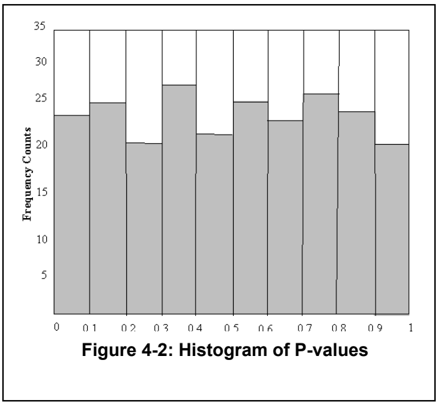
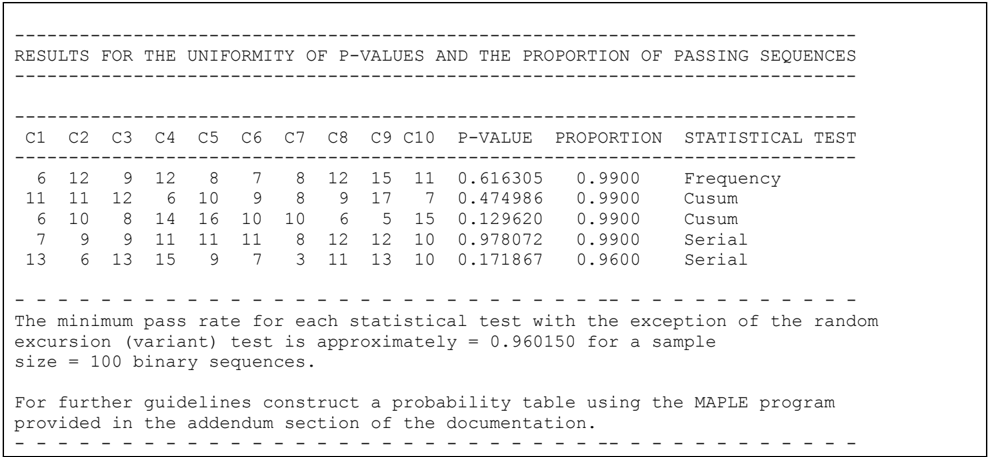
- Main analysis: For each sequence, P-values are computed and compared to \(\alpha\); empirical interpretation examines the proportion of sequences passing a test and the uniformity of P-values. A multiple-test dependence study applied 161 test P-values to Blum-Blum-Shub sequences of length 1,000,000 and used principal components/factor analysis, concluding there was no large redundancy among tests.
Limitations
- The paper states that no set of statistical tests can absolutely certify a generator as appropriate, that statistical testing cannot substitute for cryptanalysis, and that generator design and cryptanalysis are outside its scope.
- The paper states that many examples use small sample sizes for illustration only, e.g., \(n=10\), where the normal approximation is not really applicable; many tests rely on asymptotic reference distributions for large \(n\) (order \(10^3\) to \(10^7\)), and input parameter constraints apply.
- The text makes evident additional limitations: numerical precision can degrade for large incomplete gamma parameter \(a\); Maurer’s variance approximation can make the test 2.67 times more permissive than theoretically admitted; Random Excursions is discontinued if \(J<500\); and multiple tests can yield contradictory conclusions, as in the Random Excursions example where one state gave a non-random result while seven states gave random results.
Model-written summary. Check it against the paper before relying on it.
Integrity signals
Registry
Cites
Statistics
Figures

Verification
Claims the paper makes
0 Valid · 1 Not valid · 11 Not checked · 13 Own results and interpretations
A result the paper reports from its own data — it cites no other source for it, so there is none to check. The quote shows it is in the paper.
In the paper
“The asymptotic distribution of ( Ln -µ n ) / σ n along the sequence of even or odd values of n is that of a discrete random variable obtained via a mixture of two geometric random variables (one of them taking only negative values). Strictly speaking, the asymptotic distribution as such does not exist.”
A result the paper reports from its own data — it cites no other source for it, so there is none to check. The quote shows it is in the paper.
In the paper
“However, no set of statistical tests can absolutely certify a generator as appropriate for usage in a particular application, i.e., statistical testing cannot serve as a substitute for cryptanalysis.”
A result the paper reports from its own data — it cites no other source for it, so there is none to check. The quote shows it is in the paper.
In the paper
“This graph showed that there is no large redundancy among our tests.”
In the paper
“Ueli Maurer of the Department of Computer Science at Princeton University introduced this test in 1992. Maurer's test statistic relates closely to the per-bit entropy of the stream, which its author asserts is 'the correct quality measure for a secret-key source in a cryptographic application.'”
What the sources say
- Not matchedcites Maurer
This doesn’t read as a citation we can look up.
- Not matched
What the paper did — it cites no source for this, so there is none to check. The quote shows it is in the paper.
In the paper
“The test rejects the randomness hypothesis immediately if J is too small, i.e., if the following P-value is small:”
20 more claims
Create a free account to see all 25 claims and every source verdict.
Claims other papers make about this one
Each is checked against this paper’s own text: does it say what the citing paper says it does?
The source backs part of the claim, not all of it — or backs it for a different population, condition or comparison.
In the citing paper
“However, the latest version 2.1.2 [1], released in 2014, does not incorporate several modifications.”
From Checking the quality of approximation of p-values in statistical tests for random number generators by using a three-level test (2019) · cites this paper as [1]
Experimental — accuracy not yet measuredThe source backs part of the claim, not all of it — or backs it for a different population, condition or comparison.
In the citing paper
“The NIST test suite consists of 15 statistical tests for randomness of bit sequences, and its result is a list of 188 p -values.”
From Checking the quality of approximation of p-values in statistical tests for random number generators by using a three-level test (2019) · cites this paper as [1]
Experimental — accuracy not yet measuredThe cited source says what the claim attributes to it.
In the citing paper
“Note that the current implementation of the NIST test suite uses one-level or two-level tests, differently from the above experiments”
From Checking the quality of approximation of p-values in statistical tests for random number generators by using a three-level test (2019) · cites this paper as [1]
The cited source says what the claim attributes to it.
In the citing paper
“NIST SP-800.22 statistical test suite [90] and Die-hard test suite [91] and Test U01 [92] and AIS31 [93] are most common statistical test suites to evaluate their RNGs by researchers.”
From True Random Number Generators Using Electrical Noise (2019) · cites this paper as [90]
Self-check
Percentages, sums and reported differences re-computed from the paper’s own numbers.
Each contradiction between two passages listed here was confirmed by an independent check.
Rated minor: it would not touch a result — a value no result rests on, a p-value that stays on the same side of the significance level, or a conflict that is clerical, resolved elsewhere in the paper, or outside its own findings.
In the paper
§ 2.3.8 Example
“(input) τ = 0.02 (processing) π = 0.42 (processing) Vn(obs) = 52 (output) P-value = 0.500798 (conclusion) Since P-value ≥ 0.01 , accept the sequence as random.”
§ 2.3.4 Test Description
“If it can be shown that π -1 ≥τ , then the 2 Runs test need not be performed (i.e., the test should not have been run because of a failure to pass test 1, the Frequency (Monobit) test). If the test is not applicable, then the P-value is set to 0.0000.”
Rated minor: it would not touch a result — a value no result rests on, a p-value that stays on the same side of the significance level, or a conflict that is clerical, resolved elsewhere in the paper, or outside its own findings.
In the paper
§ 2.7.4 Test Description
“| 8-10 | 010 (hit) | 2 | 110 | 1 |”
§ 2.7.4 Test Description
“For the above example, if m = 3 and the template B = 001, then the examination proceeds as follows:”
Rated minor: it would not touch a result — a value no result rests on, a p-value that stays on the same side of the significance level, or a conflict that is clerical, resolved elsewhere in the paper, or outside its own findings.
In the paper
§ 2.9.3 Test Statistic and Reference Distribution
“f n : The sum of the log2 distances between matching Lbit templates, i.e., the sum of the number of digits in the distance between Lbit templates.”
§ 3.9 Maurer's 'Universal Statistical' Test
“Then it averages over all the expansion lengths by the number of test blocks.”
Rated minor: it would not touch a result — a value no result rests on, a p-value that stays on the same side of the significance level, or a conflict that is clerical, resolved elsewhere in the paper, or outside its own findings.
In the paper
§ Input Parameters:
“The parameters p , q and s are not fixed in code; thus, the user will not be able to reconstruct the original sequence because these values will vary (i.e., they are dependent on the system time).”
§ Input Parameters:
“The input parameters have been fixed so the code will reproduce the same results.”
Rated minor: it would not touch a result — a value no result rests on, a p-value that stays on the same side of the significance level, or a conflict that is clerical, resolved elsewhere in the paper, or outside its own findings.
In the paper
§ 5.5.2 Global Parameters
“| MAXNUMOFTEMPLATES | 40 | Non-overlapping Templates Test | | NUMOFTESTS | 16 | Max number of tests | | NUMOFGENERATORS | 12 | Max number of PRNGs |”
§ A.2 Configuration Information
“| 2. | #define MAXNUMOFTEMPLATES | 148 | | 3. | #define NUMOFTESTS | 15 | | 4. | #define NUMOFGENERATORS | 10 |”
2 more findings
Create a free account to see every finding of this check.
Citations
Cites
Handbook of Mathematical Functions
McQuarrie, D. A. (1966) · American Journal of Physics · doi:10.1119/1.1972842 · Cited by 40,433
Numerical recipes in C: the art of scientific computing
(1993) · Choice Reviews Online · doi:10.5860/choice.30-5638 · Cited by 17,933
Rayward-Smith, V. J. (1991) · Journal of the Operational Research Society · doi:10.1057/jors.1991.155 · Cited by 16,821
Handbook of applied cryptography
(1997) · Choice Reviews Online · doi:10.5860/choice.34-4512 · Cited by 10,357
Handbook of Mathematical Functions
(2018) · A Century of Excellence in MEASUREMENTS, STANDARDS, and TECHNOLOGY · doi:10.1201/9781351069397-39 · Cited by 9,062
A universal algorithm for sequential data compression
Ziv, J., & Lempel, A. (1977) · IEEE Transactions on Information Theory · doi:10.1109/tit.1977.1055714 · Cited by 5,456
The Art of Computer Programming
Worlton, W. J. (1968) · Nuclear Science and Engineering · doi:10.13182/nse68-a19548 · Cited by 2,251
Handbook of Applied Cryptography
Menezes, A. J., van Oorschot, P. C., & Vanstone, S. A. (2018) · CRC Press eBooks · doi:10.1201/9780429466335 · Cited by 1,770
Numerical Recipes in C-The Art of Scientific Computing.
G., W., Press, W. H., Flannery, B. P., Teukolsky, S. A., & Vetterling, W. T. (1989) · Mathematics of Computation · doi:10.2307/2008673 · Cited by 1,513
The Fourier Transform and its Applications
Cattermole, K. W. (1965) · Electronics and Power · doi:10.1049/ep.1965.0268 · Cited by 1,417
Cited by
Items 2,301–2,400 of 3,620
Quantum random number generation using an on-chip nanowire plasmonic waveguide
Strydom, C., Soleymani, S., Özdemir, Ş. K., & Tame, M. S. (2024) · New Journal of Physics · doi:10.1088/1367-2630/ad2d1c · Cited by 6
“The generated bits did not require any post-processing to pass the industry standard ENT [98] and NIST [99] Statistical Test Suites.”
MethodArbekov, I. M., & Molotkov, S. N. (2024) · Uspekhi Fizicheskih Nauk · doi:10.3367/ufnr.2024.02.039658 · Cited by 3
IoT Image Security Using DNA Technique
Begum, S. S., & Muniganti, P. (2024) · International Conference on Emerging Smart Computing and Informatics (ESCI) · doi:10.1109/esci59607.2024.10497451 · Cited by 3
“DNA is regarded as an extremely fast encryption method that can rapidly encrypt a large amount of data[10].”
BackgroundInsights Gained After a Decade of Cellular Automata-Based Cryptography
Mariot, L. (2024) · Lecture notes in computer science · doi:10.1007/978-3-031-65887-7_3 · Cited by 3
Wang, Q., Kuang, D., & Yu, S. (2024) · Chaos Solitons & Fractals · doi:10.1016/j.chaos.2024.115655 · Cited by 3
FPGA design and implementation of TRNG architecture using ADPLL based on fir as loop filter
Meitei, H. B., & Kumar, M. (2024) · Analog Integrated Circuits and Signal Processing · doi:10.1007/s10470-024-02295-8 · Cited by 5
“A sequence that has a P-value greater than or equal to 0.001 is considered to have successfully passed the NIST test [36, 37].”
InfluentialSIMECK-T: An Ultra-Lightweight Encryption Scheme for Resource-Constrained Devices
Anton, A., Csereoka, P., Capota, E. A., & Cioargă, R.-D. (2025) · Applied Sciences · doi:10.3390/app15031279 · Cited by 9
Pautasso, D. (2015) · Meridiano 47 - Journal of Global Studies · doi:10.20889/m47e16012 · Cited by 14
Impact of Rotations in the Salsa 20/8 Image Encryption Scheme
Jolfaei, A., Mirghadri, A., & Vizandan, A. (2012) · International Journal of Computer Theory and Engineering · doi:10.7763/ijcte.2012.v4.611 · Cited by 3
A Dynamic 3D S-Box based on Cylindrical Coordinate System for Blowfish Algorithm
Alabaichi, A. (2015) · Indian Journal of Science and Technology · doi:10.17485/ijst/2015/v8i30/86800 · Cited by 3
Highly sensitive universal statistical test
Yamamoto, H., & Liu, Q. (2016) · IEEE International Symposium on Information Theory (ISIT) · doi:10.1109/isit.2016.7541389 · Cited by 3
“We note that Lempel-Ziv compression test included in the first NIST statistical test suite [2] was excluded in the revised test suit [3] because of some defects.”
MethodNew results on reduced-round Tiny Encryption Algorithm using genetic programming
Kubíček, K., Novotný, J., Švenda, P., & Ukrop, M. (2016) · Cited by 3
Isolated desynchronization and intertwined synchronization in networks of semiconductor lasers
Xu, M., Pan, W., & Zhang, L. (2018) · Optical Engineering · doi:10.1117/1.oe.57.4.046106 · Cited by 3
A Method to Compute an Appropriate Sample Size of a Two-Level Test for the NIST Test Suite
Haramoto, H., & Matsumoto, M. (2018) · Springer proceedings in mathematics & statistics · doi:10.1007/978-3-319-91436-7_15 · Cited by 2
The Transfer of Hidden Information in Data in the AMR-WB Codec
Plátěnka, V., Mazalek, A., & Vranova, Z. (2019) · Communication and Information Technologies (KIT) · doi:10.23919/kit.2019.8883461 · Cited by 3
“The PRNG used fulfilled the tests of the National Institute of Standards and Technology (NIST) [12].”
MethodA Low-Overhead Secure Image Compression over Wireless Multimedia Sensor Network
Pal, T., & Bit, S. D. (2019) · IEEE International Symposium on Smart Electronic Systems (iSES) · doi:10.1109/ises47678.2019.00014 · Cited by 3
“We measure the average randomness of frame intensities using the frequency monobit test [10] in which the value close to 1 indicates high randomness.”
MethodPayback of Image Encryption Techniques: A Quantitative Investigation
Stalin, S., Maheshwary, P., & Shukla, P. K. (2019) · International Conference on Intelligent Computing and Control Systems (ICICCS) · doi:10.1109/iccs45141.2019.9065762 · Cited by 3
“NIST statistical test suite: NISTSP-800-22 statistical test suite is a group of 15 special assessments designed to observe the “randomness traits” of bit sequences by way of the assessment of share of the passing sequences, PP, and P-fee distribution, PV [42].”
Parity-based, bias-free optical quantum random number generation with min-entropy estimation
Coleman, M. R., Ingalls, K. G., Kavulich, J. T., Kemmerly, S. J., Salinas, N. C., Ramirez, E. V., & Schlosshauer, M. (2020) · Journal of the Optical Society of America B · doi:10.1364/josab.392286 · Cited by 3
Mishra, K. N. (2020) · Springer eBooks · doi:10.1007/978-3-030-37468-6_7 · Cited by 3
Software engineering based self-checking process for cyber security system in VANET
Yasir, M. N., & Croock, M. S. (2020) · International Journal of Power Electronics and Drive Systems/International Journal of Electrical and Computer Engineering · doi:10.11591/ijece.v10i6.pp5844-5852 · Cited by 3
A New Bit Plane Specific Longest Repeating Pattern Test for Statistical Analysis of Bit Sequences
Jangid, B. L., & Ratan, R. (2020) · Advances in intelligent systems and computing · doi:10.1007/978-981-15-4032-5_85 · Cited by 4
Development of a modified UMAC algorithm based on cryptocode constructions
Havrylova, A., Volkov, I., Kozhedub, Y., et al. (2020) · Eastern-European Journal of Enterprise Technologies · doi:10.15587/1729-4061.2020.210683 · Cited by 3
Gunay, R., & Ergün, S. (2020) · IEEE International Midwest Symposium on Circuits and Systems (MWSCAS) · doi:10.1109/mwscas48704.2020.9184641 · Cited by 3
A new optical random number generator circuit design using single-photon avalanche diodes
Ejdehakosh, S., Ansarian, M., & Karami, M. A. (2020) · Optik · doi:10.1016/j.ijleo.2020.165698 · Cited by 3
Sequences of numbers via permutation polynomials over some finite rings
Bhatta, G. R. V., Shankar, B. R., Mishra, V. N., et al. (2020) · Proyecciones (Antofagasta) · doi:10.22199/issn.0717-6279-2020-05-0079 · Cited by 3
Revealing the Secret Parameters of an FPGA-Based “True” Random Number Generator
Ergün, S., & Acar, B. (2020) · IEEE International Symposium on Circuits and Systems proceedings · doi:10.1109/iscas45731.2020.9181280 · Cited by 3
A Stream Cipher Based on Fractional Pseudo Chaotic Random Number Generator
Yang, C., Taralova, I., Loiseau, J. J., & Assad, S. E. (2020) · International Conference for Internet Technology and Secured Transactions · doi:10.23919/icitst51030.2020.9351350 · Cited by 4
“The NIST (National Institute of Standard and Technology) test is a suite of 15 different bitwise tests used to investigate and measure the randomness of a sequence [22].”
MethodLiu, H., Zhang, C., Fei, H., Hu, W., & Guo, D. (2020) · Asian Hardware Oriented Security and Trust Symposium (AsianHOST) · doi:10.1109/asianhost51057.2020.9358259 · Cited by 3
“We use NIST test suite [23] to test the key randomness under static and mobile scenarios with and without CGC and Clustering (one cluster contains 5 subcarriers), respectively.”
MethodFPGA Implementation of a Chaos-based Stream Cipher and Evaluation of its Performances
Dridi, F., Atamech, C., Assad, S. E., et al. (2020) · International Journal of Chaotic Computing · doi:10.20533/ijcc.2046.3359.2020.0023 · Cited by 3
Sampling methods for cryptographic tests
Marinakis, G. (2021) · doi:10.47260/jamb/1113 · Cited by 3
LISH: A New Random Number Generator using ECG Noises
Lyp, T., Karimian, N., & Tehranipoor, F. (2021) · International Conference on Consumer Electronics · doi:10.1109/icce50685.2021.9427726 · Cited by 5
West, J., Lee, K., Banerjee, S., et al. (2021) · International Conference on Information Processing in Sensor Networks (IPSN) · doi:10.1145/3412382.3458899 · Cited by 3
Automata-Derived Chaotic Image Encryption Scheme
Kafetzis, I. S., Moysis, L., VOLOS, C. K., Nistazakis, H. E., Munoz-Pacheco, J. M., & Stouboulos, I. N. (2022) · International Conference on Modern Circuits and Systems Technologies · doi:10.1109/mocast54814.2022.9837491 · Cited by 3
“From any value x k of the map (1), a random bit is produced as the boolean result of the comparison ( The randomness of the proposed PRBG is verified through the NIST statistical suite [16] for 100 bitstreams, each consisting of 10 6 bits.”
MethodModeling Attacks Resilient Multiple PUF-CPRNG Architecture Design Methodology
Dheeraj, A., Das, P., Kiran Kumar, A., et al. (2022) · IEEE International System-on-Chip Conference (SOCC) · doi:10.1109/socc56010.2022.9908089 · Cited by 3
Karthik, P., Shanthibala, P., Bhardwaj, A., Bharany, S., Yu, H., & Zikria, Y. B. (2022) · Journal of King Saud University - Computer and Information Sciences · doi:10.1016/j.jksuci.2022.12.002 · Cited by 3
“To perform the analysis the NIST-approved frequency (Monobit) test was conducted on the PSSHF (Bassham, et al., 2021).”
ML-Based Cryptographic Keys Quality Assessment for 5G / 6G Networks Privacy and Security
Proskurin, D., Gnatyuk, S. O., Охріменко, Т., & Iavich, M. (2023) · IEEE International Conference on Intelligent Data Acquisition and Advanced Computing Systems: Technology and Applications (IDAACS) · doi:10.1109/idaacs58523.2023.10348795 · Cited by 3
“Assessing the randomness of number sequences has been a topic of interest for researchers and practitioners across various fields, including cryptography, statistical sampling, and computer simulations [2, 4, 5].”
BackgroundMethodExperimental Statistical Attacks on Block and Stream Ciphers
Doroshenko, S., Fionov, A. N., Lubkin, A., et al. (2009) · Notes on numerical fluid mechanics and multidisciplinary design · doi:10.1007/978-3-540-69010-8_12 · Cited by 3
Pseudorandom Number Generator Using Optimal Normal Basis
Jang, I., & Yoo, H. S. (2006) · Lecture notes in computer science · doi:10.1007/11751595_23 · Cited by 3
“The application areas require different random properties, but it is required that PRNG should pass the standard statistical properties [ 1 ].”
BackgroundEncryption using Deterministic Chaos.
Blackledge, J. (2010) · Arrow@dit (Dublin Institute of Technology) · doi:10.21427/d7vs65 · Cited by 4
Cryptanalysis of a double scroll based “True” random bit generator
Ergün, S. (2015) · IEEE International Midwest Symposium on Circuits and Systems (MWSCAS) · doi:10.1109/mwscas.2015.7282066 · Cited by 3
Analysis of Secret Key Randomness Exploiting the Radio Channel Variability
Mazloum, T., & Sibille, A. (2015) · International Journal of Antennas and Propagation · doi:10.1155/2015/106360 · Cited by 3
Online low‐sidelobe waveform generator for noise radars based on the graph theory
Haghshenas, H., & Nayebi, M. M. (2013) · IET Radar Sonar & Navigation · doi:10.1049/iet-rsn.2012.0163 · Cited by 3
A high-speed truly random number generator based on an autonomous chaotic oscillator
Ergün, S. (2014) · IEEE Asia Pacific Conference on Circuits and Systems (APCCAS) · doi:10.1109/apccas.2014.7032758 · Cited by 3
Random numbers from an integrated CMOS double-scroll
Li, S., & Cao, F. (2010) · IEICE Electronics Express · doi:10.1587/elex.7.1382 · Cited by 3
Rethinking Stream Ciphers: Can Extracting be Better than Expanding?
Coluccia, A. (2013) · Wireless Personal Communications · doi:10.1007/s11277-013-1159-z · Cited by 3
Statistical testing of random number sequences using CUDA
Suciu, A., Zegreanu, L., & Zima, C. T. (2010) · IEEE International Conference on Intelligent Computer Communication and Processing (ICCP) · doi:10.1109/iccp.2010.5606413 · Cited by 3
“Future work includes implementing in CUDA all the NIST statistical tests as well as tests from other well known batteries such as TestU01 [7] or Diehard [8].”
MethodInfluential40-Gbps random bit generation by oversampling chaos from an injected semiconductor laser
Li, X., & Chan, S.-C. (2012) · Proceedings of SPIE, the International Society for Optical Engineering/Proceedings of SPIE · doi:10.1117/12.999791 · Cited by 3
“The output bits are tested using the commonly adopted National Institute of Standards and Technology (NIST) Special Publication 800-22 statistical tests of randomness [12].”
MethodTheory and Experiments of Fast Non-Deterministic Random Bit Generation Using On-Chip Chaos Lasers
Sunada, S., Harayama, T., Arai, K., Muramatsu, J., Yoshimura, K., Tsuzuki, K., Davis, P., & Uchida, A. (2012) · Procedia IUTAM · doi:10.1016/j.piutam.2012.06.025 · Cited by 3
A highly secure chaotic stream cipher using map and orbit hopping
El‐Khamy, S. E., El-Nasr, M. A., & El-Zein, A. (2008) · National Radio Science Conference · doi:10.1109/nrsc.2008.4542358 · Cited by 3
Real Time Random Number GeneratorTesting
Dionísio, J., Mota, T., Pinto, I., et al. (2014) · Procedia Technology · doi:10.1016/j.protcy.2014.10.207 · Cited by 3
A comparison of binary number generators for wireless body sensor networks security
Zhang, G. H., Zhang, Y. X., & Zhang, Y. (2012) · doi:10.1109/bhi.2012.6211700 · Cited by 3
“It is supplied in appendix D of [4] and is a base of a pseudorandom number generator [5] and security protocol [6].”
BackgroundGPUs as high‐performance random sources
Pyo, C., & Lee, G. (2014) · Electronics Letters · doi:10.1049/el.2013.4047 · Cited by 3
Passerat‐Palmbach, J., Mazel, C., & Hill, D. R. C. (2014) · Concurrency and Computation Practice and Experience · doi:10.1002/cpe.3214 · Cited by 4
How Homogenize Chaos-Based Pseudo-random Sequences
Li-Yuan, S., Sheng, Z., & Yan-Yu, X. (2008) · doi:10.1109/csse.2008.1346 · Cited by 3
A Macro-Model for the Efficient Simulation of an ADC-based RNG
Pareschi, F., Setti, G., & Rovatti, R. (2005) · IEEE International Symposium on Circuits and Systems proceedings · doi:10.1109/iscas.2005.1465594 · Cited by 3
“01 , as suggested in [7].”
MethodResultInfluentialStatistical Testing of Random Number Sequences Using Graphics Processing Units
Suciu, A., Zegreanu, L., & Zima, C. T. (2009) · Balkan Conference in Informatics · doi:10.1109/bci.2009.37 · Cited by 3
“The goal of the Overlapping Templates Test is to count the number of occurrences of a predefined bit string in the input data.”
MethodInfluentialSecure Arithmetic Coding with Error Detection Capability
Sinaie, M., & Vakili, V. T. (2010) · EURASIP Journal on Information Security · doi:10.1155/2010/621521 · Cited by 3
“In this study, NIST SP 800-22 [21] tests are used for testing the randomness of the cipher.”
MethodOn the Design of a Family of Ci Pseudo-Random Number Generators
Bahi, J. M., Fang, X., Guyeux, C., et al. (2011) · International Conference on Wireless Communications, Networking and Mobile Computing · doi:10.1109/wicom.2011.6040161 · Cited by 3
Intelligent Random Sequence Generating
Chegini, M. G., & Mehrabi, A. (2009) · International Conference on Natural Computation (ICNC) · doi:10.1109/icnc.2009.569 · Cited by 3
New chaotic image encryption technique
Hassan, H. A. H., Kassem, A., Harkouss, Y., et al. (2012) · doi:10.1109/relabira.2012.6235103 · Cited by 3
“For the PWLCM map, perturbed by neural network, the NIST tests (table I) have been performed on a trial of 100 binary sequences, each containing 10 6 bits, the results shows that this generator is in compliance with NIST standards of statistical randomness[15].”
MethodPareschi, F., Rovatti, R., & Setti, G. (2008) · IEEE Asia Pacific Conference on Circuits and Systems (APCCAS) · doi:10.1109/apccas.2008.4746245 · Cited by 3
Metastability-based Feedback Method for Enhancing FPGA-based TRNG
Lee, D., Seo, H., & Kim, H. (2014) · Multimedia and Ubiquitous Engineering · Cited by 4
Yousif, & Ajantha (2012) · International Journal of Advanced Computer Science and Applications · doi:10.14569/ijacsa.2012.030415 · Cited by 3
Wireless secret key generation versus capable adversaries
Madiseh, M. G. (2011) · Cited by 3
Pseudo random sequence generation from a new chaotic system
Cai, B., Wang, G., & Yuan, F. (2015) · IEEE International Conference on Communication Technology (ICCT) · doi:10.1109/icct.2015.7399962 · Cited by 3
A GPU implementation of secret sharing scheme based on cellular automata
Hernandez-Becerril, R. A., Ramirez, A. G. B., Nakano-Miyatake, M., Perez-Meana, H. M., & Tachiquín, M. P. R. (2016) · The Journal of Supercomputing · doi:10.1007/s11227-016-1646-6 · Cited by 5
“The randomness of all encrypted data must be evaluated using some standard statistical tests, such as FIPS 140-2 [13] and NIST SP800-22 [27].”
MethodInfluentialRandomness Tests in Hostile Environments
Goll, M., & Gueron, S. (2016) · IEEE Transactions on Dependable and Secure Computing · doi:10.1109/tdsc.2016.2537799 · Cited by 3
A Format-Compliant Selective Encryption Scheme for Real-Time Video Streaming of the H.264/AVC
Sbiaa, F., Kotel, S., Zeghid, M., et al. (2016) · International Journal of Advanced Computer Science and Applications · doi:10.14569/ijacsa.2016.070452 · Cited by 3
Statistical Analysis of the eSTREAM Competition Winners
Eljadi, F. M., & Alshaikhli, I. F. T. (2015) · International Conference on Advanced Computer Science Applications and Technologies · doi:10.1109/acsat.2015.43 · Cited by 3
Randomness Testing: Result Interpretation and Speed
Sýs, M., & Matyáš, V. (2016) · Lecture notes in computer science · doi:10.1007/978-3-662-49301-4_24 · Cited by 3
Templates selection in non‐overlapping template matching test
Chen, M., Chen, H., Fan, L., et al. (2016) · Electronics Letters · doi:10.1049/el.2016.0260 · Cited by 3
“A number of statistical test suites have existed: NIST SP800-22 [1], Marsaglia ’ s DIEHARD test suite [2], CryptXS test suite [3] and so on.”
BackgroundMethodConstruction of pseudorandom binary sequences using chaotic maps
Malchev, D., & Ibryam, I. I. (2015) · Applied Mathematical Sciences · doi:10.12988/ams.2015.52149 · Cited by 4
Pseudorandom number generator using Rabbit cipher
Kashmar, A. H., & Ismail, E. S. (2015) · Applied Mathematical Sciences · doi:10.12988/ams.2015.5143 · Cited by 3
Evaluating Entropy Sources for True Random Number Generators by Collision Counting
Skórski, M. (2016) · Communications in computer and information science · doi:10.1007/978-981-10-2741-3_6 · Cited by 3
NEW ALTERNATE LOZI FUNCTION FOR RANDOM NUMBER GENERATION
Espinel, A., Taralova, I., & Lozi, R. (2011) · Cited by 3
Structural improvements of chaotic PRNG implementations
Spenger, G., & Keller, J. (2016) · International Conference for Internet Technology and Secured Transactions · doi:10.1109/icitst.2016.7856754 · Cited by 3
Secured Wireless Sensor Network Using Improved Key Management
Habeeb, I. J., & Muhajjar, R. A. (2016) · doi:10.1145/3033288.3033351 · Cited by 3
“Also the key generator has been tested using some of NIST testing [16] and have a good randomization.”
MethodReducing Costs in HSM-Based Data Centers
Prisco, R. D., Santis, A. D., & Mannetta, M. (2017) · Lecture notes in computer science · doi:10.1007/978-3-319-57186-7_1 · Cited by 4
Das, M., Goswami, R. S., Dutta, M. P., et al. (2017) · International Journal of Security and Its Applications · doi:10.14257/ijsia.2017.11.3.04 · Cited by 3
“Vernum [3-4] proposed that if the generated keys would be changed from session to session during data transmission then it would be impossible to break the keys.”
BackgroundSecurity assessment of the Spanish contactless identity card
Rodríguez, R. J., & García-Escartín, J. C. (2017) · IET Information Security · doi:10.1049/iet-ifs.2017.0299 · Cited by 8
Fast Identification of Encrypted Traffic via Large-Scale Sparse Screening
Meng, P., Zhou, G., & Meng, J. (2017) · International Conference on Advanced Cloud and Big Data · doi:10.1109/cbd.2017.54 · Cited by 3
Correlation immune pseudo-random number generator based on fuzzy logic
Anikin, I. V., & Alnajjar, K. (2017) · International Conference on Industrial Engineering, Applications and Manufacturing (ICIEAM) · doi:10.1109/icieam.2017.8076445 · Cited by 3
“We used a 1024000 bits sequence, divided it into 1000 samples with length of 1024 bits, examined them with using the most important five statistical tests of NIST tests packet[11]: T1 = “Frequency(monobit)”, T2 = “Frequency(Block)”, T3 = “Runs”, T4 = “Longest Runs of Ones”, T5 = “Approximate Entropy”.”
MethodAnalysis of enhanced SDEx method
Milczarski, P., Hłobaż, A., & Podlaski, K. (2017) · IEEE International Conference on Intelligent Data Acquisition and Advanced Computing Systems: Technology and Applications (IDAACS) · doi:10.1109/idaacs.2017.8095245 · Cited by 3
“In this paper two tests from NIST Statistical Suite [22] are used: plaintext avalanche and key avalanche.”
MethodInfluentialSecurity analysis of a chaos-based image encryption scheme
Ergün, S. (2018) · IEEE Mediterranean Electrotechnical Conference (MELECON) · doi:10.1109/melcon.2018.8379068 · Cited by 3
Hybrid image sharing scheme using non-recursive hash key based stream cipher
Tripathi, S. K., Gupta, B., & Pandian, K. K. S. (2018) · Multimedia Tools and Applications · doi:10.1007/s11042-018-6663-4 · Cited by 3
“In Table 4, the specified NIST [34] test suite is used to analyze the statistical property for the generated dynamic key stream binary sequences (K 0 , K 1 , . . .) by calculating the p - values.”
MethodA Technique to Test Non-Binary Random Number Generator
Epishkina, A. V. (2018) · Procedia Computer Science · doi:10.1016/j.procs.2018.11.039 · Cited by 3
Research of crypto-code designs construction for using in post quantum cryptography
Yevseiev, S., Havrylova, A., Tomashevsky, B., & Samadov, F. (2019) · Development Management · doi:10.21511/dm.4(4).2018.03 · Cited by 4
A Low-Power Thin-Film Si Heterojunction FET Noise Amplifier for Generation of True Random Numbers
Hekmatshoar, B., & SHAHIDI, G. G. (2019) · IEEE Journal of the Electron Devices Society · doi:10.1109/jeds.2019.2902183 · Cited by 4
“This is further corroborated by the NIST SP-800-22 tests [12] listed in Table 1.”
MethodHigh entropy secrecy generation from wireless CIR
Li, H., Shen, C., Zhao, Y., et al. (2019) · Journal of Communications and Networks · doi:10.1109/jcn.2019.000019 · Cited by 3
“We plan to investigate additional randomness metrics incorporated in our algorithms that can pass existing benchmark testing including the NIST tool [12].”
MethodResultInfluentialA New DNA Based Approach of Generating Key-Dependent Shift Rows Transformation
AL-Wattar, A. H., Mahmod, R., Zukarnain, Z. A., & Udzir, N. I. (2015) · International Journal of Network Security & Its Applications · doi:10.5121/ijnsa.2015.7107 · Cited by 8
Attack on a Microcomputer-Based Random Number Generator Using Auto-synchronization
Ergün, S. (2019) · Asian Hardware Oriented Security and Trust Symposium (AsianHOST) · doi:10.1109/asianhost47458.2019.9006666 · Cited by 4
Security Evaluation of the Enhanced IDEA Algorithm
Ledda, M. K. C., Gerardo, B. D., & Hernandez, A. A. (2019) · World Symposium on Communication Engineering (WSCE) · doi:10.1109/wsce49000.2019.9041086 · Cited by 3
Generating True Random Numbers Based on Multicore CPU Using Race Conditions and Chaotic Maps
Teh, J. S., Alawida, M., & Samsudin, A. (2020) · Arabian Journal for Science and Engineering · doi:10.1007/s13369-020-04552-0 · Cited by 3
Bitcoin Blockchain Steganographic Analysis
Giron, A. A., Martina, J. E., & Custódio, R. F. (2020) · Lecture notes in computer science · doi:10.1007/978-3-030-61638-0_3 · Cited by 4
Ansari, O., Amin, M., Maqsood, M., et al. (2020) · IEEE Access · doi:10.1109/access.2020.3042969 · Cited by 3
“According to NIST recommendations [21], an image of minimum size of 16 MB is transmitted in the intended direction of Bob along θ IR = 60 o .”
MethodPerformance-enhancing of RSA public key via three-dimensional hyperchaotic system
Alwan, N. A., Yousif, A. Y., & Al-Saidi, N. M. G. (2021) · AIP conference proceedings · doi:10.1063/5.0040397 · Cited by 3
True Random Number Generation in an Optical I/Q Modulator
Vokić, N., Milovančev, D., Pacher, C., Hübel, H., & Schrenk, B. (2020) · European Conference on Optical Communication · doi:10.1109/ecoc48923.2020.9333271 · Cited by 3
Origin Attribution of RSA Public Keys
Branca, E., Abazari, F., Carranza, R. R., & Stakhanova, N. (2021) · Lecture notes of the Institute for Computer Sciences, Social Informatics and Telecommunications Engineering · doi:10.1007/978-3-030-90019-9_19 · Cited by 3
Zhu, M., Wang, X., Xu, B., Yu, S., Chen, Z., & Guo, H. M. (2021) · Journal of Physics Conference Series · doi:10.1088/1742-6596/1865/2/022018 · Cited by 3
“The final produced random numbers pass all NIST [15] randomness tests.”
BackgroundInfluentialDesign and Implementation of a flexible Multi-purpose Cryptographic System on low cost FPGA
Maache, A., & Kalache, A. (2023) · International journal of electrical and computer engineering systems · doi:10.32985/ijeces.14.1.6 · Cited by 3
“For consistency and simplicity, the general nature NIST’s statistical test suite is used to evaluate both RNGs [5].”
Metadata
- Authors
- Bassham, L. E., Rukhin, A. L., Soto, J., Nechvatal, J. R., Smid, M. E., Barker, E. B., Leigh, S. D., Levenson, M., Vangel, M., Banks, D. L., Heckert, N. A., Dray, J. F., & Vo, S.
- Affiliations
- National Institute of Standards and Technology (US)
- Venue
- NIST Special Publication 800-22 Revision 1a
- Published
- 2010
- OpenAlex
- W1517403092
- Semantic Scholar
- 961fc0f6c68303cde94a28fdb24e6eaf3ef040b4
- Cited by
- 3,617
- References
- 34
- Citations by year
- 2026: 128 · 2025: 205 · 2024: 192 · 2023: 208 · 2022: 166 · 2021: 291 · 2020: 290 · 2019: 250 · 2018: 254 · 2017: 207 · 2016: 183 · 2015: 184 · 2014: 201 · 2013: 155 · 2012: 139
- Type
- report
- Language
- en
- Open access
- gold
- doi.org
- Topics
- Physical Sciences › Computer Science › Artificial Intelligence › Cryptographic Implementations and Security
- Physical Sciences › Mathematics › Discrete Mathematics and Combinatorics › Coding theory and cryptography
- Physical Sciences › Computer Science › Computer Vision and Pattern Recognition › Chaos-based Image/Signal Encryption
- Keywords
- random number generators, pseudorandom number generators, cryptographic randomness, NIST SP 800-22, randomness testing
About these checks
Registry, retraction, Cites and statistics results are computed, not judged, with one exception: a printed reference that no index lists is read once by a model before it counts as a citation error. Claims are extracted by a model and kept only when their quote appears verbatim in the text; each cited source is then checked, with a model’s help, for whether it says what the claim relies on. Those verdicts can be wrong — read the claim’s quote and the cited source before relying on one.
A language model drew the claims from the paper on 2026-09-27 (prompt extract-v2).
Statistics and arithmetic are recomputed, not judged.
Confidence bands are shown only for fields calibrated on our annotated test set. None is calibrated yet, so no band is shown.
What counts as a claim ›How we measure confidence ›How we check this ›
Are you an author, or do you see a problem with this page? Request a review
Data sources
Bibliographic data: Semantic Scholar, OpenAlex, Crossref.
Contains information from the Semantic Scholar Academic Graph Datasets, made available under the ODC Attribution License (ODC-BY 1.0).
Semantic Scholar’s data is described in: Kinney, R., et al. (2023). The Semantic Scholar Open Data Platform. arXiv:2301.10140.
