

The effect of interactivity with a music video game on second language vocabulary recall
Open accessThe DOI matches its Crossref record; 64 of the 64 references it cites were found in a registry or an index.
Abstract
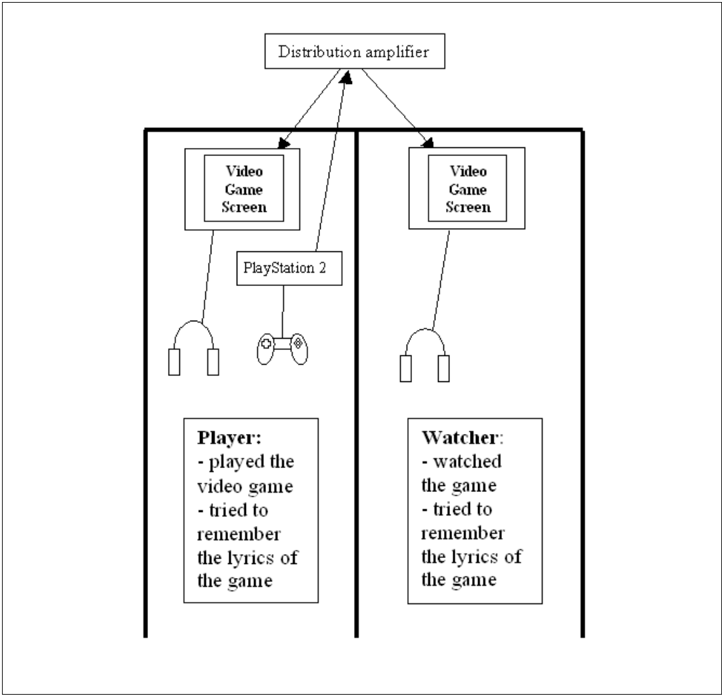
Video games are potential sources of second language input; however, the medium's fundamental characteristic, interactivity, has not been thoroughly examined in terms of its effect on learning outcomes.This experimental study investigated to what degree, if at all, video game interactivity would help or hinder the noticing and recall of second language vocabulary.Eighty randomly-selected Japanese university undergraduates were paired based on similar English language and game proficiencies.One subject played an Englishlanguage music video game for 20 minutes while the paired subject watched the game simultaneously on another monitor.Following gameplay, a vocabulary recall test, a cognitive load measure, an experience questionnaire, and a two-week delayed vocabulary recall test were administered.Results were analyzed using paired samples t-tests and various analyses of variance.Both the players and the watchers of the video game recalled vocabulary from the game, but the players recalled significantly less vocabulary than the watchers.This seems to be a result of the extraneous cognitive load induced by the interactivity of the game; the players perceived the game and its language to be significantly more difficult than the watchers did.Players also reported difficulty simultaneously attending to gameplay and vocabulary.Both players and watchers forgot significant amounts of vocabulary over the course of the study.We relate these findings to theories and studies of vocabulary acquisition and video game-based language learning, and then suggest implications for language teaching and learning with interactive multimedia.
Overview
The claims and statistics of this paper haven’t been checked yet.
Free: it reads the open-access text and checks the first 5 claims that cite a source we can check. Create a free account to check every claim.
Integrity signals
Registry
Cites
Statistics
Figures
Verification
Claims the paper makes
The claims and statistics of this paper haven’t been checked yet.
Free: it reads the open-access text and checks the first 5 claims that cite a source we can check. Create a free account to check every claim.
Claims other papers make about this one
Each is checked against this paper’s own text: does it say what the citing paper says it does?
The cited source says what the claim attributes to it.
In the citing paper
“In other words, although deHaan et al. (2010) instructed the Players to memorize the lyrics, it did not occupy a significant role in succeeding in game-play.”
From Readers, Players, and Watchers: EFL Students’ Vocabulary Acquisition through Digital Video Games (2017) · cites this paper as deHaan et al. (2010)
The cited source says what the claim attributes to it.
In the citing paper
“the most influential outlier (deHaan et al., 2010) had a very large negative effect ( d = -2.43).”
From Second language (L2) gains through digital game-based language learning (DGBLL): A meta-analysis (2022) · cites this paper as deHaan et al., 2010
The cited source says what the claim attributes to it.
In the citing paper
“It is also worth noting that deHaan et al. (2010) appears to be an outlier (see Figure 1).”
From Second language (L2) gains through digital game-based language learning (DGBLL): A meta-analysis (2022) · cites this paper as deHaan et al. (2010)
Self-check
Percentages, sums and reported differences re-computed from the paper’s own numbers.
The self-check needs the paper’s full text.
Citations
Cites
Faul, F., Erdfelder, E., Lang, A.-G., & Buchner, A. (2007) · Behavior Research Methods · doi:10.3758/bf03193146 · Cited by 65,971
The magical number seven, plus or minus two: Some limits on our capacity for processing information.
Miller, G. A. (1994) · Psychological Review · doi:10.1037/0033-295x.101.2.343 · Cited by 17,161
Mayer, R. E. (2009) · doi:10.1017/cbo9780511811678 · Cited by 7,800
Mayer, R. (2020) · doi:10.1017/9781316941355 · Cited by 7,777
What Video Games Have to Teach Us about Learning and Literacy
(2004) · Education + Training · doi:10.1108/et.2004.00446dae.002 · Cited by 6,674
Defining virtual reality: Dimensions determining telepresence
Steuer, J. (1992) · Journal of Communication · doi:10.1111/j.1460-2466.1992.tb00812.x · Cited by 5,459
Baddeley, A. (1992) · Science · doi:10.1126/science.1736359 · Cited by 5,258
Cognitive load theory, learning difficulty, and instructional design
Sweller, J. (1994) · Learning and Instruction · doi:10.1016/0959-4752(94)90003-5 · Cited by 3,801 · cited 2×
“, a fast food restaurant), since more complete schema can contribute to lower cognitive load (Douglas & Hargadon, 2001; Sweller, 1994).”
BackgroundCognitive Load Theory and Instructional Design: Recent Developments
Paas, F., Renkl, A., & Sweller, J. (2003) · Educational Psychologist · doi:10.1207/s15326985ep3801_1 · Cited by 3,041 · cited 3×
“Language Learning & Technology http://llt.msu.edu/vol14num2/dehaanreedkuwada.pdf June 2010, Volume 14, Number 2 pp. 74–94 Copyright © 2010, ISSN 1094-3501 74 THE EFFECT OF INTERACTIVITY WITH A MUSIC VIDEO GAME ON SECOND LANGUAGE VOCABULARY RECALL”
Background(2020) · Encyclopedia of Education and Information Technologies · doi:10.1007/978-3-030-10576-1_300187 · Cited by 2,893
Research works printed but not linked: 6
- deHaan, J. (2005a). Learning language through video games: A theoretical framework, an analysis of game genres and questions for future research. In S. Schaffer & M. Price (Eds.), Interactive Convergence: Critical Issues in Multimedia (vol. 10), Chapter 14, pp. 229-239. Retrieved from http://www.inter- disciplinary.net/publishing/idp/eBooks/icindex.htm
- Engelkamp, J. (2001). Action memory: A system-oriented approach. In H. D. Zimmer, R. Cohen, M. Guynn, J. Engelkamp, R. Kormi-Nouri, & M. N. Foley (Eds.), Memory for action: A distinct form of episodic memory? (pp. 49-96). New York: Oxford University Press.
- Knight, S. (1994). Dictionary: The tool of last resort in foreign language reading? A new perspective. Modern Language Journal, 78(3), 285-299.
- Schmidt, R. W. (2001). Attention. In P. Robinson (Ed.), Cognition and second language instruction
- Squire, K. D. (2006). From content to context: Video games as designed experiences Educational Researcher, 35(8), 19-29.
- Um, E. J., & deHaan, J. (2005). Video games and cognitive apprenticeship-based learning. Proceedings of the Association for Educational Communications and Technology, USA, 28, 499-505.
Cited by
Items 201–275 of 275
Game Design Interaction in Digital Gameplay and Language Teaching and Learning
Shintaku, K. (2018) · Advances in educational technologies and instructional design book series · doi:10.4018/978-1-5225-5140-9.ch022 · Cited by 2
What do we Learn by Observing Collaborative Design Among Cross-Domain, Cross-Role Educators?
Matuk, C. F., Tam, F., & Martinez, J. (2019) · FabLearn Conference (FabLearn) · doi:10.1145/3311890.3311923 · Cited by 1
“the game’s ease-of-use, including considerations of the time, resources, and knowledge needed for students to play the game, and the game’s potential to be integrated into a larger educational context, factors in teachers’ decisions to adopt games [23]; (2) Intrinsic integration of players’ in-game and domain-relevant…”
BackgroundInterconnected English language and music learning with digital technologies
Marić, S. J. (2017) · Beyond Philology An International Journal of Linguistics Literary Studies and English Language Teaching · Cited by 1
Vazirabad, A. F., & Farrokhi, F. (2021) · Journal of Modern Research in English Language Studies · doi:10.30479/jmrels.2020.12523.1552 · Cited by 1
“In an experimental study by DeHaan, Reed and Kuwada (2010), they investigated the impact of digital games to hinder recall and noticing new vocabulary acquisition among Japanese university undergraduates.”
BackgroundCHAT framework to study affordances in CALL environments
Dey-Plissonneau, A. (2021) · The EuroCALL Review · doi:10.4995/eurocall.2021.14991 · Cited by 1
Supporting Foreign Language Vocabulary Learning Through Kinect-Based Gaming
Ürün, M. F., Aksoy, H., & Comez, R. (2018) · IGI Global eBooks · doi:10.4018/978-1-5225-7663-1.ch070 · Cited by 1
Teaching English vocabulary and online games to eighth grade students
Pintado-Peñaloza, K. J., & Fajardo-Dack, T. (2022) · CIENCIAMATRIA · doi:10.35381/cm.v8i1.689 · Cited by 4
“…that memory retention of the vocabulary of the students was lower when they played online games than when using flashcards; however, the spelling of the English words was higher than the other method (Dehaan, 2010) in his study demonstrated that players recalled less vocabulary than the viewers.”
BackgroundResultThe Impact of Online Machine Translation (OMT) on Vocabulary Learning and Translation Ability
Ebyary, K. E. (2023) · CDELT Occasional Papers in the Development of English Education · doi:10.21608/opde.2023.337479 · Cited by 1
Knight, J. (2024) · International Multilingual Research Journal · doi:10.1080/19313152.2024.2418770 · Cited by 1
“…related to digital games and plurilingualism include “monolingual games” that were found to contribute toward supporting players in acquiring new vocabulary items (deHaan et al., 2010; Hitosugi et al., 2014; Sundqvist, 2019; Zou et al., 2021) and therefore growing a player’s plurilingual repertory.”
Learning English through video gaming
Baierschmidt, J. (2012) · Institutional Repositories DataBase (IRDB) · Cited by 1
Facilitating Motivation in a Virtual World Within a Second Language Acquisition Classroom
Gump, A. (2015) · Digital Commons - University of South Florida (University of South Florida) · Cited by 4
Andersen, T. (2019) · NVA (Nasjonalt vitenarkiv) · Cited by 3
Heidt, J. (2020) · Carleton University's Institutional Repository (MacOdrum Library, Carleton University) · doi:10.22215/etd/2020-14155 · Cited by 2
The Multimodal Affordances of Commercial-off-the-Shelf Video Games That Support Vocabulary Learning
Charlebois, J. (2022) · Carleton University's Institutional Repository (MacOdrum Library, Carleton University) · doi:10.22215/etd/2022-15032 · Cited by 4
Motivation and Affect in Digital Game-Based Language Learning and Teaching
Jabbari, N. (2025) · Springer eBooks · doi:10.1007/978-3-031-51447-0_133-1 · Cited by 1
Playing Video Games in Japanese: Motivation, Language Learning, and Navigation
Smith, G. E. (2014) · Spectrum Research Repository (Concordia University) · Cited by 1
HOW PLAYING SERIOUS VIDEO GAMES CAN MOTIVATE CHILDREN TO LEARN A LANGUAGE
Castro, J., & Abraham, L. (2014)
Chinese Learners’ Attitudes Toward Instructional Strategies
(2015) · US-China Foreign Language · doi:10.17265/1539-8080/2015.02.005
Web 2.0 and Digital Games in Language Learning and Teaching: The Lerna Project.
Venezia, F. D. (2013)
An Ecological Analysis of Digital Game-Mediated Second Language Learning
Zhao, J. (2015) · UA Campus Repository (The University of Arizona) · Cited by 1
English Teachers' Practice and Perspectives on Using Educational Computer Games in EIL Context
Wang, L.-J., Wu, Y., & Hu, C.-M. (2016) · International Journal of Technology and Human Interaction · doi:10.4018/ijthi.2016070103
“ECGs are computers games with pedagogical purposes, have been widely discussed in the field of English teaching in recent years (deHaan et al., 2010; Ketelhut et al., 2011; Peterson, 2010; Yang et al., 2010; Zheng et al., 2009).”
BackgroundTheory and Practice in Computer-Assisted Vocabulary Learning: A Case Study
Prince, P. (2014) · Advances in educational technologies and instructional design book series · doi:10.4018/978-1-4666-6174-5.ch013
Kotuła, K. (2016) · Second language learning and teaching · doi:10.1007/978-3-319-30373-4_14
Kotuła, K. (2013) · Homo Ludens
Das Potential von Computerspielen nutzen
Kolibius, L. D. (2019) · Springer eBooks · doi:10.1007/978-3-662-57895-7_9
Alcaraz-Valencia, P. A., Gaytan-Lugo, L. S., & Gallardo, S. C. H. (2017) · Advances in human and social aspects of technology book series · doi:10.4018/978-1-5225-2616-2.ch013
Strnad, S. (2018) · STARS (University of Central Florida) · Cited by 1
Perceived Challenges and Opportunities of Digital Games
Alshaya, K., & Beck, P. (2020) · Advances in educational technologies and instructional design book series · doi:10.4018/978-1-7998-4360-3.ch012
Towards Musical Game Therapy: A Survey on Music Therapy and Games for Health Promotion.
Alam, N. F., Paliyawan, P., & Thawonmas, R. (2020) · Cited by 2
Barcomb, M. (2021) · Spectrum Research Repository (Concordia University)
Ibrahim, K. H. S. (2021) · IGI Global eBooks · doi:10.4018/978-1-6684-3710-0.ch010
Edumeet. II International Conference on Transfers for Innovation and Pedagogical Change 2021
Agurruza, J. U., & Hernández, C. (2022) · UPM Digital Archive (Technical University of Madrid) · doi:10.20868/upm.book.70165
Greene, R. D., & Hakuta, K. (2015) · Wiley eBooks · doi:10.1002/9781118900772.etrds0116
L2 Languaging in a Massively Multiplayer Online Game: An Exploration of Learner Variations
Zhao, J. (2018) · IGI Global eBooks · doi:10.4018/978-1-5225-7663-1.ch040
Theory and Practice in Computer-Assisted Vocabulary Learning: A Case Study
Prince, P. (2018) · IGI Global eBooks · doi:10.4018/978-1-5225-7663-1.ch047
Musaoglu, S. (2020) · American Educational Research Association Annual Meeting (AERA) · doi:10.3102/1580175
拉脱维亚线上汉语教学纵论 = A Study of Online Chinese Teaching in Latvia
Bingyu, B. (2022) · doi:10.22364/ochtl.22
PROMOTING CHILDREN’S CONSERVATION AWARENESS OF Macaca fascicularis THROUGH NARRATIVE VIDEO
Anggraini, F. D., Prasetyo, A. P. B., & Iswari, R. S. (2019) · Unnes Science Education Journal · doi:10.15294/usej.v8i3.22097
Gry cyfrowe a nauczanie języków obcych – próba podsumowania dwudziestu lat badań i nowe perspektywy
Kotuła, K. (2023) · Applied Linguistics Papers · doi:10.32612/uw.25449354.2023.3.pp.22-33 · Cited by 1
Lesser, A. (2024) · Oxford University Press eBooks · doi:10.1093/oso/9780197696644.005.0001
Lesser, A. (2024) · Oxford University Press eBooks · doi:10.1093/oso/9780197696644.003.0003
Lesser, A. (2024) · Oxford University Press eBooks · doi:10.1093/oso/9780197696644.002.0006
Lesser, A. (2024) · Oxford University Press eBooks · doi:10.1093/oso/9780197696644.003.0002
Lesser, A. (2024) · Oxford University Press eBooks · doi:10.1093/oso/9780197696644.003.0004
Connecting Musical Concepts With Games
Lesser, A. (2024) · Oxford University Press eBooks · doi:10.1093/oso/9780197696644.003.0006
Lesser, A. (2024) · Oxford University Press eBooks · doi:10.1093/oso/9780197696644.002.0005
Lesser, A. (2024) · Oxford University Press eBooks · doi:10.1093/oso/9780197696644.002.0003
Lesser, A. (2024) · Oxford University Press eBooks · doi:10.1093/oso/9780197696644.003.0007
Lesser, A. (2024) · Oxford University Press eBooks · doi:10.1093/oso/9780197696644.002.0007
Lesser, A. (2024) · Oxford University Press eBooks · doi:10.1093/oso/9780197696644.003.0001
Responding to Music With Games
Lesser, A. (2024) · Oxford University Press eBooks · doi:10.1093/oso/9780197696644.003.0005
Schütze, U. (2024) · Bilingual processing and acquisition · doi:10.1075/bpa.19.lof
Schütze, U. (2024) · Bilingual processing and acquisition · doi:10.1075/bpa.19.toc
Schütze, U. (2024) · Bilingual processing and acquisition · doi:10.1075/bpa.19.c1
Schütze, U. (2024) · Bilingual processing and acquisition · doi:10.1075/bpa.19.preface
Schütze, U. (2024) · Bilingual processing and acquisition · doi:10.1075/bpa.19.prelim
Schütze, U. (2024) · Bilingual processing and acquisition · doi:10.1075/bpa.19.bio
Schütze, U. (2024) · Bilingual processing and acquisition · doi:10.1075/bpa.19.lot
Schütze, U. (2024) · Bilingual processing and acquisition · doi:10.1075/bpa.19.dedication
Schütze, U. (2024) · Bilingual processing and acquisition · doi:10.1075/bpa.19.c6
Schütze, U. (2024) · Bilingual processing and acquisition · doi:10.1075/bpa.19.c3
Schütze, U. (2024) · Bilingual processing and acquisition · doi:10.1075/bpa.19.c2
The case of AI and Virtual Reality
Schütze, U. (2024) · Bilingual processing and acquisition · doi:10.1075/bpa.19.c5
Schütze, U. (2024) · Bilingual processing and acquisition · doi:10.1075/bpa.19.index
Schütze, U. (2024) · Bilingual processing and acquisition · doi:10.1075/bpa.19.refs
Challenges in Integrating Machine Learning and Deep Learning with VR/AR
Elango, E., Natarajan, G., Hanees, A. L., & Balasundaram, I. (2025) · Wiley eBooks · doi:10.1002/9781394336081.ch8
Poole, F. J., & Dixon, D. H. (2026) · Research methods in applied linguistics · doi:10.1075/rmal.15.07poo
Incidental vocabulary learning through gaming: An exploratory study in an extramural context
Suprapas, I., & González‐Fernández, B. (2026) · ITL Review of Applied Linguistics · doi:10.1075/itl.25017.sup
Examining Discourse Patterns on Live Streaming: Is there potential for EFL learning?
Kreider, K. L. (2026) · Englishes in Practice · doi:10.2478/eip-2026-0002
Game on: Transforming ESL learning through gamification in higher education
Grab, M. Ö. (2026) · Next research. · doi:10.1016/j.nexres.2026.101656 · Cited by 1
Wang, S., Patterson, Y., & Wenger, M. (2026) · Future in Educational Research · doi:10.1002/fer3.70044
Gamified Language Learning: The Impact of Role-Playing Games on Beginner Japanese Acquisition
Wang, Y.-F., Hsu, M., & Wang, M. Y.-F. (2026) · Language Teaching Research · doi:10.1177/13621688261457895
Oh My Gosh! Engagement With Extramural English Among 6-Year-Olds
Rindal, U., & Sundqvist, P. (2026) · CALICO Journal · doi:10.3138/calico-2025-0016
Tornberg, J. (2026) · UTUPub (University of Turku)
Plante, P., Marier, S., & Bonenfant, M. (2026) · Médiations et médiatisations · doi:10.52358/mm.vi24.563
Metadata
- Authors
- deHaan, J., Reed, W. M., & Kuwanda, K.
- Affiliations
- University of Shizuoka (JP)
- ORCID
- deHaan, Jonathan
- Venue
- Language Learning & Technology
- Published
- 2010-06-01
- Volume
- 14
- Issue
- 2
- Pages
- 74-94
- ISSN
- 1094-3501 (ISSN-L)
- OpenAlex
- W2122519738
- Cited by
- 266
- References
- 62
- Citations by year
- 2026: 10 · 2025: 12 · 2024: 39 · 2023: 11 · 2022: 18 · 2021: 28 · 2020: 16 · 2019: 16 · 2018: 19 · 2017: 12 · 2016: 15 · 2015: 17 · 2014: 16 · 2013: 14 · 2012: 17
- FWCI
- 22.72
- Type
- journal article
- Language
- en
- Open access
- diamond
- doi.org
- Licence
- Locations
- Language learning & technology (publishedVersion, cc-by-nc-nd)
- DOAJ (DOAJ: Directory of Open Access Journals) (submittedVersion, cc-by-sa)
- ScholarSpace (University of Hawaii at Manoa) (submittedVersion)
- Topics
- Social Sciences › Psychology › Developmental and Educational Psychology › Second Language Acquisition and Learning
- Social Sciences › Psychology › Developmental and Educational Psychology › Educational Games and Gamification
- Social Sciences › Arts and Humanities › Language and Linguistics › Subtitles and Audiovisual Media
- Keywords
- music video games, vocabulary acquisition, extraneous cognitive load, noticing, Japanese learners of English, interactive multimedia, delayed recall
About these checks
Registry, retraction, Cites and statistics results are computed, not judged, with one exception: a printed reference that no index lists is read once by a model before it counts as a citation error. Claims are extracted by a model and kept only when their quote appears verbatim in the text; each cited source is then checked, with a model’s help, for whether it says what the claim relies on. Those verdicts can be wrong — read the claim’s quote and the cited source before relying on one.
Statistics and arithmetic are recomputed, not judged.
Confidence bands are shown only for fields calibrated on our annotated test set. None is calibrated yet, so no band is shown.
What counts as a claim ›How we measure confidence ›How we check this ›
Are you an author, or do you see a problem with this page? Request a review
Data sources
Bibliographic data: Semantic Scholar, OpenAlex, Crossref.
Contains information from the Semantic Scholar Academic Graph Datasets, made available under the ODC Attribution License (ODC-BY 1.0).
Semantic Scholar’s data is described in: Kinney, R., et al. (2023). The Semantic Scholar Open Data Platform. arXiv:2301.10140.
