

The effect of interactivity with a music video game on second language vocabulary recall
Open accessThe DOI matches its Crossref record; 64 of the 64 references it cites were found in a registry or an index.
Abstract
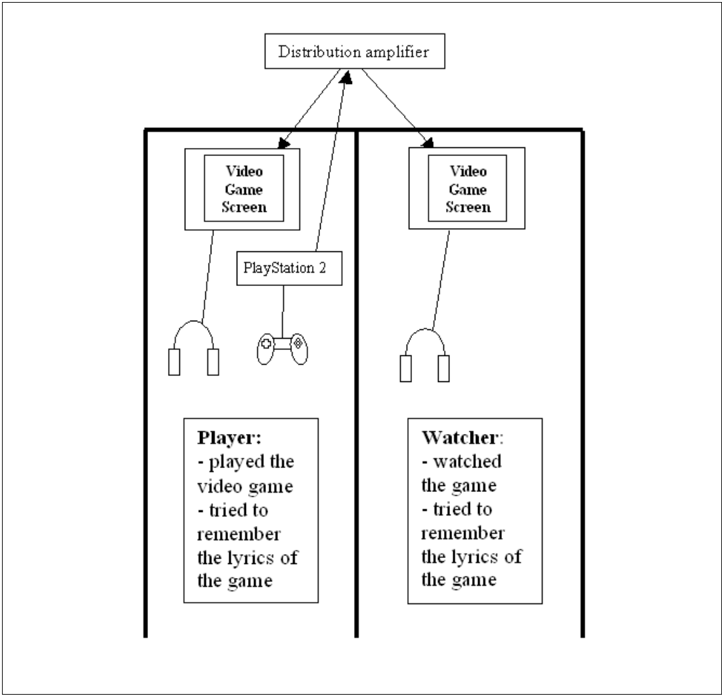
Video games are potential sources of second language input; however, the medium's fundamental characteristic, interactivity, has not been thoroughly examined in terms of its effect on learning outcomes.This experimental study investigated to what degree, if at all, video game interactivity would help or hinder the noticing and recall of second language vocabulary.Eighty randomly-selected Japanese university undergraduates were paired based on similar English language and game proficiencies.One subject played an Englishlanguage music video game for 20 minutes while the paired subject watched the game simultaneously on another monitor.Following gameplay, a vocabulary recall test, a cognitive load measure, an experience questionnaire, and a two-week delayed vocabulary recall test were administered.Results were analyzed using paired samples t-tests and various analyses of variance.Both the players and the watchers of the video game recalled vocabulary from the game, but the players recalled significantly less vocabulary than the watchers.This seems to be a result of the extraneous cognitive load induced by the interactivity of the game; the players perceived the game and its language to be significantly more difficult than the watchers did.Players also reported difficulty simultaneously attending to gameplay and vocabulary.Both players and watchers forgot significant amounts of vocabulary over the course of the study.We relate these findings to theories and studies of vocabulary acquisition and video game-based language learning, and then suggest implications for language teaching and learning with interactive multimedia.
Overview
The claims and statistics of this paper haven’t been checked yet.
Free: it reads the open-access text and checks the first 5 claims that cite a source we can check. Create a free account to check every claim.
Integrity signals
Registry
Cites
Statistics
Figures
Verification
Claims the paper makes
The claims and statistics of this paper haven’t been checked yet.
Free: it reads the open-access text and checks the first 5 claims that cite a source we can check. Create a free account to check every claim.
Claims other papers make about this one
Each is checked against this paper’s own text: does it say what the citing paper says it does?
The cited source says what the claim attributes to it.
In the citing paper
“In other words, although deHaan et al. (2010) instructed the Players to memorize the lyrics, it did not occupy a significant role in succeeding in game-play.”
From Readers, Players, and Watchers: EFL Students’ Vocabulary Acquisition through Digital Video Games (2017) · cites this paper as deHaan et al. (2010)
The cited source says what the claim attributes to it.
In the citing paper
“the most influential outlier (deHaan et al., 2010) had a very large negative effect ( d = -2.43).”
From Second language (L2) gains through digital game-based language learning (DGBLL): A meta-analysis (2022) · cites this paper as deHaan et al., 2010
The cited source says what the claim attributes to it.
In the citing paper
“It is also worth noting that deHaan et al. (2010) appears to be an outlier (see Figure 1).”
From Second language (L2) gains through digital game-based language learning (DGBLL): A meta-analysis (2022) · cites this paper as deHaan et al. (2010)
Self-check
Percentages, sums and reported differences re-computed from the paper’s own numbers.
The self-check needs the paper’s full text.
Citations
Cites
Faul, F., Erdfelder, E., Lang, A.-G., & Buchner, A. (2007) · Behavior Research Methods · doi:10.3758/bf03193146 · Cited by 65,971
The magical number seven, plus or minus two: Some limits on our capacity for processing information.
Miller, G. A. (1994) · Psychological Review · doi:10.1037/0033-295x.101.2.343 · Cited by 17,161
Mayer, R. E. (2009) · doi:10.1017/cbo9780511811678 · Cited by 7,800
Mayer, R. (2020) · doi:10.1017/9781316941355 · Cited by 7,777
What Video Games Have to Teach Us about Learning and Literacy
(2004) · Education + Training · doi:10.1108/et.2004.00446dae.002 · Cited by 6,674
Defining virtual reality: Dimensions determining telepresence
Steuer, J. (1992) · Journal of Communication · doi:10.1111/j.1460-2466.1992.tb00812.x · Cited by 5,459
Cognitive load theory, learning difficulty, and instructional design
Sweller, J. (1994) · Learning and Instruction · doi:10.1016/0959-4752(94)90003-5 · Cited by 5,426 · cited 2×
“, a fast food restaurant), since more complete schema can contribute to lower cognitive load (Douglas & Hargadon, 2001; Sweller, 1994).”
BackgroundBaddeley, A. (1992) · Science · doi:10.1126/science.1736359 · Cited by 5,258
Cognitive Load Theory and Instructional Design: Recent Developments
Paas, F., Renkl, A., & Sweller, J. (2003) · Educational Psychologist · doi:10.1207/s15326985ep3801_1 · Cited by 3,041 · cited 3×
“Language Learning & Technology http://llt.msu.edu/vol14num2/dehaanreedkuwada.pdf June 2010, Volume 14, Number 2 pp. 74–94 Copyright © 2010, ISSN 1094-3501 74 THE EFFECT OF INTERACTIVITY WITH A MUSIC VIDEO GAME ON SECOND LANGUAGE VOCABULARY RECALL”
Background(2020) · Encyclopedia of Education and Information Technologies · doi:10.1007/978-3-030-10576-1_300187 · Cited by 2,893
Research works printed but not linked: 6
- deHaan, J. (2005a). Learning language through video games: A theoretical framework, an analysis of game genres and questions for future research. In S. Schaffer & M. Price (Eds.), Interactive Convergence: Critical Issues in Multimedia (vol. 10), Chapter 14, pp. 229-239. Retrieved from http://www.inter- disciplinary.net/publishing/idp/eBooks/icindex.htm
- Engelkamp, J. (2001). Action memory: A system-oriented approach. In H. D. Zimmer, R. Cohen, M. Guynn, J. Engelkamp, R. Kormi-Nouri, & M. N. Foley (Eds.), Memory for action: A distinct form of episodic memory? (pp. 49-96). New York: Oxford University Press.
- Knight, S. (1994). Dictionary: The tool of last resort in foreign language reading? A new perspective. Modern Language Journal, 78(3), 285-299.
- Schmidt, R. W. (2001). Attention. In P. Robinson (Ed.), Cognition and second language instruction
- Squire, K. D. (2006). From content to context: Video games as designed experiences Educational Researcher, 35(8), 19-29.
- Um, E. J., & deHaan, J. (2005). Video games and cognitive apprenticeship-based learning. Proceedings of the Association for Educational Communications and Technology, USA, 28, 499-505.
Cited by
Items 101–200 of 275
The Roles of Attitudinal Perceptions and Cognitive Achievements in a Serious Game
Cheon, J., Chung, S., & Lee, S. (2015) · Journal of Educational Computing Research · doi:10.1177/0735633114568851 · Cited by 17
“Prior literature illustrated that players who take serious games can increase recall and comprehensive test scores in many areas, such as language (deHaan, Reed, & Kuwada, 2010), electricity (Mayer & Johnson, 2010), history (Mansour & El-Said, 2008), and physics (Squire, Barnett, & Grant, 2004).”
BackgroundInvestigating the Effects of an Adventure Video Game on Foreign Language Learning
Chen, H. H.-J., & Yang, C. T.-Y. (2011) · Lecture notes in computer science · doi:10.1007/978-3-642-23456-9_31 · Cited by 16
“deHaan, Reed, and Kuwada[6] conducted a study on the interactivity of a PS2 music game.”
BackgroundAdapting arcade games for learning
Cai, C. J. (2013) · CHI Conference Extended Abstracts on Human Factors in Computing Systems (CHI EA) · doi:10.1145/2468356.2479490 · Cited by 16
“Because retrieval practice exerts greater cognitive effort than non-recall studying, and the interactivity of gaming introduces an additional cognitive load [3], it is unclear whether retrieval practice will remain advantageous in an intense game setting.”
BackgroundKeehl, O. G., & Melcer, E. F. (2019) · International Conference on the Foundations of Digital Games (FDG) · doi:10.1145/3337722.3337764 · Cited by 17
“These games addressed various aspects of language acquisition, such as vocabulary and meaning [2, 7, 15], pronunciation and tones [9, 11, 17], grammar”
BackgroundShang, X. (2025) · Results in Engineering · doi:10.1016/j.rineng.2025.108452 · Cited by 18
Developing and evaluating an online video-assisted collocation learning system for EFL students
Shen, W.-W., Lin, J., Cheng, W. K., & Hong, Z. (2021) · Interactive Learning Environments · doi:10.1080/10494820.2021.2003408 · Cited by 15
“Watching videos for L2 vocabulary acquisition is a proven instructional approach, as clearly demonstrated by various studies (Danan, 2004; DeHaan et al., 2010; Hsieh, 2020; Hsu et al., 2013; Teng, 2019b).”
BackgroundResultCarcioppolo, N., Kim, S. Y., Sanchez, M. I., Mao, B., Malova, E., Ryan, A., Lun, D., Ewing, C., & Hu, S. (2022) · Social Science & Medicine · doi:10.1016/j.socscimed.2022.115281 · Cited by 15
Synthesis of Research on Video Games for the Four Second Language Skills and Vocabulary Practice
Yudintseva, A. (2015) · Open Journal of Social Sciences · doi:10.4236/jss.2015.311011 · Cited by 17
“First-person shooter games [21] show little evidence of listening comprehension improvements and rhythm games [27] are less effective for vocabulary acquisition.”
BackgroundDigital Games and Second Language Learning
Reinders, H. (2016) · Springer eBooks · doi:10.1007/978-3-319-02328-1_26-1 · Cited by 18
A Systematic Review of Video Games for Second Language Acquisition
Li, J. (2019) · Advances in educational technologies and instructional design book series · doi:10.4018/978-1-7998-0246-4.ch021 · Cited by 17
Inteligencia artificial, su regulación en la investigación científica, caso México
Velazquez-Ramos, C. Y., la O-Camacho, I. J. D., Camacho, A. D., Aguirre, L. R. D., & Marcelino-Aranda, M. (2012) · Revista Tecnología en Marcha · doi:10.18845/tm.v39i5.8512 · Cited by 13
A Review of Research on the Application of Digital Games in Foreign Language Education
Peterson, M., White, J. S., Mirzaei, M. S., & Wang, Q. (2021) · IGI Global eBooks · doi:10.4018/978-1-6684-3710-0.ch094 · Cited by 21
Jia, W., Zhang, L., Pack, A., Guan, Y., & Zou, B. (2024) · Language Learning & Technology · doi:10.64152/10125/73554 · Cited by 14
“…al., 2020); only a handful of studies make an explicit distinction among vocabulary knowledge types and draw specifically on productive vocabulary (deHaan et al., 2010; Franciosi, 2017) or both receptive vocabulary (RV) and productive vocabulary (PV) (Rasti-Behbahani & Shahbazi, 2020; Sundqvist &…”
BackgroundIntroduction: A Scoping Review of Second Language Vocabulary Learning in the Wild
Reynolds, B. L. (2023) · Springer eBooks · doi:10.1007/978-981-99-1490-6_1 · Cited by 13
A Genre Analysis of Research Article Discussions in Applied Linguistics
Dujsik, D. (2013) · Seoul National University Open Repository (Seoul National University) · Cited by 23
Cheon, J., Chung, S., Song, J., & Kim, Y. (2013) · Interactive Learning Environments · doi:10.1080/10494820.2013.788030 · Cited by 11
“…recall test or comprehensive test) to reveal positive effects of serious games in various subject areas, such as physics (Squire, Barnett, & Grant, 2004), electricity (Johnson & Mayer, 2010; Mayer & Johnson, 2010), history (Mansour & El-Said, 2008), and language (deHaan, Reed, & Kuwada, 2010).”
BackgroundPromoting Spoken Interaction and Student Engagement With Board Games in a Language Teaching Context
York, J. (2019) · Advances in educational technologies and instructional design book series · doi:10.4018/978-1-7998-2015-4.ch001 · Cited by 12
Using Community of Inquiry to Scaffold Language Learning in Out-of-School Gaming: A Case Study
Li, K., Peterson, M., & Wang, Q. (2020) · International Journal of Game-Based Learning · doi:10.4018/ijgbl.2021010103 · Cited by 13
Defining Game-Mediated Second and Foreign Language Teaching and Learning: A Review
Gao, Y., & Gee, E. R. (2023) · International Journal of Game-Based Learning · doi:10.4018/ijgbl.323210 · Cited by 12
Delivery Ghost: Effects of Language Immersion and Interactivity in a Language Learning Game
Cho, J. Y., Andersen, E., & Kizilcec, R. F. (2021) · CHI Conference Extended Abstracts on Human Factors in Computing Systems (CHI EA) · doi:10.1145/3411763.3451767 · Cited by 10
Al-Madani, F. M. (2021) · International Journal of Education and Information Technologies · doi:10.46300/9109.2021.15.5 · Cited by 9
ENHANCING EFL ADOLESCENT LEARNERS’ VOCABULARY ACQUISITION VIA ONLINE SINGLE PLAYER ROLE-PLAY GAMES
Lin, C., & Guo, Y.-H. (2021) · LANGUAGE LITERACY Journal of Linguistics Literature and Language Teaching · doi:10.30743/ll.v5i1.3506 · Cited by 9
A Deep Learning Model with Virtual Reality Technology for Second Language Acquisition
Zhao, Y., & Liu, S. (2022) · Mobile Information Systems · doi:10.1155/2022/9686725 · Cited by 9
RetractedThe Impact of Computer Games on EFL Learners' Spelling: A Qualitative Study
Shokri, H., & Abdolmanafi-Rokni, S. J. (2014) · Studies in English Language Teaching · doi:10.22158/selt.v2n3p266 · Cited by 9
Schütze, U. (2024) · Bilingual processing and acquisition · doi:10.1075/bpa.19.c4 · Cited by 9
Li, K., Fan, Q., & Hu, P. (2025) · Innovation in Language Learning and Teaching · doi:10.1080/17501229.2025.2509754 · Cited by 9
Ge, Z.-G. (2024) · Computer Assisted Language Learning · doi:10.1080/09588221.2024.2342885 · Cited by 12
Rankin, Y. A., Tibi, S., Kennington, C., & Han, N. (2021) · Proceedings of the ACM on Human-Computer Interaction · doi:10.1145/3474706 · Cited by 10
“Embodied learning has emerged as a novel way to engage L2 students in leveraging physical motion in a classroom setting to promote collaborative learning activities that increase L2 students’ vocabulary acquisition [40, 48, 49].”
BackgroundExploring Socio-Cultural Elements in Three Commercial English Language Learning Apps
Garnes-Tarazona, I. (2018) · International Journal of Computer-Assisted Language Learning and Teaching · doi:10.4018/ijcallt.2018010105 · Cited by 10
Sillabo di riferimento per l’insegnamento dell’italiano della musica
Balboni, P. (2018) · SAIL · doi:10.30687/978-88-6969-270-3 · Cited by 8
Vnucko, G., Kralova, Z., & Tirpakova, A. (2024) · Heliyon · doi:10.1016/j.heliyon.2024.e33301 · Cited by 7
“[65,66]), our research highlights the undeniable benefits of digital games for vocabulary acquisition (e.g., [34 – 36]).”
BackgroundMetacognitive Strategies and Perceived Factors Affecting the Speaking Performance of ESL Learners
Dayag-Tungpalan, M. L. (2023) · Journal for Educators Teachers and Trainers · doi:10.47750/jett.2023.14.02.049 · Cited by 7
Du, J. (2023) · Applied Mathematics and Nonlinear Sciences · doi:10.2478/amns.2023.2.01382 · Cited by 7
Sanchez, D. R. (2022) · Multimodal Technologies and Interaction · doi:10.3390/mti6030019 · Cited by 7
Gaming Literacy and Its Pedagogical Implications
Lo, N., & Mok, B. C.-Y. (2019) · Digital culture and humanities · doi:10.1007/978-981-13-1277-9_8 · Cited by 7
Ramey, L. T., Neville, D., Amer, S., deHaan, J. W., Durand, M., Essary, B., Howland, R., Kapadia, M., Kronenberg, F. A., Shelton, B. E., et al. (2019) · Digital philology · doi:10.1353/dph.2019.0016 · Cited by 8
Self-citationWordsearch, an Educational Game in Language Learning
Goumas, S., Terzopoulos, G., Tsompanoudi, D., & Iliopoulou, A. (2020) · Journal of Engineering Science and Technology Review · doi:10.25103/jestr.131.07 · Cited by 7
“Following their experiments in [34], authors point out that”
BackgroundSoundHunters: Increasing Learner Phonological Awareness in Plains Cree
Lothian, D., Akçayır, G., Sparrow, A., Mcleod, O., & Epp, C. D. (2020) · Lecture notes in computer science · doi:10.1007/978-3-030-52237-7_28 · Cited by 8
“Along with the amount of challenge, the type of interactivity provided could play a role in the activity’s effectiveness, as some types of interactions that learners have with games have been associated with increased vocabulary retention [15].”
BackgroundA Systematic Review of Video Games for Second Language Acquisition
Li, J. (2021) · IGI Global eBooks · doi:10.4018/978-1-6684-3710-0.ch064 · Cited by 9
Alrajhi, A. S. (2020) · Electronic Journal of Foreign Language Teaching · doi:10.56040/asla1731 · Cited by 8
“Paying attention to both playing and language in games might be a challenging task for players. deHaan, Reed, and Kuwanda (2010) noted that increasing cognitive load that results from serious game play can possibly impede retention of encountered vocabulary items.”
BackgroundVideo Games: The Interface Between Language Learning and Storytelling
Parsayi, F., & Soyoof, A. (2018) · International Journal of Pedagogies and Learning · Cited by 20
Involvement Load and Vocabulary Acquisition in Digital Game-Based Tasks
Rasti-Behbahani, A. (2023) · Springer eBooks · doi:10.1007/978-981-99-1490-6_6 · Cited by 6
Music to My Ears: Developing Kanji Stroke Knowledge through an Educational Music Game
Keehl, O. G., & Melcer, E. F. (2021) · Multimodal Technologies and Interaction · doi:10.3390/mti5120083 · Cited by 10
“These games targeted a variety of aspects involved in language acquisition, including vocabulary and meaning [22,36,37], pronunciation and tones [34,35,38], grammar [31], writing [29,33] and even culture [22,32].”
BackgroundMethodAmin, N. M., & Bakar, M. S. A. (2022) · Sains Insani · doi:10.33102/sainsinsani.vol7no1.376 · Cited by 8
Zhetpisbayeva, B. A., & Shelestova, T. (2017) · lnternational Electronic Journal of Elementary Education · doi:10.26822/iejee.2017131946 · Cited by 6
Yu, Z. (2018) · International Journal of Gaming and Computer-Mediated Simulations · doi:10.4018/ijgcms.2018040101 · Cited by 8
Scholz, K. W. (2016) · UWSpace (University of Waterloo) · Cited by 15
The design and implementation of “unplugged” game-based learning in computing educationPreprint
Huang, W. (2020) · SocArXiv (OSF Preprints) · doi:10.31235/osf.io/ykq82 · Cited by 6
Kyle Lai, K.-W., & Howard Chen, H.-J. (2025) · Computers & Education · doi:10.1016/j.compedu.2025.105343 · Cited by 5
Ge, Z.-G., & Li, Q. (2024) · Education and Information Technologies · doi:10.1007/s10639-024-13176-y · Cited by 8
“Some scholars found gamification could improve language learning performance (Hwang et al. 2016; Liu & Huang, 2019), while others found through experiments that gamified language learning might not be as effective as expected (Jonathan et al., 2010).”
Zheng, J., Berg, E., Byrne, M. L., & Rakesh, D. (2025) · Journal of Adolescence · doi:10.1002/jad.70069 · Cited by 7
Educational Neuroscience and the Affective Affordances of Video Games in Language Learning
Gorham, T., & GORHAM, J. (2016) · Elsevier eBooks · doi:10.1016/b978-0-12-801738-8.00008-7 · Cited by 6
The Method of Teaching English Using Music
Omolara, I. (2023) · International Journal Papier Public Review · doi:10.47667/ijppr.v4i1.187 · Cited by 5
Grove, F. D., LOOY, J. V., & Mechant, P. (2013) · International Journal of Game-Based Learning · doi:10.4018/ijgbl.2013040102 · Cited by 7
Implication from Incidental and Intentional Learning in Taking up a Foreign Language
Lu, Y. (2021) · Advances in Social Science, Education and Humanities Research/Advances in social science, education and humanities research · doi:10.2991/assehr.k.211220.091 · Cited by 5
“DeHaan illustrates that how to balance attending to gameplay and vocabulary at the same time is still essential [8].”
BackgroundLearnful L2 Gaming: The Wisdom of the Wild
Reinhardt, J. S., & Han, Y. (2021) · Educational linguistics · doi:10.1007/978-3-030-74958-3_9 · Cited by 5
Su, Y. (2021) · Journal of Language Teaching · doi:10.54475/jlt.2021.015 · Cited by 6
Understanding L2 use in MMOGs: A linguistic framework of digital gaming
Ibrahim, K. H. S. (2022) · Foreign Language Annals · doi:10.1111/flan.12659 · Cited by 6
Noroozloo, N., Ahmadi, S. D., & Mehrdad, A. G. (2015) · Cumhuriyet Science Journal · Cited by 11
Tapping into the field of foreign language learning games
Grove, F. D., Cornillie, F., Mechant, P., & LOOY, J. V. (2012) · International Journal of Arts and Technology · doi:10.1504/ijart.2013.050690 · Cited by 6
Cultural and Philosophical Understanding of Game-based Learning in STEM Subjects
Garay, J. (2021) · International Journal of Educational Sciences · doi:10.31901/24566322.2022/32.1-3.1178 · Cited by 4
“The interests of non-players are usually peaked when players are playing games that are motion controlled when they are in the same rooms (deHaan et al. 2010).”
Teaching English vocabulary to students through online games
Pintado-Peñaloza, K. J., & Fajardo-Dack, T. (2022) · Revista Arbitrada Interdisciplinaria Koinonía · doi:10.35381/r.k.v7i1.1676 · Cited by 4
“…that memory retention of the vocabulary of the students was lower when they played online games than when using flashcards; however, the spelling of the English words was higher than the other method (Dehaan, 2010) in his study demonstrated that players recalled less vocabulary than the viewers.”
BackgroundResultMeasuring cognitive load: a meta-analysis of load measurement sensitivity
Hodson, J. L. (2016) · J. Willard Marriott Library · doi:10.26053/0h-znjx-1b00 · Cited by 8
Adapting existing games for education using speech recognition
Cai, C. J. (2013) · DSpace@MIT (Massachusetts Institute of Technology) · Cited by 5
Buendgens-Kosten, J. (2022) · The JALT CALL Journal · doi:10.29140/jaltcall.v18n3.548 · Cited by 3
“Many of these are mono-lingual, but even as monolingual games they can contribute towards growing a player’s plurilingual repertory by supporting this person for example in acquiring new vocabulary items (deHaan et al., 2010; Di Zou et al., 2021; Hitosugi et al., 2014; Sundqvist, 2019).”
Talk to Me! Games and Studentsâ Willingness to Communicate
Reinders, H., & Wattana, S. (2014) · Digital Games in Language Learning and Teaching · doi:10.1057/9781137005267.0015 · Cited by 3
Gamifying the Music Classroom: Digital Tools for Practical Application
Lesser, A. (2024) · doi:10.1093/oso/9780197696644.001.0001 · Cited by 4
Digital Games for Language Learning: A Scoping Review
Shahiwala, S., & Rahul, D. R. (2025) · Research Synthesis in Applied Linguistics · doi:10.1080/29984475.2025.2497862 · Cited by 4
Wang, J. (2022) · Scientific Programming · doi:10.1155/2022/1626448 · Cited by 3
RetractedEmre, B., Güllep, B., Şenel, G. H., & Kaban, A. L. (2022) · Advances in educational technologies and instructional design book series · doi:10.4018/978-1-6684-4446-7.ch010 · Cited by 3
Virtual Reality, Artificial Intelligence and Language Learning: The need for attention
Schütze, U. (2024) · Bilingual processing and acquisition · doi:10.1075/bpa.19 · Cited by 6
Technology and the Changing Nature of Narratives in Language Learning and Teaching
Kronenberg, F. A. (2013) · Cutting-edge technologies in higher education · doi:10.1108/s2044-9968(2013)000006f007 · Cited by 3
Wattana, S. (2013) · UC Research Repository (University of Canterbury) · doi:10.26021/9498 · Cited by 10
(2021) · doi:10.37546/jaltsig.call2020 · Cited by 3
Motivation and Affect in Digital Game-Based Language Learning and Teaching
Jabbari, N., Eshaghi, S. M., & Zarrinabadi, N. (2025) · Springer eBooks · doi:10.1007/978-3-031-51447-0_133-2 · Cited by 3
Shahiwala, S., & Rahul, D. R. (2025) · System · doi:10.1016/j.system.2025.103864 · Cited by 2
Conceptualizing Digital Game-Mediated L2 Learning and Pedagogy
Reinhardt, J., & Sykes, J. M. (2014) · Digital Games in Language Learning and Teaching · doi:10.1057/9781137005267.0008 · Cited by 2
Han, F., & Wang, Z. (2017) · ASCILITE Publications · doi:10.14742/apubs.2017.749 · Cited by 4
“…primary focus of the gaming environment is not on linguistic aspects, the digital games may not necessarily be conducive to language learning (e.g., deHaan, Reed, Kuwada, 2010), whereas gaming environment which supplies sufficient opportunities of repetition of linguistic elements tends to lead to…”
BackgroundDwivedi, U., & Misra, M. (2024) · International Journal of Human-Computer Interaction · doi:10.1080/10447318.2024.2430920 · Cited by 2
“In academic researches one common thread is that most investigations are exploring effects of video game engagement on behavior of the user or player (Bellotti et al., 2011; deHaan et al., 2010; Fox et al., 2015; Lin, 2013a; Sperring & Strandvall, 2008).”
Zhang, L., Huang, Y., Fang, L., Guan, T., Jong, M. S., & Shang, J. (2026) · International Journal of Human-Computer Interaction · doi:10.1080/10447318.2026.2630086 · Cited by 2
“…pattern of emotional transitions toward rational, calm, and objective states holds particular significance within the context of DGBLL. Existing research has highlighted that DGBLL environments pose significant challenges to learners’ cognitive load (e.g., deHaan et al., 2010; Yang & Li, 2024).”
Cognitive Load Optimization of Context and Digital Game-Based Vocabulary Learning and Retention
Rasti-Behbahani, A., Khallaf, N. M., Sadeghi, K., & Sulaiman, M. A. B. A. (2026) · International Journal of Computer-Assisted Language Learning and Teaching · doi:10.4018/ijcallt.405414 · Cited by 2
The Effect of Computer-assisted Language Learning and E-learning on Vocabulary Learning
Farsi, M., Sarvestani, N. S., Hassanzade, S., & Sharif, M. (2014) · Cited by 2
Reinders, H. (2012) · Palgrave Macmillan UK eBooks · doi:10.1057/9781137005267_1 · Cited by 2
Influence of Video Games on Children’s English Language Learning: A Case of Bangladesh
Snigdha, S. S., & Debnath, A. (2024) · EIKI Journal of Effective Teaching Methods · doi:10.59652/jetm.v2i1.165 · Cited by 2
“By requiring players to comprehend and utilize new terms in context, these games help players develop their foreign language vocabulary (Gee, 2011; Isbister, 2016; Hitosugi et al.,2014; DeHaan et al., 2010).”
BackgroundShintaku, K. (2024) · Advances in educational technologies and instructional design book series · doi:10.4018/979-8-3693-2687-9.ch011 · Cited by 3
(Digital) Games and language teaching
York, J. (2025) · Language learning and language teaching · doi:10.1075/lllt.63.09yor · Cited by 2
Hewagodage, V. (2019) · Advances in higher education and professional development book series · doi:10.4018/978-1-7998-0426-0.ch004 · Cited by 4
Baturay, M. H., YASTIBAŞ, A. E., Ekşi, G. Y., & Çinar, C. A. (2021) · Advances in game-based learning book series · doi:10.4018/978-1-7998-7271-9.ch027 · Cited by 2
A Comparative Study of Gamified Scaffolding Modes in Virtual Language Learning EnvironmentPreprint
Jiang, X., Wang, R., Hoang, T. N., Ranaweera, C., & Myers, T. (2023) · SSRN Electronic Journal · doi:10.2139/ssrn.4625862 · Cited by 3
VIDEO GAMES AS LANGUAGE LEARNING TOOLS
Hladonik, G. (2021) · Innovate Pedagogy · doi:10.32843/2663-6085/2021/33-2.27 · Cited by 1
Estudios de lingüística aplicada III
de València, U. P., Cazevieille, F. O., Pastor, M. L. C., de València, U. P., Forteza, F. R., de València, U. P., Skorczynska, H., de València, U. P., Vallés, I. T. T., & de València, U. P. (2019) · Editorial Universitat Politècnica de València eBooks · doi:10.4995/sclin.2019.651301 · Cited by 1
The effects of digital games on English for Specific Purposes (ESP) vocabulary retention
Nguyen, T. M. D. (2026) · HO CHI MINH CITY OPEN UNIVERSITY JOURNAL OF SCIENCE - SOCIAL SCIENCES · doi:10.46223/hcmcoujs.soci.en.16.9.4814.2026 · Cited by 1
“Similarly, DeHaan et al. (2010) suggest that while interaction with a music video game temporarily enhances vocabulary acquisition, it does not significantly support long-term vocabulary retention because it lacks opportunities for review and realistic application.”
Zollo, S. A. (2015) · Lingue e linguaggi · doi:10.1285/i22390359v12p205 · Cited by 1
“They are a combination of subtitles, repetition and authentic language, graphics, colours and sound like videogames but there is no interactivity (deHaan 2010) and their main purpose is not to entertain like in video games but to inform and raise awareness.”
BackgroundInstructional and Gaming Elements: What Are They and Where Do They Intersect?
Procci, K., & Bowers, C. A. (2014) · Cambridge University Press eBooks · doi:10.1017/cbo9781107280137.004 · Cited by 3
Vocabulary Mediation in the Second Language Classroom: An Exploratory Study
Walter, B. R. (2016) · Cited by 1
Developing User-Centered Video Game Concepts for Language Learning
Poels, Y., Annema, J.-H., Zaman, B., & Frederik Cornillie, B. (2012) · Cited by 1
Zhu, W., & Liu, Z. (2017) · English Language Teaching · doi:10.5539/elt.v10n7p203 · Cited by 1
Ibrahim, K. H. S. (2018) · Advances in educational technologies and instructional design book series · doi:10.4018/978-1-5225-5140-9.ch020 · Cited by 1
Integrated Supplementary Task-based Games
Maghsoud, H. (2018) · International Journal of English Language Teaching · doi:10.5430/ijelt.v5n2p43 · Cited by 1
Metadata
- Authors
- deHaan, J., Reed, W. M., & Kuwanda, K.
- Affiliations
- University of Shizuoka (JP)
- ORCID
- deHaan, Jonathan
- Venue
- Language Learning & Technology
- Published
- 2010-06-01
- Volume
- 14
- Issue
- 2
- Pages
- 74-94
- ISSN
- 1094-3501 (ISSN-L)
- OpenAlex
- W2122519738
- Cited by
- 266
- References
- 62
- Citations by year
- 2026: 10 · 2025: 12 · 2024: 39 · 2023: 11 · 2022: 18 · 2021: 28 · 2020: 16 · 2019: 16 · 2018: 19 · 2017: 12 · 2016: 15 · 2015: 17 · 2014: 16 · 2013: 14 · 2012: 17
- FWCI
- 22.72
- Type
- journal article
- Language
- en
- Open access
- diamond
- doi.org
- Licence
- Locations
- Language learning & technology (publishedVersion, cc-by-nc-nd)
- DOAJ (DOAJ: Directory of Open Access Journals) (submittedVersion, cc-by-sa)
- ScholarSpace (University of Hawaii at Manoa) (submittedVersion)
- Topics
- Social Sciences › Psychology › Developmental and Educational Psychology › Second Language Acquisition and Learning
- Social Sciences › Psychology › Developmental and Educational Psychology › Educational Games and Gamification
- Social Sciences › Arts and Humanities › Language and Linguistics › Subtitles and Audiovisual Media
- Keywords
- music video games, vocabulary acquisition, extraneous cognitive load, noticing, Japanese learners of English, interactive multimedia, delayed recall
About these checks
Registry, retraction, Cites and statistics results are computed, not judged, with one exception: a printed reference that no index lists is read once by a model before it counts as a citation error. Claims are extracted by a model and kept only when their quote appears verbatim in the text; each cited source is then checked, with a model’s help, for whether it says what the claim relies on. Those verdicts can be wrong — read the claim’s quote and the cited source before relying on one.
Statistics and arithmetic are recomputed, not judged.
Confidence bands are shown only for fields calibrated on our annotated test set. None is calibrated yet, so no band is shown.
What counts as a claim ›How we measure confidence ›How we check this ›
Are you an author, or do you see a problem with this page? Request a review
Data sources
Bibliographic data: Semantic Scholar, OpenAlex, Crossref.
Contains information from the Semantic Scholar Academic Graph Datasets, made available under the ODC Attribution License (ODC-BY 1.0).
Semantic Scholar’s data is described in: Kinney, R., et al. (2023). The Semantic Scholar Open Data Platform. arXiv:2301.10140.
