

At what rate do learners learn and retain new vocabulary from reading a graded reader?
Open accessThe DOI matches its Crossref record; 30 of the 30 references it cites were found in a registry or an index; 1 of the 23 sources its claims cite were checked for support.
Abstract
This study examined the rate at which vocabulary was learned from reading the 400 headword graded reader A Little Princess. To ascertain whether words of different frequency of occurrence rates were more likely to be learned and retained or forgotten, 25 words within five bands of differing frequency of occurrence (15 to 18 times to those appearing only once) were selected. The spelling of each word was changed to ensure that each test item was unknown to the 15 intermediate level (or above) female Japanese subjects. Three tests (word-form recognition, prompted meaning recognition and unprompted meaning recognition) were administered immediately after reading, after one week and after a three month delay. The results show that words can be learned incidentally but that most of the words were not learned. More frequent words were more likely to be learned and were more resistant to decay. The data suggest that, on average, the meaning of only one of the 25 items will be remembered after three months, and the meaning of none of the items that were met fewer than eight times will be remembered three months later. The data thus suggest that very little new vocabulary is retained from reading one graded reader, and that a massive amount of graded reading is needed to build new vocabulary. It is suggested that the benefits of reading a graded reader should not only be assessed by researching vocabulary gains and retention, but by looking at how graded readers help develop and enrich already known vocabulary.
Overview
CoChat Summary
## TL;DR
This experiment tested whether Japanese university women could learn substitute vocabulary from reading one 400-headword graded reader, with tests immediately, after one week, and after three months. The main finding was that some words were learned incidentally, but most were not retained, and learning was much better for higher-frequency items than for low-frequency ones.
## Key findings
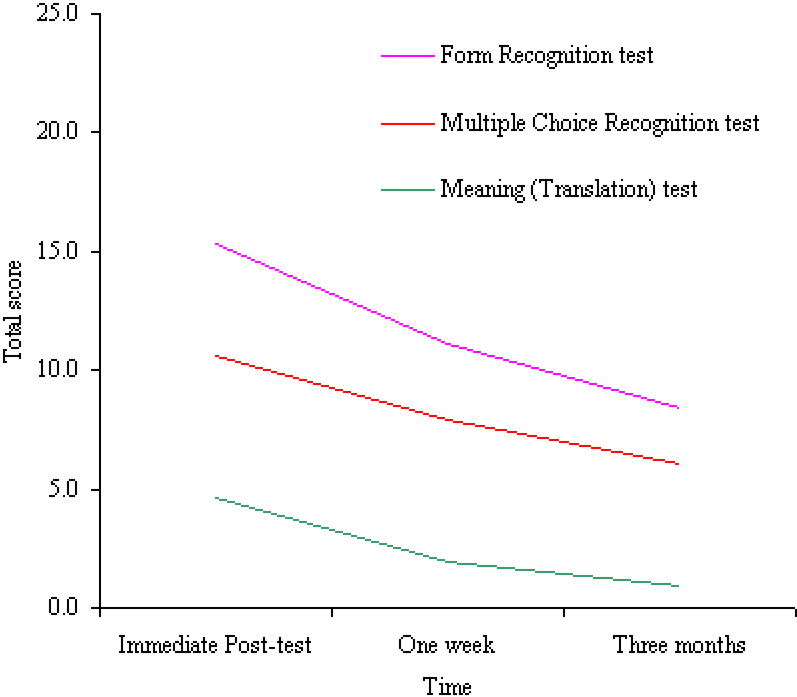
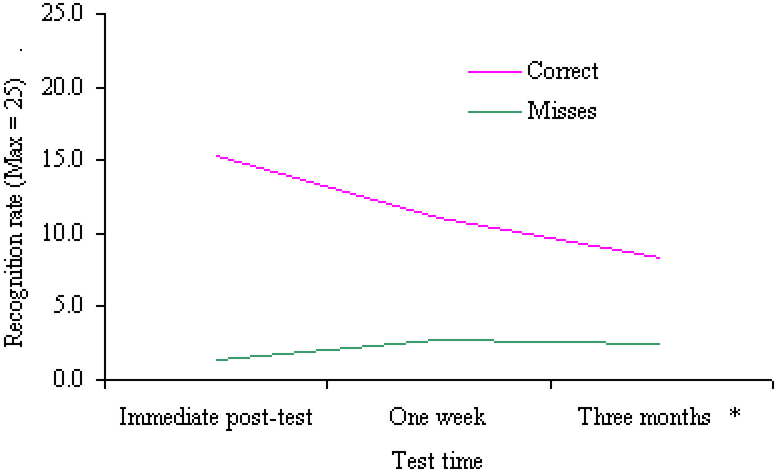
- On the word-form recognition test, mean scores fell from 15.3/25 immediately after reading to 11.1/25 after one week and 8.4/25 after three months; incorrect selections rose from 1.3 to 2.8 to 2.4.
- On the multiple-choice recognition test, mean scores declined from 10.6/25 immediately to 7.9/25 after one week and 6.1/25 after three months.
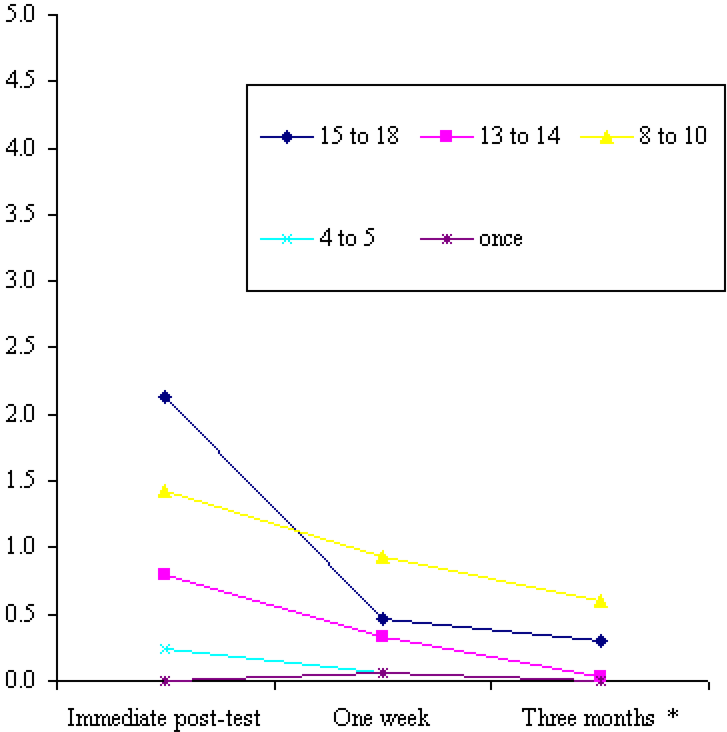
- On the meaning (translation) test, mean scores dropped from 4.6/25 immediately to 1.9/25 after one week and 0.9/25 after three months; the paper states this means about one new word from one hour of reading was retained after three months.
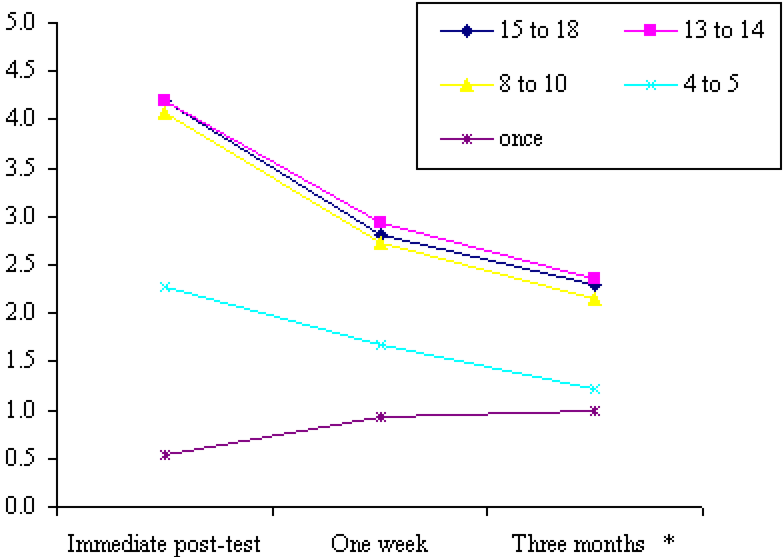
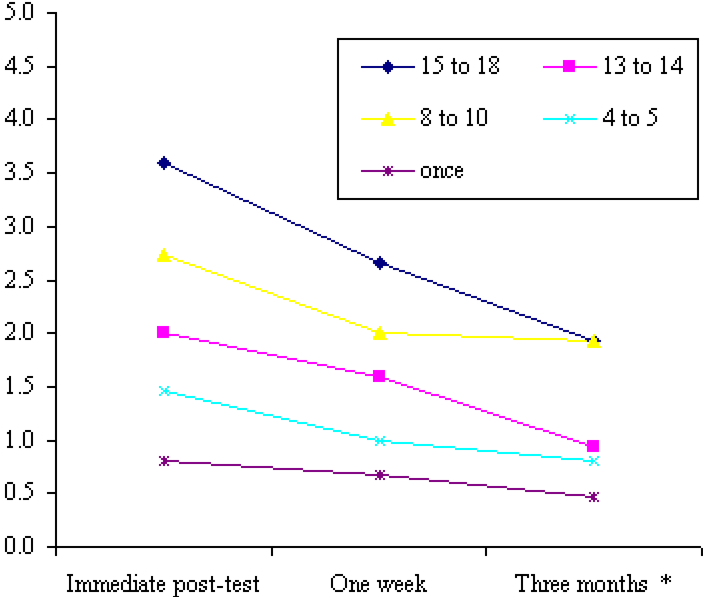
- Frequency mattered: words met 15–18 times were learned and retained more often, while words met fewer than 8 times were near zero on the translation test; the paper states that words met fewer than 8 times had 0 chance of being remembered three months later.
- The paper reports significant differences among test types at the immediate post-test (F = 17.11, p < .001) and significant declines over time for each test: word-form recognition (F = 35.45, p < .001), multiple-choice (F = 22.00, p < .001), and translation (F = 15.41, p = .002).
## Methods
- Design: 15 Japanese female university students read one graded reader, *A Little Princess*, with 25 substitute words embedded at different occurrence frequencies; vocabulary was tested immediately, after one week, and after three months.
- Sample and materials: Participants were 19–21 years old, lower-intermediate or above, mostly English Club members; the text contained 5,872 words, and the study used three test formats: word-form recognition, multiple-choice recognition, and meaning translation.
- Analysis: Scores were summarized by test and by occurrence frequency; the paper reports repeated measures ANOVAs and compares retention/decay across test types and frequency bands.
## Limitations
- The paper explicitly says there were relatively few subjects and that a larger sample would be better to show frequency effects more clearly.
- It says only 5,872 words were read, so a longer text or multiple texts would be better for judging vocabulary learning from reading.
- It also says the study would be stronger with texts containing a better variety of word frequencies so that all test words are equally guessable.
- Evident from the text: the study used one graded reader only, so the findings may not generalize to broader reading conditions or to other texts.
Model-written summary. Check it against the paper before relying on it.
Integrity signals
Registry
Cites
Statistics
Figures
Verification
Claims the paper makes
1 Valid · 4 Not valid · 13 Not checked · 162 Own results and interpretations
The cited sources support only part of this claim — read each source’s verdict below.
In the paper
“Secondly, learners need to meet an unknown word many times before it is learned (Nagy, Herman and Anderson, 1985; Nagy, Anderson and Herman, 1987; Shu, Anderson and Zhang, 1995; Nation 2001: 237).”
What the sources say
- Partly supportedcites Nagy, Herman and Anderson, 1985 matched to “Learning Words from Context” (1985) sourceExperimental — accuracy not yet measured
The ‘Learning Words from Context’ section says that full knowledge seldom follows one encounter and that word learning often proceeds in small increments. But the Conclusion reports unmistakable learning from one or very few encounters. The claim omits the distinction between beginning to learn a word and learning its full meaning, making repeated encounters sound necessary for any learning. (LLM, conf=0.87)
- Not checked — no full text of the sourcecites Nagy, Anderson and Herman, 1987 matched to “Learning Word Meanings From Context During Normal Reading” (1987) source
- Not checked — no full text of the sourcecites Nation 2001: 237 matched to “Learning Vocabulary in Another Language” (2001) source
plainstates a cause- Asserted: passes — The authors put it forward as true.
- Checkable: passes — It can be checked against evidence.
- Load-bearing: passes — The paper’s conclusions depend on it.
- Based: passes — The paper gives a reason why it holds.
- Partly supported
A result the paper reports from its own data — it cites no other source for it, so there is none to check. The quote shows it is in the paper.
In the paper
“More frequent words were more likely to be learned and were more resistant to decay.”
hedgedstates an association- Asserted: passes — The authors put it forward as true.
- Checkable: passes — It can be checked against evidence.
- Load-bearing: passes — The paper’s conclusions depend on it.
- Based: passes — The paper gives a reason why it holds.
A result the paper reports from its own data — it cites no other source for it, so there is none to check. The quote shows it is in the paper.
In the paper
“The results show that words can be learned incidentally but that most of the words were not learned.”
plainstates a cause- Asserted: passes — The authors put it forward as true.
- Checkable: passes — It can be checked against evidence.
- Load-bearing: passes — The paper’s conclusions depend on it.
- Based: passes — The paper gives a reason why it holds.
A result the paper reports from its own data — it cites no other source for it, so there is none to check. The quote shows it is in the paper.
In the paper
“More frequent words were more likely to be learned and were more resistant to decay.”
hedgedstates an association- Asserted: passes — The authors put it forward as true.
- Checkable: passes — It can be checked against evidence.
- Load-bearing: passes — The paper’s conclusions depend on it.
- Based: passes — The paper gives a reason why it holds.
A result the paper reports from its own data — it cites no other source for it, so there is none to check. The quote shows it is in the paper.
In the paper
“The data suggest that, on average, the meaning of only one of the 25 items will be remembered after three months”
hedged- Asserted: passes — The authors put it forward as true.
- Checkable: passes — It can be checked against evidence.
- Load-bearing: passes — The paper’s conclusions depend on it.
- Based: passes — The paper gives a reason why it holds.
- Rests on 2 assumptions not shown here.
78 more claims
Create a free account to see all 180 claims and to verify the 1 reference still open.
- Probably not a substantial claim. 60
- The quote only partly states this claim. 9
- It may state two separate claims as one. 50
Claims other papers make about this one
Each is checked against this paper’s own text: does it say what the citing paper says it does?
The source backs part of the claim, not all of it — or backs it for a different population, condition or comparison.
In the citing paper
“the Waring and Takaki (2003) study showed that in approximately 56 minutes of meaning-focused reading of a graded reader, four words were learned reasonably well, and another 12 were partially learnt.”
From The Four Strands (2007) · cites this paper as Waring and Takaki (2003)
Experimental — accuracy not yet measuredThe source backs part of the claim, not all of it — or backs it for a different population, condition or comparison.
In the citing paper
“Gi v en the same amount of time, deliberate language-focused learning acti v ities result in more learning than the incidental learning from meaning-focused acti v ities.”
From The Four Strands (2007) · cites this paper as Waring and Takaki (2003)
Experimental — accuracy not yet measuredThe cited source says what the claim attributes to it.
In the citing paper
“This study showed that small amounts of learning of v arious strengths occurred incidentally as a result of meaning-focused reading.”
From The Four Strands (2007) · cites this paper as Waring and Takaki's (2003)
In the citing paper
“In a similar study conducted by Waring and Takaki (2003), a multiple-choice, immediate posttest measure indicated that of 25 new words available for learning in the graded reader A Little Princess, 11 words were learned (as measured by success on these tests), a gain of 42%.”
From Incidental vocabulary acquisition from reading, reading-while-listening, and listening to stories (2008) · cites this paper as Waring and Takaki, 2003
In the citing paper
“Their results showed that incidental vocabulary learning from reading occurred at several levels and the gain scores depended on the test type, but not much new vocabulary was learned.”
From Incidental vocabulary acquisition from reading, reading-while-listening, and listening to stories (2008) · cites this paper as Waring and Takaki, 2003
2 more claims about this paper
Create a free account to see every claim other papers make about this one.
Citations
Cites
Learning Vocabulary in Another Language
Nation, I. S. P. (2001) · Cambridge University Press · doi:10.1017/cbo9781139524759 · Cited by 6,608
The Role of Consciousness in Second Language Learning1
SCHMIDT, R. W. (1990) · Applied Linguistics · doi:10.1093/applin/11.2.129 · Cited by 5,435 · cited 1×
“Some recent research has suggested the noticing of a form is an essential step in word learning (Schmidt, 1990).”
BackgroundExtensive Reading in the Second Language Classroom
Day, R. R., Bamford, J., Renandya, W. A., Jacobs, G. M., & Yu, V. W.-S. (1998) · RELC Journal · doi:10.1177/003368829802900211 · Cited by 1,276 · cited 1×
“As has been mentioned elsewhere, vocabulary growth is not the main aim of graded or extensive reading (e.g., Day and Bamford, 1998, 2002; Waring, 1997; Waring and Takahashi, 2000; Prowse, 2002).”
BackgroundNagy, W. E., Herman, P. A., & Anderson, R. C. (1985) · Reading Research Quarterly · doi:10.2307/747758 · Cited by 1,249
The Power of Reading: Insights from the Research
Barnett, M. A., & Krashen, S. (1994) · The Modern Language Journal · doi:10.2307/330145 · Cited by 792 · cited 4×
“Krashen (1993) 42 ESL learners 15 page of text French text plus watched a video Multiple-choice 6.6 words above controls”
InfluentialLearning Word Meanings From Context During Normal Reading
Nagy, W. E., Anderson, R. C., & Herman, P. A. (1987) · American Educational Research Journal · doi:10.3102/00028312024002237 · Cited by 757 · cited 1×
“Secondly, learners need to meet an unknown word many times before it is learned (Nagy, Herman and Anderson, 1985; Nagy, Anderson and Herman, 1987; Shu, Anderson and Zhang, 1995; Nation 2001: 237).”
BackgroundAssessing Second Language Vocabulary Knowledge: Depth Versus Breadth
Wesche, M., & Paribakht, T. S. (1996) · The Canadian Modern Language Review · doi:10.3138/cmlr.53.1.13 · Cited by 673 · cited 1×
“The complications associated with multiple-choice tests as accurate measures of word knowledge are legion and well documented elsewhere (e.g., Anderson and Freebody, 1981; Meara and Buxton, 1987; Wesche and Paribakht, 1996; Waring, 1999).”
BackgroundUnknown vocabulary density and reading comprehension
Hu, M., & Nation, P. (2020) · doi:10.26686/wgtn.12560354.v1 · Cited by 650
Beyond a Clockwork Orange: Acquiring second language vocabulary through reading
Horst, M., Cobb, T., & Meara, P. (1998) · Reading in a Foreign Language · doi:10.64152/10125/66953 · Cited by 565 · cited 1×
“Horst, Cobb and Meara (1998) also point out that some of the incidental learning from exposure experiments are "methodologically flawed" (1998: 210).”
BackgroundRetention of Inferred and Given Word Meanings: Experiments in Incidental Vocabulary Learning
Hulstijn, J. H. (1992) · Vocabulary and Applied Linguistics · doi:10.1007/978-1-349-12396-4_11 · Cited by 497 · cited 1×
“(scores above controls who did not see the text) Dupuy and Krashen (1993) 42 ESL learners 15 page of text French text plus watched a video Multiple-choice 6.6 words above controls Hulstijn (1992) 65 EFL learners 907 words Advertisement in Dutch State the meaning of 12 words 1 of 13 words (7.6”
BackgroundInfluential
Research works printed but not linked: 6
- Anderson, R. C. and Freebody, P. (1981). Reading comprehension and the assessment and acquisition of word knowledge. In J. Guthrie (Ed.), Comprehension and teaching (pp. 77-117). Newark, Delaware: International Reading Association.
- Burnett, F. H. retold by J. Bassett. (1991). A little princess . Oxford: Oxford University Press.
- Waring, R. (Ed.). (1997). Special edition on extensive reading. The Language Teacher, 21.
- Waring, R. (1999). Tasks for assessing receptive and productive second language vocabulary . Ph.D. Thesis. University of Wales, Swansea. http://www1.harenet.ne.jp/~waring/papers/phd/title.html
- Waring, R. & Takahashi, S. (2000). The Oxford University Press guide to the 'why and 'how' of using graded readers . Tokyo: Oxford University Press.
- Wesche, M. & Paribakht, T. (1996). Assessing vocabulary knowledge: Depth vs. breadth. Canadian Modern Language Review , 53, 13-40.
Cited by
Items 201–300 of 535
Kida, S., & Barcroft, J. (2017) · Studies in Second Language Acquisition · doi:10.1017/s0272263117000146 · Cited by 21
“Even though L2 vocabulary acquisition involves multiple components of knowledge (see, e.g., Nation, 2001, 2007), studies oftentimes have assessed only one component or aspect of this knowledge (Waring & Takaki, 2003).”
BackgroundThe effect of input modes and number of exposures on the learning of L2 binomials
Alotaibi, S., Pellicer‐Sánchez, A., & Conklin, K. (2021) · ITL Review of Applied Linguistics · doi:10.1075/itl.21001.alo · Cited by 13
“However, as recognized by Waring and Takaki (2003), using immediate posttests to assess learners’ knowledge, when new lexical items are still fresh in the mind, may result in higher gains than might be found at a delay.”
BackgroundUse of word lists in a high‐stakes, low‐exposure context: Topic‐driven or frequency‐informed
Marsden, E. J., Dudley, A., & Hawkes, R. (2023) · Modern Language Journal · doi:10.1111/modl.12866 · Cited by 16
Teng, M. F. (2023) · Computer Assisted Language Learning · doi:10.1080/09588221.2023.2275158 · Cited by 29
“Empirical studies have also documented the potential of reading (Waring & Takaki, 2003), extensive reading with audio support (Webb & Chang, 2015), viewing TV programs (Peters & Webb, 2018), and captioned videos (Teng, 2023a), on incidental vocabulary learning, including collocation (Teng, 2019a).”
Learners’ Incidental Vocabulary Acquisition: A Case on Narrative and Expository Texts
Shokouhi, H., & Maniati, M. (2009) · English Language Teaching · doi:10.5539/elt.v2n1p13 · Cited by 19
“As in Waring and Takaki (2003), the substitute words were also checked by five learners, who were not part of the experiment, to ensure that that they could pronounce them fairly well so that it would not slow their reading.”
BackgroundMethodInfluentialMizumoto, A. (2009) · Institutional Repositories DataBase (IRDB) · doi:10.32286/00000057 · Cited by 22
Orthography-induced Transfer in the Production of Novice Adult English-speaking Learners of Spanish
Rafat, Y. (2012) · TSpace (University of Toronto) · Cited by 22
Yi, W., & DEKEYSER, R. M. (2022) · System · doi:10.1016/j.system.2022.102825 · Cited by 20
“Waring and Takaki (2003) found that after being exposed to target pseudowords in an English graded reader 15 to 18 times, Japanese EFL learners acquired 61%, 42%, and 18% of the target items in terms of form recognition, meaning recognition, and meaning production (translation), respectively.”
Bahramlou, K., & Esmaeili, A. (2019) · Journal of Psycholinguistic Research · doi:10.1007/s10936-019-09638-x · Cited by 17
“In both naturalistic (Horst et al. 1998; Hulstijn 1992; Waring and Takaki 2003; Zahar et al. 2001) and interventionist studies (Paribakht and Wesche 1997; Wesche and Paribakht 1998, 2000), the learners were not instructed in the implementation of lexical inferencing strategy.”
BackgroundGarnier, M. (2013) · International Journal of Research Studies in Language Learning · doi:10.5861/ijrsll.2013.521 · Cited by 20
“This compares quite well to many studies of incidental vocabulary learning from reading (see Waring & Takaki, 2003, Table 1 for an overview), especially for studies which required translation confirmation of learning and a long (3-month) delayed test: 4% (Waring & Takaki, 2003); 3% (Brown, Waring,…”
ResultDoes Perceptual Learning Style Matching Affect L2 Incidental Vocabulary Acquisition through Reading?
Hatami, S. (2019) · Canadian Journal of Applied Linguistics · doi:10.7202/1058463ar · Cited by 15
CAN TED TALK TRANSCRIPTS SERVE AS EXTENSIVE READING MATERIAL FOR MID-FREQUENCY VOCABULARY LEARNING?
Hsu, W. (2020) · TEFLIN Journal - A publication on the teaching and learning of English · doi:10.15639/teflinjournal.v31i2/181-203 · Cited by 21
“Referring to previous research on incidental learning and repetition (Vidal, 2011; Waring & Takaki, 2003; Webb, 2007), Nation (2014) conjectured that 12 repetitions would be enough to allow for a chance to learn a new word and used 12 repetitions as the cut-off point for subsequent series of…”
MethodMizumoto, Atsushi, A., & Takeuchi, O. (2010) · Cited by 13
Impact of exercise format and repetition on learning verb–noun collocations
Ferguson, P., Siyanova‐Chanturia, A., & Leeming, P. (2021) · Language Teaching Research · doi:10.1177/13621688211038091 · Cited by 19
“This is surprising, as the importance of repetition for vocabulary uptake is well documented (e.g. Peters, 2014; Waring & Takaki, 2003; Webb, Newton, & Chang, 2013).”
Effects of context on implicit and explicit lexical knowledge: An event-related potential study
Choi, S., Kim, J., & Ryu, K. (2014) · Neuropsychologia · doi:10.1016/j.neuropsychologia.2014.09.003 · Cited by 19
“Specifically, with the advent of communicative language paradigms, language teachers have discouraged L2 learners from acquiring new words in a decontextualized manner and instead encouraged learning new words in meaningful contexts (e.g., Krashen, 1989; Waring & Takaki, 2003).”
BackgroundA Rote Strategy in Memorizing Vocabulary for ESL Learners
Wu, Q. (2014) · Procedia - Social and Behavioral Sciences · doi:10.1016/j.sbspro.2014.07.408 · Cited by 17
Sánchez, R. C., & Pérez, A. S. (2012) · Revista Española de Lingüística Aplicada/Spanish Journal of Applied Linguistics · Cited by 22
The effects of emotional context and exposure frequency on L2 contextual word learning
Hao, S., Liang, L., Wang, J., Liu, H., & Chen, B. (2021) · International Journal of Bilingualism · doi:10.1177/13670069211016540 · Cited by 13
Hofweber, J. E., Aumônier, L., Janke, V., Gullberg, M., & Marshall, C. R. (2022) · Frontiers in Psychology · doi:10.3389/fpsyg.2022.895880 · Cited by 16
“, 2007; Peters and Webb, 2018; Rodgers and Webb, 2020) and written contexts (e.g., Horst et al., 1998; Hulstijn, 2003; Waring and Takaki, 2003; Webb, 2005; Pigada and Schmitt, 2006; Pellicer-Sánchez, 2016).”
An Empirical Study of Optimizing Cognitive Load in Multimedia Integrated English Teaching
Wang, X. (2014) · Studies in literature and language · doi:10.3968/n · Cited by 3
Dispersion and frequency: Is there any difference as regards their relation to L2 vocabulary gains?
Mármol, G. A. (2015) · International Journal of English Studies · doi:10.6018/ijes/2015/2/201471 · Cited by 12
Acquisition of three word knowledge aspects through reading
Daskalovska, N. (2015) · The Journal of Educational Research · doi:10.1080/00220671.2014.918530 · Cited by 16
“…Cho & Krashen, 1994; Day, Omura, & Hiramatsu, 1991; Dupuy & Krashen, 1993; Elley & Mangubhai, 1983; Grabe & Stoller, 1997; Horst et al., 1998; Leung, 2002; Mason & Krashen, 2004; Pigada & Schmitt, 2006; Pitts, White, & Krashen, 1989; Schmitt, 1998; Waring & Takaki, 2003; Wodinsky & Nation, 1988).”
BackgroundMethodResultInfluentialThe effect of a discrimination task on L2 learners' recall of collocations and compounds
Boers, F., Eyckmans, J., & Lindstromberg, S. (2013) · International Journal of Applied Linguistics · doi:10.1111/ijal.12033 · Cited by 14
Unveiling the coverage patterns of newspapers on the personal data protection act
Chua, H. N., Wong, S. F., Chang, Y., & Libaque-Sáenz, C. F. (2017) · Government Information Quarterly · doi:10.1016/j.giq.2017.02.006 · Cited by 12
“When words that are likely to be new to the readers are repeated eight or more times, sizable and consistent learning is achieved (Horst et al., 1998; Webbs, 2007; Rott, 1999; Saragi et al., 1978; Waring & Takaki, 2003).”
BackgroundEbadi, S., Vakilifard, A., & Bahramlou, K. (2018) · Cogent Education · doi:10.1080/2331186x.2018.1507176 · Cited by 14
“Waring and Takaki (2003) argued that, considering the time that was invested in reading the texts, these amounts of vocabulary gains are not substantial.”
BackgroundResultInfluentialProficiency and sentence constraint effects on second language word learning
Ma, T., Chen, B., Lu, C., & Dunlap, S. (2015) · Acta Psychologica · doi:10.1016/j.actpsy.2015.05.014 · Cited by 14
Reynolds, B. L., & Ding, C. (2022) · English Teaching Practice & Critique · doi:10.1108/etpc-05-2021-0049 · Cited by 17
– The IAFOR International Conference on Education – Hawaii 2022 Official Conference Proceedings
(2022) · IAFOR International Conference on Education, official conference proceedings · doi:10.22492/issn.2189-1036.2022 · Cited by 17
Deconstructing the Concept of ‘Incidental’ L2 Vocabulary Learning
Sok, S. (2014) · Studies in Applied Linguistics and TESOL · doi:10.7916/d8j67gjp · Cited by 21
What can readers read after graded readers?
McQuillan, J. (2016) · Reading in a Foreign Language · doi:10.64152/10125/66715 · Cited by 45
“In Waring and Takaki (2003), at least 15 repetitions were required for a similar level of success (72%).”
BackgroundResultFisher, T., Sharples, M., Pemberton, R., Ogata, H., Uosaki, N., Edmonds, P., Hull, A., & Tschorn, P. (2012) · International Journal of Mobile and Blended Learning · doi:10.4018/jmbl.2012100104 · Cited by 12
Task type and incidental L2 vocabulary learning: Repetition versus task involvement load
Ansarin, A. A., & Bayazidi, A. (2016) · Southern African Linguistics and Applied Language Studies · doi:10.2989/16073614.2016.1201774 · Cited by 14
Park, A. Y., Isaacs, T., & Woodfield, H. (2018) · Applied Linguistics Review · doi:10.1515/applirev-2017-0025 · Cited by 30
Computer‐Assisted Vocabulary Load Analysis
Webb, S., & Nation, P. (2012) · Wiley eBooks · doi:10.1002/9781405198431.wbeal0179 · Cited by 12
Souleyman, H. M. (2009) · UA Campus Repository (The University of Arizona) · Cited by 22
Vocabulary learning strategies (VLS) in second language acquisition (SLA): a review of literature
NG LI WEN, W., & MUHAMMAD NAIM, R. (2023) · International Journal of Language, Literacy and Translation · doi:10.36777/ijollt2023.6.2.087 · Cited by 9
Pu, P., Chang, D. Y., & Wang, S. (2024) · System · doi:10.1016/j.system.2024.103416 · Cited by 18
The effect of context on the processing and learning of novel L2 vocabulary while reading
Chandy, R., Serrano, R., & Pellicer‐Sánchez, A. (2024) · Applied Psycholinguistics · doi:10.1017/s0142716424000407 · Cited by 22
“Key among these are learner-related variables such as proficiency and text-related variables like the context in which target items appear (Beck et al., 1983; Uchihara et al., 2019; Waring & Takaki, 2003; Webb & Chang, 2015a).”
The Effect of Exposure Frequency on Incidental Vocabulary Acquisition
Heidari‐Shahreza, M. A., Moinzadeh, A., & Barati, H. (2014) · GEMA Online Journal of Language Studies · doi:10.17576/gema-2014-1401-04 · Cited by 11
“In almost similar studies, Waring and Takaki (2003), Pigada and Schmit (2006), and Brown, Waring and Donkaewbua (2008) further explored the incidental acquisition and retention (or recall) of vocabulary knowledge.”
BackgroundReading Habits, Language Learning Achievements and Principles for Deep Knowledge
Chiang, I.-C. N. (2016) · Linguistics and Literature Studies · doi:10.13189/lls.2016.040304 · Cited by 18
The guessing from context test
Sasao, Y., & Webb, S. (2018) · ITL Review of Applied Linguistics · doi:10.1075/itl.00009.sas · Cited by 11
“Although successful guesses do not always lead to learning (e.g., Brown, Waring, & Donkaewbua, 2008; Horst, Cobb, & Meara, 1998; Waring & Takaki, 2003), guessing makes a significant contribution to word retention.”
BackgroundEnglish vocabulary exposure in South African township schools: Pitfalls and opportunities
Stoffelsma, L. (2019) · Reading & Writing · doi:10.4102/rw.v10i1.209 · Cited by 19
“…children will actually learn these words depends on contextual quality of the encounters, but based on the studies reported earlier (cf. Brown et al. 2008; Waring & Takaki 2003; Webb 2007), it can be argued that they have sufficient opportunities to learn these words and expand on their vocabulary.”
BackgroundSemantic Frame and EVT for Chinese EFL Learners
Xu, F., & Li, T. (2011) · Journal of Language Teaching and Research · doi:10.4304/jltr.2.3.649-654 · Cited by 10
Teaching/Developing Vocabulary Using ICTs and Digital Resources
Elgort, I. (2018) · Wiley eBooks · doi:10.1002/9781118784235.eelt0735 · Cited by 14
A Review on Studies into Incidental Vocabulary Acquisition through Different Input
Tang, Z. (2020) · English Language Teaching · doi:10.5539/elt.v13n6p89 · Cited by 8
“Unlike the results of most studies mentioned in the preceding part, a small part of studies indicated that the number and quality of vocabulary acquired through reading could be limited (Pellicer-Sánchez & Schmitt, 2010; Waring & Takaki, 2003).”
ResultSerrano, R. (2023) · Education Sciences · doi:10.3390/educsci13050493 · Cited by 18
Re-Thinking the Principles of (Vocabulary) Learning and Their Applications
Nation, P. (2024) · Languages · doi:10.3390/languages9050160 · Cited by 39
“There is a persistent finding that being able to recognize or recall a word meaning requires more repetitions than developing receptive familiarity with a word form (Pellicer-S á nchez 2020; Waring and Takaki 2003).”
BackgroundThe Effect of Instruction in Deriving Word Meaning on Incidental Vocabulary Learning in EFL Context
Derakhshan, A., & Shahrzad, A. (2011) · World Journal of English Language · doi:10.5430/wjel.v1n1p68 · Cited by 12
“…Hollander, & Greidanus, 1996; Jacobs, Dufon, & Hong, 1994; Knight, 1994; Laufer & Shumueli, 1997; Mondria & Wit-de Boer, 1991; Paribakht & Wesche 1996, 1997; Watanabe, 1997), and on the effectiveness of the number of encounters needed to learn the words (Waring and Takaki, 2003; Webb, 2007).”
BackgroundMethodInfluentialThe Effect of Contextual Clues and Topic Familiarity on L2 Lexical Inferencing and Retention
Kaivanpanah, S. (2017) · Porta Linguarum Revista Interuniversitaria de Didáctica de las Lenguas Extranjeras · doi:10.30827/digibug.53951 · Cited by 12
“Interestingly, this is echoed by Waring and Takaki (2003) who argued that vocabulary learning is a cumulative process in that learners build up knowledge of a word through repeated encounters.”
BackgroundResultTsai, M. (2020) · International Journal of Applied Linguistics · doi:10.1111/ijal.12311 · Cited by 10
Vocabulary of reading materials in English and French L2 textbooks: A cross-lingual corpus study
Parys, A. V., Wilde, V. D., Macken, L., & Perez, M. M. (2024) · System · doi:10.1016/j.system.2024.103396 · Cited by 11
Second-language Acquisition of Irish and the Role of Reading
Hickey, T. M., & Stenson, N. J. (2016) · Palgrave Macmillan UK eBooks · doi:10.1057/9781137453471_12 · Cited by 9
Adapting marketing strategies: a linguistic analysis of wine advertising in Spain, 1970-2010
Mármol, G. A., & Albaladejo, F. J. M. (2019) · Journal of Evolutionary Studies in Business-JESB · doi:10.1344/jesb2019.1.j054 · Cited by 7
Kida, S. (2020) · Second language Research · doi:10.1177/0267658320931919 · Cited by 15
“…of exposure frequency to new L2 words during reading in both experimental and natural settings (Bisson et al., 2014; Chen and Truscott, 2010; Horst et al., 1998; Pellicer-Sánchez and Schmitt, 2010; Rott, 1999; Tekmen and Daloğlu, 2006; Waring and Takaki, 2003; Webb, 2007; Zahar et al., 2001).”
BackgroundLin, P.-C., Lu, H.-K., & Fan, S.-M. (2014) · International Journal of Emerging Technologies in Learning (iJET) · doi:10.3991/ijet.v9i3.3500 · Cited by 11
“Moodle Reader is a system that supports the extensive reading approach (ER) in English as Second or Foreign Language (ESL/EFL) programs [4,5].”
BackgroundA Validation Study of the CEFR Levels of Phrasal Verbs in the English Vocabulary Profile
Negishi, M., Tono, Y., & Fujita, Y. (2012) · English Profile Journal · doi:10.1017/s2041536212000037 · Cited by 7
Demystifying the Effect of Narrow Reading on EFL Learners’ Vocabulary Recall and Retention
Abdollahi, M., & Farvardin, M. T. (2016) · Education Research International · doi:10.1155/2016/5454031 · Cited by 14
“Waring and Takaki [26] found the possibility of incidental vocabulary learning through reading and showed higher acquisition and retention rates among words of frequent occurrence.”
BackgroundFormen der (Re-)Präsentation fachlichen Wissens
Heinz, T., Brouër, B., Janzen, M., Kilian, J., & Verlag, W. (2020) · Waxmann Verlag GmbH eBooks · doi:10.31244/9783830990208 · Cited by 7
Gruber, A., & Tonkyn, A. (2013) · Language Learning Journal · doi:10.1080/09571736.2013.856456 · Cited by 12
Learning English vocabulary from film audio description: A case of Polish sighted students
Sadowska, A. (2015) · Roczniki Humanistyczne · doi:10.18290/rh.2015.63.11-7 · Cited by 10
“By analogy with the research on incidental vocabulary learning from reading and listening (Waring & Nation 2004; Brown, Waring, & Donkaewbua 2008; Waring & Takaki 2003) I did not expect spectacular results.”
ResultPartial Lexical Knowledge in Tests of Incidental Vocabulary Learning from L2 Reading
Bruton, A. (2007) · Canadian Modern Language Review/ La Revue canadienne des langues vivantes · doi:10.3138/cmlr.64.1.163 · Cited by 14
“partial knowledge was either all-or-nothing while in the open-ended tests it was half, and ‘equal’ to a full M/C score, which was also the case in Waring and Takaki (2003). Finally, these total scores do not show the details of either individual or group lexical development, of course, since the M/C options were given…”
BackgroundInfluentialКуликова, О. Н., Otto, S. E. K., Maxey, J., Destruel, É., Liskin-Gasparro, J. E., Severino, C., & Mills, M. (2015) · doi:10.17077/etd.nxurfdwv · Cited by 30
Incidental vocabulary learning: A scientometric review
Shahiwala, S., Rahul, D. R., & Baker, J. R. (2024) · Research Methods in Applied Linguistics · doi:10.1016/j.rmal.2024.100160 · Cited by 14
Biseko, J. M. (2025) · Cogent Education · doi:10.1080/2331186x.2025.2455047 · Cited by 25
“:3) anchez & Schmitt, 2010), 6 – 7 times (Gardner, 2008; Morin & Goebel, 2001), 8 – 10 times (Waring & Takaki, 2003; Webb, 2007), and 12 times (Coady, 1997; Nation, 2014) is required for the vocabulary acquisition to take place.”
Iglesias-Diéguez, K., Martínez‐Adrián, M., & del Puerto, F. G. (2025) · Language Awareness · doi:10.1080/09658416.2025.2456754 · Cited by 11
“Such high percentages of implicit learning contrast with the findings reported in studies that have not dealt with interaction, which suggest that implicit vocabulary learning proceeds at a slow pace (Teng, 2020; Waring & Takaki, 2003).”
A Multiword Unit Analysis : COCA Multiword Unit List 20 and ColloGram
Shin, D., & Chon, Y. V. (2019) · The Journal of AsiaTEFL · doi:10.18823/asiatefl.2019.16.2.11.608 · Cited by 8
“For instance, in addition to word lists that have been utilized for the development of graded readers (Nation & MingTzu, 1999; Waring, 2003; Wodinsky & Nation, 1988), further incorporation of the graded MWU list will allow learners to be exposed to large quantities of MWU items through reading in…”
MethodLearning vocabulary in a foreign language: A computer software based model attempt
Yilmaz, Y. Y. (2015) · Journal of Language and Linguistic Studies · Cited by 8
Ma, Q. (2015) · Porta Linguarum Revista Interuniversitaria de Didáctica de las Lenguas Extranjeras · doi:10.30827/digibug.53762 · Cited by 11
Lexis that rings a bell: on the influence of auditory support in vocabulary acquisition
Bürki, A. (2010) · International Journal of Applied Linguistics · doi:10.1111/j.1473-4192.2009.00246.x · Cited by 8
Motivational Strategies, Task Effectiveness and Incidental Acquisition of Second Language Vocabulary
Ajideh, P., Rahimpour, M., Amini, D., & Farrokhi, F. (2013) · Journal of Language Teaching and Research · doi:10.4304/jltr.4.5.1044-1052 · Cited by 9
Vocabulary acquisition in L2: does CALL really help?
Averianova, I. E. (2015) · EUROCALL Conference · doi:10.14705/rpnet.2015.000306 · Cited by 6
“Incidental vocabulary acquisition has proved effective for advanced L2 learners (Nagy, 1997) and only after repeated exposure (Waring & Takaki, 2003), e.g. extensive reading or listening.”
BackgroundExtensive Reading in a Formal English Reading Class
Jeon, J. (2008) · English Teaching · doi:10.15858/engtea.63.4.200812.49 · Cited by 6
“In fact, there have been studies where the whole program was devoted to reading alone (e.g. Cho & Krashen, 1994, Contantino, Lee, Cho & Krashen, 1997; Elley, 1991; Horst, Cobb & Meara, 1998; Kim, H & Krashen, 1997; Lai, 1993; Tudor & Hafiz, 1989; Walker, 1997; Waring & Takaki, 2003).”
BackgroundVocabulary acquisition and the textbook: What opportunities are there for young learners?
Nordlund, M. (2015) · ITL Review of Applied Linguistics · doi:10.1075/itl.166.2.01nor · Cited by 11
Czytanie ekstensywne – tekst w perspektywie glottodydaktycznej
Seretny, A. (2014) · PUBLISHING HOUSE OF THE UNIVERSITY OF SILESIA (University of Silesia) · Cited by 10
In What Order Should Learners Learn Japanese Vocabulary? A Corpus-based Approach
Matsushita, T. (2012) · Open Access Victoria University of Wellington | Te Herenga Waka (Figshare) · doi:10.26686/wgtn.17011514 · Cited by 14
Getting ER Into the Curriculum: No More Excuses!
Ewert, D. (2017) · The CATESOL Journal · doi:10.5070/b5.35991 · Cited by 6
“…2017), better reading rates (Beglar & Hunt, 2014; Beglar, Hunt, & Kite, 2012), richer vocabulary (Horst, 2009; Horst, Cobb, & Meara, 1998; Lao & Krashen, 2000; Pulido, 2009; Waring & Takaki, 2003), improved listening ability (Robb & Kano, 2013), and writing (Im, Ahn, & Yoon, 2010; Tsang, 1996).”
A holistic evaluation framework for Chinese graded reading system
Li, R., & Zhang, J. (2025) · Journal of Data and Information Science · doi:10.2478/jdis-2025-0045 · Cited by 5
Kim, Y., Kang, S., & D’Arienzo, M. (2021) · Modern Language Journal · doi:10.1111/modl.12742 · Cited by 6
Revisiting Word Exposure Frequency and Incidental Vocabulary Acquisition
Zhu, Y. (2015) · Theory and Practice in Language Studies · doi:10.17507/tpls.0505.11 · Cited by 7
Designing reading tasks to maximise vocabulary learning
Nation, P. (2014) · DOAJ (DOAJ: Directory of Open Access Journals) · Cited by 11
Incidental Vocabulary Acquisition from Reading an Authentic Text.
Daskalovska, N. (2014) · Goce Delchev University Repository (Goce Delčev University of Štip) · Cited by 13
The Relationship Between Lexis and Reading Comprehension: A Review
Rosado, N., & Caro, K. G. (2018) · English Language Teaching · doi:10.5539/elt.v11n11p136 · Cited by 11
The effects of task-induced involvement load and input modality on incidental vocabulary learning
Kıvrak, C., & Gökmen, D. U. (2019) · Journal of Language and Linguistic Studies · doi:10.17263/jlls.668478 · Cited by 10
Suk, N. (2021) · System · doi:10.1016/j.system.2021.102614 · Cited by 10
Vocabulary learning from reading and listening: Replications of Brown et al. (2008) and Vidal (2011)
Serrano, R. (2022) · Language Teaching · doi:10.1017/s0261444822000179 · Cited by 8
“A MEANING RECOGNITION test could capture some vocabulary gains that the meaning recall tests could not, as found by Brown et al. (2008) and also Waring and Takaki (2003).”
BackgroundMethodThe impact of reading on three aspects of word knowledge: spelling, meaning and collocation
Daskalovska, N. (2011) · Procedia - Social and Behavioral Sciences · doi:10.1016/j.sbspro.2011.04.103 · Cited by 6
“…words need to be encountered at least 10 times in order that significant learning can occur (Pellicer-Sánchez and Schmitt, 2010; Saragi et al, 1973; Waring and Takaki, 2003), but they also show that even one or two encounters in context enable learners to gain some knowledge of previously unknown…”
BackgroundThe Effects of Control for Ability Level on EFL Reading of Graded Readers
Wan-a-rom, U. (2011) · English Language Teaching · doi:10.5539/elt.v5n1p49 · Cited by 10
The Impact of Textual Input Enhancement on Iranian Elementary EFL learners’ Vocabulary Intake
Nahavandi, N., & Mukundan, J. (2014) · Asian Social Science · doi:10.5539/ass.v10n21p216 · Cited by 8
THE EFFECT OF LEARNING CONTEXT ON L2 LISTENING DEVELOPMENT: KNOWLEDGE AND PROCESSING
Yu, X., Janse, E., & Schoonen, R. (2020) · Studies in Second Language Acquisition · doi:10.1017/s0272263120000534 · Cited by 12
“However, L2 incidental vocabulary learning has been associated with low retention rates, which is why some studies (e.g., Horst et al., 1998; Waring & Takaki, 2003) have claimed that the role incidental learning plays in L2 vocabulary acquisition may have been overestimated.”
ResultIntensive Reading, Extensive Reading and the English Reader Marathon at Tsurumi University
Miller, K. (2013) · Institutional Repositories DataBase (IRDB) · doi:10.24791/00000049 · Cited by 5
Motivation for Vocabulary Learning of College Students
Deng, Q. (2010) · Lincoln (University of Nebraska) · Cited by 9
Weinberg, A., Boukacem, D., & Bürger, S. (2012) · Canadian Modern Language Review/ La Revue canadienne des langues vivantes · doi:10.3138/cmlr.68.1.001 · Cited by 6
Keshavarz, M. H., & Mohammadi, V. (2009) · Journal of English Language Studies · Cited by 11
Vocabulary development through reading: A comparison of approaches
Boutorwick, T. (2017) · Open Access Victoria University of Wellington | Te Herenga Waka (Figshare) · doi:10.26686/wgtn.17060540.v1 · Cited by 8
“…knowledge to develop, while other research has shown that closer to six times is needed (Rott, 1999) and yet other research suggests eight to 10 exposures is the point where incidental learning begins to accelerate (e.g., Horst, Cobb, & Nicolae, 2005; Pigada & Schmitt, 2006; Waring & Takaki, 2003).”
BackgroundWord Roots in English: Learning English Words through Form and Meaning Similarity
Zheng, W. (2011) · Open Access Victoria University of Wellington | Te Herenga Waka (Figshare) · doi:10.26686/wgtn.16998841 · Cited by 5
Udry, I., & Berthelé, R. (2025) · International Journal of Lexicography · doi:10.1093/ijl/ecaf004 · Cited by 9
Zhao, J., & Huang, J. (2023) · Frontiers in Psychology · doi:10.3389/fpsyg.2023.1125483 · Cited by 9
Teng, M. F. (2024) · Computer Assisted Language Learning · doi:10.1080/09588221.2024.2421517 · Cited by 10
Defining with Simple Vocabulary in English Dictionaries
Kamiński, M. P. (2021) · Terminology and lexicography research and practice · doi:10.1075/tlrp.22 · Cited by 11
Exploring the impact of data-driven learning in extensive reading
Hadley, G., & Hadley, H. (2021) · Studies in corpus linguistics · doi:10.1075/scl.102.07had · Cited by 5
Metadata
- Authors
- Waring, R., & Takaki, M.
- Affiliations
- Notre Dame Seishin University (JP)
- ORCID
- Waring, Rob
- Venue
- Reading in a Foreign Language
- Published
- 2003-10-01
- Volume
- 15
- Issue
- 2
- Pages
- 130-163
- ISSN
- 0264-2425 (ISSN-L)
- 1539-0578
- OpenAlex
- W140060905
- Cited by
- 547
- References
- 28
- Citations by year
- 2026: 16 · 2025: 16 · 2024: 11 · 2023: 18 · 2022: 30 · 2021: 48 · 2020: 58 · 2019: 35 · 2018: 26 · 2017: 31 · 2016: 30 · 2015: 34 · 2014: 45 · 2013: 28 · 2012: 32
- FWCI
- 6.13
- Type
- journal article
- Language
- en
- Open access
- hybrid
- doi.org
- Licence
- Locations
- Reading in a Foreign Language (publishedVersion, cc-by-nc-nd)
- ScholarSpace (University of Hawaii at Manoa) (submittedVersion)
- Reading in a Foreign Language
- Funders
- University of Oxford
- Topics
- Social Sciences › Psychology › Developmental and Educational Psychology › Second Language Acquisition and Learning
- Social Sciences › Psychology › Developmental and Educational Psychology › Reading and Literacy Development
- Social Sciences › Arts and Humanities › Language and Linguistics › EFL/ESL Teaching and Learning
- Keywords
- vocabulary acquisition, vocabulary retention, graded readers, incidental learning, word frequency, Japanese learners of English, A Little Princess, word recognition, meaning recognition
About these checks
Registry, retraction, Cites and statistics results are computed, not judged, with one exception: a printed reference that no index lists is read once by a model before it counts as a citation error. Claims are extracted by a model and kept only when their quote appears verbatim in the text; each cited source is then checked, with a model’s help, for whether it says what the claim relies on. Those verdicts can be wrong — read the claim’s quote and the cited source before relying on one.
The claim verdicts this report counts are experimental: their accuracy is not yet measured.
A language model drew the claims from the paper on 2026-10-10, under version 3 of the claim definition (model deepseek-v4.1-flash, prompt extract-v3).
A second model labelled each claim on 2026-10-10 (model jev-1.13-20260917, definition revision gold-guideline-v0.2).
Cited sources are checked with a language model’s help (gpt-6-sol).
Statistics and arithmetic are recomputed, not judged.
Confidence bands are shown only for fields calibrated on our annotated test set. None is calibrated yet, so no band is shown.
What counts as a claim ›How we measure confidence ›How we check this ›
Are you an author, or do you see a problem with this page? Request a review
Data sources
Bibliographic data: Semantic Scholar, OpenAlex, Crossref.
Contains information from the Semantic Scholar Academic Graph Datasets, made available under the ODC Attribution License (ODC-BY 1.0).
Semantic Scholar’s data is described in: Kinney, R., et al. (2023). The Semantic Scholar Open Data Platform. arXiv:2301.10140.
