

At what rate do learners learn and retain new vocabulary from reading a graded reader?
Open accessThe DOI matches its Crossref record; 30 of the 30 references it cites were found in a registry or an index; 1 of the 23 sources its claims cite were checked for support.
Abstract
This study examined the rate at which vocabulary was learned from reading the 400 headword graded reader A Little Princess. To ascertain whether words of different frequency of occurrence rates were more likely to be learned and retained or forgotten, 25 words within five bands of differing frequency of occurrence (15 to 18 times to those appearing only once) were selected. The spelling of each word was changed to ensure that each test item was unknown to the 15 intermediate level (or above) female Japanese subjects. Three tests (word-form recognition, prompted meaning recognition and unprompted meaning recognition) were administered immediately after reading, after one week and after a three month delay. The results show that words can be learned incidentally but that most of the words were not learned. More frequent words were more likely to be learned and were more resistant to decay. The data suggest that, on average, the meaning of only one of the 25 items will be remembered after three months, and the meaning of none of the items that were met fewer than eight times will be remembered three months later. The data thus suggest that very little new vocabulary is retained from reading one graded reader, and that a massive amount of graded reading is needed to build new vocabulary. It is suggested that the benefits of reading a graded reader should not only be assessed by researching vocabulary gains and retention, but by looking at how graded readers help develop and enrich already known vocabulary.
Overview
CoChat Summary
## TL;DR
This experiment tested whether Japanese university women could learn substitute vocabulary from reading one 400-headword graded reader, with tests immediately, after one week, and after three months. The main finding was that some words were learned incidentally, but most were not retained, and learning was much better for higher-frequency items than for low-frequency ones.
## Key findings
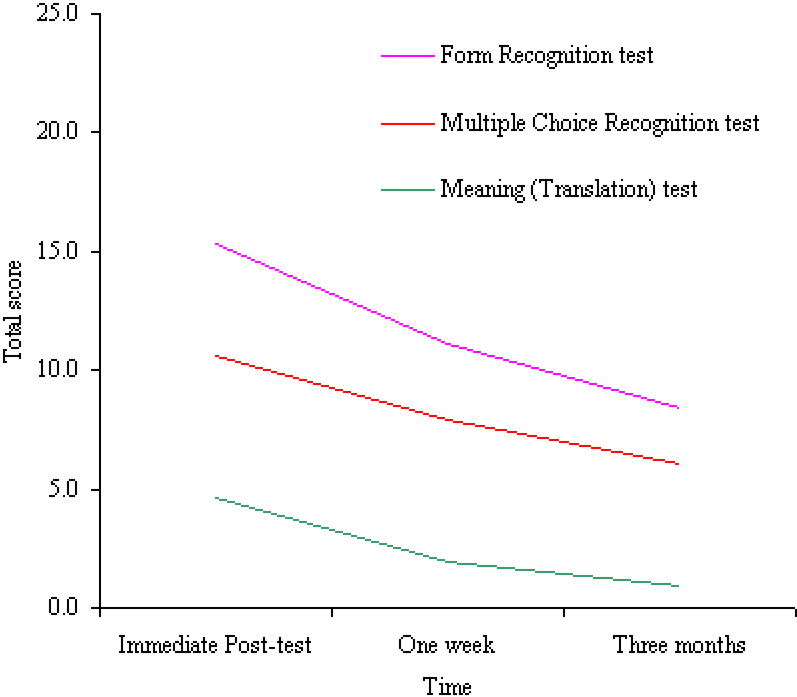
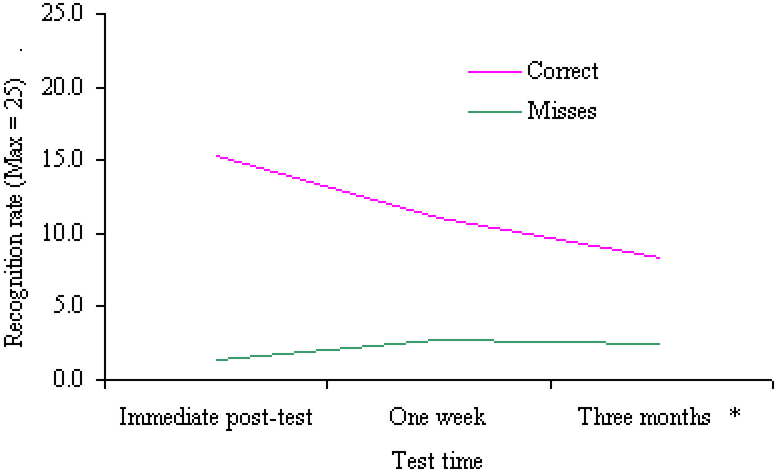
- On the word-form recognition test, mean scores fell from 15.3/25 immediately after reading to 11.1/25 after one week and 8.4/25 after three months; incorrect selections rose from 1.3 to 2.8 to 2.4.
- On the multiple-choice recognition test, mean scores declined from 10.6/25 immediately to 7.9/25 after one week and 6.1/25 after three months.
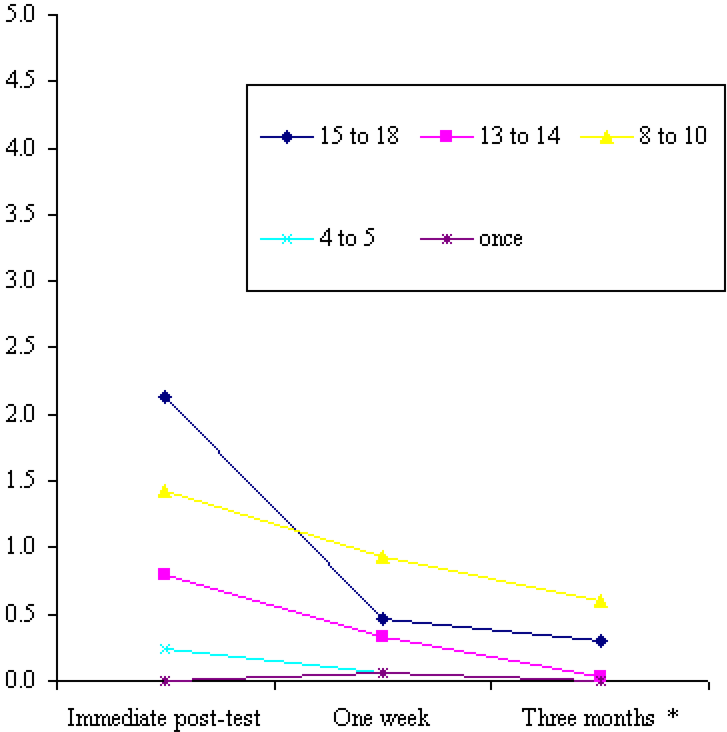
- On the meaning (translation) test, mean scores dropped from 4.6/25 immediately to 1.9/25 after one week and 0.9/25 after three months; the paper states this means about one new word from one hour of reading was retained after three months.
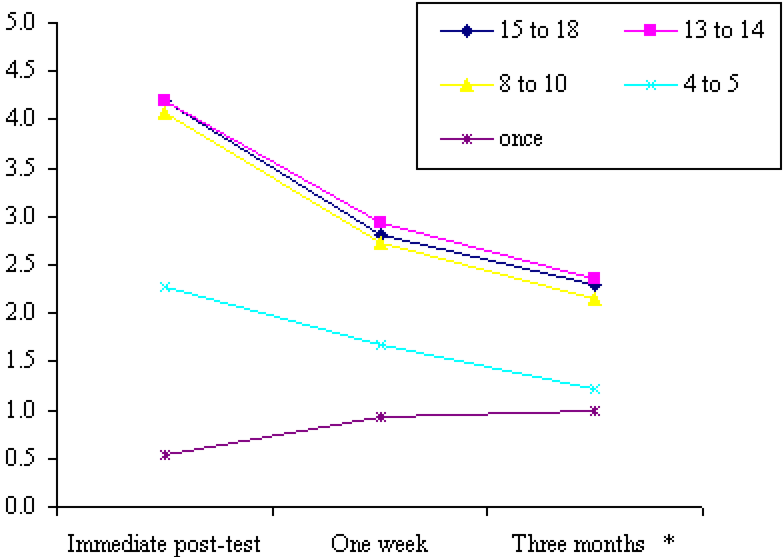
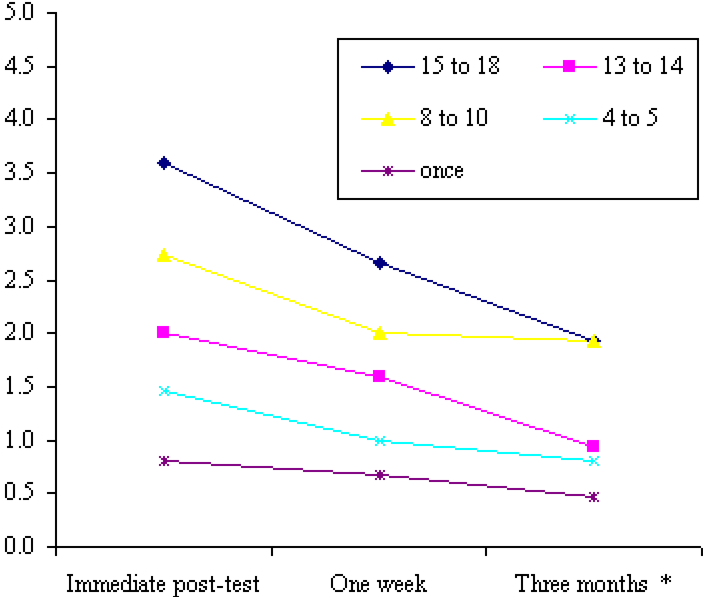
- Frequency mattered: words met 15–18 times were learned and retained more often, while words met fewer than 8 times were near zero on the translation test; the paper states that words met fewer than 8 times had 0 chance of being remembered three months later.
- The paper reports significant differences among test types at the immediate post-test (F = 17.11, p < .001) and significant declines over time for each test: word-form recognition (F = 35.45, p < .001), multiple-choice (F = 22.00, p < .001), and translation (F = 15.41, p = .002).
## Methods
- Design: 15 Japanese female university students read one graded reader, *A Little Princess*, with 25 substitute words embedded at different occurrence frequencies; vocabulary was tested immediately, after one week, and after three months.
- Sample and materials: Participants were 19–21 years old, lower-intermediate or above, mostly English Club members; the text contained 5,872 words, and the study used three test formats: word-form recognition, multiple-choice recognition, and meaning translation.
- Analysis: Scores were summarized by test and by occurrence frequency; the paper reports repeated measures ANOVAs and compares retention/decay across test types and frequency bands.
## Limitations
- The paper explicitly says there were relatively few subjects and that a larger sample would be better to show frequency effects more clearly.
- It says only 5,872 words were read, so a longer text or multiple texts would be better for judging vocabulary learning from reading.
- It also says the study would be stronger with texts containing a better variety of word frequencies so that all test words are equally guessable.
- Evident from the text: the study used one graded reader only, so the findings may not generalize to broader reading conditions or to other texts.
Model-written summary. Check it against the paper before relying on it.
Integrity signals
Registry
Cites
Statistics
Figures
Verification
Claims the paper makes
1 Valid · 4 Not valid · 13 Not checked · 162 Own results and interpretations
The cited sources support only part of this claim — read each source’s verdict below.
In the paper
“Secondly, learners need to meet an unknown word many times before it is learned (Nagy, Herman and Anderson, 1985; Nagy, Anderson and Herman, 1987; Shu, Anderson and Zhang, 1995; Nation 2001: 237).”
What the sources say
- Partly supportedcites Nagy, Herman and Anderson, 1985 matched to “Learning Words from Context” (1985) sourceExperimental — accuracy not yet measured
The ‘Learning Words from Context’ section says that full knowledge seldom follows one encounter and that word learning often proceeds in small increments. But the Conclusion reports unmistakable learning from one or very few encounters. The claim omits the distinction between beginning to learn a word and learning its full meaning, making repeated encounters sound necessary for any learning. (LLM, conf=0.87)
- Not checked — no full text of the sourcecites Nagy, Anderson and Herman, 1987 matched to “Learning Word Meanings From Context During Normal Reading” (1987) source
- Not checked — no full text of the sourcecites Nation 2001: 237 matched to “Learning Vocabulary in Another Language” (2001) source
plainstates a cause- Asserted: passes — The authors put it forward as true.
- Checkable: passes — It can be checked against evidence.
- Load-bearing: passes — The paper’s conclusions depend on it.
- Based: passes — The paper gives a reason why it holds.
- Partly supported
A result the paper reports from its own data — it cites no other source for it, so there is none to check. The quote shows it is in the paper.
In the paper
“More frequent words were more likely to be learned and were more resistant to decay.”
hedgedstates an association- Asserted: passes — The authors put it forward as true.
- Checkable: passes — It can be checked against evidence.
- Load-bearing: passes — The paper’s conclusions depend on it.
- Based: passes — The paper gives a reason why it holds.
A result the paper reports from its own data — it cites no other source for it, so there is none to check. The quote shows it is in the paper.
In the paper
“The results show that words can be learned incidentally but that most of the words were not learned.”
plainstates a cause- Asserted: passes — The authors put it forward as true.
- Checkable: passes — It can be checked against evidence.
- Load-bearing: passes — The paper’s conclusions depend on it.
- Based: passes — The paper gives a reason why it holds.
A result the paper reports from its own data — it cites no other source for it, so there is none to check. The quote shows it is in the paper.
In the paper
“More frequent words were more likely to be learned and were more resistant to decay.”
hedgedstates an association- Asserted: passes — The authors put it forward as true.
- Checkable: passes — It can be checked against evidence.
- Load-bearing: passes — The paper’s conclusions depend on it.
- Based: passes — The paper gives a reason why it holds.
A result the paper reports from its own data — it cites no other source for it, so there is none to check. The quote shows it is in the paper.
In the paper
“The data suggest that, on average, the meaning of only one of the 25 items will be remembered after three months”
hedged- Asserted: passes — The authors put it forward as true.
- Checkable: passes — It can be checked against evidence.
- Load-bearing: passes — The paper’s conclusions depend on it.
- Based: passes — The paper gives a reason why it holds.
- Rests on 2 assumptions not shown here.
78 more claims
Create a free account to see all 180 claims and to verify the 1 reference still open.
- Probably not a substantial claim. 60
- The quote only partly states this claim. 9
- It may state two separate claims as one. 50
Claims other papers make about this one
Each is checked against this paper’s own text: does it say what the citing paper says it does?
The source backs part of the claim, not all of it — or backs it for a different population, condition or comparison.
In the citing paper
“the Waring and Takaki (2003) study showed that in approximately 56 minutes of meaning-focused reading of a graded reader, four words were learned reasonably well, and another 12 were partially learnt.”
From The Four Strands (2007) · cites this paper as Waring and Takaki (2003)
Experimental — accuracy not yet measuredThe source backs part of the claim, not all of it — or backs it for a different population, condition or comparison.
In the citing paper
“Gi v en the same amount of time, deliberate language-focused learning acti v ities result in more learning than the incidental learning from meaning-focused acti v ities.”
From The Four Strands (2007) · cites this paper as Waring and Takaki (2003)
Experimental — accuracy not yet measuredThe cited source says what the claim attributes to it.
In the citing paper
“This study showed that small amounts of learning of v arious strengths occurred incidentally as a result of meaning-focused reading.”
From The Four Strands (2007) · cites this paper as Waring and Takaki's (2003)
In the citing paper
“In a similar study conducted by Waring and Takaki (2003), a multiple-choice, immediate posttest measure indicated that of 25 new words available for learning in the graded reader A Little Princess, 11 words were learned (as measured by success on these tests), a gain of 42%.”
From Incidental vocabulary acquisition from reading, reading-while-listening, and listening to stories (2008) · cites this paper as Waring and Takaki, 2003
In the citing paper
“Their results showed that incidental vocabulary learning from reading occurred at several levels and the gain scores depended on the test type, but not much new vocabulary was learned.”
From Incidental vocabulary acquisition from reading, reading-while-listening, and listening to stories (2008) · cites this paper as Waring and Takaki, 2003
2 more claims about this paper
Create a free account to see every claim other papers make about this one.
Citations
Cites
Learning Vocabulary in Another Language
Nation, I. S. P. (2001) · Cambridge University Press · doi:10.1017/cbo9781139524759 · Cited by 6,608
The Role of Consciousness in Second Language Learning1
SCHMIDT, R. W. (1990) · Applied Linguistics · doi:10.1093/applin/11.2.129 · Cited by 5,435 · cited 1×
“Some recent research has suggested the noticing of a form is an essential step in word learning (Schmidt, 1990).”
BackgroundExtensive Reading in the Second Language Classroom
Day, R. R., Bamford, J., Renandya, W. A., Jacobs, G. M., & Yu, V. W.-S. (1998) · RELC Journal · doi:10.1177/003368829802900211 · Cited by 1,276 · cited 1×
“As has been mentioned elsewhere, vocabulary growth is not the main aim of graded or extensive reading (e.g., Day and Bamford, 1998, 2002; Waring, 1997; Waring and Takahashi, 2000; Prowse, 2002).”
BackgroundNagy, W. E., Herman, P. A., & Anderson, R. C. (1985) · Reading Research Quarterly · doi:10.2307/747758 · Cited by 1,249
The Power of Reading: Insights from the Research
Barnett, M. A., & Krashen, S. (1994) · The Modern Language Journal · doi:10.2307/330145 · Cited by 792 · cited 4×
“Krashen (1993) 42 ESL learners 15 page of text French text plus watched a video Multiple-choice 6.6 words above controls”
InfluentialLearning Word Meanings From Context During Normal Reading
Nagy, W. E., Anderson, R. C., & Herman, P. A. (1987) · American Educational Research Journal · doi:10.3102/00028312024002237 · Cited by 757 · cited 1×
“Secondly, learners need to meet an unknown word many times before it is learned (Nagy, Herman and Anderson, 1985; Nagy, Anderson and Herman, 1987; Shu, Anderson and Zhang, 1995; Nation 2001: 237).”
BackgroundAssessing Second Language Vocabulary Knowledge: Depth Versus Breadth
Wesche, M., & Paribakht, T. S. (1996) · The Canadian Modern Language Review · doi:10.3138/cmlr.53.1.13 · Cited by 673 · cited 1×
“The complications associated with multiple-choice tests as accurate measures of word knowledge are legion and well documented elsewhere (e.g., Anderson and Freebody, 1981; Meara and Buxton, 1987; Wesche and Paribakht, 1996; Waring, 1999).”
BackgroundUnknown vocabulary density and reading comprehension
Hu, M., & Nation, P. (2020) · doi:10.26686/wgtn.12560354.v1 · Cited by 650
Beyond a Clockwork Orange: Acquiring second language vocabulary through reading
Horst, M., Cobb, T., & Meara, P. (1998) · Reading in a Foreign Language · doi:10.64152/10125/66953 · Cited by 565 · cited 1×
“Horst, Cobb and Meara (1998) also point out that some of the incidental learning from exposure experiments are "methodologically flawed" (1998: 210).”
BackgroundRetention of Inferred and Given Word Meanings: Experiments in Incidental Vocabulary Learning
Hulstijn, J. H. (1992) · Vocabulary and Applied Linguistics · doi:10.1007/978-1-349-12396-4_11 · Cited by 497 · cited 1×
“(scores above controls who did not see the text) Dupuy and Krashen (1993) 42 ESL learners 15 page of text French text plus watched a video Multiple-choice 6.6 words above controls Hulstijn (1992) 65 EFL learners 907 words Advertisement in Dutch State the meaning of 12 words 1 of 13 words (7.6”
BackgroundInfluential
Research works printed but not linked: 6
- Anderson, R. C. and Freebody, P. (1981). Reading comprehension and the assessment and acquisition of word knowledge. In J. Guthrie (Ed.), Comprehension and teaching (pp. 77-117). Newark, Delaware: International Reading Association.
- Burnett, F. H. retold by J. Bassett. (1991). A little princess . Oxford: Oxford University Press.
- Waring, R. (Ed.). (1997). Special edition on extensive reading. The Language Teacher, 21.
- Waring, R. (1999). Tasks for assessing receptive and productive second language vocabulary . Ph.D. Thesis. University of Wales, Swansea. http://www1.harenet.ne.jp/~waring/papers/phd/title.html
- Waring, R. & Takahashi, S. (2000). The Oxford University Press guide to the 'why and 'how' of using graded readers . Tokyo: Oxford University Press.
- Wesche, M. & Paribakht, T. (1996). Assessing vocabulary knowledge: Depth vs. breadth. Canadian Modern Language Review , 53, 13-40.
Cited by
Review article: Instructed second language vocabulary learning
Schmitt, N. (2008) · Language Teaching Research · doi:10.1177/1362168808089921 · Cited by 1,467
“Waring and Takaki (2003) also found stronger gains and retention for recognition than recall knowledge.”
BackgroundVocabulary in Language Teaching
Meyer, L. L., & Schmitt, N. (2002) · TESOL Quarterly · doi:10.2307/3588334 · Cited by 1,438
Vocabulary in Language Teaching
Schmitt, N., & Schmitt, D. (2020) · Cambridge University Press eBooks · doi:10.1017/9781108569057 · Cited by 878
The Effects of Repetition on Vocabulary Knowledge
Webb, S. (2007) · Applied Linguistics · doi:10.1093/applin/aml048 · Cited by 807
Incidental vocabulary acquisition from reading, reading-while-listening, and listening to stories
Brown, R., Waring, R., & Donkaewbua, S. (2008) · Reading in a Foreign Language · doi:10.64152/10125/66816 · Cited by 628
Self-citationVocabulary acquisition from extensive reading: A case study
Pigada, M., & Schmitt, N. (2006) · Reading in a Foreign Language · doi:10.64152/10125/66611 · Cited by 576
“The hypothesis is that reading will affect all three aspects of word knowledge, but spelling is expected to be affected the most, based on the findings of Schmitt (1998) and Waring and Takaki (2003).”
InfluentialNation, P. (2007) · Innovation in Language Learning and Teaching · doi:10.2167/illt039.0 · Cited by 494
“For example, the Waring and Takaki (2003) study showed that in approximately 56 minutes of meaning-focused reading of a graded reader, four words were learned reasonably well, and another 12 were partially learnt.”
BackgroundEffectiveness of vocabulary learning via mobile phone
Lu, M. (2008) · Journal of Computer Assisted Learning · doi:10.1111/j.1365-2729.2008.00289.x · Cited by 457
“The serious attrition of vocabulary shown in the decreased effectiveness of the learning via mobile phone in the delayed test underscores the recycling of vocabulary in materials and instruction (cf. Waring & Takaki 2003).”
BackgroundVocabulary Demands of Television Programs
Webb, S., & Rodgers, M. P. H. (2009) · Language Learning · doi:10.1111/j.1467-9922.2009.00509.x · Cited by 447
INCIDENTAL VOCABULARY ACQUISITION THROUGH VIEWING L2 TELEVISION AND FACTORS THAT AFFECT LEARNING
Peters, E., & Webb, S. (2018) · Studies in Second Language Acquisition · doi:10.1017/s0272263117000407 · Cited by 423
“…L2 vocabulary is learned incidentally through viewing a single TV program in the same way that L2 words are learned through reading a single text (e.g., Horst, Cobb, & Meara, 1998; Pellicer-Sánchez & Schmitt, 2010; Saragi, Nation, &Meister, 1978;Waring & Takaki, 2003) remains to be examined.”
BackgroundIncidental Learning of Collocation
Webb, S., Newton, J., & Chang, A. (2013) · Language Learning · doi:10.1111/j.1467-9922.2012.00729.x · Cited by 371
The Lexical Coverage of Movies
Webb, S., & Rodgers, M. P. H. (2009) · Applied Linguistics · doi:10.1093/applin/amp010 · Cited by 193
INCIDENTAL L2 VOCABULARY ACQUISITION FROM AND WHILE READING: An Eye-Tracking Study
Pellicer-Sánchez, A. (2016) · Studies in Second Language Acquisition · doi:10.1017/s0272263115000224 · Cited by 356
“Waring and Takaki ( 2003 ) examined incidental acquisition of the meaning of new words at both the recognition and recall levels using a multiple-choice and a translation task, respectively.”
BackgroundResultThe Effect of Type of Written Exercise on L2 Vocabulary Retention
Folse, K. S. (2006) · TESOL Quarterly · doi:10.2307/40264523 · Cited by 164
“Future research could use multiple 290 TESOL QUARTERLY instruments to ascertain vocabulary learning over time (e.g., short-term vs. long-term retention), as done by Waring and Takaki (2003).”
MethodUchihara, T., Webb, S., & Yanagisawa, A. (2019) · Language Learning · doi:10.1111/lang.12343 · Cited by 300
“Researchers have normally substituted nonwords for high-frequency real words appearing in a text to make sure that participants do not engage in learning new concepts (Hatami, 2017; van Zeeland & Schmitt, 2013; Waring & Takaki, 2003; Webb, 2007).”
BackgroundMethodInfluentialIncidental vocabulary acquisition from an authentic novel: Do Things Fall Apart?
Pellicer-Sánchez, A., & Schmitt, N. (2010) · Reading in a Foreign Language · doi:10.64152/10125/66652 · Cited by 293
“Studies with delayed posttests invariably found some decay of knowledge (e.g., Waring & Takaki, 2003), and it seems extremely likely that the type of gains reported here would not remain intact without further exposures or some explicit reinforcement.”
BackgroundResultIncidental vocabulary acquisition through L2 listening: A dimensions approach
van Zeeland, H., & Schmitt, N. (2013) · System · doi:10.1016/j.system.2013.07.012 · Cited by 274
Osborne, J., Simon, S., Christodoulou, A., Howell‐Richardson, C., & Richardson, K. (2013) · Journal of Research in Science Teaching · doi:10.1002/tea.21073 · Cited by 268
Experimental and Intervention Studies on Formulaic Sequences in a Second Language
Boers, F., & Lindstromberg, S. (2012) · Annual Review of Applied Linguistics · doi:10.1017/s0267190512000050 · Cited by 260
7. RESEARCH IN TEACHING VOCABULARY
Read, J. (2004) · Annual Review of Applied Linguistics · doi:10.1017/s0267190504000078 · Cited by 259
“(For investigations of the vocabulary learning potential in graded readers, see Nation & Wang, 1999 and Waring & Takaki, 2003).”
BackgroundThe effects of context on incidental vocabulary learning
Webb, S. (2008) · Reading in a Foreign Language · doi:10.64152/10125/66826 · Cited by 256
“Language 20(2) than 10 encounters are needed, and Waring and Takaki (2003) reported that it may take more than 20 encounters to incidentally learn the meaning of a word.”
BackgroundA framework for developing EFL reading vocabulary
Hunt, A., & Beglar, D. (2005) · Reading in a Foreign Language · doi:10.64152/10125/66601 · Cited by 251
“Indeed, in a study involving fifteen Japanese university students, Waring and Takaki (2003) found that very little vocabulary was retained three months after reading a single graded reader.”
BackgroundThe Role of Task‐Induced Involvement and Learner Proficiency in L2 Vocabulary Acquisition
Kim, Y. (2008) · Language Learning · doi:10.1111/j.1467-9922.2008.00442.x · Cited by 249
Elgort, I., & Warren, P. (2014) · Language Learning · doi:10.1111/lang.12052 · Cited by 240
Computing the vocabulary demands of L2 reading
Cobb, T. (2007) · Language Learning & Technology · doi:10.64152/10125/44117 · Cited by 238
“An alternate source of evidence for substantial amounts of hidden vocabulary growth through reading is provided by Waring and Takaki (2003) using a different methodology.”
MethodLearning L2 collocations incidentally from reading
Pellicer-Sánchez, A. (2017) · Language Teaching Research · doi:10.1177/1362168815618428 · Cited by 225
“…& Donkaewbua, 2008; Horst, Cobb, & Meara, 1998; Pellicer-Sánchez, 2015; Pellicer-Sánchez & Schmitt, 2010; Pigada & Schmitt, 2006; Rott, 1999; Waring & Takaki, 2003; Webb, 2005, 2007a, 2007b), with different degrees of certainty of that knowledge (Pellicer-Sánchez, 2015; Wesche & Paribakht,…”
BackgroundWebb, S., & Chang, A. C.-S. (2015) · Language Teaching Research · doi:10.1177/1362168814559800 · Cited by 224
“These findings contrast those of Waring and Takaki (2003), who found that recognition of form–meaning connection was 24.4% and recall of meaning was 3.6% three months after participants read a single graded reader.”
BackgroundResultInfluentialIncidental vocabulary learning in a natural reading context: an eye-tracking study
GODFROID, A., AHN, J., CHOI, I., BALLARD, L., CUI, Y., JOHNSTON, S., LEE, S., SARKAR, A., & YOON, H.-J. (2018) · Bilingualism: Language and Cognition · doi:10.1017/s1366728917000219 · Cited by 218
“These results and similar findings from reading research suggest that learners are faster at building up recognition than recalllevel vocabulary knowledge (Mohamed, 2017; PellicerSánchez, 2015; Pellicer-Sánchez & Schmitt, 2010; Waring & Takaki, 2003; Webb, 2007).”
BackgroundResultInfluentialCONTEXTUAL WORD LEARNING DURING READING IN A SECOND LANGUAGE: AN EYE-MOVEMENT STUDY
Elgort, I., Brysbaert, M., Stevens, M., & Van Assche, E. (2018) · Studies in Second Language Acquisition · doi:10.1017/s0272263117000109 · Cited by 213
“One of the most powerful predictors of CWL is number of encounters with the word (Anderson, 1989; Ellis, 2002; Hulstijn, 2001; Waring & Takaki, 2003).”
BackgroundInfluentialComparing Focus on Form and Focus on FormS in Second-Language Vocabulary Learning
Laufer, B. (2006) · The Canadian Modern Language Review · doi:10.3138/cmlr.63.1.149 · Cited by 212
“This position is supported by empirical studies showing that only a small number of L2 words can be ‘picked up’ from exposure to texts without any subsequent vocabulary practice (Day, Omura, & Hiramatsu, 1991; Horst, Cobb, & Meara, 1998; Hulstijn, 1992; Waring 2003; Zahar, Cobb & Spada, 2001).”
BackgroundHow effective is second language incidental vocabulary learning? A meta-analysis
Webb, S., Uchihara, T., & Yanagisawa, A. (2023) · Language Teaching · doi:10.1017/s0261444822000507 · Cited by 200
“There have been many studies demonstrating that L2 words can be learned incidentally through reading (e.g., Day et al., 1991; Pitts et al., 1989; Waring & Takaki, 2003).”
InfluentialDesigning a smartphone app to teach English (L2) vocabulary
Wu, Q. (2015) · Computers & Education · doi:10.1016/j.compedu.2015.02.013 · Cited by 180
Understanding Advanced Second-Language Reading
Bernhardt, E. (2010) · Routledge eBooks · doi:10.4324/9780203852408 · Cited by 180
Incidental vocabulary acquisition: The effects of task type, word occurrence and their combination
Laufer, B., & Rozovski-Roitblat, B. (2011) · Language Teaching Research · doi:10.1177/1362168811412019 · Cited by 179
“Waring and Takaki (2003) investigated 25 target words that appeared with different frequencies in a text: 1 time, 4–5, 8–10, 13–14, and 15–18 times.”
BackgroundMin, H. (2008) · Language Learning · doi:10.1111/j.1467-9922.2007.00435.x · Cited by 177
Narrow Viewing: The Vocabulary in Related Television Programs
RODGERS, M. P. H., & WEBB, S. (2011) · TESOL Quarterly · doi:10.5054/tq.2011.268062 · Cited by 174
HOW DOES PRIOR WORD KNOWLEDGE AFFECT VOCABULARY LEARNING PROGRESS IN AN EXTENSIVE READING PROGRAM?
Webb, S., & Chang, A. C.-S. (2015) · Studies in Second Language Acquisition · doi:10.1017/s0272263114000606 · Cited by 172
“The vast majority of L2 reading studies have looked at incidental learning through reading a single text (e.g., Day et al., 1991 ; Dupuy & Krashen, 1993 ; Horst et al., 1998 ; Pitts et al., 1989 ; Waring & Takaki, 2003 ).”
BackgroundDirect Teaching of Vocabulary after Reading: Is It Worth the Effort?
Sonbul, S., & Schmitt, N. (2010) · ELT Journal · doi:10.1093/elt/ccp059 · Cited by 170
Assessing vocabulary size through multiple-choice formats: Issues with guessing and sampling rates
Gyllstad, H., Vilkaitė, L., & Schmitt, N. (2015) · ITL - International Journal of Applied Linguistics · doi:10.1075/itl.166.2.04gyl · Cited by 164
Research into practice: Vocabulary
Nation, I. S. P. (2011) · Language Teaching · doi:10.1017/s0261444811000267 · Cited by 152
“However, this evidence needs to be treated with caution because studies such as those by Waring & Takaki (2003) and Pigada & Schmitt (2006) demonstrate the different strengths and kinds of vocabulary learning that can occur incidentally, leading us to suspect that earlier studies using single…”
BackgroundThe Effect of Pleasure Reading on Japanese University EFL Learners’ Reading Rates
Beglar, D., Hunt, A., & Kite, Y. (2012) · Language Learning · doi:10.1111/j.1467-9922.2011.00651.x · Cited by 148
Eckerth, J., & Tavakoli, P. (2012) · Language Teaching Research · doi:10.1177/1362168811431377 · Cited by 149
“Significant strands of research have explored the effects of word exposure frequency (Rott, 2007; Waring and Takaki, 2003; Zahar et al., 2001), word enhancement (Han et al., 2008; Watanabe, 1997; Yoshi, 2006) and active translation of new words (Hummel, 2010), as well as the effects of learners’…”
BackgroundMethodAkbulut, Y. (2007) · Instructional Science · doi:10.1007/s11251-007-9016-7 · Cited by 184
“Three types of vocabulary tests were developed: form recognition, meaning recognition and meaning production based on the tests used by Knight (1994), Rott (1999), and Waring and Takaki (2003) .”
BackgroundMethodSecond language reading and incidental vocabulary learning
Nation, P., & Waring, P. (2020) · doi:10.26686/wgtn.12560288 · Cited by 146
“The Waring & Takaki (2003) experiment used 15 subjects to examine how SECOND LANGUAGE READING AND INCIDENTAL VOCABULARY LEARNING many words of varying frequencies of occurrence rates were learned and retained from the reading of one graded reader A Little Princess.”
BackgroundMethodInfluentialPeters, E. (2013) · Language Teaching Research · doi:10.1177/1362168813505384 · Cited by 195
The Effect of Frequency of Input‐Enhancements on Word Learning and Text Comprehension
Rott, S. (2007) · Language Learning · doi:10.1111/j.1467-9922.2007.00406.x · Cited by 147
Principles guiding vocabulary learning through extensive reading
Nation, P. (2020) · doi:10.26686/wgtn.12543404.v1 · Cited by 144
“Much smaller scale experiments focusing on vocabulary gains from reading have shown that a reasonable number of words are learnt incidentally to various strengths of knowledge (Brown, Waring & Donkaewbua, 2008; Horst, 2005; Pigada & Schmitt, 2006; Pulido, 2004; Waring & Takaki, 2003).”
BackgroundLaufer, B. (2010) · International Journal of Lexicography · doi:10.1093/ijl/ecq039 · Cited by 183
LEARNING VOCABULARY THROUGH READING, LISTENING, AND VIEWING: WHICH MODE OF INPUT IS MOST EFFECTIVE?
Feng, Y., & Webb, S. (2019) · Studies in Second Language Acquisition · doi:10.1017/s0272263119000494 · Cited by 232
“Empirical studies have confirmed that repeated encounters with unfamiliar words are needed for L2 incidental vocabulary learning to occur through reading (Hu, 2013; Pigada & Schmitt, 2006; Waring & Takaki, 2003).”
BackgroundResultInfluentialEXPOSURE FREQUENCY IN L2 READING: AN EYE-MOVEMENT PERSPECTIVE OF INCIDENTAL VOCABULARY LEARNING
Mohamed, A. (2017) · Studies in Second Language Acquisition · doi:10.1017/s0272263117000092 · Cited by 157
Incidental vocabulary learning through viewing television
Rodgers, M., & Webb, S. (2019) · ITL Review of Applied Linguistics · doi:10.1075/itl.18034.rod · Cited by 166
The Effects of Vocabulary Learning on Collocation and Meaning
Webb, S., & Kagimoto, E. (2009) · TESOL Quarterly · doi:10.1002/j.1545-7249.2009.tb00227.x · Cited by 179
“…items (Mackin, 1978), research on vocabulary learning in an EFL context indicates that incidentally acquiring meaning for even relatively salient single-word items is a relatively slow process with learning dependent on the amount of input (Horst, Cobb, & Meara, 1998; Waring & Takaki, 2003).”
BackgroundResultBeyond raw frequency: Incidental vocabulary acquisition in extensive reading
Kweon, S.-O., & Kim, H.-R. (2008) · Reading in a Foreign Language · doi:10.64152/10125/66819 · Cited by 127
“In examining vocabulary learning and retention by 15 Japanese college students who read one graded reader, Waring and Takaki (2003) changed the forms of the 25 words that were used in the text to make them into non-words to control for previous knowledge of the words (e.g., changing house into windle). They found that…”
BackgroundMethodResultInfluentialVocabulary Learning through Assisted and Unassisted Repeated Reading
Webb, S., & Chang, A. C.-S. (2012) · The Canadian Modern Language Review · doi:10.3138/cmlr.1204.1 · Cited by 86
“Research shows that both L1 words (e.g., Jenkins, Stein, & Wysocki, 1984; Nagy, Herman, & Anderson, 1985) and L2 words (e.g., Day, Omura, & Hiramatsu, 1991; Horst, 2005; Hulstijn, 1992; Pitts,White, & Krashen, 1989; Waring & Takaki, 2003) are learned incidentally through reading.”
BackgroundInfluentialRodgers, M. (2013) · doi:10.26686/wgtn.17005078.v1 · Cited by 118
Khezrlou, S., Ellis, R., & Sadeghi, K. (2017) · System · doi:10.1016/j.system.2017.01.009 · Cited by 140
A comparative study on the effects of a VR and PC visual novel game on vocabulary learning
Lai, K.-W. K., & Chen, H.-J. H. (2023) · Computer Assisted Language Learning · doi:10.1080/09588221.2021.1928226 · Cited by 114
“The number of word occurrence necessary for learning have varied across previous studies (Horst, Cobb, & Meara, 1998; Waring & Takaki, 2003; Webb, 2007), though generally there is consensus that the higher the frequency of words encountered in a given context, the more likely it is for learners to…”
ResultBisson, M., van Heuven, W. J. B., Conklin, K., & Tunney, R. J. (2014) · Language Learning · doi:10.1111/lang.12085 · Cited by 111
“Language Learning ISSN 0023-8333”
BackgroundInfluentialThe Effect of Content Retelling on Vocabulary Uptake From a TED Talk
Nguyen, C., & Boers, F. (2018) · TESOL Quarterly · doi:10.1002/tesq.441 · Cited by 158
“…studies have focused on reading input as a source of incidental vocabulary acquisition (e.g., Horst, Cobb, & Meara, 1998; Pigada & Schmitt, 2006; Waring & Takaki, 2003) and have investigated such variables as repeated encounters with the same words (Chen & Truscott, 2010; Eckerth & Tavakoli,…”
BackgroundThe Impact of a Serious Game on Vocabulary and Content Learning
Chen, H.-J. H., & Hsu, H.-L. (2020) · Computer Assisted Language Learning · doi:10.1080/09588221.2019.1593197 · Cited by 109
Retention of new words: Quantity of encounters, quality of task, and degree of knowledge
Laufer, B., & Rozovski-Roitblat, B. (2015) · Language Teaching Research · doi:10.1177/1362168814559797 · Cited by 105
“(For studies on the effect of multiple encounters, see Nation & Wang, 1999; Pigada & Schmitt, 2006; Waring & Takaki, 2003; Webb, 2007, and for examples of the effect of vocabulary activities, see Hulstijn & Laufer, 2001; Keating, 2008; Kim, 2008; Peters, 2007; Pichette, De Serres, & Lafontaine,…”
BackgroundMethodInfluentialTürk, E., & Erçetin, G. (2012) · Computer Assisted Language Learning · doi:10.1080/09588221.2012.692384 · Cited by 120
“Four vocabulary tests were developed for the present study following Knight (1994), Laufer and Goldstein (2004), Rott (1999), and Waring and Takaki (2003) to measure different levels of vocabulary knowledge.”
BackgroundMethodInfluentialIs Text Written for Children Useful for L2 Extensive Reading?
Webb, S., & Macalister, J. (2012) · TESOL Quarterly · doi:10.1002/tesq.70 · Cited by 121
“…(Day, Omura, & Hiramatsu, 1991; Dupuy & Krashen, 1993; Horst, 2005; Horst, Cobb, & Meara, 1998; Hulstijn, 1992; Pitts, White, & Krashen, 1989; Waring & Takaki, 2003), increased reading rate (Bell, 2001; Iwahori, 2008), interest and motivation towards reading (Cho & Krashen, 1994;…”
BackgroundInfluentialINCIDENTAL VOCABULARY LEARNING IN SLA: EFFECTS OF FREQUENCY, AURAL ENHANCEMENT, AND WORKING MEMORY
Malone, J. (2018) · Studies in Second Language Acquisition · doi:10.1017/s0272263117000341 · Cited by 100
“Horst et al. (1998) argued for eight, Rott (1999) for two, and Waring and Takaki (2003) more than 20.”
BackgroundMethodInfluentialHOW DOES MODE OF INPUT AFFECT THE INCIDENTAL LEARNING OF COLLOCATIONS?
Webb, S., & Chang, A. C.-S. (2020) · Studies in Second Language Acquisition · doi:10.1017/s0272263120000297 · Cited by 120
Toomer, M., & Elgort, I. (2019) · Language Learning · doi:10.1111/lang.12335 · Cited by 115
Tekmen, E. A. F., & Daloǧlu, A. (2006) · Foreign Language Annals · doi:10.1111/j.1944-9720.2006.tb02263.x · Cited by 94
Incidental Vocabulary Learning Through Listening to Teacher Talk
Jin, Z., & Webb, S. (2020) · Modern Language Journal · doi:10.1111/modl.12661 · Cited by 108
“There will typically be decay of vocabulary knowledge if words that are learned incidentally are not encountered further (e.g., Waring & Takaki, 2003).”
BackgroundResultInfluentialIntentional vs. incidental vocabulary learning
Ahmad, J. (2011) · Elt research journal · Cited by 171
The I Don't Know Option in the Vocabulary Size Test
Zhang, X. (2013) · TESOL Quarterly · doi:10.1002/tesq.98 · Cited by 107
Incidental L2 vocabulary learning from viewing captioned videos: Effects of learner-related factors
Teng, M. F. (2022) · System · doi:10.1016/j.system.2022.102736 · Cited by 151
Hulme, R. C., Barsky, D., & Rodd, J. M. (2019) · Language Learning · doi:10.1111/lang.12313 · Cited by 37
“The impact of the number of exposures on adults’ incidental vocabulary learning from reading has mainly been investigated in the domain of second language (L2) learning (e.g., M. Horst, Cobb, & Meara, 1998; Pellicer-Sánchez & Schmitt, 2010; Rott, 1999; Waring & Takaki, 2003; Webb, 2007).”
BackgroundResultLee, S., & Pulido, D. (2017) · Language Teaching Research · doi:10.1177/1362168816637381 · Cited by 84
“However, the false recognition response totals were subtracted from the total score to correct for guessing (Waring & Takaki, 2003) (Cronbach’s α = .82). b Translation production.”
MethodBisson, M.-J., van Heuven, W. J. B., Conklin, K., & Tunney, R. J. (2015) · Quarterly Journal of Experimental Psychology · doi:10.1080/17470218.2014.979211 · Cited by 102
Çakmak, F., & Erçetin, G. (2017) · ReCALL · doi:10.1017/s0958344017000155 · Cited by 99
“These tests are regarded as direct tests that require demonstrating learner ’ s understanding of target words or production of the target forms for giving meaning either in L1 or L2 (Laufer & Goldstein, 2004; Waring & Takaki, 2003).”
BackgroundShould Vocabulary Instruction Be Integrated or Isolated?
File, K., & Adams, R. J. (2010) · TESOL Quarterly · doi:10.5054/tq.2010.219943 · Cited by 116
Teng, F. (2018) · Innovation in Language Learning and Teaching · doi:10.1080/17501229.2016.1203328 · Cited by 76
“The best solution, as mentioned in Waring and Takaki (2003), was to replace these words with pseudowords.”
BackgroundInfluentialGolonka, E., Bowles, A. R., Silbert, N. H., Kramasz, D., Blake, C., & Buckwalter, T. (2015) · Modern Language Journal · doi:10.1111/modl.12191 · Cited by 84
Do the cognacy characteristics of loanwords make them more easily learned than noncognates?
Rogers, J., Webb, S., & Nakata, T. (2014) · Language Teaching Research · doi:10.1177/1362168814541752 · Cited by 96
“Research has indicated that the use of multiple measures of vocabulary knowledge can provide a more accurate assessment of vocabulary learning than a single test (Nagy, Herman, & Anderson, 1985; Waring & Takaki, 2003; Webb, 2005, 2007, 2008a, 2009).”
BackgroundThe effects of synonymy on second-language vocabulary learning
Webb, S. (2007) · Reading in a Foreign Language · doi:10.64152/10125/66814 · Cited by 123
“L2 studies examining incidental learning have shown that vocabulary gains are extremely small and that incidental learning is a gradual process in which repeated encounters in context are needed to learn words (Horst, Cobb, & Meara, 1998; Rott, 1999; Waring & Takaki, 2003).”
BackgroundRott, S. (2005) · Reading in a Foreign Language · doi:10.64152/10125/66793 · Cited by 90
“In general, processing a new word repeatedly in one or multiple texts has been found to be conducive to incidental word learning (for a review, see Horst, Cobb and Meara, 1998; Paribakht and Wesche, 1999; Rott, 1999; Waring and Takaki, 2003; Zahar, Cobb and Spada, 2001).”
Sentence Reading and Writing for Second Language Vocabulary Acquisition
Pichette, F., de Serres, L., & Lafontaine, M. (2011) · Applied Linguistics · doi:10.1093/applin/amr037 · Cited by 100
“As discussed by Webb (2005), however, this methodological approach throws into doubt the nature of the processes that actually take place during the experiment, for several reasons.”
BackgroundMethodFrequency in Incidental Vocabulary Acquisition Research: An Undefined Concept and Some Consequences
Reynolds, B. L., & Wible, D. (2014) · TESOL Quarterly · doi:10.1002/tesq.197 · Cited by 73
Examining incidental vocabulary acquisition from captioned video: Does test modality matter?
Jelani, N. A. M., & Boers, F. (2018) · ITL Review of Applied Linguistics · doi:10.1075/itl.00011.jel · Cited by 80
“…by-product of message-focused activities, have looked mostly at acquisition from reading (e.g., Horst, Cobb, & Meara, 1998; Pigada & Schmitt, 2006; Waring & Takaki, 2003), with only a comparatively small number of studies so far investigating vocabulary acquisition from listening (e.g., Van…”
BackgroundTeng, (. F. (2020) · Language Teaching Research · doi:10.1177/1362168819829026 · Cited by 70
“As suggested by Waring and Takaki (2003), learners exhibit significantly decreased performance in new word retention after a longer intervening period.”
BackgroundResultInfluentialYanagisawa, A., & Webb, S. (2021) · Language Learning · doi:10.1111/lang.12444 · Cited by 111
Pellicer‐Sánchez, A., Conklin, K., & Vilkaitė‐Lozdienė, L. (2020) · Language Learning · doi:10.1111/lang.12430 · Cited by 94
“…in line with previous studies in the L1 (e.g., Joseph et al., 2014; Nagy et al., 1985; Saragi et al., 1978) and the L2 (e.g., Brown et al., 2008; Godfroid et al., 2018; PellicerSánchez, 2016; Pellicer-Sánchez & Schmitt, 2010; Pigada & Schmitt, 2006; Waring & Takaki, 2003; Webb, 2005, 2007a, 2007b).”
BackgroundInfluentialSoyoof, A., Reynolds, B. L., Shadiev, R., & Vazquez-Calvo, B. (2024) · Computer Assisted Language Learning · doi:10.1080/09588221.2021.2021242 · Cited by 58
“While some studies have proposed six to eight exposures sufficient for acquisition (Bisson et al., 2013; Horst & Meara, 1999; Rott, 1999; Waring & Takaki, 2003), others have suggested more than ten times may be required (Pigada & Schmitt, 2006).”
BackgroundTeng, M. F. (2016) · Language Learning Journal · doi:10.1080/09571736.2016.1244217 · Cited by 91
“…knowledge incidentally, available research on the incidental vocabulary acquisition has shown that the number of encounters needed to acquire an unknown word is unclear (Waring and Takaki 2003), and the word knowledge that learners can acquire in this way may be partial (Laufer 2009; Schmitt 2010).”
BackgroundResultEFL textbooks for young learners: a comparative analysis of vocabulary
Nordlund, M. (2016) · Education Inquiry · doi:10.3402/edui.v7.27764 · Cited by 65
The Role of Task‐Induced Involvement and Learner Proficiency in L2 Vocabulary Acquisition
Kim, Y. (2011) · Language Learning · doi:10.1111/j.1467-9922.2011.00644.x · Cited by 89
Tanaka, H., & Stapleton, P. (2007) · The reading matrix · Cited by 101
Suárez, M. D. M., & Gesa, F. (2019) · Language Learning Journal · doi:10.1080/09571736.2019.1617768 · Cited by 88
Maximizing Young Learners’ Input: An Intervention Program
Tragant, E., Muñoz, C., & Spada, N. M. (2016) · Canadian Modern Language Review/ La Revue canadienne des langues vivantes · doi:10.3138/cmlr.2942 · Cited by 69
“…level of mastery from reading exposure alone is an extremely slow process (Hill & Laufer, 2003); indeed, it has been suggested that reading graded readers does not lead to learning many new words, but that it is useful in developing and enriching partially-known vocabulary (Waring & Takaki, 2003).”
BackgroundPulling Mobile Assisted Language Learning (MALL) into the Mainstream: MALL in Broad Practice
Wu, Q. (2015) · PLoS ONE · doi:10.1371/journal.pone.0128762 · Cited by 79
“[25] and [26] concluded that there are a minimum number of encounters with a word needed to recognize its morphological form.”
BackgroundDoes adding pictures to glosses enhance vocabulary uptake from reading?
Boers, F., Warren, P., He, L., & Deconinck, J. (2017) · System · doi:10.1016/j.system.2017.03.017 · Cited by 82
“It is well known that frequency of encounters matters for incidental vocabulary acquisition (e.g., Waring & Takaki, 2003).”
BackgroundVu, D. V., & Peters, E. (2020) · RELC Journal · doi:10.1177/0033688220911485 · Cited by 90
“The superior gains in form recognition in this study corroborate previous studies (Pigada and Schmitt, 2006; Sauer, 2017; Waring and Takaki, 2003), which suggests that extensive reading can effectively boost learners’ knowledge of word forms.”
BackgroundResultReading rate gains during a one-semester extensive reading course
Huffman, J. (2014) · Reading in a Foreign Language · doi:10.64152/10125/66879 · Cited by 105
“…Hayashi, 1999; Horst, 2005; Mason & Krashen, 1997; Nagy, Herman, & Anderson, 1985; Pitts, White, & Krashen, 1989; Saragi, Nation, & Meister, 1978; Waring & Takaki, 2003) and affect (Mori, 2004; Nishino, 2007; Robb & Susser, 1989; Stoeckel, Reagan, & Hann, 2012; Yang, 2001) as well as general…”
How much input do you need to learn the most frequent 9,000 words?
Nation, P. (2020) · Open Access Victoria University of Wellington | Te Herenga Waka (Figshare) · doi:10.26686/wgtn.12543437.v1 · Cited by 55
“Waring and Takaki (2003) found that at least eight repetitions of a word in a graded reader were needed to have a 50% chance of remembering the word three months later.”
BackgroundWei, Z. (2014) · Language Teaching Research · doi:10.1177/1362168814541734 · Cited by 64
Metadata
- Authors
- Waring, R., & Takaki, M.
- Affiliations
- Notre Dame Seishin University (JP)
- ORCID
- Waring, Rob
- Venue
- Reading in a Foreign Language
- Published
- 2003-10-01
- Volume
- 15
- Issue
- 2
- Pages
- 130-163
- ISSN
- 0264-2425 (ISSN-L)
- 1539-0578
- OpenAlex
- W140060905
- Cited by
- 547
- References
- 28
- Citations by year
- 2026: 16 · 2025: 16 · 2024: 11 · 2023: 18 · 2022: 30 · 2021: 48 · 2020: 58 · 2019: 35 · 2018: 26 · 2017: 31 · 2016: 30 · 2015: 34 · 2014: 45 · 2013: 28 · 2012: 32
- FWCI
- 6.13
- Type
- journal article
- Language
- en
- Open access
- hybrid
- doi.org
- Licence
- Locations
- Reading in a Foreign Language (publishedVersion, cc-by-nc-nd)
- ScholarSpace (University of Hawaii at Manoa) (submittedVersion)
- Reading in a Foreign Language
- Funders
- University of Oxford
- Topics
- Social Sciences › Psychology › Developmental and Educational Psychology › Second Language Acquisition and Learning
- Social Sciences › Psychology › Developmental and Educational Psychology › Reading and Literacy Development
- Social Sciences › Arts and Humanities › Language and Linguistics › EFL/ESL Teaching and Learning
- Keywords
- vocabulary acquisition, vocabulary retention, graded readers, incidental learning, word frequency, Japanese learners of English, A Little Princess, word recognition, meaning recognition
About these checks
Registry, retraction, Cites and statistics results are computed, not judged, with one exception: a printed reference that no index lists is read once by a model before it counts as a citation error. Claims are extracted by a model and kept only when their quote appears verbatim in the text; each cited source is then checked, with a model’s help, for whether it says what the claim relies on. Those verdicts can be wrong — read the claim’s quote and the cited source before relying on one.
The claim verdicts this report counts are experimental: their accuracy is not yet measured.
A language model drew the claims from the paper on 2026-10-10, under version 3 of the claim definition (model deepseek-v4.1-flash, prompt extract-v3).
A second model labelled each claim on 2026-10-10 (model jev-1.13-20260917, definition revision gold-guideline-v0.2).
Cited sources are checked with a language model’s help (gpt-6-sol).
Statistics and arithmetic are recomputed, not judged.
Confidence bands are shown only for fields calibrated on our annotated test set. None is calibrated yet, so no band is shown.
What counts as a claim ›How we measure confidence ›How we check this ›
Are you an author, or do you see a problem with this page? Request a review
Data sources
Bibliographic data: Semantic Scholar, OpenAlex, Crossref.
Contains information from the Semantic Scholar Academic Graph Datasets, made available under the ODC Attribution License (ODC-BY 1.0).
Semantic Scholar’s data is described in: Kinney, R., et al. (2023). The Semantic Scholar Open Data Platform. arXiv:2301.10140.
