

At what rate do learners learn and retain new vocabulary from reading a graded reader?
Open accessThe DOI matches its Crossref record; 30 of the 30 references it cites were found in a registry or an index; 1 of the 23 sources its claims cite were checked for support.
Abstract
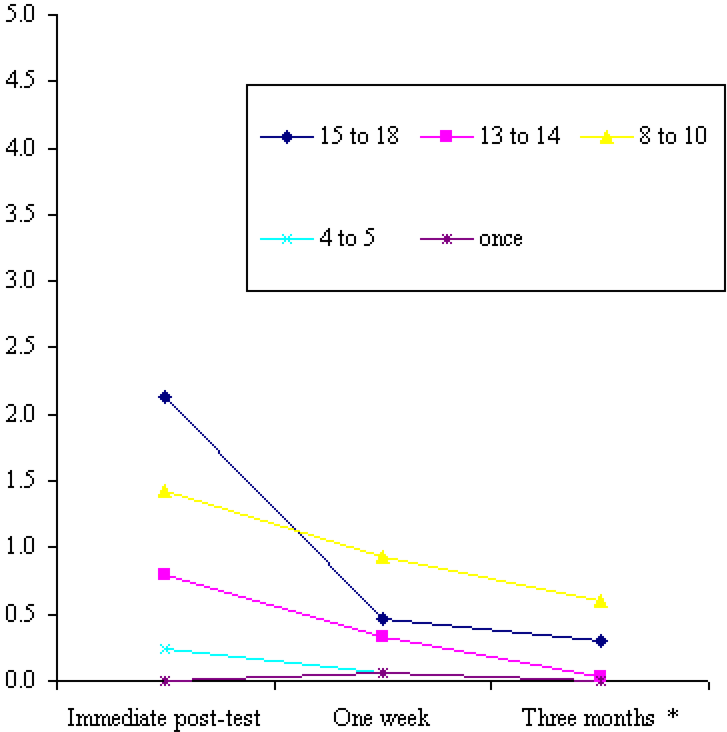
This study examined the rate at which vocabulary was learned from reading the 400 headword graded reader A Little Princess. To ascertain whether words of different frequency of occurrence rates were more likely to be learned and retained or forgotten, 25 words within five bands of differing frequency of occurrence (15 to 18 times to those appearing only once) were selected. The spelling of each word was changed to ensure that each test item was unknown to the 15 intermediate level (or above) female Japanese subjects. Three tests (word-form recognition, prompted meaning recognition and unprompted meaning recognition) were administered immediately after reading, after one week and after a three month delay. The results show that words can be learned incidentally but that most of the words were not learned. More frequent words were more likely to be learned and were more resistant to decay. The data suggest that, on average, the meaning of only one of the 25 items will be remembered after three months, and the meaning of none of the items that were met fewer than eight times will be remembered three months later. The data thus suggest that very little new vocabulary is retained from reading one graded reader, and that a massive amount of graded reading is needed to build new vocabulary. It is suggested that the benefits of reading a graded reader should not only be assessed by researching vocabulary gains and retention, but by looking at how graded readers help develop and enrich already known vocabulary.
Overview
CoChat Summary
## TL;DR
This experiment tested whether Japanese university women could learn substitute vocabulary from reading one 400-headword graded reader, with tests immediately, after one week, and after three months. The main finding was that some words were learned incidentally, but most were not retained, and learning was much better for higher-frequency items than for low-frequency ones.
## Key findings
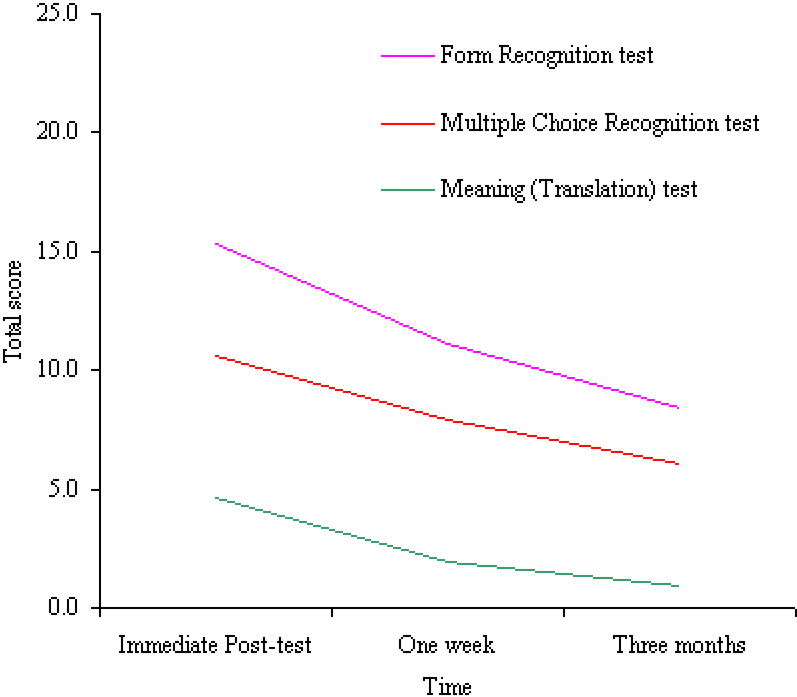
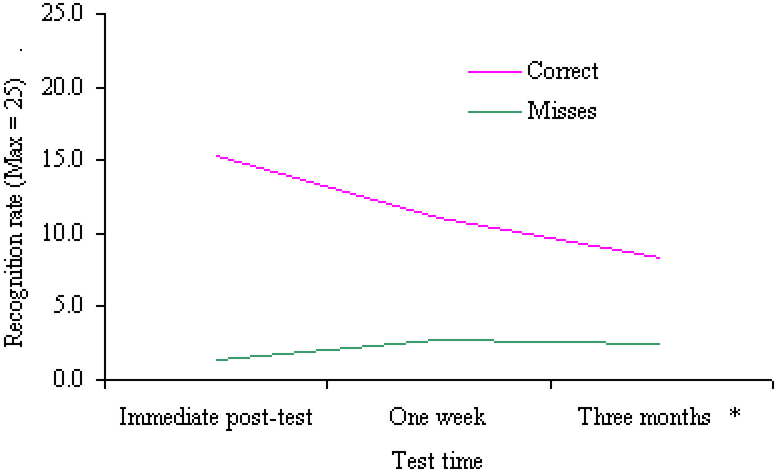
- On the word-form recognition test, mean scores fell from 15.3/25 immediately after reading to 11.1/25 after one week and 8.4/25 after three months; incorrect selections rose from 1.3 to 2.8 to 2.4.
- On the multiple-choice recognition test, mean scores declined from 10.6/25 immediately to 7.9/25 after one week and 6.1/25 after three months.
- On the meaning (translation) test, mean scores dropped from 4.6/25 immediately to 1.9/25 after one week and 0.9/25 after three months; the paper states this means about one new word from one hour of reading was retained after three months.
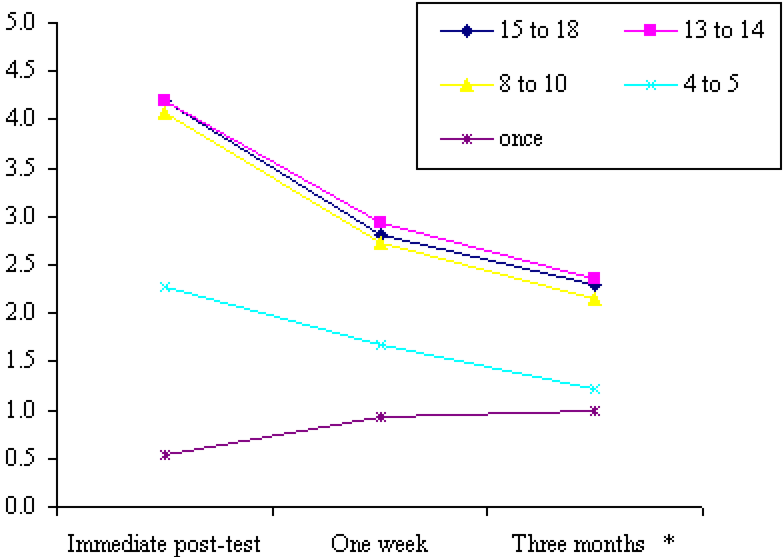
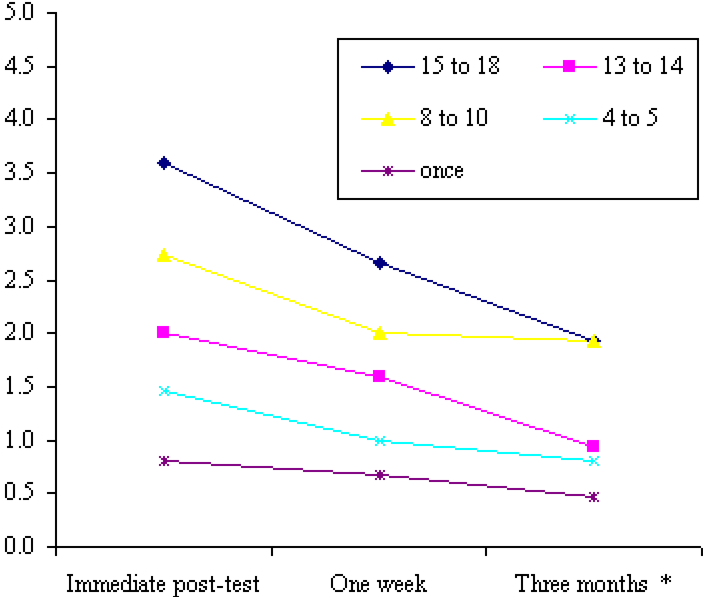
- Frequency mattered: words met 15–18 times were learned and retained more often, while words met fewer than 8 times were near zero on the translation test; the paper states that words met fewer than 8 times had 0 chance of being remembered three months later.
- The paper reports significant differences among test types at the immediate post-test (F = 17.11, p < .001) and significant declines over time for each test: word-form recognition (F = 35.45, p < .001), multiple-choice (F = 22.00, p < .001), and translation (F = 15.41, p = .002).
## Methods
- Design: 15 Japanese female university students read one graded reader, *A Little Princess*, with 25 substitute words embedded at different occurrence frequencies; vocabulary was tested immediately, after one week, and after three months.
- Sample and materials: Participants were 19–21 years old, lower-intermediate or above, mostly English Club members; the text contained 5,872 words, and the study used three test formats: word-form recognition, multiple-choice recognition, and meaning translation.
- Analysis: Scores were summarized by test and by occurrence frequency; the paper reports repeated measures ANOVAs and compares retention/decay across test types and frequency bands.
## Limitations
- The paper explicitly says there were relatively few subjects and that a larger sample would be better to show frequency effects more clearly.
- It says only 5,872 words were read, so a longer text or multiple texts would be better for judging vocabulary learning from reading.
- It also says the study would be stronger with texts containing a better variety of word frequencies so that all test words are equally guessable.
- Evident from the text: the study used one graded reader only, so the findings may not generalize to broader reading conditions or to other texts.
Model-written summary. Check it against the paper before relying on it.
Integrity signals
Registry
Cites
Statistics
Figures
Verification
Claims the paper makes
1 Valid · 4 Not valid · 13 Not checked · 162 Own results and interpretations
The cited sources support only part of this claim — read each source’s verdict below.
In the paper
“Secondly, learners need to meet an unknown word many times before it is learned (Nagy, Herman and Anderson, 1985; Nagy, Anderson and Herman, 1987; Shu, Anderson and Zhang, 1995; Nation 2001: 237).”
What the sources say
- Partly supportedcites Nagy, Herman and Anderson, 1985 matched to “Learning Words from Context” (1985) sourceExperimental — accuracy not yet measured
The ‘Learning Words from Context’ section says that full knowledge seldom follows one encounter and that word learning often proceeds in small increments. But the Conclusion reports unmistakable learning from one or very few encounters. The claim omits the distinction between beginning to learn a word and learning its full meaning, making repeated encounters sound necessary for any learning. (LLM, conf=0.87)
- Not checked — no full text of the sourcecites Nagy, Anderson and Herman, 1987 matched to “Learning Word Meanings From Context During Normal Reading” (1987) source
- Not checked — no full text of the sourcecites Nation 2001: 237 matched to “Learning Vocabulary in Another Language” (2001) source
plainstates a cause- Asserted: passes — The authors put it forward as true.
- Checkable: passes — It can be checked against evidence.
- Load-bearing: passes — The paper’s conclusions depend on it.
- Based: passes — The paper gives a reason why it holds.
- Partly supported
A result the paper reports from its own data — it cites no other source for it, so there is none to check. The quote shows it is in the paper.
In the paper
“More frequent words were more likely to be learned and were more resistant to decay.”
hedgedstates an association- Asserted: passes — The authors put it forward as true.
- Checkable: passes — It can be checked against evidence.
- Load-bearing: passes — The paper’s conclusions depend on it.
- Based: passes — The paper gives a reason why it holds.
A result the paper reports from its own data — it cites no other source for it, so there is none to check. The quote shows it is in the paper.
In the paper
“The results show that words can be learned incidentally but that most of the words were not learned.”
plainstates a cause- Asserted: passes — The authors put it forward as true.
- Checkable: passes — It can be checked against evidence.
- Load-bearing: passes — The paper’s conclusions depend on it.
- Based: passes — The paper gives a reason why it holds.
A result the paper reports from its own data — it cites no other source for it, so there is none to check. The quote shows it is in the paper.
In the paper
“More frequent words were more likely to be learned and were more resistant to decay.”
hedgedstates an association- Asserted: passes — The authors put it forward as true.
- Checkable: passes — It can be checked against evidence.
- Load-bearing: passes — The paper’s conclusions depend on it.
- Based: passes — The paper gives a reason why it holds.
A result the paper reports from its own data — it cites no other source for it, so there is none to check. The quote shows it is in the paper.
In the paper
“The data suggest that, on average, the meaning of only one of the 25 items will be remembered after three months”
hedged- Asserted: passes — The authors put it forward as true.
- Checkable: passes — It can be checked against evidence.
- Load-bearing: passes — The paper’s conclusions depend on it.
- Based: passes — The paper gives a reason why it holds.
- Rests on 2 assumptions not shown here.
78 more claims
Create a free account to see all 180 claims and to verify the 1 reference still open.
- Probably not a substantial claim. 60
- The quote only partly states this claim. 9
- It may state two separate claims as one. 50
Claims other papers make about this one
Each is checked against this paper’s own text: does it say what the citing paper says it does?
The source backs part of the claim, not all of it — or backs it for a different population, condition or comparison.
In the citing paper
“the Waring and Takaki (2003) study showed that in approximately 56 minutes of meaning-focused reading of a graded reader, four words were learned reasonably well, and another 12 were partially learnt.”
From The Four Strands (2007) · cites this paper as Waring and Takaki (2003)
Experimental — accuracy not yet measuredThe source backs part of the claim, not all of it — or backs it for a different population, condition or comparison.
In the citing paper
“Gi v en the same amount of time, deliberate language-focused learning acti v ities result in more learning than the incidental learning from meaning-focused acti v ities.”
From The Four Strands (2007) · cites this paper as Waring and Takaki (2003)
Experimental — accuracy not yet measuredThe cited source says what the claim attributes to it.
In the citing paper
“This study showed that small amounts of learning of v arious strengths occurred incidentally as a result of meaning-focused reading.”
From The Four Strands (2007) · cites this paper as Waring and Takaki's (2003)
In the citing paper
“In a similar study conducted by Waring and Takaki (2003), a multiple-choice, immediate posttest measure indicated that of 25 new words available for learning in the graded reader A Little Princess, 11 words were learned (as measured by success on these tests), a gain of 42%.”
From Incidental vocabulary acquisition from reading, reading-while-listening, and listening to stories (2008) · cites this paper as Waring and Takaki, 2003
In the citing paper
“Their results showed that incidental vocabulary learning from reading occurred at several levels and the gain scores depended on the test type, but not much new vocabulary was learned.”
From Incidental vocabulary acquisition from reading, reading-while-listening, and listening to stories (2008) · cites this paper as Waring and Takaki, 2003
2 more claims about this paper
Create a free account to see every claim other papers make about this one.
Citations
Cites
Learning Vocabulary in Another Language
Nation, I. S. P. (2001) · Cambridge University Press · doi:10.1017/cbo9781139524759 · Cited by 6,608
The Role of Consciousness in Second Language Learning1
SCHMIDT, R. W. (1990) · Applied Linguistics · doi:10.1093/applin/11.2.129 · Cited by 5,435 · cited 1×
“Some recent research has suggested the noticing of a form is an essential step in word learning (Schmidt, 1990).”
BackgroundExtensive Reading in the Second Language Classroom
Day, R. R., Bamford, J., Renandya, W. A., Jacobs, G. M., & Yu, V. W.-S. (1998) · RELC Journal · doi:10.1177/003368829802900211 · Cited by 1,276 · cited 1×
“As has been mentioned elsewhere, vocabulary growth is not the main aim of graded or extensive reading (e.g., Day and Bamford, 1998, 2002; Waring, 1997; Waring and Takahashi, 2000; Prowse, 2002).”
BackgroundNagy, W. E., Herman, P. A., & Anderson, R. C. (1985) · Reading Research Quarterly · doi:10.2307/747758 · Cited by 1,249
The Power of Reading: Insights from the Research
Barnett, M. A., & Krashen, S. (1994) · The Modern Language Journal · doi:10.2307/330145 · Cited by 792 · cited 4×
“Krashen (1993) 42 ESL learners 15 page of text French text plus watched a video Multiple-choice 6.6 words above controls”
InfluentialLearning Word Meanings From Context During Normal Reading
Nagy, W. E., Anderson, R. C., & Herman, P. A. (1987) · American Educational Research Journal · doi:10.3102/00028312024002237 · Cited by 757 · cited 1×
“Secondly, learners need to meet an unknown word many times before it is learned (Nagy, Herman and Anderson, 1985; Nagy, Anderson and Herman, 1987; Shu, Anderson and Zhang, 1995; Nation 2001: 237).”
BackgroundAssessing Second Language Vocabulary Knowledge: Depth Versus Breadth
Wesche, M., & Paribakht, T. S. (1996) · The Canadian Modern Language Review · doi:10.3138/cmlr.53.1.13 · Cited by 673 · cited 1×
“The complications associated with multiple-choice tests as accurate measures of word knowledge are legion and well documented elsewhere (e.g., Anderson and Freebody, 1981; Meara and Buxton, 1987; Wesche and Paribakht, 1996; Waring, 1999).”
BackgroundUnknown vocabulary density and reading comprehension
Hu, M., & Nation, P. (2020) · doi:10.26686/wgtn.12560354.v1 · Cited by 650
Beyond a Clockwork Orange: Acquiring second language vocabulary through reading
Horst, M., Cobb, T., & Meara, P. (1998) · Reading in a Foreign Language · doi:10.64152/10125/66953 · Cited by 565 · cited 1×
“Horst, Cobb and Meara (1998) also point out that some of the incidental learning from exposure experiments are "methodologically flawed" (1998: 210).”
BackgroundRetention of Inferred and Given Word Meanings: Experiments in Incidental Vocabulary Learning
Hulstijn, J. H. (1992) · Vocabulary and Applied Linguistics · doi:10.1007/978-1-349-12396-4_11 · Cited by 497 · cited 1×
“(scores above controls who did not see the text) Dupuy and Krashen (1993) 42 ESL learners 15 page of text French text plus watched a video Multiple-choice 6.6 words above controls Hulstijn (1992) 65 EFL learners 907 words Advertisement in Dutch State the meaning of 12 words 1 of 13 words (7.6”
BackgroundInfluential
Research works printed but not linked: 6
- Anderson, R. C. and Freebody, P. (1981). Reading comprehension and the assessment and acquisition of word knowledge. In J. Guthrie (Ed.), Comprehension and teaching (pp. 77-117). Newark, Delaware: International Reading Association.
- Burnett, F. H. retold by J. Bassett. (1991). A little princess . Oxford: Oxford University Press.
- Waring, R. (Ed.). (1997). Special edition on extensive reading. The Language Teacher, 21.
- Waring, R. (1999). Tasks for assessing receptive and productive second language vocabulary . Ph.D. Thesis. University of Wales, Swansea. http://www1.harenet.ne.jp/~waring/papers/phd/title.html
- Waring, R. & Takahashi, S. (2000). The Oxford University Press guide to the 'why and 'how' of using graded readers . Tokyo: Oxford University Press.
- Wesche, M. & Paribakht, T. (1996). Assessing vocabulary knowledge: Depth vs. breadth. Canadian Modern Language Review , 53, 13-40.
Cited by
Items 401–500 of 535
Hien, N. T. T., & Vy, N. T. T. (2021) · Dalat University Journal of Science · doi:10.37569/dalatuniversity.12.1.818(2022 · Cited by 4
Aldukhayel, D. (2022) · World Journal of English Language · doi:10.5430/wjel.v12n1p390 · Cited by 3
Investigating the Impact of Focusing on Academic Vocabulary Using Multiple Assessment Measures
Alothman, K. (2014) · Cited by 4
Ehsanzadehsorati, S. (2018) · FIU - Digital Commons (Florida International University) · doi:10.25148/etd.fidc007043 · Cited by 2
“However, there is not a fixed reasonable number of vocabulary words to pick up as an optimal number that should be covered during a particular time; the number of words is related to the learners’ proficiency level and motivational aspects, as well (Waring & Takaki, 2003).”
BackgroundSrimanee, J. (2009) · PSU Knowledge Bank (Prince of Songkla University) · Cited by 1
Sandom, M. (2013) · Open Access Victoria University of Wellington | Te Herenga Waka (Figshare) · doi:10.26686/wgtn.17006086 · Cited by 14
The development of vocabulary learning model based on the cognitive theory of multimedia learning
Jawaut, N. (2018) · Chula Digiverse · doi:10.58837/chula.the.2018.204 · Cited by 1
Fajt, B. (2022) · Eötvös Loránd Tudományegyetem · doi:10.15476/elte.2022.098 · Cited by 4
A Competency-based Proficiency Framework for Ritsumeikan Secondary Schools
Flanagan, A. (2010) · School for International Training Digital Collections (School for International Training)
One-time treatment for incidental vocabulary learning: Call for discontinuation
Bogdanov, S. G. (2013) · Scholar Electronic Repository of the New Bulgarian University (New Bulgarian University)
Kunz, C. A. (2015) · Digital Commons - Hamline (Hamline University)
Vocabulary used in e-mails by mixed-ability EFL secondary school students
Alonso, A. C. (2013) · RIUR (Universidad de La Rioja)
Creating and Validating an Advanced Practical Word List
Wang, C. (2012) · Open Access Victoria University of Wellington | Te Herenga Waka (Figshare) · doi:10.26686/wgtn.16993621.v1
The Effectiveness of Assisted Extensive Reading on Developing Reading
El-Deen, Z. B. (2009) · Cited by 4
The effect of frequency of occurrence of lexical items in incidental vocabulary learning
Vural, E. (2016) · Journal of Human Sciences · doi:10.14687/ijhs.v13i1.3557 · Cited by 1
Paired Reading with iPads in the Grade 6 French Immersion Classroom
Dorion, C. L. H. (2015) · UVic’s Research and Learning Repository (University of Victoria)
When one is Not Enough: Translation Rating and the Assessment of Partial Word Knowledge
Troy, C., & Tsau, S.-R. (2010) · doi:10.7118/jhss.201006.0087
“His battery of 10 tests includes three that 2 More recently, pseudowords have been employed as substitutes for authentic L2 target words in studies of incidental vocabulary acquisition such as (Reider, 2002; Waring & Takaki, 2003; Webb, 2007).”
BackgroundMethodExtensive Reading in Foreign Language Learning Contexts: Issues and Implications
Huang, Y. (2015) · Cited by 2
Sugita, M. (2016) · Journal of Extensive Reading · Cited by 1
Effects of Interaction using Wiki on Productive Vocabulary Knowledge
Jang, Y.-S. (2014) · The Journal of the Korea Contents Association · doi:10.5392/jkca.2014.14.05.487
The Influences of Task Type and Repetition on L2 Vocabulary Learning
조영아, & 마지현 (2014) · Korean Journal of English Language and Linguistics · doi:10.15738/kjell.14.2.201406.349 · Cited by 1
The Effect of Multiple Encounters in Contextualized Learning
Sánchez, M. J. (2016) · Porta Linguarum Revista Interuniversitaria de Didáctica de las Lenguas Extranjeras · doi:10.30827/digibug.53888
Task Effectiveness and Word Learning in a Second Language Acquisition
조영아, & 마지현 (2015) · Studies in English Language & Literature · doi:10.21559/aellk.2015.41.1.015
Guessing Vocabulary through Context in a Multimodal Medium : An Exploratory Study
Nguyen, A. (2015) · Institutional Repositories DataBase (IRDB)
The bidirectional role of lexis in extensive reading
Kern, J. Y. (2008)
Exploring the Relationship between the Amount of Reading and Incidental Vocabulary Learning
Goh, G.-Y. (2016) · English Language and Linguistics · doi:10.17960/ell.2016.22.2.002
Conditions on the Acquisition of Implicit and Explicit Collocational Knowledge
하주연, & 윤현숙 (2016) · Korean Journal of English Language and Linguistics · doi:10.15738/kjell.16.4.201612.695 · Cited by 1
Implementation of Extensive Reading in a Regular Korean High School Context
Youn, J.-H. (2015) · Cited by 3
Creating and using corpora: A principled approach to identifying key language within art & design
King, D., & Hickey, H. (2017) · University of the Arts London Research Online (University of the Arts London) · Cited by 1
Didactic Model: Teaching the English Temporal System to Arabic Freshman Learners of English
Hmidani, T. (2017) · PROFILE Issues in Teachers Professional Development · doi:10.15446/profile.v19n_sup1.68617 · Cited by 1
Takanami, S. (2018) · ARELE: Annual Review of English Language Education in Japan · doi:10.20581/arele.28.0_257
“After this, Webb (2007) also used this methodology and conducted research using ten test formats to examine the effects of repetition on vocabulary knowledge.”
BackgroundMethodHow to Use L2 Movies Effectively to Learn New Vocabulary: A New Theoretical Perspective
Journal, A. W. E., & Alharthi, A. A. (2018) · Arab World English Journal · doi:10.2139/ssrn.3226720 · Cited by 2
Second Language Vocabulary Research : 2003
Tanaka, Y. L. (2012) · Institutional Repositories DataBase (IRDB)
THE EFFECT OF STANDARD AND REVERSED SUBTITLING VERSUS NO SUBTITLING MODE ON L٢ VOCABULARY LEARNING
Fazilatfar, A. M., Ghorbani, S., & Samavarchi, L. (2011) · Cited by 1
Interferencja leksykalna – ważna strategia czytelnicza w języku obcym
Seretny, A. (2019) · Jagiellonian University Repository (Jagiellonian University)
Extensive Reading for Statistical Learning
Ewert, D. E. (2019) · Wiley eBooks · doi:10.1002/9781119472384.ch26 · Cited by 3
Incidental vocabulary acquisition during reading by adult native speakers of German
Bordag, D., Kirschenbaum, A., Opitz, A., & Tschirner, E. (2012) · ExLing Conferences · doi:10.36505/exling-2012/05/0006/000212
Vocabulary acquisition, input, and extensive reading: A conversation
(2013) · The Language Teacher · doi:10.37546/jalttlt37.4-8
“…& Nation, 2000; Laufer, 1989), you have to meet the unknown words six to eight times to be learned at all (e.g., Horst, Cobb, & Meara, 1998; Waring & Takaki, 2003), you have to see the words again at optimally spaced intervals to retain them (see Ebbinghaus, 1885/1964), etc. Browne: I’m…”
BackgroundMohamed, M. (2020) · Carleton University's Institutional Repository (MacOdrum Library, Carleton University) · doi:10.22215/etd/2020-14306
Retention of Inferred L2 Word Meaning Based on Morphological and Contextual Clues
Kamimura, K. (2020) · ARELE: Annual Review of English Language Education in Japan · doi:10.20581/arele.31.0_161 · Cited by 1
Tram, D. H. B., & Hung, H. C. M. (2018) · HO CHI MINH CITY OPEN UNIVERSITY JOURNAL OF SCIENCE - SOCIAL SCIENCES · doi:10.46223/hcmcoujs.soci.en.8.2.283.2018
“As cited in Waring and Takaki (2003), in incidental learning through ER, one half of the learned vocabulary would likely to be lost after three months which means more and more chances to expose to the words is totally necessary for memorizing them.”
BackgroundEvaluating the efficacy of yes-no checklist tests to assess knowledge of multi-word lexical units
Stubbe, R., & Cochrane, Y. (2018) · Vocabulary Learning and Instruction · doi:10.7820/vli.v08.1.stubbe.cochrane · Cited by 1
Zhu, Y., & Huang, Y. (2021) · Journal of Language Teaching and Research · doi:10.17507/jltr.1206.11 · Cited by 4
Ghobain, E. A. (2021) · ONOMAZEIN · doi:10.7764/onomazein.53.05 · Cited by 1
Léger-Zheng, E., & Théophanous, O. (2021) · Lexis · doi:10.4000/lexis.5937 · Cited by 1
Reading a whole book to learn vocabulary
Nation, P. (2020) · doi:10.26686/wgtn.12730952.v1
VOCABULARY INPUT IN ESL TEXTBOOKS: A CORPUS-BASED ANALYSIS
Udaya, M. (2022) · European Journal of Education Studies · doi:10.46827/ejes.v8i6.4117 · Cited by 4
“The figures vary among researchers, with estimates ranging between 5–6 (Cameron, 2001; Nation, 1990) and twenty (Waring & Takaki, 2003) occurrences.”
BackgroundReading a whole book to learn vocabulary
Nation, P. (2020) · doi:10.26686/wgtn.12730952
“47 of movies, Webb and Rodgers (2009b) show that a vocabulary size of at least 5,000 word families is needed, while the most difficult genre of movie require a vocabulary size of 10,000 word families.”
BackgroundKoekemoer, T., Ebersöhn, L., Joubert, I., et al. (2013) · UpSpace Institutional Repository (University of Pretoria)
Pishghadam, R., Jajarmi, H., Shayesteh, S., Khodaverdi, A., & Nassaji, H. (2022) · Frontiers in Psychology · doi:10.3389/fpsyg.2022.707234
“While Horst et al. (1998); Waring and Takaki (2003), and Webb (2007) respectively found 8, 10, and 12 repetitions as the optimal number, Vidal (2011) minimized the frequency to two and three meaningful repetitions in a reading context.”
BackgroundIncidental Vocabulary Learning from Language Exposure
Schmitt, N., & Schmitt, D. (2020) · Cambridge University Press eBooks · doi:10.1017/9781108569057.007 · Cited by 1
Corpus Insights: Frequency and Formulaic Language
Schmitt, N., & Schmitt, D. (2020) · Cambridge University Press eBooks · doi:10.1017/9781108569057.005
Frequency of Selected Words/Phrases in COCA and BNC
Schmitt, N., & Schmitt, D. (2020) · Cambridge University Press eBooks · doi:10.1017/9781108569057.011
Missing Words from the Reading Passages
Schmitt, N., & Schmitt, D. (2020) · Cambridge University Press eBooks · doi:10.1017/9781108569057.013
Assessing Vocabulary Knowledge
Schmitt, N., & Schmitt, D. (2020) · Cambridge University Press eBooks · doi:10.1017/9781108569057.010
Schmitt, N., & Schmitt, D. (2020) · Cambridge University Press eBooks · doi:10.1017/9781108569057.009
The Nature and Size of Vocabulary
Schmitt, N., & Schmitt, D. (2020) · Cambridge University Press eBooks · doi:10.1017/9781108569057.002
Schmitt, N., & Schmitt, D. (2020) · Cambridge University Press eBooks · doi:10.1017/9781108569057.016
Schmitt, N., & Schmitt, D. (2020) · Cambridge University Press eBooks · doi:10.1017/9781108569057.001
Schmitt, N., & Schmitt, D. (2020) · Cambridge University Press eBooks · doi:10.1017/9781108569057.015
(2020) · Terminology and lexicography research and practice · doi:10.1075/tlrp.22.additional
Schmitt, N., & Schmitt, D. (2020) · Cambridge University Press eBooks · doi:10.1017/9781108569057.014
History of Vocabulary in Language Teaching
Schmitt, N., & Schmitt, D. (2020) · Cambridge University Press eBooks · doi:10.1017/9781108569057.003
Intentional Vocabulary Learning
Schmitt, N., & Schmitt, D. (2020) · Cambridge University Press eBooks · doi:10.1017/9781108569057.008
Categories of Vocabulary and Word Lists
Schmitt, N., & Schmitt, D. (2020) · Cambridge University Press eBooks · doi:10.1017/9781108569057.006
Schmitt, N., & Schmitt, D. (2020) · Cambridge University Press eBooks · doi:10.1017/9781108569057.012
Bui, T. B. T. (2019) · Open Access Victoria University of Wellington | Te Herenga Waka (Figshare) · doi:10.26686/wgtn.17136788
“…the target lexical items in the language input (Horst, Cobb, & Meara, 1998; Pellicer-Sanchez, 2015; Pellicer-Sanchez & Schmitt, 2010; Pigada & Schmitt, 2006; Waring & Takaki, 2003; Webb, 2005), only recently have researchers started investigating the acquisition of MWEs incidentally from reading.”
BackgroundResultInfluentialMarianne (2008) · Open Access Victoria University of Wellington | Te Herenga Waka (Figshare) · doi:10.26686/wgtn.16958467.v1 · Cited by 3
Nation, P. (2020) · doi:10.26686/wgtn.12552167
Toomer, M. (2019) · Open Access Victoria University of Wellington | Te Herenga Waka (Figshare) · doi:10.26686/wgtn.17143838
“…words through incidental exposure, for example, in extensive reading, tend to be small, although repetition of the target items has been shown to increase the likelihood of learner uptake (Elgort & Warren, 2014; Nation & Wang, 1999; Waring & Takaki, 2003; Webb, 2007; Zahar, Cobb, & Spada, 2003).”
BackgroundResearching Vocabulary in the EFL Context: A Commentary on Four Studies for JALT Vocabulary SIG
Webb, S. (2015) · Vocabulary Learning and Instruction · doi:10.7820/vli.v04.1.webb
Schmitt, N., & Schmitt, D. (2020) · Cambridge University Press eBooks · doi:10.1017/9781108569057.017
Incidental learning of collocation
Webb, S., Newton, J., & Chang, A. (2020) · doi:10.26686/wgtn.12749645
Strong, B. (2017) · Open Access Victoria University of Wellington | Te Herenga Waka (Figshare) · doi:10.26686/wgtn.17065166
Multilingual learners: Vocabulary and beyond
Geva, E., & Fraser, C. (2017) · John Benjamins Publishing Company eBooks · doi:10.1075/z.206.13gev
Rodgers, M. (2013) · Open Access Victoria University of Wellington | Te Herenga Waka (Figshare) · doi:10.26686/wgtn.17005078 · Cited by 183
Nation, P. (2020) · Open Access Victoria University of Wellington | Te Herenga Waka (Figshare) · doi:10.26686/wgtn.12552167.v1
File, K., & ADAMS, R. (2010) · TESOL Quarterly · doi:10.5054/tq.2010.238720
Tadayonifar, M., Entezari, M., & Valızadeh, M. (2021) · doi:10.26686/wgtn.15001038
Tadayonifar, M., Entezari, M., & Valızadeh, M. (2021) · doi:10.26686/wgtn.15001038.v1
The guessing from context test
Sasao, Y., & Webb, S. (2020) · Benjamins current topics · doi:10.1075/bct.109.itl.00009.sas
The Multimodal Affordances of Commercial-off-the-Shelf Video Games That Support Vocabulary Learning
Charlebois, J. (2022) · Carleton University's Institutional Repository (MacOdrum Library, Carleton University) · doi:10.22215/etd/2022-15032 · Cited by 4
Wang, S., & Wang, S. (2022) · Chinese as a Second Language (漢語教學研究—美國中文教師學會學報) The journal of the Chinese Language Teachers Association USA · doi:10.1075/csl.21029.wan · Cited by 1
Vocabulary Gains in a Japanese University Extensive Reading Program
Higginbotham, G. (2022) · doi:10.37546/jaltpcp2021-16
ŞİMŞEK, R. (2022) · International Journal of Language Academy · doi:10.29228/ijla.66191
A Longitudinal Study of Swedish Upper Secondary School Students’ Vocabulary Development
Sjöling, C. H. (2023) · Nordic Journal of English Studies · doi:10.35360/njes.717 · Cited by 2
Teng, M. (2023) · SSRN Electronic Journal · doi:10.2139/ssrn.4617187
Comparing Incidental Vocabulary Learning Between Read-to-Comprehend and Read-to-Produce Groups
Kim, H.-S., & Choi, U.-Y. (2023) · Modern English Education · doi:10.18095/meeso.2023.24.1.208
“According to the criteria for appropriate reading text presented by Waring and Takaki (2003), a text should not be so complex as to impede word guessing.”
MethodEzeh, N. G., & Olaolu, T. A. (2023) · English Language Teaching · doi:10.5539/elt.v17n1p65 · Cited by 1
“Most of these researchers have examined the relationship between vocabulary learning and reading, instead of measuring vocabulary growth through ER (Moroishi Wei, 2006; Waring & Takaki, 2003, Sahin, et al; 2014).”
BackgroundHung, N. T., & Hoang, N. H. (2023) · VNU Journal of Foreign Studies · doi:10.63023/2525-2445/jfs.ulis.5052 · Cited by 2
“Although it generally concurs that this activity provides grounds for extensive lexical development (Chun et al., 2012; Nation & Wang, 1999; Waring & Takaki, 2003), reservations persist as the practicality of this practice is often crippled by several factors, including limited attentional…”
BackgroundThe effects of incidental learning and input frequency on the perception of non-native speech
Lee, A. H., & Lloyd, J. S. (2024) · Second language Research · doi:10.1177/02676583241249348 · Cited by 2
“Following a seminal study by Saragi et al. (1978), many researchers have reported a positive correlation between frequency and incidental vocabulary learning at varying degrees (Horst et al., 1998; Rott, 1999; Vidal, 2003, 2011; Waring and Takaki, 2003; Webb, 2007).”
Kamiński, M. P. (2021) · Terminology and lexicography research and practice · doi:10.1075/tlrp.22.ind
Kamiński, M. P. (2021) · Terminology and lexicography research and practice · doi:10.1075/tlrp.22.c7
Kamiński, M. P. (2021) · Terminology and lexicography research and practice · doi:10.1075/tlrp.22.ack
The defining vocabulary and the user
Kamiński, M. P. (2021) · Terminology and lexicography research and practice · doi:10.1075/tlrp.22.c6
Kamiński, M. P. (2021) · Terminology and lexicography research and practice · doi:10.1075/tlrp.22.intro
Metadata
- Authors
- Waring, R., & Takaki, M.
- Affiliations
- Notre Dame Seishin University (JP)
- ORCID
- Waring, Rob
- Venue
- Reading in a Foreign Language
- Published
- 2003-10-01
- Volume
- 15
- Issue
- 2
- Pages
- 130-163
- ISSN
- 0264-2425 (ISSN-L)
- 1539-0578
- OpenAlex
- W140060905
- Cited by
- 547
- References
- 28
- Citations by year
- 2026: 16 · 2025: 16 · 2024: 11 · 2023: 18 · 2022: 30 · 2021: 48 · 2020: 58 · 2019: 35 · 2018: 26 · 2017: 31 · 2016: 30 · 2015: 34 · 2014: 45 · 2013: 28 · 2012: 32
- FWCI
- 6.13
- Type
- journal article
- Language
- en
- Open access
- hybrid
- doi.org
- Licence
- Locations
- Reading in a Foreign Language (publishedVersion, cc-by-nc-nd)
- ScholarSpace (University of Hawaii at Manoa) (submittedVersion)
- Reading in a Foreign Language
- Funders
- University of Oxford
- Topics
- Social Sciences › Psychology › Developmental and Educational Psychology › Second Language Acquisition and Learning
- Social Sciences › Psychology › Developmental and Educational Psychology › Reading and Literacy Development
- Social Sciences › Arts and Humanities › Language and Linguistics › EFL/ESL Teaching and Learning
- Keywords
- vocabulary acquisition, vocabulary retention, graded readers, incidental learning, word frequency, Japanese learners of English, A Little Princess, word recognition, meaning recognition
About these checks
Registry, retraction, Cites and statistics results are computed, not judged, with one exception: a printed reference that no index lists is read once by a model before it counts as a citation error. Claims are extracted by a model and kept only when their quote appears verbatim in the text; each cited source is then checked, with a model’s help, for whether it says what the claim relies on. Those verdicts can be wrong — read the claim’s quote and the cited source before relying on one.
The claim verdicts this report counts are experimental: their accuracy is not yet measured.
A language model drew the claims from the paper on 2026-10-10, under version 3 of the claim definition (model deepseek-v4.1-flash, prompt extract-v3).
A second model labelled each claim on 2026-10-10 (model jev-1.13-20260917, definition revision gold-guideline-v0.2).
Cited sources are checked with a language model’s help (gpt-6-sol).
Statistics and arithmetic are recomputed, not judged.
Confidence bands are shown only for fields calibrated on our annotated test set. None is calibrated yet, so no band is shown.
What counts as a claim ›How we measure confidence ›How we check this ›
Are you an author, or do you see a problem with this page? Request a review
Data sources
Bibliographic data: Semantic Scholar, OpenAlex, Crossref.
Contains information from the Semantic Scholar Academic Graph Datasets, made available under the ODC Attribution License (ODC-BY 1.0).
Semantic Scholar’s data is described in: Kinney, R., et al. (2023). The Semantic Scholar Open Data Platform. arXiv:2301.10140.
