

At what rate do learners learn and retain new vocabulary from reading a graded reader?
Open accessThe DOI matches its Crossref record; 30 of the 30 references it cites were found in a registry or an index; 1 of the 23 sources its claims cite were checked for support.
Abstract
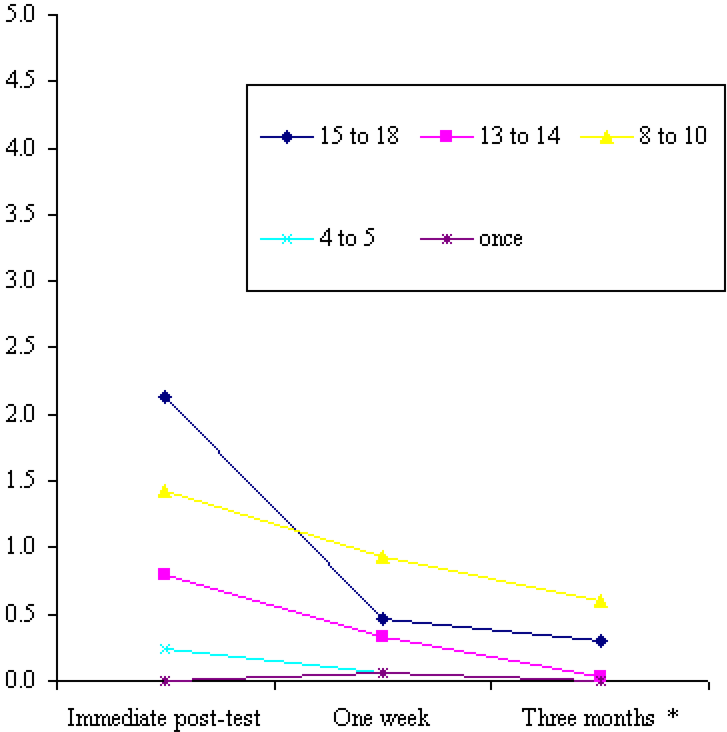
This study examined the rate at which vocabulary was learned from reading the 400 headword graded reader A Little Princess. To ascertain whether words of different frequency of occurrence rates were more likely to be learned and retained or forgotten, 25 words within five bands of differing frequency of occurrence (15 to 18 times to those appearing only once) were selected. The spelling of each word was changed to ensure that each test item was unknown to the 15 intermediate level (or above) female Japanese subjects. Three tests (word-form recognition, prompted meaning recognition and unprompted meaning recognition) were administered immediately after reading, after one week and after a three month delay. The results show that words can be learned incidentally but that most of the words were not learned. More frequent words were more likely to be learned and were more resistant to decay. The data suggest that, on average, the meaning of only one of the 25 items will be remembered after three months, and the meaning of none of the items that were met fewer than eight times will be remembered three months later. The data thus suggest that very little new vocabulary is retained from reading one graded reader, and that a massive amount of graded reading is needed to build new vocabulary. It is suggested that the benefits of reading a graded reader should not only be assessed by researching vocabulary gains and retention, but by looking at how graded readers help develop and enrich already known vocabulary.
Overview
CoChat Summary
## TL;DR
This experiment tested whether Japanese university women could learn substitute vocabulary from reading one 400-headword graded reader, with tests immediately, after one week, and after three months. The main finding was that some words were learned incidentally, but most were not retained, and learning was much better for higher-frequency items than for low-frequency ones.
## Key findings
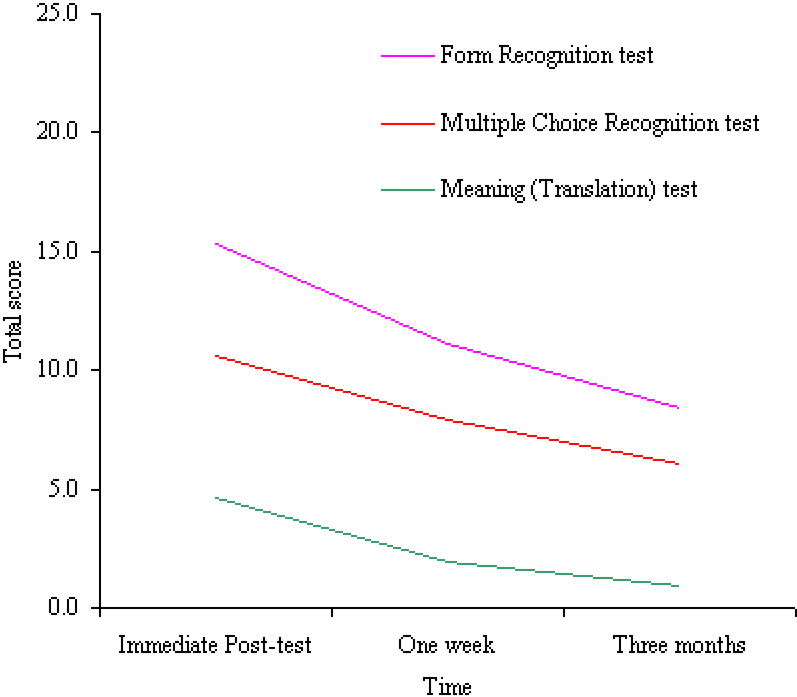
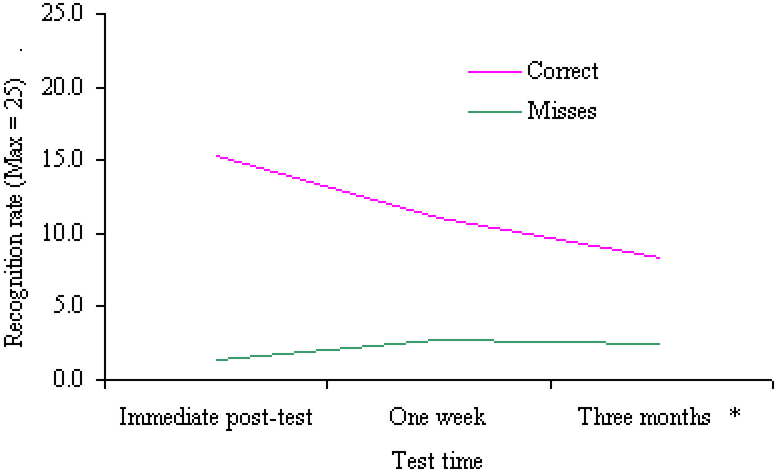
- On the word-form recognition test, mean scores fell from 15.3/25 immediately after reading to 11.1/25 after one week and 8.4/25 after three months; incorrect selections rose from 1.3 to 2.8 to 2.4.
- On the multiple-choice recognition test, mean scores declined from 10.6/25 immediately to 7.9/25 after one week and 6.1/25 after three months.
- On the meaning (translation) test, mean scores dropped from 4.6/25 immediately to 1.9/25 after one week and 0.9/25 after three months; the paper states this means about one new word from one hour of reading was retained after three months.
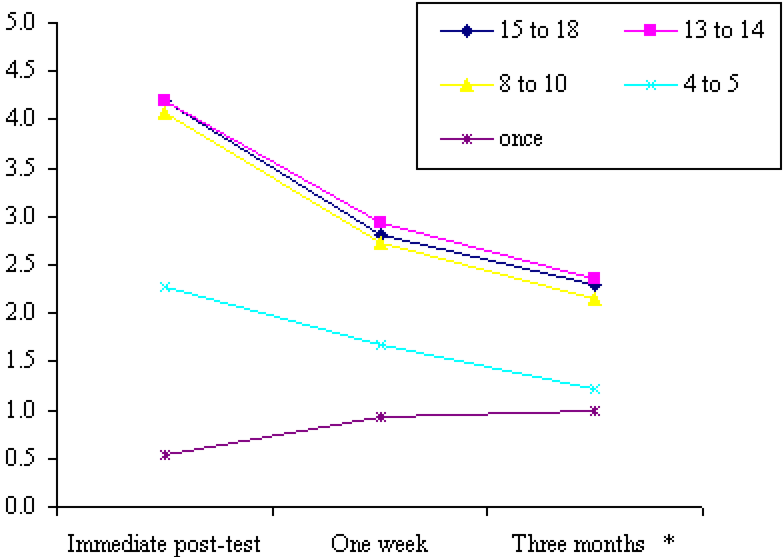
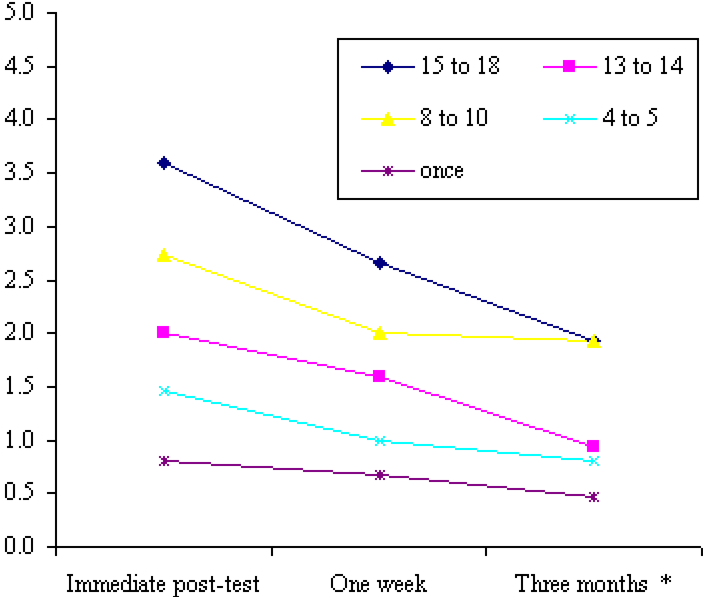
- Frequency mattered: words met 15–18 times were learned and retained more often, while words met fewer than 8 times were near zero on the translation test; the paper states that words met fewer than 8 times had 0 chance of being remembered three months later.
- The paper reports significant differences among test types at the immediate post-test (F = 17.11, p < .001) and significant declines over time for each test: word-form recognition (F = 35.45, p < .001), multiple-choice (F = 22.00, p < .001), and translation (F = 15.41, p = .002).
## Methods
- Design: 15 Japanese female university students read one graded reader, *A Little Princess*, with 25 substitute words embedded at different occurrence frequencies; vocabulary was tested immediately, after one week, and after three months.
- Sample and materials: Participants were 19–21 years old, lower-intermediate or above, mostly English Club members; the text contained 5,872 words, and the study used three test formats: word-form recognition, multiple-choice recognition, and meaning translation.
- Analysis: Scores were summarized by test and by occurrence frequency; the paper reports repeated measures ANOVAs and compares retention/decay across test types and frequency bands.
## Limitations
- The paper explicitly says there were relatively few subjects and that a larger sample would be better to show frequency effects more clearly.
- It says only 5,872 words were read, so a longer text or multiple texts would be better for judging vocabulary learning from reading.
- It also says the study would be stronger with texts containing a better variety of word frequencies so that all test words are equally guessable.
- Evident from the text: the study used one graded reader only, so the findings may not generalize to broader reading conditions or to other texts.
Model-written summary. Check it against the paper before relying on it.
Integrity signals
Registry
Cites
Statistics
Figures
Verification
Claims the paper makes
1 Valid · 4 Not valid · 13 Not checked · 162 Own results and interpretations
The cited sources support only part of this claim — read each source’s verdict below.
In the paper
“Secondly, learners need to meet an unknown word many times before it is learned (Nagy, Herman and Anderson, 1985; Nagy, Anderson and Herman, 1987; Shu, Anderson and Zhang, 1995; Nation 2001: 237).”
What the sources say
- Partly supportedcites Nagy, Herman and Anderson, 1985 matched to “Learning Words from Context” (1985) sourceExperimental — accuracy not yet measured
The ‘Learning Words from Context’ section says that full knowledge seldom follows one encounter and that word learning often proceeds in small increments. But the Conclusion reports unmistakable learning from one or very few encounters. The claim omits the distinction between beginning to learn a word and learning its full meaning, making repeated encounters sound necessary for any learning. (LLM, conf=0.87)
- Not checked — no full text of the sourcecites Nagy, Anderson and Herman, 1987 matched to “Learning Word Meanings From Context During Normal Reading” (1987) source
- Not checked — no full text of the sourcecites Nation 2001: 237 matched to “Learning Vocabulary in Another Language” (2001) source
plainstates a cause- Asserted: passes — The authors put it forward as true.
- Checkable: passes — It can be checked against evidence.
- Load-bearing: passes — The paper’s conclusions depend on it.
- Based: passes — The paper gives a reason why it holds.
- Partly supported
A result the paper reports from its own data — it cites no other source for it, so there is none to check. The quote shows it is in the paper.
In the paper
“More frequent words were more likely to be learned and were more resistant to decay.”
hedgedstates an association- Asserted: passes — The authors put it forward as true.
- Checkable: passes — It can be checked against evidence.
- Load-bearing: passes — The paper’s conclusions depend on it.
- Based: passes — The paper gives a reason why it holds.
A result the paper reports from its own data — it cites no other source for it, so there is none to check. The quote shows it is in the paper.
In the paper
“The results show that words can be learned incidentally but that most of the words were not learned.”
plainstates a cause- Asserted: passes — The authors put it forward as true.
- Checkable: passes — It can be checked against evidence.
- Load-bearing: passes — The paper’s conclusions depend on it.
- Based: passes — The paper gives a reason why it holds.
A result the paper reports from its own data — it cites no other source for it, so there is none to check. The quote shows it is in the paper.
In the paper
“More frequent words were more likely to be learned and were more resistant to decay.”
hedgedstates an association- Asserted: passes — The authors put it forward as true.
- Checkable: passes — It can be checked against evidence.
- Load-bearing: passes — The paper’s conclusions depend on it.
- Based: passes — The paper gives a reason why it holds.
A result the paper reports from its own data — it cites no other source for it, so there is none to check. The quote shows it is in the paper.
In the paper
“The data suggest that, on average, the meaning of only one of the 25 items will be remembered after three months”
hedged- Asserted: passes — The authors put it forward as true.
- Checkable: passes — It can be checked against evidence.
- Load-bearing: passes — The paper’s conclusions depend on it.
- Based: passes — The paper gives a reason why it holds.
- Rests on 2 assumptions not shown here.
78 more claims
Create a free account to see all 180 claims and to verify the 1 reference still open.
- Probably not a substantial claim. 60
- The quote only partly states this claim. 9
- It may state two separate claims as one. 50
Claims other papers make about this one
Each is checked against this paper’s own text: does it say what the citing paper says it does?
The source backs part of the claim, not all of it — or backs it for a different population, condition or comparison.
In the citing paper
“the Waring and Takaki (2003) study showed that in approximately 56 minutes of meaning-focused reading of a graded reader, four words were learned reasonably well, and another 12 were partially learnt.”
From The Four Strands (2007) · cites this paper as Waring and Takaki (2003)
Experimental — accuracy not yet measuredThe source backs part of the claim, not all of it — or backs it for a different population, condition or comparison.
In the citing paper
“Gi v en the same amount of time, deliberate language-focused learning acti v ities result in more learning than the incidental learning from meaning-focused acti v ities.”
From The Four Strands (2007) · cites this paper as Waring and Takaki (2003)
Experimental — accuracy not yet measuredThe cited source says what the claim attributes to it.
In the citing paper
“This study showed that small amounts of learning of v arious strengths occurred incidentally as a result of meaning-focused reading.”
From The Four Strands (2007) · cites this paper as Waring and Takaki's (2003)
In the citing paper
“In a similar study conducted by Waring and Takaki (2003), a multiple-choice, immediate posttest measure indicated that of 25 new words available for learning in the graded reader A Little Princess, 11 words were learned (as measured by success on these tests), a gain of 42%.”
From Incidental vocabulary acquisition from reading, reading-while-listening, and listening to stories (2008) · cites this paper as Waring and Takaki, 2003
In the citing paper
“Their results showed that incidental vocabulary learning from reading occurred at several levels and the gain scores depended on the test type, but not much new vocabulary was learned.”
From Incidental vocabulary acquisition from reading, reading-while-listening, and listening to stories (2008) · cites this paper as Waring and Takaki, 2003
2 more claims about this paper
Create a free account to see every claim other papers make about this one.
Citations
Cites
Learning Vocabulary in Another Language
Nation, I. S. P. (2001) · Cambridge University Press · doi:10.1017/cbo9781139524759 · Cited by 6,608
The Role of Consciousness in Second Language Learning1
SCHMIDT, R. W. (1990) · Applied Linguistics · doi:10.1093/applin/11.2.129 · Cited by 5,435 · cited 1×
“Some recent research has suggested the noticing of a form is an essential step in word learning (Schmidt, 1990).”
BackgroundExtensive Reading in the Second Language Classroom
Day, R. R., Bamford, J., Renandya, W. A., Jacobs, G. M., & Yu, V. W.-S. (1998) · RELC Journal · doi:10.1177/003368829802900211 · Cited by 1,276 · cited 1×
“As has been mentioned elsewhere, vocabulary growth is not the main aim of graded or extensive reading (e.g., Day and Bamford, 1998, 2002; Waring, 1997; Waring and Takahashi, 2000; Prowse, 2002).”
BackgroundNagy, W. E., Herman, P. A., & Anderson, R. C. (1985) · Reading Research Quarterly · doi:10.2307/747758 · Cited by 1,249
The Power of Reading: Insights from the Research
Barnett, M. A., & Krashen, S. (1994) · The Modern Language Journal · doi:10.2307/330145 · Cited by 792 · cited 4×
“Krashen (1993) 42 ESL learners 15 page of text French text plus watched a video Multiple-choice 6.6 words above controls”
InfluentialLearning Word Meanings From Context During Normal Reading
Nagy, W. E., Anderson, R. C., & Herman, P. A. (1987) · American Educational Research Journal · doi:10.3102/00028312024002237 · Cited by 757 · cited 1×
“Secondly, learners need to meet an unknown word many times before it is learned (Nagy, Herman and Anderson, 1985; Nagy, Anderson and Herman, 1987; Shu, Anderson and Zhang, 1995; Nation 2001: 237).”
BackgroundAssessing Second Language Vocabulary Knowledge: Depth Versus Breadth
Wesche, M., & Paribakht, T. S. (1996) · The Canadian Modern Language Review · doi:10.3138/cmlr.53.1.13 · Cited by 673 · cited 1×
“The complications associated with multiple-choice tests as accurate measures of word knowledge are legion and well documented elsewhere (e.g., Anderson and Freebody, 1981; Meara and Buxton, 1987; Wesche and Paribakht, 1996; Waring, 1999).”
BackgroundUnknown vocabulary density and reading comprehension
Hu, M., & Nation, P. (2020) · doi:10.26686/wgtn.12560354.v1 · Cited by 650
Beyond a Clockwork Orange: Acquiring second language vocabulary through reading
Horst, M., Cobb, T., & Meara, P. (1998) · Reading in a Foreign Language · doi:10.64152/10125/66953 · Cited by 565 · cited 1×
“Horst, Cobb and Meara (1998) also point out that some of the incidental learning from exposure experiments are "methodologically flawed" (1998: 210).”
BackgroundRetention of Inferred and Given Word Meanings: Experiments in Incidental Vocabulary Learning
Hulstijn, J. H. (1992) · Vocabulary and Applied Linguistics · doi:10.1007/978-1-349-12396-4_11 · Cited by 497 · cited 1×
“(scores above controls who did not see the text) Dupuy and Krashen (1993) 42 ESL learners 15 page of text French text plus watched a video Multiple-choice 6.6 words above controls Hulstijn (1992) 65 EFL learners 907 words Advertisement in Dutch State the meaning of 12 words 1 of 13 words (7.6”
BackgroundInfluential
Research works printed but not linked: 6
- Anderson, R. C. and Freebody, P. (1981). Reading comprehension and the assessment and acquisition of word knowledge. In J. Guthrie (Ed.), Comprehension and teaching (pp. 77-117). Newark, Delaware: International Reading Association.
- Burnett, F. H. retold by J. Bassett. (1991). A little princess . Oxford: Oxford University Press.
- Waring, R. (Ed.). (1997). Special edition on extensive reading. The Language Teacher, 21.
- Waring, R. (1999). Tasks for assessing receptive and productive second language vocabulary . Ph.D. Thesis. University of Wales, Swansea. http://www1.harenet.ne.jp/~waring/papers/phd/title.html
- Waring, R. & Takahashi, S. (2000). The Oxford University Press guide to the 'why and 'how' of using graded readers . Tokyo: Oxford University Press.
- Wesche, M. & Paribakht, T. (1996). Assessing vocabulary knowledge: Depth vs. breadth. Canadian Modern Language Review , 53, 13-40.
Cited by
Items 101–200 of 535
Why should Literature be Used in the Language Classroom?
Daskalovska, N., & Dimova, V. (2012) · Procedia - Social and Behavioral Sciences · doi:10.1016/j.sbspro.2012.05.271 · Cited by 100
“…acquire vocabulary (Brown et al., 2008; Dupuy and Krashen, 1993; Grabe and Stoller, 1997; Horst et al., 1998; Pigada and Schmitt, 2006; Pitts et al., 1989; Waring and Takaki, 2003), they can improve their writing ability (Elley and Mangubhai, 1983) and grammar knowledge (Pagada and Schmitt, 2006).”
BackgroundLexical coverage and profiling
Nurmukhamedov, U., & Webb, S. (2019) · Language Teaching · doi:10.1017/s0261444819000028 · Cited by 62
Multidimensional vocabulary acquisition through deliberate vocabulary list learning
Yamamoto, Y. (2014) · System · doi:10.1016/j.system.2013.12.005 · Cited by 60
“Recent studies have reported that incidental vocabulary learning contexts will not produce large receptive vocabulary gains or long-term retention as had once been thought (e.g., Nation, 2001; Waring & Nation, 2004; Waring & Takaki, 2003).”
BackgroundInfluentialIntegrating a computer-based flashcard program into academic vocabulary learning
Altıner, C. (2011) · Iowa State University Digital Repository (Iowa State University) · doi:10.31274/etd-180810-375 · Cited by 68
Bordag, D., Kirschenbaum, A., Tschirner, E., & Opitz, A. (2014) · Bilingualism Language and Cognition · doi:10.1017/s1366728914000078 · Cited by 53
Developing an intelligent tool for computer-assisted formulaic language learning from YouTube videos
Lin, P. (2021) · ReCALL · doi:10.1017/s0958344021000252 · Cited by 59
“Learners need to encounter a new item eight to 20 times to remember and learn the item (Pigada & Schmitt, 2006; Rott, 1999; Waring & Takaki, 2003).”
Choo, L. B., Lin, D. T. A., & Pandian, A. (2012) · Procedia - Social and Behavioral Sciences · doi:10.1016/j.sbspro.2012.09.572 · Cited by 43
“…those on L2 learners – have also found that the use of extensive reading alone has resulted in low rates of vocabulary acquisition, demonstrating the inadequacy of this approach for L2 learners (Rosszell, 2007; Waring and Takaki, 2003; Zahar, Cobb and Spada, 2001; Horst, Cobb and Meara, 1998).”
BackgroundReading a whole book to learn vocabulary
Nation, P. (2018) · ITL - International Journal of Applied Linguistics · doi:10.1075/itl.00005.nat · Cited by 7
“Incidental learning results in learning small numbers of strongly known words and reasonable numbers of words at various strengths of knowledge (Pellicer-Sánchez & Schmitt, 2010; Pigada & Schmitt, 2006; Waring & Takaki, 2003).”
BackgroundBarclay, S., & Pellicer‐Sánchez, A. (2021) · ITL Review of Applied Linguistics · doi:10.1075/itl.20011.bar · Cited by 47
Effects of L1 and L2 glosses on incidental vocabulary acquisition and lexical representations
Choi, S. (2015) · Learning and Individual Differences · doi:10.1016/j.lindif.2015.11.018 · Cited by 49
Aryadoust, V., Zakaria, A., Lim, M. H., & Chen, C. (2020) · Frontiers in Psychology · doi:10.3389/fpsyg.2020.01941 · Cited by 55
Chun, E., Choi, S., & Kim, J. (2012) · Neuroscience Letters · doi:10.1016/j.neulet.2012.05.069 · Cited by 59
Extensive Reading Quizzes and Reading Attitudes
Stoeckel, T., Reagan, N., & Hann, F. (2012) · TESOL Quarterly · doi:10.1002/tesq.10 · Cited by 64
Saidi, L. G., & Ansaldo, A. I. (2017) · Frontiers in Human Neuroscience · doi:10.3389/fnhum.2017.00463 · Cited by 62
“This result is consistent with past work on the efficacy of repetition in L2 learning, with both linguistically close and distant languages (e.g., Horst et al., 1998; Rott, 1999; Waring and Takaki, 2003; de la Fuente, 2006;Webb, 2007; Schmitt, 2008).”
ResultA Review of Middle School Vocabulary Interventions: Five Research-Based Recommendations for Practice
Elleman, A. M., Oslund, E. L., Griffin, N. M., & Myers, K. E. (2019) · Language Speech and Hearing Services in Schools · doi:10.1044/2019_lshss-voia-18-0145 · Cited by 62
Measuring Native-Speaker Vocabulary Size
Nation, P., & Coxhead, A. (2021) · John Benjamins Publishing Company eBooks · doi:10.1075/z.233 · Cited by 50
Lee, S.-M. (2023) · ReCALL · doi:10.1017/s0958344022000209 · Cited by 38
“For instance, while Waring and Takaki (2003), Teng (2014, 2019), Webb (2007), and Rott (1999) claimed that learners need up to 18, 14, 10, and six encounters, respectively, with a target word to achieve substantial acquisition in incidental vocabulary leaning, Hulstijn, Hollander and Greidanus…”
BackgroundEFFECTS OF NARROW READING AND LISTENING ON L2 VOCABULARY LEARNING
Chang, A. C.-S. (2019) · Studies in Second Language Acquisition · doi:10.1017/s0272263119000032 · Cited by 48
“…gain; it interacts with many other variables, such as dimensions of vocabulary knowledge (Mohamed, 2018; Pellicer-Sanchez, 2016; Teng, 2018; Waring and Takaki, 2003), test methods (Brown et al., 2008), the context surrounding the target vocabulary (Webb, 2008), total time spent on each…”
BackgroundReynolds, B. L. (2015) · Applied Linguistics Review · doi:10.1515/applirev-2015-0021 · Cited by 45
Bergström, D., Norberg, C., & Nordlund, M. (2021) · Language Awareness · doi:10.1080/09658416.2021.1893326 · Cited by 72
Language Education – Vocabulary
Nation, P. (2006) · Elsevier eBooks · doi:10.1016/b0-08-044854-2/00678-7 · Cited by 42
Gauging the Semantic Transparency of Idioms: Do Natives and Learners See Eye to Eye?
Boers, F., & Webb, S. (2015) · Cambridge University Press eBooks · doi:10.1017/cbo9781139342100.018 · Cited by 50
Willingness to Communicate: A Predictor of Pushing Vocabulary Knowledge from Receptive to Productive
Heidari, K. (2019) · Journal of Psycholinguistic Research · doi:10.1007/s10936-019-09639-w · Cited by 61
Direct teaching of vocabulary after listening: is it worth the effort and what method is best?
Hennebry‐Leung, M., Rogers, V., Macaro, E., & Murphy, V. A. (2013) · Language Learning Journal · doi:10.1080/09571736.2013.849751 · Cited by 53
Pellicer‐Sánchez, A., Siyanova‐Chanturia, A., & Parente, F. (2022) · Applied Psycholinguistics · doi:10.1017/s014271642200011x · Cited by 49
“Reading has been shown to be an important source of incidental vocabulary learning in a L1 (Freebody & Anderson, 1983; Nagy et al., 1985; Saragi et al., 1978) and L2 (Pellicer-Sánchez & Schmitt, 2010; Waring & Takaki, 2003; Webb, 2007; Zahar et al., 2001).”
Sonbul, S., El‐Dakhs, D. A. S., Conklin, K., & Carrol, G. (2022) · Studies in Second Language Acquisition · doi:10.1017/s0272263122000237 · Cited by 38
Effects of help options in a multimedia listening environment on L2 vocabulary acquisition
Mohsen, M. A. (2016) · Computer Assisted Language Learning · doi:10.1080/09588221.2016.1210645 · Cited by 42
“Second language (L2) vocabulary acquisition has been the issue of many research studies conducted in L2 reading comprehension input (e.g., Pellicer-Sa (cid:1) nchez, & Schmitt, 2010; Waring & Takaki, 2003).”
BackgroundEbadi, S., Weisi, H., Monkaresi, H., & Bahramlou, K. (2018) · Computer Assisted Language Learning · doi:10.1080/09588221.2018.1451344 · Cited by 44
“Low vocabulary gains have been reported from lexical infer-encing studies (Bengeleil & Paribakht, 2004; Day, Omura, & Hiramatsu, 1991; Dupuy & Krashen, 1993; Horst, Cobb, & Meara, 1998; Hulstijn, 1992; Min, 2008; Pitts, White, & Krashen, 1989; Waring & Takaki, 2003; Zahar, Cobb, & Spada, 2001).”
BackgroundInfluentialNamaziandost, E., Esfahani, F. R., Ahmadi, S., & Yates, G. C. R. (2019) · Cogent Education · doi:10.1080/2331186x.2019.1615740 · Cited by 42
“In our study, it could be possible that consistent exposure to written input facilitated the participants’ incidental vocabulary learning (Mikeladze, 2014; Waring & Takaki, 2003).”
BackgroundCheng, J., Matthews, J., Lange, K., & McLean, S. (2022) · TESOL Quarterly · doi:10.1002/tesq.3137 · Cited by 40
Vocabulary acquisition and young learners: Different tasks, similar involvement loads
Silva, B. B., & Otwinowska, A. (2017) · IRAL - International Review of Applied Linguistics in Language Teaching · doi:10.1515/iral-2016-0097 · Cited by 36
“To learn one new word from reading, the learner needs to read several thousand other words (Waring and Takaki 2003).”
BackgroundResultInfluentialReynolds, B. L. (2018) · IRAL - International Review of Applied Linguistics in Language Teaching · doi:10.1515/iral-2015-0115 · Cited by 38
Webb, S. (2011) · International Journal of English Studies · doi:10.6018/ijes/2011/1/137131 · Cited by 32
“…because research on incidental vocabulary learning has shown that the more unknown words are encountered in context, the more likely they are to be learned (Horst, Cobb, & Meara, 1998; Jenkins, Stein, & Wysocki, 1984; Rott, 1999; Saragi, Nation, & Meister, 1978; Waring & Takaki, 2003; Webb, 2007).”
BackgroundInfluentialLiu, T., Fan, M. H.-M., & PAAS, F. G. W. C. (2013) · Computers & Education · doi:10.1016/j.compedu.2013.08.001 · Cited by 36
“In an analysis of the rate of learning depending on the frequency of occurrence, Waring and Takaki (2003) found that words that had been met more frequently were more likely to be learned.”
BackgroundThe value of picture-book reading-based collaborative output activities for vocabulary retention
Sun, C. (2016) · Language Teaching Research · doi:10.1177/1362168816655364 · Cited by 45
“As Waring and Nation (2004) asserted, ‘the ability to recognize which words occurred in the text and which words did not indicates that some familiarity with the form of a word has been achieved’ (pp. 16–17), which is an important step prior to working out what it means (Waring & Takaki, 2003).”
BackgroundHeidari‐Shahreza, M. A., & Tavakoli, M. (2012) · Language Learning Journal · doi:10.1080/09571736.2012.708051 · Cited by 37
“There is, however, still controversy concerning how different aspects of vocabulary knowledge may be affected by repetition (for a review, see Horst, Cobb and Meara 1998 ; Paribakht and Wesche 1999 ; Rott 1999 ; Waring and Takaki 2003 ; Zahar, Cobb and Spada 2001 ).”
BackgroundReynolds, B. L. (2014) · Reading Research Quarterly · doi:10.1002/rrq.88 · Cited by 40
Yang, H.-C., & Sun, Y. (2011) · Computer Assisted Language Learning · doi:10.1080/09588221.2011.624523 · Cited by 35
“Thus, as Waring and Takaki (2003) point out, using only one test allows us to look at only one dimension of word knowledge gains.”
BackgroundUchihara, T., Webb, S., Saito, K., & Trofimovich, P. (2021) · Studies in Second Language Acquisition · doi:10.1017/s0272263121000218 · Cited by 34
“…learning activities (e.g., learning through reading graded readers), greater numbers of encounters with target words seem necessary, with 6 (Rott, 1999), 8 (Horst et al., 1998; Pellicer-Sánchez, 2016), 10 (Webb, 2007), or even more than 20 encounters (Waring & Takaki, 2003) required for learning.”
Xiaoning, C., & Teng, M. F. (2017) · Chinese Journal of Applied Linguistics · doi:10.1515/cjal-2017-0004 · Cited by 31
Park, A. Y. (2020) · Studies in Second Language Learning and Teaching · doi:10.14746/ssllt.2020.10.2.6 · Cited by 60
“This amount of reading is regarded crucial for an effective ER approach in a number of studies (Day & Prentice, 2016; Nation, 2013; Waring & Takaki, 2003).”
BackgroundBoakye, N. A. N. Y. (2017) · Reading & Writing · doi:10.4102/rw.v8i1.153 · Cited by 49
Nation, P. (2006) · Elsevier eBooks · doi:10.1016/b0-08-044854-2/00635-0 · Cited by 44
Aka, N. (2020) · System · doi:10.1016/j.system.2020.102250 · Cited by 44
Macaro, E., & Mutton, T. (2009) · Language Learning Journal · doi:10.1080/09571730902928045 · Cited by 36
“learning lists of words), but rather the extent to which the reader has to stop and think about an unknown word rather than quickly infer its general meaning from the immediate and wider context or, indeed, skip the word altogether and move on (see Waring and Takaki ( 2003 ) for vocabulary gains made from reading grad…”
BackgroundPromoting contextual vocabulary learning through an adaptive computer‐assisted EFL reading system
Wang, Y. ‐. (2016) · Journal of Computer Assisted Learning · doi:10.1111/jcal.12132 · Cited by 39
Elgort, I., Beliaeva, N., & Boers, F. (2019) · Studies in Second Language Acquisition · doi:10.1017/s0272263119000561 · Cited by 37
“…readers become familiar with the form of a word relatively quickly, the development and integration of semantic knowledge takes longer and, in some cases, remains incomplete after multiple contextual encounters (Elgort et al., 2018; Elgort & Warren, 2014; Waring & Takaki, 2003; Webb, 2007).”
BackgroundMuñoz, C., Pattemore, A., & Avello, D. (2022) · Computer Assisted Language Learning · doi:10.1080/09588221.2022.2113898 · Cited by 35
“The higher gains observed on the meaning recognition test are in line with previous findings in the area of vocabulary from written input showing word learning outcomes vary depending on the type of test used (Waring & Takaki, 2003).”
Teaching reading: Research into practice
Macalister, J. (2014) · Language Teaching · doi:10.1017/s026144481400007x · Cited by 38
Checking the effectiveness of Quizlet® as a tool for vocabulary learning
Barr, B. (2016) · Institutional Repositories DataBase (IRDB) · doi:10.15045/elf_0020104 · Cited by 30
“This passive approach to building vocabulary, however, has been identified as overly gradual, thus requiring multiple encounters with words before learning can be said to occur (Horst, Cobb, & Maera, 1998; Rott, 1999; Waring & Takaki, 2003).”
BackgroundChou, M. (2021) · Innovation in Language Learning and Teaching · doi:10.1080/17501229.2021.1885412 · Cited by 41
“…attitudes and motivation for learning (e.g. Al-Homoud and Schmitt 2009; Taguchi, Takayasu-Maass, and Gorsuch 2004), (2) textual authenticity (Allen 2009; Claridge 2005), and (3) the effects of graded readers on language acquisition (e.g. Green 2005; Waring and Takaki 2003; Webb and Chang 2015).”
BackgroundMousavi, F., & Gholami, J. (2014) · Procedia - Social and Behavioral Sciences · doi:10.1016/j.sbspro.2014.03.543 · Cited by 37
Alavi, S., & Keyvanshekouh, A. (2012) · English Language Teaching · doi:10.5539/elt.v5n6p135 · Cited by 28
“According to Waring and Takaki (2003) and Brown, Waring and Donekaewbua (2008), a word has to be met ten to fifteen times or more, to be learned incidentally by reading graded material, and even so, the retention might not last longer than 3 months.”
BackgroundYamagata, S. (2016) · Language Teaching Research · doi:10.1177/1362168816659784 · Cited by 39
“Generally speaking, vocabulary acquisition is an incremental process; thus, ample opportunities to encounter target words are necessary (Rott, 1999; Waring & Takaki, 2003; Webb & Macalister, 2013).”
BackgroundSkoufaki, S., & Petrić, B. (2021) · English for Specific Purposes · doi:10.1016/j.esp.2021.03.002 · Cited by 32
Time Spent on Reading and Reading Comprehension in Second Language Learning
Pichette, F. (2005) · Canadian Modern Language Review/ La Revue canadienne des langues vivantes · doi:10.3138/cmlr.62.2.243 · Cited by 30
“Waring and Takaki (2003) observed that, on average, the meaning of only one of their 25 target words was remembered after three months, and they found no recall for words encountered fewer than eight times.”
BackgroundPellicer‐Sánchez, A. (2015) · Journal of Spanish Language Teaching · doi:10.1080/23247797.2015.1104029 · Cited by 31
Peker, H., Regalla, M. L., & Cox, T. D. (2018) · Foreign Language Annals · doi:10.1111/flan.12338 · Cited by 29
Hu, H.-C. M. (2013) · Journal of Language Teaching and Research · doi:10.4304/jltr.4.3.487-495 · Cited by 31
Incidental learning of collocation
Webb, S., Newton, J., & Chang, A. (2020) · doi:10.26686/wgtn.12749645.v1 · Cited by 24
L2 self-paced reading data collection across three contexts: In-person, online, and crowdsourcing
Patterson, A. S., & Nicklin, C. (2023) · Research Methods in Applied Linguistics · doi:10.1016/j.rmal.2023.100045 · Cited by 26
Akbulut, Y. (2007) · The Turkish Online Journal of Educational Technology · Cited by 27
Le-Thi, D., Rodgers, M., & Pellicer‐Sánchez, A. (2018) · TESL Canada Journal · doi:10.18806/tesl.v34i3.1276 · Cited by 35
“Substantial research has suggested the effects of frequency of occurrence on incidental learning from reading (e.g., Pellicer-Sánchez, 2016; Pellicer-Sánchez & Schmitt, 2010; Waring & Takaki, 2003; Webb, 2007a) and listening (e.g., van Zeeland & Schmitt, 2013; Vidal, 2011).”
BackgroundMultimedia Games and Vocabulary Learning
Ghanbaran, S., & Ketabi, S. (2014) · Theory and Practice in Language Studies · doi:10.4304/tpls.4.3.489-496 · Cited by 39
“Depending merely on extensive reading– particularly in L2 context –has been shown to lead to low degrees of vocabulary acquisition, showing the insufficiency of this approach towardssecond language learners (Rosszell, 2007; Waring & Takaki, 2003; Zahar, Cobb &Spada, 2001).”
BackgroundEhsanzadeh, . J. (2012) · TESL Canada Journal · doi:10.18806/tesl.v29i2.1098 · Cited by 34
“A pseudoword is “an invented word constructed according to the orthographic and morphological rules of the target language” (Pulido, 2007, p. 73) and refers to an already known, common concept (Waring & Takaki, 2003).”
BackgroundElgort, I., van de Wetering, R., Arrow, T., & Beyersmann, E. (2023) · Language Learning · doi:10.1111/lang.12579 · Cited by 23
Examining Child and Word Characteristics in Vocabulary Learning of Struggling Readers
Elleman, A. M., Steacy, L. M., Olinghouse, N. G., & Compton, D. L. (2017) · Scientific Studies of Reading · doi:10.1080/10888438.2016.1265970 · Cited by 29
“…have demonstrated that, in general, the likelihood of learning a word’s meaning improves with the number of times it is encountered in context (Horst, Cobb, & Meara, 1998; Jenkins, Stein, & Wysocki, 1984; Nagy et al., 1987; Nagy & Herman, 1985; Reynolds, 2015; Waring & Takaki, 2003; Webb, 2007).”
BackgroundRolls, H., & Rodgers, M. (2017) · English for Specific Purposes · doi:10.1016/j.esp.2017.07.002 · Cited by 32
Using glossaries to increase the lexical coverage of television programs
Webb, S. (2010) · Reading in a Foreign Language · doi:10.64152/10125/66653 · Cited by 20
“In a study examining the vocabulary in 88 television programs, Webb and Rodgers (2009a) suggest that 95% coverage may be sufficient for comprehension of television programs.”
BackgroundAssisted repeated reading with an advanced-level Japanese EFL reader: A longitudinal diary study
Taguchi, E., Gorsuch, G. J., Takayasu-Maass, M., & Snipp, K. M. (2012) · Reading in a Foreign Language · doi:10.64152/10125/66670 · Cited by 45
“ER seems to increase learner vocabulary (e.g., Al-Homoud & Schmitt, 2009; Cirocki, 2009; Waring & Takaki, 2003; Yamashita, 2008), motivation (Poulshock, 2010; Takase, 2009); and reading fluency (Bell, 2001; Fujigaki, 2009; Iwahori 2008; Nation, 2009).”
The role of orthotactic probability in incidental and intentional vocabulary acquisition L1 and L2
Bordag, D., Kirschenbaum, A., Rogahn, M., & Tschirner, E. (2016) · Second language Research · doi:10.1177/0267658316665879 · Cited by 23
“The reading research has revealed large differences in the amounts of incidentally acquired words, both between L1 and L2 and between studies within L1 and L2 (for overviews, see Waring and Nation, 2004; Waring and Takaki, 2003).”
BackgroundMalmström, H., Mežek, Š., Pecorari, D., Shaw, P. M., & Irvine, A. (2016) · Classroom Discourse · doi:10.1080/19463014.2016.1224723 · Cited by 26
Allan, R. (2016) · System · doi:10.1016/j.system.2016.04.005 · Cited by 27
A study of L2 vocabulary acquisition under incidental and intentional conditions
Sok, S., & Han, Z. (2020) · Vigo International Journal of Applied Linguistics · doi:10.35869/vial.v0i17.1467 · Cited by 28
Vocabulary Learning through Extensive Reading: A Case Study.
Senoo, Y., & Yonemoto, K. (2014) · Canadian Journal of Applied Linguistics · Cited by 32
Extensive graded reading in the liberal arts and sciences
Poulshock, J. (2010) · Reading in a Foreign Language · doi:10.64152/10125/66839 · Cited by 29
Repetition in Incidental Vocabulary Learning
Webb, S. (2020) · Wiley eBooks · doi:10.1002/9781405198431.wbeal1425 · Cited by 19
A Corpus-based Study of Lexis in L2 English Textbooks
Norberg, C., & Nordlund, M. (2018) · Journal of Language Teaching and Research · doi:10.17507/jltr.0903.03 · Cited by 26
Boers, F., Lindstromberg, S., & Webb, S. (2014) · RELC Journal · doi:10.1177/0033688214522714 · Cited by 21
“…uptake of the phrases from reading occurred from five encounters upwards, and, as expected, the more often the phrases were encountered during reading, the better the scores were in the post-test – which parallels earlier findings concerning uptake of single words (Waring and Takaki, 2003).”
ResultVocabulary Acquisition Strategies of Indonesian Postgraduate Students through Reading.
Subekti, N. B., & Lawson, M. J. (2007) · Cited by 16
Sánchez‐Gutiérrez, C., Serrano, M. P., & García, P. R. (2019) · Journal of Spanish Language Teaching · doi:10.1080/23247797.2019.1590000 · Cited by 24
Nation, P., & Anthony, L. (2020) · Open Access Victoria University of Wellington | Te Herenga Waka (Figshare) · doi:10.26686/wgtn.12543455.v1 · Cited by 16
Bergström, D., Norberg, C., & Nordlund, M. (2022) · Education Inquiry · doi:10.1080/20004508.2022.2163050 · Cited by 34
“Researchers have suggested that a text suitable for vocabulary development should include at least 95% already known vocabulary (Nation & Anthony, 2013; Schmitt & Schmitt, 2020) and recycle appropriate target vocabulary (e.g. Waring & Takaki, 2003).”
Implicit Vs. Explicit Vocabulary Learning: Which Approach Serves Long-term Recall Better?
Mirzaii, M. (2012) · 3L: Language, Linguistics, Literature® · Cited by 34
PRIMARY TEACHERS' KNOWLEDGE AND KNOWLEDGE CALIBRATION OF EARLY LITERACY PRACTICES
Al‐Hazza, T. C., Fleener, C., & Hager, J. (2008) · ODU Digital Commons (Old Dominion University) · Cited by 23
Developing Reading Materials for ESL Learners
Mukundan, J., Zarifi, A., & Kalajahi, S. A. R. (2016) · SensePublishers eBooks · doi:10.1007/978-94-6300-432-9_6 · Cited by 21
Teng, M. F. (2015) · BELT – Brazilian English Language Teaching Journal · doi:10.15448/2178-3640.2015.1.20033 · Cited by 24
“Waring and Takaki (2003) proposed that almost one half of the vocabulary learned incidentally through reading was lost after three months, and the learners needed at least eight instances to achieve a 50% chance of recognizing a word after three months.”
BackgroundMethodResultInfluentialVocabulary Learning During Reading: Benefits of Contextual Inferences Versus Retrieval Opportunities
van den Broek, G. S. E., Wesseling, E., Huijssen, L., Lettink, M., & van Gog, T. (2022) · Cognitive Science · doi:10.1111/cogs.13135 · Cited by 41
“Factors that have been studied in the past include the number of exposures (e.g., Chen & Truscott, 2010; Hulme et al., 2019; Waring & Takaki, 2003; Webb, 2007), visual enhancement of words in the text (e.g., Han et al., 2008; Kim, 2006), and the amount and variability of information provided in the…”
BackgroundRabie‐Ahmed, A., & Mohamed, A. (2022) · Foreign Language Annals · doi:10.1111/flan.12636 · Cited by 39
Incidencia de la lectura en el vocabulario en lengua materna y extranjera
Díaz, I. C. S. (2017) · Ocnos Revista de Estudios sobre Lectura · doi:10.18239/ocnos_2017.16.1.1151 · Cited by 23
Rapid L2 Word Learning through High Constraint Sentence Context: An Event-Related Potential Study
Chen, B., Ma, T., Liang, L., & Liu, H. (2017) · Frontiers in Psychology · doi:10.3389/fpsyg.2017.02285 · Cited by 18
“believe that L2 learners need multiple times (Horst et al., 1998; Waring and Takaki, 2003; Tekmen and Daloglu, 2006; Webb, 2008; Pellicer-Sánchez and Schmitt, 2010).”
BackgroundMethodInfluentialChinese compound word inference through context and word-internal cues
Xu, Y., & Zhang, J. (2020) · Language Teaching Research · doi:10.1177/1362168820905811 · Cited by 19
“Regardless, the literature generally reported low retention of lexical information through lexical inferencing in reading (e.g. Hu & Nassaji, 2012; Waring & Takaki, 2003).”
BackgroundIncidental L2 vocabulary learning from audiovisual input: the effects of different types of glosses
Çekiç, A. (2022) · Computer Assisted Language Learning · doi:10.1080/09588221.2022.2062004 · Cited by 23
“…is defined as learning of new words as by-product of meaning-focused processing of linguistic input (Hulstijn, 2003), emphasized reading as its primary source in L1 (e.g. Nagy et al., 1985; Saragi et al., 1978) and later also in L2 (Day et al., 1991; Pitts et al., 1989; Waring & Takaki, 2003).”
BackgroundTHE EFFECT OF STANDARD AND REVERSED SUBTITLING VERSUS NO SUBTITLING MODE ON L2 VOCABULARY LEARNING
Fazilatfar, A. M., Ghorbani, S., & Samavarchi, L. (2011) · doi:10.22099/jtls.2012.393 · Cited by 24
“Based on the scoring method of this test in Waring and Takaki (2001), the correct answers (equivalents in Persian) in our study were given one point.”
MethodGeva, E., Galili, K., Katzir, T., & Shany, M. (2017) · Reading and Writing · doi:10.1007/s11145-017-9759-8 · Cited by 17
Omidian, T., Akbary, M., & Shahriari, H. (2019) · WORD · doi:10.1080/00437956.2019.1567040 · Cited by 20
“Research on the incidental learning of single-word items has shown that repetition through multiple encounters can eventually lead to the learning of a word’s meaning (Chen & Truscott 2010; Horst 2009; Horst, Cobb & Meara 1998; Rott 1999; Waring & Takaki 2003; Webb 2007).”
BackgroundÇekiç, A., & Bakla, A. (2019) · Instructional Science · doi:10.1007/s11251-019-09483-4 · Cited by 16
The Impact of Free-time Reading on Foreign Language Vocabulary Development
Pietilä, P., & Merikivi, R. (2014) · Journal of Language Teaching and Research · doi:10.4304/jltr.5.1.28-36 · Cited by 26
“What is more, the words tested were rather unusual in both: Waring and Takaki (2003) had substituted each test word with a non-existing but Englishlooking word, whereas Pellicer-Sánchez and Schmitt (2010) used only African words from their otherwise English novel.”
BackgroundMethodInfluentialJia, W., Pack, A., Guan, Y., Zhang, L., & Zou, B. (2023) · Computer Assisted Language Learning · doi:10.1080/09588221.2023.2276800 · Cited by 36
“First, they only provide a snapshot of vocabulary growth (Schmitt, 2010) and are often prone to overestimating the degree of long-term learning by failing to capture the dynamic and incremental nature of the vocabulary learning process (Waring & Takaki, 2003).”
Metadata
- Authors
- Waring, R., & Takaki, M.
- Affiliations
- Notre Dame Seishin University (JP)
- ORCID
- Waring, Rob
- Venue
- Reading in a Foreign Language
- Published
- 2003-10-01
- Volume
- 15
- Issue
- 2
- Pages
- 130-163
- ISSN
- 0264-2425 (ISSN-L)
- 1539-0578
- OpenAlex
- W140060905
- Cited by
- 547
- References
- 28
- Citations by year
- 2026: 16 · 2025: 16 · 2024: 11 · 2023: 18 · 2022: 30 · 2021: 48 · 2020: 58 · 2019: 35 · 2018: 26 · 2017: 31 · 2016: 30 · 2015: 34 · 2014: 45 · 2013: 28 · 2012: 32
- FWCI
- 6.13
- Type
- journal article
- Language
- en
- Open access
- hybrid
- doi.org
- Licence
- Locations
- Reading in a Foreign Language (publishedVersion, cc-by-nc-nd)
- ScholarSpace (University of Hawaii at Manoa) (submittedVersion)
- Reading in a Foreign Language
- Funders
- University of Oxford
- Topics
- Social Sciences › Psychology › Developmental and Educational Psychology › Second Language Acquisition and Learning
- Social Sciences › Psychology › Developmental and Educational Psychology › Reading and Literacy Development
- Social Sciences › Arts and Humanities › Language and Linguistics › EFL/ESL Teaching and Learning
- Keywords
- vocabulary acquisition, vocabulary retention, graded readers, incidental learning, word frequency, Japanese learners of English, A Little Princess, word recognition, meaning recognition
About these checks
Registry, retraction, Cites and statistics results are computed, not judged, with one exception: a printed reference that no index lists is read once by a model before it counts as a citation error. Claims are extracted by a model and kept only when their quote appears verbatim in the text; each cited source is then checked, with a model’s help, for whether it says what the claim relies on. Those verdicts can be wrong — read the claim’s quote and the cited source before relying on one.
The claim verdicts this report counts are experimental: their accuracy is not yet measured.
A language model drew the claims from the paper on 2026-10-10, under version 3 of the claim definition (model deepseek-v4.1-flash, prompt extract-v3).
A second model labelled each claim on 2026-10-10 (model jev-1.13-20260917, definition revision gold-guideline-v0.2).
Cited sources are checked with a language model’s help (gpt-6-sol).
Statistics and arithmetic are recomputed, not judged.
Confidence bands are shown only for fields calibrated on our annotated test set. None is calibrated yet, so no band is shown.
What counts as a claim ›How we measure confidence ›How we check this ›
Are you an author, or do you see a problem with this page? Request a review
Data sources
Bibliographic data: Semantic Scholar, OpenAlex, Crossref.
Contains information from the Semantic Scholar Academic Graph Datasets, made available under the ODC Attribution License (ODC-BY 1.0).
Semantic Scholar’s data is described in: Kinney, R., et al. (2023). The Semantic Scholar Open Data Platform. arXiv:2301.10140.
