

At what rate do learners learn and retain new vocabulary from reading a graded reader?
Open accessThe DOI matches its Crossref record; 30 of the 30 references it cites were found in a registry or an index; 1 of the 23 sources its claims cite were checked for support.
Abstract
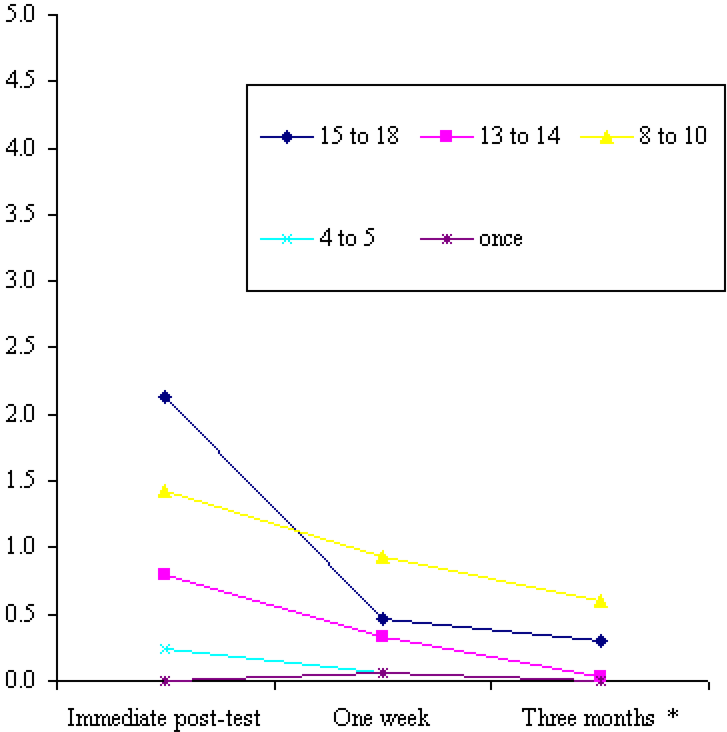
This study examined the rate at which vocabulary was learned from reading the 400 headword graded reader A Little Princess. To ascertain whether words of different frequency of occurrence rates were more likely to be learned and retained or forgotten, 25 words within five bands of differing frequency of occurrence (15 to 18 times to those appearing only once) were selected. The spelling of each word was changed to ensure that each test item was unknown to the 15 intermediate level (or above) female Japanese subjects. Three tests (word-form recognition, prompted meaning recognition and unprompted meaning recognition) were administered immediately after reading, after one week and after a three month delay. The results show that words can be learned incidentally but that most of the words were not learned. More frequent words were more likely to be learned and were more resistant to decay. The data suggest that, on average, the meaning of only one of the 25 items will be remembered after three months, and the meaning of none of the items that were met fewer than eight times will be remembered three months later. The data thus suggest that very little new vocabulary is retained from reading one graded reader, and that a massive amount of graded reading is needed to build new vocabulary. It is suggested that the benefits of reading a graded reader should not only be assessed by researching vocabulary gains and retention, but by looking at how graded readers help develop and enrich already known vocabulary.
Overview
CoChat Summary
## TL;DR
This experiment tested whether Japanese university women could learn substitute vocabulary from reading one 400-headword graded reader, with tests immediately, after one week, and after three months. The main finding was that some words were learned incidentally, but most were not retained, and learning was much better for higher-frequency items than for low-frequency ones.
## Key findings
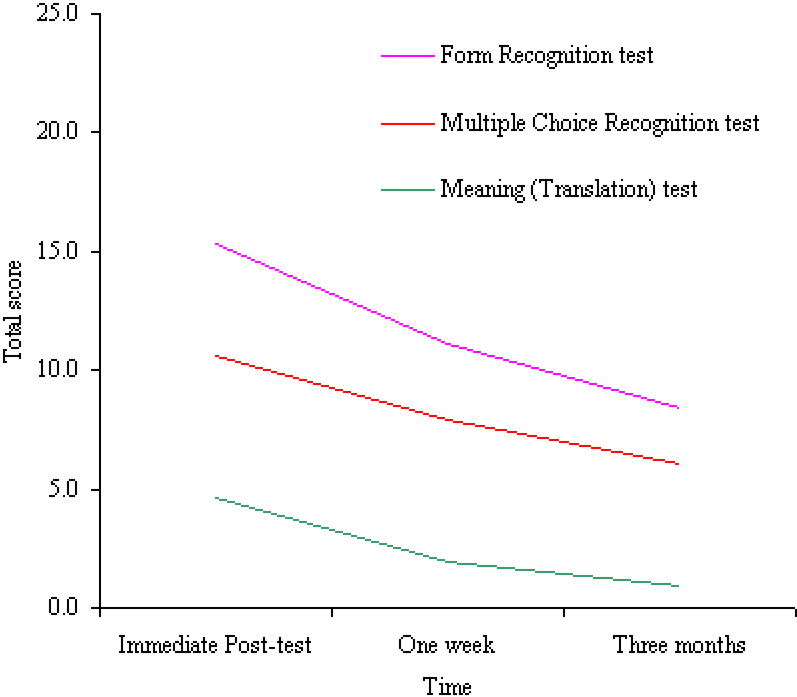
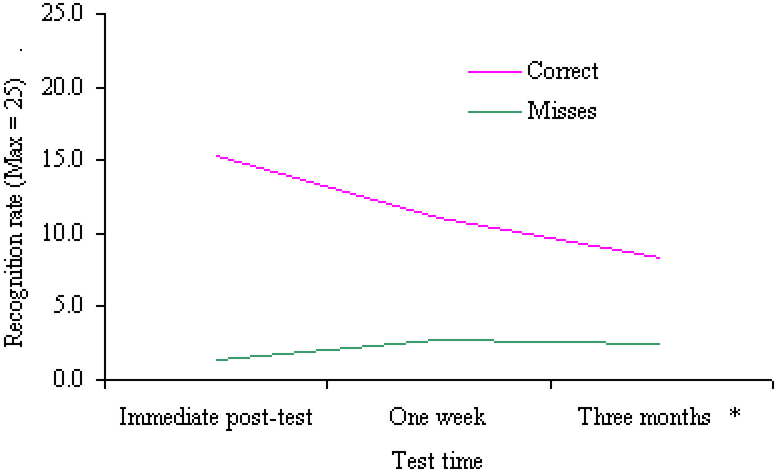
- On the word-form recognition test, mean scores fell from 15.3/25 immediately after reading to 11.1/25 after one week and 8.4/25 after three months; incorrect selections rose from 1.3 to 2.8 to 2.4.
- On the multiple-choice recognition test, mean scores declined from 10.6/25 immediately to 7.9/25 after one week and 6.1/25 after three months.
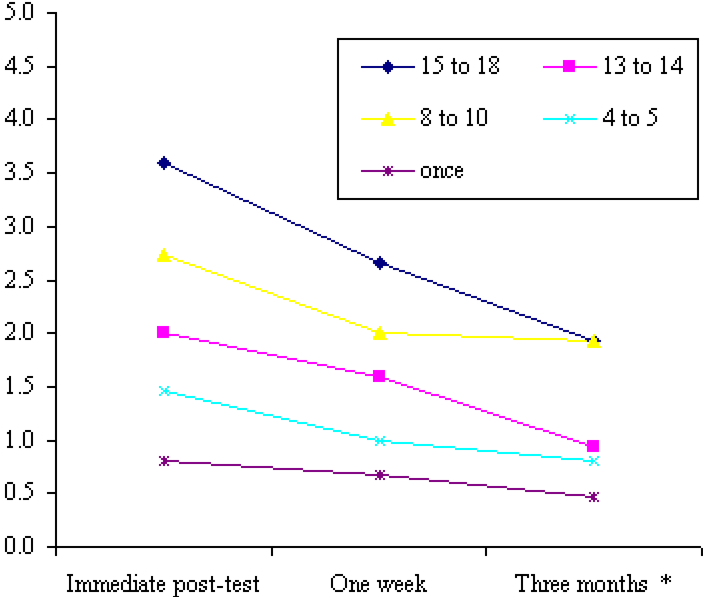
- On the meaning (translation) test, mean scores dropped from 4.6/25 immediately to 1.9/25 after one week and 0.9/25 after three months; the paper states this means about one new word from one hour of reading was retained after three months.
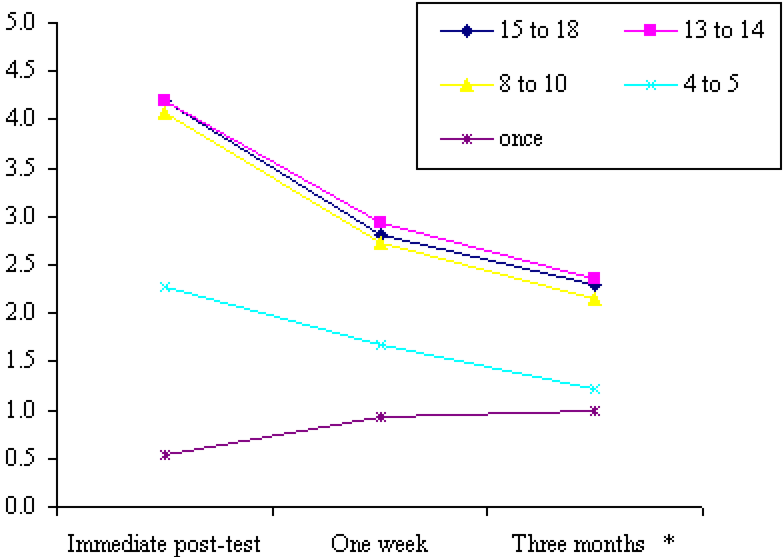
- Frequency mattered: words met 15–18 times were learned and retained more often, while words met fewer than 8 times were near zero on the translation test; the paper states that words met fewer than 8 times had 0 chance of being remembered three months later.
- The paper reports significant differences among test types at the immediate post-test (F = 17.11, p < .001) and significant declines over time for each test: word-form recognition (F = 35.45, p < .001), multiple-choice (F = 22.00, p < .001), and translation (F = 15.41, p = .002).
## Methods
- Design: 15 Japanese female university students read one graded reader, *A Little Princess*, with 25 substitute words embedded at different occurrence frequencies; vocabulary was tested immediately, after one week, and after three months.
- Sample and materials: Participants were 19–21 years old, lower-intermediate or above, mostly English Club members; the text contained 5,872 words, and the study used three test formats: word-form recognition, multiple-choice recognition, and meaning translation.
- Analysis: Scores were summarized by test and by occurrence frequency; the paper reports repeated measures ANOVAs and compares retention/decay across test types and frequency bands.
## Limitations
- The paper explicitly says there were relatively few subjects and that a larger sample would be better to show frequency effects more clearly.
- It says only 5,872 words were read, so a longer text or multiple texts would be better for judging vocabulary learning from reading.
- It also says the study would be stronger with texts containing a better variety of word frequencies so that all test words are equally guessable.
- Evident from the text: the study used one graded reader only, so the findings may not generalize to broader reading conditions or to other texts.
Model-written summary. Check it against the paper before relying on it.
Integrity signals
Registry
Cites
Statistics
Figures
Verification
Claims the paper makes
1 Valid · 4 Not valid · 13 Not checked · 162 Own results and interpretations
The cited sources support only part of this claim — read each source’s verdict below.
In the paper
“Secondly, learners need to meet an unknown word many times before it is learned (Nagy, Herman and Anderson, 1985; Nagy, Anderson and Herman, 1987; Shu, Anderson and Zhang, 1995; Nation 2001: 237).”
What the sources say
- Partly supportedcites Nagy, Herman and Anderson, 1985 matched to “Learning Words from Context” (1985) sourceExperimental — accuracy not yet measured
The ‘Learning Words from Context’ section says that full knowledge seldom follows one encounter and that word learning often proceeds in small increments. But the Conclusion reports unmistakable learning from one or very few encounters. The claim omits the distinction between beginning to learn a word and learning its full meaning, making repeated encounters sound necessary for any learning. (LLM, conf=0.87)
- Not checked — no full text of the sourcecites Nagy, Anderson and Herman, 1987 matched to “Learning Word Meanings From Context During Normal Reading” (1987) source
- Not checked — no full text of the sourcecites Nation 2001: 237 matched to “Learning Vocabulary in Another Language” (2001) source
plainstates a cause- Asserted: passes — The authors put it forward as true.
- Checkable: passes — It can be checked against evidence.
- Load-bearing: passes — The paper’s conclusions depend on it.
- Based: passes — The paper gives a reason why it holds.
- Partly supported
A result the paper reports from its own data — it cites no other source for it, so there is none to check. The quote shows it is in the paper.
In the paper
“More frequent words were more likely to be learned and were more resistant to decay.”
hedgedstates an association- Asserted: passes — The authors put it forward as true.
- Checkable: passes — It can be checked against evidence.
- Load-bearing: passes — The paper’s conclusions depend on it.
- Based: passes — The paper gives a reason why it holds.
A result the paper reports from its own data — it cites no other source for it, so there is none to check. The quote shows it is in the paper.
In the paper
“The results show that words can be learned incidentally but that most of the words were not learned.”
plainstates a cause- Asserted: passes — The authors put it forward as true.
- Checkable: passes — It can be checked against evidence.
- Load-bearing: passes — The paper’s conclusions depend on it.
- Based: passes — The paper gives a reason why it holds.
A result the paper reports from its own data — it cites no other source for it, so there is none to check. The quote shows it is in the paper.
In the paper
“More frequent words were more likely to be learned and were more resistant to decay.”
hedgedstates an association- Asserted: passes — The authors put it forward as true.
- Checkable: passes — It can be checked against evidence.
- Load-bearing: passes — The paper’s conclusions depend on it.
- Based: passes — The paper gives a reason why it holds.
A result the paper reports from its own data — it cites no other source for it, so there is none to check. The quote shows it is in the paper.
In the paper
“The data suggest that, on average, the meaning of only one of the 25 items will be remembered after three months”
hedged- Asserted: passes — The authors put it forward as true.
- Checkable: passes — It can be checked against evidence.
- Load-bearing: passes — The paper’s conclusions depend on it.
- Based: passes — The paper gives a reason why it holds.
- Rests on 2 assumptions not shown here.
78 more claims
Create a free account to see all 180 claims and to verify the 1 reference still open.
- Probably not a substantial claim. 60
- The quote only partly states this claim. 9
- It may state two separate claims as one. 50
Claims other papers make about this one
Each is checked against this paper’s own text: does it say what the citing paper says it does?
The source backs part of the claim, not all of it — or backs it for a different population, condition or comparison.
In the citing paper
“the Waring and Takaki (2003) study showed that in approximately 56 minutes of meaning-focused reading of a graded reader, four words were learned reasonably well, and another 12 were partially learnt.”
From The Four Strands (2007) · cites this paper as Waring and Takaki (2003)
Experimental — accuracy not yet measuredThe source backs part of the claim, not all of it — or backs it for a different population, condition or comparison.
In the citing paper
“Gi v en the same amount of time, deliberate language-focused learning acti v ities result in more learning than the incidental learning from meaning-focused acti v ities.”
From The Four Strands (2007) · cites this paper as Waring and Takaki (2003)
Experimental — accuracy not yet measuredThe cited source says what the claim attributes to it.
In the citing paper
“This study showed that small amounts of learning of v arious strengths occurred incidentally as a result of meaning-focused reading.”
From The Four Strands (2007) · cites this paper as Waring and Takaki's (2003)
In the citing paper
“In a similar study conducted by Waring and Takaki (2003), a multiple-choice, immediate posttest measure indicated that of 25 new words available for learning in the graded reader A Little Princess, 11 words were learned (as measured by success on these tests), a gain of 42%.”
From Incidental vocabulary acquisition from reading, reading-while-listening, and listening to stories (2008) · cites this paper as Waring and Takaki, 2003
In the citing paper
“Their results showed that incidental vocabulary learning from reading occurred at several levels and the gain scores depended on the test type, but not much new vocabulary was learned.”
From Incidental vocabulary acquisition from reading, reading-while-listening, and listening to stories (2008) · cites this paper as Waring and Takaki, 2003
2 more claims about this paper
Create a free account to see every claim other papers make about this one.
Citations
Cites
Learning Vocabulary in Another Language
Nation, I. S. P. (2001) · Cambridge University Press · doi:10.1017/cbo9781139524759 · Cited by 6,608
The Role of Consciousness in Second Language Learning1
SCHMIDT, R. W. (1990) · Applied Linguistics · doi:10.1093/applin/11.2.129 · Cited by 5,435 · cited 1×
“Some recent research has suggested the noticing of a form is an essential step in word learning (Schmidt, 1990).”
BackgroundExtensive Reading in the Second Language Classroom
Day, R. R., Bamford, J., Renandya, W. A., Jacobs, G. M., & Yu, V. W.-S. (1998) · RELC Journal · doi:10.1177/003368829802900211 · Cited by 1,276 · cited 1×
“As has been mentioned elsewhere, vocabulary growth is not the main aim of graded or extensive reading (e.g., Day and Bamford, 1998, 2002; Waring, 1997; Waring and Takahashi, 2000; Prowse, 2002).”
BackgroundNagy, W. E., Herman, P. A., & Anderson, R. C. (1985) · Reading Research Quarterly · doi:10.2307/747758 · Cited by 1,249
The Power of Reading: Insights from the Research
Barnett, M. A., & Krashen, S. (1994) · The Modern Language Journal · doi:10.2307/330145 · Cited by 792 · cited 4×
“Krashen (1993) 42 ESL learners 15 page of text French text plus watched a video Multiple-choice 6.6 words above controls”
InfluentialLearning Word Meanings From Context During Normal Reading
Nagy, W. E., Anderson, R. C., & Herman, P. A. (1987) · American Educational Research Journal · doi:10.3102/00028312024002237 · Cited by 757 · cited 1×
“Secondly, learners need to meet an unknown word many times before it is learned (Nagy, Herman and Anderson, 1985; Nagy, Anderson and Herman, 1987; Shu, Anderson and Zhang, 1995; Nation 2001: 237).”
BackgroundAssessing Second Language Vocabulary Knowledge: Depth Versus Breadth
Wesche, M., & Paribakht, T. S. (1996) · The Canadian Modern Language Review · doi:10.3138/cmlr.53.1.13 · Cited by 673 · cited 1×
“The complications associated with multiple-choice tests as accurate measures of word knowledge are legion and well documented elsewhere (e.g., Anderson and Freebody, 1981; Meara and Buxton, 1987; Wesche and Paribakht, 1996; Waring, 1999).”
BackgroundUnknown vocabulary density and reading comprehension
Hu, M., & Nation, P. (2020) · doi:10.26686/wgtn.12560354.v1 · Cited by 650
Beyond a Clockwork Orange: Acquiring second language vocabulary through reading
Horst, M., Cobb, T., & Meara, P. (1998) · Reading in a Foreign Language · doi:10.64152/10125/66953 · Cited by 565 · cited 1×
“Horst, Cobb and Meara (1998) also point out that some of the incidental learning from exposure experiments are "methodologically flawed" (1998: 210).”
BackgroundRetention of Inferred and Given Word Meanings: Experiments in Incidental Vocabulary Learning
Hulstijn, J. H. (1992) · Vocabulary and Applied Linguistics · doi:10.1007/978-1-349-12396-4_11 · Cited by 497 · cited 1×
“(scores above controls who did not see the text) Dupuy and Krashen (1993) 42 ESL learners 15 page of text French text plus watched a video Multiple-choice 6.6 words above controls Hulstijn (1992) 65 EFL learners 907 words Advertisement in Dutch State the meaning of 12 words 1 of 13 words (7.6”
BackgroundInfluential
Research works printed but not linked: 6
- Anderson, R. C. and Freebody, P. (1981). Reading comprehension and the assessment and acquisition of word knowledge. In J. Guthrie (Ed.), Comprehension and teaching (pp. 77-117). Newark, Delaware: International Reading Association.
- Burnett, F. H. retold by J. Bassett. (1991). A little princess . Oxford: Oxford University Press.
- Waring, R. (Ed.). (1997). Special edition on extensive reading. The Language Teacher, 21.
- Waring, R. (1999). Tasks for assessing receptive and productive second language vocabulary . Ph.D. Thesis. University of Wales, Swansea. http://www1.harenet.ne.jp/~waring/papers/phd/title.html
- Waring, R. & Takahashi, S. (2000). The Oxford University Press guide to the 'why and 'how' of using graded readers . Tokyo: Oxford University Press.
- Wesche, M. & Paribakht, T. (1996). Assessing vocabulary knowledge: Depth vs. breadth. Canadian Modern Language Review , 53, 13-40.
Cited by
Items 301–400 of 535
Effects of L1 and L2 word-level vs. L2 sentence-level glosses on vocabulary learning
Rassaei, E., & Folse, K. S. (2024) · System · doi:10.1016/j.system.2024.103273 · Cited by 10
Intentional vs. Incidental vocabulary learning & Iranian EFL Learners’ Retention
shahpari, N., Shamshiri, H. R., & Rashidi, N. (2014) · Cited by 5
Teng, M. F. (2015) · doi:10.6294/eagle.2015.0102.03 · Cited by 11
Ma, T., Chen, R., Dunlap, S., & Chen, B. (2016) · Frontiers in Psychology · doi:10.3389/fpsyg.2016.01396 · Cited by 8
“…times and second language word learning found that with increased encounters, word learning increased Frontiers in Psychology | www.frontiersin.org 5 September 2016 | Volume 7 | Article 1396 (Waring and Takaki, 2003; Tekmen and Daloǧlu, 2006; Webb, 2008; Pellicer-Sánchez and Schmitt, 2010).”
BackgroundInfluentialIncidental L2 Vocabulary Acquisition and Reading: Concerns, Progresses and Future Directions
Wang, Q. (2020) · Chinese Journal of Applied Linguistics · doi:10.1515/cjal-2020-0031 · Cited by 8
“Evidence has been accumulating to demonstrate that reading is a major contributor to 469 acquiring vocabulary knowledge for L2 learners (Chun, Choi, & Kim, 2012; Krashen, 1989, 2008; McQuillan & Krashen, 2008; Nagy, 1997; Nation & Wang, 1999; Waring & Takaki, 2003).”
BackgroundInfluentialThe Relationship Between Incidental Vocabulary Learning and Extensive Listening to Podcasts
(2023) · International Journal of TESOL Studies · doi:10.58304/ijts.20230207 · Cited by 10
“The number of repetitions needed to acquire a word ranges from 5-16 (Cobb & Meara, 1998; Nation, 1999; Webb & Chang, 2015; Webb, 2007; Horst, 2005) to even 20 (Waring & Takaki, 2003).”
The Effect of Task-Based Reading on Fl Vocabulary Learning
Mesa, R. E., Bruton, A., & Ridgway, T. (2007) · ITL Review of Applied Linguistics · doi:10.2143/itl.153.0.2022819 · Cited by 4
Reading and Vocabulary Acquisition
Daskalovska, N. (2014) · Goce Delchev University Repository (Goce Delčev University of Štip) · Cited by 8
Ewert, D. E. (2012) · Cited by 6
Building Fluency with Extensive Reading
Waring, R. (2014) · Palgrave Macmillan UK eBooks · doi:10.1057/9781137449405_13 · Cited by 14
Self-citationRevisiting the extensive reading effect on TOEFL scores
Williams, D. (2008) · Cited by 4
The Effect of Group Work on English Vocabulary Learning
Lin, S.-F. (2018) · Journal of Education and Learning · doi:10.5539/jel.v7n4p163 · Cited by 19
“Studies have however found limited vocabulary learning through meaning-focused reading (Horst, Cobb and Meara, 1998; Waring and Takaki, 2003; Rosszell, 2007).”
BackgroundWebb, S. (2018) · Wiley eBooks · doi:10.1002/9781119261650.ch21 · Cited by 7
You, C., Wang, Y., Li, P., Zhao, X., Lu, H., Wang, X., Yao, Y., & Chen, W. (2026) · Electronics · doi:10.3390/electronics15030660 · Cited by 4
Learning Grammar and Vocabulary through Reading: A Case Study
Daskalovska, N. (2014) · International Journal of Sciences: Basic and Applied Research · Cited by 6
Bilingual word learning: Recognizing novel words in context
Lauro, J. G., Toassi, P. F. P., & Fontes, A. B. A. D. L. (2025) · Learning and Instruction · doi:10.1016/j.learninstruc.2025.102230 · Cited by 5
Ángel, R. D. (2014) · The reading matrix · Cited by 4
Lee, S. (2015) · STEM Journal · doi:10.16875/stem.2015.16.1.23 · Cited by 3
The Impact of Extensive Reading on Learning and Increasing Vocabulary at Elementary Level
Iqbal, S. A. (2017) · Studies in English Language Teaching · doi:10.22158/selt.v5n3p481 · Cited by 11
“Following Waring and Takaki (2003) and Brown et al. (2008), in order for the test to be reliable, 25 words from the graded readers were selected 485 Published by SCHOLINK INC. as test items in each test type.”
MethodGentry, J. E., & Lindsey, P. (2008) · Journal of the American Academy of Special Education Professionals · doi:10.64546/jaasep.53 · Cited by 3
“Limited English proficiency students (LEP) also encounter similar language learning problems, especially, in the single most important area of language development—vocabulary acquisition (Hardman, Drew, and Egan, 2005; Pikulski and Templeton, 2004; Schmitt and McCarthy, 1997; Waring and Takaki, 2003).”
Pedagojik Bakımdan Arapça Okuma Dil Becerisinde Materyal Tasarımı
KILIÇ, R. (2019) · ARTUKLU AKADEMİ · doi:10.34247/artukluakademi.551118 · Cited by 3
Using Technologies to Foster the Reading Habit in L2 (English)
Mateo, R. M., & Chicote-Beato, M. (2021) · Human Language Rights and Security · doi:10.22363/2713-0614-2021-1-1-72-97 · Cited by 6
Tadayonifar, M., Entezari, M., & Valızadeh, M. (2021) · Journal of language and Education · doi:10.17323/jle.2021.11020 · Cited by 7
“Language researchers have proposed extensive reading as an effective way to acquire a large vocabulary repertoire (Pitts, White, & Krashen, 1989; Waring & Takaki, 2003).”
BackgroundExamining incidental vocabulary acquisition from captioned video: Does test modality matter?
Jelani, N. A. M., & Boers, F. (2020) · Benjamins Current Topics · doi:10.1075/bct.109.itl.00011.jel · Cited by 4
Hatami, S. (2017) · Vocabulary Learning and Instruction · doi:10.7820/vli.v06.1.hatami · Cited by 5
Tağa, T., & Kalenderoğlu, İ. (2022) · International Journal of Education and Literacy Studies · doi:10.7575/aiac.ijels.v.10n.4p.81 · Cited by 4
“At the same time, it can be thought that the immediate test results do not reflect the actual situation of the students, and they overestimate the students’ vocabulary (Waring & Takaki, 2003).”
BackgroundIncidental vocabulary acquisition from documentary viewing: A study on the role of captions
Durbahn, M. (2019) · Arboles y Rizomas · doi:10.35588/ayr.v1i1.3776 · Cited by 6
“…incidentally from reading (Brown, Waring, & Donkaewbua, 2008; Pellicer-Sánchez & Schmitt, 2010; Pigada & Schmitt, 2006; Rott, 1999; Vidal, 2011; Waring & Takaki, 2003; Webb, 2007), listening (Brown, et al., 2008; van Zeeland & Schmitt, 2013; Vidal, 2003, 2011), reading-while-listening (Brown,…”
Proposing an E-Learning System for Personalized EFL Vocabulary Learning
Wang, Y. H. (2014) · International Symposium on Computer, Consumer and Control · doi:10.1109/is3c.2014.299 · Cited by 4
“[1], [7], [11], [16], [20], [21], [22], [23]) to positively affect the small, gradual increments of”
BackgroundThree factors in vocabulary acquisition in a university French immersion adjunct context
Bürger, S., & Weinberg, A. (2014) · Journal of Immersion and Content-Based Language Education · doi:10.1075/jicb.2.1.02bur · Cited by 4
Raising Cultural Awareness through Implicit Exposure to Culturally-loaded Vocabulary
Heidari‐Shahreza, M. A. (2014) · International Journal of Culture and History · doi:10.5296/ijch.v1i2.5824 · Cited by 4
“Likewise, Waring and Takaki (2003), Pigada and Schmit (2006), and Brown, Waring and Donkaewbua (2008) investigated the possible effects of exposure frequency within the perspective of implicit vocabulary acquisition.”
BackgroundThe Challenge of Learning to Listen: From the Perspective of Flow Theory
木村, 春. (2008) · 研究年報 · doi:10.15012/00000543 · Cited by 5
ARAPÇADAN TÜRKÇEYE ÖDÜNÇLENEN KELİMELERİN ARAPÇA KELİMELERİ ANLAYIP EZBERLEMEDE ETKİSİ
KILIÇ, R. (2019) · Abant İzzet Baysal Üniversitesi İlahiyat Fakültesi Dergisi · doi:10.33931/abuifd.518231 · Cited by 3
CLAUSE TYPE AND WORD SALIENCY IN SECOND LANGUAGE INCIDENTAL VOCABULARY ACQUISITION
Watts, M. L. (2008) · The reading matrix · Cited by 6
Gülşen, E., & Mede, E. (2019) · Elt research journal · Cited by 7
Predictores de la competencia léxica del futuro profesorado
Díaz, I. C. S., Ibáñez, E. T., & Oliva, M. F. R. (2021) · Estudios filológicos · doi:10.4067/s0071-17132021000100223 · Cited by 11
Sasao, Y. (2013) · Open Access Victoria University of Wellington | Te Herenga Waka (Figshare) · doi:10.26686/wgtn.17011511 · Cited by 23
“…L1 acquisition (Jenkins, Stein, & Wysocki, 1984; Nagy, Anderson, & Herman, 1987; Nagy, et al., 1985; Shu, Anderson, & Zhang, 1995) and L2 acquisition (Brown, et al., 2008; Day, et al., 1991; Dupuy & Krashen, 1993; Horst, et al., 1998; Hulstijn, 1992; Pitts, et al., 1989; Waring & Takaki, 2003).”
Wei, R., & Hu, D. (2025) · SAGE Open · doi:10.1177/21582440251334243 · Cited by 10
“Early research predominantly focused on vocabulary learning through reading (e.g., Chen & Truscott, 2010; Waring & Takaki, 2003; Webb, 2007).”
How Much Should I Read? An Analysis of Word Learning Opportunities in Children's Novels
Wang, Z., O’Reilly, T., Flor, M., Klebanov, B. B., & Bruce, K. (2025) · Reading Research Quarterly · doi:10.1002/rrq.70025 · Cited by 2
Ding, C., & Reynolds, B. L. (2026) · IRAL - International Review of Applied Linguistics in Language Teaching · doi:10.1515/iral-2025-0020 · Cited by 2
“…been a prominent area of research, particularly in Western contexts (Chandy et al. 2024; Elgort and Warren 2014; Godfroid et al. 2018; Horst 2005; Horst et al. 1998; Krashen 1985; Lim and Lee 2025; Pigada and Schmitt 2006; Puim ė ge et al. 2025; Vu and Peters 2022, 2023; Waring and Takaki 2003).”
Yamagata, S., & Yoshida, H. (2015) · Theory and Practice in Language Studies · doi:10.17507/tpls.0504.02 · Cited by 3
Unraveling the Affordances of 'Silas Marner' in a Japanese University EFL Context
Canning, N. A., & Nelson, M. E. (2018) · L2 Journal · doi:10.5070/l210235419 · Cited by 3
“The work of Waring and Takaki (2003), for instance, points to the lack of convincing evidence that regular graded reading positively affects incidental vocabulary acquisition.”
BackgroundAn Analysis of Japanese EFL Learners’ Lexical Network Changes
Aotani, N., & Takahashi, S. (2021) · Frontiers in Education · doi:10.3389/feduc.2020.621437 · Cited by 5
“…whether learning of second language vocabulary could be sufficiently accomplished by extensive reading (Horst et al., 1998; Hulstijn and Laufer, 2001; Laufer and Hulstijn, 2001; Waring and Takaki, 2003; Krashen, 2004; Pagata and Schmitt, 2006; Cobb, 2007; McQuillan and Krashen, 2008;Webb, 2008).”
BackgroundEnhancing EFL Learners’ Reading Vocabulary Acquisition through Task-Based Instruction
Ramadhan, G. R., Saukah, A., & Andreani, S. (2021) · JoLLA Journal of Language Literature and Arts · doi:10.17977/um064v1i22021p221-238 · Cited by 10
“Waring and Takaki (2003) showed that a context helps students to study words, but it is more effective to encounter the words numerous times.”
BackgroundInfluentialFostering Cultural Understanding Through Vocabulary: The Case of Graded Readers
Ponte, M. D. C. (2023) · International Journal of TESOL Studies · doi:10.58304/ijts.20230204 · Cited by 7
“In turn, reading can contribute to vocabulary growth (Nation, 2001, Waring & Takaki, 2003).”
West, J. (2017) · Journal of Education and Training Studies · doi:10.11114/jets.v5i10.2588 · Cited by 3
“…learning) is utilised for vocabulary acquisition, results of various other studies (Brown, Waring, & Donkaewbua, 2008: p. 156; Horst, 2005: p. 373; Kilian et al., 1995: p. 12; Mirzaii, 2012: p. 10; Senoo & Yonemoto, 2014: p. 16; Waring & Takaki, 2003: p. 153) have found encouraging results.”
Lindert, E. L.-T., van der Knaap, E., & de Graaff, R. (2018) · Deutsch als Fremdsprache · doi:10.37307/j.2198-2430.2018.03.05 · Cited by 2
Ansarin, A. A., Hadidi, Y., & Khabbazi, S. K. (2021) · The Journal of AsiaTEFL · doi:10.18823/asiatefl.2021.18.1.5.76 · Cited by 2
“…learning was the repeated findings that learners guess the meanings of the new words through the context more easily, as well as the fact that incidental vocabulary learning has been argued to motivate learners for extensive reading (Choi, 2016; Chun, Choi, & Kim, 2012; Waring & Takaki, 2003).”
BackgroundSerial Position Effects and Forgetting Curves: Implications in Word Memorization
Zhang, G. (2014) · Studies in English Language Teaching · doi:10.22158/selt.v2n3p306 · Cited by 2
“Waring & Takaki (2003) speculated that it might take between 25-30 encounters to acquire new vocabulary.”
BackgroundListening to Learn: Boosting Vocabulary with Interactive Activities.
Cohen, J. (2008) · Cited by 3
Is Incidental Vocabulary Acquisition Feasible to EFL Learning?
Jian-ping, L. (2013) · English Language Teaching · doi:10.5539/elt.v6n10p245 · Cited by 2
“The average is 10 times (Saragi, Nation & Meister, 1978), and at least 8 times is needed (Horst, Cobb & Meara, 1998; Waring & Takaki, 2003).”
BackgroundExtensive Listening in a Self-access Learning Environment
Ewert, D. E., & Mahan, R. (2011) · Cited by 5
Sun, Y. (2016) · The reading matrix · Cited by 4
schmidt, D. (2016) · Himalayan Linguistics · doi:10.5070/h915129783 · Cited by 4
Sánchez‐Gutiérrez, C., & Mella, M. S. (2017) · Journal of Spanish Language Teaching · doi:10.1080/23247797.2017.1315262 · Cited by 6
Wang, Q. (2019) · The Journal of AsiaTEFL · doi:10.18823/asiatefl.2019.16.4.9.1201 · Cited by 7
Leveraging Spanish knowledge and cognitive aptitude in Portuguese learning
Bonilla, C. L., Golonka, E., Pandža, N. B., Linck, J. A., Michael, E. B., Clark, M., Lancaster, A., & Richardson, D. L. (2020) · Issues in Hispanic and Lusophone linguistics · doi:10.1075/ihll.24.08bon · Cited by 3
Comparing L2 Incidental Vocabulary Learning Through Viewing, Listening, and Reading
Aldukhayel, D. (2022) · Journal of Language Teaching and Research · doi:10.17507/jltr.1303.15 · Cited by 3
“Whereas the impact of reading on L2 vocabulary learning has been empirically established (e.g., Pellicer-Sanchez & Schmitt, 2010; Waring & Takaki, 2003), more research efforts are still needed to show the impact of other modes of input on vocabulary acquisition.”
BackgroundInfluentialVocabulary in digital science resources for middle school learners
Arndt, R. (2022) · Applied Corpus Linguistics · doi:10.1016/j.acorp.2022.100023 · Cited by 7
Vocabulary Learning Strategies Used by Class Ten Students
Tiwari, H. P. (2023) · Nepal Journal of Multidisciplinary Research · doi:10.3126/njmr.v6i3.59019 · Cited by 5
“Active listening in the classroom, a prevalent strategy among participants, aligns with the well-documented importance of classroom-based instruction in vocabulary acquisition (Waring & Takaki, 2003).”
BackgroundIncidental Learning of Japanese through Reading Online, in Print, and in Digital Games
Peterson, J. (2016) · ScholarsArchive (Brigham Young University) · Cited by 2
Chou, I.-C. (2018) · International Journal of Education and Literacy Studies · doi:10.7575/aiac.ijels.v.6n.1p.17 · Cited by 4
“…conventionally considered more effective than implicit instruction directed toward ELL students Incidental vocabulary acquisition occurs only after repeated exposure and results in relatively small gains in the L2 learning (Marzba & Kamalian, 2013; Rott, 1999; Waring & Takaki, 2003, Nation, 2001).”
BackgroundReading a whole book to learn vocabulary
Nation, P. (2020) · Benjamins current topics · doi:10.1075/bct.109.itl.00005.nat · Cited by 3
Hsu, W. (2021) · JET (Journal of English Teaching) · doi:10.33541/jet.v7i3.3118 · Cited by 1
“On the contrary, Waring and Takaki (2003) maintained that a minimum of 20 repetitions would be necessary for incidental learning.”
BackgroundApproaches to Teaching Second Language Words
Sonbul, S. (2026) · Wiley eBooks · doi:10.1002/9781405198431.wbeal0034 · Cited by 2
Izaks, J. N. (2015) · Unisa Institutional Repository (University of South Africa) · Cited by 3
Extensive reading in a second language : literature review and pedagogical implications
Hong, S. (2014) · Texas ScholarWorks (Texas Digital Library) · Cited by 2
The Impact of Unfamiliar Proper Names on ESL Learners' Listening Comprehension
Kobeleva, P. P. (2008) · Open Access Victoria University of Wellington | Te Herenga Waka (Figshare) · doi:10.26686/wgtn.16945726.v1 · Cited by 34
Incidental Phrasal Verb Acquisition through Second Language Reading
Hare, A. J. (2010) · Spectrum Research Repository (Concordia University) · Cited by 3
Incidental acquisition of foreign language vocabulary through multi-modal situations
Bisson, M. (2013) · Nottingham ePrints (University of Nottingham) · Cited by 5
Golebiewska, P. (2013) · CLOK (University of Central Lancashire) · Cited by 2
Benson, S. (2020) · Open Access Victoria University of Wellington | Te Herenga Waka (Figshare) · doi:10.26686/wgtn.17145713.v1 · Cited by 3
Teng, M. F. (2022) · PsyArXiv (OSF Preprints) · doi:10.31234/osf.io/acqfm · Cited by 2
Vocabulary networks workshop 2: Activating words in a network
Meara, P. M., & Miralpeix, I. (2022) · Vocabulary Learning and Instruction · doi:10.7820/vli.v11.1.meara2 · Cited by 1
Yuan, X., & Tang, X. (2025) · System · doi:10.1016/j.system.2025.103641 · Cited by 1
Pu, P., Chang, D. Y., & Wang, S. (2025) · International Journal of Applied Linguistics · doi:10.1111/ijal.12828 · Cited by 6
Incidental learning of English derivational noun suffixes through reading: an eye-tracking study
Shi, J., Reynolds, B. L., & Rusk, B. V. (2025) · Applied Psycholinguistics · doi:10.1017/s0142716425100131 · Cited by 2
“This finding aligns with previous L2 vocabulary studies, which have found that eight exposures to a new word are generally sufficient for incidental learning (Horst et al., 1998; Waring & Takaki, 2003; Pellicer-Sánchez, 2016).”
InfluentialLexical Syllabus in Elementary and Secondary Education: Construction and Implementation
Laufer, B. (2026) · TESOL Quarterly · doi:10.1002/tesq.70195 · Cited by 1
Pedagogical Implications of Teaching English Collocations to Korean EFL Learners
Nam, H. (2013) · Studies in English Education · Cited by 2
Estudio empírico sobre la incidencia del léxico en la comprensión de la lengua extranjera
Cecilia, R. R. (2013) · RLA. Revista de lingüística teórica y aplicada · doi:10.4067/s0718-48832013000200006 · Cited by 3
Malmström, H. (2014) · International Journal of Listening · doi:10.1080/10904018.2014.880928 · Cited by 2
“…2,000 level, could cause NNSLs comprehension problems when listening to Bible readings and preaching simply because NNSLs are less likely to have been exposed to infrequent words than frequent words and exposure to an unknown word is crucial for comprehension (Schmitt, 2000; Waring & Takaki, 2003).”
BackgroundMármol, G. A. (2012) · Porta Linguarum Revista Interuniversitaria de Didáctica de las Lenguas Extranjeras · doi:10.30827/digibug.14964 · Cited by 5
“Some authors (Waring and Takaki 2003; Pigada and Schmitt 2006) go even further by suggesting that it takes at least 20 occurrences for a word to become noticeable to a learner.”
BackgroundA Strategy-based Scheme for Promoting Vocabulary Retention among Language Learners
Nemati, A. (2009) · Cited by 1
Incidental Vocabulary Acquisition from Pleasure Reading
Strong, B., & Boutorwick, T. (2012) · Cited by 1
The Impact of Extensive Reading on Remedial Students
Takase, A., & Otsuki, K. (2011) · 近畿大学教養・外国語教育センター紀要. 外国語編 · Cited by 1
김부자 (2009) · The Jungang Journal of English Language and Literature · doi:10.18853/jjell.2009.51.4.006 · Cited by 1
Multilingual learners: Vocabulary and beyond
Geva, E., & Fraser, C. (2017) · Cited by 2
Reading Attitude and L2 Extensive Reading
Tanemura, S. (2020) · doi:10.32234/jacetjournal.64.0_149 · Cited by 5
What Does It Mean to “Know” a Word?
Schmitt, N., & Schmitt, D. (2020) · Cambridge University Press eBooks · doi:10.1017/9781108569057.004 · Cited by 1
Stubbe, R. (2014) · Vocabulary Learning and Instruction · doi:10.7820/vli.v03.1.stubbe · Cited by 4
“A passive recall test was chosen because translation ability is a strong indicator of which words students can actually understand while reading (Waring & Takaki, 2003) and ‘‘asking participants to provide mother-tongue equivalents of the target language words was the most univocal way of verifying…”
BackgroundMethodInfluentialIncidental Vocabulary Learning in a Postcolonial English Second Language Context
Stoffelsma, L., Antwi, V., & Hanson, R. (2024) · Language Matters · doi:10.1080/10228195.2024.2341010 · Cited by 4
Ghorbani, V., & Mamashli, S. (2023) · Journal of Studies in Applied Language · doi:10.61186/jsal.6.4.27 · Cited by 1
Budiartha, C. I. W. E., & Akmar, A. S. M. (2024) · Global Expert Jurnal Bahasa dan Sastra · doi:10.36982/jge.v12i1.4440 · Cited by 8
Kamiński, M. P. (2021) · Terminology and lexicography research and practice · doi:10.1075/tlrp.22.c4 · Cited by 1
Luo, J. (2014) · Journal of Language Teaching and Research · doi:10.4304/jltr.5.5.1192-1197 · Cited by 2
“To pick up a new word from IVA, some scholars (Zahar, Cobb & Spada, 2001) reveal that the word frequency needs from 6 to 20 times’ encountering, and the average is 10 times (Saragi, Nation & Meister, 1978), and 8 times at least is needed (Horst, Cobb & Meara, 1998; Waring & Takaki, 2003).”
BackgroundLiu, Y. (2013) · Asian Social Science · doi:10.5539/ass.v9n10p142 · Cited by 2
“…some confirm the effectiveness of learning through extensive reading (Pellicer-Sánchez & Schmitt, 2010; Kweon & Kim, 2008), but most of them (Waring & Takaki, 2003; Horst et al., 1998; Lahav, 1996; Knight, 1994) show that learners incidentally gain small amounts of vocabulary knowledge from…”
BackgroundCourse and Material Design for Active ESP Journalism English Teaching
Pendery, D. (2015) · Cited by 1
조영아, & 마지현 (2013) · Studies in English Language & Literature · doi:10.21559/aellk.2013.39.1.017 · Cited by 1
Efecto de la enseñanza extensiva en la memorización del léxico: un estudio de investigación-acción
Mella, M. S., & Sánchez‐Gutiérrez, C. (2017) · Sintagma revista de lingüística · doi:10.21001/sintagma.2017.29.04 · Cited by 1
Explicit Teaching and Incidental Learning of Vocabulary: Where Is the Pendulum Swinging to?
Al-Homoud, F. (2019) · International Journal of English Linguistics · doi:10.5539/ijel.v9n6p445 · Cited by 2
“In addition, incidental learning is inclined to long-term retention (Rott, 1999; Sokmen, 1997; Waring & Takaki, 2003).”
BackgroundYabancı Dil Olarak Türkçe Ders Kitaplarında Sözcük Listelerinin Değerlendirilmesi
ZENCİ, S. Ç. (2021) · Karamanoğlu Mehmetbey Üniversitesi Edebiyat Fakültesi Dergisi · doi:10.47948/efad.869597 · Cited by 1
Metadata
- Authors
- Waring, R., & Takaki, M.
- Affiliations
- Notre Dame Seishin University (JP)
- ORCID
- Waring, Rob
- Venue
- Reading in a Foreign Language
- Published
- 2003-10-01
- Volume
- 15
- Issue
- 2
- Pages
- 130-163
- ISSN
- 0264-2425 (ISSN-L)
- 1539-0578
- OpenAlex
- W140060905
- Cited by
- 547
- References
- 28
- Citations by year
- 2026: 16 · 2025: 16 · 2024: 11 · 2023: 18 · 2022: 30 · 2021: 48 · 2020: 58 · 2019: 35 · 2018: 26 · 2017: 31 · 2016: 30 · 2015: 34 · 2014: 45 · 2013: 28 · 2012: 32
- FWCI
- 6.13
- Type
- journal article
- Language
- en
- Open access
- hybrid
- doi.org
- Licence
- Locations
- Reading in a Foreign Language (publishedVersion, cc-by-nc-nd)
- ScholarSpace (University of Hawaii at Manoa) (submittedVersion)
- Reading in a Foreign Language
- Funders
- University of Oxford
- Topics
- Social Sciences › Psychology › Developmental and Educational Psychology › Second Language Acquisition and Learning
- Social Sciences › Psychology › Developmental and Educational Psychology › Reading and Literacy Development
- Social Sciences › Arts and Humanities › Language and Linguistics › EFL/ESL Teaching and Learning
- Keywords
- vocabulary acquisition, vocabulary retention, graded readers, incidental learning, word frequency, Japanese learners of English, A Little Princess, word recognition, meaning recognition
About these checks
Registry, retraction, Cites and statistics results are computed, not judged, with one exception: a printed reference that no index lists is read once by a model before it counts as a citation error. Claims are extracted by a model and kept only when their quote appears verbatim in the text; each cited source is then checked, with a model’s help, for whether it says what the claim relies on. Those verdicts can be wrong — read the claim’s quote and the cited source before relying on one.
The claim verdicts this report counts are experimental: their accuracy is not yet measured.
A language model drew the claims from the paper on 2026-10-10, under version 3 of the claim definition (model deepseek-v4.1-flash, prompt extract-v3).
A second model labelled each claim on 2026-10-10 (model jev-1.13-20260917, definition revision gold-guideline-v0.2).
Cited sources are checked with a language model’s help (gpt-6-sol).
Statistics and arithmetic are recomputed, not judged.
Confidence bands are shown only for fields calibrated on our annotated test set. None is calibrated yet, so no band is shown.
What counts as a claim ›How we measure confidence ›How we check this ›
Are you an author, or do you see a problem with this page? Request a review
Data sources
Bibliographic data: Semantic Scholar, OpenAlex, Crossref.
Contains information from the Semantic Scholar Academic Graph Datasets, made available under the ODC Attribution License (ODC-BY 1.0).
Semantic Scholar’s data is described in: Kinney, R., et al. (2023). The Semantic Scholar Open Data Platform. arXiv:2301.10140.
