

Hashtag usage and user engagement on Instagram: The case of #foodfestivals
Open accessThe DOI matches its Crossref record; 58 of the 58 references it cites were found in a registry or an index; none of the 28 sources its claims cite is checked for support yet.
Abstract
In events and festivals, social media has emerged as a platform for co-creating value and enhancing engagement. In particular, the use of hashtags on social media enhances impressions, raises awareness towards a brand, and helps reach a broader audience. As such, this study aims at uncovering the extent to which hashtags influence user engagement on Instagram. It also provides an overview of how festival experiences are communicated on social media via hashtags. As different types of events and festivals are unique in nature, this study takes food festivals as the research context. Based on Instagram posts captioned with #foodfestivals, collocation analysis, linked analysis, and word trees were applied to visualize hashtag usage. A spearman correlation was conducted to assess the interplay between hashtags and user engagement. The findings reveal sweets and desserts to be the most popular feature, gaining attention for further investigation in food festivals. Furthermore, grounded in the notion of information overload, the findings suggest that the number of hashtags might not necessarily influence user engagement, whereas the length of hashtags and captions seems to have a negative impact on engagement rate. On the whole, this is a cross-disciplinary study that bridges data science, digital marketing, and applied psychology with events and festivals. Although this study is based in the context of food festival, the same notion can be replicated to other types of event. This research highlights the use of hashtags as one of the subtle yet persuasive factors in influencing user engagement when it comes to festival experiences.
Overview
CoChat Summary
TL;DR
This study analyzes 3,669 public Instagram posts captioned #foodfestivals from 2019 to examine how hashtag usage relates to user engagement and how food festival experiences are communicated. It finds sweets/desserts dominate co-hashtags, while number of hashtags is not significantly correlated with engagement, but longer hashtags, captions, and total posts are negatively correlated with engagement rate.
Key findings
- The dataset contained 3,669 public posts published in 2019, with 59,399 hashtags identified; after removing 427 video-posts, the main analysis used 3,248 posts. Voyant Tool identified 55,423 words and 14,236 unique terms.
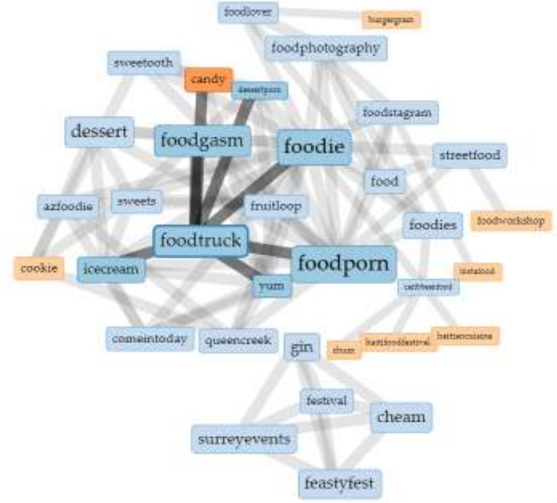
- Top hashtags included #foodie (822), #foodporn (582), #food (532), #foodfest (386), and #foodphotography (381). Collocation analysis showed sweets/desserts as a dominant theme: #foodie co-occurred with #dessert (185), #sweetooth (182), #sweets (181), and #icecream (103); #foodporn co-occurred with #foodphotography (148), #foodgasm (112), #sweetooth (103), #icecream (103), and #dessert (103).
- Posts averaged 15 hashtags (SD=9.36), hashtags averaged 177 characters (SD=113.32), captions without hashtags averaged approximately 236 characters (SD=259.88), and total post length averaged about 412 characters (SD=293.71).
- Spearman correlations found no statistically significant relationship between engagement rate and number of hashtags, r_s(3246) = -.009, p = .594. Engagement rate had a weak negative correlation with hashtag length, r_s(3246) = -.031, p = .011; a negative relationship with caption length without hashtags, r_s(3246) = -.069, p < .000; and a negative relationship with total post length, r_s(3246) = -.087, p < .000.
Methods
- Instagram posts captioned #foodfestivals were crawled with Octoparse; 3,669 public posts published in 2019 were extracted, with data collection in the first week of December 2019 and a second round three weeks later. Synonyms such as #foodfestival or #foodfestival2019 were excluded to avoid duplication, and the study did not differentiate between posts by festivalgoers or event organizers.
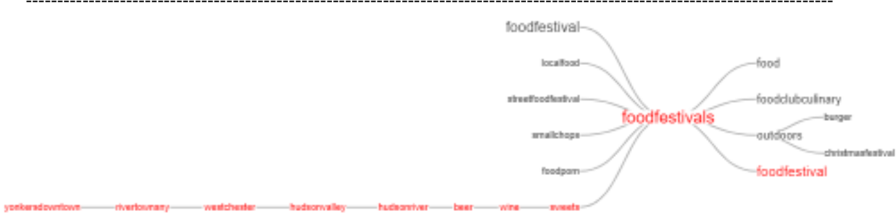
- Non-English and emoji hashtags were removed; the final dataset was imported into Voyant Tool for collocation analysis, linked analysis, and word trees, with #foodfestivals and #foodfestival excluded from analysis.
- Number of hashtags and character counts were calculated in Excel. Engagement rate was computed, as stated in the paper, by taking the number of followers an account has and dividing it by the number of likes from a given post; Spearman correlation was run in SPSS. Video-posts (427) were removed because Instagram does not provide likes for them, leaving 3,248 posts.
Limitations
- The paper states that non-English hashtags were removed, but other English hashtags may be incompatible because they derived from their original language (e.g., pinyin in Chinese or Japanese); it also presumes information overload as one reason for lower engagement and notes that post length is not the only factor influencing user engagement, suggesting future work on text sentiment and pictorial content.
- The paper states that it did not separate business/official accounts and private accounts, and suggests future research could analyze differences between projected and perceived images, potentially using word-embedding techniques to identify business accounts; it also notes that comparison between hashtags in posts and hashtags in comments merits attention, and that methods could be extended to other tourism contexts.
- Evident from the text: the design is cross-sectional and correlational, using one hashtag (#foodfestivals) and one year (2019), so the reported associations cannot establish causality or generalize beyond this sample.
Model-written summary. Check it against the paper before relying on it.
Integrity signals
Registry
Cites
Statistics
Figures
Verification
Claims the paper makes
0 Valid · 5 Not valid · 23 Not checked · 26 Own results and interpretations
A result the paper states — it cites no source for it, so there is none to check. The quote shows it is in the paper.
In the paper
“this study unveiled a strong negative relationship between user engagement and the length of the whole post.”
§ Hashtag usage and user engagement on Instagram: The case of #foodfestivals > Discussion
boostedstates an association- Asserted: passes — The authors put it forward as true.
- Checkable: passes — It can be checked against evidence.
- Load-bearing: passes — The paper’s conclusions depend on it.
- Based: passes — The paper gives a reason why it holds.
The paper states this without a source or data behind it here, so there is nothing to check it against. The quote shows it is in the paper.
In the paper
“Furthermore, the results imply that dessert-related hashtags have a closer link to #foodtruck.”
§ Hashtag usage and user engagement on Instagram: The case of #foodfestivals > Discussion
hedgedstates an association- Asserted: passes — The authors put it forward as true.
- Checkable: passes — It can be checked against evidence.
- Load-bearing: unclear — It is unclear whether the paper’s conclusions depend on it.
- Based: unclear — It is unclear why the paper says it holds.
A result the paper reports from its own data — it cites no other source for it, so there is none to check. The quote shows it is in the paper.
In the paper
“popular trends that may not have been recognized otherwise, such as the feature of sweets and desserts in food festivals, have been revealed.”
§ Hashtag usage and user engagement on Instagram: The case of #foodfestivals > Conclusions
hedged- Asserted: passes — The authors put it forward as true.
- Checkable: passes — It can be checked against evidence.
- Load-bearing: passes — The paper’s conclusions depend on it.
- Based: passes — The paper gives a reason why it holds.
The paper states this without a source or data behind it here, so there is nothing to check it against. The quote shows it is in the paper.
In the paper
“Surprisingly, hashtags related to American food (e.g.#burgergram) appear to be isolated from most of the interconnected hashtags.”
§ Hashtag usage and user engagement on Instagram: The case of #foodfestivals > Discussion
hedged- Asserted: passes — The authors put it forward as true.
- Checkable: passes — It can be checked against evidence.
- Load-bearing: unclear — It is unclear whether the paper’s conclusions depend on it.
- Based: unclear — It is unclear why the paper says it holds.
A result the paper reports from its own data — it cites no other source for it, so there is none to check. The quote shows it is in the paper.
In the paper
“Regarding the length of captions without hashtags, the posts average at approximately 236 characters in length (SD=259.88).”
§ Hashtag usage and user engagement on Instagram: The case of #foodfestivals > Main analysis: Spearman correlation
plain- Asserted: passes — The authors put it forward as true.
- Checkable: passes — It can be checked against evidence.
- Load-bearing: unclear — It is unclear whether the paper’s conclusions depend on it.
- Based: passes — The paper gives a reason why it holds.
27 more claims
Create a free account to see all 54 claims and to verify the 25 references still open.
- It may state two separate claims as one. 6
- Probably not a substantial claim. 21
Self-check
Percentages, sums and reported differences re-computed from the paper’s own numbers.
Each contradiction between two passages listed here was confirmed by an independent check.
Rated major: it would touch a result — a value a result rests on, reported and recomputed p-values on opposite sides of the significance level, two passages that conflict with no sign which is right, or a cited work retracted before this paper was published.
In the paper
§ Hashtag usage and user engagement on Instagram: The case of #foodfestivals > Discussion
“a post with short to moderate length encourages consumers' engagement the most”
§ Hashtag usage and user engagement on Instagram: The case of #foodfestivals > Material & methods
“the engagement rate of a post was computed by taking the number of followers an account has and dividing it by the number of likes from a given post”
Citations
Cites
de Vries, L., Gensler, S., & Leeflang, P. S. H. (2012) · Journal of Interactive Marketing · doi:10.1016/j.intmar.2012.01.003 · Cited by 2,060
Social media as a destination marketing tool: its use by national tourism organisations
Hays, S., Page, S. J., & Buhalis, D. (2013) · Current Issues in Tourism · doi:10.1080/13683500.2012.662215 · Cited by 967
Ryu, K., & Jang, S. S. (2007) · Journal of Hospitality & Tourism Research · doi:10.1177/1096348006295506 · Cited by 639
Factors influencing popularity of branded content in Facebook fan pages
Sabate, F., Berbegal-Mirabent, J., Cañabate, A., & Lebherz, P. R. (2014) · European Management Journal · doi:10.1016/j.emj.2014.05.001 · Cited by 557
Fu, S., Li, H., Liu, Y., Pirkkalainen, H., & Salo, M. (2020) · Information Processing & Management · doi:10.1016/j.ipm.2020.102307 · Cited by 462
WHAT THE HASHTAG?: A content analysis of Canadian politics on Twitter
Small, T. A. (2011) · Information, Communication & Society · doi:10.1080/1369118x.2011.554572 · Cited by 433
Investigating the role of festivalscape in culinary tourism: The case of food and wine events
Mason, M. C., & Paggiaro, A. (2012) · Tourism Management · doi:10.1016/j.tourman.2011.12.016 · Cited by 412
Mariani, M. M., Di Felice, M., & Mura, M. (2016) · Tourism Management · doi:10.1016/j.tourman.2015.12.008 · Cited by 390
Value co-creation and co-destruction in the Airbnb sharing economy
Camilleri, J., & Neuhofer, B. (2017) · International Journal of Contemporary Hospitality Management · doi:10.1108/ijchm-09-2016-0492 · Cited by 349
On predicting the popularity of newly emerging hashtags in Twitter
Ma, Z., Sun, A., & Cong, G. (2013) · Journal of the American Society for Information Science and Technology · doi:10.1002/asi.22844 · Cited by 245
Research works printed but not linked: 6
- Bodnár, M., Jackle, F., & Linzner, T. (2020). Exploring the difference in perception of service quality of Low Cost Carrier customers through online reviews: Social Media Analysis. In ISCONTOUR 2020 Tourism Research Perspectives: Proceedings of the International Student Conference in Tourism Research (p. 231). BoD-Books on Demand.
- Bruwer, J., & Kelley, K. (2015). Service performance quality evaluation and satisfaction in a USA wine festivalscape. International Journal of Event and Festival Management, 6(1), 18-38.
- Gallardo, L., Felipe, J. L., García-Unanue, J., Burillo, P., Ubago-Guisado, E., Fernández-Luna, Á., & Calabuig, F. (2017). Influence of quality attributes on the general satisfaction of participants during a European sporting event. Journal of Physical Education and Sport, 17(1), 248-253.
- Lis, A., & Tomanek, M. (2020). Sport management: Thematic mapping of the research field. Journal of Physical Education and Sport, 20(1201-1208).
- Ma, Z., Sun, A., & Cong, G. (2013). On predicting the popularity of newly emerging hashtags in Twitter. Journal of the American Society for Information Science and Technology, 64(7), 1399-1410.
- Malhotra, A., Malhotra, C. K., & See, A. (2012). How to get your messages retweeted. MIT Sloan Management Review, 53(2), 61-66.
Cited by
Sörensen, I., Vogler, D., Fürst, S., & Schäfer, M. S. (2023) · Journal of Marketing for HIGHER EDUCATION · doi:10.1080/08841241.2023.2289009 · Cited by 41
The use of social media to promote unhealthy food and beverage consumption among Indonesian children
Guo, I., Padmita, A. C., Matsuzaki, M., Gittelsohn, J., Feeley, A. B., Watson, F., Susanti, E., Mangunadikusumo, E. W., Nuraliyah, F., & Colozza, D. (2025) · BMC Nutrition · doi:10.1186/s40795-025-01040-2 · Cited by 23
Social media engagement in the maritime industry during the pandemic
Koh, L. Y., Ng, C., Wang, X., & Yuen, K. F. (2023) · Technological Forecasting and Social Change · doi:10.1016/j.techfore.2023.122553 · Cited by 18
Chen, J., Lin, Y., Tang, X., & Deng, S. (2023) · Behaviour and Information Technology · doi:10.1080/0144929x.2023.2241084 · Cited by 10
#FOODPORN KAVRAMI VE SOSYAL MEDYA ILE İLIŞKISI
YILDIRIM, Y., & DOĞAN, T. (2022) · İmgelem · doi:10.53791/imgelem.1054542 · Cited by 10
Metadata
- Authors
- Celuch, K.
- Affiliations
- Nicolaus Copernicus University (PL)
- Corresponding author
- Celuch, Krzysztof
- ORCID
- Celuch, Krzysztof
- Venue
- Journal of Physical Education and Sport
- Publisher
- RO Sport & Art Association
- Published
- 2021-04-30
- Volume
- 21
- Issue
- S2
- Pages
- 966-973
- ISSN
- 2247-8051 (ISSN-L)
- 2247-806X
- OpenAlex
- W4247784099
- Cited by
- 52
- References
- 58
- Citations by year
- 2026: 9 · 2025: 12 · 2024: 14 · 2023: 10 · 2022: 7
- FWCI
- 3.83
- Type
- journal article
- Language
- en
- Open access
- diamond
- doi.org
- Licence
- Locations
- Journal of Physical Education and Sport (publishedVersion, cc-by-nc-nd)
- Topics
- Social Sciences › Business, Management and Accounting › Marketing › Digital Marketing and Social Media
- Social Sciences › Communication › Media and Digital Communication
- Social Sciences › Health › Social Media in Health Education
- Keywords
- hashtags, user engagement, Instagram, food festivals, social media marketing, information overload, engagement rate, event marketing, value co-creation
About these checks
Registry, retraction, Cites and statistics results are computed, not judged, with one exception: a printed reference that no index lists is read once by a model before it counts as a citation error. Claims are extracted by a model and kept only when their quote appears verbatim in the text; each cited source is then checked, with a model’s help, for whether it says what the claim relies on. Those verdicts can be wrong — read the claim’s quote and the cited source before relying on one.
A language model drew the claims from the paper on 2026-11-24, under version 3 of the claim definition (model deepseek-v4.1-flash, prompt extract-v3).
A second model labelled each claim on 2026-11-24 (model jev-1.13-20260917, definition revision gold-guideline-v0.2).
Statistics and arithmetic are recomputed, not judged.
Confidence bands are shown only for fields calibrated on our annotated test set. None is calibrated yet, so no band is shown.
What counts as a claim ›How we measure confidence ›How we check this ›
Are you an author, or do you see a problem with this page? Request a review
How to cite
Cite CoChat for the checks on this page, and the paper for its own findings.
- This page
- CoChat. (2026). Citation check: Hashtag usage and user engagement on Instagram: The case of #foodfestivals. https://app.cochat.ai/papers/10.7752/jpes.2021.s2120
- The paper
- Celuch, K. (2021). Hashtag usage and user engagement on Instagram: The case of #foodfestivals. Journal of Physical Education and Sport. https://doi.org/10.7752/jpes.2021.s2120
Data sources
Bibliographic data: Semantic Scholar, OpenAlex, Crossref.
Contains information from the Semantic Scholar Academic Graph Datasets, made available under the ODC Attribution License (ODC-BY 1.0).
Semantic Scholar’s data is described in: Kinney, R., et al. (2023). The Semantic Scholar Open Data Platform. arXiv:2301.10140.
