

Hashtag usage and user engagement on Instagram: The case of #foodfestivals
Open accessThe DOI matches its Crossref record; 58 of the 58 references it cites were found in a registry or an index; none of the 28 sources its claims cite is checked for support yet.
Abstract
In events and festivals, social media has emerged as a platform for co-creating value and enhancing engagement. In particular, the use of hashtags on social media enhances impressions, raises awareness towards a brand, and helps reach a broader audience. As such, this study aims at uncovering the extent to which hashtags influence user engagement on Instagram. It also provides an overview of how festival experiences are communicated on social media via hashtags. As different types of events and festivals are unique in nature, this study takes food festivals as the research context. Based on Instagram posts captioned with #foodfestivals, collocation analysis, linked analysis, and word trees were applied to visualize hashtag usage. A spearman correlation was conducted to assess the interplay between hashtags and user engagement. The findings reveal sweets and desserts to be the most popular feature, gaining attention for further investigation in food festivals. Furthermore, grounded in the notion of information overload, the findings suggest that the number of hashtags might not necessarily influence user engagement, whereas the length of hashtags and captions seems to have a negative impact on engagement rate. On the whole, this is a cross-disciplinary study that bridges data science, digital marketing, and applied psychology with events and festivals. Although this study is based in the context of food festival, the same notion can be replicated to other types of event. This research highlights the use of hashtags as one of the subtle yet persuasive factors in influencing user engagement when it comes to festival experiences.
Overview
CoChat Summary
TL;DR
This study analyzes 3,669 public Instagram posts captioned #foodfestivals from 2019 to examine how hashtag usage relates to user engagement and how food festival experiences are communicated. It finds sweets/desserts dominate co-hashtags, while number of hashtags is not significantly correlated with engagement, but longer hashtags, captions, and total posts are negatively correlated with engagement rate.
Key findings
- The dataset contained 3,669 public posts published in 2019, with 59,399 hashtags identified; after removing 427 video-posts, the main analysis used 3,248 posts. Voyant Tool identified 55,423 words and 14,236 unique terms.
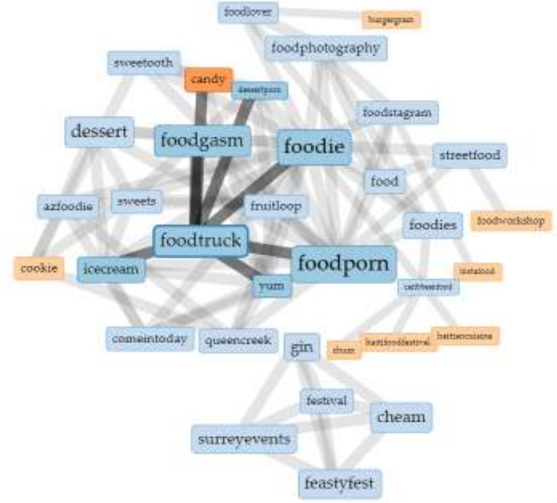
- Top hashtags included #foodie (822), #foodporn (582), #food (532), #foodfest (386), and #foodphotography (381). Collocation analysis showed sweets/desserts as a dominant theme: #foodie co-occurred with #dessert (185), #sweetooth (182), #sweets (181), and #icecream (103); #foodporn co-occurred with #foodphotography (148), #foodgasm (112), #sweetooth (103), #icecream (103), and #dessert (103).
- Posts averaged 15 hashtags (SD=9.36), hashtags averaged 177 characters (SD=113.32), captions without hashtags averaged approximately 236 characters (SD=259.88), and total post length averaged about 412 characters (SD=293.71).
- Spearman correlations found no statistically significant relationship between engagement rate and number of hashtags, r_s(3246) = -.009, p = .594. Engagement rate had a weak negative correlation with hashtag length, r_s(3246) = -.031, p = .011; a negative relationship with caption length without hashtags, r_s(3246) = -.069, p < .000; and a negative relationship with total post length, r_s(3246) = -.087, p < .000.
Methods
- Instagram posts captioned #foodfestivals were crawled with Octoparse; 3,669 public posts published in 2019 were extracted, with data collection in the first week of December 2019 and a second round three weeks later. Synonyms such as #foodfestival or #foodfestival2019 were excluded to avoid duplication, and the study did not differentiate between posts by festivalgoers or event organizers.
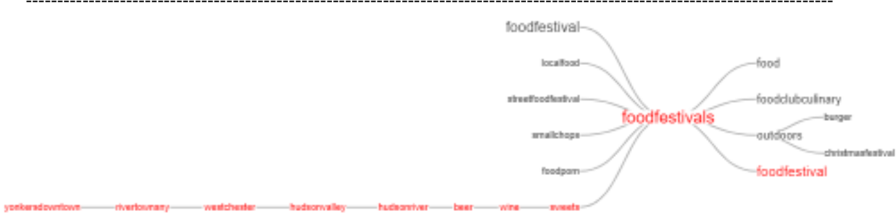
- Non-English and emoji hashtags were removed; the final dataset was imported into Voyant Tool for collocation analysis, linked analysis, and word trees, with #foodfestivals and #foodfestival excluded from analysis.
- Number of hashtags and character counts were calculated in Excel. Engagement rate was computed, as stated in the paper, by taking the number of followers an account has and dividing it by the number of likes from a given post; Spearman correlation was run in SPSS. Video-posts (427) were removed because Instagram does not provide likes for them, leaving 3,248 posts.
Limitations
- The paper states that non-English hashtags were removed, but other English hashtags may be incompatible because they derived from their original language (e.g., pinyin in Chinese or Japanese); it also presumes information overload as one reason for lower engagement and notes that post length is not the only factor influencing user engagement, suggesting future work on text sentiment and pictorial content.
- The paper states that it did not separate business/official accounts and private accounts, and suggests future research could analyze differences between projected and perceived images, potentially using word-embedding techniques to identify business accounts; it also notes that comparison between hashtags in posts and hashtags in comments merits attention, and that methods could be extended to other tourism contexts.
- Evident from the text: the design is cross-sectional and correlational, using one hashtag (#foodfestivals) and one year (2019), so the reported associations cannot establish causality or generalize beyond this sample.
Model-written summary. Check it against the paper before relying on it.
Integrity signals
Registry
Cites
Statistics
Figures
Verification
Claims the paper makes
0 Valid · 5 Not valid · 23 Not checked · 26 Own results and interpretations
A result the paper states — it cites no source for it, so there is none to check. The quote shows it is in the paper.
In the paper
“this study unveiled a strong negative relationship between user engagement and the length of the whole post.”
§ Hashtag usage and user engagement on Instagram: The case of #foodfestivals > Discussion
boostedstates an association- Asserted: passes — The authors put it forward as true.
- Checkable: passes — It can be checked against evidence.
- Load-bearing: passes — The paper’s conclusions depend on it.
- Based: passes — The paper gives a reason why it holds.
The paper states this without a source or data behind it here, so there is nothing to check it against. The quote shows it is in the paper.
In the paper
“Furthermore, the results imply that dessert-related hashtags have a closer link to #foodtruck.”
§ Hashtag usage and user engagement on Instagram: The case of #foodfestivals > Discussion
hedgedstates an association- Asserted: passes — The authors put it forward as true.
- Checkable: passes — It can be checked against evidence.
- Load-bearing: unclear — It is unclear whether the paper’s conclusions depend on it.
- Based: unclear — It is unclear why the paper says it holds.
A result the paper reports from its own data — it cites no other source for it, so there is none to check. The quote shows it is in the paper.
In the paper
“popular trends that may not have been recognized otherwise, such as the feature of sweets and desserts in food festivals, have been revealed.”
§ Hashtag usage and user engagement on Instagram: The case of #foodfestivals > Conclusions
hedged- Asserted: passes — The authors put it forward as true.
- Checkable: passes — It can be checked against evidence.
- Load-bearing: passes — The paper’s conclusions depend on it.
- Based: passes — The paper gives a reason why it holds.
The paper states this without a source or data behind it here, so there is nothing to check it against. The quote shows it is in the paper.
In the paper
“Surprisingly, hashtags related to American food (e.g.#burgergram) appear to be isolated from most of the interconnected hashtags.”
§ Hashtag usage and user engagement on Instagram: The case of #foodfestivals > Discussion
hedged- Asserted: passes — The authors put it forward as true.
- Checkable: passes — It can be checked against evidence.
- Load-bearing: unclear — It is unclear whether the paper’s conclusions depend on it.
- Based: unclear — It is unclear why the paper says it holds.
A result the paper reports from its own data — it cites no other source for it, so there is none to check. The quote shows it is in the paper.
In the paper
“Regarding the length of captions without hashtags, the posts average at approximately 236 characters in length (SD=259.88).”
§ Hashtag usage and user engagement on Instagram: The case of #foodfestivals > Main analysis: Spearman correlation
plain- Asserted: passes — The authors put it forward as true.
- Checkable: passes — It can be checked against evidence.
- Load-bearing: unclear — It is unclear whether the paper’s conclusions depend on it.
- Based: passes — The paper gives a reason why it holds.
27 more claims
Create a free account to see all 54 claims and to verify the 25 references still open.
- It may state two separate claims as one. 6
- Probably not a substantial claim. 21
Self-check
Percentages, sums and reported differences re-computed from the paper’s own numbers.
Each contradiction between two passages listed here was confirmed by an independent check.
Rated major: it would touch a result — a value a result rests on, reported and recomputed p-values on opposite sides of the significance level, two passages that conflict with no sign which is right, or a cited work retracted before this paper was published.
In the paper
§ Hashtag usage and user engagement on Instagram: The case of #foodfestivals > Discussion
“a post with short to moderate length encourages consumers' engagement the most”
§ Hashtag usage and user engagement on Instagram: The case of #foodfestivals > Material & methods
“the engagement rate of a post was computed by taking the number of followers an account has and dividing it by the number of likes from a given post”
Citations
Cites
de Vries, L., Gensler, S., & Leeflang, P. S. H. (2012) · Journal of Interactive Marketing · doi:10.1016/j.intmar.2012.01.003 · Cited by 2,060
Social media as a destination marketing tool: its use by national tourism organisations
Hays, S., Page, S. J., & Buhalis, D. (2013) · Current Issues in Tourism · doi:10.1080/13683500.2012.662215 · Cited by 967
Ryu, K., & Jang, S. S. (2007) · Journal of Hospitality & Tourism Research · doi:10.1177/1096348006295506 · Cited by 639
Factors influencing popularity of branded content in Facebook fan pages
Sabate, F., Berbegal-Mirabent, J., Cañabate, A., & Lebherz, P. R. (2014) · European Management Journal · doi:10.1016/j.emj.2014.05.001 · Cited by 557
Fu, S., Li, H., Liu, Y., Pirkkalainen, H., & Salo, M. (2020) · Information Processing & Management · doi:10.1016/j.ipm.2020.102307 · Cited by 462
WHAT THE HASHTAG?: A content analysis of Canadian politics on Twitter
Small, T. A. (2011) · Information, Communication & Society · doi:10.1080/1369118x.2011.554572 · Cited by 433
Investigating the role of festivalscape in culinary tourism: The case of food and wine events
Mason, M. C., & Paggiaro, A. (2012) · Tourism Management · doi:10.1016/j.tourman.2011.12.016 · Cited by 412
Mariani, M. M., Di Felice, M., & Mura, M. (2016) · Tourism Management · doi:10.1016/j.tourman.2015.12.008 · Cited by 390
Value co-creation and co-destruction in the Airbnb sharing economy
Camilleri, J., & Neuhofer, B. (2017) · International Journal of Contemporary Hospitality Management · doi:10.1108/ijchm-09-2016-0492 · Cited by 349
On predicting the popularity of newly emerging hashtags in Twitter
Ma, Z., Sun, A., & Cong, G. (2013) · Journal of the American Society for Information Science and Technology · doi:10.1002/asi.22844 · Cited by 245
The influence of social media on the consumers’ hotel decision journey
Varkaris, E., & Neuhofer, B. (2017) · Journal of Hospitality and Tourism Technology · doi:10.1108/jhtt-09-2016-0058 · Cited by 241
The Impact of Content, Context, and Creator on User Engagement in Social Media Marketing
Jaakonmäki, R., Müller, O., & vom Brocke, J. (2017) · Proceedings of the Annual Hawaii International Conference on System Sciences · doi:10.24251/hicss.2017.136 · Cited by 240
Wong, J. W. C., Lai, I. K. W., & Tao, Z. (2020) · Current Issues in Tourism · doi:10.1080/13683500.2019.1649372 · Cited by 239
Increasing the ROI of social media marketing
Kumar, V., & Mirchandani, R. (2013) · IEEE Engineering Management Review · doi:10.1109/emr.2013.6596535 · Cited by 237
TANGSERV: A Multiple Item Scale for Measuring Tangible Quality in Foodservice Industry
Raajpoot, N. A. (2002) · Journal of Foodservice Business Research · doi:10.1300/j369v05n02_08 · Cited by 219
Destination food image and intention to eat destination foods: a view from Korea
Seo, S., Yun, N., & Kim, O. Y. (2014) · Current Issues in Tourism · doi:10.1080/13683500.2014.934210 · Cited by 195
Analysis of push and pull factors in food travel motivation
Su, D. N., Johnson, L. W., & O’Mahony, B. (2020) · Current Issues in Tourism · doi:10.1080/13683500.2018.1553152 · Cited by 188
Organ, K., Koenig-Lewis, N., Palmer, A., & Probert, J. (2015) · Tourism Management · doi:10.1016/j.tourman.2014.10.021 · Cited by 184
Coloring the destination: The role of color psychology on Instagram
Yu, C.-E., Xie, S. Y., & Wen, J. (2020) · Tourism Management · doi:10.1016/j.tourman.2020.104110 · Cited by 181
Luxury brands and social media: drivers and outcomes of consumer engagement on Instagram
Oliveira, M., & Fernandes, T. (2020) · Journal of Strategic Marketing · doi:10.1080/0965254x.2020.1777459 · Cited by 170
The role of food festivals in branding culinary destinations
Yang, F. X., Wong, I. A., Tan, X. S., & Wu, D. C. W. (2020) · Tourism Management Perspectives · doi:10.1016/j.tmp.2020.100671 · Cited by 163
Gastronomic festivals: attitude, motivation and satisfaction of the tourist
López-Guzmán, T., Uribe Lotero, C. P., Pérez Gálvez, J. C., & Ríos Rivera, I. (2017) · British Food Journal · doi:10.1108/bfj-06-2016-0246 · Cited by 158
Competing for Attention in Social Media under Information Overload Conditions
Feng, L., Hu, Y., Li, B., Stanley, H. E., Havlin, S., & Braunstein, L. A. (2015) · PLOS ONE · doi:10.1371/journal.pone.0126090 · Cited by 133
A Taste of Tourism: Visitors' Motivations to Attend a Food Festival
Chang, W., & Yuan, J. J. (2011) · Event Management · doi:10.3727/152599511x12990855575024 · Cited by 119
Lin, H., Swarna, H., & Bruning, P. F. (2017) · Business Horizons · doi:10.1016/j.bushor.2017.05.006 · Cited by 115
Understanding consumer engagement with celebrity-endorsed E-Cigarette advertising on instagram
Phua, J., Lin, J.-S., & Lim, D. (2018) · Computers in Human Behavior · doi:10.1016/j.chb.2018.02.031 · Cited by 102
Contemporary issues in events, festivals and destination management
van Niekerk, M. (2017) · International Journal of Contemporary Hospitality Management · doi:10.1108/ijchm-01-2017-0031 · Cited by 100
The role of Instagram in the UNESCO's creative city of gastronomy: A case study of Macau
Yu, C.-E., & Sun, R. (2019) · Tourism Management · doi:10.1016/j.tourman.2019.05.011 · Cited by 96
Analyzing the effects of an urban food festival: A place theory approach
Lau, C., & Li, Y. (2018) · Annals of Tourism Research · doi:10.1016/j.annals.2018.10.004 · Cited by 92
Understanding online event experience: The importance of communication, engagement and interaction
Kharouf, H., Biscaia, R., Garcia-Perez, A., & Hickman, E. (2020) · Journal of Business Research · doi:10.1016/j.jbusres.2019.12.037 · Cited by 84
Meteorological Factors Affecting Pan Evaporation in the Haihe River Basin, China
Yan, Z., Wang, S., Ma, D., Liu, B., Lin, H., & Li, S. (2019) · Water · doi:10.3390/w11020317 · Cited by 68
A Taste of Tourism: Visitors' Motivations to Attend a Food Festival
Chang, W. (2011) · Event Management · doi:10.3727/152599511x13082349958190 · Cited by 57
Key Image Attributes to Elicit Likes and Comments on Instagram
Aramendia-Muneta, M. E., Olarte-Pascual, C., & Ollo-López, A. (2021) · Journal of Promotion Management · doi:10.1080/10496491.2020.1809594 · Cited by 55
The Blended Festivalscape and its Sustainability at Nonurban Festivals
Gration, D., Arcodia, C., Raciti, M., & Stokes, R. (2011) · Event Management · doi:10.3727/152599511x13175676722564 · Cited by 50
Kim, Y., Lee, Y., & Love, C. (2009) · Journal of Convention & Event Tourism · doi:10.1080/15470140903178567 · Cited by 46
Customer experience with farmers’ markets: what hashtags can reveal
Pilař, L., Balcarová, T., Rojík, S., Tichá, I., & Poláková, J. (2018) · The International Food and Agribusiness Management Review · doi:10.22434/ifamr2017.0039 · Cited by 44
Villamediana-Pedrosa, J. D., Vila-Lopez, N., & Küster-Boluda, I. (2019) · Current Issues in Tourism · doi:10.1080/13683500.2018.1554625 · Cited by 42
The Relationship Among Social Media Consumption, Team Identification, and Behavioral IntentionsPreprint
Park, J.-A., & Dittmore, S. W. (2014) · SSRN Electronic Journal · doi:10.2139/ssrn.2504608 · Cited by 41
Kim, H. L., & Hyun, S. S. (2019) · Sustainability · doi:10.3390/su11226523 · Cited by 41
Digital Festival Engagement: On the Interplay Between Festivals, Place Brands, and Social Media
Laurell, C., & Björner, E. (2018) · Event Management · doi:10.3727/152599518x15300559276930 · Cited by 35
Bruwer, J., & Kelley, K. (2015) · International Journal of Event and Festival Management · doi:10.1108/ijefm-04-2014-0009 · Cited by 29
Linking accommodation choice, information overload and choice overload
Sthapit, E. (2018) · Current Issues in Tourism · doi:10.1080/13683500.2018.1488821 · Cited by 17
Tweets, hashtags and virality: Marketing the Affordable Care Act in social media
Leonhardt, J. M. (2015) · Journal of Direct Data and Digital Marketing Practice · doi:10.1057/dddmp.2015.4 · Cited by 17
A measurement scale for food festival visitor experience
Ding, D., & Lee, H. M. (2017) · International Journal of Tourism Sciences · doi:10.1080/15980634.2017.1349069 · Cited by 17
Sustainability, social, and technology development trends in Events
Singh, N. K. (2020) · Events and Tourism Review · doi:10.18060/24221 · Cited by 13
Macau wine festivalscape: Attendees’ satisfaction and behavioural intentions
Choe, J., Qian, X., O’ Regan, M., & Yap, M. H. T. (2018) · Hospitality & Society · doi:10.1386/hosp.8.3.273_7 · Cited by 10
Branding dilemma: the case of branding Hyderabad city
Nukhu, R., & Singh, S. (2020) · International Journal of Tourism Cities · doi:10.1108/ijtc-08-2019-0130 · Cited by 9
Belenioti, Z. C., Sophia, G., & Crhis, V. (2017) · Research at York St John (York St John University) · Cited by 9
Social Media and Entrepreneurship: The Case of Food Trucks
Wallsten, S., & Rhyan, C. N. (2014) · Cited by 9
Zarei, G., & Pachal, Z. M. (2019) · Asia Pacific Journal of Tourism Research · doi:10.1080/10941665.2018.1564339 · Cited by 8
Lever, M. W., Mulvey, M. S., & Elliot, S. (2017) · ScholarWorks@UMassAmherst (University of Massachusetts Amherst) · Cited by 8
Sung, J., Koo, G.-Y., Dittmore, S. W., & Eddy, T. (2016) · Journal of Physical Education and Sport · doi:10.7752/jpes.2016.03121 · Cited by 7
Almela, M. (2011) · English Studies · doi:10.1080/0013838x.2010.537050 · Cited by 6
Hashtags as a way to expedite the zakat supply chain
Doktoralina, C. M., Bahari, Z., Hassan, S. A., Ismail, N. A., & Mardiyah, S. A. L. (2020) · Uncertain Supply Chain Management · doi:10.5267/j.uscm.2019.7.004 · Cited by 4
Scholtz, M., & Kruger, M. (2020) · Current Issues in Tourism · doi:10.1080/13683500.2019.1615039 · Cited by 3
Sung, J., GiYoung, K., Dittmore, S. W., & Eddy, T. W. (2016) · Journal of Physical Education and Sport · Cited by 3
Street eats: Your guide to local food trucks
Hrdlicka, J., Lempke, K., & Drost, E. (2017) · Ethos · Cited by 1
FROM COMMENTS TO HASHTAGS STRATEGIES: ENHANCING CRUISE COMMUNICATION IN FACEBOOK AND TWITTER
Tiago, T., Couto, J. P., Tiago, F., & Dias Faria, S. (2017) · tourismos · doi:10.26215/tourismos.v12i3.530
Research works printed but not linked: 6
- Bodnár, M., Jackle, F., & Linzner, T. (2020). Exploring the difference in perception of service quality of Low Cost Carrier customers through online reviews: Social Media Analysis. In ISCONTOUR 2020 Tourism Research Perspectives: Proceedings of the International Student Conference in Tourism Research (p. 231). BoD-Books on Demand.
- Bruwer, J., & Kelley, K. (2015). Service performance quality evaluation and satisfaction in a USA wine festivalscape. International Journal of Event and Festival Management, 6(1), 18-38.
- Gallardo, L., Felipe, J. L., García-Unanue, J., Burillo, P., Ubago-Guisado, E., Fernández-Luna, Á., & Calabuig, F. (2017). Influence of quality attributes on the general satisfaction of participants during a European sporting event. Journal of Physical Education and Sport, 17(1), 248-253.
- Lis, A., & Tomanek, M. (2020). Sport management: Thematic mapping of the research field. Journal of Physical Education and Sport, 20(1201-1208).
- Ma, Z., Sun, A., & Cong, G. (2013). On predicting the popularity of newly emerging hashtags in Twitter. Journal of the American Society for Information Science and Technology, 64(7), 1399-1410.
- Malhotra, A., Malhotra, C. K., & See, A. (2012). How to get your messages retweeted. MIT Sloan Management Review, 53(2), 61-66.
Cited by
Sörensen, I., Vogler, D., Fürst, S., & Schäfer, M. S. (2023) · Journal of Marketing for HIGHER EDUCATION · doi:10.1080/08841241.2023.2289009 · Cited by 41
The use of social media to promote unhealthy food and beverage consumption among Indonesian children
Guo, I., Padmita, A. C., Matsuzaki, M., Gittelsohn, J., Feeley, A. B., Watson, F., Susanti, E., Mangunadikusumo, E. W., Nuraliyah, F., & Colozza, D. (2025) · BMC Nutrition · doi:10.1186/s40795-025-01040-2 · Cited by 23
Social media engagement in the maritime industry during the pandemic
Koh, L. Y., Ng, C., Wang, X., & Yuen, K. F. (2023) · Technological Forecasting and Social Change · doi:10.1016/j.techfore.2023.122553 · Cited by 18
Chen, J., Lin, Y., Tang, X., & Deng, S. (2023) · Behaviour and Information Technology · doi:10.1080/0144929x.2023.2241084 · Cited by 10
#FOODPORN KAVRAMI VE SOSYAL MEDYA ILE İLIŞKISI
YILDIRIM, Y., & DOĞAN, T. (2022) · İmgelem · doi:10.53791/imgelem.1054542 · Cited by 10
Metadata
- Authors
- Celuch, K.
- Affiliations
- Nicolaus Copernicus University (PL)
- Corresponding author
- Celuch, Krzysztof
- ORCID
- Celuch, Krzysztof
- Venue
- Journal of Physical Education and Sport
- Publisher
- RO Sport & Art Association
- Published
- 2021-04-30
- Volume
- 21
- Issue
- S2
- Pages
- 966-973
- ISSN
- 2247-8051 (ISSN-L)
- 2247-806X
- OpenAlex
- W4247784099
- Cited by
- 52
- References
- 58
- Citations by year
- 2026: 9 · 2025: 12 · 2024: 14 · 2023: 10 · 2022: 7
- FWCI
- 3.83
- Type
- journal article
- Language
- en
- Open access
- diamond
- doi.org
- Licence
- Locations
- Journal of Physical Education and Sport (publishedVersion, cc-by-nc-nd)
- Topics
- Social Sciences › Business, Management and Accounting › Marketing › Digital Marketing and Social Media
- Social Sciences › Communication › Media and Digital Communication
- Social Sciences › Health › Social Media in Health Education
- Keywords
- hashtags, user engagement, Instagram, food festivals, social media marketing, information overload, engagement rate, event marketing, value co-creation
About these checks
Registry, retraction, Cites and statistics results are computed, not judged, with one exception: a printed reference that no index lists is read once by a model before it counts as a citation error. Claims are extracted by a model and kept only when their quote appears verbatim in the text; each cited source is then checked, with a model’s help, for whether it says what the claim relies on. Those verdicts can be wrong — read the claim’s quote and the cited source before relying on one.
A language model drew the claims from the paper on 2026-11-24, under version 3 of the claim definition (model deepseek-v4.1-flash, prompt extract-v3).
A second model labelled each claim on 2026-11-24 (model jev-1.13-20260917, definition revision gold-guideline-v0.2).
Statistics and arithmetic are recomputed, not judged.
Confidence bands are shown only for fields calibrated on our annotated test set. None is calibrated yet, so no band is shown.
What counts as a claim ›How we measure confidence ›How we check this ›
Are you an author, or do you see a problem with this page? Request a review
Data sources
Bibliographic data: Semantic Scholar, OpenAlex, Crossref.
Contains information from the Semantic Scholar Academic Graph Datasets, made available under the ODC Attribution License (ODC-BY 1.0).
Semantic Scholar’s data is described in: Kinney, R., et al. (2023). The Semantic Scholar Open Data Platform. arXiv:2301.10140.
