

The DOI matches its Crossref record; 24 of the 26 references it cites were found in a registry or an index, and 1 are not checked yet.
Analysis of Discrepancies Between Pulse Oximetry and Arterial Oxygen Saturation Measurements by Race and Ethnicity and Association With Organ Dysfunction and Mortality
Open accessAbstract
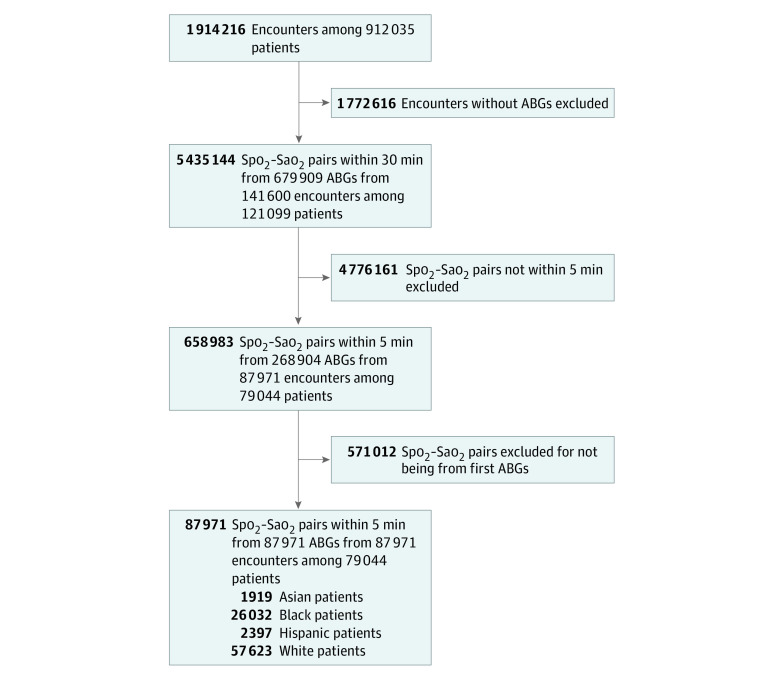
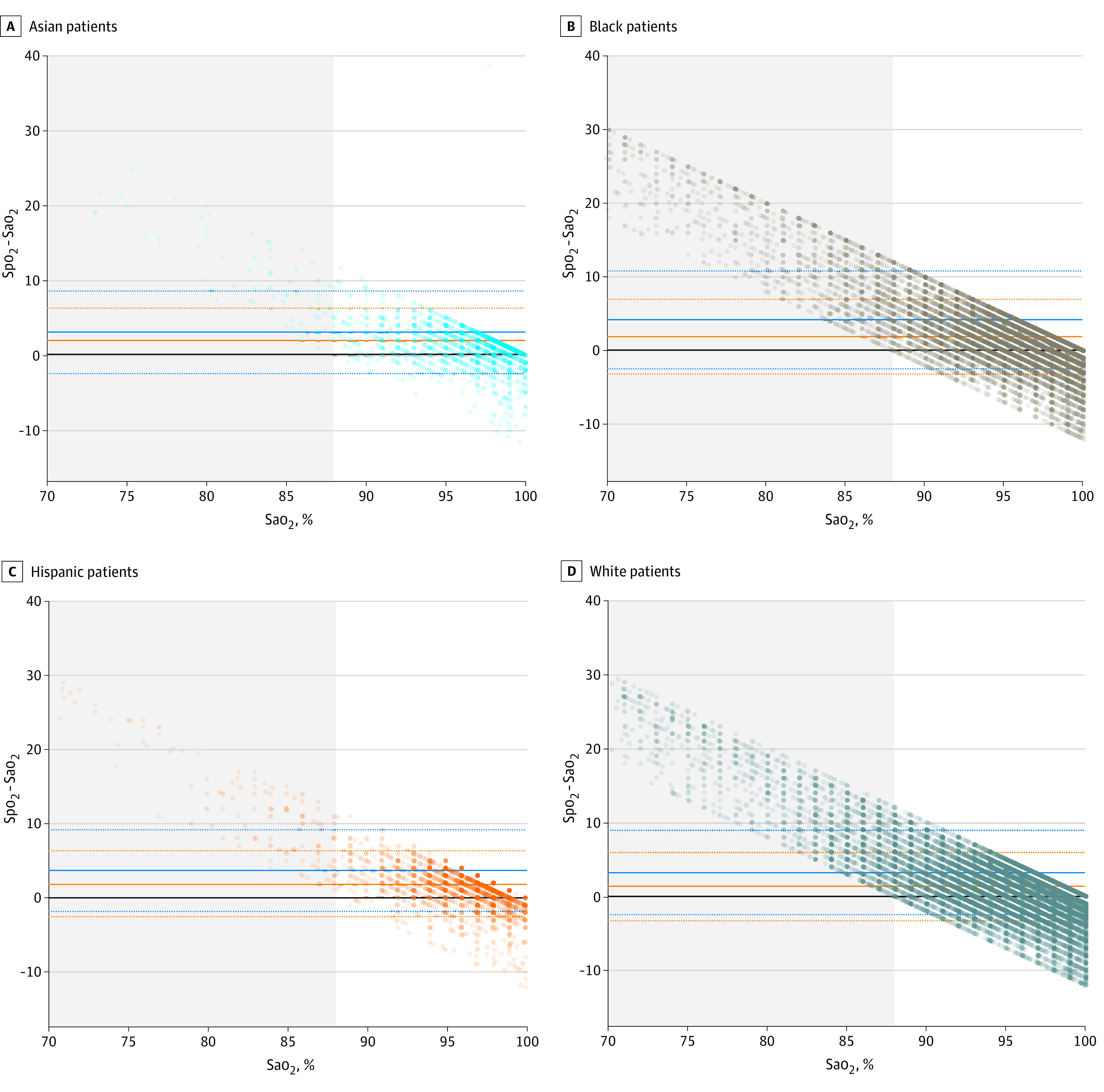
Importance: Discrepancies in oxygen saturation measured by pulse oximetry (Spo2), when compared with arterial oxygen saturation (Sao2) measured by arterial blood gas (ABG), may differentially affect patients according to race and ethnicity. However, the association of these disparities with health outcomes is unknown. Objective: To examine racial and ethnic discrepancies between Sao2 and Spo2 measures and their associations with clinical outcomes. Design, Setting, and Participants: This multicenter, retrospective, cross-sectional study included 3 publicly available electronic health record (EHR) databases (ie, the Electronic Intensive Care Unit-Clinical Research Database and Medical Information Mart for Intensive Care III and IV) as well as Emory Healthcare (2014-2021) and Grady Memorial (2014-2020) databases, spanning 215 hospitals and 382 ICUs. From 141 600 hospital encounters with recorded ABG measurements, 87 971 participants with first ABG measurements and an Spo2 of at least 88% within 5 minutes before the ABG test were included. Exposures: Patients with hidden hypoxemia (ie, Spo2 ≥88% but Sao2 <88%). Main Outcomes and Measures: Outcomes, stratified by race and ethnicity, were Sao2 for each Spo2, hidden hypoxemia prevalence, initial demographic characteristics (age, sex), clinical outcomes (in-hospital mortality, length of stay), organ dysfunction by scores (Sequential Organ Failure Assessment [SOFA]), and laboratory values (lactate and creatinine levels) before and 24 hours after the ABG measurement. Results: The first Spo2-Sao2 pairs from 87 971 patient encounters (27 713 [42.9%] women; mean [SE] age, 62.2 [17.0] years; 1919 [2.3%] Asian patients; 26 032 [29.6%] Black patients; 2397 [2.7%] Hispanic patients, and 57 632 [65.5%] White patients) were analyzed, with 4859 (5.5%) having hidden hypoxemia. Hidden hypoxemia was observed in all subgroups with varying incidence (Black: 1785 [6.8%]; Hispanic: 160 [6.0%]; Asian: 92 [4.8%]; White: 2822 [4.9%]) and was associated with greater organ dysfunction 24 hours after the ABG measurement, as evidenced by higher mean (SE) SOFA scores (7.2 [0.1] vs 6.29 [0.02]) and higher in-hospital mortality (eg, among Black patients: 369 [21.1%] vs 3557 [15.0%]; P < .001). Furthermore, patients with hidden hypoxemia had higher mean (SE) lactate levels before (3.15 [0.09] mg/dL vs 2.66 [0.02] mg/dL) and 24 hours after (2.83 [0.14] mg/dL vs 2.27 [0.02] mg/dL) the ABG test, with less lactate clearance (-0.54 [0.12] mg/dL vs -0.79 [0.03] mg/dL). Conclusions and Relevance: In this study, there was greater variability in oxygen saturation levels for a given Spo2 level in patients who self-identified as Black, followed by Hispanic, Asian, and White. Patients with and without hidden hypoxemia were demographically and clinically similar at baseline ABG measurement by SOFA scores, but those with hidden hypoxemia subsequently experienced higher organ dysfunction scores and higher in-hospital mortality.
Overview
The claims and statistics of this paper haven’t been checked yet.
Run the check — free, no account needed. It reads the open-access text and checks the sources it cites.
Integrity signals
Registry
Cites
Statistics
Figures
Verification
Claims the paper makes
The claims and statistics of this paper haven’t been checked yet.
Run the check — free, no account needed. It reads the open-access text and checks the sources it cites.
Claims other papers make about this one
Each is checked against this paper’s own text: does it say what the citing paper says it does?
The source backs part of the claim, not all of it — or backs it for a different population, condition or comparison.
In the citing paper
“leading to lower hospital admission; higher occult hypoxemia; and delayed or no access to dexamethasone, therapeutic oxygen, and COVID-19 therapies, resulting in increased hospital readmission, organ dysfunction, and mortality [11-18].”
From Impact of skin pigmentation on pulse oximetry blood oxygenation and wearable pulse rate accuracy: systematic review and meta-analysis (2024) · cites this paper as [15]
Experimental — accuracy not yet measuredThe cited source says what the claim attributes to it.
In the citing paper
“Recent studies have shown a positive bias in oxygen saturation measurements in patients with darkly pigmented skin, particularly under low saturation conditions.”
From Skin pigmentation influence on pulse oximetry accuracy: a systematic review and bibliometric analysis (2022) · cites this paper as [54]
The cited source says what the claim attributes to it.
In the citing paper
“Patients with darker skin pigmentation are more likely than patients with lighter skin color to have overestimated SpO2 readings”
From Impact of skin pigmentation on pulse oximetry blood oxygenation and wearable pulse rate accuracy: systematic review and meta-analysis (2024) · cites this paper as [15]
In the citing paper
“More recent studies have also revealed that dark skin pigmentation influences the accuracy and performance of pulse oximeters devices, resulting in overestimations [17,49,50,51,52,53] with increased incidence in the risk for occult hypoxemia (SO2<88% despite normal SpO2>92%) [54,55].”
From Skin pigmentation influence on pulse oximetry accuracy: a systematic review and bibliometric analysis (2022) · cites this paper as [54]
In the citing paper
“Due to this increasing evidence, several health organizations and healthcare professionals have raised growing concerns about the clinical accuracy of pulse oximetry in dark-skinned patients [20,57,58,59,60,61], particularly in detecting occult hypoxemia [54,55].”
From Skin pigmentation influence on pulse oximetry accuracy: a systematic review and bibliometric analysis (2022) · cites this paper as [54]
In the citing paper
“A prevalence of occult hypoxemia in dark-skinned subjects has been recently confirmed in three studies, showing that dark-skinned patients may have over three times the risk of experiencing occult hypoxemia during hospitalization compared to light-skinned patients [53,54,55].”
From Skin pigmentation influence on pulse oximetry accuracy: a systematic review and bibliometric analysis (2022) · cites this paper as [54]
Self-check
Percentages, sums and reported differences re-computed from the paper’s own numbers.
The self-check needs the paper’s full text.
Citations
Cites
Goldberger, A. L., Amaral, L. A. N., Glass, L., Hausdorff, J. M., Ivanov, P. C., Mark, R. G., Mietus, J. E., Moody, G. B., Peng, C.-K., & Stanley, H. E. (2000) · Circulation · doi:10.1161/01.cir.101.23.e215 · Cited by 14,809
Vincent, J. L., Moreno, R., Takala, J., Willatts, S., De Mendonça, A., Bruining, H., Reinhart, C. K., Suter, P. M., & Thijs, L. G. (1996) · Intensive Care Medicine · doi:10.1007/bf01709751 · Cited by 11,674
MIMIC-III, a freely accessible critical care database
Johnson, A. E. W., Pollard, T. J., Shen, L., Lehman, L.-W. H., Feng, M., Ghassemi, M., Moody, B., Szolovits, P., Anthony Celi, L., & Mark, R. G. (2016) · Scientific Data · doi:10.1038/sdata.2016.35 · Cited by 8,141
Vandenbroucke, J. P., Elm, E. V., Altman, D. G., Gøtzsche, P. C., Mulrow, C. D., Pocock, S. J., Poole, C., Schlesselman, J. J., Egger, M., & initiative, F. T. S. (2007) · Annals of Internal Medicine · doi:10.7326/0003-4819-147-8-200710160-00010-w1 · Cited by 3,543
The Triad of Sleep Apnea, Hypertension, and Chronic Kidney Disease: A Spectrum of Common Pathology
Aziz, F., & Chaudhary, K. R. (2016) · Cardiorenal Medicine · doi:10.1159/000450796 · Cited by 3,285
Pollard, T. J., Johnson, A. E. W., Raffa, J. D., Celi, L. A., Mark, R. G., & Badawi, O. (2018) · Scientific Data · doi:10.1038/sdata.2018.178 · Cited by 1,993
Racial bias in pulse oximetry measurement
Sjoding, M. W., Dickson, R. P., Iwashyna, T. J., Gay, S. E., & Valley, T. S. (2020) · New England Journal of Medicine · doi:10.1056/nejmc2029240 · Cited by 1,114
Jansen, T. C., van Bommel, J., Schoonderbeek, F. J., Sleeswijk Visser, S. J., van der Klooster, J. M., Lima, A. P., Willemsen, S. P., & Bakker, J. (2010) · American Journal of Respiratory and Critical Care Medicine · doi:10.1164/rccm.200912-1918oc · Cited by 894
Intermittent Hypoxemia and OSA
Dewan, N. A., Nieto, F. J., & Somers, V. K. (2015) · Chest · doi:10.1378/chest.14-0500 · Cited by 641
Effects of skin pigmentation on pulse oximeter accuracy at low saturation
Bickler, P. E., Feiner, J. R., & Severinghaus, J. W. (2005) · Anesthesiology · doi:10.1097/00000542-200504000-00004 · Cited by 427
Cited by
Sorted by citations
A New Global Definition of Acute Respiratory Distress Syndrome
Matthay, M. A., Arabi, Y. M., Arroliga, A. C., Bernard, G. R., Bersten, A. D., Brochard, L. J., Calfee, C. S., Combes, A., Daniel, B. M., Ferguson, N. D., et al. (2023) · American Journal of Respiratory and Critical Care Medicine · doi:10.1164/rccm.202303-0558ws · Cited by 916
Porsbjerg, C. M., Melén, E., Lehtimäki, L. A., & Shaw, D. E. (2023) · The Lancet · doi:10.1016/s0140-6736(22)02125-0 · Cited by 632
Fawzy, A., Wu, T. D., Wang, K., Robinson, M. L., Farha, J., Bradke, A., Golden, S. H., Xu, Y., & Garibaldi, B. T. (2022) · JAMA Internal Medicine · doi:10.1001/jamainternmed.2022.1906 · Cited by 326
Wearable Photoplethysmography for Cardiovascular Monitoring
Charlton, P. H., Kyriacou, P. A., Mant, J., Marozas, V., Chowienczyk, P., & Alastruey, J. (2022) · Proceedings of the IEEE · doi:10.1109/jproc.2022.3149785 · Cited by 250
The Sequential Organ Failure Assessment (SOFA) Score: has the time come for an update?
Moreno, R. P., Rhodes, A., Piquilloud, L., Glenn Hernández, P., Takala, J. A., Gershengorn, H. B., Tavares, M., Coopersmith, C. M., Myatra, S. N., Singer, M., et al. (2023) · Critical Care · doi:10.1186/s13054-022-04290-9 · Cited by 258
Metadata
- Authors
- Wong, A.-K. I., Charpignon, M., Kim, H., Josef, C., de Hond, A. A. H., Fojas, J. J., Tabaie, A., Liu, X., Mireles-Cabodevila, E., Carvalho, L., Kamaleswaran, R., Madushani, R. W. M. A., Adhikari, L., Holder, A. L., Steyerberg, E. W., Buchman, T. G., Lough, M. E., & Celi, L. A.
- Affiliations
- Emory University (US)
- Massachusetts Institute of Technology (US)
- Johns Hopkins University (US)
- Leiden University Medical Centre, Department of Biomedical Data Sciences, Leiden, the Netherlands
- Beth Israel Deaconess Medical Center (US)
- Beihang University (CN)
- School of Biological Science and Medical Engineering, Beihang University, Beijing, China
- Cleveland Clinic (US)
- Boston Medical Center (US)
- Philips (United States) (US)
- Leiden University Medical Center (NL)
- Stanford Health Care (US)
- Corresponding author
- Wong, An-Kwok Ian
- ORCID
- Venue
- JAMA Network Open
- Publisher
- American Medical Association (AMA)
- Published
- 2021-11-03
- Volume
- 4
- Issue
- 11
- Pages
- e2131674
- ISSN
- 2574-3805 (ISSN-L)
- PMC
- PMC9178439
- OpenAlex
- W3210241905
- Cited by
- 268
- References
- 25
- Citations by year
- 2026: 26 · 2025: 53 · 2024: 62 · 2023: 67 · 2022: 60
- FWCI
- 14.36
- Type
- journal article
- Language
- en
- Open access
- gold
- doi.org
- Licence
- cc-by
- Locations
- JAMA Network Open (publishedVersion, cc-by)
- PubMed Central (publishedVersion, cc-by)
- PubMed (publishedVersion)
- Leiden Repository (Leiden University) (submittedVersion, cc-by)
- Data Archiving and Networked Services (DANS) (submittedVersion, cc-by)
- DSpace@MIT (Massachusetts Institute of Technology) (submittedVersion, cc-by-nc)
- Funders
- U.S. Department of Defense
- National Institutes of Health (5r01eb017205-07, R01-EB017205, EB017205, NIBIB R01 EB017205, UL1TR002378)
- Uniformed Services University of the Health Sciences (HT9404-13-1-0032, HU0001, USUHS HT9404-13-1-0032, HU0001-15-2-0001)
- Biomedical Advanced Research and Development Authority
- National Institute of General Medical Sciences (K23GM137182, T32GM095442, R01GM139967)
- National Institute of Biomedical Imaging and Bioengineering (NIBIB R01 EB017205, R01-EB017205, EB017205)
- National Center for Advancing Translational Sciences
- Topics
- Physical Sciences › Engineering › Biomedical Engineering › Non-Invasive Vital Sign Monitoring
- Health Sciences › Medicine › Surgery › Hemodynamic Monitoring and Therapy
- Health Sciences › Medicine › Critical Care and Intensive Care Medicine › Sepsis Diagnosis and Treatment
- Keywords
- pulse oximetry, arterial oxygen saturation, racial and ethnic disparities, arterial blood gases, intensive care unit patients, organ dysfunction, SOFA score, in-hospital mortality, length of hospital stay, lactate, creatinine, Black patients, Hispanic patients, health disparities, hypoxemia detection
- MeSH terms
- Oxygen Saturation, Aged, Hypoxia, Creatinine, Cross-Sectional Studies, Ethnicity, Female, Georgia, Humans, Male, Middle Aged, Multiple Organ Failure, Oximetry, Retrospective Studies, Racial Groups
About these checks
Registry, retraction, Cites and statistics results are computed, not judged, with one exception: a printed reference that no index lists is read once by a model before it counts as a citation error. Claims are extracted by a model and kept only when their quote appears verbatim in the text; each cited source is then checked, with a model’s help, for whether it says what the claim relies on. Those verdicts can be wrong — read the claim’s quote and the cited source before relying on one.
Statistics and arithmetic are recomputed, not judged.
Confidence bands are shown only for fields calibrated on our annotated test set. None is calibrated yet, so no band is shown.
What counts as a claim ›How we measure confidence ›How we check this ›
Are you an author, or do you see a problem with this page? Request a review
