

The DOI matches its Crossref record; 202 of the 203 references it cites were found in a registry or an index; 26 of the 44 sources its claims cite were checked for support.
Probiotics for treating acute infectious diarrhoea
Open accessAbstract
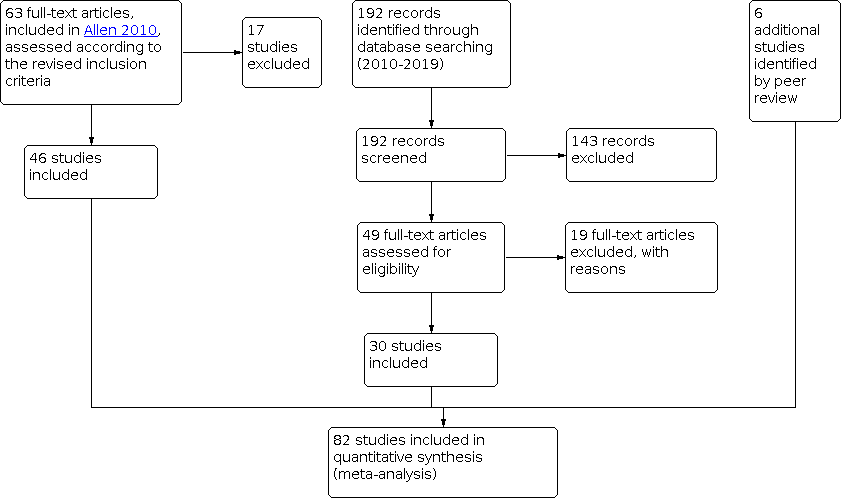
BackgroundProbiotics may be effective in reducing the duration of acute infectious diarrhoea. ObjectivesTo assess the effects of probiotics in proven or presumed acute infectious diarrhoea. Search methodsWe searched the trials register of the Cochrane Infectious Diseases Group, MEDLINE, and Embase from inception to 17 December 2019, as well as the Cochrane Controlled Trials Register (Issue 12, 2019), in the Cochrane Library, and reference lists from studies and reviews.We included additional studies identified during external review. Selection criteriaRandomized controlled trials comparing a specified probiotic agent with a placebo or no probiotic in people with acute diarrhoea that is proven or presumed to be caused by an infectious agent. Data collection and analysisTwo review authors independently applied inclusion criteria, assessed risk of bias, and extracted data.Primary outcomes were measures of diarrhoea duration (diarrhoea lasting ≥ 48 hours; duration of diarrhoea).Secondary outcomes were number of people hospitalized in community studies, duration of hospitalization in inpatient studies, diarrhoea lasting ≥ 14 days, and adverse events. Main resultsWe included 82 studies with a total of 12,127 participants.These studies included 11,526 children (age < 18 years) and 412 adults (three studies recruited 189 adults and children but did not specify numbers in each age group).No cluster-randomized trials were included.Studies varied in the definitions used for "acute diarrhoea" and "end of the diarrhoeal illness" and in the probiotic(s) tested.A total of 53 trials were undertaken in countries where both child and adult mortality was low or very low, and 26 where either child or adult mortality was high.Probiotics for treating acute infectious diarrhoea (Review)
Overview
AI snapshot
Written from the paper’s full text.
TL;DR
This Cochrane review of 82 randomized trials found that, in trials at low risk of bias, probiotics probably make little or no difference to whether acute infectious diarrhoea lasts ≥48 hours, and it is uncertain whether they shorten diarrhoea duration. The authors conclude that current evidence does not support using probiotics to treat acute infectious diarrhoea.
Key findings
- In low-risk-of-bias trials, probiotics vs control showed no difference in diarrhoea lasting ≥48 hours (RR 1.00, 95% CI 0.91 to 1.09; 2 trials, 1770 participants; moderate-certainty evidence).
- In low-risk-of-bias trials, mean duration of diarrhoea was 8.64 hours shorter with probiotics, but the 95% CI ranged from 29.4 hours shorter to 12.1 hours longer (6 trials, 3058 participants; very low-certainty evidence).
- Across all trials, pooled estimates suggested benefit (diarrhoea ≥48 hours RR 0.64, 95% CI 0.52 to 0.79; duration MD 21.3 hours shorter, 95% CI 15.7 to 26.9), but heterogeneity was very high and funnel plots suggested publication bias.
- Duration of hospitalization was shorter in probiotic groups (MD −18.03 hours, 95% CI −27.28 to −8.78; 24 trials, 4056 participants; I² = 96%), but no clear differences were detected for diarrhoea lasting ≥14 days or hospitalization in community studies; no serious adverse events were attributed to probiotics.
Methods
- Cochrane systematic review and meta-analysis of randomized controlled trials comparing a specified probiotic with placebo or no probiotic in adults and children with acute diarrhoea presumed or proven to be infectious; searches ran to 17 December 2019.
- Included 82 trials with 12,127 participants (11,526 children and 412 adults; 189 participants of unclear age group), with two reviewers independently assessing eligibility, risk of bias, and extracting data.
- Primary outcomes were diarrhoea lasting ≥48 hours and duration of diarrhoea; analyses used random-effects models because of marked heterogeneity, with GRADE certainty assessment, prespecified subgroup analyses, and sensitivity analyses limited to trials at low risk of bias.
Limitations
- The paper states that many included studies had high or unclear risk of bias, statistical heterogeneity was marked and largely unexplained, and funnel plots indicated publication bias.
- The paper notes that most participants were children, adult data were sparse, definitions of acute diarrhoea and recovery varied widely, and probiotic identity/viability was confirmed in only a few trials; adverse-event reporting was limited.
- The most robust analysis was restricted to only 2 trials for diarrhoea lasting ≥48 hours and 6 trials for duration, and GRADE certainty was moderate for the former and very low for the latter.
Model-written summary. Check it against the paper before relying on it.
Integrity signals
Registry
Cites
Statistics
Figures
Verification
Claims the paper makes
73 Own result · 18 Own interpretation · 12 Supported · 11 Own method · 6 Partly supported · 5 No basis given · 4 Sources not found · 4 No full text of the sources · 2 Supported so far · 2 Couldn’t confirm · 1 Mixed support · 1 Not supported · accuracy not yet measured
At least one cited source doesn’t support this claim or points to a different paper, and none confirmed it — see the verdicts below.
In the paper
“The very marked heterogeneity between studies in this and other reviews argues against “core” properties shared by different probiotics that are effective against diarrhoea due to many different infectious agents and its occurrence in different populations and regions (Hill 2014).”
§ Probiotics for treating acute infectious diarrhoea > Authors' conclusions
What the sources say
- Disputedcites Hill 2014 sourceExperimental — accuracy not yet measured
The Core benefits section (p. 3) takes the opposite position: the panel says evidence supports ‘core’ benefits of certain probiotics and explicitly contrasts that view with the idea that every strain produces a different outcome. The Consensus statements (p. 3) also include infectious diarrhoea among the outcomes considered in support of general digestive-tract benefits. The paper does not use study heterogeneity to argue against shared properties. (LLM, conf=0.89)
Checked by a reasoning model — may be wrong.
plaindirect- Asserted: passes — The authors put it forward as true.
- Checkable: passes — It can be checked against evidence.
- Load-bearing: passes — The paper’s conclusions depend on it.
- Based: passes — The paper gives a reason why it holds.
- Disputed
Some cited sources support this claim and some don’t — read each source’s verdict below.
In the paper
“Our findings do not support recommendations for the use of specific probiotics for acute infectious diarrhoea in children (Floch 2015; Guarino 2018; Sniffen 2018).”
§ Probiotics for treating acute infectious diarrhoea > Authors' conclusions
What the sources say
- Supportedcites Floch 2015 source
The citing authors’ statement about their own findings is not attributed to Floch et al.; the citation identifies the recommendations those findings challenge. The paper’s recommendations table (Additional information; page unavailable) lists specific probiotics for treating infectious diarrhoea in children, including LGG and Saccharomyces boulardii. (LLM, conf=0.91)
- Supportedcites Guarino 2018 source
The citing authors’ statement about their own findings is not attributed to Guarino 2018; the citation identifies a source of recommendations for specific probiotics. In Results > Active Treatment of Diarrhea, the paper says selected probiotic strains can be considered for children with acute gastroenteritis as an adjunct to oral rehydration solution. (LLM, conf=0.90)
- Disputedcites Sniffen 2018 sourceExperimental — accuracy not yet measured
The Discussion (page unavailable) says the opposite: it finds strong evidence of efficacy for several specific probiotics in treating pediatric acute diarrhea, and moderate evidence for another formulation. The Results section also reports that S. boulardii reduced diarrhea duration in children. (LLM, conf=0.90)
Checked by a reasoning model — may be wrong.
plain- Asserted: passes — The authors put it forward as true.
- Checkable: passes — It can be checked against evidence.
- Load-bearing: passes — The paper’s conclusions depend on it.
- Based: passes — The paper gives a reason why it holds.
- Supported
Every source the paper cites for this claim was checked and supports it.
In the paper
“In children from middle‐ and high‐income countries, probiotics reduced diarrhoea duration by 14% (95% CI 3.8% to 24.2%) and stool frequency on day two by 13.1% (95% CI 0.8% to 25.3%; Applegate 2013).”
§ Probiotics for treating acute infectious diarrhoea > Background > Why it is important to do this review
What the sources say
- Supportedcites Applegate 2013 source
The Results report that probiotics reduced stool frequency on day two of treatment by 13.1% (95% CI 0.8%–25.3%). The Discussion says the review combined studies from low- and middle-income countries with studies from high-income countries, consistent with the citing sentence’s population description. (LLM, conf=0.90)
plaindirect- Asserted: passes — The authors put it forward as true.
- Checkable: passes — It can be checked against evidence.
- Load-bearing: passes — The paper’s conclusions depend on it.
- Based: passes — The paper gives a reason why it holds.
- Supported
Every source the paper cites for this claim was checked and supports it.
In the paper
“However, due to substantive heterogeneity of effect size between studies, evidence was insufficient to show a specific probiotic regimen as more effective than another (Allen 2010).”
§ Probiotics for treating acute infectious diarrhoea > Background > Why it is important to do this review
What the sources say
- Supportedcites Allen 2010 source
The Discussion (page unavailable) says that subgroup analyses did not explain the between-study heterogeneity and found no important differences in effect by probiotic strain, number of strains, viability, or dose. This supports the claim that the review could not identify one probiotic regimen as more effective than another. (LLM, conf=0.91)
plain- Asserted: passes — The authors put it forward as true.
- Checkable: passes — It can be checked against evidence.
- Load-bearing: passes — The paper’s conclusions depend on it.
- Based: passes — The paper gives a reason why it holds.
- Supported
Every source the paper cites for this claim was checked and supports it.
In the paper
“In children from middle‐ and high‐income countries, probiotics reduced diarrhoea duration by 14% (95% CI 3.8% to 24.2%) and stool frequency on day two by 13.1% (95% CI 0.8% to 25.3%; Applegate 2013).”
§ Probiotics for treating acute infectious diarrhoea > Background > Why it is important to do this review
What the sources say
- Supportedcites Applegate 2013 source
The Results report a 14.0% reduction in diarrhea duration (95% CI 3.8%–24.2%) and a 13.1% reduction in stool frequency on day two (95% CI 0.8%–25.3%). Table 2 lists the countries contributing to the diarrhea-duration estimate, and the Discussion says the review included studies from both lower- and middle-income countries and high-income countries. (LLM, conf=0.93)
plaindirect- Asserted: passes — The authors put it forward as true.
- Checkable: passes — It can be checked against evidence.
- Load-bearing: passes — The paper’s conclusions depend on it.
- Based: passes — The paper gives a reason why it holds.
- Supported
Every source the paper cites for this claim was checked and supports it.
In the paper
“Findings from the previous version of this Cochrane Review show that when probiotics were used, the mean duration of diarrhoea was shorter, and fewer children had diarrhoea lasting four days or longer.”
§ Probiotics for treating acute infectious diarrhoea > Background > Why it is important to do this review
What the sources say
- Supportedcites Allen 2010 source
The review’s Main results (page not provided) report a risk ratio of 0.41 for diarrhoea lasting four days or longer with probiotics, indicating fewer such cases. They also report a shorter mean duration of diarrhoea. The cited review is the previous version referred to in the citing sentence. (LLM, conf=0.92)
plaindirect- Asserted: passes — The authors put it forward as true.
- Checkable: passes — It can be checked against evidence.
- Load-bearing: passes — The paper’s conclusions depend on it.
- Based: passes — The paper gives a reason why it holds.
- Supported
The sources with a verdict support this claim; the rest weren’t checked yet, have no full text we could read, or their verdicts aren’t rated yet.
In the paper
“In both meta‐analyses, evidence was insufficient to support a specific strain or regimen.”
§ Probiotics for treating acute infectious diarrhoea > Background > Why it is important to do this review
What the sources say
- Not checked — no full text of the sourcecites Salari 2012 source
- Supportedcites Applegate 2013 source
The Discussion (page unavailable) says the review could assess only LGG separately, found no significant strain-specific effect, and could not separate probiotic mixtures to evaluate individual strains or doses. The evidence table also notes differing doses and treatment durations and says there were not enough data to make a statement about each strain. This supports the conclusion that the evidence did not establish a specific strain or regimen. (LLM, conf=0.88)
plain- Asserted: passes — The authors put it forward as true.
- Checkable: passes — It can be checked against evidence.
- Load-bearing: passes — The paper’s conclusions depend on it.
- Based: passes — The paper gives a reason why it holds.
The sources with a verdict support this claim; the rest weren’t checked yet, have no full text we could read, or their verdicts aren’t rated yet.
In the paper
“However, in spite of this increased evidence base, recent systematic reviews have not identified a specific probiotic preparation for use in clinical practice.”
§ Probiotics for treating acute infectious diarrhoea > Background > Why it is important to do this review
What the sources say
- Not checked — no full text of the sourcecites Salari 2012 source
- Supportedcites Applegate 2013 source
The Discussion reports that this review could assess a pooled effect for only one individual strain, LGG, and that result was not significant. It could not separate probiotic mixtures by strain or dose, supporting the claim that the review did not identify a specific preparation for clinical use. (LLM, conf=0.88)
plain- Asserted: passes — The authors put it forward as true.
- Checkable: passes — It can be checked against evidence.
- Load-bearing: passes — The paper’s conclusions depend on it.
- Based: passes — The paper gives a reason why it holds.
Every source the paper cites for this claim was checked and supports it.
In the paper
“Findings from the previous version of this Cochrane Review show that when probiotics were used, the mean duration of diarrhoea was shorter, and fewer children had diarrhoea lasting four days or longer.”
§ Probiotics for treating acute infectious diarrhoea > Background > Why it is important to do this review
What the sources say
- Supportedcites Allen 2010 source
The Main results and Effects of interventions sections report that probiotics shortened mean diarrhoea duration and reduced the risk of diarrhoea lasting at least four days. The review’s History section says the 2010 update did not change its conclusions, supporting the reference to the previous version. (LLM, conf=0.92)
plaindirect- Asserted: passes — The authors put it forward as true.
- Checkable: passes — It can be checked against evidence.
- Load-bearing: passes — The paper’s conclusions depend on it.
- Based: passes — The paper gives a reason why it holds.
- Supported
Every source the paper cites for this claim was checked and supports it.
In the paper
“Of note, a recent large, well‐conducted trial of L rhamnosus GG in children in the USA did not observe a probiotic effect (Schnadower 2018).”
§ Probiotics for treating acute infectious diarrhoea > Discussion > Certainty of the evidence
What the sources say
- Supportedcites Schnadower 2018 source
The Methods (Trial Design and Oversight; page not provided) describe a randomized, double-blind trial at 10 US pediatric emergency departments. The Discussion (page not provided) reports that, among 971 preschool children with acute gastroenteritis, L. rhamnosus GG produced no better outcomes than placebo. This supports the citing sentence’s description of a large US trial that did not observe a probiotic benefit. (LLM, conf=0.94)
plain- Asserted: passes — The authors put it forward as true.
- Checkable: passes — It can be checked against evidence.
- Load-bearing: unclear — It is unclear whether the paper’s conclusions depend on it.
- Based: passes — The paper gives a reason why it holds.
- Supported
- It may state two separate claims as one. 65
- Probably not a substantial claim. 19
- The quote only partly states this claim. 1
The cited sources support only part of this claim — read each source’s verdict below.
In the paper
“A notable finding was that two recently conducted large trials undertaken in children did not show a probiotic effect for the number of children with diarrhoea lasting ≥ 48 hours (Analysis 1.1) or for mean duration of diarrhoea (Analysis 1.2; Freedman 2018a; Schnadower 2018).”
§ Probiotics for treating acute infectious diarrhoea > Results > Effects of interventions
What the sources say
- Not matchedcites Freedman 2018a
Couldn’t be matched to a paper in Crossref, so it can’t be checked.
- Partly supportedcites Schnadower 2018 sourceExperimental — accuracy not yet measured
The Results > Secondary Outcomes section reports no significant difference in diarrhea duration between the probiotic and placebo groups. The Abstract > Results gives median durations, not mean durations. Our copy does not report a comparison of the number of children whose diarrhea lasted at least 48 hours; its 48-hour subgroup concerns symptoms before treatment. (LLM, conf=0.85)
plain- Asserted: passes — The authors put it forward as true.
- Checkable: passes — It can be checked against evidence.
- Load-bearing: passes — The paper’s conclusions depend on it.
- Based: passes — The paper gives a reason why it holds.
It may state two separate claims as one.
- Not matched
The cited sources support only part of this claim — read each source’s verdict below.
In the paper
“Finally, two recent studies each recruited a large number of participants, potentially making a significant contribution to the evidence base (Freedman 2018a; Schnadower 2018).”
§ Probiotics for treating acute infectious diarrhoea > Background > Why it is important to do this review
What the sources say
- Not matchedcites Freedman 2018a
Couldn’t be matched to a paper in Crossref, so it can’t be checked.
- Supportedcites Schnadower 2018 source
The Results (Participants and Adherence to Trial Intervention; page not provided) report that 971 participants were randomized, supporting the claim that the Schnadower study recruited a large number. The Discussion also describes its large sample and explains how its findings differ from earlier, smaller trials. This verdict concerns Schnadower 2018 only, not the other study cited in the sentence. (LLM, conf=0.93)
hedged- Asserted: passes — The authors put it forward as true.
- Checkable: passes — It can be checked against evidence.
- Load-bearing: unclear — It is unclear whether the paper’s conclusions depend on it.
- Based: passes — The paper gives a reason why it holds.
It may state two separate claims as one.
- Not matched
The cited sources that could be checked couldn’t confirm or dispute this claim.
In the paper
“Two review authors independently assessed the risk of bias for each trial using the Cochrane ’Risk of bias’ assessment tool (Higgins 2012).”
§ Probiotics for treating acute infectious diarrhoea > Methods > Data collection and analysis
What the sources say
- Could not verifycites Higgins 2012 sourceExperimental — accuracy not yet measured
The Introduction (page unavailable) identifies this paper’s subject as inconsistency in network meta-analysis, not the Cochrane Risk of Bias tool. Searches for the tool and for independent trial-level risk-of-bias assessment found no passage in our copy that identifies the tool or describes the cited assessment procedure. (LLM, conf=0.77)
plain- Asserted: passes — The authors put it forward as true.
- Checkable: passes — It can be checked against evidence.
- Load-bearing: fails — The paper’s conclusions may not depend on it.
- Based: passes — The paper gives a reason why it holds.
Probably not a substantial claim. The paper’s conclusions may not depend on it.
- Could not verify
The cited sources support only part of this claim — read each source’s verdict below.
In the paper
“Schnadower 2018 reported similar rates of adverse events in the two groups, except that wheezing was more common in children receiving L rhamnosus GG than in controls (5/472 versus 0/479 children; P = 0.03; borderline statistical significance in view of multiple comparisons); SAEs occurred in a similar number of children in each group.”
§ Probiotics for treating acute infectious diarrhoea > Results > Effects of interventions
What the sources say
- Partly supportedcites Schnadower 2018 sourceExperimental — accuracy not yet measured
Split into 2 atoms — 0 confirmed, 2 partially supported, 0 disputed, 0 misattributed, 0 unverifiable. Expand the claim to see per-atom verdicts.
plain- Asserted: passes — The authors put it forward as true.
- Checkable: passes — It can be checked against evidence.
- Load-bearing: unclear — It is unclear whether the paper’s conclusions depend on it.
- Based: passes — The paper gives a reason why it holds.
It may state two separate claims as one.
- Partly supported
The cited sources support only part of this claim — read each source’s verdict below.
In the paper
“The identity and viability of probiotic organisms were evaluated by bacteriology and molecular methods in seven studies (Freedman 2015; Freedman 2018a; Hong Chau 2018; Mao 2008; Rosenfeldt 2002a; Rosenfeldt 2002b; Schnadower 2018), and were evaluated independently of the study team in two of these studies (Freedman 2015; Schnadower 2018).”
§ Probiotics for treating acute infectious diarrhoea > Results > Effects of interventions
What the sources say
- Not checked — no full text of the sourcecites Freedman 2015 source
- Not matchedcites Freedman 2018a
Couldn’t be matched to a paper in Crossref, so it can’t be checked.
- Partly supportedcites Schnadower 2018 sourceExperimental — accuracy not yet measured
The Methods section (“Testing of Stool Samples and L. rhamnosus GG Testing”; page not provided) says the trial’s probiotic capsules were independently tested for contaminants and viability. The Results section reports colony-forming-unit measurements. Our copy does not say that molecular methods were used to verify the probiotic’s identity; its PCR testing concerned stool pathogens. This paper also does not establish the citing sentence’s totals of seven studies and two independently evaluated studies. (LLM, conf=0.85)
plain- Asserted: passes — The authors put it forward as true.
- Checkable: passes — It can be checked against evidence.
- Load-bearing: fails — The paper’s conclusions may not depend on it.
- Based: passes — The paper gives a reason why it holds.
Probably not a substantial claim. The paper’s conclusions may not depend on it. It may state two separate claims as one.
Every source the paper cites for this claim was checked and supports it.
In the paper
“The Lactobacillus casei group comprises the closely related species L casei, L paracasei, and L rhamnosus, including L rhamnosus GG, and it is difficult to differentiate between these species (Hill 2018).”
§ Probiotics for treating acute infectious diarrhoea > Results > Effects of interventions
What the sources say
- Supportedcites Hill 2018 source
The Introduction identifies L. casei, L. paracasei, and L. rhamnosus as closely related members of the group and names L. rhamnosus GG as a member. “A Brief Taxonomic History” describes distinguishing these species as important and their taxonomy as convoluted and challenging, supporting the difficulty of differentiation. (LLM, conf=0.91)
plain- Asserted: passes — The authors put it forward as true.
- Checkable: passes — It can be checked against evidence.
- Load-bearing: fails — The paper’s conclusions may not depend on it.
- Based: passes — The paper gives a reason why it holds.
Probably not a substantial claim. The paper’s conclusions may not depend on it. It may state two separate claims as one.
- Supported
The cited sources support only part of this claim — read each source’s verdict below.
In the paper
“Fifty studies reported that no adverse events (AEs) were attributed to the probiotic(s), and two studies stated that no serious AEs (SAEs) were attributed to the probiotic (Phavichitr 2013; Simadibrata 2013).”
§ Probiotics for treating acute infectious diarrhoea > Results > Effects of interventions
What the sources say
- Not matchedcites Phavichitr 2013
Couldn’t be matched to a paper in Crossref, so it can’t be checked.
- Supportedcites Simadibrata 2013 source
The Discussion (page unavailable) states that no serious adverse event was found in Simadibrata’s study. This supports citing it as one of the two studies reporting no serious adverse events; the count of fifty studies is not attributed to this individual trial. (LLM, conf=0.91)
plain- Asserted: passes — The authors put it forward as true.
- Checkable: passes — It can be checked against evidence.
- Load-bearing: passes — The paper’s conclusions depend on it.
- Based: passes — The paper gives a reason why it holds.
It may state two separate claims as one.
- Not matched
Every source the paper cites for this claim was checked and supports it.
In the paper
“A systematic review of L reuteri DSM 17938 for treating acute gastroenteritis in children reported marked statistical heterogeneity and very low certainty of evidence for both duration of diarrhoea and duration of hospitalization (Patro‐Gołab 2019).”
§ Probiotics for treating acute infectious diarrhoea > Discussion > Agreements and disagreements with other studies or reviews
What the sources say
- Supportedcites Patro‐Gołab 2019 source
The Results (§3.2) report high heterogeneity for both diarrhoea duration (I² = 72%) and hospitalization duration (I² = 83%). The Discussion (§4.1) rates the evidence for each outcome as very low certainty. (LLM, conf=0.95)
plain- Asserted: passes — The authors put it forward as true.
- Checkable: passes — It can be checked against evidence.
- Load-bearing: unclear — It is unclear whether the paper’s conclusions depend on it.
- Based: passes — The paper gives a reason why it holds.
It may state two separate claims as one.
- Supported
Every source the paper cites for this claim was checked and supports it.
In the paper
“A recent systematic review and network meta‐analysis of interventions for acute diarrhoea in children reported high statistical heterogeneity for duration of diarrhoea for L rhamnosus GG, S boulardii, and other probiotics grouped together versus standard treatment and certainty of evidence was graded as low or very low (Florez 2018).”
§ Probiotics for treating acute infectious diarrhoea > Discussion > Agreements and disagreements with other studies or reviews
What the sources say
- Supportedcites Florez 2018 source
Split into 2 atoms — 2 confirmed, 0 partially supported, 0 disputed, 0 misattributed, 0 unverifiable. Expand the claim to see per-atom verdicts.
plain- Asserted: passes — The authors put it forward as true.
- Checkable: passes — It can be checked against evidence.
- Load-bearing: passes — The paper’s conclusions depend on it.
- Based: passes — The paper gives a reason why it holds.
It may state two separate claims as one.
- Supported
The cited sources that could be checked couldn’t confirm or dispute this claim.
In the paper
“A recent systematic review that summarised trials of S boulardii in children with rotavirus diarrhoea (n = 548 children; five RCTs) reported a modest reduction in diarrhoea duration (MD –0.57 days; 95% CI –0.83 to –0.30) with consistency in findings (I2 = 0%) and moderate certainty evidence (Padayachee 2019).”
§ Probiotics for treating acute infectious diarrhoea > Discussion > Agreements and disagreements with other studies or reviews
What the sources say
- Could not verifycites Padayachee 2019 sourceExperimental — accuracy not yet measured
Split into 2 atoms — 0 confirmed, 0 partially supported, 0 disputed, 0 misattributed, 2 unverifiable. Expand the claim to see per-atom verdicts.
plaindirectn = 548- Asserted: passes — The authors put it forward as true.
- Checkable: passes — It can be checked against evidence.
- Load-bearing: unclear — It is unclear whether the paper’s conclusions depend on it.
- Based: passes — The paper gives a reason why it holds.
It may state two separate claims as one.
- Could not verify
A result the paper reports from its own data — it cites no other source for it, so there is none to check. The quote shows it is in the paper.
In the paper
“We included 82 studies with a total of 12,127 participants.”
§ Probiotics for treating acute infectious diarrhoea > Abstract > Main results
plainn = 12,127- Asserted: passes — The authors put it forward as true.
- Checkable: passes — It can be checked against evidence.
- Load-bearing: unclear — It is unclear whether the paper’s conclusions depend on it.
- Based: passes — The paper gives a reason why it holds.
It may state two separate claims as one. The quote only partly states this claim.
A result the paper reports from its own data — it cites no other source for it, so there is none to check. The quote shows it is in the paper.
In the paper
“Heterogeneity also was not explained by types of participants (age, nutritional/socioeconomic status captured by mortality stratum, region of the world where studies were undertaken), diarrhoea in children caused by rotavirus, exposure to antibiotics, and the few studies of children who were also treated with zinc.”
§ Probiotics for treating acute infectious diarrhoea > Abstract > Main results
plain- Asserted: passes — The authors put it forward as true.
- Checkable: passes — It can be checked against evidence.
- Load-bearing: passes — The paper’s conclusions depend on it.
- Based: passes — The paper gives a reason why it holds.
It may state two separate claims as one.
A result the paper reports from its own data — it cites no other source for it, so there is none to check. The quote shows it is in the paper.
In the paper
“These included analyses limited to the probiotics Lactobacillus rhamnosus GG and Saccharomyces boulardii.”
§ Probiotics for treating acute infectious diarrhoea > Abstract > Main results
plain- Asserted: passes — The authors put it forward as true.
- Checkable: passes — It can be checked against evidence.
- Load-bearing: fails — The paper’s conclusions may not depend on it.
- Based: passes — The paper gives a reason why it holds.
Probably not a substantial claim. The paper’s conclusions may not depend on it.
A result the paper reports from its own data — it cites no other source for it, so there is none to check. The quote shows it is in the paper.
In the paper
“A total of 53 trials were undertaken in countries where both child and adult mortality was low or very low, and 26 where either child or adult mortality was high.”
§ Probiotics for treating acute infectious diarrhoea > Abstract > Main results
plain- Asserted: passes — The authors put it forward as true.
- Checkable: passes — It can be checked against evidence.
- Load-bearing: fails — The paper’s conclusions may not depend on it.
- Based: passes — The paper gives a reason why it holds.
Probably not a substantial claim. The paper’s conclusions may not depend on it. It may state two separate claims as one.
A result the paper reports from its own data — it cites no other source for it, so there is none to check. The quote shows it is in the paper.
In the paper
“Effect size was similar and marked heterogeneity persisted in pre‐specified subgroup analyses of the primary outcomes that included all studies.”
§ Probiotics for treating acute infectious diarrhoea > Abstract > Main results
plain- Asserted: passes — The authors put it forward as true.
- Checkable: passes — It can be checked against evidence.
- Load-bearing: passes — The paper’s conclusions depend on it.
- Based: passes — The paper gives a reason why it holds.
It may state two separate claims as one.
A result the paper reports from its own data — it cites no other source for it, so there is none to check. The quote shows it is in the paper.
In the paper
“No cluster‐randomized trials were included.”
§ Probiotics for treating acute infectious diarrhoea > Abstract > Main results
plain- Asserted: passes — The authors put it forward as true.
- Checkable: passes — It can be checked against evidence.
- Load-bearing: fails — The paper’s conclusions may not depend on it.
- Based: passes — The paper gives a reason why it holds.
Probably not a substantial claim. The paper’s conclusions may not depend on it.
A result the paper reports from its own data — it cites no other source for it, so there is none to check. The quote shows it is in the paper.
In the paper
“In addition, there were no clear differences in effect size for the primary outcomes in post hoc analyses according to decade of publication of studies and whether or not trials had been registered.”
§ Probiotics for treating acute infectious diarrhoea > Abstract > Main results
boosted- Asserted: passes — The authors put it forward as true.
- Checkable: passes — It can be checked against evidence.
- Load-bearing: unclear — It is unclear whether the paper’s conclusions depend on it.
- Based: passes — The paper gives a reason why it holds.
It may state two separate claims as one.
The paper states this without a source or data behind it here, so there is nothing to check it against. The quote shows it is in the paper.
In the paper
“Studies varied in the definitions used for “acute diarrhoea” and “end of the diarrhoeal illness” and in the probiotic(s) tested.”
§ Probiotics for treating acute infectious diarrhoea > Abstract > Main results
plain- Asserted: passes — The authors put it forward as true.
- Checkable: passes — It can be checked against evidence.
- Load-bearing: unclear — It is unclear whether the paper’s conclusions depend on it.
- Based: passes — The paper gives a reason why it holds.
It may state two separate claims as one.
A result the paper reports from its own data — it cites no other source for it, so there is none to check. The quote shows it is in the paper.
In the paper
“Forty‐one (50.0%) studies were considered low risk for generation of the allocation sequence, 12 (14.6%) for concealment of allocation, 36 (43.9%) for blinding of participants and personnel, 30 (36.6%) for blinding of outcome assessment, 65 (79.3%) for loss to follow‐up, and 71 (86.6%) for selective reporting (Figure).”
§ Probiotics for treating acute infectious diarrhoea > Results > Risk of bias in included studies
plain- Asserted: passes — The authors put it forward as true.
- Checkable: passes — It can be checked against evidence.
- Load-bearing: unclear — It is unclear whether the paper’s conclusions depend on it.
- Based: passes — The paper gives a reason why it holds.
It may state two separate claims as one.
A result the paper reports from its own data — it cites no other source for it, so there is none to check. The quote shows it is in the paper.
In the paper
“In total, 82 studies met the inclusion criteria (Characteristics of included studies).”
- Also stated in: § Summary of main results · plain
“This review included 82 studies with a total of 12,127 participants.”
§ Probiotics for treating acute infectious diarrhoea > Results > Description of studies
plainn = 12,127- Asserted: passes — The authors put it forward as true.
- Checkable: passes — It can be checked against evidence.
- Load-bearing: unclear — It is unclear whether the paper’s conclusions depend on it.
- Based: passes — The paper gives a reason why it holds.
It may state two separate claims as one.
- Also stated in: § Summary of main results · plain
A result the paper reports from its own data — it cites no other source for it, so there is none to check. The quote shows it is in the paper.
In the paper
“These studies included 11,526 children (age < 18 years) and 412 adults (three studies recruited 189 adults and children but did not specify numbers in each age group).”
§ Probiotics for treating acute infectious diarrhoea > Abstract > Main results
plainn = 11,526- Asserted: passes — The authors put it forward as true.
- Checkable: passes — It can be checked against evidence.
- Load-bearing: unclear — It is unclear whether the paper’s conclusions depend on it.
- Based: passes — The paper gives a reason why it holds.
It may state two separate claims as one.
A result the paper reports from its own data — it cites no other source for it, so there is none to check. The quote shows it is in the paper.
In the paper
“The 82 selected studies recruited a total of 12,127 participants, including 11,526 children (age < 18 years) and 412 adults.”
§ Probiotics for treating acute infectious diarrhoea > Results > Description of studies
plainn = 12,127- Asserted: passes — The authors put it forward as true.
- Checkable: passes — It can be checked against evidence.
- Load-bearing: unclear — It is unclear whether the paper’s conclusions depend on it.
- Based: passes — The paper gives a reason why it holds.
It may state two separate claims as one.
A result the paper reports from its own data — it cites no other source for it, so there is none to check. The quote shows it is in the paper.
In the paper
“In six trials (433 participants) of Lactobacillus reuteri, there was consistency amongst findings (I² = 0%)”
§ Probiotics for treating acute infectious diarrhoea > Abstract > Main results
plainn = 433- Asserted: passes — The authors put it forward as true.
- Checkable: passes — It can be checked against evidence.
- Load-bearing: unclear — It is unclear whether the paper’s conclusions depend on it.
- Based: passes — The paper gives a reason why it holds.
It may state two separate claims as one.
A result the paper reports from its own data — it cites no other source for it, so there is none to check. The quote shows it is in the paper.
In the paper
“Effect size was similar in the sensitivity analysis and marked heterogeneity persisted.”
§ Probiotics for treating acute infectious diarrhoea > Abstract > Main results
plain- Asserted: passes — The authors put it forward as true.
- Checkable: passes — It can be checked against evidence.
- Load-bearing: unclear — It is unclear whether the paper’s conclusions depend on it.
- Based: passes — The paper gives a reason why it holds.
It may state two separate claims as one.
A result the paper reports from its own data — it cites no other source for it, so there is none to check. The quote shows it is in the paper.
In the paper
“In seven trials (2333 participants) of acute diarrhoea in the community, probiotics did not reduce the risk of hospitalization (RR 1.21, 95% CI 0.86 to 1.69) with consistency in findings between studies (I² = 0%; Analysis 2.1).”
§ Probiotics for treating acute infectious diarrhoea > Results > Effects of interventions
plainn = 2,333- Asserted: passes — The authors put it forward as true.
- Checkable: passes — It can be checked against evidence.
- Load-bearing: passes — The paper’s conclusions depend on it.
- Based: passes — The paper gives a reason why it holds.
It may state two separate claims as one.
A result the paper reports from its own data — it cites no other source for it, so there is none to check. The quote shows it is in the paper.
In the paper
“The effect estimate for probiotics on the duration of diarrhoea in children treated with zinc was similar to that in the main analysis, and marked statistical heterogeneity persisted (Analysis 10.1).”
§ Probiotics for treating acute infectious diarrhoea > Results > Effects of interventions
plain- Asserted: passes — The authors put it forward as true.
- Checkable: passes — It can be checked against evidence.
- Load-bearing: unclear — It is unclear whether the paper’s conclusions depend on it.
- Based: passes — The paper gives a reason why it holds.
It may state two separate claims as one.
A result the paper reports from its own data — it cites no other source for it, so there is none to check. The quote shows it is in the paper.
In the paper
“For both diarrhoea lasting ≥ 48 hours and mean duration of diarrhoea, effect estimates were similar in studies where participants may have been exposed to antibiotics before recruitment and marked statistical heterogeneity between studies persisted (Analysis 9.1; Analysis 9.2).”
§ Probiotics for treating acute infectious diarrhoea > Results > Effects of interventions
plain- Asserted: passes — The authors put it forward as true.
- Checkable: passes — It can be checked against evidence.
- Load-bearing: unclear — It is unclear whether the paper’s conclusions depend on it.
- Based: passes — The paper gives a reason why it holds.
It may state two separate claims as one.
A result the paper reports from its own data — it cites no other source for it, so there is none to check. The quote shows it is in the paper.
In the paper
“However, there were no clear differences in effect sizes in these analyses, and heterogeneity persisted.”
§ Probiotics for treating acute infectious diarrhoea > Discussion > Certainty of the evidence
boosted- Asserted: passes — The authors put it forward as true.
- Checkable: passes — It can be checked against evidence.
- Load-bearing: passes — The paper’s conclusions depend on it.
- Based: passes — The paper gives a reason why it holds.
It may state two separate claims as one.
A result the paper reports from its own data — it cites no other source for it, so there is none to check. The quote shows it is in the paper.
In the paper
“When analysis was restricted to studies where all indicators of risk of bias were low, there was no heterogeneity with consistent estimates of null effect in the two large studies meeting these criteria for number of participants with diarrhoea lasting ≥ 48 hours between study arms (RR 1.00, 95% CI 0.91 to 1.09; I² = 0%; two trials, 1770 participants; Analysis 11.1: subgroup 7).”
§ Probiotics for treating acute infectious diarrhoea > Results > Effects of interventions
plainn = 1,770- Asserted: passes — The authors put it forward as true.
- Checkable: passes — It can be checked against evidence.
- Load-bearing: passes — The paper’s conclusions depend on it.
- Based: passes — The paper gives a reason why it holds.
It may state two separate claims as one.
A result the paper reports from its own data — it cites no other source for it, so there is none to check. The quote shows it is in the paper.
In the paper
“Similarly, for trials reporting mean duration of diarrhoea that were at low risk of bias for all six indices of study quality, no difference was demonstrated between intervention and control (MD 8.6 hours less, 95% CI 29.4 less to 12.1 hours more; 6 trials, 3058 participants). Heterogeneity persisted (I² = 97%; Analysis 11.2: subgroup 7).”
§ Probiotics for treating acute infectious diarrhoea > Results > Effects of interventions
plainn = 3,058- Asserted: passes — The authors put it forward as true.
- Checkable: passes — It can be checked against evidence.
- Load-bearing: passes — The paper’s conclusions depend on it.
- Based: passes — The paper gives a reason why it holds.
It may state two separate claims as one.
A result the paper reports from its own data — it cites no other source for it, so there is none to check. The quote shows it is in the paper.
In the paper
“In nine trials (2928 participants), probiotics did not reduce the risk of diarrhoea lasting ≥ 14 days (RR 0.49, 95% CI 0.16 to 1.53) with heterogeneity in findings between studies (I² = 60%; Analysis 2.3).”
§ Probiotics for treating acute infectious diarrhoea > Results > Effects of interventions
plainn = 2,928- Asserted: passes — The authors put it forward as true.
- Checkable: passes — It can be checked against evidence.
- Load-bearing: passes — The paper’s conclusions depend on it.
- Based: passes — The paper gives a reason why it holds.
It may state two separate claims as one.
A result the paper reports from its own data — it cites no other source for it, so there is none to check. The quote shows it is in the paper.
In the paper
“The remaining 17 studies did not report on adverse events.”
§ Probiotics for treating acute infectious diarrhoea > Results > Effects of interventions
plain- Asserted: passes — The authors put it forward as true.
- Checkable: passes — It can be checked against evidence.
- Load-bearing: fails — The paper’s conclusions may not depend on it.
- Based: passes — The paper gives a reason why it holds.
Probably not a substantial claim. The paper’s conclusions may not depend on it.
A result the paper reports from its own data — it cites no other source for it, so there is none to check. The quote shows it is in the paper.
In the paper
“For this diarrhoeal pathogen, the effects of probiotics were similar to those in the main analyses, but again with marked statistical heterogeneity and risk of bias in many studies.”
§ Probiotics for treating acute infectious diarrhoea > Discussion > Certainty of the evidence
plain- Asserted: passes — The authors put it forward as true.
- Checkable: passes — It can be checked against evidence.
- Load-bearing: passes — The paper’s conclusions depend on it.
- Based: passes — The paper gives a reason why it holds.
It may state two separate claims as one.
A result the paper reports from its own data — it cites no other source for it, so there is none to check. The quote shows it is in the paper.
In the paper
“Although most studies reported absence of adverse events due to probiotics, few studies provided a description of the methods used for detecting and classifying adverse events and few reported specific data on adverse events.”
§ Probiotics for treating acute infectious diarrhoea > Discussion > Overall completeness and applicability of evidence
plain- Asserted: passes — The authors put it forward as true.
- Checkable: passes — It can be checked against evidence.
- Load-bearing: unclear — It is unclear whether the paper’s conclusions depend on it.
- Based: passes — The paper gives a reason why it holds.
It may state two separate claims as one.
A result the paper reports from its own data — it cites no other source for it, so there is none to check. The quote shows it is in the paper.
In the paper
“Effect sizes were similar and heterogeneity persisted in our pre‐planned subgroup analyses according to probiotic strain, diarrhoea caused by rotavirus, age, severity of illness, country mortality stratum or region, exposure to antibiotics, treatment with zinc in children, and risk of bias.”
§ Probiotics for treating acute infectious diarrhoea > Discussion > Overall completeness and applicability of evidence
plain- Asserted: passes — The authors put it forward as true.
- Checkable: passes — It can be checked against evidence.
- Load-bearing: passes — The paper’s conclusions depend on it.
- Based: passes — The paper gives a reason why it holds.
It may state two separate claims as one.
A result the paper reports from its own data — it cites no other source for it, so there is none to check. The quote shows it is in the paper.
In the paper
“There was great variability in the methodological quality of trials, but this did not appear to have contributed to heterogeneity.”
§ Probiotics for treating acute infectious diarrhoea > Discussion > Certainty of the evidence
hedged- Asserted: passes — The authors put it forward as true.
- Checkable: passes — It can be checked against evidence.
- Load-bearing: unclear — It is unclear whether the paper’s conclusions depend on it.
- Based: passes — The paper gives a reason why it holds.
It may state two separate claims as one.
A result the paper reports from its own data — it cites no other source for it, so there is none to check. The quote shows it is in the paper.
In the paper
“The funnel plots are suggestive of publication bias for diarrhoea lasting ≥ 48 hours (Figure; Habord test; t = ‐4.57, P < 0.001) and possibly also mean duration of diarrhoea (Figure; Egger’s test; t = ‐3.33, P = 0.002).”
§ Probiotics for treating acute infectious diarrhoea > Results > Effects of interventions
hedgedcorrelational- Asserted: passes — The authors put it forward as true.
- Checkable: passes — It can be checked against evidence.
- Load-bearing: passes — The paper’s conclusions depend on it.
- Based: passes — The paper gives a reason why it holds.
It may state two separate claims as one.
The paper states this without a source or data behind it here, so there is nothing to check it against. The quote shows it is in the paper.
In the paper
“However, most study participants were children, and available data for adults are sparse.”
§ Probiotics for treating acute infectious diarrhoea > Discussion > Overall completeness and applicability of evidence
plain- Asserted: passes — The authors put it forward as true.
- Checkable: passes — It can be checked against evidence.
- Load-bearing: unclear — It is unclear whether the paper’s conclusions depend on it.
- Based: passes — The paper gives a reason why it holds.
It may state two separate claims as one.
A result the paper reports from its own data — it cites no other source for it, so there is none to check. The quote shows it is in the paper.
In the paper
“Heterogeneity was not resolved in sensitivity analysis according to individual parameters of risk of bias nor in subgroup analysis of trials where risk of bias for all six parameters was low.”
§ Probiotics for treating acute infectious diarrhoea > Discussion > Certainty of the evidence
plain- Asserted: passes — The authors put it forward as true.
- Checkable: passes — It can be checked against evidence.
- Load-bearing: passes — The paper’s conclusions depend on it.
- Based: passes — The paper gives a reason why it holds.
It may state two separate claims as one.
A result the paper reports from its own data — it cites no other source for it, so there is none to check. The quote shows it is in the paper.
In the paper
“For children younger than five years, the effect estimate for diarrhoea lasting ≥ 48 hours was lower than in the main analysis (26 studies, 5033 children; RR 0.72, 95% CI 0.59 to 0.88) and marked statistical heterogeneity persisted (I² = 97%; Analysis 5.1: subgroup 1).”
§ Probiotics for treating acute infectious diarrhoea > Results > Effects of interventions
plainn = 5,033- Asserted: passes — The authors put it forward as true.
- Checkable: passes — It can be checked against evidence.
- Load-bearing: unclear — It is unclear whether the paper’s conclusions depend on it.
- Based: passes — The paper gives a reason why it holds.
It may state two separate claims as one.
A result the paper reports from its own data — it cites no other source for it, so there is none to check. The quote shows it is in the paper.
In the paper
“Also great variability in reported outcomes is evident, which limited data available for meta‐analysis for the primary outcomes.”
§ Probiotics for treating acute infectious diarrhoea > Discussion > Overall completeness and applicability of evidence
plaindirect- Asserted: passes — The authors put it forward as true.
- Checkable: passes — It can be checked against evidence.
- Load-bearing: passes — The paper’s conclusions depend on it.
- Based: passes — The paper gives a reason why it holds.
It may state two separate claims as one.
A result the paper reports from its own data — it cites no other source for it, so there is none to check. The quote shows it is in the paper.
In the paper
“Fifteen studies were registered in a trial database. For both primary outcomes, effect estimates were similar to the main analysis in these studies, and marked statistical heterogeneity persisted (Analysis 13.1; Analysis 13.2).”
§ Probiotics for treating acute infectious diarrhoea > Results > Effects of interventions
plain- Asserted: passes — The authors put it forward as true.
- Checkable: passes — It can be checked against evidence.
- Load-bearing: unclear — It is unclear whether the paper’s conclusions depend on it.
- Based: passes — The paper gives a reason why it holds.
It may state two separate claims as one.
A result the paper reports from its own data — it cites no other source for it, so there is none to check. The quote shows it is in the paper.
In the paper
“Diarrhoea lasting ≥ 48 hours was reported in 21 studies (2354 participants) of participants who required admission and therefore were likely to have more severe illness. The effect estimate in these trials (RR 0.62, 95% CI 0.52 to 0.74) was similar to all studies, and marked heterogeneity in findings persisted (I² = 75%; Analysis 6.1).”
§ Probiotics for treating acute infectious diarrhoea > Results > Effects of interventions
plainn = 2,354- Asserted: passes — The authors put it forward as true.
- Checkable: passes — It can be checked against evidence.
- Load-bearing: unclear — It is unclear whether the paper’s conclusions depend on it.
- Based: passes — The paper gives a reason why it holds.
It may state two separate claims as one.
A result the paper reports from its own data — it cites no other source for it, so there is none to check. The quote shows it is in the paper.
In the paper
“In fewer studies, the effect estimate for L reuteri in reducing the duration of diarrhoea was similar to that in the main analysis but with less heterogeneity across studies (6 studies/433 participants; MD 22.8 hours, 95% CI 13.7 to 32.0; I² = 48%; Analysis 3.2: subgroup 3).”
§ Probiotics for treating acute infectious diarrhoea > Results > Effects of interventions
plaindirectn = 433- Asserted: passes — The authors put it forward as true.
- Checkable: passes — It can be checked against evidence.
- Load-bearing: unclear — It is unclear whether the paper’s conclusions depend on it.
- Based: passes — The paper gives a reason why it holds.
It may state two separate claims as one.
A result the paper reports from its own data — it cites no other source for it, so there is none to check. The quote shows it is in the paper.
In the paper
“In 20 studies (1414 participants, all of whom were children), the reduction in duration of diarrhoea was similar to that in the main analysis, and marked statistical heterogeneity between studies persisted (MD 22.1 hours, 95% CI 14.2 to 29.9; I² = 84%; Analysis 4.1).”
§ Probiotics for treating acute infectious diarrhoea > Results > Effects of interventions
plaindirectn = 1,414- Asserted: passes — The authors put it forward as true.
- Checkable: passes — It can be checked against evidence.
- Load-bearing: unclear — It is unclear whether the paper’s conclusions depend on it.
- Based: passes — The paper gives a reason why it holds.
It may state two separate claims as one.
A result the paper reports from its own data — it cites no other source for it, so there is none to check. The quote shows it is in the paper.
In the paper
“Pooled estimates of probiotic effect for these strains were similar to our overall findings, and statistical heterogeneity persisted for the first two strains.”
§ Probiotics for treating acute infectious diarrhoea > Discussion > Certainty of the evidence
plain- Asserted: passes — The authors put it forward as true.
- Checkable: passes — It can be checked against evidence.
- Load-bearing: unclear — It is unclear whether the paper’s conclusions depend on it.
- Based: passes — The paper gives a reason why it holds.
It may state two separate claims as one.
A result the paper reports from its own data — it cites no other source for it, so there is none to check. The quote shows it is in the paper.
In the paper
“The effect estimate for diarrhoea lasting ≥ 48 hours among participants taking S boulardii was similar to the main analysis but was not statistically significant and findings show marked heterogeneity (RR 0.70, 95% CI 0.37 to 1.33; 9 studies, 1823 participants; I² = 99%; Analysis 3.1: subgroup 2).”
§ Probiotics for treating acute infectious diarrhoea > Results > Effects of interventions
plainn = 1,823- Asserted: passes — The authors put it forward as true.
- Checkable: passes — It can be checked against evidence.
- Load-bearing: unclear — It is unclear whether the paper’s conclusions depend on it.
- Based: passes — The paper gives a reason why it holds.
It may state two separate claims as one.
A result the paper reports from its own data — it cites no other source for it, so there is none to check. The quote shows it is in the paper.
In the paper
“Trials that evaluated L reuteri had less heterogeneity but risk of bias was present in all included studies.”
§ Probiotics for treating acute infectious diarrhoea > Discussion > Certainty of the evidence
plaincorrelational- Asserted: passes — The authors put it forward as true.
- Checkable: passes — It can be checked against evidence.
- Load-bearing: unclear — It is unclear whether the paper’s conclusions depend on it.
- Based: passes — The paper gives a reason why it holds.
It may state two separate claims as one.
A result the paper reports from its own data — it cites no other source for it, so there is none to check. The quote shows it is in the paper.
In the paper
“Although there was greater consistency among trials of adults (I² = 0%), only a few of these trials were included in this analysis and risk of bias was present in many.”
§ Probiotics for treating acute infectious diarrhoea > Discussion > Certainty of the evidence
plain- Asserted: passes — The authors put it forward as true.
- Checkable: passes — It can be checked against evidence.
- Load-bearing: unclear — It is unclear whether the paper’s conclusions depend on it.
- Based: passes — The paper gives a reason why it holds.
It may state two separate claims as one.
A result the paper reports from its own data — it cites no other source for it, so there is none to check. The quote shows it is in the paper.
In the paper
“Mean duration of diarrhoea was reported in 36 inpatient studies (5071 participants) and in 8 outpatient studies (828 participants). The effect estimate was similar in these two groups, and marked heterogeneity was present in both analyses (I² = 97% and 94%, respectively; Analysis 6.2).”
§ Probiotics for treating acute infectious diarrhoea > Results > Effects of interventions
plainn = 5,071- Asserted: passes — The authors put it forward as true.
- Checkable: passes — It can be checked against evidence.
- Load-bearing: unclear — It is unclear whether the paper’s conclusions depend on it.
- Based: passes — The paper gives a reason why it holds.
It may state two separate claims as one.
A result the paper reports from its own data — it cites no other source for it, so there is none to check. The quote shows it is in the paper.
In the paper
“The reduction in duration of diarrhoea was similar to that in the main analysis, and marked statistical heterogeneity persisted (MD 24.6 hours, 95% CI 14.0 to 35.3; 11 studies, 1617 participants; I² = 89%; Analysis 3.2: subgroup 2).”
§ Probiotics for treating acute infectious diarrhoea > Results > Effects of interventions
plaindirectn = 1,617- Asserted: passes — The authors put it forward as true.
- Checkable: passes — It can be checked against evidence.
- Load-bearing: unclear — It is unclear whether the paper’s conclusions depend on it.
- Based: passes — The paper gives a reason why it holds.
It may state two separate claims as one.
A result the paper reports from its own data — it cites no other source for it, so there is none to check. The quote shows it is in the paper.
In the paper
“In 24 inpatient trials (4056 participants), duration of hospitalization was reduced in the probiotic arm (MD 18.0 hours, 95% CI 8.8 to 27.3) but with marked statistical heterogeneity (I² = 95%; Analysis 2.2).”
§ Probiotics for treating acute infectious diarrhoea > Results > Effects of interventions
plaindirectn = 4,056- Asserted: passes — The authors put it forward as true.
- Checkable: passes — It can be checked against evidence.
- Load-bearing: passes — The paper’s conclusions depend on it.
- Based: passes — The paper gives a reason why it holds.
It may state two separate claims as one.
A result the paper reports from its own data — it cites no other source for it, so there is none to check. The quote shows it is in the paper.
In the paper
“Effect estimates were also similar when studies were grouped according to geographical region. Statistical heterogeneity persisted in these analyses with the exception of studies done in the Eur‐A region (Analysis 8.1: subgroup 3; I² = 27%).”
§ Probiotics for treating acute infectious diarrhoea > Results > Effects of interventions
plain- Asserted: passes — The authors put it forward as true.
- Checkable: passes — It can be checked against evidence.
- Load-bearing: unclear — It is unclear whether the paper’s conclusions depend on it.
- Based: passes — The paper gives a reason why it holds.
It may state two separate claims as one.
A result the paper reports from its own data — it cites no other source for it, so there is none to check. The quote shows it is in the paper.
In the paper
“Among all trials included in this review, there was evidence of publication bias in trials reporting numbers of participants with diarrhoea lasting 48 hours or longer, with a greater number of smaller studies reporting a positive effect of probiotics (Figure).”
§ Probiotics for treating acute infectious diarrhoea > Discussion > Certainty of the evidence
plaincorrelational- Asserted: passes — The authors put it forward as true.
- Checkable: passes — It can be checked against evidence.
- Load-bearing: passes — The paper’s conclusions depend on it.
- Based: passes — The paper gives a reason why it holds.
It may state two separate claims as one.
A result the paper reports from its own data — it cites no other source for it, so there is none to check. The quote shows it is in the paper.
In the paper
“The effect estimate for diarrhoea lasting ≥ 48 hours was similar according to decade of publication (Analysis 12.1), and the difference between groups was of borderline statistical significance in the most recent studies (from 2010; 15 trials/3972 participants; RR 0.78, 95% CI 0.63 to 0.98; Analysis 12.1; subgroup 4).”
§ Probiotics for treating acute infectious diarrhoea > Results > Effects of interventions
plainn = 3,972 ·- Asserted: passes — The authors put it forward as true.
- Checkable: passes — It can be checked against evidence.
- Load-bearing: unclear — It is unclear whether the paper’s conclusions depend on it.
- Based: passes — The paper gives a reason why it holds.
It may state two separate claims as one.
A result the paper reports from its own data — it cites no other source for it, so there is none to check. The quote shows it is in the paper.
In the paper
“In keeping with clinical management, diarrhoea aetiology was determined in only a minority of studies and meta‐analysis was possible only for rotavirus diarrhoea.”
§ Probiotics for treating acute infectious diarrhoea > Discussion > Certainty of the evidence
plain- Asserted: passes — The authors put it forward as true.
- Checkable: passes — It can be checked against evidence.
- Load-bearing: passes — The paper’s conclusions depend on it.
- Based: passes — The paper gives a reason why it holds.
It may state two separate claims as one.
A result the paper reports from its own data — it cites no other source for it, so there is none to check. The quote shows it is in the paper.
In the paper
“in fewer studies of adults (≥ 18 years; 5 studies, 393 participants), probiotics reduced the RR of diarrhoea lasting ≥ 48 hours to a lesser degree than in the main analysis but with consistency between studies (RR 0.62, 95% CI 0.54 to 0.71; I² = 0%; Analysis 5.1: subgroup 2).”
§ Probiotics for treating acute infectious diarrhoea > Results > Effects of interventions
plaindirectn = 393- Asserted: passes — The authors put it forward as true.
- Checkable: passes — It can be checked against evidence.
- Load-bearing: unclear — It is unclear whether the paper’s conclusions depend on it.
- Based: passes — The paper gives a reason why it holds.
It may state two separate claims as one.
A result the paper reports from its own data — it cites no other source for it, so there is none to check. The quote shows it is in the paper.
In the paper
“Analysis of these trials has changed our conclusion as they do not provide evidence of probiotic efficacy.”
§ Probiotics for treating acute infectious diarrhoea > Discussion > Agreements and disagreements with other studies or reviews
plaindirect- Asserted: passes — The authors put it forward as true.
- Checkable: passes — It can be checked against evidence.
- Load-bearing: passes — The paper’s conclusions depend on it.
- Based: passes — The paper gives a reason why it holds.
It may state two separate claims as one.
A result the paper reports from its own data — it cites no other source for it, so there is none to check. The quote shows it is in the paper.
In the paper
“Heterogeneity persisted in these analyses with the exception of studies done in the Eur‐A region”
§ Probiotics for treating acute infectious diarrhoea > Discussion > Certainty of the evidence
plain- Asserted: passes — The authors put it forward as true.
- Checkable: passes — It can be checked against evidence.
- Load-bearing: unclear — It is unclear whether the paper’s conclusions depend on it.
- Based: passes — The paper gives a reason why it holds.
It may state two separate claims as one.
A result the paper reports from its own data — it cites no other source for it, so there is none to check. The quote shows it is in the paper.
In the paper
“Marked statistical heterogeneity and presence of risk of bias were also evident in studies that included people exposed to antibiotics and in the few studies of children treated with zinc.”
§ Probiotics for treating acute infectious diarrhoea > Discussion > Certainty of the evidence
plain- Asserted: passes — The authors put it forward as true.
- Checkable: passes — It can be checked against evidence.
- Load-bearing: passes — The paper’s conclusions depend on it.
- Based: passes — The paper gives a reason why it holds.
It may state two separate claims as one.
A result the paper reports from its own data — it cites no other source for it, so there is none to check. The quote shows it is in the paper.
In the paper
“In analysis limited to trials evaluating the same probiotic strain, there was marked heterogeneity in findings and risk of bias in many of the included trials.”
§ Probiotics for treating acute infectious diarrhoea > Authors' conclusions
plain- Asserted: passes — The authors put it forward as true.
- Checkable: passes — It can be checked against evidence.
- Load-bearing: passes — The paper’s conclusions depend on it.
- Based: passes — The paper gives a reason why it holds.
It may state two separate claims as one.
What the paper did — it cites no source for this, so there is none to check. The quote shows it is in the paper.
In the paper
“Two review authors independently reviewed the titles of articles and, when available, abstracts generated by the search to identify potentially relevant studies.”
§ Probiotics for treating acute infectious diarrhoea > Methods > Data collection and analysis
plain- Asserted: passes — The authors put it forward as true.
- Checkable: passes — It can be checked against evidence.
- Load-bearing: fails — The paper’s conclusions may not depend on it.
- Based: passes — The paper gives a reason why it holds.
Probably not a substantial claim. The paper’s conclusions may not depend on it.
What the paper did — it cites no source for this, so there is none to check. The quote shows it is in the paper.
In the paper
“To maximize the use of available data, we included participants of all ages and non‐blinded (open) studies; however, to keep results as robust as possible, we did not include quasi‐randomized and unpublished studies.”
§ Probiotics for treating acute infectious diarrhoea > Methods > Criteria for considering studies for this review
plain- Asserted: passes — The authors put it forward as true.
- Checkable: passes — It can be checked against evidence.
- Load-bearing: passes — The paper’s conclusions depend on it.
- Based: passes — The paper gives a reason why it holds.
Probably not a substantial claim.
What the paper did — it cites no source for this, so there is none to check. The quote shows it is in the paper.
In the paper
“Eligibility was assessed independently by these two people using a standard form and based on the information presented in the article.”
§ Probiotics for treating acute infectious diarrhoea > Methods > Data collection and analysis
plain- Asserted: passes — The authors put it forward as true.
- Checkable: passes — It can be checked against evidence.
- Load-bearing: fails — The paper’s conclusions may not depend on it.
- Based: passes — The paper gives a reason why it holds.
Probably not a substantial claim. The paper’s conclusions may not depend on it.
What the paper did — it cites no source for this, so there is none to check. The quote shows it is in the paper.
In the paper
“Two review authors independently extracted data using standard forms and compared the results.”
§ Probiotics for treating acute infectious diarrhoea > Methods > Data collection and analysis
plain- Asserted: passes — The authors put it forward as true.
- Checkable: passes — It can be checked against evidence.
- Load-bearing: fails — The paper’s conclusions may not depend on it.
- Based: passes — The paper gives a reason why it holds.
Probably not a substantial claim. The paper’s conclusions may not depend on it. It may state two separate claims as one.
What the paper did — it cites no source for this, so there is none to check. The quote shows it is in the paper.
In the paper
“Two review authors independently applied inclusion criteria, assessed risk of bias, and extracted data.”
§ Probiotics for treating acute infectious diarrhoea > Abstract > Data collection and analysis
plain- Asserted: passes — The authors put it forward as true.
- Checkable: passes — It can be checked against evidence.
- Load-bearing: fails — The paper’s conclusions may not depend on it.
- Based: passes — The paper gives a reason why it holds.
Probably not a substantial claim. The paper’s conclusions may not depend on it. It may state two separate claims as one.
What the paper did — it cites no source for this, so there is none to check. The quote shows it is in the paper.
In the paper
“This analysis is based on large trials with low risk of bias.”
§ Probiotics for treating acute infectious diarrhoea > Abstract > Authors' conclusions
plain- Asserted: passes — The authors put it forward as true.
- Checkable: passes — It can be checked against evidence.
- Load-bearing: passes — The paper’s conclusions depend on it.
- Based: passes — The paper gives a reason why it holds.
It may state two separate claims as one.
What the paper did — it cites no source for this, so there is none to check. The quote shows it is in the paper.
In the paper
“Trial reports were scrutinized to ensure that multiple publications from the same trial were included only once.”
§ Probiotics for treating acute infectious diarrhoea > Methods > Data collection and analysis
plain- Asserted: passes — The authors put it forward as true.
- Checkable: passes — It can be checked against evidence.
- Load-bearing: fails — The paper’s conclusions may not depend on it.
- Based: passes — The paper gives a reason why it holds.
Probably not a substantial claim. The paper’s conclusions may not depend on it.
What the paper did — it cites no source for this, so there is none to check. The quote shows it is in the paper.
In the paper
“We attempted to identify all relevant studies regardless of language.”
§ Probiotics for treating acute infectious diarrhoea > Methods > Search methods for identification of studies
plain- Asserted: passes — The authors put it forward as true.
- Checkable: passes — It can be checked against evidence.
- Load-bearing: fails — The paper’s conclusions may not depend on it.
- Based: passes — The paper gives a reason why it holds.
Probably not a substantial claim. The paper’s conclusions may not depend on it.
A conclusion the paper draws from its own results — it cites no other source for it, so there is none to check. The quote shows it is in the paper.
In the paper
“Between‐study heterogeneity may be due to other differences between trials such as the definitions used for “acute diarrhoea” and “the end of the diarrhoeal episode.””
§ Probiotics for treating acute infectious diarrhoea > Discussion > Overall completeness and applicability of evidence
hedgedconditional- Asserted: passes — The authors put it forward as true.
- Checkable: passes — It can be checked against evidence.
- Load-bearing: fails — The paper’s conclusions may not depend on it.
- Based: passes — The paper gives a reason why it holds.
Probably not a substantial claim. The paper’s conclusions may not depend on it.
A conclusion the paper draws from its own results — it cites no other source for it, so there is none to check. The quote shows it is in the paper.
In the paper
“Differences in causes of diarrhoea likely account for some of the statistical heterogeneity between studies and have likely changed over time, for example, as a result of immunization programmes such as those for rotavirus.”
§ Probiotics for treating acute infectious diarrhoea > Discussion > Overall completeness and applicability of evidence
hedgedconditional- Asserted: passes — The authors put it forward as true.
- Checkable: passes — It can be checked against evidence.
- Load-bearing: unclear — It is unclear whether the paper’s conclusions depend on it.
- Based: passes — The paper gives a reason why it holds.
It may state two separate claims as one.
A conclusion the paper draws from its own results — it cites no other source for it, so there is none to check. The quote shows it is in the paper.
In the paper
“Probiotics were not associated with adverse events, but reporting was limited.”
§ Probiotics for treating acute infectious diarrhoea > Discussion > Summary of main results
plaincorrelational- Asserted: passes — The authors put it forward as true.
- Checkable: passes — It can be checked against evidence.
- Load-bearing: unclear — It is unclear whether the paper’s conclusions depend on it.
- Based: passes — The paper gives a reason why it holds.
It may state two separate claims as one.
A conclusion the paper draws from its own results — it cites no other source for it, so there is none to check. The quote shows it is in the paper.
In the paper
“The included trials were undertaken in many different countries from different world regions and, therefore, were adequate to address the main research question.”
§ Probiotics for treating acute infectious diarrhoea > Discussion > Overall completeness and applicability of evidence
plaindirect- Asserted: passes — The authors put it forward as true.
- Checkable: passes — It can be checked against evidence.
- Load-bearing: passes — The paper’s conclusions depend on it.
- Based: passes — The paper gives a reason why it holds.
It may state two separate claims as one.
In the paper
“However, a recent review found no evidence that the source of funding for trials of probiotics in diarrhoea had affected trial results (Saa 2019).”
§ Probiotics for treating acute infectious diarrhoea > Discussion > Overall completeness and applicability of evidence
What the sources say
- Not checked — no full text of the sourcecites Saa 2019 source
plain- Asserted: passes — The authors put it forward as true.
- Checkable: passes — It can be checked against evidence.
- Load-bearing: fails — The paper’s conclusions may not depend on it.
- Based: passes — The paper gives a reason why it holds.
Probably not a substantial claim. The paper’s conclusions may not depend on it.
A conclusion the paper draws from its own results — it cites no other source for it, so there is none to check. The quote shows it is in the paper.
In the paper
“Probiotics did not prevent hospitalization with acute diarrhoea, with consistency in study findings.”
§ Probiotics for treating acute infectious diarrhoea > Discussion > Summary of main results
plain- Asserted: passes — The authors put it forward as true.
- Checkable: passes — It can be checked against evidence.
- Load-bearing: passes — The paper’s conclusions depend on it.
- Based: passes — The paper gives a reason why it holds.
It may state two separate claims as one.
In the paper
“Similarly, marked statistical heterogeneity in the duration of diarrhoea was reported in another recent review of L rhamnosus GG in paediatric diarrhoea (Li 2019).”
§ Probiotics for treating acute infectious diarrhoea > Discussion > Agreements and disagreements with other studies or reviews
What the sources say
- Not matchedcites Li 2019
Couldn’t be matched to a paper in Crossref, so it can’t be checked.
plain- Asserted: passes — The authors put it forward as true.
- Checkable: passes — It can be checked against evidence.
- Load-bearing: fails — The paper’s conclusions may not depend on it.
- Based: passes — The paper gives a reason why it holds.
Probably not a substantial claim. The paper’s conclusions may not depend on it.
- Not matched
None of the sources cited for this claim could be matched to a paper in Crossref, so there is nothing to check it against.
In the paper
“Correspondence following this review highlighted that the effect of the probiotic was not statistically significant when analysis was limited to studies at low risk of bias (Schnadower 2019b), and that marked heterogeneity persisted in these analyses (Szajewska 2019b).”
§ Probiotics for treating acute infectious diarrhoea > Discussion > Agreements and disagreements with other studies or reviews
What the sources say
- Not matchedcites Schnadower 2019b
Couldn’t be matched to a paper in Crossref, so it can’t be checked.
- Not matchedcites Szajewska 2019b
Couldn’t be matched to a paper in Crossref, so it can’t be checked.
plain- Asserted: passes — The authors put it forward as true.
- Checkable: passes — It can be checked against evidence.
- Load-bearing: fails — The paper’s conclusions may not depend on it.
- Based: passes — The paper gives a reason why it holds.
Probably not a substantial claim. The paper’s conclusions may not depend on it. It may state two separate claims as one.
- Not matched
A conclusion the paper draws from its own results — it cites no other source for it, so there is none to check. The quote shows it is in the paper.
In the paper
“Marked variability in study design likely contributed to the high level of statistical heterogeneity.”
§ Probiotics for treating acute infectious diarrhoea > Authors' conclusions
hedgedconditional- Asserted: passes — The authors put it forward as true.
- Checkable: passes — It can be checked against evidence.
- Load-bearing: passes — The paper’s conclusions depend on it.
- Based: fails — The paper may give no reason why it holds.
Probably not a substantial claim. The paper may give no reason why it holds.
Self-check
Percentages, sums and reported differences re-computed from the paper’s own numbers.
Each contradiction between two passages listed here was confirmed by an independent check.
Rated major: it would touch a result — a value a result rests on, reported and recomputed p-values on opposite sides of the significance level, two passages that conflict with no sign which is right, or a cited work retracted before this paper was published.
In the paper
§ Probiotics for treating acute infectious diarrhoea > Abstract > Main results
“In six trials (433 participants) of Lactobacillus reuteri, there was consistency amongst findings (I² = 0%)”
§ Probiotics for treating acute infectious diarrhoea > Results > Effects of interventions
“6 studies/433 participants; MD 22.8 hours, 95% CI 13.7 to 32.0; I² = 48%”
Rated major: it would touch a result — a value a result rests on, reported and recomputed p-values on opposite sides of the significance level, two passages that conflict with no sign which is right, or a cited work retracted before this paper was published.
In the paper
§ Probiotics for treating acute infectious diarrhoea > Abstract > Main results
“risk of hospitalization in community studies (RR 1.26, 95% CI 0.84 to 1.89; 6 studies, 2283 participants)”
§ Probiotics for treating acute infectious diarrhoea > Results > Effects of interventions
“In seven trials (2333 participants) of acute diarrhoea in the community, probiotics did not reduce the risk of hospitalization (RR 1.21, 95% CI 0.86 to 1.69)”
Rated minor: it would not touch a result — a value no result rests on, a p-value that stays on the same side of the significance level, or a conflict that is clerical, resolved elsewhere in the paper, or outside its own findings.
In the paper
§ Probiotics for treating acute infectious diarrhoea > Abstract > Main results
“I² = 96%; MD ‐18.03 hours, 95% CI ‐27.28 to ‐8.78, random‐effects model: 24 trials, 4056 participants”
§ Probiotics for treating acute infectious diarrhoea > Results > Effects of interventions
“In 24 inpatient trials (4056 participants), duration of hospitalization was reduced in the probiotic arm (MD 18.0 hours, 95% CI 8.8 to 27.3) but with marked statistical heterogeneity (I² = 95%”
Rated minor: it would not touch a result — a value no result rests on, a p-value that stays on the same side of the significance level, or a conflict that is clerical, resolved elsewhere in the paper, or outside its own findings.
In the paper
§ Probiotics for treating acute infectious diarrhoea > Results > Effects of interventions
“probiotics reduced the RR of diarrhoea lasting ≥ 48 hours to a lesser degree than in the main analysis but with consistency between studies (RR 0.62, 95% CI 0.54 to 0.71”
§ Probiotics for treating acute infectious diarrhoea > Results > Effects of interventions
“The risk of diarrhoea lasting ≥ 48 hours was reduced in people receiving a probiotic compared with controls (36 trials/6053 participants; risk ratio (RR) 0.64, 95% confidence interval (CI) 0.52 to 0.79”
Cited works that were retracted
Works this paper cites that were later retracted, from the retraction notices publishers deposit. Major when the notice came out before this paper was published.
Rated major: it would touch a result — a value a result rests on, reported and recomputed p-values on opposite sides of the significance level, two passages that conflict with no sign which is right, or a cited work retracted before this paper was published.
Cited work 10.1002/14651858.cd001264 · retracted 1998-10-26 · notice 10.1002/14651858.cd001264.pub2 · this paper published 2020-12-08
Citations
Cites
1 retracted
Rice-based oral rehydration solution for treating diarrhoea
Fontaine, O., Gore, S., & Pierce, N. (1998) · Cochrane Database of Systematic Reviews · doi:10.1002/14651858.cd001264 · Cited by 79
RetractedHill (2014) · doi:10.1038/nrgastro.2014.66 · Cited by 9,592
Kotloff, K. L., Nataro, J. P., Blackwelder, W. C., Nasrin, D., Farag, T. H., Panchalingam, S., Wu, Y., Sow, S. O., Sur, D., Breiman, R. F., et al. (2013) · The Lancet · doi:10.1016/s0140-6736(13)60844-2 · Cited by 3,560
Liu, L., Oza, S., Hogan, D., Chu, Y., Perin, J., Zhu, J., Lawn, J. E., Cousens, S., Mathers, C., & Black, R. E. (2016) · The Lancet · doi:10.1016/s0140-6736(16)31593-8 · Cited by 3,453
The world health report 2001 - Mental health: new understanding, new hope
Sayers, J. (2001) · Europe PMC (PubMed Central) · doi:10.1590/s0042-96862001001100014 · Cited by 3,307
Liu, L., Oza, S., Hogan, D., Perin, J., Rudan, I., Lawn, J. E., Cousens, S., Mathers, C., & Black, R. E. (2015) · The Lancet · doi:10.1016/s0140-6736(14)61698-6 · Cited by 3,167
GRADE guidelines: a new series of articles in the Journal of Clinical Epidemiology
Guyatt, G. H., Oxman, A. D., Schünemann, H. J., Tugwell, P., & Knottnerus, A. (2011) · Journal of Clinical Epidemiology · doi:10.1016/j.jclinepi.2010.09.011 · Cited by 3,094
Consistency and inconsistency in network meta-analysis: concepts and models for multi-arm studies
Higgins, J. P. T., Jackson, D., Barrett, J. K., Lu, G., Ades, A. E., & White, I. R. (2012) · Research Synthesis Methods · doi:10.1002/jrsm.1044 · Cited by 2,098
Besselink, M. G., van Santvoort, H. C., Buskens, E., Boermeester, M. A., van Goor, H., Timmerman, H. M., Nieuwenhuijs, V. B., Bollen, T. L., van Ramshorst, B., Witteman, B. J., et al. (2008) · The Lancet · doi:10.1016/s0140-6736(08)60207-x · Cited by 1,367
Doron, S., & Snydman, D. R. (2015) · Clinical Infectious Diseases · doi:10.1093/cid/civ085 · Cited by 942
Research works printed but not linked: 44
- Azim, 2014, Efficacy of probiotics (Saccharomyces bulardii) in acute watery diarrhoea in children, Journal of Rawalpindi Medical College (JRMC), 18, 213
- Burki, 2017, Efficacy of Saccharomyces boullardii in children with acute diarrhoea, Medical Forum, 28, 112
- Cetina-Sauri, 1994, Evaluation of Saccharomyces boulardii in children with acute diarrhea, Annales de Pediatrie, 41, 397
- D'Apuzzo, 1982, The treatment of acute diarrhoea in paediatrics using Streptococcus faecium: results of a double blind trial, Therapeutische Umschau, 39, 1033
- Hernandez, 1998, Clinical therapeutic effect of Saccharomyces boulardii on children with acute diarrhea, Revista de Enfermedades Infecciosas en Pediatria, 11, 87
- Höchter, 1990, Saccharomyces boulardii in the treatment of acute adult diarrhoea., Münchener Medizinische Wochenschrift, 132, 188
- Jasinski, 2002, Efficacy of Lactobacillus GG in oral rehydration solution, Pediatrika, 22, 231
- Javeed, 2018, Effect of oral Saccharomyces boulardii supplementation on the duration of acute watery diarrhea in children, Pakistan Journal of Medical and Health Sciences, 12, 212
- Khan, 2017, Efficacy of Lactobacillus reuteri in acute watery diarrhea, Medical Forum, 28, 7
- Kowalska-Duplaga, 1999, Lactobif, a marketed probiotic product containing Bifidobacterium ruminantium, was not effective in the treatment of acute rotavirus diarrhoea in infants, Gut, 44, 17
- Kowalska-Duplaga, 2004, Efficacy of Trilac® in the treatment of acute diarrhoea in infants and young children - a multicentre, randomised, double blind placebo-controlled study, Pediatria Wspolczesna, Gastroenterologia, Hepatologia i Zywienie Dziecka, 6, 295
- Sirsat, 2017, Role of Saccharomyces boulardii in management of acute diarrhoea of children - A randomized controlled trial, MedPulse International Journal of Pediatrics, 4, 68
- Urganci, 2001, Evaluation of the efficacy of Saccharomyces boulardii in children with acute diarrhoea, Archives of Gastroenterohepatology, 20, 81
- Ahmadipour, 2018, Probiotic or zinc, which is more effective in treatment of diarrhea in children?, Journal of Pediatric Gastroenterology and Nutrition Conference: 51st Annual Meeting European Society for Paediatric Gastroenterology, Hepatology and Nutrition, 66, 332
- Bellomo, 1979, A new approach for the treatment of enteritides in paediatrics, Médecine et Hygiène, 37, 3781
- Bellomo, 1982, Controlled study of Enterococcus LAB strain SF68 in acute enteritis in children with concomitant respiratory infection, Clinica Pediatrica, 64, 219
- 1995, Controlled clinical trial of Lacteol Fort Sachet versus furazolidone or berberine in treatment of acute diarrhoea in children, Annales de Pediatrie, 42, 396
- Boulloche, 1994, Management of acute diarrhoea in infants and young children. Controlled study of the anti-diarrheal efficacy of killed L. acidophilus (LB strain) versus a placebo and a reference drug (loperamide), Annales de Pediatrie, 41, 457
- Cetina-Sauri, 1990, Therapeutic evaluation of children with acute diarrhea, Tribuna Medica, 81, 141
- Costa-Ribeiro, 2000, Use of Lactobacillus GG in the treatment of severe, acute diarrhoea in adverse environmental conditions, Journal of Pediatric Gastroenterology and Nutrition, 31 Suppl 2, 251
- Costa-Ribeiro, 2000, Prophylactic administration of Lactobacillus GG to children in a daycare center, Journal of Pediatric Gastroenterology and Nutrition, 31 Suppl 2, 252
- 2004, Efficacy of Bacillus coagulans tablets in the treatment of acute and chronic diarrhoea, International Journal of Immunotherapy, 20, 17
- Frigerio, 1986, A lactic acid producer enterococcus in the prevention of antibiotic-associated diarrhoea and in the treatment of acute diarrhoeal disorders: a double-blind multicentre placebo-controlled clinical trial (Abstract), Digestive Diseases and Sciences, 31 Suppl, 496
- Girola, 1995, Efficacy of probiotic preparation with living, freeze-dried lactic acid bacteria and yeast on child diarrhoea, Archivio di Medicina Interna, 47, 61
- Grandy, 2010, Probiotics in the treatment of acute rotavirus diarrhoea. A randomized, double-blind, controlled trial using two different probiotic preparations in Bolivian children, BMC Infectious Diseases, 10, 253, 10.1186/1471-2334-10-253 · DOI
- Hafeez, 2002, The efficacy of Saccharomyces boulardii in the treatment of acute watery diarrhoea in children: a multicentre randomized controlled trial, Journal of College of Physicians and Surgeons Pakistan, 12, 432
- Henker, 2007, Acute diarrhoea in infants and small children. Successful adjuvant therapy with the probiotic Mutaflor, Pädiat. Prax, 71, 605
- Jimenez-Rodriguez C Jimenez-Diaz J Hernandez-Martinez F Rodriguez-De-vera B Efficacy of probiotics against acute diarrhoea in warm areas Annals of Nutrition and Metabolism Conference: 9th workshop probiotics and prebiotics 2018
- Khan, 2012, Clinical efficacy of use of probiotic “Saccharomyces boulardii” in children with acute watery diarrhea, Pakistan Pediatric Journal, 36, 122
- Lahiri, 2015, Beneficial role of probiotic in acute childhood diarrhoea, Journal of Harmonized Research in Medical and Health Science, 2, 26
- Mazo, 2006, Efficacy and safety of milk fermented by lactobacillus (kumis) in nutritional recovery of undernourished children and control of their diarrhoea episodes, Revista Facultad Nacional de Salud Pública, 24, 83
- Moraes, 2001, A multicentric, randomised, investigator-blind, parallel group study to assess the efficacy, safety and tolerability of Racecadotril versus Saccharomyces boulardii in the treatment of acute diarrhoea in adults, Revista Brasileira de Medicina, 58, 65
- Perez, 2019, Coddle study: Bacillus clausii as an adjunctive treatment of acute community-acquired diarrhoea in Filipino children, Journal of Pediatric Gastroenterology and Nutrition, 68, 477
- Satoh, 1984, Effect of Bifidobacterium breve administration on clinical course and intestinal flora in children with acute diarrhea [Abstract], Nippon Shonikagakkai Zasshi, 88, 2178
- Sepp, 1995, Impact of a Lactobacillus probiotic on the faecal microflora in children with shigellosis, Microecology and Therapy, 23, 74
- Simakachorn, 2000, Erratum, Journal of Pediatric Gastroenterology, 30, 228
- Singh, 2018, Comparison of clinical efficacy of Saccharomyces boulardii with yogurt in acute watery diarrhea in children, Pakistan Paediatric Journal, 42, 167
- Sugita, 1994, Efficacy of Lactobacillus preparation bioloactis powder in children with rotavirus enteritis, Japan Journal of Pediatrics, 47, 2755
- Táborská, 1997, Smecta and Lactobacillus acidophilus ND in the treatment of acute diarrhoea in children, Ceskoslovenská Pediatrie, 52, 29
- Zareen, 2018, Effects of probiotics in shortening the duration of acute diarrhea; a randomized control study, Pakistan Journal of Medical and Health Sciences, 12, 471
- Clarke M Oxman A Optimal search strategy. Cochrane Reviewers' Handbook 4.2 [updated March 2003]; Appendix 5c In: The Cochrane Library. The Cochrane Collaboration. Chichester, UK: John Wiley & Sons, Ltd.; 2003, Issue 3
- Schnadower, 2019, Letter: Lactobacillus rhamnosus GG offers no benefit over placebo in children with acute gastroenteritis, Alimentary Pharmacology & Therapeutics, 50, 620, 10.1111/apt.15418 · DOI
- Division of Diarrhoeal and Acute Respiratory Disease Control, 1990, The Treatment of Diarrhoea. A Manual for Physicians and Other Senior Health Workers
- Department of Child and Adolescent Health and Development, 2005, The Treatment of Diarrhoea: A Manual for Physicians and Other Senior Health Workers
Cited by
Sorted by citations
The Potential Impact of Probiotics on Human Health: An Update on Their Health-Promoting Properties
Maftei, N.-M., Raileanu, C. R., Balta, A. A., Ambrose, L., Boev, M., Marin, D. B., & Lisa, E. L. (2024) · Microorganisms · doi:10.3390/microorganisms12020234 · Cited by 381
“However, following a Cochrane analysis of 82 studies that included adults and children, the conclusion was that probiotics still have a low, even uncertain, ability to reduce the duration of acute diarrhea [108].”
BackgroundProbiotics for the Management of Pediatric Gastrointestinal Disorders
Szajewska, H., Canani, R. B., Domellöf, M., Guarino, A., Hojsak, I., Indrio, F., Vecchio, A. L., Mihatsch, W. A., Mosca, A., Orel, R., et al. (2022) · Journal of Pediatric Gastroenterology and Nutrition · doi:10.1097/mpg.0000000000003633 · Cited by 232
“Since 2019, 4 meta-analyses focusing on the use of probiotics for the treatment of acute infectious diarrhea have been published (17–20).”
World Gastroenterology Organisation Global Guidelines: Probiotics and Prebiotics
Guarner, F., Sanders, M. E., Szajewska, H., Cohen, H., Eliakim, R., Herrera-deGuise, C., Karakan, T., Merenstein, D., Piscoya, A., Ramakrishna, B., et al. (2024) · Journal of Clinical Gastroenterology · doi:10.1097/mcg.0000000000002002 · Cited by 209
Involvement of Probiotics and Postbiotics in the Immune System Modulation
Yeşilyurt, N., Yılmaz, B., Ağagündüz, D., & Capasso, R. (2021) · Biologics · doi:10.3390/biologics1020006 · Cited by 222
“The latest Cochrane report states that probiotics are successfully used to prevent infectious diarrhea in both children and adults [138].”
BackgroundMalnutrition and Gut Microbiota in Children
Iddrisu, I., Monteagudo-Mera, A., Poveda, C. G., Pyle, S., Shahzad, M. A., Andrews, S. C., & Walton, G. (2021) · Nutrients · doi:10.3390/nu13082727 · Cited by 186
“Indeed, a recent Cochrane review based on large clinical trials with low risk of bias [51] reported little or no effect of probiotics in the reduction of diarrhoea.”
BackgroundThe clinical evidence for postbiotics as microbial therapeutics
Mosca, A., y Abreu, A. T. A., Gwee, K., Ianiro, G., Tack, J. F., Nguyễn, T. V. H., & Hill, C. (2022) · Gut Microbes · doi:10.1080/19490976.2022.2117508 · Cited by 156
Prebiotics and Probiotics for Gastrointestinal Disorders
Rau, S., Gregg, A., Yaceczko, S. D., & Limketkai, B. N. (2024) · Nutrients · doi:10.3390/nu16060778 · Cited by 127
“In contrast, a previous systematic review and meta-analysis by the Cochrane Collaboration in 2020 found no difference in the incidence or duration of acute infectious diarrhea in the probiotic versus control groups [55].”
ResultProbiotics in Pediatrics. A Review and Practical Guide
Depoorter, L., & Vandenplas, Y. (2021) · Nutrients · doi:10.3390/nu13072176 · Cited by 112
“This Cochrane review included large trials with low risk of bias and came to a similar conclusion as the AGA [7], that probiotics probably make little or no difference to the number of people who have diarrhea lasting 48 h or longer, and whether probiotics reduce the duration of diarrhea remains uncertain [23].”
BackgroundMethodLactobacillus reuteri in digestive system diseases: focus on clinical trials and mechanisms
Peng, Y., Ma, Y., Luo, Z., Jiang, Y.-F., Xu, Z., & Yu, R. (2023) · Frontiers in Cellular and Infection Microbiology · doi:10.3389/fcimb.2023.1254198 · Cited by 84
“reuteri in infectious diarrhea may also be related to its metabolite production such as reuterin, with the ability to inhibit an extensive range of germs (Collinson et al., 2020).”
BackgroundGuyatt, G. H., Wang, Y., Eachempati, P., Iorio, A., Murad, M. H., Hultcrantz, M., Chu, D. K., Flórez, I. D., Hemkens, L. G., Agoritsas, T., et al. (2025) · BMJ · doi:10.1136/bmj-2024-083864 · Cited by 85
“60 Here, several small studies favour probiotics to a greater extent than the large studies but only one small study is less favourable than the large studies.”
Exploring the Probiotic Potential of Bacteroides spp. Within One Health Paradigm
Tufail, M. A., & Schmitz, R. A. (2024) · Probiotics and Antimicrobial Proteins · doi:10.1007/s12602-024-10370-9 · Cited by 65
“This finding was supported by another systematic study which also found a reduction in CDAD incidence with probiotic use [29].”
Invasive Infections Associated with the Use of Probiotics in Children: A Systematic Review
D’Agostin, M., Squillaci, D., Lazzerini, M., Barbi, E., Wijers, L., & Lozzo, P. D. (2021) · Children · doi:10.3390/children8100924 · Cited by 60
Revisiting the intestinal microbiome and its role in Diarrhea and constipation
Iancu, M. A., Profir, M., Roşu, O. A., Ionescu, R. F., Cretoiu, S. M., & Gaspar, B. S. (2023) · Microorganisms · doi:10.3390/microorganisms11092177 · Cited by 53
“Most cases of diarrhea are improved in a few days, but severe diarrhea can lead to serious dehydration and become lethal [65].”
BackgroundAwuchi, C. G., & Okpala, C. O. R. (2022) · Journal of Food Bioactives · doi:10.31665/jfb.2022.18317 · Cited by 59
Zhou, Q., Xie, Z., Wu, D., Liu, L., Shi, Y., Li, P., & Gu, Q. (2022) · Foods · doi:10.3390/foods11203302 · Cited by 56
“Bifidobacterium are beneficial microbiota of the gut and have many important physiological functions such as tumor suppression [35], immune enhancement [36], allergy relief [37], and inflammation reduction [38].”
BackgroundPorcari, S., Ng, S. C., Zitvogel, L., Sokol, H., Weersma, R. K., Elinav, E., Gasbarrini, A., Cammarota, G., Tilg, H., & Ianiro, G. (2025) · Cell · doi:10.1016/j.cell.2025.04.016 · Cited by 56
Lactobacilli biology, applications and host interactions
Mejía-Caballero, A., & Marco, M. L. (2025) · Nature Reviews Microbiology · doi:10.1038/s41579-025-01205-7 · Cited by 65
“Although some meta-analyses concluded there is insufficient evidence (for example, for acute infectious diarrhoea) 129 , an umbrella meta-analysis found at least moderate evidence supporting probiotics for the management of obesity 130 .”
Oral delivery of probiotics using single‐cell encapsulation
Han, J., McClements, D. J., Liu, X., & Liu, F. (2024) · Comprehensive Reviews in Food Science and Food Safety · doi:10.1111/1541-4337.13322 · Cited by 51
Li, Z., Zhu, G., Li, C., Lai, H., Liu, X., & Zhang, L. (2021) · Nutrients · doi:10.3390/nu13124319 · Cited by 55
“Our study demonstrated that probiotics could facilitate antidiarrheal effects on acute diarrhea in children, which was consistent with a previous report [7].”
BackgroundResultSelf-citationLi, Y., Ali, I., Lei, Z., Li, Y., Yang, M., Yang, C., & Li, L. (2023) · Metabolites · doi:10.3390/metabo13020228 · Cited by 40
An, S., Kim, K., Kim, M. H., Jung, J. H., & Kim, Y. W. (2022) · Medicina · doi:10.3390/medicina58111644 · Cited by 35
Clostridium butyricum Bacteremia Associated with Probiotic Use, Japan
Sada, R. M., Matsuo, H., Motooka, D., Kutsuna, S., Hamaguchi, S., Yamamoto, G., & Ueda, A. (2024) · Emerging infectious diseases · doi:10.3201/eid3004.231633 · Cited by 37
Manthey, C. F., Epple, H., Keller, K., Lübbert, C., Posovszky, C., Ramharter, M., Reuken, P. A., Suerbaum, S., Vehreschild, M. J. G. T., Weinke, T., et al. (2024) · Zeitschrift für Gastroenterologie · doi:10.1055/a-2240-1428 · Cited by 32
Yao, M., Cao, J., Zhang, L., Wang, K., Lin, H., Qin, L., Zhang, Q., Qu, C., Miao, J., & Xue, C. (2024) · Journal of Agricultural and Food Chemistry · doi:10.1021/acs.jafc.4c02868 · Cited by 33
The Impact of Bioactive Molecules from Probiotics on Child Health: A Comprehensive Review
Guamán, L. P., Carrera-Pacheco, S. E., Zúñiga-Miranda, J., Terán, E., Erazo, C., & Barba‐Ostria, C. (2024) · Nutrients · doi:10.3390/nu16213706 · Cited by 38
Recommendations to Improve Quality of Probiotic Systematic Reviews With Meta-Analyses
McFarland, L. V., Hecht, G. A., Sanders, M. E., Goff, D. A., Goldstein, E. J. C., Hill, C., Johnson, S., Kashi, M. R., Kullar, R., Marco, M. L., et al. (2023) · JAMA Network Open · doi:10.1001/jamanetworkopen.2023.46872 · Cited by 29
Wu, Y., Nie, C., Luo, R., Qi, F., Bai, X., Chen, H., Niu, J., Chen, C., & Zhang, W. (2022) · Frontiers in Microbiology · doi:10.3389/fmicb.2021.813245 · Cited by 28
“Previous studies have shown that most Bacteroides, Bifidobacterium, Prevotella, and Rumenococci produce acetic acid through “pyruvate via the acetyl-CoA pathway” (Louis et al., 2014; Koh et al., 2016).”
BackgroundInfluentialDanis, R., Mego, M., Antonova, M., Štěpánová, R., Svobodník, A., Hejnová, R., & Wawruch, M. (2022) · Integrative Cancer Therapies · doi:10.1177/15347354221144309 · Cited by 27
Gill Jenkins, P. M. (2022) · Food & Nutrition Journal · doi:10.29011/2575-7091.100245 · Cited by 27
“However, the conclusion of a Cochrane analysis of 82 studies including adults and children was that the ability of probiotics to reduce the duration of acute diarrhoea is uncertain [42].”
Approach to diarrhoeal disorders in children
Viegelmann, G. C., Dorji, J., Guo, X., & Hy, L. (2021) · Singapore Medical Journal · doi:10.11622/smedj.2021234 · Cited by 30
“(12,13) Racecadotril is an antisecretory agent that has been shown to be effective in reducing secretory diarrhoea, including that caused by rotavirus.”
BackgroundSăsăran, M. O., Mărginean, C. O., Adumitrăchioaiei, H., & Meliţ, L. E. (2023) · Nutrients · doi:10.3390/nu15030643 · Cited by 21
“Consequently, the most recently published Cochrane systematic review underlines that there is insufficient data to allow pathogen-specific analysis of the role of probiotic supplementation in acute gastroenteritis, due to the paucity of the studies which have identified etiological agents of diarrhea or have conducted…”
BackgroundFreedman, S. B., Finkelstein, Y., Pang, X. L., Chui, L., Tarr, P. I., VanBuren, J. M., Olsen, C. S., Lee, B. E., Hall-Moore, C. M., Sapién, R. E., et al. (2021) · Clinical Infectious Diseases · doi:10.1093/cid/ciab876 · Cited by 23
Ivashkin, V. T., Gorelov, A. V., Abdulganieva, D. I., Alekseeva, O. P., Alekseenko, S. A., Baranovsky, A. Y., Zakharova, I. N., Zolnikova, O. Y., Владимирович, И. К., Ivashkina, N. Y., et al. (2024) · Russian Journal of Gastroenterology Hepatology Coloproctology · doi:10.22416/1382-4376-2024-117-312 · Cited by 21
An insight into the health beneficial of probiotics dairy products: a critical review
He, J., Li, W., Deng, J., Lin, Q., Bai, J., Zhang, L., & Fang, Y. (2022) · Critical Reviews in Food Science and Nutrition · doi:10.1080/10408398.2022.2090493 · Cited by 20
“There was not enough data to support its validity (Collinson et al. 2020; Vassilopoulou, Spyromitrou-Xioufi, and Ladomenou 2021).”
BackgroundUsing probiotics in paediatric populations
Schneider, R. E., & Sant’Anna, A. (2022) · Paediatrics & Child Health · doi:10.1093/pch/pxac087 · Cited by 18
Specific Probiotics for the Treatment of Pediatric Acute Gastroenteritis in India
McFarland, L. V., Srinivasan, R., Setty, R., Ganapathy, S., Bavdekar, A., Mitra, M., Raju, B. B., & Mohan, N. (2021) · JPGN Reports · doi:10.1097/pg9.0000000000000079 · Cited by 17
“We found 7 meta-analyses previously published on probiotics and treatment of PAGE (19–23, 65, 66) and all combined results from trials done in different countries.”
Benefits of probiotic use on COVID-19: A systematic review and meta-analysis
Viana, S. N. A., Pereira, T. D. R. S., Alves, J. D. C., et al. (2022) · Critical Reviews in Food Science and Nutrition · doi:10.1080/10408398.2022.2128713 · Cited by 17
“…are improvement of side effects induced by antibiotics and infectious agents, such as intestinal dysbiosis, diarrhea and immune dysregulation (Collinson et al. 2020; McFarland, Evans, and Goldstein 2018; Zhao et al. 2021), in addition to reducing the risk of virus infection, decreasing viral…”
BackgroundGarcía-Santos, J. A., Nieto-Ruíz, A., García-Ricobaraza, M., Cerdó, T., & Campoy, C. (2023) · International Journal of Molecular Sciences · doi:10.3390/ijms24119427 · Cited by 18
Fagnant, H. S., Isidean, S. D., Wilson, L., Bukhari, A. S., Allen, J. T., Agans, R., Lee, D. M., Hatch‐McChesney, A., Whitney, C. C., Sullo, E., et al. (2023) · Advances in Nutrition · doi:10.1016/j.advnut.2023.02.002 · Cited by 17
Chen, K. G., Jin, S., Ma, Y., Cai, L., Xu, P., Nie, Y., Luo, L., Yu, Q., Shen, Y., Zhou, Z., et al. (2024) · European Journal of Clinical Nutrition · doi:10.1038/s41430-024-01428-6 · Cited by 19
“Notably, the bene fi cial adjuvant effect of BLa80 in treating acute watery diarrhea was evident as early as the second day of the treatment, consistent with fi ndings from a similar probiotic intervention [21].”
BackgroundDahiya, D., & Nigam, P. S. N. (2023) · Microorganisms · doi:10.3390/microorganisms11092190 · Cited by 15
“In cases of acute infectious diarrhoea, probiotics may act against the harmful microbes that could be the main cause of diarrhoea [30].”
BackgroundAltcheh, J., Carosella, M., Ceballos, A., D’Andrea, U., Jofre, S. M., Marotta, C., Mugeri, D., Sabbaj, L., Soto, A., Josse, C., et al. (2022) · Medicine · doi:10.1097/md.0000000000030500 · Cited by 18
“al also found a significant reduction in diarrhea (-1 day) in his meta-analysis of 11 RCTs with S boulardii.[32] No meta-analyses of only community-acquired PAGE and probiotics were found in the literature.”
BackgroundHiguchi, T., Furuichi, M., Maeda, N., et al. (2023) · Journal of Infection and Chemotherapy · doi:10.1016/j.jiac.2023.11.005 · Cited by 13
Mego, M., Kasperova, B., Chovanec, J., et al. (2024) · Frontiers in Oncology · doi:10.3389/fonc.2024.1438657 · Cited by 13
Schnadower, D., O’Connell, K. J., VanBuren, J. M., Vance, C., Tarr, P. I., Schuh, S., Hurley, K. F., Rogers, A. J., Poonai, N., Roskind, C. G., et al. (2020) · The American Journal of Gastroenterology · doi:10.14309/ajg.0000000000001295 · Cited by 16
“Using inpatient status as a proxy for increased disease severity, a 2010 Cochrane review found diarrhea duration was decreased by 42 hours (95% CI 31–55) in outpatients as compared with a 21-hour reduction (95% CI 10–31) among hospitalized children, reflecting a greater postulated benefit among those withmilder diseas…”
BackgroundWu, Y., Nie, C., Xu, C., Luo, R., Chen, H., Niu, J., Bai, X., & Zhang, W. (2022) · Journal of the Science of Food and Agriculture · doi:10.1002/jsfa.11791 · Cited by 14
El‐Saadony, M. T., Saad, A. M., Sitohy, M. Z., Alkafaas, S. S., Dladla, M., Ghosh, S., Mohammed, D. M., Ibrahim, E. H., Fahmy, M. A., Elkelish, A., et al. (2026) · Frontiers in Immunology · doi:10.3389/fimmu.2025.1713426 · Cited by 16
Pernica, J. M., Arscott‐Mills, T., Steenhoff, A. P., Mokomane, M., Moorad, B., Bapabi, M., Lechiile, K., Mangwegape, O., Batisani, B., Mawoko, N., et al. (2022) · BMJ Global Health · doi:10.1136/bmjgh-2021-007826 · Cited by 12
Majeed, M. A., Nagabhushanam, K., Arumugam, S., Chadalavada, N., Seepana, J., Annamalai, T., Murali, A., Prakasan, P., & Mundkur, L. (2024) · Frontiers in Pediatrics · doi:10.3389/fped.2023.1338126 · Cited by 11
“However, clinical studies investigating the ef fi cacy of probiotics for the treatment of diarrheal diseases reported contentious results with both ef fi cacious and not-so-positive effects (14, 18).”
ResultMicrobial metabolites and heart failure: Friends or enemies?
Lu, X., Liu, J., Zhou, B., Wang, S., Liu, Z., Mei, F., Luo, J., & Cui, Y. (2022) · Frontiers in Microbiology · doi:10.3389/fmicb.2022.956516 · Cited by 11
“Probiotics and prebiotics could maintain and restore microbial homeostasis and protect the host from myocardial damage (Wieërs et al., 2019; Collinson et al., 2020).”
BackgroundKadia, B. M., & Allen, S. J. (2024) · Nutrients · doi:10.3390/nu16030336 · Cited by 11
“In our experience, the evidence from clinical trials that specific probiotics improve health is compromised by the large number of different probiotics that are evaluated, with few studies evaluating the same strains [16].”
BackgroundSelf-citationCombatting infectious diarrhea: innovations in treatment and vaccination strategies
Chavda, V. P., Vuppu, S., Mishra, T., Kamaraj, S., Sharma, N., Punetha, S., Sairam, A., Vaghela, D. A., Dargahi, N., & Apostolopoulos, V. (2024) · Expert Review of Vaccines · doi:10.1080/14760584.2023.2295015 · Cited by 12
“Generally, the administration of pro-biotics decreased the likelihood that diarrhea would persist for four or more days by 59%, the period lasted by 25 hours, and the number of diarrheal stools passed on day 2 following the intervention by around one [54].”
InfluentialMinaz, A., Alam, R., Jiwani, U., Vadsaria, K., Khan, A., Ishaq, A., Sultan, S., Mohsin, M., Sharif, A., Nisar, Y. B., et al. (2024) · Journal of Global Health · doi:10.7189/jogh.14.04236 · Cited by 12
“Building on these contrasting viewpoints, this review aligns with previous systematic reviews that have largely remained inconclusive about the efficacy of probiotics [13,56].”
Lv, J.-J., Li, X., Wang, J.-B., Yang, X., Yin, M.-Y., & Yang, C.-H. (2024) · Scientific Reports · doi:10.1038/s41598-024-51520-x · Cited by 13
Giacosa, A., Riva, A., Petrangolini, G., et al. (2022) · Nutrients · doi:10.3390/nu14091858 · Cited by 9
“Al suggested that it could be uncertain if probiotics actually reduce the duration of acute infectious diarrhea [28].”
BackgroundWeingarden, A. R., & Ko, C. W. (2023) · The American Journal of Gastroenterology · doi:10.14309/ajg.0000000000002578 · Cited by 11
“…lasting $ 48 hours was similar in patients treated with probiotics compared with controls (relative risk [RR] 1.00, 95% con fi dence interval [CI] 0.91 – 1.09), with no di ff erence in duration of diarrhea (mean di ff erence 8.64 hours shorter, 95% CI 29.4 hours shorter to 12.1 hours longer) (26).”
BackgroundInfluentialVecchio, A. L., Nunziata, F., Bruzzese, D., Conelli, M. L., & Guarino, A. (2022) · Beneficial Microbes · doi:10.3920/bm2022.0024 · Cited by 9
Effect of Rotavirus Infection and 2′-Fucosyllactose Administration on Rat Intestinal Gene Expression
Sáez‐Fuertes, L., Azagra-Boronat, I., Massot‐Cladera, M., et al. (2023) · Nutrients · doi:10.3390/nu15081996 · Cited by 9
Zhang, J., Wan, S., & Gui, Q. (2021) · Translational Pediatrics · doi:10.21037/tp-21-195 · Cited by 9
“Saccharomyces boulardii is a nonpathogenic fungal probiotic, which evidence-based medicine has proved has a clear effect on the treatment of acute infection, nonspecific diarrhea, antibiotic-associated diarrhea (AAD) and irritable bowel syndrome (6).”
BackgroundAhmad, R., Nnamdi, O. A., Etando, A., Sharma, P., Sinha, S., Chowdhury, K., Rowaiye, A. B., Akter, S., Mou, T. J., Dhingra, S., et al. (2023) · Journal of Applied Pharmaceutical Science · doi:10.7324/japs.2023.142387 · Cited by 12
Probiotics in infants for prevention of allergic disease
Wang, H. Z., Hayles, E. H., Fiander, M., Sinn, J. K. H., & Osborn, D. A. (2025) · Cochrane Database of Systematic Reviews · doi:10.1002/14651858.cd006475.pub3 · Cited by 14
Poeta, M., Bene, M. D., Vecchio, A. L., & Guarino, A. (2024) · Advances in experimental medicine and biology · doi:10.1007/978-3-031-58572-2_9 · Cited by 7
Clinical practice guidelines for acute infectious diarrhea in children in China (2024)
Fang, Y., Wan, C., Gong, S., Fang, F. Z., Sun, M., Qian, Y., Huang, Y., Wang, B., Xu, C., Jin, Y., et al. (2025) · World Journal of Pediatrics · doi:10.1007/s12519-025-00894-7 · Cited by 10
“The benefits of probiotics are related to the strain, dosage, pathogen, and the com-714 bined use of prebiotics (evidence level B) [27, 28].”
Ruszkowski, J., Majkutewicz, K., Rybka, E., Kutek, M., Dębska-Ślizień, A. M., & Witkowski, J. M. (2021) · Biomedicine & Pharmacotherapy · doi:10.1016/j.biopha.2021.112044 · Cited by 8
Wanyama, H., Akhtar, T. S., & Abbas, S. (2025) · Gastroenterology Review · doi:10.5114/pg.2025.148486 · Cited by 8
“Some reviews, like a Cochrane review involving 12,127 participants across 82 studies, found that probiotics offered little to no benefit in reducing the duration or occurrence of diarrhea lasting over 48 h. Additionally, they seemed not to reduce the duration of diarrhea [30].”
Paiandeh, M., Maghalian, M., Mohammad‐Alizadeh‐Charandabi, S., & Mirghafourvand, M. (2024) · BMC Pediatrics · doi:10.1186/s12887-024-05179-y · Cited by 12
“Heterogeneity was assessed using the I² [23].”
BackgroundSlöcker-Barrio, M., López‐Herce, J., & Solana-García, M. J. (2025) · Nutrients · doi:10.3390/nu17071222 · Cited by 7
“…of probiotic use in AGE due to the small number of studies identifying etiological agents of diarrhea or conducting specific statistical analysis focused on individual pathogens and raises concerns about the safety and efficacy of different combinations and dosages of probiotic strains [88,95].”
Gnatzy, L., Ismailos, G., Vertzoni, M., & Reppas, C. I. (2023) · European Journal of Pharmaceutical Sciences · doi:10.1016/j.ejps.2023.106510 · Cited by 6
Moreno-Muñoz, J. A., Delgado-Ojeda, J., & López, J. J. (2024) · Microorganisms · doi:10.3390/microorganisms12061183 · Cited by 6
“Authorities in the domain propose conducting trials that compare the administration of diverse dosages of the same or various strains [51,52].”
BackgroundProbiotics and Prebiotics for the Treatment of Irritable Bowel Syndrome—A Narrative Review
Lopes, C. M., Monteiro, C. S. D. J., Duarte, A. P., & dos Santos, J. L. (2024) · Journal of Clinical Medicine · doi:10.3390/jcm13216337 · Cited by 7
“…acting in clinical situations such as: persistent diarrhea in children [5], diarrhea associated with Clostridium difficile [6], infectious diarrhea [7], necrotizing enterocolitis [8], the eradication of Helicobacter pylori [9], in functional abdominal pain disorders in children [10], functional…”
BackgroundGuimarães, A. P., Uliana, D. S., Sant’Ana, M. R., & José, J. F. B. D. S. (2025) · Probiotics and Antimicrobial Proteins · doi:10.1007/s12602-025-10454-0 · Cited by 6
“Over the past 10 years, meta-analyses have examined the impact of Lacticaseibacil-lus rhamnosus ( L. rhamnosus ) supplementation on a range of illnesses, including diarrhea, dental caries, respiratory infections, and anxiety [10–16].”
Riddell, M., Lam, K., Funk, A., Lodha, N., Lorenzetti, D., & Freedman, S. B. (2021) · JAMA Network Open · doi:10.1001/jamanetworkopen.2021.25236 · Cited by 6
Zheng, X., Wang, Y., Gong, W., Cai, Q., Li, J., & Wu, J. (2022) · Frontiers in Microbiology · doi:10.3389/fmicb.2022.996794 · Cited by 6
Sy, K., Ondevilla, N. A. P., Fang, H.-Y., Liu, P.-W., Chen, P.-W., Lin, J., Chen, P.-T., & Chang, H. (2022) · Sensors and Actuators B Chemical · doi:10.1016/j.snb.2022.133160 · Cited by 5
Untargeted metabolic footprinting uncovers key biochemical changes in fermented camel milk
Wang, D., Li, J., Li, L., Guo, S., & Chen, Y. (2024) · LWT · doi:10.1016/j.lwt.2024.116089 · Cited by 5
Prados-Bo, A., Rabassa, M., Bosch, M., & Casino, G. (2022) · BMJ Open · doi:10.1136/bmjopen-2022-063316 · Cited by 7
Lazzerini, M., Sforzi, I., Liguoro, I., et al. (2024) · BMJ Paediatrics Open · doi:10.1136/bmjpo-2024-002569 · Cited by 5
Riccò, M., Zaniboni, A., Satta, E., Baldassarre, A., Cerviere, M. P., Marchesi, F., & Peruzzi, S. (2022) · Tropical Medicine and Infectious Disease · doi:10.3390/tropicalmed7110370 · Cited by 4
Viral diarrheas – newer advances in diagnosis and management
Acevedo-Rodriguez, J. G., Contreras, C. A., & Ochoa, T. J. (2024) · Current Opinion in Infectious Diseases · doi:10.1097/qco.0000000000001053 · Cited by 4
“Probiotics are suggested as adjuvant therapy for acute gastroenteritis, since they can promote ‘healthy microbiota diversity’; effectiveness in diar-rheal symptoms is species and strains specific [36 37].”
Marasco, G., Bruni, A., Nardone, O. M., & Lopetuso, L. R. (2024) · Journal of Clinical Medicine · doi:10.3390/jcm13164749 · Cited by 4
RAJU, G. E., Pottendla, S., & Yaparthi, S. (2025) · Asian Journal of Pharmaceutical and Clinical Research · doi:10.22159/ajpcr.2025v18i2.53662 · Cited by 4
COMPARISON OF EFFICACY OF YOGURT VERSUS PROBIOTICS FOR THE MANAGEMENT OF ACUTE DIARRHOEA
Anjum, B. A., Hussain, M., Iqbal, M. B., et al. (2022) · Journal of Ayub Medical College Abbottabad · doi:10.55519/jamc-02-9215 · Cited by 4
Rawashdeh, M. O., Al-Zoubi, B., Barbar, M., Burayzat, S., Alhindawi, E., Al-Matti, A. A., & Altamimi, E. M. (2022) · International Journal of Pediatrics · doi:10.1155/2022/4456232 · Cited by 5
“The efficacy of probiotics for the treatment of diarrhoea in the general population remains debatable when symptoms last longer than 48 hours [63].”
BackgroundGastrointestinal Tract Infections: Viruses
Esona, M. D., Gautam, R., Chhabra, P., Vinjé, J., Bowen, M. D., & Burke, R. M. (2021) · Elsevier eBooks · doi:10.1016/b978-0-12-818731-9.00217-2 · Cited by 4
An update on the use of ‘biotics’ in pediatric infectious gastroenteritis
Wampers, A., Huysentruyt, K., & Vandenplas, Y. (2024) · Expert Opinion on Pharmacotherapy · doi:10.1080/14656566.2024.2387672 · Cited by 3
“The Cochrane review from 2020 [42] included large RCTs with low risk of bias, comparing a specific probiotic with a placebo or no probiotic agent in patients (children and .7).”
Sybesma, W., Westerik, N., Dalukdeniya, C., Tumuhimbise, J., Gregorowitsch, E., Garssen, J., Wijeyesekera, A., & Kort, R. (2025) · Scientific Reports · doi:10.1038/s41598-025-93603-3 · Cited by 4
Park, Y. E., & Kim, J. H. (2023) · Kosin Medical Journal · doi:10.7180/kmj.23.115 · Cited by 4
“Furthermore, the review found uncertain evidence regarding the effect of probiotics on the duration of diarrhea symptoms, as the data from six studies involving 3,058 individuals were of low certainty [77].”
BackgroundPető, Á., Kósa, D., Szilvássy, Z., Fehér, P. S., Ujhelyi, Z., Kovács, G. E., Német, I., Pócsi, I., & Bácskay, I. (2023) · Fermentation · doi:10.3390/fermentation9080767 · Cited by 3
Clinical Efficacy of Use of Probiotics in Children with Acute Watery Diarrhea
Haidry, B., Ahmed, N., Saddique, T., Abbasi, M., Yaqoob, M., & Rasheed, N. (2024) · Annals of PIMS-Shaheed Zulfiqar Ali Bhutto Medical University · doi:10.48036/apims.v20i2.868 · Cited by 6
“8,9 For the treatment of acute watery diarrhea, a variety of probiotics have been employed.”
BackgroundAntagonistic Effects of Corynebacterium pseudodiphtheriticum 090104 on Respiratory Pathogens
Moyano, R. O., Maidana, S. D., Imamura, Y., Elean, M., Namai, F., Suda, Y., Nishiyama, K., Melnikov, V. G., Kitazawa, H., & Villena, J. (2024) · Microorganisms · doi:10.3390/microorganisms12071295 · Cited by 4
Substantial non-compliance of online pharmacy catalogues with guidelines
Barlage, L., & Seifert, R. (2024) · Naunyn-Schmiedeberg s Archives of Pharmacology · doi:10.1007/s00210-024-03571-0 · Cited by 3
Dahiya, D., & Nigam, P. S. N. (2026) · Applied Sciences · doi:10.3390/app16084023 · Cited by 2
Kakar, Z., Essazai, A. B., Ahmed, S. M., et al. (2022) · Pakistan Journal of Medical and Health Sciences · doi:10.53350/pjmhs20221612253 · Cited by 2
Azzopardi, N., Fenech, M., & Piscopo, T. V. (2012) · InTech eBooks · doi:10.5772/49962 · Cited by 2
Probióticos y Prebióticos. Rol en la Terapéutica de la Enfermedad Diarreica Aguda Infantil
Játiva‐Mariño, E., Manterola, C., Macías, R., & Narváez, D. (2021) · International Journal of Morphology · doi:10.4067/s0717-95022021000100294 · Cited by 2
Gerasimets, E. A., Rumyantsev, N. A., Ilin, R. S., & Goryachev, D. V. (2024) · Ведомости Научного центра экспертизы средств медицинского применения · doi:10.30895/1991-2919-2024-14-4-463-473 · Cited by 2
Can probiotics replace antibiotics? Not yet, says the evidence
Łukasik, J., & Szajewska, H. (2025) · Expert Review of Anti-infective Therapy · doi:10.1080/14787210.2025.2499485 · Cited by 2
“While some strains, such as Lacticaseibacillus rhamnosus GG and Saccharomyces boulardii , showed modest reductions in diarrhea duration and are recommended by some scientific organizations, the overall effect remains inconsistent [9–11].”
Exploring the Therapeutic Landscape of Probiotics in Enteric and Respiratory Viral Infections
Malik, Y. S., Pathania, A., De, U. K., Manu, M., Panwar, H., Kaur, J., Mishra, A. K., Kumar, N., Ghosh, S., Sarkar, V. K., et al. (2025) · Probiotics and Antimicrobial Proteins · doi:10.1007/s12602-025-10683-3 · Cited by 3
General Practitioners and Gut Microbiota: Surveying Knowledge and Awareness in Italy
Tosetti, C., Belvedere, A., Berardino, M., Bertolusso, L., Cantarini, R., Carofiglio, F., Bella, F. D., Franchi, D., Furnari, A., Marturano, A., et al. (2025) · Gastrointestinal Disorders · doi:10.3390/gidisord7040060 · Cited by 1
“Although large, low-bias trials exist, the efficacy of probiotics in reducing gastroenteritis symptoms remains uncertain [38].”
Probiotics for treating acute diarrhea in children: an evidence synthesis
Chen, C., Liu, P., Xiao, L., Cao, Q., Zhou, D., Liu, X., Shen, M., Jia, X., & Zhang, L. (2026) · Frontiers in Pediatrics · doi:10.3389/fped.2025.1722257 · Cited by 1
“(43).”
Metadata
- Authors
- Collinson, S., Deans, A., Padua-Zamora, A., Gregorio, G. V., Li, C., Dans, L. F., & Allen, S. J.
- Affiliations
- Liverpool School of Tropical Medicine (GB)
- Urgent Care; Team Medical; Paraparaumu New Zealand
- Philippine General Hospital (PH)
- Venue
- Cochrane Database of Systematic Reviews
- Publisher
- Wiley
- Published
- 2020-12-08
- Volume
- 2020
- Issue
- 12
- ISSN
- 1361-6137 (ISSN-L)
- 1465-1858
- PMC
- PMC8166250
- OpenAlex
- W4211012807
- Semantic Scholar
- f70de0a0060e62224515a25e2e66c788a97b0e88
- Cited by
- 153
- References
- 202
- Citations by year
- 2026: 15 · 2025: 26 · 2024: 37 · 2023: 27 · 2022: 25 · 2021: 19 · 2020: 1
- FWCI
- 10.47
- Type
- journal article
- Language
- en
- Open access
- bronze
- doi.org
- Locations
- Cochrane Database of Systematic Reviews (publishedVersion)
- LSTM Online Archive (Liverpool School of Tropical Medicine) (acceptedVersion)
- Funders
- London School of Hygiene and Tropical Medicine
- Topics
- Life Sciences › Agricultural and Biological Sciences › Food Science › Probiotics and Fermented Foods
- Health Sciences › Medicine › Gastroenterology › Gastrointestinal motility and disorders
- Health Sciences › Nursing › Nutrition and Dietetics › Infant Nutrition and Health
- Keywords
- probiotics, acute infectious diarrhea, diarrhea duration, paediatric diarrhoea, hospitalization, adverse events, Lactobacillus, Bifidobacterium, diarrhea treatment
About these checks
Registry, retraction, Cites and statistics results are computed, not judged, with one exception: a printed reference that no index lists is read once by a model before it counts as a citation error. Claims are extracted by a model and kept only when their quote appears verbatim in the text; each cited source is then checked, with a model’s help, for whether it says what the claim relies on. Those verdicts can be wrong — read the claim’s quote and the cited source before relying on one.
A language model drew the claims from the paper on 2026-10-18, under version 3 of the claim definition (model deepseek-v4.1-flash, prompt extract-v3).
A second model labelled each claim on 2026-10-18 (model jev-1.13-20260917, definition revision gold-guideline-v0.2).
Cited sources are checked with a language model’s help (gpt-6-sol).
Statistics and arithmetic are recomputed, not judged.
Confidence bands are shown only for fields calibrated on our annotated test set. None is calibrated yet, so no band is shown.
What counts as a claim ›How we measure confidence ›How we check this ›
Are you an author, or do you see a problem with this page? Request a review
